October 1, 2026

6
min read
Data Loss Prevention Reviews: Securing Your Most Valuable Asset
Data loss prevention reviews for 2026: what DLP buyers praise, the four complaints in almost every review, and why Strac users rate it 4.9 out of 5 on G2.

Data loss prevention reviews for 2026: what DLP buyers praise, the four complaints in almost every review, and why Strac users rate it 4.9 out of 5 on G2.

Data loss prevention reviews are ratings and written feedback from the people who buy, deploy and run DLP tools every day: security engineers, IT directors, compliance leads and CISOs. They appear on software review sites, in peer communities, and in reference calls during a sales cycle.
A vendor datasheet tells you what a product can do. A review tells you what it actually did in someone else's environment, with their data, their SaaS stack and their staffing. That difference matters more for DLP than for most security categories, because DLP succeeds or fails on tuning, accuracy and day-to-day workload, none of which show up on a feature list.
Data loss prevention itself is the set of controls that find sensitive data such as PII, PHI, PCI data, credentials and source code, track where it moves, and act on it according to policy. If you need the fundamentals first, the guide to data loss prevention compliance covers how DLP maps to regulations.

The reviews written in 2022 and 2023 were mostly about email gateways, network appliances and endpoint agents. The reviews written now are about something else.
Data moved into SaaS. Customer records live in Slack threads, Zendesk tickets, Google Drive folders and Jira issues. Reviewers now judge a DLP tool by whether it can see inside those apps without routing traffic through a proxy.
Generative AI became a leak path. Employees paste customer data into ChatGPT, Claude, Gemini and Copilot every day. Shadow AI tools show up without procurement, and reviewers now ask whether a DLP product can catch a sensitive paste in the browser before it is sent.
AI agents started touching data. Agents connected over MCP can read a CRM or a database and pass the results to a model. Buyers who run agents now rate DLP tools on whether they inspect those tool calls at all, which is why MCP DLP has started to appear in evaluations.
Vendors merged and renamed. McAfee DLP is now Trellix DLP, Digital Guardian is part of Fortra, and Microsoft Information Protection lives inside Microsoft Purview. Older reviews may describe a product that has since changed owners, pricing or roadmap, so the date on a review matters.
A high star rating on its own tells you very little. Read reviews with these questions in mind.
Who wrote it? A review from a security engineer at a 300-person SaaS company is more useful to a similar company than a review from a 50,000-seat bank, and the reverse is also true. Filter by company size and industry before you read.
How long have they used it? A review written in week two describes the onboarding. A review written in year two describes the tuning, the false positive rate and the renewal conversation.
What channels do they protect? A tool can be excellent for email and weak for Slack. Look for reviewers who protect the same apps you do.
What happens after an alert? This is the most revealing line in any DLP review. If reviewers describe triage queues and manual cleanup, expect the same. If they describe data being redacted or access being revoked automatically, the tool is doing the work for them.
What do the negative reviews say? Every product has them. A pattern of complaints about the same issue, such as deployment time or support response, is a stronger signal than any single five-star review.
The summaries below reflect the themes that come up most often in public reviews and peer feedback for each product. They are patterns, not scores, and your own proof of concept should confirm them.
Reviewers like that Purview is built into Microsoft 365 and that sensitivity labels follow documents across Outlook, SharePoint, OneDrive and Teams. The common complaints are policy complexity, licensing that requires higher Microsoft tiers for full coverage, and limited reach into non-Microsoft apps such as Slack, Zendesk or Salesforce. See the Microsoft Purview alternatives guide for options.
Reviewers credit Symantec with mature content inspection and wide coverage across endpoint, network, email and storage. The most frequent concerns are the infrastructure needed to run it, the effort required to tune policies, and uncertainty about support and pricing since the Broadcom acquisition.
Reviewers value Forcepoint's policy depth and its risk-adaptive approach, which adjusts enforcement based on user behavior. The recurring complaints are long deployments that often need professional services and a steep learning curve for administrators. The Forcepoint alternatives guide covers the options buyers compare it against.
Reviewers praise the depth of Fortra's endpoint agent and its visibility into file movement on Windows, macOS and Linux. The common trade-offs are agent weight on devices and SaaS coverage that is narrower than the endpoint story.
Reviewers mention solid device control and discovery for on-premises environments, and a familiar console for long-time McAfee customers. The main concerns are the pace of cloud and generative AI coverage and the overhead of managing the platform.
Reviewers like that Check Point DLP runs inside the gateways many teams already own, with predefined policies that make setup faster than standalone suites. The limits they mention are the dependence on network traffic and less visibility into data already sitting inside SaaS apps.
Reviewers of both platforms appreciate getting DLP as part of a broader security service edge rollout, including controls for web traffic and generative AI apps. The shared complaint is that DLP only sees what flows through the proxy, and fixing data that already sits inside a SaaS app is not the default action. See the Zscaler DLP alternatives guide for more.
Reviewers of both value endpoint telemetry and, in Cyberhaven's case, data lineage that shows where a file came from. The common gap is that detection is stronger than remediation inside SaaS apps. The CrowdStrike DLP review and Cyberhaven competitors posts go deeper.
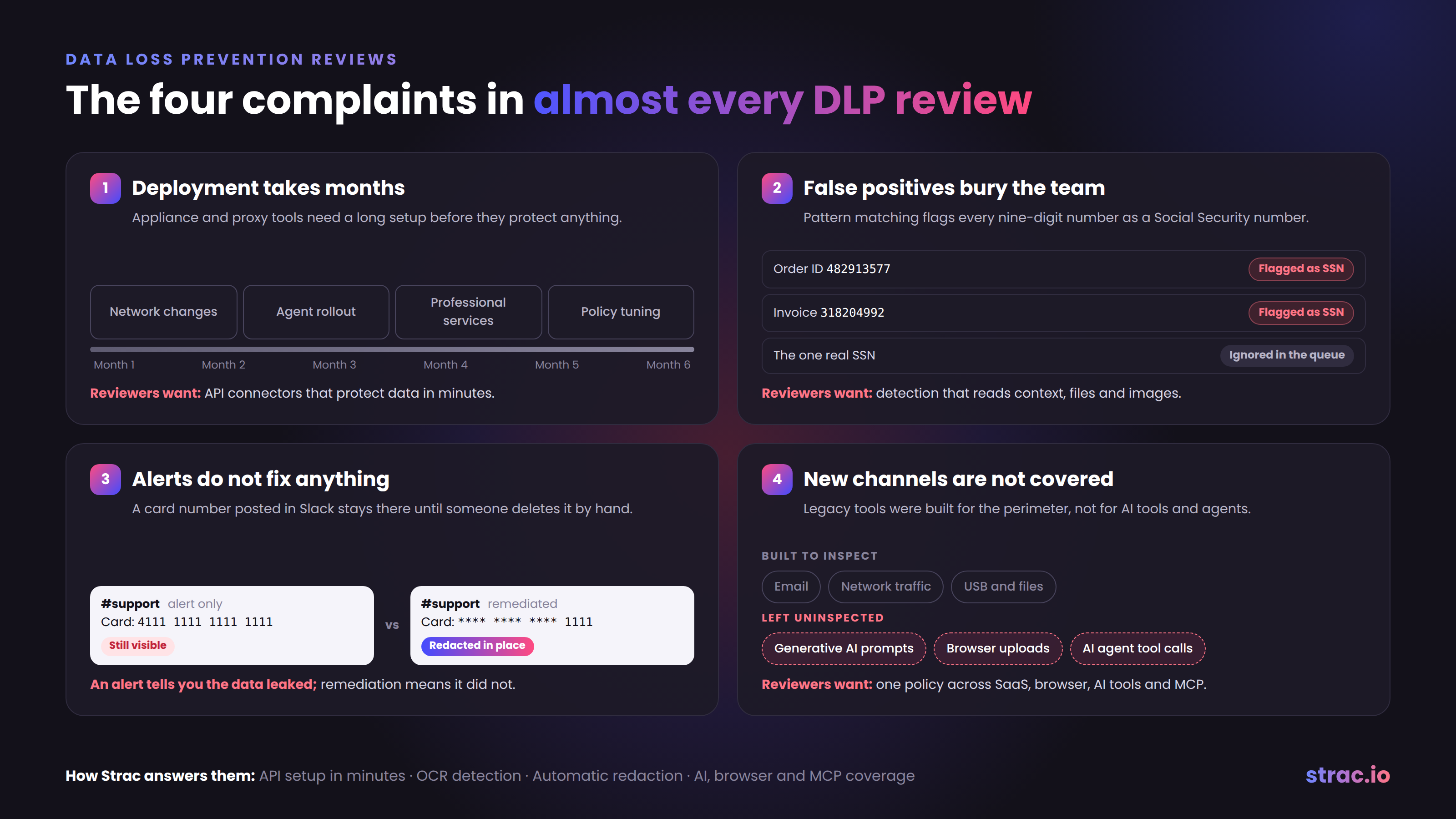
Read enough DLP reviews and the same frustrations appear across vendors.
Deployment takes months. Appliance-based and proxy-based tools need network changes, agent rollouts and professional services before they protect anything.
False positives bury the team. Pattern matching alone flags every nine-digit number as a Social Security number. Reviewers describe analysts ignoring alerts because most of them are wrong. The guide to reducing DLP false positives covers how to fix this.
Alerts do not fix anything. A card number posted in a Slack channel stays there until someone deletes it by hand. An alert tells you the data leaked; remediation means it did not.
New channels are not covered. Generative AI prompts, file uploads in the browser and AI agent tool calls fall outside what most legacy tools were designed to inspect. The post on why legacy DLP fails for AI explains the reasons.
Strac holds a 4.9 out of 5 rating on G2 and carries G2 badges including Easiest Setup, Best Support, Best Meets Requirements for cloud data security, and High Performer and Momentum Leader for sensitive data discovery. The themes in those reviews line up closely with the four complaints above.
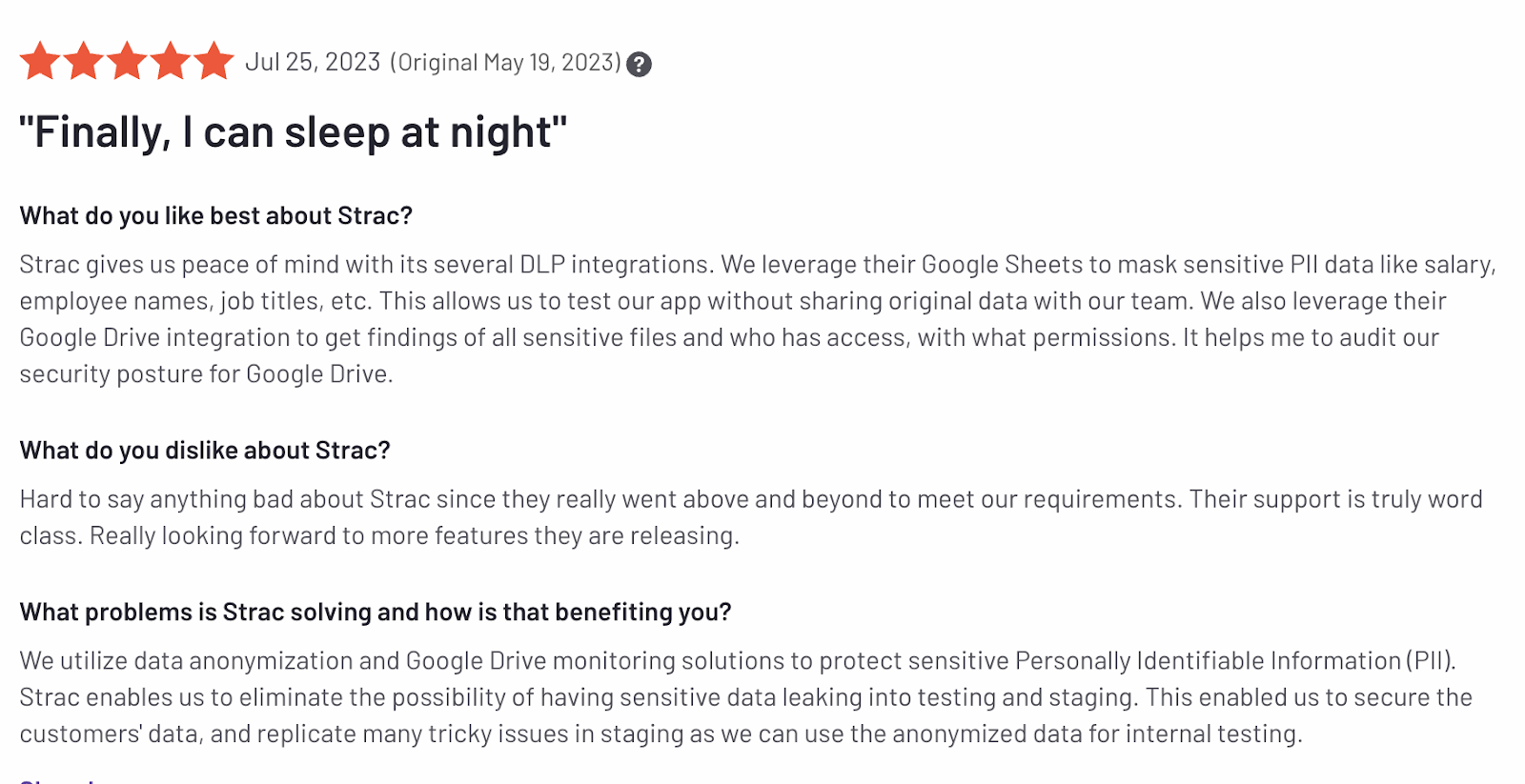
Setup in minutes, not months. Reviewers describe connecting Slack, Google Drive, Gmail or Zendesk by API in under ten minutes with no proxy and no network change. One IT director called it "simple to implement and monitor without heavy user overhead."
Detection that reads files and images. Reviewers point to accurate detection of PII, PHI, PCI data and secrets, including inside screenshots, PDFs and attachments through OCR. One CEO noted that Strac's model "picks up any kind of attachment/image that may contain sensitive data."
Action instead of noise. This is the theme reviewers mention most. A security director at a mid-market financial services company wrote that most DLP tools they evaluated "created noise but didn't solve the problem," and that Strac "stood out by actually taking action."
Support that responds. Reviewers consistently call out a fast, hands-on support team, which is reflected in the Best Support badge.
Honest limits. Some reviewers mention early login friction, since addressed with SSO, and admin features that were still maturing when they started. Both point to a product that ships quickly and listens to feedback. You can read more customer stories on the Wall of Love and in the case studies.
Strac is a DLP, data discovery and DSPM platform that covers SaaS, cloud, browser, endpoint, generative AI and MCP from one console and one set of policies.
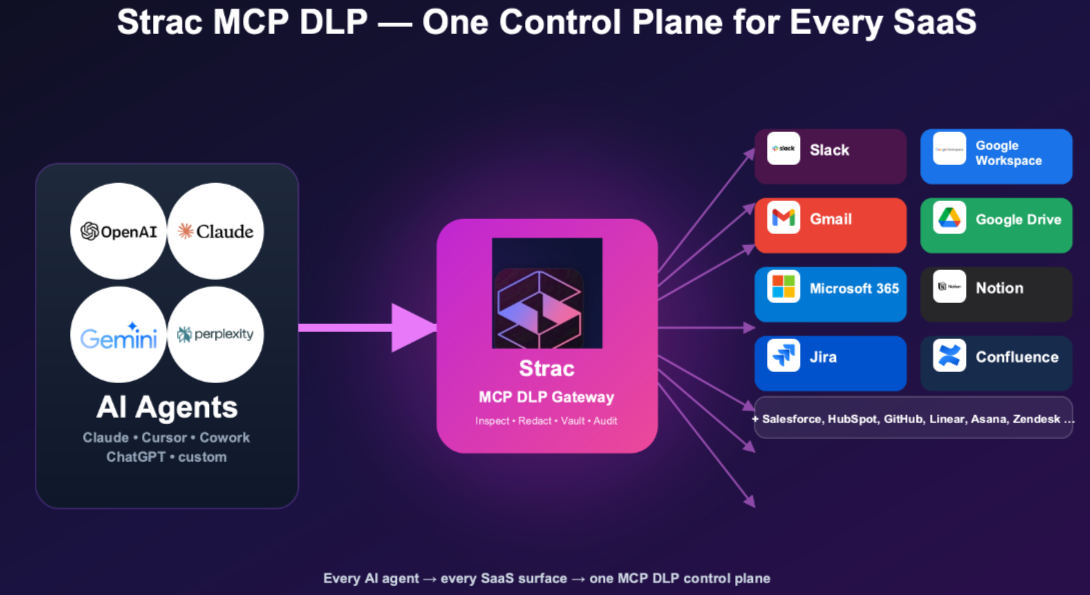
SaaS apps. SaaS DLP connects by API to Slack, Google Drive, Gmail, Microsoft 365, OneDrive, Zendesk, Salesforce, Jira, Notion, Intercom, HubSpot, Box, Zoom and more. Slack DLP, Google Drive DLP, Gmail DLP, Office 365 DLP and Zendesk DLP scan messages, files and tickets in real time and across history. The full list is on the integrations page.
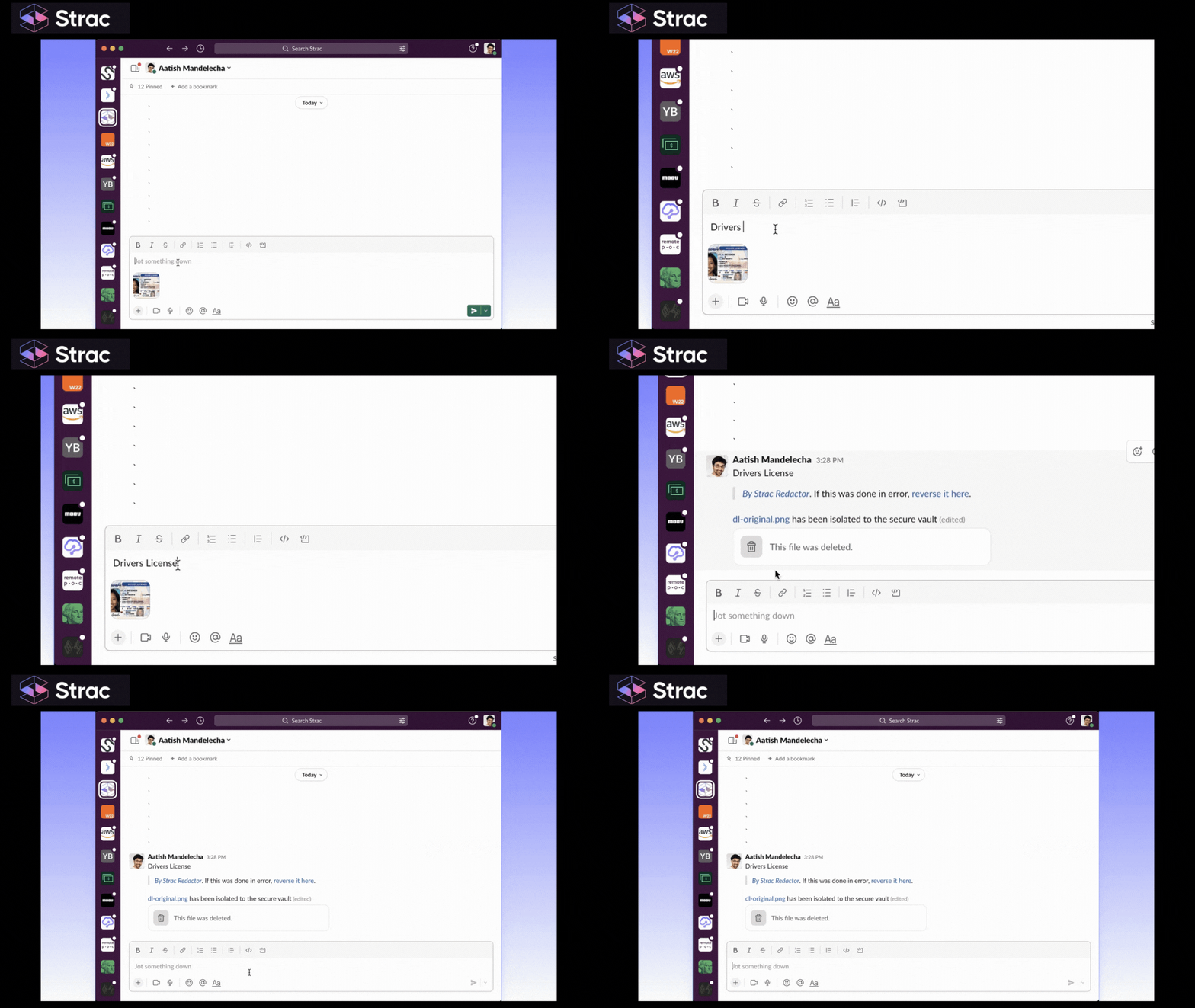
Endpoint and browser. Endpoint DLP covers managed devices, including Mac DLP and Linux DLP. Browser DLP in Chrome and Edge checks pastes, uploads and form submissions at the moment they happen. Strac keeps no keystroke logs or screenshots.

Generative AI and shadow AI. AI DLP, ChatGPT DLP and Claude DLP redact sensitive data before it reaches the model, so people keep using the tools they like. Shadow AI discovery shows which AI tools are in use and what kinds of data are going to them. See how to detect shadow AI for the detection side.
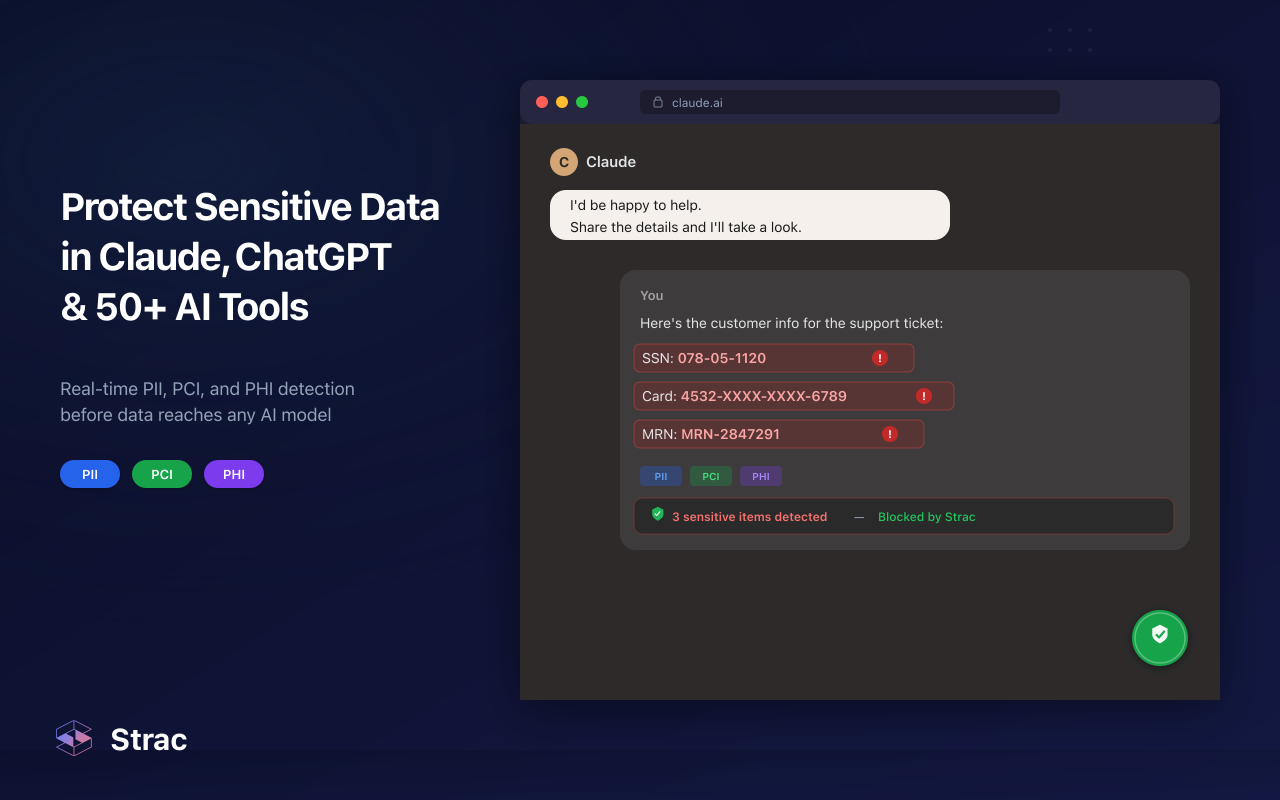
MCP and AI agents. MCP DLP inspects every agent tool call and response, removes PII, PHI and secrets, and flags prompt injection attempts across the MCP integrations. It lets you protect AI agents without taking away their tools.
Discovery, posture and lineage. Sensitive data discovery and classification scans SaaS apps and cloud storage such as AWS S3 at rest. DSPM flags overshared files and misconfigured storage, and data lineage tracks where a file came from and where it went. The PII scanner reads documents and images, not only text.

Remediation, in this order:
Compliance. Policies map to HIPAA, SOC 2, ISO 27001, PCI DSS, GDPR and CCPA, with templates for each. Teams with their own applications use the API docs to redact data inside their pipelines.
Other tools tell you where sensitive data went; Strac changes what arrives there.
Use this list when you read reviews and run a proof of concept.
A longer version lives in the DLP security checklist.
Related reading:
DLP reviews all say the same thing in different words: a tool that only alerts becomes a queue, and a tool that takes months to deploy protects nothing in the meantime. Identity, network and endpoint controls all fail eventually, and the data layer is the backstop. Redact sensitive data on every action across SaaS, cloud, browser, endpoint, generative AI and MCP, and a mistake never becomes a breach. Book a demo to see why Strac customers rate it 4.9 out of 5.
No. Analyst rankings score vendors on strategy, market presence and roadmap. Reviews come from people running the tool every day, so they reveal deployment time, false positives and support quality, which rankings rarely cover in detail.
Because many DLP tools rely on pattern matching, which flags anything that looks like a card or ID number. Tools that combine trained detectors, context and OCR produce fewer false alarms, which is a common theme in higher-rated reviews.
No. The best-reviewed tools redact the sensitive part and let the work continue. Blocking pushes people toward personal devices and unapproved apps, while redaction keeps data safe without slowing anyone down.
No. Every detector misses something, and people find new channels. That is why automatic remediation matters: when sensitive data is redacted on every action, anything that slips past one control is already stripped of its sensitive parts.
Start with the channels your data actually moves through, then read reviews from teams like yours. The guide to the best DLP software and the AI data governance pillar cover the next steps.
“Don’t just alert on problems, fix them.”
Scott Roberts, Chief Information Security Officer, UiPath









Customers include