Top 10 Endpoint DLP Solutions & Software Compared (2026)
The 10 best endpoint DLP solutions for 2026 compared — Strac, Symantec, Digital Guardian, Forcepoint, Trellix and more — on coverage, deployment and remediation.
Real-time remediation; redact, mask, block; is now mandatory, not optional.
The best endpoint DLP solutions unify endpoint, SaaS, and AI protection into one architecture; eliminating blind spots and reducing real exposure risk.
Endpoint attacks continue to rise, with 68% of organizations reporting data and IT infrastructure compromises. These attacks can lead to significant financial losses and reputational harm. Companies increasingly turn to Endpoint Data Loss Prevention (DLP) to safeguard their data and reputation. Endpoint DLP solutions fortify endpoints where data exchange occurs to prevent sensitive information from leaving an organization's secure network boundaries.
✨ How Strac Endpoint DLP Compares
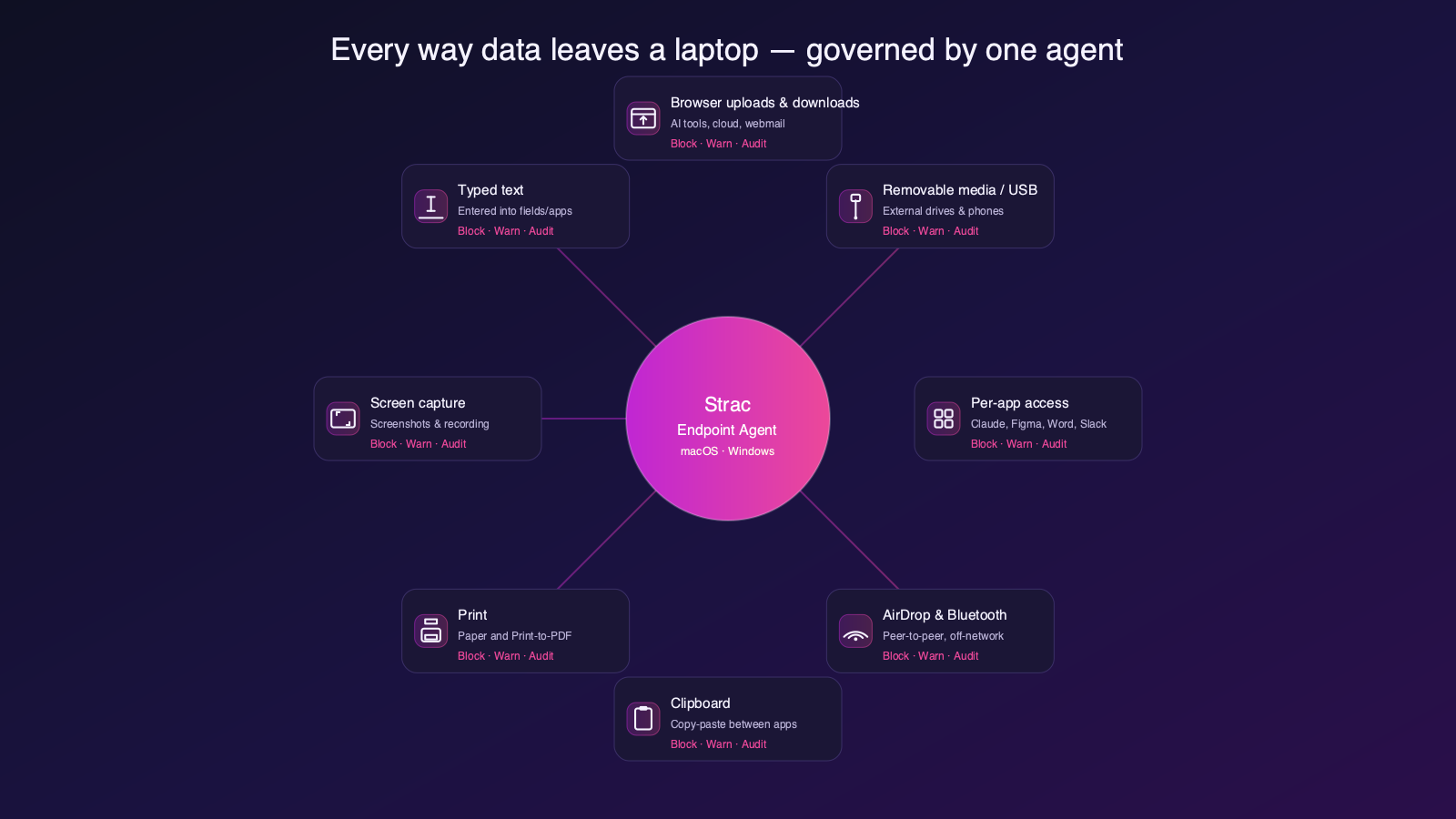
Most endpoint DLP solutions block channels bluntly — lock the USB port, ban the clipboard — and pay for it in false positives and user revolt. Strac takes a content-aware approach: it inspects what’s moving and applies policy by data type, across every exit, on macOS and Windows.
Content-aware endpoint control across eight exits — the Strac approach vs. blunt channel blocking.
Content-aware, not blunt — a code paste is fine; a live secret or 500 SSNs is not.
Eight channels, three modes — browser, USB, per-app, AirDrop/BT, clipboard, print, screen, typed text, each Block/Warn/Audit.
One policy everywhere — same classifiers as Strac SaaS, cloud, and MCP DLP; one audit trail for SOC 2, HIPAA, PCI, GDPR.
In this blog post, we explore the top 10 endpoint DLP solutions that help organizations safeguard their most valuable assets.
✨ Traditional Endpoint DLP approaches are broken
Traditional endpoint DLP solutions were built to lock down laptops. That made sense when data mostly lived on devices and inside corporate networks. It doesn’t make sense anymore.
Today, sensitive data moves constantly; from endpoints to Slack, Salesforce, Google Drive, Snowflake, and straight into ChatGPT. If your endpoint DLP only watches the device, you’re missing where the real risk happens.
Here’s why traditional endpoint DLP solutions fail:
They protect devices; not data. Once data leaves the endpoint and enters SaaS or AI tools, visibility drops.
They rely on location; not context. A file shared internally may be fine. The same file pasted into an AI tool can be a compliance event.
They slow people down. Heavy agents and hard blocks push users to find workarounds.
In 2026, winning endpoint DLP solutions look different:
Unified protection across endpoints, SaaS apps, and GenAI
Content-aware classification; not just pattern matching
Real-time remediation; redact, mask, block
Coaching users instead of just punishing them
Endpoint DLP still matters. But endpoint-only thinking is what’s broken.
Factors to consider when evaluating Endpoint DLP Solutions
When selecting an Endpoint DLP solution, consider the following factors:
Cloud and SaaS application evaluation: Make sure the solution fully supports all the SaaS applications you use and provides extensive coverage for cloud applications.
Real-time data monitoring and classification: Verify that the solution is capable of monitoring, identifying, categorizing, and reporting sensitive data in real-time.
Security protocols: Seek out multi-factor authentication, detailed security controls, and defenses against phishing and malware threats.
Data management and policy implementation: Confirm that the solution can categorize data based on security risks, encrypt or tokenize sensitive data, and supports custom rules and policies.
Deployment flexibility and integration: Evaluate how adaptable the deployment methods are and how seamlessly the solution integrates with your current infrastructure.
Scalability: Explore the detection methods employed in DLP techniques and their ability to handle increasing data volumes and flexibility of policy controls.
Automated responses: Evaluate the automatic responses activated by policy breaches and the availability of encryption for data both at rest and in transit.
Insider threats and user behavior analysis: Ensure that the solution utilizes user behavior analytics to identify abnormal patterns and possible insider threats.
Support, training, and updates: Make sure that training resources are present with 24/7 technical assistance, and frequent updates are provided by the vendor.
Cost efficiency and regulatory compliance: Assess the overall ownership cost with licensing, implementation, and continuous maintenance expenses, and ensure adherence to regulatory requirements such as GDPR or HIPAA.
Management of false positives: Gain insight into how the solution handles false positives and the methods employed to reduce their occurrence.
Endpoint DLP Solutions Compared
Solution
Coverage
Deployment
Remediation
Best for
Strac
SaaS, cloud, browser, AI/MCP + endpoint
Agentless + light endpoint agent
Redact, mask, block, vault
Unified coverage, not endpoint-only
Symantec DLP (Broadcom)
Endpoint, network, storage
Agent + infrastructure
Block, quarantine, encrypt
Large regulated enterprises
Digital Guardian (Fortra)
Endpoint, network
Agent-based
Block, encrypt
IP and source-code protection
Forcepoint DLP
Endpoint, network, cloud
Agent-based
Block, quarantine
Network + endpoint enforcement
Trellix DLP
Endpoint, device
Agent-based
Block, encrypt, device control
Device control focus
Endpoint Protector (CoSoSys)
Endpoint, device control
Agent-based
Block, encrypt
Cross-platform device control
Microsoft (Purview endpoint)
Windows, Edge, M365
Native + agent
Block, warn, label
Microsoft-only estates
Zscaler DLP
Web, cloud (inline)
Proxy/agent
Block, isolate
Inline SASE stacks
The dividing line is scope: an endpoint-only tool leaves your SaaS, cloud, and AI surfaces to other products and other consoles. See the full picture in what endpoint DLP is.
Looking beyond the endpoint? Compare the full market in our roundup of the best data loss prevention solutions across SaaS, cloud, email, and AI.
Top 10 Endpoint Data Loss Prevention Solutions in 2026
🎥 1. Strac DLP
Rated 5/5 on G2
Strac offers comprehensive data loss prevention for SaaS, Cloud apps, and endpoints, providing strong protection against security and compliance threats. Its powerful features guarantee the security of your sensitive information at every stage, safeguarding your business from potential risks.
Strac Endpoint Data LinageSolution
- Unified DLP + DSPM across SaaS, Cloud, Browser/GenAI, and Endpoints Strac is a unified DLP + DSPM platform designed for modern data flows — spanning SaaS apps, cloud infrastructure, browsers / GenAI tools, and endpoint devices (macOS, Windows, and Linux). This eliminates fragmented point solutions and gives security teams a single control plane to discover, classify, monitor, and remediate sensitive data wherever it moves.
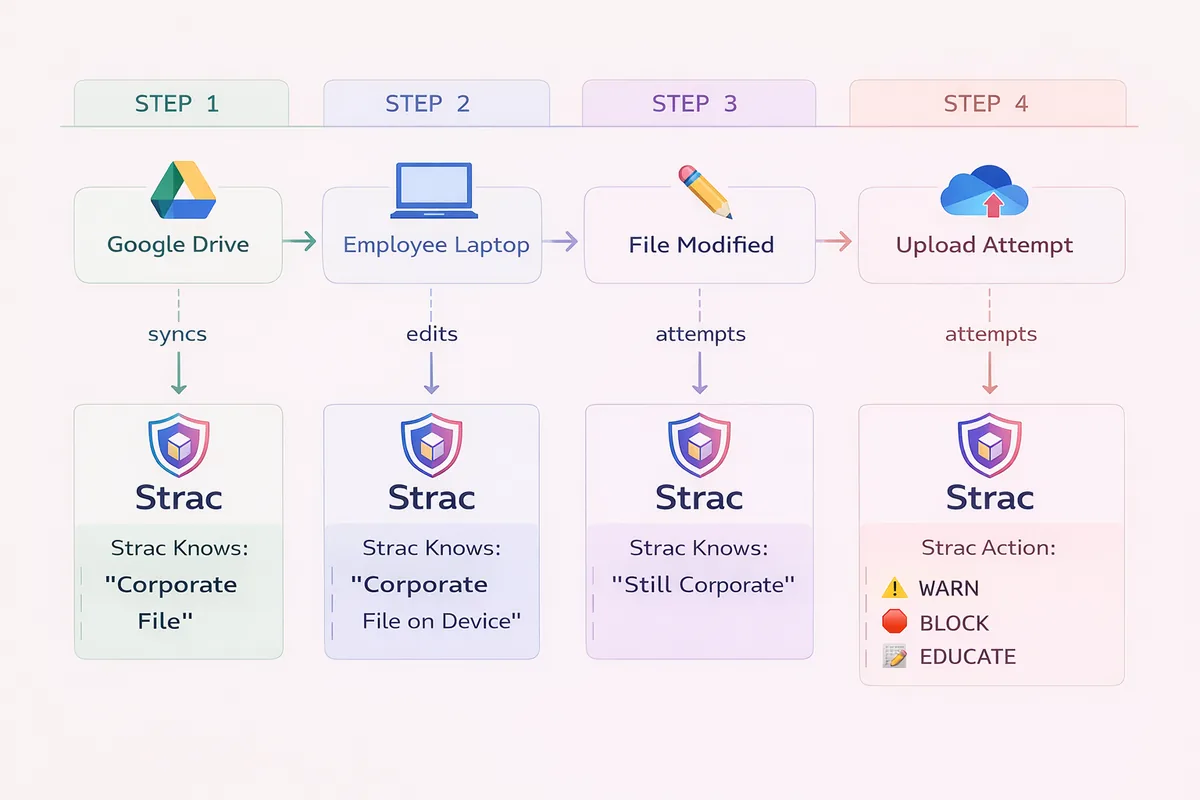
- Endpoint DLP for macOS, Windows, and Linux with end-to-end data lineage Strac extends protection to employee devices with Endpoint DLP for macOS, Windows, and Linux, enabling organizations to monitor and control how sensitive data is created, accessed, copied, moved, and uploaded from endpoints. Unlike legacy endpoint-only DLP tools, Strac ties endpoint activity into data lineage, showing where sensitive data originated (SaaS or cloud), how it moved across apps and devices, and where it was ultimately shared or exfiltrated. This gives security teams true end-to-end traceability from source → endpoint → browser/GenAI → destination.
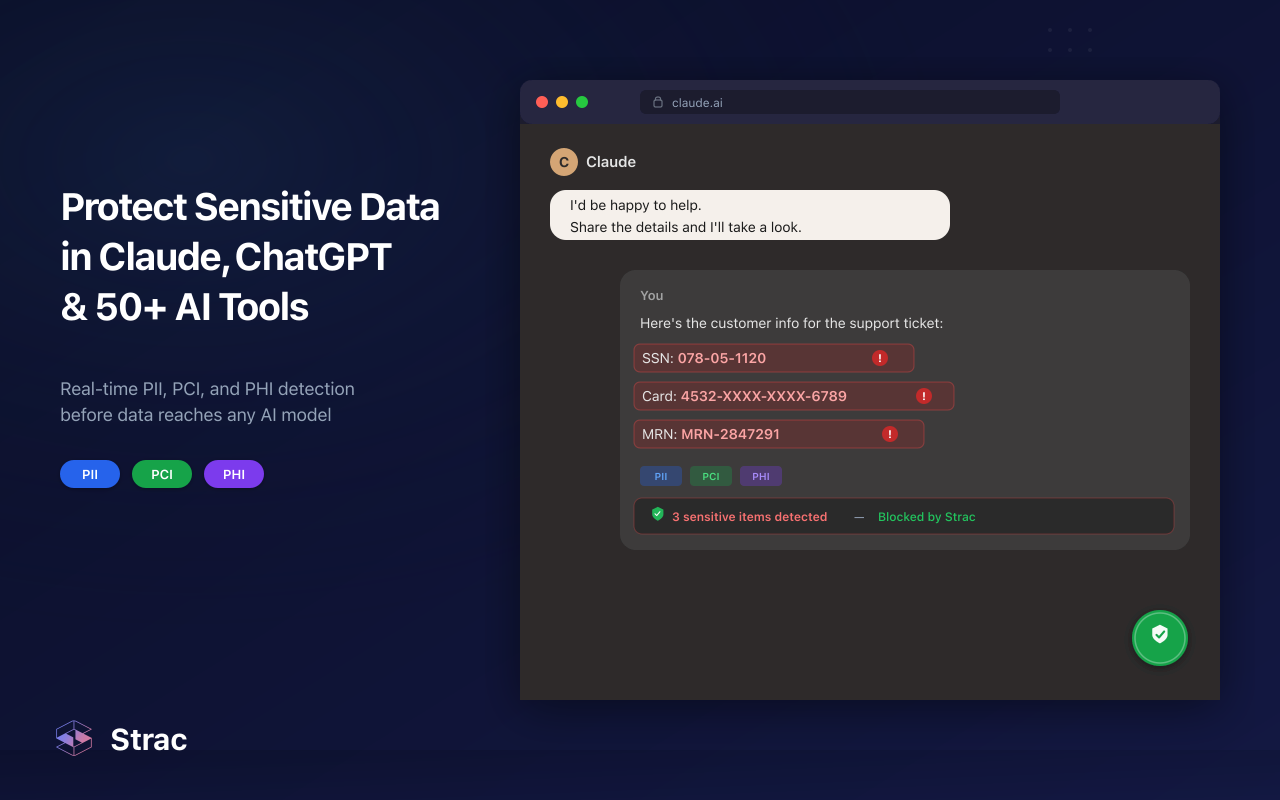
- GenAI & Browser DLP for the fastest-growing exfiltration path As employees interact with tools like ChatGPT, Gemini, and Copilot, Strac enforces real-time protection directly in the browser. Sensitive content can be blocked, redacted, or warned at the moment of upload or prompt submission, reducing accidental leakage into AI tools and shadow AI workflows — without breaking productivity.
- Historical + real-time scanning across endpoints, SaaS, and cloud Strac continuously scans both historical data and live events across endpoints, SaaS apps, and cloud data stores. This helps uncover legacy exposures (old files on laptops, publicly shared documents, misconfigured cloud buckets) while also detecting new risk in real time as data is accessed, copied, or shared.
- Automated remediation across data at rest and in motion Strac supports policy-driven remediation actions including redaction, masking, revoking public or external access, deletion, endpoint enforcement, browser enforcement, and real-time alerting. This allows teams to move beyond passive detection and actively prevent or fix risky data movement across SaaS, cloud, GenAI, and endpoints.
- Low false positives through contextual, lineage-aware detection By combining context-aware ML models, domain-specific detection, continuous feedback loops, and lineage-aware risk scoring, Strac reduces alert fatigue and improves precision. Alerts are enriched with who accessed the data, where it came from, where it went, and whether policy was violated, making investigations faster and more actionable.
- Proven in real-world production environments Strac is deployed in production at companies such as UiPath, Crypto.com, and Underdog Fantasy, protecting sensitive data across high-volume SaaS workflows, cloud data stores, GenAI usage, and endpoint devices. These deployments demonstrate Strac’s ability to operate at enterprise scale with real user behavior, not just controlled demos.
Key features
Advanced algorithms automatically identify and remove sensitive data from various communication channels without manual intervention.
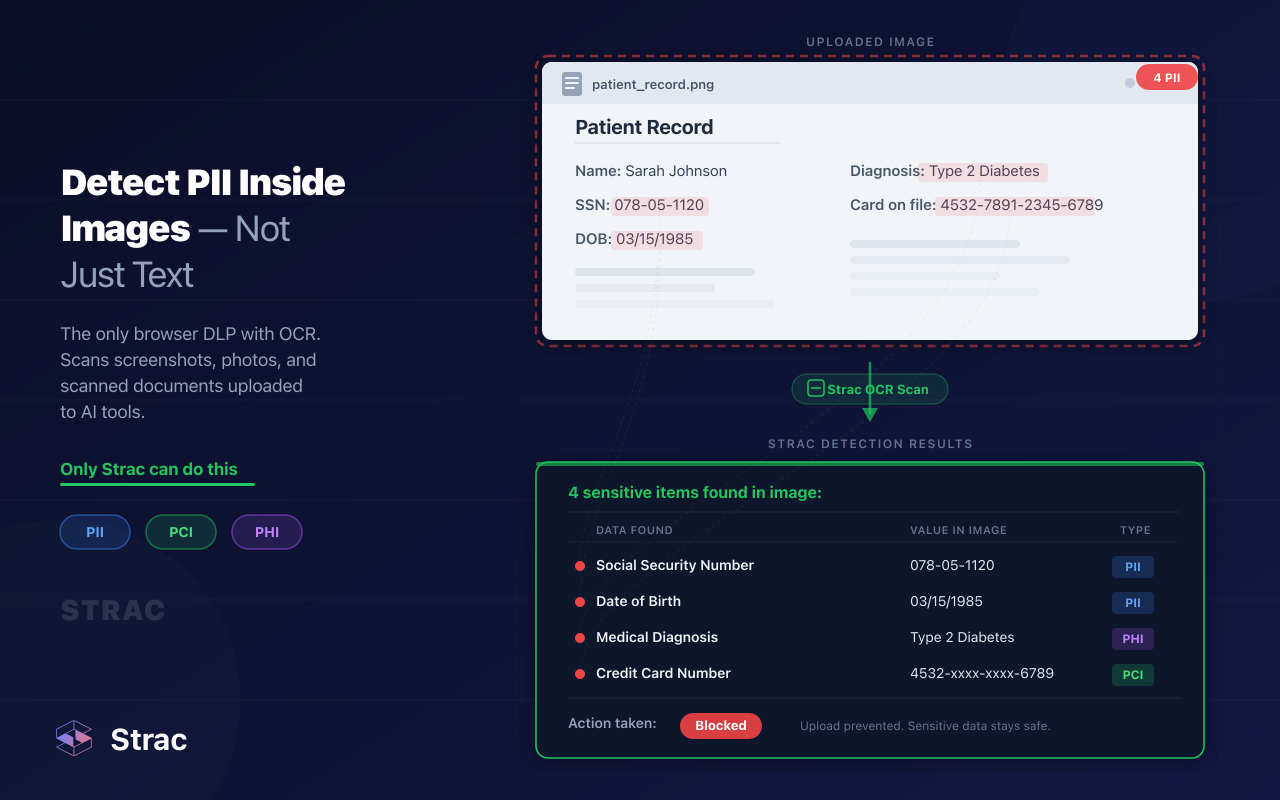
Strac's remediation capabilities effectively detect and mask sensitive information from chat messages and attachments in a wide range of file formats (pdf, jpeg, png, images, screenshots, word docs, excel spreadsheets).
Integrates with popular applications such as Zendesk, Slack, Gmail, and Intercom.
Complies with PCI, SOC 2, HIPAA, GDPR, NIST CSF, and NIST 800-53 standards.
Policies, data elements, access control, and remediation processes are customizable.
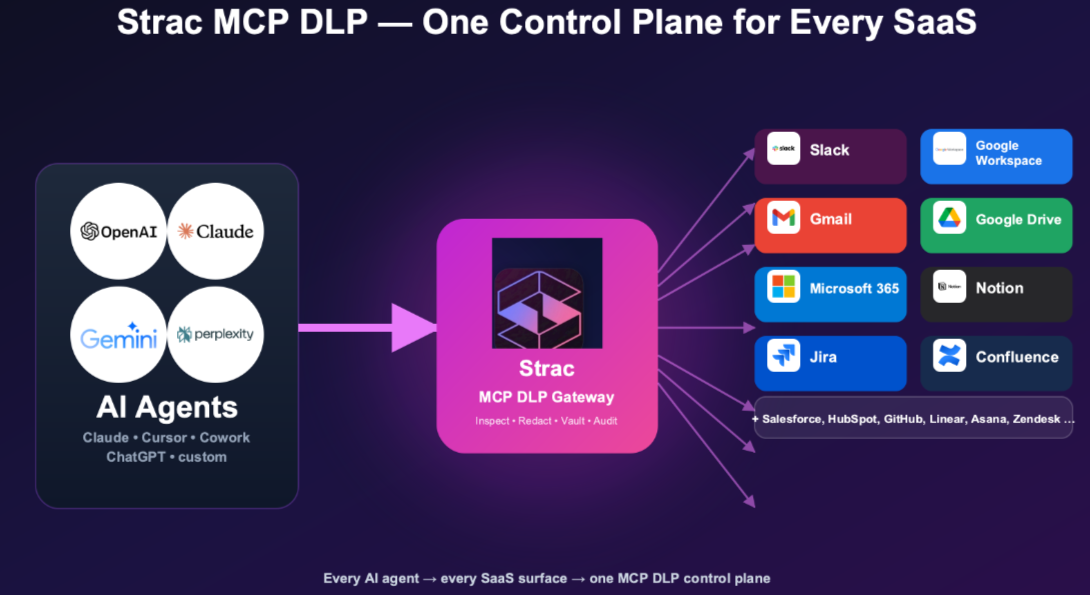
MCP DLP: Detects, redacts, or blocks sensitive data flowing between AI agents (ChatGPT, Claude, Copilot, Cursor) and connected SaaS applications through MCP connector before data reaches the AI model.
Supports numerous integrations: Strac seamlessly connects with popular cloud and SaaS platforms like Zendesk, Slack, Gmail, Office 365, and Salesforce in less than 10 minutes. It also provides DLP solutions for Generative AI products such as ChatGPT and Google Bard. With API access, it can detect and redact sensitive data before sending it to LLM providers like OpenAI or AWS Bedrock.
Accurate Detection: Strac's custom machine learning models are highly accurate in identifying sensitive PII, PHI, PCI, and confidential data with minimal false positives and false negatives.
Customizable Detectors: Strac supports all types of sensitive data element detectors for PCI, HIPAA, GDPR, and other confidential data types. Customers can also customize their own data elements.
Inline Redaction (remediation): Strac has the capability to redact (mask or blur) sensitive text within any attachment.
API support: Developers can utilize Strac's APIs to detect or redact sensitive data as needed.
Tokenization and Data Protection: Strac's APIs enable the secure extraction and tokenization of sensitive personally identifiable information (PII) data, ensuring the safeguarding of customer information on both front-end applications and back-end servers.
Exceptional Support: Strac's dedicated customer support team guides clients through the integration process and beyond, ensuring a seamless experience overall.
Tailored Settings: Strac offers pre-built compliance templates containing all sensitive data elements for detection and redaction, along with customizable configurations to meet specific business needs, guaranteeing alignment with individual data protection requirements. Check out Strac’s full catalog of sensitive data elements .
Strac Slack DLP: Line Redaction
Pricing
Strac provides multiple pricing options for teams of all sizes. It also offers a free 30-day trial. Connect with the team for further information.
Symantec Data Loss Prevention (DLP) safeguards sensitive data across an organization's network, ensuring compliance, preventing data breaches, and upholding privacy standards by actively monitoring and preventing unauthorized data transfers.
Key features
Application security
Device management
Real-time monitoring
Cloud app discovery
Granular policies
Activity log
Pros
Intelligence in immediately blocking potential threats
Comprehensive web protection
Ease of management and integration
Cons
Bug of multiple push notifications
Lack of detailed notifications regarding vulnerabilities
Resource utilization is high
Problems with MAC support
Pricing
Contact Symantec’s enterprise sales team for pricing information.
Digital Guardian serves as a Software as a Service (SaaS) solution for Enterprise Data Loss Prevention (DLP), providing rapid deployment and flexible scalability to ensure the security of your data.
Key features
Analytics and reporting capabilities
Endpoints, networks, and storage systems protection
Advanced reporting to get insights into corporate data consumption
Customized policy setups to meet the demands of individual organizations
Data classification solutions.
Pros
Offers deep insights into data movement and user behavior
Highly flexible and customizable to fit various needs
Provides extensive security across various platforms
Cons
Can be complex to set up and manage.
May slow down system performance.
Potentially expensive, especially for smaller organizations.
Steep learning curve
False positives
Pricing
Contact the Digital Guardian team for further information on pricing.
Forcepoint is a powerful DLP solution that enhances security for cloud applications, enabling organizations to assess risks and implement control measures. By utilizing contextual risk assessment, Forcepoint effectively evaluates the security of these applications and promptly notifies administrators of any potential risky users or configurations.
Key features
Endpoint support and cloud applications support
Offers innovative data security measures to safeguard cloud applications and stop data loss
Provides risk indicators and aggregated discovery reports on the centralized discovery dashboard
Allows administrators to monitor users by providing real-time activity monitoring and analytics
Offers live behavioral tracking and diagnostics
Pros
Implementation flexibility across a wide range of use cases
Comprehensive data discovery and coverage whether in circulation or in storage
Flexible and adaptive rules
Cons
Customer service is charged as an add-on
Complex GUI
Lacks OCR features and capabilities for user behavior learning and data alarm production
Check Point platform is engineered to safeguard sensitive data from accidental exposure. Through sophisticated algorithms, it prevents unauthorized data transfer outside your organization, thereby controlling access to confidential information exclusively for authorized users.
Key features
Allows data owners to get timely information on how their data is being handled.
Content awareness
Smart console management
Automated notifications and reports
SSL inspection for encrypted transmissions
Pros
Centralized management
URL filtering
Provides complete visibility and control over sensitive data
Cons
Setting up the system can be complex, particularly when deploying across multiple servers
Restricted to its environment and lacks third-party system compatibility
Offers limited template flexibility
False positives
Lacks advanced features like auto-learning and third-party asset management integration
Pricing
Contact the CheckPoint team for further information on pricing.
Microsoft's Defender for Cloud Apps provides advanced monitoring, security, and management for your cloud applications. Its seamless integration with Microsoft's cloud apps enables deep visibility into potential threats and user activities with improved data management and advanced analytics to address cyber threats across your cloud applications.
Key features
Automated processes and policies for data control.
Integration with popular Single Sign-On (SSO) solutions
User-friendly interface
Seamless integration with Microsoft ecosystem
Pros
Scalability
Comprehensive visibility, threat detection, and data protection capabilities
Cons
Limited support for third-party cloud apps
Complex configuration
Complex regulatory compliance
Pricing
The cost of Microsoft Defender For Cloud Apps varies depending on the program and agreement. For further details about pricing, get in touch with Microsoft's sales team.
Endpoint Protector offers a Data Loss Prevention (DLP) solution to safeguard businesses across various sectors and sizes, ensuring protection for Intellectual Property, Personal Identifiable Information, and Insider Threats. Its advanced cross-platform features cater to macOS, Windows, and Linux systems, while also providing enforced encryption for USB storage devices.
Key features
Cross-platform collaboration
A single window for extensive management, reducing administrative workload
Enhanced DPI capacity to improve content-aware protection guidelines
Data blocking to prevent unwanted access to sensitive information
Pros
Ensures data safety both in transit and at rest, bolstering overall security
Sales and implementation teams are highly professional and supportive, ensuring smooth onboarding
Endpoint Protector needs fewer hardware resources making it more cost-effective
Cons
The licensing cost might be high for smaller organizations
Steep learning curve and setup complexity
Lack of data masking
No DB Fingerprint audit
Price
Contact the Endpoint team for further information on pricing.
Zscaler top-of-the-line security for online gateways, cloud applications, and zero-trust network access. This platform helps enterprises protect their internet traffic and defend against advanced threats.
Key features
Scans and analyzes data in repositories to detect sensitive information
Automatically labels and categorizes data based on predefined policies
Threat recognition
Incident remediation and response
On demand global visibility
Pros
Zero trust architecture
Ease of deployment
Centralized policy management
Scalability
Cons
Interface and compatibility issues
Requires raising tickets for minor changes or issues, which can be time-consuming.
SSL handshake failures
When deploying IPsec to transfer data to a ZEN node, users have experienced added latency.
Complex rule and policy configuration
Pricing
Contact the Zscaler team for further information on pricing.
Trellix is a comprehensive Data Loss Prevention (DLP) solution designed to protect sensitive information across an organization's network. With four core products - Trellix DLP Endpoint, Trellix DLP Discover, Trellix DLP Monitor, and Trellix DLP Protect - it offers a robust suite of security measures to safeguard against unauthorized access and data breaches
Key features
Unauthorized device prevention: Prevents external devices from connecting to your company network
Data monitoring: Ensures the security of sensitive data types such as PCI, PII, and PHI across different endpoint vectors
Endpoint-sensitive file discovery
Content inspection: Examines files and database tables for sensitive information
Data categorization: Manual and automatic data classification, as well as third-party integrations, are supported
Pros
Supports more than 300 types of content
Provides a self-remediation scan option
Stops the transfer of sensitive data
Cons
Policies change during version updates, causing confusion and potential security risks
Audit features are not up to the mark, making compliance and security monitoring challenging
False positives
Complex rule configuration, making the process cumbersome
The application experiences lagging and freezing issues, disrupting workflow
Pricing
Contact the Trellix team for further information on pricing.
Choosing an endpoint DLP solution isn’t about who has the longest feature list. It’s about who actually reduces data risk in the way your teams work today.
Here’s what to focus on:
Map real exfiltration paths. USB is obvious. Browser uploads, Slack shares, cloud drives, and AI prompts are where data actually leaks.
Decide what must block vs what can log. Not everything needs a hard stop. Be intentional.
Run a real POC. Test performance, user friction, and bypass behavior; not just dashboards.
Look beyond the endpoint. Policies should follow data into SaaS and GenAI; not stop at the laptop.
Prioritize remediation. Alerts are noise. Real-time redaction and blocking reduce risk.
Reduce false positives. If users ignore it, it doesn’t work.
The right endpoint DLP solution protects data; not just devices.
Endpoint agents don't see inside a ChatGPT prompt — pair them with browser DLP for the in-tab layer.
Weighing insider-risk tools against endpoint DLP? Our guide to Code42 Incydr alternatives maps that exact trade-off.
Endpoint DLP solutions that only control devices are outdated. Data no longer lives on laptops; it lives in SaaS apps, cloud storage, APIs, and GenAI tools.
If your endpoint DLP solution doesn’t follow data beyond the device, you have blind spots.
The right endpoint DLP solution protects data across endpoints, SaaS, and AI; with real-time remediation, low noise, and minimal friction.
Is endpoint DLP still necessary if we already have CASB / SaaS DLP?
Yes — because CASB/SaaS DLP mostly covers data inside SaaS. The moment data lands on an endpoint (downloaded files, screenshots, local exports, synced folders), you need endpoint visibility and controls. Best practice is SaaS DLP + Endpoint DLP + Browser/GenAI DLP working together. Strac is built exactly for this unified model across SaaS, cloud, browser/GenAI, and endpoints.
Can endpoint DLP stop employees from uploading sensitive files to ChatGPT, Gemini, or Copilot?
Endpoint DLP alone usually can’t reliably stop prompt-based exfiltration because the risk happens in the browser and inside GenAI workflows. The most effective approach is browser/GenAI enforcement (block/coach/redact at the moment of upload/paste) + endpoint context (what file was accessed, which app touched it). Strac supports Browser/GenAI DLP plus endpoint visibility so you can enforce and investigate end-to-end.
Why do “classic” endpoint DLP tools create so much noise?
Because they often rely on brittle rules, overbroad keyword matching, and “scan everything” policies without context (who, where, intent, destination). That leads to alert fatigue and teams turning policies off. Modern DLP needs context-aware detection, tuning loops, and better signal (destination app/site, identity, data type, lineage). Strac reduces noise using contextual ML + rule tuning + feedback loops.
Is endpoint DLP basically “spyware” or employee monitoring?
It shouldn’t be. Good endpoint DLP focuses on data risk events, not surveillance. A privacy-forward approach is: monitor only sensitive-data interactions, restrict collection to security-relevant metadata, apply retention limits, and be transparent in policy and training. Strac is designed for security outcomes (prevent leaks + prove controls), not keystroke-style monitoring.
How do we do endpoint DLP without breaking developer workflows?
Start with “protect the exits,” not “police the laptop.” Concretely:
Block/coach only on high-risk destinations (GenAI tools, web uploads, personal drives)
Exclude build artifacts and known safe repos
Use labels / classification to scope enforcement
Roll out in “alert-only” mode first, then tighten Strac supports policy-driven rollouts across endpoints + browser + SaaS so engineering teams aren’t constantly disrupted.
What’s the real difference between endpoint DLP and data lineage DLP?
Endpoint DLP answers: what happened on this device (file accessed, moved, uploaded). Data lineage DLP answers: where did the sensitive data originate, how did it move across apps/devices, and where did it end up (source → endpoint → browser/GenAI → destination). Strac’s approach ties endpoint signals into broader data lineage, so investigations and remediation aren’t isolated to one machine.
Do we need historical scanning, or is real-time endpoint DLP enough?
You need both. Real-time helps stop new leaks, but historical scanning finds the backlog: old sensitive files sitting on laptops, synced folders, legacy exports, and forgotten archives that become tomorrow’s breach. Strac supports historical + real-time scanning across endpoints, SaaS, and cloud so you’re not blind to existing risk.
If we can’t block everything, what should endpoint DLP enforce first?
Sensitive categories (PCI/PHI/secrets) Strac is strong here because enforcement can happen at the browser + SaaS + endpoint layer, not just one place.
Discover & Protect Data on SaaS, AI, MCP, Endpoints & Cloud
Strac provides end-to-end data loss prevention for all SaaS and Cloud apps. Integrate in under 10 minutes and experience the benefits of live DLP scanning, live redaction, and a fortified SaaS environment.








.avif)


.gif)


.webp)