November 4, 2026

11
min read
Best MCP Gateway in 2026: 8 Options Compared
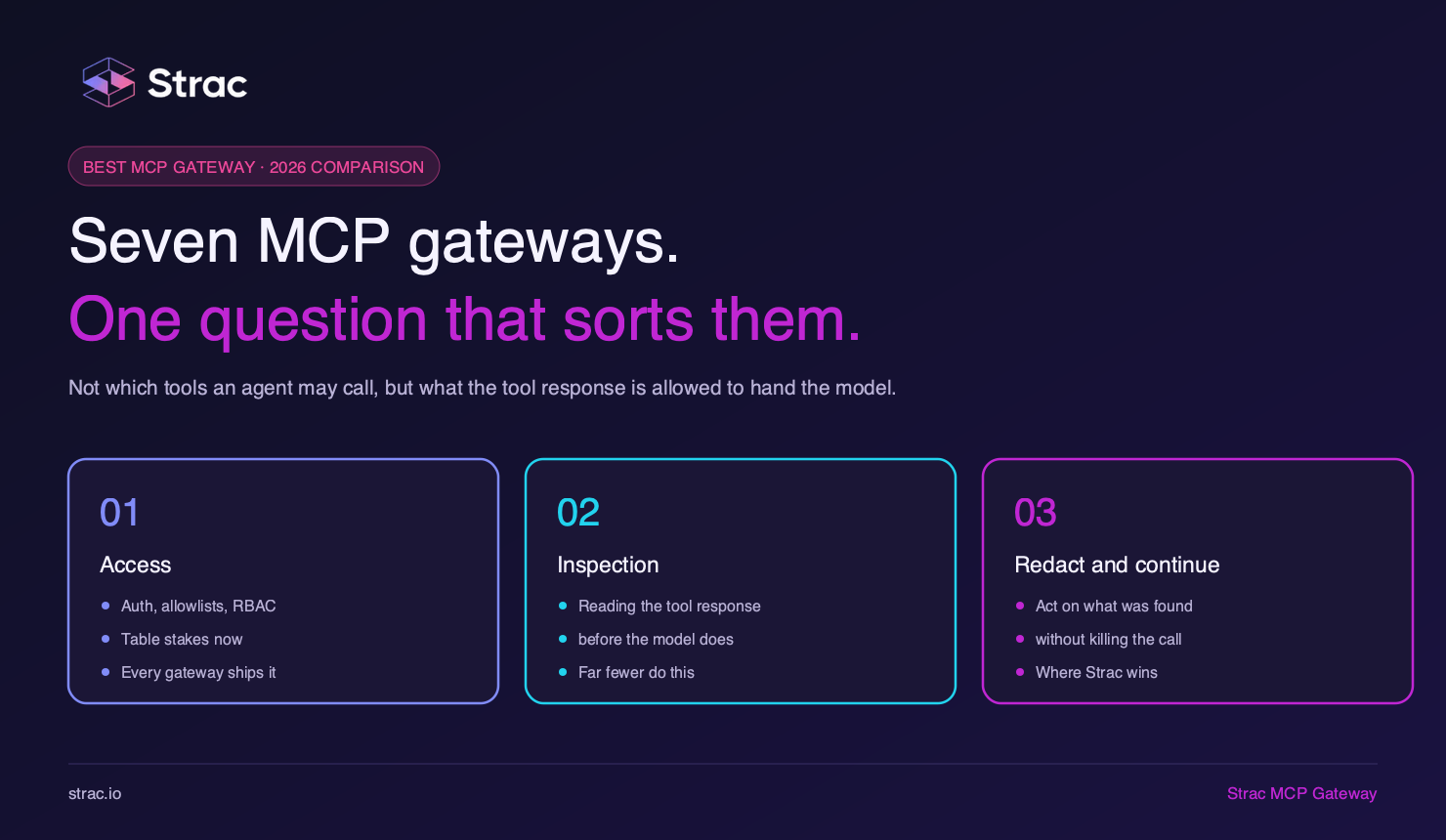
Access control is table stakes. We ranked eight MCP gateways on what inspects the tool response, where the customer records actually travel.
TL;DR:
The MCP gateway market is young enough that most products in it are under two years old, and the feature lists still look alike: connect many MCP servers, put auth in front, allowlist tools, log what happened. Useful, necessary, and not what separates them.
What separates them is whether anything inspects the data flowing back. This list is ordered on that. For what an MCP gateway is and how it differs from an MCP server, start with our MCP gateway guide; this page is the vendor comparison.
An MCP request has three places a gateway can intervene, and they are not equally useful.
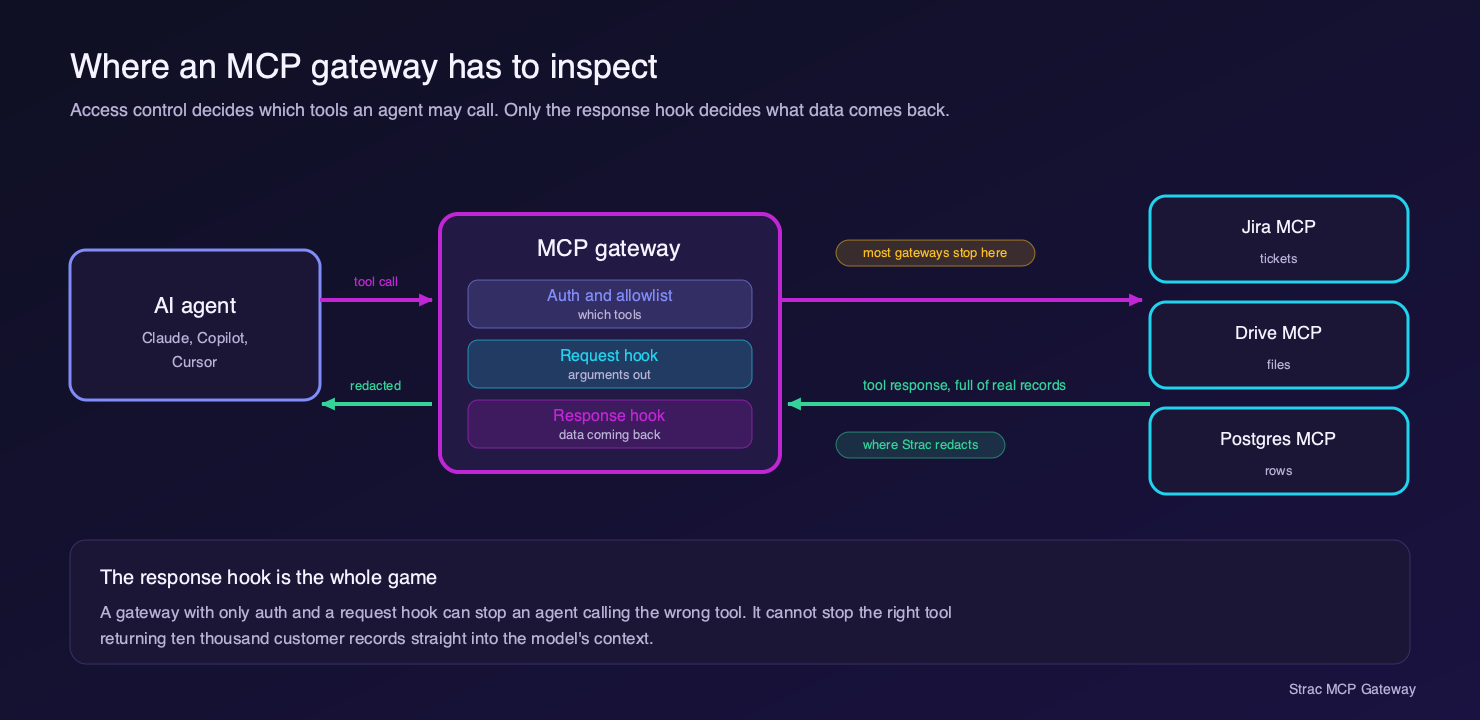
Our criteria, weighted accordingly: does it inspect tool responses, does it redact in place or only block, is detection managed or something you self-assemble, does coverage include files and images, can it run inside your network, and does the audit trail satisfy an auditor. For the threat side of this surface, see MCP data security and AI agent security.
Best for: agents reaching regulated systems, where the tool response is the risk.
Strac inspects the MCP response hook with the same managed classifier behind its DLP products: 255 data element types across PII, PHI, PCI and secrets, including 160 national ID formats, plus custom elements and exclusions. When it finds something, it redacts in place and lets the call complete, so the agent keeps working rather than hitting a failed tool call.
Two things distinguish it from the open-source options that also offer redaction. The detection is managed rather than a regex plugin you install, tune and maintain yourself. And coverage extends past text to images via OCR and PDFs, which matters because a surprising share of what agents retrieve is a scanned document.
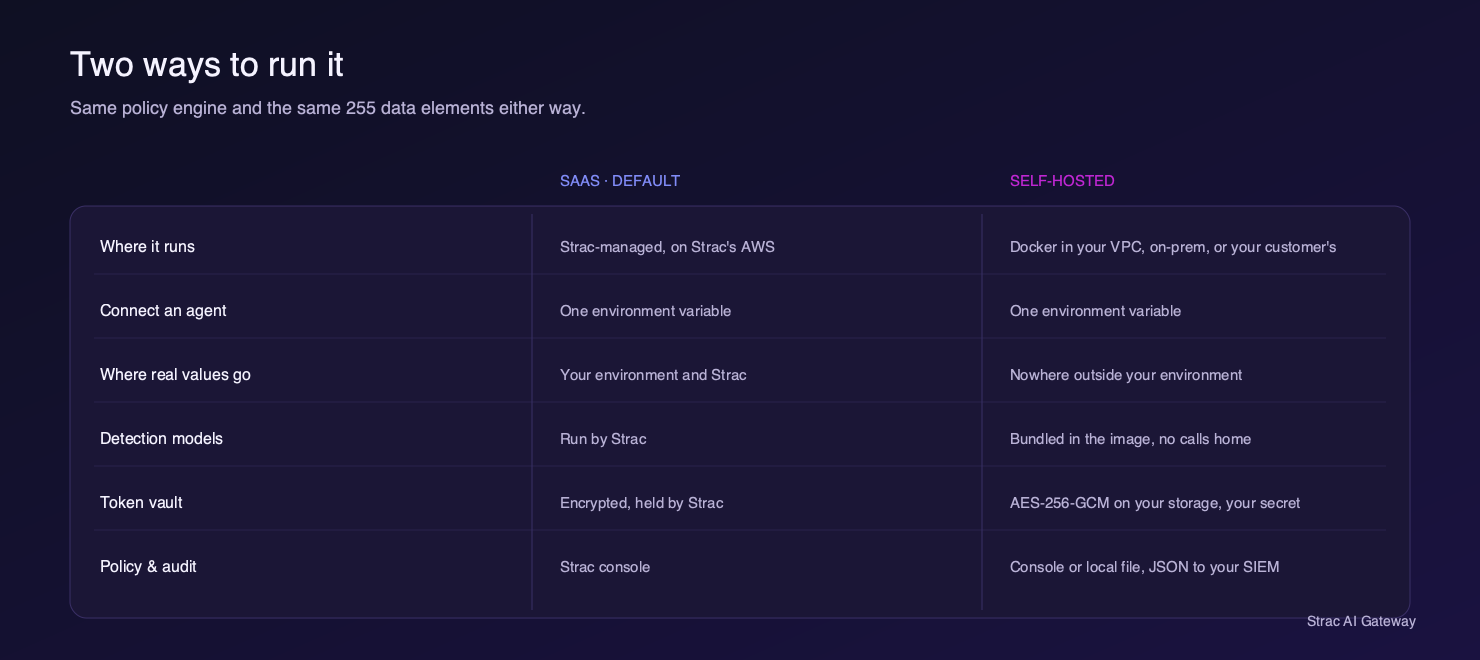
It runs as SaaS or self-hosted in your VPC, on-prem, or your customer's infrastructure, with detection models bundled in the image, nothing calling home, and JSON audit events to your own SIEM.
Strac also runs the outbound half. The same policy governs what leaves for the model provider, covered in AI gateway and MCP DLP.
The honest limitation: Strac is not a protocol federation layer. If your goal is composing dozens of MCP servers behind one endpoint with transport translation, the open-source options below do more of that today.
Best for: developers running MCP servers as containers.
Docker's gateway is open source and solves a problem nobody else treats as seriously: MCP servers are arbitrary code, and running them as isolated containers with image provenance is a real security control rather than a policy document. OAuth handling and the container isolation model are the strengths, and for a team already building agentic apps on Docker the adoption cost is close to nothing.
On data, it blocks detected secrets but does not do PII redaction, so a tool response full of customer records passes through intact. Treat it as excellent supply-chain and isolation control for MCP servers, with the payload question still open. For the servers themselves, see the best MCP servers.
Best for: teams wanting a reverse proxy and management layer with Microsoft behind it.
Microsoft publishes two different things here. The microsoft/mcp-gateway repository is an MIT-licensed open-source project you run in your own Kubernetes for session-aware routing and lifecycle management of MCP servers. It is actively developed, but it is not a supported Azure product: no SLA, no support program, and its Agents and Sessions subsystem is explicitly marked preview and single-replica, not for multi-replica or multi-tenant production. Microsoft's supported, GA path for governing MCP is Azure API Management, covered below. For prototyping session management and routing many servers behind one endpoint the repo is a reasonable starting point; for anything with a procurement review attached, API Management is the one with a product lifecycle behind it.
It is infrastructure rather than a data control. There is no classifier inspecting what tool responses contain, so the regulated-data question has to be answered by something else in your stack. Microsoft-shop teams usually land on the M365 MCP server next.
Best for: enterprises already standardized on Kong for API traffic.
Kong is the incumbent that has gone furthest on data. Its AI PII Sanitizer plugin (ai-sanitizer), introduced in Kong Gateway 3.10, uses an NLP model to detect PII and can replace values with fixed placeholders or same-type synthetic surrogates, restoring the originals in the response by default via recover_redacted. That is genuine substitution, and it is more than most of this list offers.
The caveats for MCP specifically: the sanitizer was built for LLM traffic and response-side sanitization only arrived in 3.12. Both it and Kong's MCP plugins (ai-mcp-proxy, ai-mcp-oauth2) sit behind AI Gateway Enterprise and an AI license, so neither is part of the open-source gateway, and Kong's own docs tell you not to configure the MCP proxy alongside other AI plugins on the same service or route. Detection is text only with no OCR path, and the sanitizer runs as a separate anonymizer container beside the data plane, so it is another service to operate. Strong governance, a real data story, and a shape that fits LLM traffic better than MCP tool responses. The same distinction shows up on the outbound side in what is an LLM gateway.
Best for: AWS-native teams composing tools inside one account boundary.
AgentCore Gateway handles protocol translation, tool composition and identity, turning existing APIs and Lambda functions into MCP-accessible tools without rewriting them. Inside AWS it inherits IAM and reaches private targets through PrivateLink and VPC Lattice. CloudTrail covers control-plane operations by default, but per-tool-call audit requires enabling CloudTrail data events or CloudWatch log delivery.
It is primarily an identity and access layer, and inspection of tool response contents is opt-in rather than absent. Attach an AgentCore Policy engine and a Bedrock-Guardrails-backed SensitiveInformation check can evaluate the tool output and trigger suppressOutput, which AWS documents under the heading "Suppress an MCP tool response." The tool still runs; the caller simply receives nothing. There is no mask mode, the check is ML-scored rather than deterministic with no regex option, it is off by default and available in roughly eight regions, and streamed responses are buffered until evaluation finishes. Field-level redaction means writing your own Lambda response interceptor. That is the block-or-nothing tradeoff that recurs across this list, with more configuration attached.
Best for: vendor-neutral platform teams self-hosting a federation layer.
ContextForge is the most capable open-source MCP gateway on this list, federating MCP, A2A, REST and gRPC behind one endpoint under Apache 2.0, with a genuine pre- and post-invoke hook model. Its tool_post_invoke hook receives the tool result and can modify or block it before it is returned, which means it can genuinely inspect tool responses, and that puts it ahead of most of this list architecturally.
The gap is what fills that hook. The plugin framework is inert until you set PLUGINS_ENABLED=true, and the shipped PII filter is regex-and-toggle based rather than trained detection: SSN, credit card and email are on by default, phone and IP are off, and it now ships as an external package rather than in-tree. The only ML-grade option is a self-hosted external plugin you run yourself. Either way you own the tuning, the false positives, the national ID formats the default detector has no patterns for, and the absence of any OCR path. The architecture is right; the detection engine is a project you staff rather than a product you buy. What a managed classifier covers instead is detailed in AI DLP.
Best for: teams already on Cloudflare wanting one endpoint for approved MCP servers.
Cloudflare's MCP gateway is MCP server portals in Cloudflare One, which went GA in September 2026. A portal gives users a single endpoint for approved MCP servers, with Access logging every tool, prompt and resource call, optional routing through Cloudflare Gateway for HTTP logging and DLP scanning, and Logpush into your SIEM. AI Gateway is the separate LLM-traffic layer handling routing, caching and observability. For an organization already standardized on Cloudflare the integration cost on either is minimal.
On data, the DLP verdict is flag or block, never inline masking. For an agent mid-workflow a blocked call is a failed job, and flagging passes the data through unprotected, so neither branch leaves you with a working agent and protected data at the same time. There is also a portal-specific gap worth knowing: Cloudflare documents that DLP AI prompt profiles do not apply to MCP server portal traffic. The block-versus-substitute tradeoff is covered in depth in what is an AI gateway.
Best for: Microsoft-standardized enterprises governing MCP alongside everything else.
Azure has extended API Management to govern MCP tools, bringing MCP traffic under the same platform, policy engine and Entra identity model as the rest of your estate. For a Microsoft shop that is the shortest path to approval.
Content checking in API Management runs through the llm-content-safety policy, which calls Azure AI Content Safety on exactly four harm categories, Hate, SelfHarm, Sexual and Violence, plus prompt shields and blocklists. It blocks with a 403, and there is no PII parameter in the policy schema at all. Foundry's personal-information filter offers only Annotate or Annotate and Block, with no mask mode, and it is output-only. Azure AI Language does ship real redaction, with character-mask, entity-mask and synthetic-replacement modes, but it is a separate service you call yourself and no API Management policy wires it into an MCP tool response. One more scoping limit worth knowing: API Management exposes MCP tools only, not resources or prompts.
| Gateway | Inspects tool responses | On a hit | Detection | Runs in your network |
|---|---|---|---|---|
| Strac | Yes | Redacts in place, call completes | Managed, 255 elements, OCR and PDFs | Yes, no calls home |
| Docker MCP Gateway | Secrets only | Blocks | Secret patterns | Yes, open source |
Microsoft mcp-gateway (OSS) | No | Not a data control | None | Yes, self-hosted |
| Kong | LLM traffic, not MCP responses | Substitutes, restores by default | NLP model, text only, Enterprise only | Self-managed or Konnect |
| AWS AgentCore Gateway | Optional, via AgentCore Policy | Suppresses whole response, no mask | ML-scored guardrails, off by default | Your AWS account |
| IBM ContextForge | Yes, tool_post_invoke hook | Depends on your plugin | Self-managed regex plugins | Yes, open source |
| Cloudflare (MCP server portals) | Yes, via Gateway DLP | Flags or blocks | Managed, text focused | No |
| Azure API Management | Via Content Safety | Annotates or blocks | Harm categories, PII filter | Your Azure tenant |
See it on your own data. Point one agent at Strac for a week and read the audit log. The volume of real customer data flowing back through tool responses is usually what settles the internal argument. Book a demo or browse the integrations your agents already reach.
Once PII, PHI, PCI or regulated records are in scope, the evaluation stops being about features and starts being about what you can show an auditor.
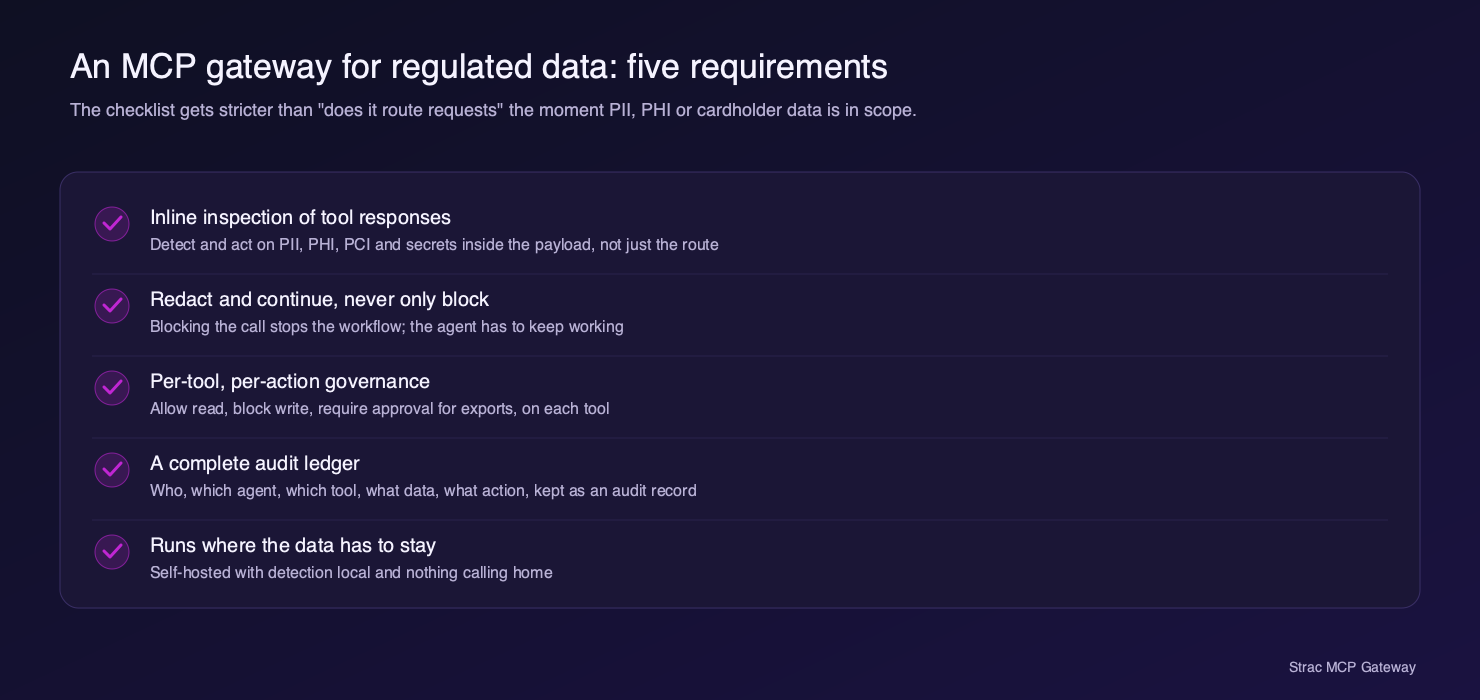
The five that matter: inline inspection of the tool response itself; redact and continue rather than block; per-tool and per-action governance; a complete audit ledger of who asked for what and what came back; and the ability to run entirely inside your own environment.
Two of these five eliminate most of the field on their own. Redact and continue rules out every block-only product, because a control that breaks the workflow gets switched off within a month and then you have neither the agent nor the control. Running where the data must stay rules out the SaaS-only options for the buyers who care most, which is usually healthcare, financial services and anyone handling another company's regulated data under contract.
On evidence specifically, be careful what you promise yourself here: a gateway's audit log is a strong input to a compliance program, not a substitute for one. What it gives you is a defensible record of which agent requested what, what came back, and what was redacted before the model saw it.
Enterprise buyers usually mean one of two different things, and the answer flips depending on which.
If enterprise means procurement fit, the cloud incumbents win. AWS, Microsoft and Azure are already on your paper, already reviewed, and adopting their gateway is a configuration change rather than a vendor onboarding. That is a real advantage and it is why those products get chosen more often than their data capabilities justify.
If enterprise means passing a data-protection review before agents touch customer systems, the shortlist is much shorter. You need a managed classifier rather than a plugin you maintain, redaction that preserves the workflow, deployment inside your own boundary, and an audit trail written for an auditor. That is the review Strac is built for, and it is the one that actually gates the deployment.
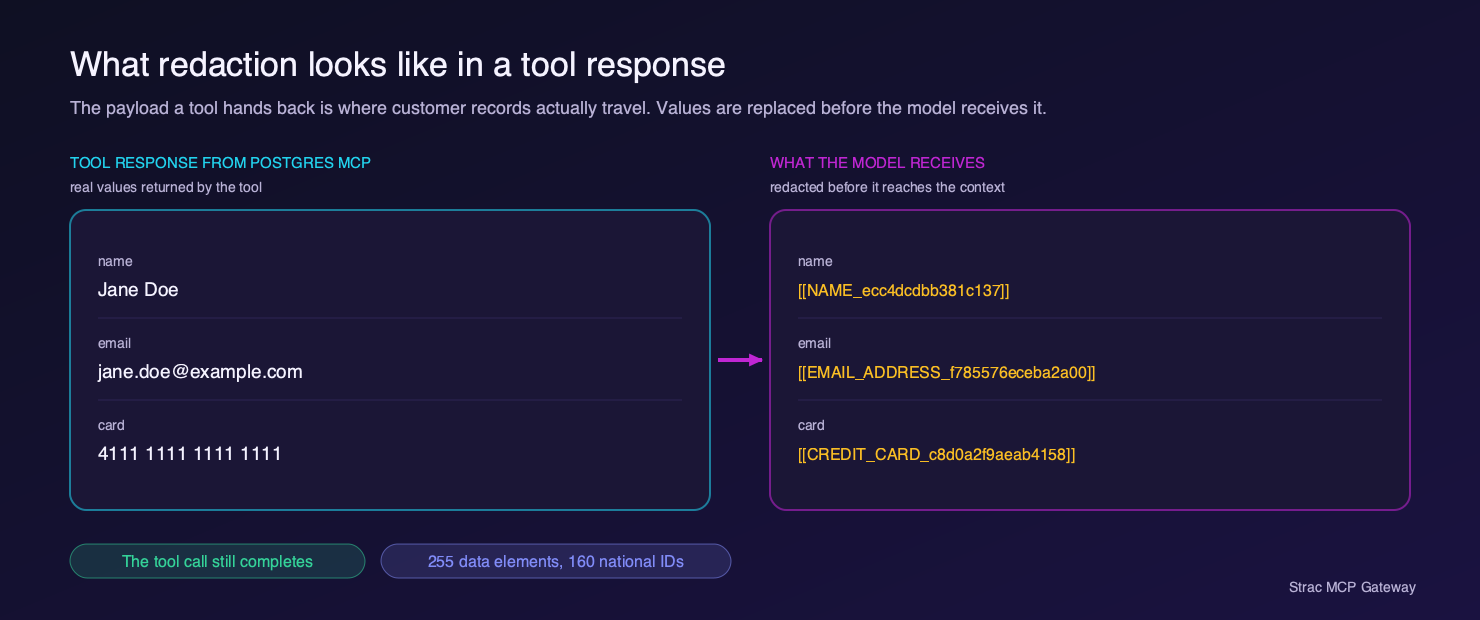
The mapping is deterministic, so the model can still tell two rows belong to the same customer and reason across them. It simply never receives the underlying values. This is the same reversible-token approach behind Strac's data masking.
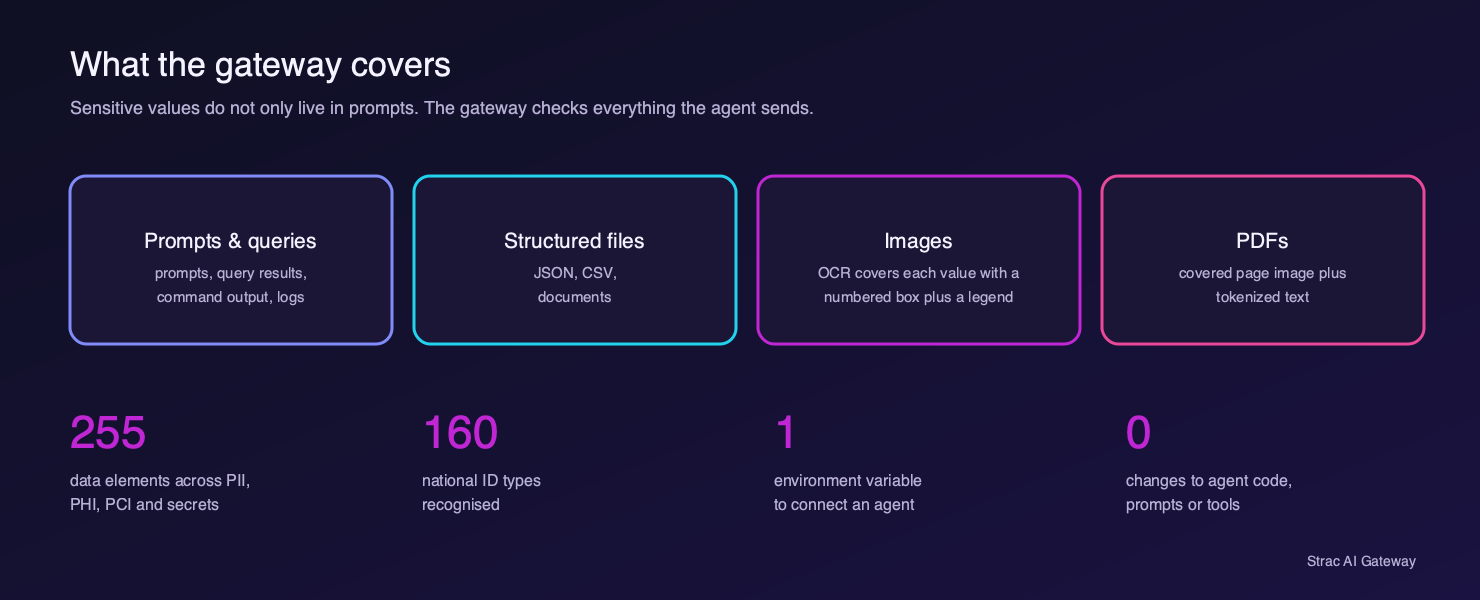
This is where text-only detection quietly fails. A Drive MCP server returns files. A ticketing MCP server returns attachments. If the classifier stops at text, the scanned onboarding form passes straight through with everything on it. See the Google Drive MCP server for a concrete version of this.
For a lot of regulated buyers this is the first question, not the last. Strac runs as SaaS on Strac's AWS, or fully self-hosted as a Docker container in your VPC, on-prem, or inside your customer's infrastructure. In the self-hosted build the detection models are bundled into the image and run on your own CPUs with no calls home, the token vault is AES-256-GCM encrypted on storage you control under a secret you hold, and the gateway's only outbound path is to the systems you point it at. Audit events go out as JSON to your own logging stack or SIEM rather than sitting in a vendor dashboard.
Strac detecting and redacting sensitive data in an AI surface. The MCP gateway applies the same detection engine to tool responses before they reach the model.
Give every vendor the same test, because it separates them faster than any feature matrix. Connect a tool that returns real customer records, ask the agent to do something that requires those records, and then check three things: did the tool call succeed, did the model receive the raw values, and can you produce a record afterwards showing exactly what was redacted.
Most products fail the second or the third. For the outbound half of the problem, see the best AI gateway comparison, and for the attack surface around all of this, MCP prompt injection and shadow MCP.
It depends which half of the problem is blocking you. If you need to control which tools an agent may call, almost every option on this list does that well and you should pick whichever matches your existing stack. If the problem is the data coming back in tool responses, the field narrows sharply. Strac ranks first because it inspects the tool response with a managed classifier covering 255 data element types and redacts in place so the call still succeeds, rather than failing it.
For PII, PHI, PCI or regulated records, the deciding features are inline inspection of tool responses, redact-and-continue rather than block-only, per-tool and per-action governance, an audit ledger showing who asked for what and what came back, and the ability to run entirely inside your own environment. Strac is the only option here that does all five as a managed product rather than as self-managed open-source plugins you have to assemble and maintain yourself.
That depends on what enterprise means in your context. If it means fitting an existing platform contract, the cloud incumbents win by default and the integration cost is close to zero. If it means passing a data-protection review before agents reach regulated systems, Strac is the one built for that conversation, with a managed classifier, reversible tokenization, a self-hosted deployment where nothing calls home, and an audit trail written for an auditor rather than for a dashboard.
For routing, federation and access control, frequently yes, and the open-source options are genuinely good. The gap shows up on data. The redaction you get is opt-in and self-managed, and it is usually regex-and-toggle rather than trained detection: you own the pattern tuning, the false positives, the national ID formats nobody wrote a rule for, and the fact that there is no OCR path for a scanned document. That is a project, not a feature.
They cover opposite directions and most serious deployments want both. An MCP gateway governs the inbound path, meaning what an agent is allowed to pull in from your tools and data sources. An AI gateway governs the outbound path, meaning what leaves for the model provider once the agent has that data. Strac runs both halves on one classifier and one policy, so the same rules apply whichever direction the data is moving.
It adds a hop, and inspection costs time proportional to how much data the tool returned. The thing worth measuring is not the millisecond overhead but what happens without it: a single tool call against a customer table can return thousands of records into the model context in one shot. Strac runs detection locally in the same environment as the gateway, and in the self-hosted build the models are bundled in the image and run on your own CPUs.
“Don’t just alert on problems, fix them.”
Scott Roberts, Chief Information Security Officer, UiPath









Customers include