Claude DLP — Data Loss Prevention for Claude AI | Strac
Strac's Claude DLP protects sensitive data across Claude Chat, Claude Desktop, Claude Code, Claude Cowork, and MCP connectors with real-time detection, redaction, and blocking.
Claude AI processes whatever data you send it — Anthropic's safety features do not filter your inputs
Strac protects every Claude surface: Chat (browser), Desktop (endpoint), Code (terminal), Cowork (workspace), and MCP connectors
Real-time detection of 100+ sensitive data types: SSN, credit card, PHI, API keys, and custom patterns
Three enforcement modes for browser and endpoint: Block, Warn and Allow, or Audit (invisible logging for security teams)
MCP DLP adds inline redaction — sensitive data is replaced with safe placeholders before Claude sees it
Deploys in under 10 minutes with zero impact on Claude's functionality
Last updated: June 2026
Claude DLP (data loss prevention for Claude) inspects everything employees and AI agents send to and receive from Claude, prompts, file uploads, and model responses, and blocks, warns, or redacts sensitive data like PII, PHI, secrets, and source code before it ever leaves your environment.
Where it applies: Claude.ai in the browser, Claude Desktop and Code on the endpoint, and Claude via API or MCP.
What it catches: customer records, health data, card numbers, API keys, and proprietary source code.
How it acts: redact, block, or warn inline, with a full audit trail for compliance.
Native integration: Strac + the Claude Compliance API
Strac connects directly to the Claude Compliance API to pull your organization’s Claude Enterprise activity into one data security and compliance view, so security teams can see and govern how Claude is used across the company, on top of the browser, endpoint, and MCP coverage below.
🤝 Strac Is an Anthropic Claude Partner
Strac is an Anthropic partner, officially listed on Anthropic’s Claude Compliance API integrations page, and integrates directly with the Claude Compliance API. That partnership lets Strac ingest your organization’s Claude Enterprise activity and give security and compliance teams a single place to see and govern how Claude is used, with the same sensitive-data detection and redaction Strac runs across SaaS, cloud, endpoint, and MCP. For regulated teams it means Claude adoption and your DLP (Data Loss Prevention) and compliance program move together, not in separate tools.
Strac is listed as a Claude Compliance API integration on Anthropic’s official support site. Verify on Anthropic’s site.
✨ Why You Need DLP for Claude
Strac applies the same DLP policy to Claude that it applies across 50+ SaaS, cloud, endpoint, and GenAI integrations.
Claude is one of the most capable AI models available, and one of the most widely adopted in enterprise. But every Claude interaction is a potential data leak.
Employees paste customer records into Claude Chat. Developers send proprietary codebases through Claude Code. Teams connect Claude to Slack, SharePoint, and databases via MCP. Claude processes all of it without filtering.
Anthropic's built-in safety controls what Claude outputs. It does not protect what you input. That gap is your responsibility.
Strac's Claude DLP closes this gap across every surface where your team interacts with Claude.
How Strac Governs Every Claude Surface
Claude shows up in the enterprise through more than one door, and each door is a different data-leak path. Strac applies one policy engine across all of them.
Claude surface
Data-leak risk
Strac control
Claude.ai chat (browser)
An employee pastes customer PII or PHI into a prompt
Redacts or blocks the sensitive data in the browser before it sends
File uploads
A spreadsheet of card numbers attached to a chat
Scans the file and strips or blocks regulated data pre-upload
Claude Desktop / Code
Source code or secrets shared with the model
Endpoint policy detects secrets and API keys inline
Claude via API / MCP
An agent pulls records from Salesforce or Jira through MCP
Inspects the MCP call and redacts data in transit to the model
Shadow use of Claude
Staff using personal Claude accounts
Discovers the usage and applies policy without a blanket block
✨ Claude Chat DLP: Browser Protection
Claude Chat at claude.ai is where the majority of enterprise Claude interactions happen. Employees copy-paste from internal tools, CRMs, support tickets, and spreadsheets directly into Claude's web interface.
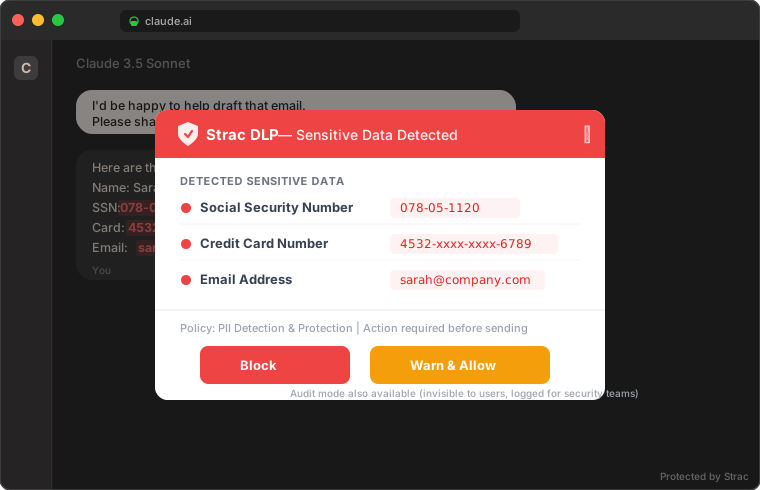
Strac detects SSNs, credit cards, and PII before they reach Claude, with configurable block, warn, or audit modes
Strac's browser extension (Chrome, Edge, Firefox, and Safari) monitors every interaction with claude.ai in real time:
What Gets Detected
Strac identifies 100+ sensitive data types in Claude Chat interactions:
Zero Friction Deployment
The browser extension deploys in minutes through Chrome Enterprise or Edge Group Policy. No proxy. No TLS interception. No network changes. Users see no performance impact, Strac's detection engine runs locally in the extension.
Strac's browser extension detects and redacts sensitive data across Claude, ChatGPT, Gemini, and every AI-powered web app
🎥 Claude Desktop DLP: Endpoint Protection
Claude Desktop is a native application for Mac and Windows. It bypasses every browser-based security control, your browser extension, your web proxy, your CASB. Employees can drag files from Finder or Explorer directly into Claude Desktop, paste clipboard content, and interact with Claude completely outside your browser DLP's visibility.
Claude Desktop also supports MCP connectors, when a user configures MCP servers in Claude Desktop, the endpoint agent works alongside MCP DLP for layered protection.
Claude Code DLP: Developer Security
Claude Code is Anthropic's command-line AI agent that runs in your terminal with full filesystem access. It reads and writes source code, runs shell commands, interacts with git, and can access any file your user account can reach.
For development teams, the primary risks are:
Strac's endpoint DLP agent monitors Claude Code sessions:
The same endpoint agent that protects Claude Code also covers Cursor, Windsurf, GitHub Copilot, and any other terminal-based AI coding tool, one agent, all AI developer tools.
Claude Cowork DLP: Workspace Protection
Claude Cowork (Claude for Work) is Anthropic's collaborative AI workspace. Teams share projects, documents, and Claude conversations in a persistent environment. The collaboration features that make Cowork productive also amplify data security risks:
Strac protects Claude Cowork through browser DLP (for web-based Cowork access) and MCP DLP (for connected data sources):
Here is how Strac's MCP DLP intercepts sensitive data before it reaches Claude in a Cowork workspace:
✨ Claude MCP DLP: Connector Security
The Model Context Protocol (MCP) lets Claude connect directly to your organization's SaaS tools and databases, pulling data autonomously based on user prompts. This is the newest and most dangerous data leak vector, traditional DLP cannot see machine-to-machine traffic flowing through MCP.
Strac's MCP DLP redacts SSNs, credit cards, and PII inline before Claude processes connected data sources
Claude can connect to:
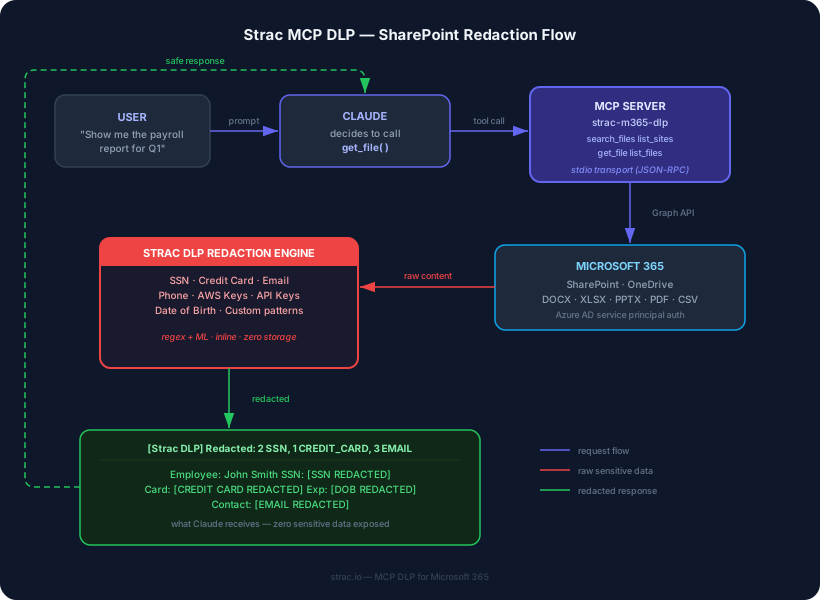
When an employee asks Claude "pull the Q1 payroll report from SharePoint," Claude calls get_file() through an MCP server, retrieves the raw document via Microsoft Graph API, and loads the full contents, SSNs, salaries, bank accounts, into its context window.
Strac's MCP DLP sits between Claude and every connected data source. When Claude calls a tool through an MCP server, Strac intercepts the raw content, detects and redacts sensitive data, and returns the clean version to Claude. The redaction is inline and zero-storage, sensitive data never reaches Claude's context window.
Every Claude surface uses the same detection engine with three configurable enforcement modes:
Mode
What the User Sees
What Security Sees
When to Use
Block
Submission is stopped. Popup shows which sensitive data was detected and why it was blocked.
Full event log: user, timestamp, data types, policy triggered.
Regulated data (HIPAA, PCI). Zero-tolerance policies.
Warn
Warning popup with detected data types. User can choose to go back or proceed.
Full event log plus the user's decision (proceeded or cancelled).
Medium-risk data. Security awareness. User education.
Audit
Nothing, completely invisible to the user.
Full event log with all detected sensitive data types and context.
Shadow AI discovery. Baseline measurement. Low-risk monitoring.
Policies are configurable per data type, per user group, and per Claude surface. Your engineering team might get Warn on Claude Code while your finance team gets Block on Claude Chat for PCI data. Audit mode is ideal for rolling out Claude DLP without disrupting workflows, security teams get full visibility before turning on enforcement.
MCP DLP adds a fourth capability: inline redaction. When Claude pulls data from connected SaaS tools through MCP, Strac replaces sensitive values with safe placeholders ([SSN REDACTED], [CREDIT CARD REDACTED]) before the data enters Claude's context window. This is server-side redaction that happens between the MCP server and the data source, distinct from browser enforcement modes.
Sensitive Data Types for Claude DLP
Strac detects and protects 100+ sensitive data types across every Claude surface:
Credit Card, CVV, Bank Account, Routing Number, IBAN
PHI
Medical Record Number, Health Plan ID, Diagnosis Code, Prescription
Secrets
AWS Keys, API Tokens, OAuth Tokens, Private Keys, Database Strings
Financial
Tax ID, EIN, Account Numbers, Salary Data
Custom
Regex patterns for internal IDs, project codes, proprietary formats
Detection uses regex + ML classification for high accuracy with minimal false positives. New patterns can be added through the Strac console without engineering work.
Strac Claude DLP Features
Real-Time Detection
Every interaction with Claude, prompt, file upload, MCP tool call, clipboard paste, is scanned in real time before data reaches Claude's context window.
Configurable Policies
Set different enforcement modes (Block, Warn, Audit) per data type, user group, and Claude surface. Fine-grained control without blanket blocking.
Complete Audit Trail
Every detection, block, warning, and audit event is logged with full context: user, timestamp, data type, Claude surface, and enforcement action. Export to your SIEM or SOAR platform.
Compliance Ready
Pre-built policy templates for HIPAA, PCI DSS, SOC 2, GDPR, and CCPA. Deploy a compliant Claude DLP policy in minutes.
Image and Document OCR
The only DLP that detects sensitive data inside images (JPEG, PNG, screenshots) and documents (PDF, DOCX, XLSX) uploaded to Claude, not just plain text prompts.
Zero-Storage Architecture
Strac never stores the sensitive data it detects. Detection metadata is logged for audit, but raw content is never retained. MCP redaction is inline, sensitive values are replaced in transit, never stored by Strac.
✨ 🎥 Strac Claude DLP Demo
See Strac's endpoint DLP protecting Claude Desktop, Cursor, and native AI apps:
For the full Strac DLP platform demo covering SaaS, endpoint, and GenAI:
Strac protects 50+ integrations including Claude, ChatGPT, Gemini, Copilot, Slack, Google Drive, Microsoft 365, and more
Book a Demo to see how Strac secures every Claude surface in a single 15-minute call.
Related Strac Claude coverage
Strac has the deepest Claude protection in the market. The full coverage:
Claude DLP (Data Loss Prevention) detects and prevents sensitive data from being exposed through any Claude AI interaction. It covers Claude Chat (browser), Claude Desktop, Claude Code, Claude Cowork, and MCP connectors. Strac's Claude DLP scans prompts, file uploads, and connected data sources in real time, blocking, warning, or silently auditing sensitive data before it reaches Claude's context window. MCP DLP adds inline redaction for data pulled from connected SaaS tools.
Does Strac work with all Claude plans?
Yes. Strac's browser DLP and endpoint DLP work with Claude Free, Pro, Team, and Enterprise plans. MCP DLP works with any Claude surface that supports MCP connectors (Claude Desktop and Claude for Work). The DLP protection is independent of Anthropic's plan, it intercepts data before it reaches Claude regardless of your subscription tier.
How does Claude DLP differ from ChatGPT DLP?
The core detection and redaction engine is the same. The key difference is surface coverage. Claude has more interaction surfaces than ChatGPT: Claude Desktop (native app), Claude Code (terminal agent with full filesystem access), Claude Cowork (shared workspaces), and MCP connectors to SaaS tools and databases. Strac covers all of these. See our ChatGPT DLP →
Can Strac protect Claude's MCP connectors?
Yes. Strac's MCP DLP sits between Claude and every connected data source, Slack, Google Drive, Microsoft 365, Notion, Jira, Confluence, and databases. When Claude calls a tool through an MCP server, Strac intercepts the raw content, redacts sensitive data, and returns the clean version. See the full MCP DLP architecture →
Does Claude DLP slow down Claude?
No. Browser DLP runs locally in the Chrome, Edge, Firefox, and Safari extension. MCP DLP runs inline in the MCP server. Endpoint DLP runs as a lightweight OS agent. All detection adds single-digit milliseconds. Users experience zero perceptible delay.
Is Claude DLP compliant with HIPAA, PCI, and SOC 2?
Yes. Strac includes pre-built policy templates for HIPAA, PCI DSS, SOC 2, GDPR, and CCPA. Every detection and enforcement action is logged with full audit trails. Strac's zero-storage architecture means sensitive data is never retained by the DLP layer.
Can I set different policies for different Claude surfaces?
Yes. Strac supports per-surface, per-data-type, and per-user-group policies. For example: Block PCI data in Claude Chat for your finance team, Warn for secrets in Claude Code for your engineering team, and Audit mode across the board for shadow AI discovery. MCP connectors use inline redaction by default.
How long does it take to deploy Claude DLP?
Under 10 minutes for browser DLP (Chrome, Edge, Firefox, and Safari extension deployment). Endpoint DLP (Mac/Windows agent) deploys through your MDM or manually in minutes. MCP DLP requires configuring Strac's MCP server as the intermediary, typically under 30 minutes with the setup guide.
Does Strac detect sensitive data in images uploaded to Claude?
Yes. Strac is the only DLP that performs OCR on images (JPEG, PNG, screenshots) uploaded to Claude and detects PII, PCI, and PHI within them. This covers screenshots of customer records, photos of documents, and any other image-based sensitive data.
Can I use Strac Claude DLP alongside Strac's SaaS DLP?
Yes. Strac is a unified data security platform. Claude DLP, SaaS DLP (Slack, Google Drive, M365, Zendesk, etc.), Cloud DLP (AWS, Azure), and Endpoint DLP all run from a single console with unified policies, detection, and audit trails. See all 50+ integrations →
What is Claude DLP?
Claude DLP (Data Loss Prevention) detects and prevents sensitive data from being exposed through any Claude AI interaction. It covers Claude Chat (browser), Claude Desktop, Claude Code, Claude Cowork, and MCP connectors. Strac's Claude DLP scans prompts, file uploads, and connected data sources in real time — blocking, warning, or silently auditing sensitive data before it reaches Claude's context window. MCP DLP adds inline redaction for data pulled from connected SaaS tools.
Does Strac work with all Claude plans?
Yes. Strac's browser DLP and endpoint DLP work with Claude Free, Pro, Team, and Enterprise plans. MCP DLP works with any Claude surface that supports MCP connectors (Claude Desktop and Claude for Work). The DLP protection is independent of Anthropic's plan — it intercepts data before it reaches Claude regardless of your subscription tier.
How does Claude DLP differ from ChatGPT DLP?
The core detection and redaction engine is the same. The key difference is surface coverage. Claude has more interaction surfaces than ChatGPT: Claude Desktop (native app), Claude Code (terminal agent with full filesystem access), Claude Cowork (shared workspaces), and MCP connectors to SaaS tools and databases. Strac covers all of these. See our ChatGPT DLP →
Can Strac protect Claude's MCP connectors?
Yes. Strac's MCP DLP sits between Claude and every connected data source — Slack, Google Drive, Microsoft 365, Notion, Jira, Confluence, and databases. When Claude calls a tool through an MCP server, Strac intercepts the raw content, redacts sensitive data, and returns the clean version. See the full MCP DLP architecture →
Does Claude DLP slow down Claude?
No. Browser DLP runs locally in the Chrome/Edge extension. MCP DLP runs inline in the MCP server. Endpoint DLP runs as a lightweight OS agent. All detection adds single-digit milliseconds. Users experience zero perceptible delay.
Discover & Protect Data on SaaS, AI, MCP, Endpoints & Cloud
Strac provides end-to-end data loss prevention for all SaaS and Cloud apps. Integrate in under 10 minutes and experience the benefits of live DLP scanning, live redaction, and a fortified SaaS environment.


.webp)







.avif)


.gif)
