September 17, 2026

8
min read
Understanding Data Loss Prevention Compliance
Data loss prevention compliance is enforcing controls on sensitive data and proving they ran. See the controls, the evidence, and how Strac delivers both.
· Data loss prevention compliance is the practiceof detecting sensitive data across SaaS, cloud, endpoints, browsers and AItools, remediating it automatically, and keeping a defensible record that mapseach action back to a framework control.
· It got harder in 2026 because the fastest dataegress path is no longer email or a USB stick: it is a paste into a chatassistant or an agent calling a tool over MCP, and neither leaves an audittrail your legacy stack can read.
· Most stacks split the problem in half: acompliance automation tool collects screenshots of settings, and a DLP toolwatches traffic. Neither side proves the other, so the audit passes while thedata keeps leaking.
· Strac closes both halves. Strac Comply runscontinuous automated tests and maps one piece of evidence to SOC 2, ISO 27001,PCI DSS, GDPR, HIPAA and NIST CSF 2.0 at once, while Strac DLP redactssensitive data in real time across browser, endpoint, SaaS, cloud and MCP.
· Thisis the compliance slice of AI data governance.Start from that pillar if you are building the wider program.
Data loss prevention compliance is the practice of enforcing technical controls over sensitive data, then proving those controls ran continuously against a named framework.
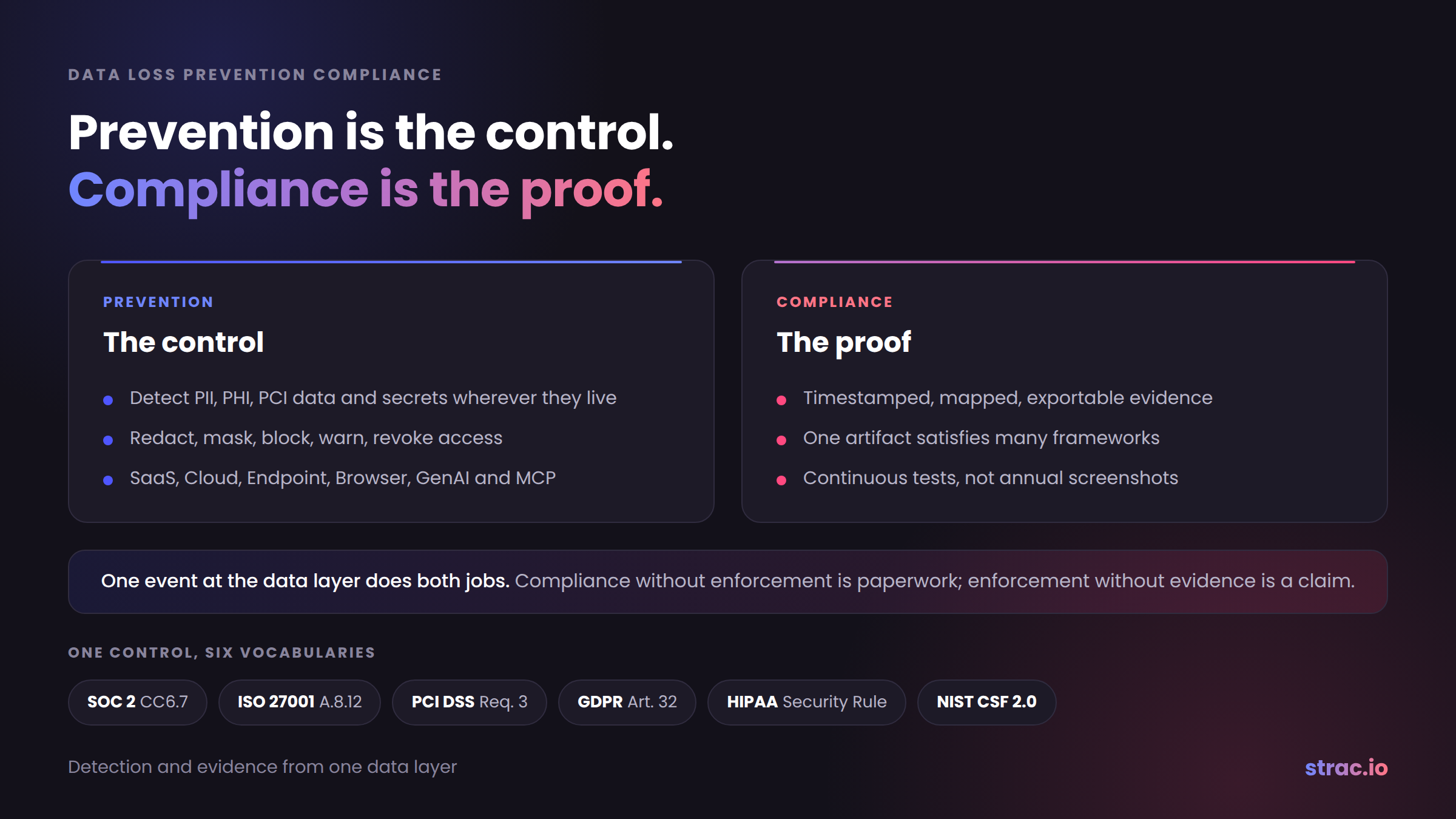
Two words are doing the work. Prevention is the control: detect PII, PHI, PCI data and secrets wherever they live and stop them from reaching somewhere they should not. Compliance is the proof: a timestamped, mapped, exportable record that the control existed, applied to the right scope, and did not quietly fail between audits.
Most programs are strong on one and thin on the other. A team with excellent detection and no evidence trail rebuilds its audit binder by hand every year. A team with a polished binder and no inspection at the data layer is documenting a control it cannot demonstrate. Compliance without enforcement is paperwork; enforcement without evidence is a claim.
Frameworks name the same requirement in their own dialect: SOC 2 CC6.7 on transmission of sensitive data, ISO 27001 Annex A 8.12 on data leakage prevention, PCI DSS Requirement 3 on stored account data, the GDPR Article 32 duty of appropriate technical measures, and the HIPAA Security Rule on safeguarding electronic protected health information. One control, six vocabularies.
The control surface moved and the evidence model did not follow.
Sensitive data used to leave through channels an organization owned: mail servers, file shares, removable media. It now leaves through a browser tab. An analyst pastes a customer export into a free summarizer, a support rep drops a card number into a chat thread, an agent with a database connection answers a question by reading the whole table and returning it over MCP. None of those actions crosses a mail gateway, and none of them shows up in a quarterly configuration screenshot.
Three things changed at once:
Legacy DLP reads the channels it was built for. Compliance automation reads configuration state. The exposure sits in the space between them.
Five capabilities, and they have to be one system rather than five purchases.
Discovery across every surface. You cannot govern what is not inventoried. That means sensitive data discovery and classification across SaaS, object storage, endpoints, browsers and AI tools, plus discovery of the tools themselves: OAuth grants, unsanctioned apps, agents and MCP servers.
Accurate detection. Regex alone produces a noise volume that teaches people to ignore alerts. Detection has to combine built-in detectors for PII, PHI, PCI and secrets with custom detectors for your own identifiers, tested by a PII scanner against real documents and images, not sample strings.
Remediation that does not stop work. The fixed ladder, in order:
Framework mapping, done once. Every detection, policy and remediation event should attach to a control ID in each framework you carry, so a single piece of evidence satisfies SOC 2, ISO 27001, PCI DSS, GDPR, HIPAA, NIST CSF 2.0, SEC Reg S-P and US state privacy law simultaneously.
Continuous evidence, not annual archaeology. Automated tests running on a schedule, with pass and fail state visible now and exportable with timestamps when the auditor arrives.
Watch Strac detect a customer record in a chat assistant prompt, redact it inline, and write the event to the control it satisfies.
Strac detects and redacts sensitive data at the moment of the action, and the same event becomes the audit evidence: the control and the proof are one record.
This is the part that most stacks never reach. A DLP alert is an operational artifact; a mapped, timestamped remediation event is a compliance artifact. When the same pipeline produces both, the evidence binder stops being a quarterly project.

Strac runs both halves of data loss prevention compliance on one data layer.
On the control side, Strac inspects content on every surface sensitive data touches: endpoint DLP on managed devices, SaaS DLP across 40+ applications, Browser DLP at the paste and upload boundary, AI DLP for generative tools, and MCP DLP for agent tool calls. Live integrations include ChatGPT DLP, Slack DLP, Google Drive DLP and the wider Google Workspace DLP surface. Detection ships built in, custom detectors take minutes, and deployment is measured in hours rather than quarters.
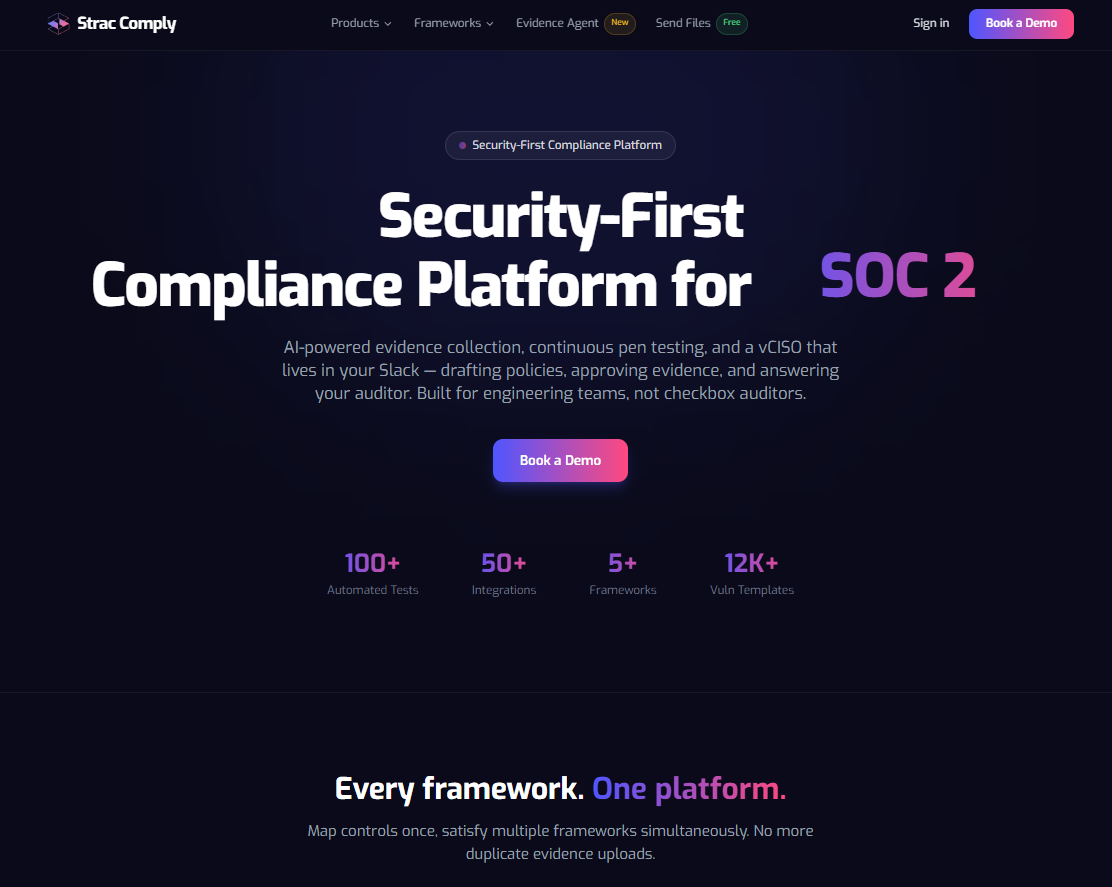
On the proof side, Strac Comply runs 100+ automated tests against connected systems, collects evidence continuously, and deduplicates it across frameworks so one control satisfies many. It carries SOC 2 Type I and II, ISO 27001, PCI DSS, GDPR, NIST CSF 2.0, HIPAA, SEC Reg S-P and US data privacy today, with FedRAMP, NIST 800-53, CCPA/CPRA and CMMC in progress. Around that sit the things auditors and customers actually ask for: penetration testing, vendor risk, access reviews, policy management, security training, a branded Trust Center, and AI-generated answers to security questionnaires backed by live control state rather than a stale spreadsheet.
Both halves are reachable by agent. Strac Comply MCP exposes the compliance program headlessly, so an AI client can build and maintain the binder against real data. That is what AI-native compliance means in practice: the program runs whether or not someone is in the dashboard.
A longer operational version lives in the DLP security checklist.
Framework specifics live on the compliance pages: HIPAA, SOC 2, ISO 27001, PCI DSS, CCPA and NIST.
Identity controls, network controls and policy documents all fail eventually, and a compliance program built only on their configuration state proves nothing about the data. The data layer is the backstop: redact sensitive information on every action and a compromise never becomes a breach, while the same event stands up as evidence of the control. Strac delivers both halves, across browser, endpoint, SaaS, cloud and MCP, mapped to every framework you carry.
No. Compliance automation collects evidence about configuration; DLP enforces controls on data in motion. Strac runs both: Strac Comply produces the mapped evidence, and the data layer produces the enforcement that evidence describes.
Because it reports alerts, not control state. Auditors ask for scope, policy, ownership and continuous operation mapped to a control ID. An alert queue answers none of those without a translation layer on top.
No. Blocking drives usage to personal devices, which removes the evidence trail entirely. Redaction and vaulting let people use generative AI while the sensitive element never leaves, which is both the safer control and the more defensible one.
No, and a vendor promising it is selling a slogan. Detection has a false negative rate and people find new channels. That is why remediation defaults to redaction at the data layer: when a control is bypassed, what escapes is already stripped of its sensitive parts.
Through cross-framework control mapping: one evidence artifact attaches to SOC 2, ISO 27001, PCI DSS, GDPR, HIPAA and NIST CSF 2.0 simultaneously rather than being recollected per audit. See AI data governance for how this fits the wider program.
.avif)


.gif)


.webp)