Data Minimization: The Complete Guide for Security and Compliance Teams
A comprehensive guide to data minimization — what it means, how GDPR, CPRA, and NIST require it, and how to automate redaction and deletion across your SaaS and cloud stack.
Data minimization means only collecting what you need, retaining it only as long as necessary, and deleting it when the purpose ends.
It is legally required under GDPR Article 5(1)(c), CPRA § 1798.100(a)(3), and NIST Privacy Framework CT.DM.
In practice, it is an enforcement problem — PI accumulates across Salesforce, Zendesk, Slack, S3, and 50+ other systems faster than manual processes can address it.
Strac automates discovery, redaction, and deletion across your entire SaaS and cloud stack.
Data Minimization: The Complete Guide for Security and Compliance Teams
Data minimization is the principle that organizations should only collect, retain, and process personal information that is necessary for a stated purpose — and should delete it when that purpose is fulfilled.
It sounds simple. In practice, it is one of the hardest privacy obligations to operationalize. Personal information accumulates across dozens of SaaS applications, cloud storage buckets, email archives, and messaging platforms. By the time a compliance team asks "do we still need this data?", the answer is often unclear — and the data is everywhere.
This guide covers what data minimization means, what it requires under each major framework, how it applies to real-world SaaS environments, and how to enforce it at scale.
What Is Data Minimization?
Data minimization is defined by three criteria — data collected and retained must be:
Adequate — sufficient to fulfill the stated purpose
Relevant — directly related to that purpose
Limited — not excessive beyond what the purpose requires
These three criteria come from GDPR Article 5(1)(c) and are reflected, with slight variations in wording, in CPRA, NIST, HIPAA, and ISO 27001. The core principle is the same across all frameworks: match the scope of data collection to the business need.
The opposite of data minimization — collecting broadly "just in case" — is now a compliance liability. Regulators across the EU, US, and Australia have all signaled that excess data collection is an enforcement priority.
Data Minimization Meaning: Collection vs Retention
Data minimization applies at two distinct points in the data lifecycle:
At collection: Only collect the data types actually needed to fulfill the stated purpose. A newsletter signup does not require a phone number. A support ticket does not require a Social Security Number unless identity verification is the stated purpose.
At retention: Delete personal information when the purpose ends. A support ticket closed 24 months ago with an SSN in the body has no ongoing business justification for retaining that SSN. A CRM contact who has not engaged in three years may have no business justification for retention at all.
Most organizations handle collection reasonably well — privacy notices and forms have been cleaned up over the past decade. The retention side is where minimization obligations accumulate into real exposure. Data that should have been deleted stays indefinitely because no process enforces the deletion.
✨ Data Minimization Requirements by Framework
Different regulations use different language but converge on the same principle. Here is how data minimization is codified across major frameworks:
Framework
Requirement
Enforcement
GDPR Article 5(1)(c)
Data must be "adequate, relevant and limited to what is necessary"
ICO, CNIL, and EU national DPAs; fines up to 4% global revenue
CPRA § 1798.100(a)(3)
Collection, use, retention, and sharing must be "reasonably necessary and proportionate"
California Privacy Protection Agency; $2,500–$7,500 per violation
NIST Privacy Framework CT.DM
"Data processing is limited to what is necessary" across the data lifecycle
Voluntary framework; baseline for US federal agencies and contractors
HIPAA Minimum Necessary
Access to PHI must be limited to the minimum necessary to accomplish the intended purpose
HHS OCR; civil and criminal penalties
ISO 27001 Annex A 8.10
Information minimization — only store data required for operations
Certification body audits; loss of certification
Australia Privacy Act APP 3.3
Only collect personal information reasonably necessary for functions
OAIC; fines up to AUD 50M for serious/repeated breaches
Data Minimization and Retention: How They Connect
Data minimization and data retention are two sides of the same obligation. Minimization scopes what you collect; retention limits determine how long you keep it.
Under GDPR, Article 5(1)(e) — the storage limitation principle — requires that data be "kept in a form which permits identification of data subjects for no longer than is necessary." Under CPRA, retention periods must be disclosed in your privacy notice and enforced in practice. Under NIST, the CT.DM-P2 practice explicitly addresses retention limits.
The practical implication: your privacy notice must state retention periods by data category, and those stated periods must be enforced in your actual systems. A gap between policy and practice is itself a compliance violation.
✨ Where Data Minimization Violations Actually Happen
Most data minimization violations are not cases of intentional over-collection. They are accumulation problems — data collected for a legitimate purpose that was never deleted when the purpose ended.
Here is where PI accumulates in modern SaaS and cloud environments:
System
Common Accumulation Pattern
Minimization Risk
CRM (Salesforce, HubSpot)
SSNs and card numbers pasted into notes by reps
High — sensitive data in unstructured fields
Support tickets (Zendesk, Intercom)
ID documents, SSNs shared for identity verification
Critical — ticket archives grow indefinitely
Messaging (Slack, Teams)
Account numbers, SSNs, API keys shared informally
High — real-time exposure plus retained history
Cloud storage (S3, Drive, SharePoint)
One-time exports with full PI that never get deleted
Critical — large volumes, low visibility
Email (Gmail, Outlook)
PHI and SSNs in onboarding and HR threads
High — email archives are rarely audited
Code repos (GitHub)
Test fixtures with real PI, hardcoded credentials
Medium — propagates through branches and forks
Strac connects to all of these systems via API and scans for PI automatically — no network proxy, no manual audits.
Each major framework has nuances worth understanding in detail.
GDPR requires the three-part adequacy, relevance, and limitation test for all personal data of EU residents — regardless of where the processing company is located. The DPA enforcement history shows that retention violations (keeping data too long) are prosecuted as frequently as over-collection.
CPRA adds a proportionality standard beyond GDPR's structure — the California Privacy Protection Agency can examine whether the volume and type of PI collected is proportionate to the disclosed business purpose. Sensitive PI (SSNs, biometrics, health data, financial data) is subject to a higher standard and new consumer controls.
NIST Privacy Framework provides a voluntary but widely-adopted structure for US organizations. The CT.DM core function maps data minimization to specific organizational practices. Many SOC 2 auditors now reference NIST PF alongside the Trust Services Criteria.
HIPAA Minimum Necessary is the healthcare-specific version of data minimization — covered entities and their business associates must limit access to PHI to the minimum necessary to accomplish the intended purpose. This applies to both access and transmission.
PCI DSS Requirement 3.3 and 3.4 require cardholder data to be minimized and deleted when no longer needed — storing full PANs beyond the authorization window without encryption and access controls is a direct violation.
Policy documents and privacy notices describe what data minimization requires. Strac enforces it across the systems where PI actually lives.
Discovery (DSPM): Strac's Data Security Posture Management layer scans 50+ SaaS and cloud integrations — Salesforce, Zendesk, Google Drive, S3, Slack, GitHub, and more — to build a live inventory of where PI is stored, what type it is, and how old it is. Most companies don't know what they have until they scan.
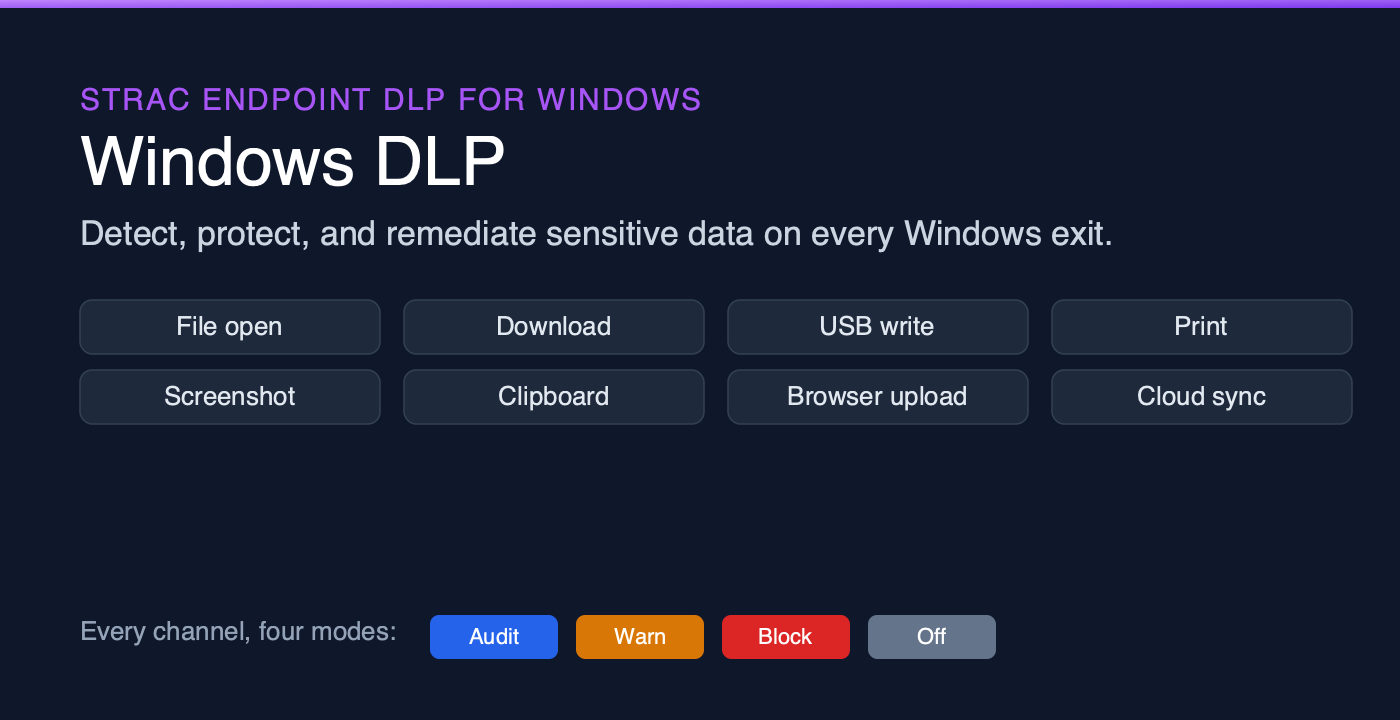
Real-time prevention (DLP): At the browser, endpoint, and API layer, Strac prevents new PI accumulation — blocking or redacting sensitive data before it reaches systems where it will be hard to remove later. Employees get coached or blocked when they try to paste SSNs into Zendesk, upload ID documents to Google Drive, or share credit card numbers in Slack.
Automated remediation: Strac redacts PI inline (replacing 123-45-6789 with [SSN REDACTED]) and deletes records or files past their retention period — automatically, on schedule, across all connected systems. No manual review required.
Strac in Customer Support — Zendesk, Intercom, Salesforce
Customer support is one of the most common places sensitive data accumulates unchecked. Customers submit identity documents, Social Security Numbers, and credit card details in ticket threads to verify their accounts or resolve issues. Once the ticket closes, that data sits in the archive indefinitely — a textbook minimization violation.
Strac scans every Zendesk, Intercom, and Salesforce record — including image attachments — and detects driver's license numbers, passport numbers, SSNs, and other regulated PII using ML and OCR. When found, Strac redacts the values inline or deletes the attachment entirely, without agent intervention.
Slack is a high-risk surface for PI exposure. Employees paste customer details into channels during onboarding or support escalations. ID documents get shared in DMs. Screenshots containing sensitive data get uploaded without a second thought.
Strac monitors Slack in real time. When a driver's license image, passport scan, or identity number is shared in any channel or DM, Strac detects and redacts it before it can be forwarded or accessed by unauthorized users. Historical Slack messages are also scanned retrospectively to address years of accumulated exposure.
Email is where the highest volume of sensitive document copies accumulates over time. Onboarding threads, KYC submissions, and verification request replies all contain passport and license attachments that persist without any retention schedule.
Strac integrates with Office 365 and Gmail to scan both new and historical email — including attachments — for identity documents and regulated PII. Files containing passport scans, driver's license images, or identity numbers can be automatically redacted or deleted. Policies can be configured to alert compliance teams, quarantine flagged messages, or remove external access.
Not all DLP tools handle data minimization. Legacy DLP operates at the network layer — it monitors email and web traffic but can't scan SaaS APIs or cloud storage for accumulated PI.
Effective data minimization software needs:
Capability
Why It Matters
SaaS API scanning
PI lives in Salesforce records and Zendesk tickets, not just email
OCR and image detection
ID documents and screenshots are PI even as images
Inline redaction
Preserves record context while removing sensitive values
Automated retention enforcement
Policy without enforcement is still a violation
Agentless deployment
Endpoint agents don't reach cloud-native systems
Cross-framework policy engine
GDPR, CPRA, HIPAA, PCI rules need one consistent policy
The data minimization principle is the requirement that personal information collected by an organization must be adequate (sufficient for its purpose), relevant (directly related to that purpose), and limited (not excessive beyond what is necessary). It is a legally binding principle under GDPR Article 5(1)(c) and similar language in CPRA, NIST, HIPAA, and ISO 27001.
What is the data minimization meaning in plain terms?
Don't collect data you don't need. Don't keep data longer than you need it. Don't use data for purposes beyond what you disclosed. Those three rules, applied consistently across every system in your environment, are what data minimization means in practice.
What is data minimization and how does it relate to retention?
Data minimization covers the scope of what you collect and process. Data retention determines how long you keep it. They are separate principles under GDPR (Article 5(1)(c) for minimization, Article 5(1)(e) for storage limitation) but operationally linked — you can't enforce minimization without enforcing retention. Your privacy notice must state retention periods, and your systems must actually delete data when those periods expire.
What are common data minimization violations?
The most common violations are retention failures — data that was legitimately collected but never deleted when the purpose ended. SSNs in year-old support tickets, credit card numbers in CRM notes, ID document attachments in closed helpdesk tickets. Regulators treat these as minimization violations even if the original collection was justified.
Does data minimization apply to employee data?
Yes. GDPR, CPRA, HIPAA, and ISO 27001 all apply their minimization requirements to employee data as well as customer data. HR records, payroll files, and benefit enrollment documents contain some of the most sensitive PI in any organization. The same principles apply: collect only what is necessary for the employment relationship, define retention periods, and enforce deletion.
How does data minimization relate to data security?
Data minimization reduces attack surface. Data you don't have cannot be breached. Organizations that practice rigorous minimization have smaller, better-understood data inventories — which makes security controls more effective and breach impact smaller. The NIST Privacy Framework explicitly connects minimization to risk reduction in the CT.DM core function.
What is the difference between data minimization and anonymization?
Data minimization limits the volume and retention of PI. Anonymization transforms PI so that individuals can no longer be identified, effectively removing it from the scope of privacy regulations. Anonymization is one technique for achieving minimization outcomes — converting a dataset from personally identifiable to anonymized is a form of deletion for regulatory purposes. GDPR's anonymization standard is strict: re-identification must be practically impossible.
The data minimization principle is the requirement that personal information collected by an organization must be adequate (sufficient for its purpose), relevant (directly related to that purpose), and limited (not excessive beyond what is necessary). It is a legally binding principle under GDPR Article 5(1)(c) and similar language in CPRA, NIST, HIPAA, and ISO 27001.
What is the data minimization meaning in plain terms?
Don't collect data you don't need. Don't keep data longer than you need it. Don't use data for purposes beyond what you disclosed. Those three rules, applied consistently across every system in your environment, are what data minimization means in practice.
What is data minimization and how does it relate to retention?
Data minimization covers the scope of what you collect and process. Data retention determines how long you keep it. They are separate principles under GDPR (Article 5(1)(c) for minimization, Article 5(1)(e) for storage limitation) but operationally linked — you can't enforce minimization without enforcing retention. Your privacy notice must state retention periods, and your systems must actually delete data when those periods expire.
What are common data minimization violations?
The most common violations are retention failures — data that was legitimately collected but never deleted when the purpose ended. SSNs in year-old support tickets, credit card numbers in CRM notes, ID document attachments in closed helpdesk tickets. Regulators treat these as minimization violations even if the original collection was justified.
Does data minimization apply to employee data?
Yes. GDPR, CPRA, HIPAA, and ISO 27001 all apply their minimization requirements to employee data as well as customer data. HR records, payroll files, and benefit enrollment documents contain some of the most sensitive PI in any organization. The same principles apply: collect only what is necessary for the employment relationship, define retention periods, and enforce deletion.
Discover & Protect Data on SaaS, AI, MCP, Endpoints & Cloud
Strac provides end-to-end data loss prevention for all SaaS and Cloud apps. Integrate in under 10 minutes and experience the benefits of live DLP scanning, live redaction, and a fortified SaaS environment.


.webp)






.avif)




.gif)
