AI Data Governance: Why Traditional DLP Fails in AI Environments (2026 Guide)
Most companies think they have AI data governance. They don’t. Legacy DLP can’t detect prompt-based leakage, AI agents, or browser activity; meaning your most sensitive data is already leaving through channels you don’t control.
AI data governance is breaking legacy DLP; sensitive data now moves through ChatGPT prompts, AI agents, and MCP connections; not files or emails
Legacy DLP fails because it cannot see context-based data flows; it misses prompt leakage, browser activity, and agent-driven access across systems
ChatGPT and GenAI tools are the biggest data leakage vector today; employees paste sensitive data directly into prompts with zero visibility or control
Modern AI data governance requires real-time control; including prompt inspection, browser-level enforcement, and context-aware detection across SaaS, cloud, and APIs
Platforms like Strac enable true AI data governance; combining DSPM + DLP with real-time redaction, GenAI protection, and unified coverage across AI, SaaS, cloud, and endpoints
AI data governance is no longer optional. It is the difference between controlled AI adoption and silent data leakage at scale.
Most teams think the risk starts when data leaves their systems. That is outdated. Today, sensitive data is exposed the moment it is pasted into ChatGPT, accessed by an AI agent, or queried through an MCP connection.
This is where legacy DLP completely breaks.
AI introduces a new reality:
Data is processed, not transferred
Agents act instead of users
The browser becomes the primary data layer
If your security model doesn’t account for this, you don’t have AI data governance — you have blind spots.
Why AI Data Governance Is Fundamentally Different
AI data governance changes how data moves, how it is exposed, and how it must be controlled.
Traditional governance assumes:
Data is stored in systems
Movement is logged
Users are the main actors
AI breaks all three.
What changes with AI:
Data moves through prompts, not files
Access happens through agents, not users
Exposure happens in real time, not post-event
This creates a new category of risk:
👉 Unstructured, high-value data leaving through invisible channels
Without browser-level enforcement: 👉 You cannot govern AI usage.
2. Prompt and Response Inspection
AI data governance is not just about inputs; outputs matter too.
Strac AI Data Elements
You need to:
Scan prompts before submission
Inspect responses for sensitive data
Prevent re-exposure of protected information
This is critical because AI can:
Transform data
Reconstruct sensitive content
Expose derived insights
3. Context-Aware Detection (Beyond Regex)
AI data governance must understand:
Business context (e.g., “board deck”, “roadmap”)
Sensitivity without structured patterns
Data relationships across systems
This requires:
ML-based classification
OCR for images and screenshots
Context-aware decision-making
4. Real-Time Enforcement (Not Alerts)
In AI workflows:
Data exposure happens instantly
Agents operate at machine speed
Your system must:
Block
Redact
Warn
Allow (based on policy)
👉 Alerts alone are useless in AI environments.
5. Unified Governance Across All Surfaces
AI data governance must unify:
SaaS (Slack, Salesforce, Drive)
Cloud (storage, data warehouses)
Browser (ChatGPT, Gemini)
APIs (MCP connections)
Endpoints
Anything less creates fragmentation; and fragmentation creates risk.
🎥 How Strac Enables AI Data Governance
Strac is built specifically for this new data movement model.
It does not treat AI as an edge case; it treats it as a core data layer.
ChatGPT & GenAI DLP (Browser Layer)
Strac:
Detects sensitive data in prompts before submission
Redacts or blocks content in real time
Supports audit, warn, block, and redact modes
Controls usage of personal vs corporate AI accounts
👉 This directly closes the biggest AI data leakage vector.
AI Data Governance Across SaaS and APIs
Strac extends governance beyond AI tools:
Slack → redact sensitive messages in real time
Strac Slack DLP
Salesforce → protect CRM data in workflows
Strac Salesforce DLP
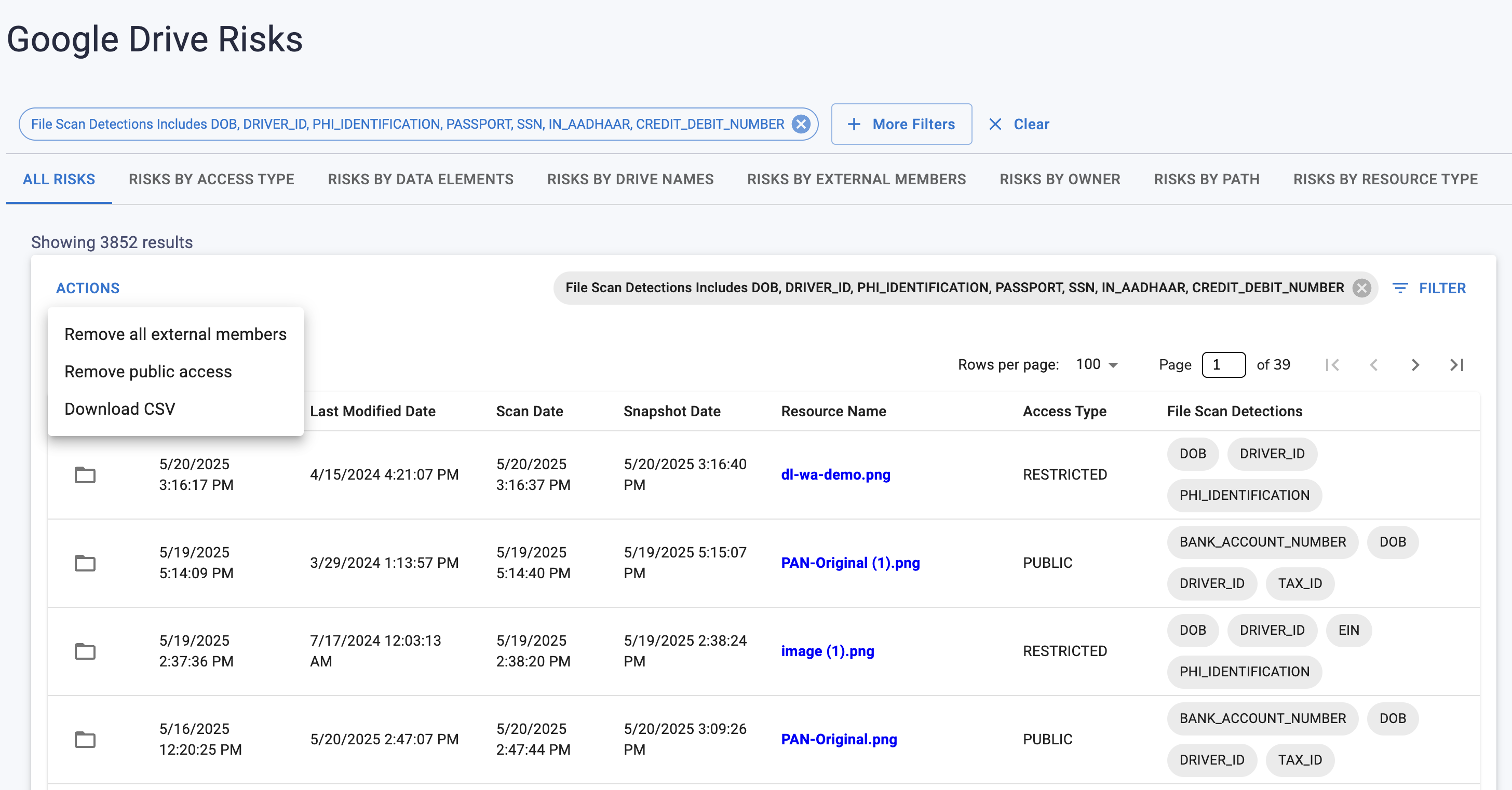
Google Drive → remove public links, external access
Strac Google Drive DLP
Intercom/Zendesk → redact customer data in tickets
Strac Intercom DLP
👉 AI data governance must include where data originates; not just where it exits.
DSPM + DLP Unified
Strac combines:
Data discovery (where sensitive data lives)
Classification (what it is)
Exposure analysis (who has access)
Remediation (what to do about it)
👉 This removes the gap between visibility and action.
What Makes Strac Different
Agentless deployment; live in minutes
Real-time redaction; not just alerts
ML + OCR detection; beyond regex
GenAI-native controls; built for ChatGPT, not retrofitted
Unified coverage; SaaS, cloud, browser, endpoints
This is what actual AI data governance looks like in production.
🎥 ✅ How Strac covers AI data security across every surface
Legacy DLP was built for email and endpoint in 2010. AI-era data flows happen across five new surfaces that legacy tools don't touch. Here's how Strac handles each one:
1. Browser DLP — every prompt to Claude, ChatGPT, Gemini, Copilot, Perplexity
Strac's browser extension intercepts every prompt before it reaches the LLM API and redacts PII, PHI, PCI (cardholder data), source code, and secrets inline. The model still works — it never sees the raw sensitive data. Coverage extends to claude.ai, ChatGPT, Gemini, Microsoft Copilot, Perplexity, Mistral, DeepSeek, plus Anthropic and OpenAI APIs. See Strac Generative AI DLP and Strac Claude DLP.
2. MCP DLP — for AI agents acting on enterprise data
When a Claude, Cursor, or ChatGPT agent calls a Slack, Gmail, Google Drive, GitHub, Notion, or any other MCP server, Strac sits inline and redacts sensitive data in every tool-call response. Strac is the first DLP with native Model Context Protocol policy enforcement — most enterprise DLP vendors still have no MCP support at all. Full background: MCP DLP guide.
3. SaaS DLP and Data Discovery — across 47+ integrations
The same redaction and labeling policies apply to every SaaS surface where data lives — Slack, Google Drive, Gmail, M365, OneDrive, SharePoint, Salesforce, Notion, Jira, Confluence, GitHub, Linear, HubSpot, Asana, Zendesk, Intercom, Box, ServiceNow, and 30+ more. Continuous data discovery and classification (DSPM) inventories every personal data type across your environment and automatically applies the right sensitivity label.
4. Cloud DSPM — AWS, Azure, GCP
Strac continuously scans AWS (S3, RDS, EBS, CloudWatch), Azure (Blob Storage, SQL), and GCP (Cloud Storage, BigQuery) for sensitive data at rest. Not point-in-time scans — continuous discovery with automatic classification. The output powers compliance evidence for GDPR, HIPAA, PCI DSS, SOC 2, and ISO 27001 audits.
5. Endpoint DLP — Mac, Windows, Linux
For data egress outside the SaaS perimeter — local file shares, USB drives, screenshots, terminal output, IDE clipboards. Strac's endpoint agent enforces the same policies as the SaaS, browser, and MCP layers, with full audit logs for any sensitive data movement.
AI data governance is the practice of controlling how sensitive data is accessed, processed, and exposed across AI tools, agents, and workflows; including prompts, APIs, and outputs.
2. Why is ChatGPT a data security risk?
Because users can paste sensitive data directly into prompts, bypassing traditional DLP controls; with no file transfer or audit event.
3. Can DLP tools detect AI data leaks?
Legacy DLP cannot. Modern platforms like Strac operate at the browser and prompt level to detect and prevent AI-driven data leakage.
4. What is MCP in AI security?
MCP (Model Context Protocol) enables AI agents to access multiple systems simultaneously; creating powerful but often ungoverned data flows.
5. How do you prevent data leakage in ChatGPT?
You need:
Prompt-level inspection
Real-time redaction/blocking
Browser-level enforcement
Unified policies across systems
Discover & Protect Data on SaaS, AI, MCP, Endpoints & Cloud
Strac provides end-to-end data loss prevention for all SaaS and Cloud apps. Integrate in under 10 minutes and experience the benefits of live DLP scanning, live redaction, and a fortified SaaS environment.


.webp)





.avif)



.gif)
