AI Governance: The Three Questions Your Program Has to Answer
AI governance is more than policy. It means knowing who is using what AI, what data goes into it, and what your agents are doing. Here is how to answer all three.
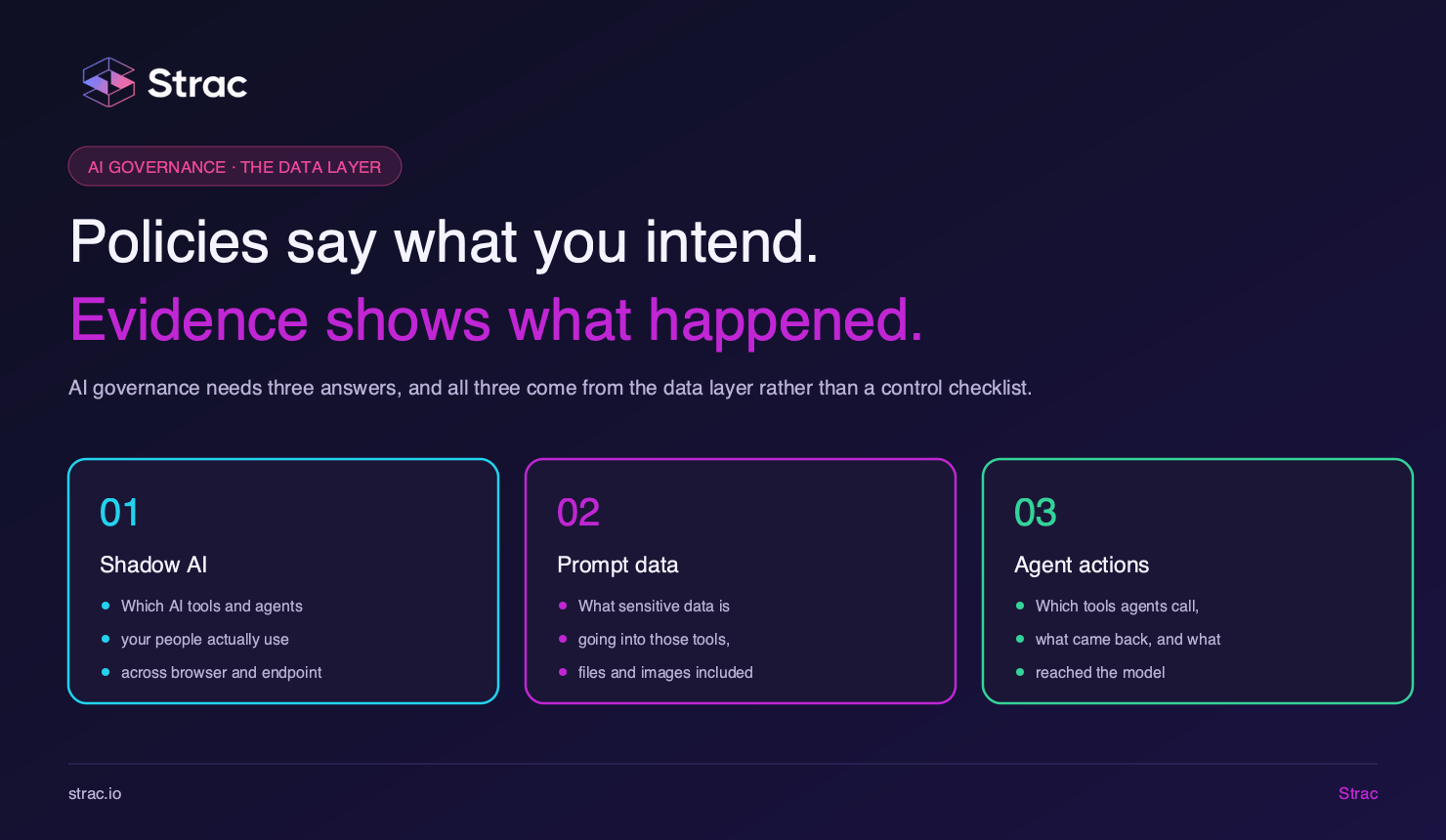
AI governance reduces to three questions: who is using what AI, what data is going into it, and what the agents are doing. All three need a data layer.
TL;DR:
AI governance is how an organization decides which AI is allowed, what data it may touch, who is accountable, and how that is proven.
Most programs are strong on documentation (policies, control mapping, risk registers) and blind on what is actually happening.
Three questions decide whether a program is real: who is using what AI, what data is going into it, and what the agents are doing.
All three need a data layer. Policy and questionnaire platforms cannot see inside a prompt, a file or a tool response.
Strac answers all three: shadow AI discovery across browser and endpoint, DLP on what enters prompts, and agent control through MCP DLP and the AI Gateway.
Almost every AI governance article you will read describes the same thing: appoint an owner, write an acceptable-use policy, inventory your AI systems, assess risk, map to a framework, review periodically. That advice is correct and it is where every program should start.
It is also where most programs stop, and the gap that leaves is specific. You end up with an approved-tools list nobody can verify, a data-handling policy nobody can enforce at the moment data is typed into a prompt, and an agent strategy with no record of what the agents retrieved. This guide covers the structural part first and then the operational part that usually goes missing.
✨ What is AI governance?
AI governance is the operating model for how AI gets adopted and used inside an organization: which systems are approved, what data they may process, who is accountable for outcomes, and how all of that is monitored and evidenced over time.
It splits into two halves that get conflated constantly, and the distinction is the single most useful thing to hold onto.
The documentation half. Policies, roles, risk assessments, framework control mapping, approval workflow, vendor review. This is what compliance platforms automate, and they do it well.
The operational half. What is actually happening right now: which AI tools are in use, what data is entering them, what agents are doing with access to your systems. This requires inspecting real traffic.
A program with only the first half passes a document review and fails the first real question. A program with only the second half has telemetry nobody has mapped to an obligation. You need both, and most companies are over-invested in one and have nothing in the other.
✨ The three questions AI governance has to answer
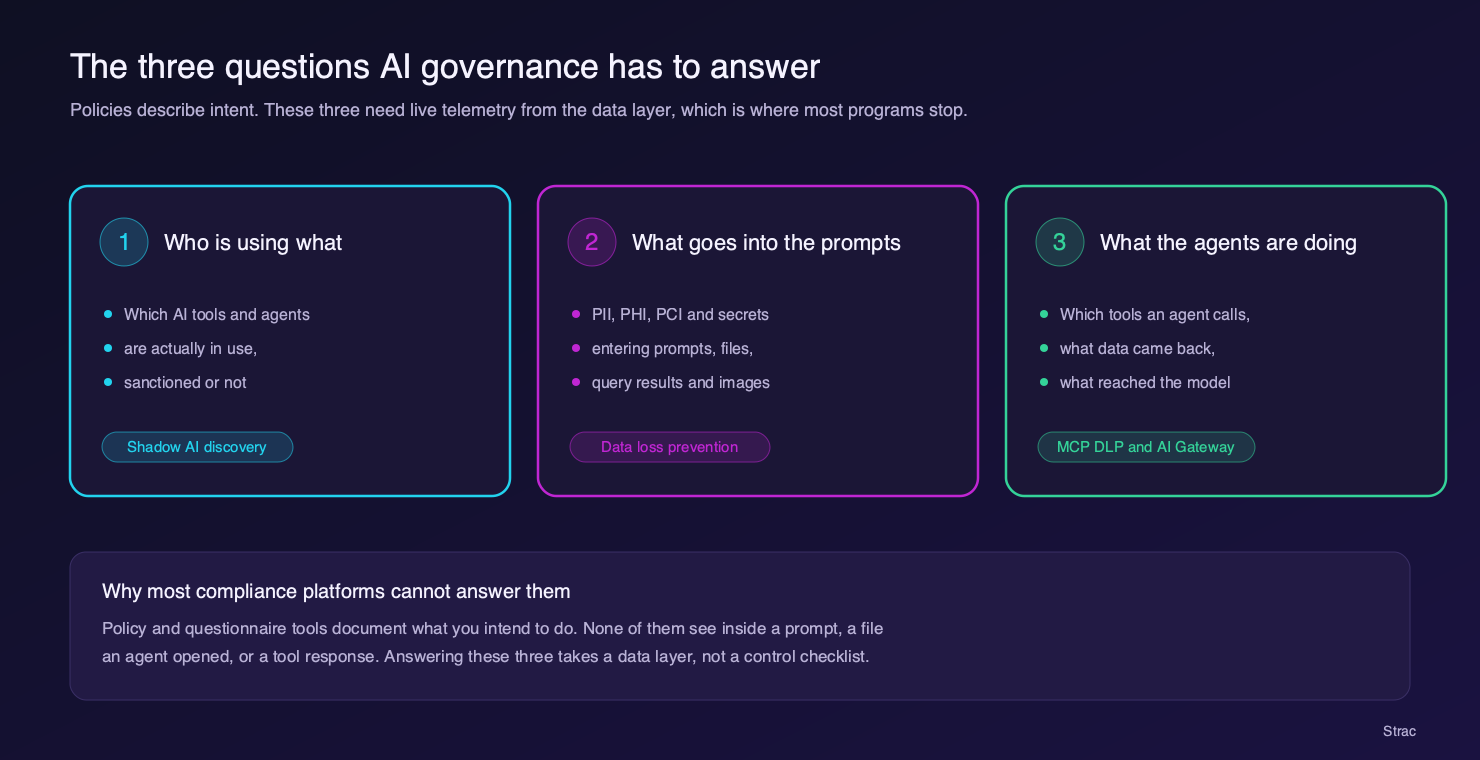
Strip away the frameworks for a moment and AI governance reduces to three questions a board, an auditor or a customer's security team will actually ask. Who is using AI here. What data is going into it. And what are the agents doing on our behalf.
Policies describe intent. These three questions need live telemetry from the data layer.
Notice what these have in common. None of them can be answered by reading a policy, filling in a questionnaire, or pulling configuration from a cloud account. Each one requires seeing inside something: a browser session, a prompt, a tool response. That is a data-layer capability, and it is the part of AI governance that compliance platforms structurally cannot reach.
✨ Layer one: who is using what AI
Every AI governance framework opens with an inventory of AI systems. The assumption behind that requirement is that you can produce one. In practice most organizations cannot, because AI adoption does not come through procurement. It arrives as a browser tab, a free tier, a desktop app, a VS Code extension, or a coding agent somebody installed on a Tuesday.
This is the shadow AI problem, and it is why network-level inventories miss most of it. Discovery has to happen where the usage happens, which means the browser and the endpoint. Strac covers both, and the output is the thing every framework asks for first: a list of the AI tools and agents actually in use, by person and by team, sanctioned or not.
The gap between that list and your approved-tools policy is usually the most useful single artifact a new AI governance program produces. It reframes the conversation from writing rules to enforcing the ones you already wrote.
✨ Layer two: what data is going into the prompts
Once you know which tools are in use, the next question is what is going into them. This is where governance becomes a data-security problem rather than a policy problem, because the risk is not that someone used an AI tool. It is that they pasted a customer record into it.
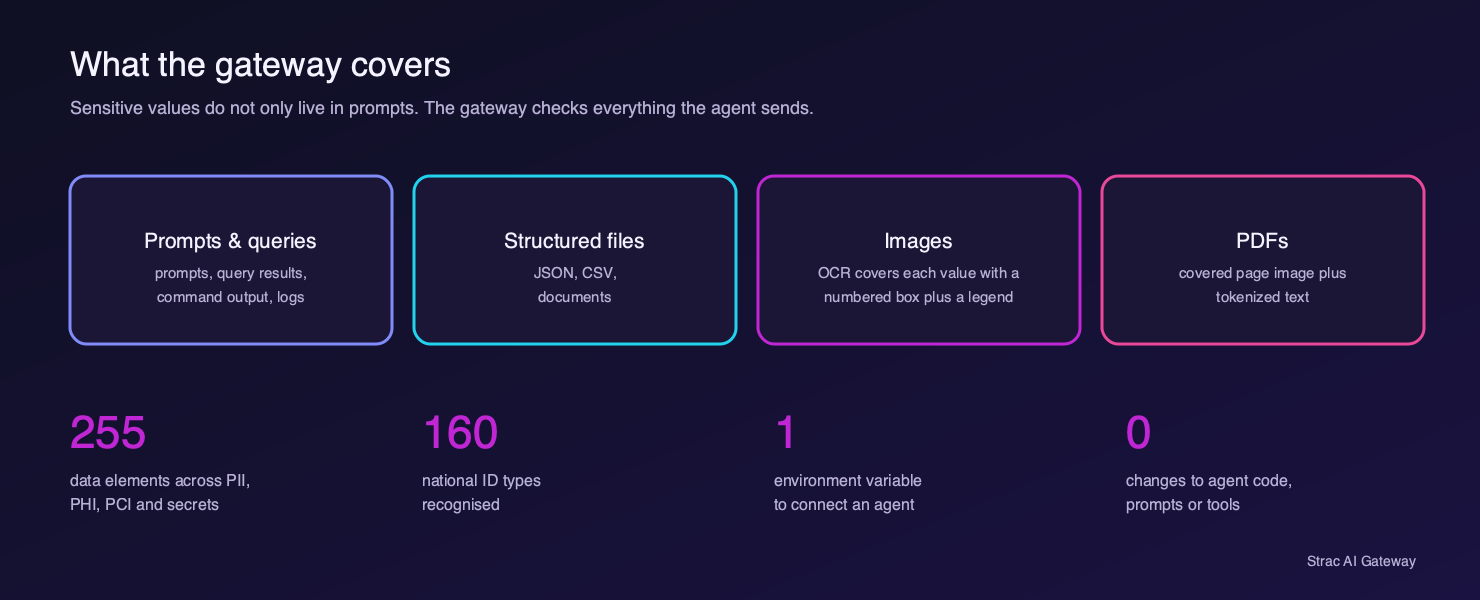
Sensitive data does not only arrive as typed prompt text. It arrives as files, query results, screenshots and scanned PDFs.
Strac's classifier covers 255 data element types across PII, PHI, PCI and secrets, including 160 national ID formats, and it inspects more than prompt text: uploaded files, query results, command output, images via OCR and PDFs. That breadth matters because the typed prompt is rarely where the worst exposure happens. It is the screenshot, the CSV export, the scanned onboarding form.
The governance output is a record of which sensitive data types were detected on the way into which AI tools, and what the policy did about it. See AI DLP for how the enforcement works.
✨ Layer three: what the agents are doing
This layer did not exist two years ago and it is now the fastest-moving risk in the category. An employee using a chat assistant leaks whatever they paste. An agent leaks whatever it decides to read, which is a far larger and less predictable surface.
Agent governance has two directions and both need controls.
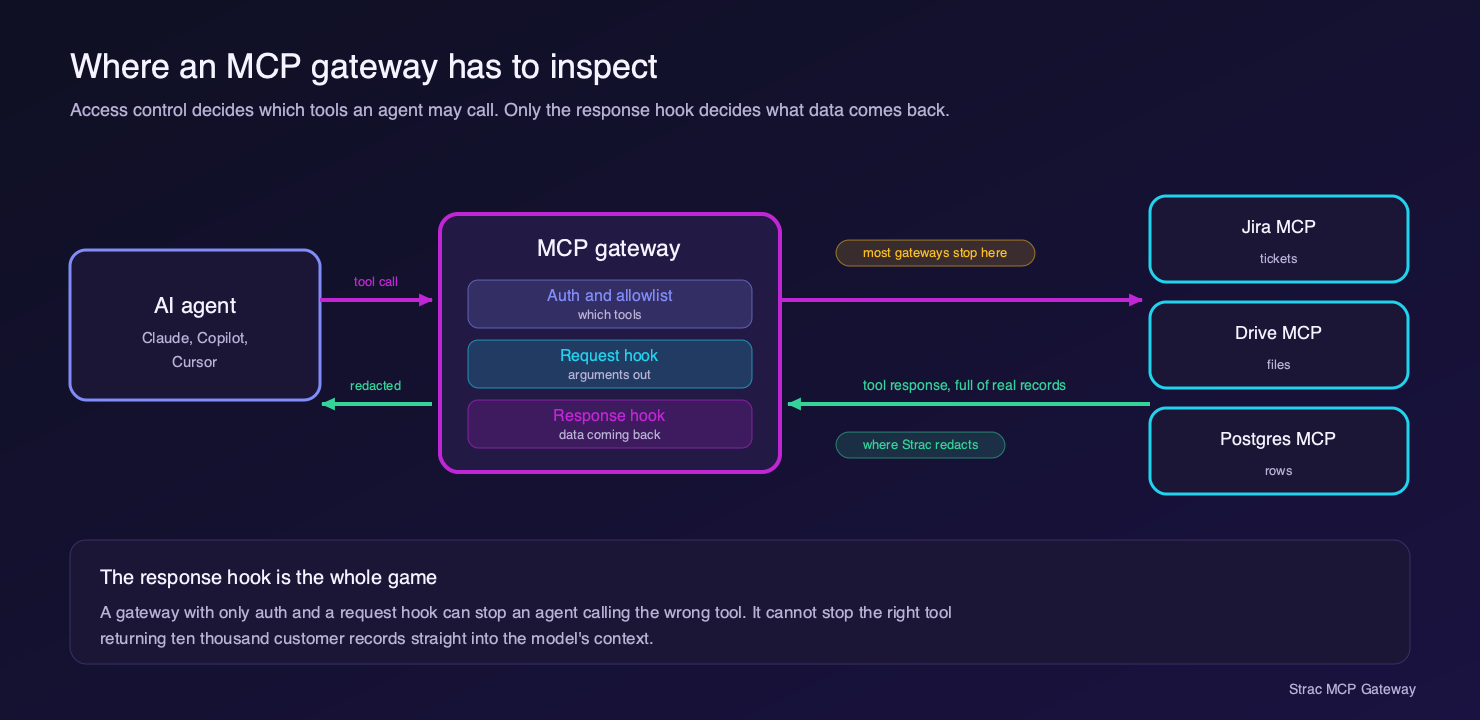
Inbound: controlling which tools an agent may call, and inspecting what the tool response hands back.
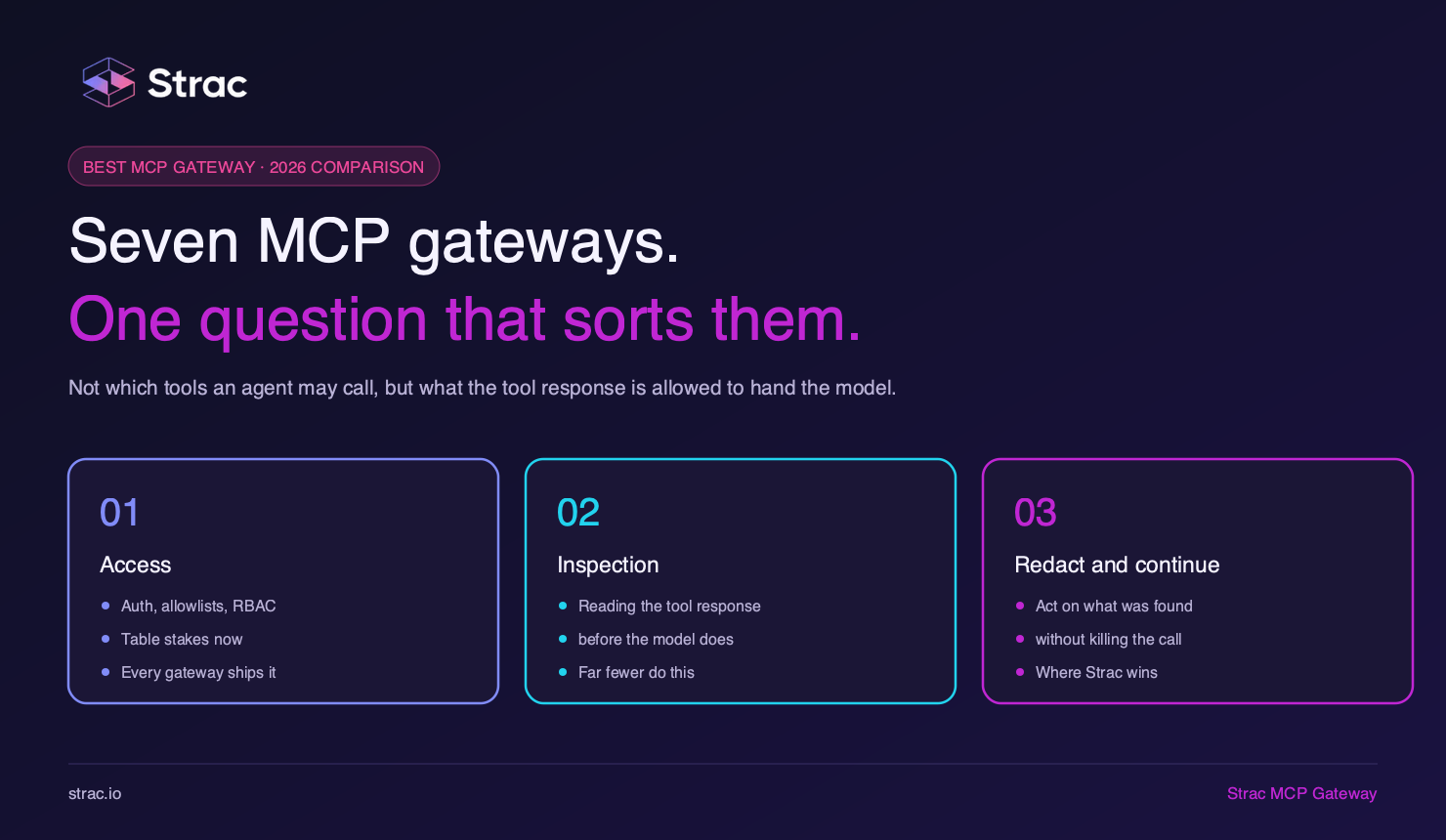
Inbound is what an agent is allowed to pull from your systems, governed through MCP DLP and an MCP gateway. Access control alone is not enough here: an agent calling an approved tool can still return ten thousand customer records in a single response.
Outbound is what reaches the model provider once the agent has that data, governed through the AI Gateway, which substitutes sensitive values for tokens before the request leaves and restores them afterwards so the agent still completes its work.
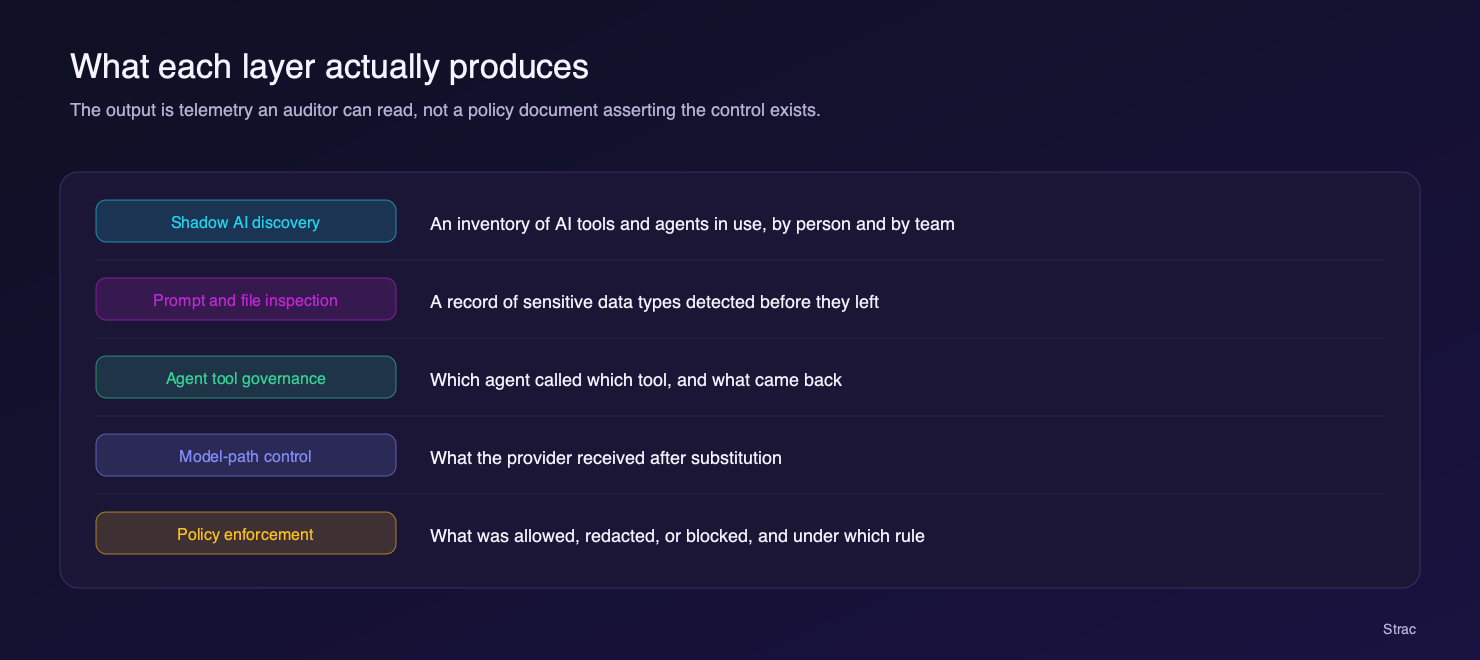
Together these produce the record an auditor will eventually ask for: which agent called which tool, what came back, what was redacted, and what the provider actually received.
✨ What each layer feeds into your compliance program
The output is telemetry your compliance program can draw on, not a replacement for it.
The output is telemetry your compliance program can draw on, so the control you mapped has an operating record behind it rather than only an assertion that it exists. Stated plainly, because the category oversells this: none of these artifacts are a compliance program on their own. They are inputs. The compliance platform states the control; the data layer shows it operated.
✨ AI governance best practices
The practices that separate programs that hold up from programs that produce a binder nobody reads.
Start from observed reality, not intent. Run discovery before writing policy, so the policy governs the environment you have.
Classify data, not tools. Tool lists churn monthly. "Can PHI enter any AI system" survives the churn and generalizes.
Put the control on the path, not in the handbook. If the only thing standing between a customer record and a chat window is a policy, there is no control.
Treat agents as a separate class. They read far more than people do and decide for themselves what to read.
Reuse your existing security program. Running AI governance as a parallel track duplicates vendor review, evidence collection and control mapping.
Assign one accountable owner. Cross-functional working group, single name on the outcome.
Instrument before you certify. A certificate backed by controls with no evidence source becomes a problem at the first surveillance audit.
Who owns AI governance?
The ownership question derails more programs than the technical one. AI governance lands across security, legal, privacy, data and the engineering teams actually shipping AI features, and when it is assigned to all of them it belongs to none.
What works in practice is a single accountable owner with a cross-functional working group, rather than a committee. In most companies under a thousand people that owner is the security leader, because the enforcement surfaces (endpoint, browser, data) already report there and the alternative is a policy function with no levers. Legal owns the obligations, privacy owns the data-subject angle, engineering owns the systems. One person owns whether the program is real.
The second structural decision is where AI governance sits relative to your existing security program. Running it as a separate parallel track duplicates vendor review, evidence collection and control mapping. Folding it into the program you already have is faster and gives you the reuse that makes it sustainable.
AI governance in regulated industries
If you handle PHI, cardholder data or financial records, two things change. The first is that the data-handling layer stops being a best practice and becomes the thing a regulator or auditor will examine directly. The second is that your customers start asking, which turns governance into a revenue question rather than a risk one.
Healthcare organizations face the sharpest version: a clinician pasting notes into a general AI tool is a disclosure, and no policy document prevents it at the moment it happens. Financial services teams tend to hit the agent problem first, because analysts adopt coding agents against production data faster than governance catches up.
The practical consequence is that discovery and ingress controls move to the front of the roadmap. You need to be able to say which AI tools touched regulated data, and prove it, before you need a certificate.
Five mistakes that stall AI governance programs
Writing policy before running discovery. You end up governing an imagined environment. Discovery first changes what the policy says.
Treating approval as a control. An approved-tools list with no enforcement is a document. The control is what happens when someone opens an unapproved tool.
Governing tools instead of data. Tool lists churn monthly; data classes do not. "Can PHI enter any AI system" survives the churn.
Running two frameworks at once. Pick the one your buyers ask for. Parallel adoption doubles the work and halves the completion rate.
Assuming the compliance platform covers it. It covers the controls and the audit trail, not the usage telemetry those controls describe. Check the evidence source before the audit.
Frameworks: NIST AI RMF, ISO 42001 and the EU AI Act
Three reference points matter for most organizations, and they do different jobs.
NIST AI RMF is voluntary and structural, organized around Govern, Map, Measure and Manage. It is the best starting scaffold because it tells you how to think rather than what to certify.
ISO 42001 is a certifiable AI management system standard, the AI analogue of ISO 27001. Choose it when customers or procurement ask for a certificate. We cover it in ISO 42001.
The EU AI Act is law rather than a standard, with obligations tiered by risk. It applies based on your market and use case, not on whether you opted in.
Whichever you adopt, the Measure and Manage functions are where programs stall, because those are the parts that need live data rather than documents. Our AI governance framework guide goes deeper on structure.
Where compliance platforms stop
Vanta, Drata and the rest of the compliance-automation category are good at what they do: control mapping, policy management, evidence collection from infrastructure, and auditor workflow. If you need SOC 2 or ISO 27001 run efficiently, they earn their place.
The limit is architectural, and it is narrowing at one edge. Both vendors have started shipping agent-scoped telemetry: Vanta inventories agents across laptops, code and vendor platforms, and Drata's AI Agent Governance, in limited availability for Anthropic agents, runs a device sensor and a policy proxy in front of agent tool calls. What neither does is inspect content. They can tell you an agent exists, who owns it and what it is permitted to reach. They cannot tell you that the file one of your analysts pasted into a browser tab carried 400 cardholder records, because they do not sit in the path of a browser session, a prompt or a file upload. Layer one and layer two are still unanswered, and layer three is answered for agent identity rather than agent payload.
In practice the mature pattern is both: a compliance platform for the framework and the auditor, and a data layer underneath producing the telemetry the AI-specific controls actually need. Strac Comply runs the first on top of the second, which is the part worth comparing.
See your own three layers. Strac Comply starts at $4,995 all in, with no sales call and a 14-day trial, and it sits alongside the same DSPM and DLP that generate the telemetry above. Book a demo or read how the compliance automation side fits together.
🎥 See the data layer
Strac discovering and protecting sensitive data across SaaS, cloud, GenAI, browser and endpoint. This is the telemetry the three AI governance layers run on.
How to start an AI governance program
A sequence that works, in the order that produces useful answers fastest.
Run discovery before you write policy. Find out which AI tools are actually in use. The gap against your assumptions sets the agenda and makes the case internally.
Classify the data, not the tools. "Is ChatGPT approved" is the wrong question. "Can customer PHI enter any AI tool" is the one that generalizes as the tool list churns.
Put controls on the ingress path. Policies are not enforcement. Inspect prompts, files and uploads where they leave.
Govern agents separately. Agent risk is not employee risk with a different interface. It needs tool-level controls on both directions.
Map to one framework and stop. Pick NIST AI RMF or ISO 42001 based on what your buyers ask for. Running two in parallel early is how programs stall.
AI governance is the set of policies, controls and evidence an organization uses to manage how AI is adopted and used: which systems are approved, what data they may process, who is accountable, and how all of that is monitored and proven over time. In practice it has two halves that are often confused. The documentation half covers policies, risk assessments and framework controls. The operational half covers what is actually happening right now, meaning which tools are in use, what data is entering them, and what agents are doing. Most programs are strong on the first half and blind on the second.
What is the difference between AI governance and AI compliance?
Compliance is conformance to a specific standard, so ISO 42001, the EU AI Act or SOC 2 as it touches AI systems. Governance is the broader operating model that compliance draws on: accountability, approved use, data handling and monitoring. You can be compliant on paper and ungoverned in practice, which is the usual failure. It shows up the first time someone asks which AI tools the company is using and nobody can produce a list.
Which AI governance framework should we use?
For most companies the practical answer is NIST AI RMF to structure the program and ISO 42001 if you need a certifiable AI management system for customers or procurement. The EU AI Act matters if you place systems on the EU market or your users are there, and it is obligation-based rather than something you certify against. Pick the one your buyers ask for, then make sure whichever you choose is backed by real telemetry rather than a document set.
How do you actually monitor AI usage across a company?
Discovery has to happen where the usage happens, which is the browser and the endpoint. People reach AI tools through a browser tab, a desktop app or a coding agent on a laptop, so network-level inventories miss most of it. Strac discovers AI usage across browser and endpoint, which is what turns an approved-tools policy into an enforceable one and gives you the inventory that every AI governance framework starts by asking for.
Can Vanta or Drata do AI governance?
They do the documentation half well: policies, control mapping, evidence collection from infrastructure and questionnaire workflow, and both now ship an AI agent registry. What they cannot do is see inside the usage. Neither inspects the contents of a prompt, a file upload or an agent's response for regulated data, which is the part the AI-specific controls actually depend on. Those answers come from DLP and discovery, which is why most mature programs end up running both.
Do we need AI governance if we only use ChatGPT and Copilot?
Yes, and that is the most common starting point. Two sanctioned tools is a governance scope, not an absence of one: you still need to know who is using them, what data is going in, whether any of it is regulated, and what your contractual retention position is. It is also rarely only two. Once you run discovery, most companies find a long tail of AI tools nobody registered, which is the gap between the policy and the reality.
What evidence does an AI governance audit actually need?
An auditor wants to see that the control exists, operates, and has operated consistently. For AI that usually means an inventory of AI systems in use, a record of what data classes they process, proof that sensitive data is controlled on the way in, approval records for high-risk uses, and logs showing the controls fired. The inventory and the data-handling records are where most programs come up short, because those require inspecting real traffic rather than describing intent.
Customer story
“Don’t just alert on problems, fix them.”
Scott Roberts, Chief Information Security Officer, UiPath
AI governance is the set of policies, controls and evidence an organization uses to manage how AI is adopted and used: which systems are approved, what data they may process, who is accountable, and how all of that is monitored and proven over time. In practice it has two halves that are often confused. The documentation half covers policies, risk assessments and framework controls. The operational half covers what is actually happening right now, meaning which tools are in use, what data is entering them, and what agents are doing. Most programs are strong on the first half and blind on the second.
What is the difference between AI governance and AI compliance?
Compliance is conformance to a specific standard, so ISO 42001, the EU AI Act or SOC 2 as it touches AI systems. Governance is the broader operating model that compliance draws on: accountability, approved use, data handling and monitoring. You can be compliant on paper and ungoverned in practice, which is the usual failure. It shows up the first time someone asks which AI tools the company is using and nobody can produce a list.
Which AI governance framework should we use?
For most companies the practical answer is NIST AI RMF to structure the program and ISO 42001 if you need a certifiable AI management system for customers or procurement. The EU AI Act matters if you place systems on the EU market or your users are there, and it is obligation-based rather than something you certify against. Pick the one your buyers ask for, then make sure whichever you choose is backed by real telemetry rather than a document set.
How do you actually monitor AI usage across a company?
Discovery has to happen where the usage happens, which is the browser and the endpoint. People reach AI tools through a browser tab, a desktop app or a coding agent on a laptop, so network-level inventories miss most of it. Strac discovers AI usage across browser and endpoint, which is what turns an approved-tools policy into an enforceable one and gives you the inventory that every AI governance framework starts by asking for.
Can Vanta or Drata do AI governance?
They do the documentation half well: policies, control mapping, evidence collection from infrastructure and questionnaire workflow, and both now ship an AI agent registry. What they cannot do is see inside the usage. Neither inspects the contents of a prompt, a file upload or an agent's response for regulated data, which is the part the AI-specific controls actually depend on. Those answers come from DLP and discovery, which is why most mature programs end up running both.
Discover & Protect Data on SaaS, AI, MCP, Endpoints & Cloud
Strac provides end-to-end data loss prevention for all SaaS and Cloud apps. Integrate in under 10 minutes and experience the benefits of live DLP scanning, live redaction, and a fortified SaaS environment.