Generative AI DLP in 2026: Browser, Endpoint, SaaS & MCP Data Loss Prevention
Generative AI DLP prevents sensitive data leaks across ChatGPT, Claude, Gemini, Copilot, MCP servers, and agents. Framework, implementation, and evaluation guide for 2026.
AI DLP is required because generative AI breaks legacy data security models. Prompts, context, and outputs are unstructured, real-time, and continuously transformed, making traditional DLP ineffective.
Traditional DLP cannot protect AI workflows. Regex-based rules, static inspection points, and post-event enforcement fail once data enters LLMs, copilots, or AI-powered SaaS tools.
AI DLP prevents leaks at the moment of risk. It inspects prompts and outputs inline, applies context-aware policies, and remediates sensitive data before exposure occurs.
Effective AI DLP combines visibility, enforcement, and remediation. Detection alone is not protection; real security requires blocking, redacting, or governing data flows in real time.
AI DLP enables safe AI adoption, not AI restriction. Organizations that deploy AI-native, SaaS-native DLP can scale GenAI usage confidently while protecting PII, PHI, IP, and regulated data.
Last updated: July 2026
For teams standardizing on Claude, Strac integrates with the Claude Compliance API to monitor and remediate sensitive data across Claude Enterprise usage — AI DLP applied right at the model layer.
AI DLP (AI data loss prevention) is a class of data loss prevention built for generative-AI workflows. It inspects prompts, chat messages, file uploads, and model responses in real time, then blocks, warns, redacts, or removes sensitive data before it reaches or leaves an AI system — coverage that file- and network-based DLP cannot provide.
What it protects: PII, PHI, PCI, secrets and API keys, and source code moving through ChatGPT, Copilot, internal LLMs, and AI agents.
Where it enforces: the browser, the endpoint, SaaS apps, and the MCP layer that connects AI agents to enterprise data.
How it remediates: inline block, warn, redact, delete, or revoke access — not just alert and log.
Generative AI is already inside everyday enterprise workflows. ChatGPT, copilots, and internal models now sit directly in systems that handle customer data, source code, financial records, and internal context. Once data enters an AI workflow, traditional DLP loses visibility and control.
This guide is the deep-dive companion to Strac's Generative AI DLP product page. If you are evaluating Gen AI DLP vendors, start there for the capability matrix and demo; come back here for the framework, architecture, and how-to-implement detail.
AI breaks the assumptions legacy DLP was built on:
prompts are unstructured
context windows aggregate data dynamically
outputs can transform or regenerate sensitive information
If your DLP only understands files, emails, or endpoints, it cannot secure AI usage.
GenAI DLP (generative AI data loss prevention) is data loss prevention built for AI tools — it stops sensitive data like PII, PHI, PCI, secrets, and source code from leaking into ChatGPT, Claude, Copilot, and internal LLMs. Strac delivers GenAI DLP across three layers traditional DLP cannot see: the browser (prompts and pastes), the endpoint (desktop AI apps), and MCP (the connectors AI agents use to reach your data) — redacting or blocking sensitive data in real time before it reaches the model.
AI DLP is best understood as data loss prevention purpose-built for LLM-driven workflows, not a simple extension of legacy controls. At its core, AI DLP governs how data moves into and out of generative AI systems by inspecting prompts, chat messages, uploads, and model-generated responses in real time. Unlike traditional approaches that focus on files or network traffic, what AI DLP is really about is controlling language, context, and intent; the fundamental units of data movement in large language models. This category is also written as GenAI DLP, Gen AI DLP, or generative AI DLP — all describing the same controls for data flowing through AI tools.
In practice, remediation in AI DLP means the ability to block, warn, redact, delete sensitive data, or remove permissions inline before data reaches or leaves an AI system.
This distinction is critical. In LLM DLP and generative AI DLP, sensitive information does not only exist as static records or attachments. It appears inside free-form text, conversational context, embeddings, and AI outputs that may summarize or transform the original data. Effective prompt DLP must therefore analyze both structured and unstructured data inline and apply enforcement before information ever reaches the model or leaves it.
Key points that define AI DLP in practice:
Scope; prompts, chats, uploads, and outputs. AI DLP covers everything that flows through an LLM interaction, including user prompts, pasted text, uploaded files, API-connected data, and AI-generated responses.
Detection across structured and unstructured data. It must accurately identify PII, PHI, PCI, secrets, credentials, and intellectual property embedded in natural language, not just in files or databases.
Real-time enforcement, not alerts. True AI DLP performs inline remediation; blocking, warning, or redacting sensitive content before submission or response; and produces audit logs for governance and compliance.
The definition of AI DLP must be operational, not theoretical. If a solution cannot see prompts in real time and cannot enforce controls before data is submitted to or returned from an LLM, it is not AI DLP in practice; it is simply legacy DLP watching from the sidelines.
AI DLP Capabilities at a Glance
Effective AI DLP is judged less on detection alone and more on whether it can act, inline, across every surface where employees and AI agents touch sensitive data. The table below maps the capabilities that define the category to how Strac delivers each one.
Capability
What AI DLP must do
How Strac delivers it
Prompt & response inspection
Read prompts, uploads, and model outputs in real time, not just files at rest
Inspects text and files in the browser, endpoint, SaaS, and MCP calls as they happen
Sensitive data detection
Identify PII, PHI, PCI, secrets, API keys, and source code inside free-form language
Pre-built and custom detectors with OCR for images, screenshots, and documents
Inline remediation
Block, warn, redact, delete, or revoke access before data leaves — not alert-only
Redact-and-continue, block, warn, or remove permissions inline at the point of use
Surface coverage
Enforce across browser, endpoint, SaaS, and the MCP agent layer
One policy engine spanning all four surfaces, including 40+ MCP connectors
Shadow AI discovery
Find unsanctioned AI tools and agents employees already use
Discovers AI tools in use and applies policy without blocking productivity
Audit & compliance evidence
Produce a defensible record of every sensitive-data event for SOC 2, HIPAA, GDPR
Immutable logs and reports that double as compliance evidence
Why Traditional DLP Breaks in AI Workflows
Traditional DLP was built for fixed boundaries; email, files, endpoints, known network paths. AI workflows do not use those boundaries.
Most AI usage happens in the browser. Users copy text, paste context, upload snippets, and interact with models using free-form language. None of this reliably passes through legacy DLP control points.
This is why traditional DLP vs AI DLP is no longer theoretical. It fails in production.
Where traditional DLP breaks:
Browser-based prompts; copy/paste never hits gateways
Unstructured language; prompts and outputs defeat pattern rules
Data transformation; AI rewrites, summarizes, regenerates sensitive info
Context aggregation; multiple sources combined into one prompt
Noise at scale; false positives spike, controls get turned off
Spicy take; when DLP gets noisy, enterprises don’t tune it. They bypass it.
Traditional DLP vs. Generative AI DLP at a glance
The table below summarizes why traditional DLP cannot cover Generative AI workflows, and what a Generative AI DLP control plane has to do differently.
Capability
Traditional DLP
Generative AI DLP (Strac)
Inspect prompts in real time
No — only files/email
Yes — every prompt before it reaches the LLM/model
Yes — every AI vendor with Drive/Slack/GitHub access
Framework evidence (SOC 2, EU AI Act Art.10, HIPAA, GDPR)
Manual mapping
Auto-mapped per finding
Deployment
Agents, weeks-months
Agentless, under 10 minutes
Why Generative AI DLP Is Critical Now
AI DLP is no longer forward-looking. Employees use AI every day for legitimate work; writing emails, debugging code, summarizing tickets, analyzing customer data. Most AI data leakage is accidental and happens fast.
Where risk shows up in practice:
Prompts and uploads create continuous data-in-motion paths
Browser-based AI bypasses email and network DLP
Once data enters a model, legacy controls are blind
Context windows and outputs act as exfil paths
If data protection cannot operate inline with AI interactions, it cannot reduce AI risk.
No inline inspection → no prevention
No context awareness → no accuracy
No enforcement → no trust
That is why AI DLP exists. Anything else is visibility without control.
The New AI Data Leak Vectors AI DLP Must Cover
AI DLP only works if it reflects how data actually leaks in production GenAI workflows. Most organizations underestimate exposure because they think in terms of prompts alone. In reality, AI creates multiple parallel data leak paths.
If you cannot map where leakage happens, you cannot enforce controls where it matters. Discovery without inline enforcement does not reduce risk.
Where AI data leakage happens in practice:
Prompt and clipboard exfiltration Employees copy and paste customer data, logs, source code, and internal context directly into ChatGPT or Gemini. This is data-in-motion, not a file transfer. Without inline prompt inspection, this path is completely ungoverned.
File uploads CSV exports, contracts, screenshots, and PDFs are uploaded into GenAI tools for analysis and summarization. If uploads are not inspected and remediated inline, AI DLP coverage is incomplete by design.
AI connectors and tool integrations GenAI tools pull data directly from SaaS systems; CRMs, ticketing tools, cloud drives, internal databases. These automated paths move sensitive data into models without manual copy-paste. If connectors are not governed, leakage scales silently.
Output leakage AI-generated responses can reproduce, transform, or infer sensitive information. Summaries expose regulated fields. Generated code leaks secrets. Masked inputs do not guarantee safe outputs.
Spicy take; most AI DLP failures happen after “prompt coverage” is declared complete.
The Requirement
AI DLP must enforce controls across inputs, uploads, integrations, and outputs in one system.
No prompt enforcement → blind spot
No upload enforcement → guaranteed gap
No output inspection → false confidence
If remediation does not happen inline, AI DLP becomes observation, not protection.
Governance and Compliance Reality
Regulators do not distinguish between data leaked by email or by AI prompt. If sensitive data enters a model without controls, it is a compliance failure.
What auditors expect to see:
visibility into AI usage
real-time enforcement on prompts and uploads
logs showing what was blocked, redacted, or allowed
Shadow AI makes this unavoidable. Teams adopt new AI tools faster than governance can approve them. AI DLP focuses on controlling data inside AI tools, not pretending AI can be blocked entirely.
🎥 Browser DLP for Generative AI
The browser is where 80% of generative AI data leaks happen. An employee opens a new ChatGPT tab, pastes a customer support ticket containing names, emails, and credit card numbers, and hits enter. The data is gone — into the model's context, often into training data, and almost always out of your compliance perimeter. Traditional DLP doesn't see this because the data never touches an email gateway, an endpoint file, or a SaaS API. It moves directly from clipboard to LLM.
Real-time prompt inspection. Scan every paste, every prompt, and every file drop into AI tabs before the user clicks submit
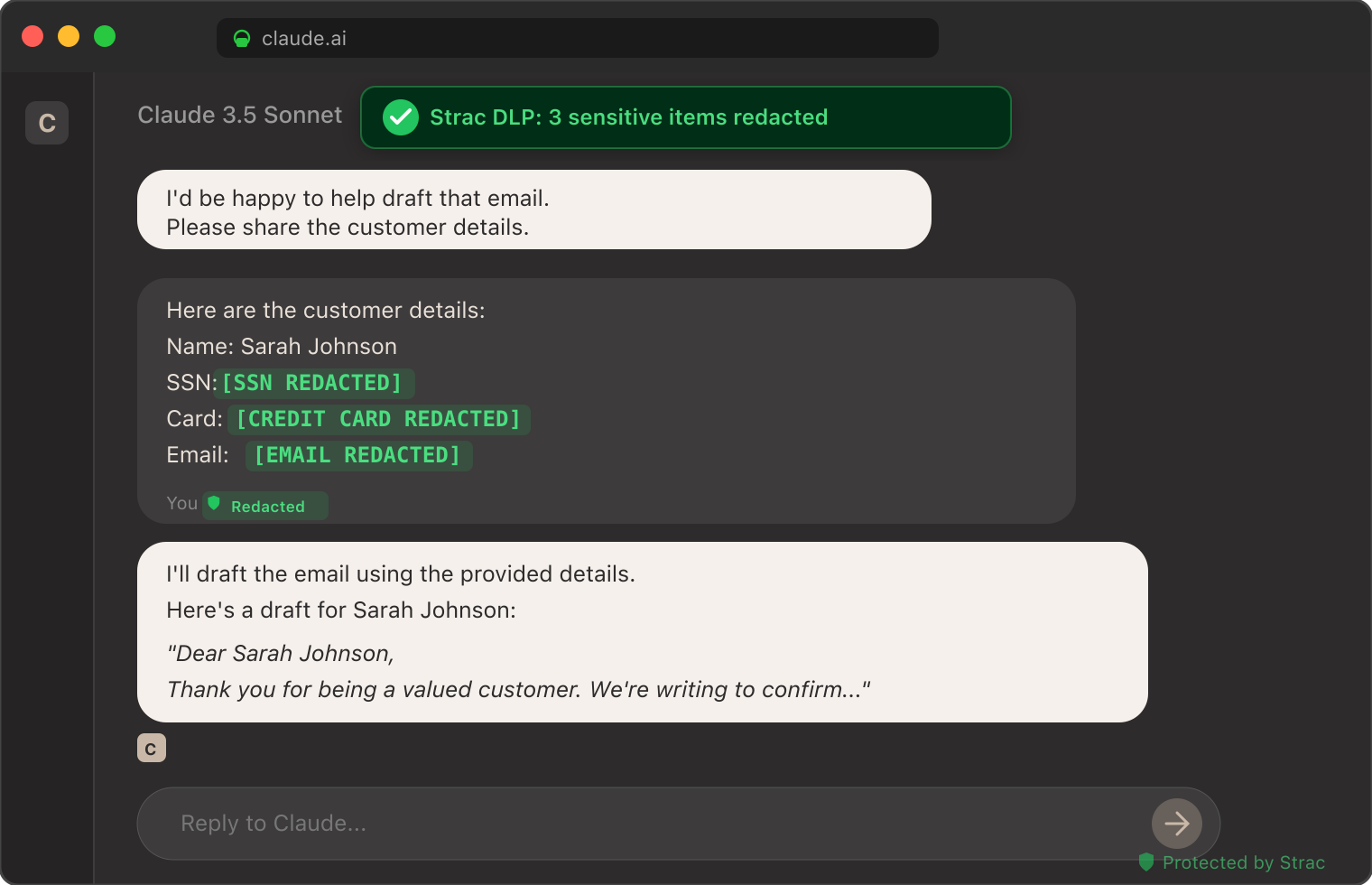
Inline redaction. Replace sensitive values with safe placeholders ([REDACTED-SSN], [REDACTED-API-KEY]) so the user can still get useful AI output without leaking the underlying data
Image OCR. Catch sensitive data inside screenshots — most AI DLP tools miss this entirely. Strac is the only DLP that detects PII, PCI, and PHI inside JPEG, PNG, and PDF uploads to ChatGPT and Claude
Coverage across every AI tab. ChatGPT, Claude, Gemini, Perplexity, Microsoft Copilot, custom GPTs, and any new AI tool that launches tomorrow — without writing new rules for each
No proxy, no TLS interception. A Chrome, Edge, Firefox, and Safari extension that deploys in minutes, not a network rewrite
Strac Browser GenAI DLP
▎ The Samsung lesson: In 2023, Samsung engineers pasted proprietary source code into ChatGPT three times in 20 days, leaking confidential semiconductor IP into a public model. Browser DLP would have caught all three incidents at the paste boundary. Samsung's response was to ban ChatGPT entirely — exactly the "Doctor No" outcome that kills AI productivity. Browser DLP lets you say yes to AI without saying yes to data leaks.
Browser DLP is necessary but not sufficient. The fastest-growing class of AI tools is desktop-native: ChatGPT desktop, Claude desktop, Cursor, Windsurf, GitHub Copilot, Ollama, LM Studio. Browser extensions can't see any of them. An employee can drag a confidential PDF straight into Claude desktop and your browser DLP has zero visibility.
Strac Endpoint Data Lineage
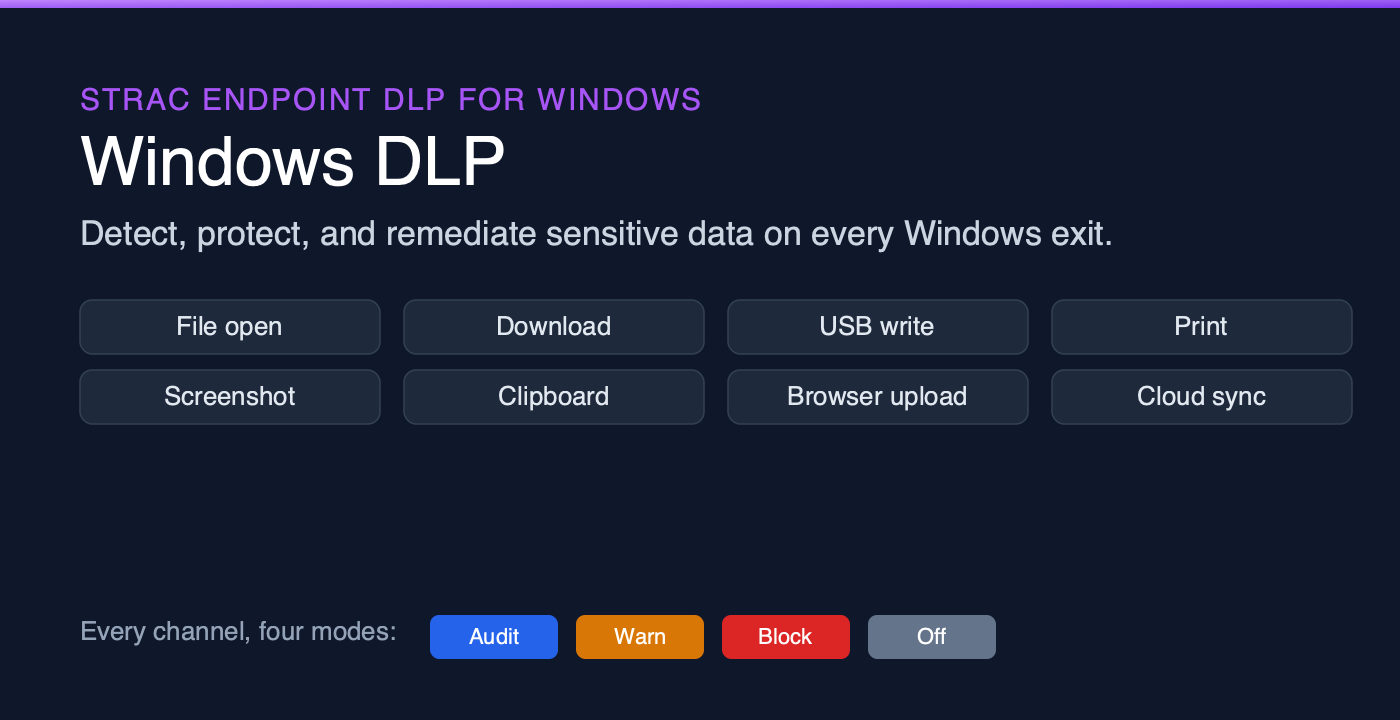
This is where endpoint DLP for AI matters. A lightweight Mac and Windows agent watches the file system and clipboard at the OS level, intercepting sensitive data before it reaches any AI client — browser-based or native.
What AI DLP must enforce on the endpoint:
Desktop AI app coverage. Detect data flowing into ChatGPT desktop, Claude desktop, Cursor, Windsurf, and any other native AI client
File-level monitoring. Catch drag-and-drop uploads of sensitive PDFs, spreadsheets, and images before they're sent to an AI app
Clipboard inspection. OS-level paste detection that works regardless of which app is the destination
Local LLM protection. Even on-device models (Ollama, LM Studio, Llama.cpp) need DLP — local doesn't mean safe if a developer is feeding production customer data into a fine-tuning loop
Lightweight agent. Sub-50MB footprint, no kernel modules, no impact on developer productivity
The endpoint surface is especially critical for engineering and data science teams. Cursor and Windsurf are now standard developer tools, and they routinely send entire codebases to Claude and GPT-4 as context. Endpoint DLP is the only way to enforce what code those tools are allowed to send.
Model Context Protocol (MCP) is the newest — and most underestimated — AI data leak vector. MCP lets AI agents autonomously connect to your databases, source code repositories, file shares, and internal APIs. Once an agent has an MCP connection, it can read customer records, query Postgres, pull secrets from a config file, and write that data into a chat response — all without a human clicking anything. Legacy DLP, CASB, and proxy controls have zero visibility into this traffic because it's machine-to-machine inside a developer's own environment.
The risk is concrete: a Claude desktop user with an MCP server connected to a customer support database can ask "summarize the top 10 escalations this week" and have full PII flowing through the model context. A Cursor MCP integration with a production database can leak schema, secrets, and live customer rows into an AI prompt. Most security teams don't even know which MCP servers exist inside their org.
What AI DLP must enforce for MCP and AI agents:
MCP server discovery. Agentless scanning of GitHub repos and developer environments to find every MCP server employees have configured — sanctioned or shadow
Sensitive data classification on MCP endpoints. Identify which MCP servers expose PII, PCI, PHI, secrets, or proprietary code
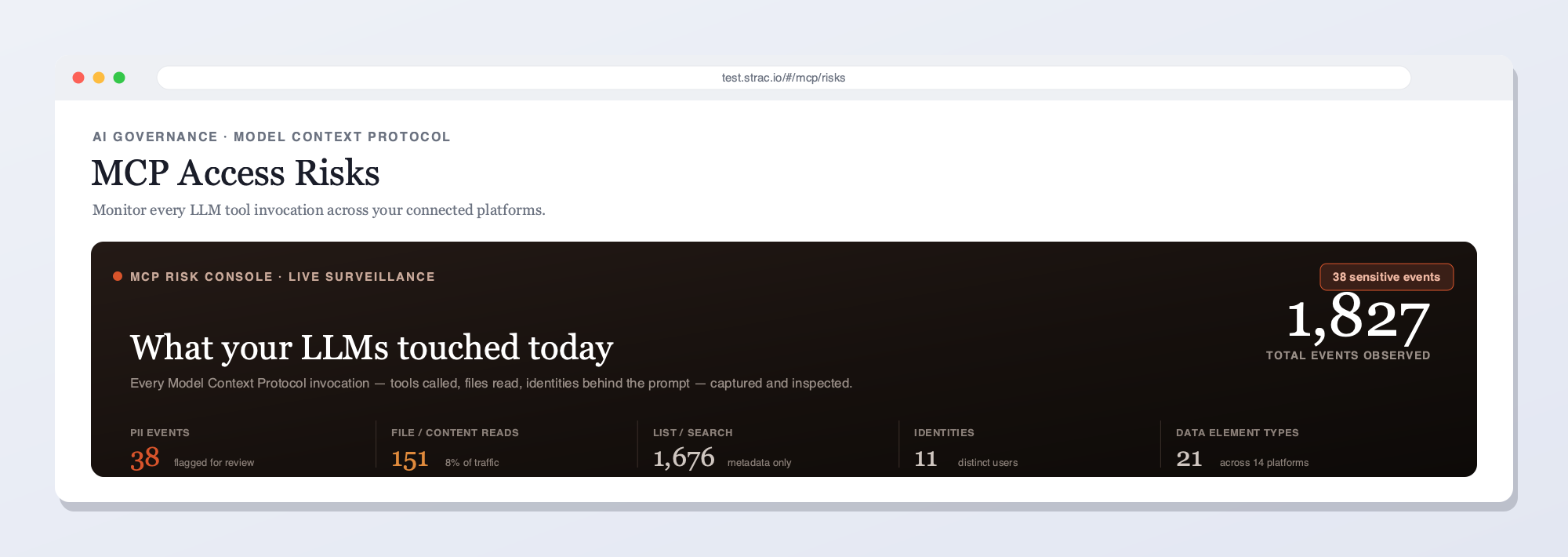
Agent tool-call monitoring. Audit which tools agents are calling, which data they're returning, and whether the data ever crosses out of the trust boundary
Cross-reference with your data map. Tie MCP exposures back to a DSPM view of where sensitive data lives, so a single Postgres MCP connector instantly shows up as a high-risk surface
No proxy required. MCP traffic terminates inside developer environments — proxy-based controls fail. Agentless discovery + endpoint hooks are the only model that scales
Strac MCP DLP
▎ The MCP timing matters. MCP went from zero to standard in under twelve months. Most enterprise security teams haven't built any controls for it yet — and the agentic AI wave coming behind it (AutoGPT-style autonomous agents, multi-step tool use) will multiply the risk by an order of magnitude. The orgs that get MCP DLP in place in 2026 will be the ones that don't make headlines in 2027.
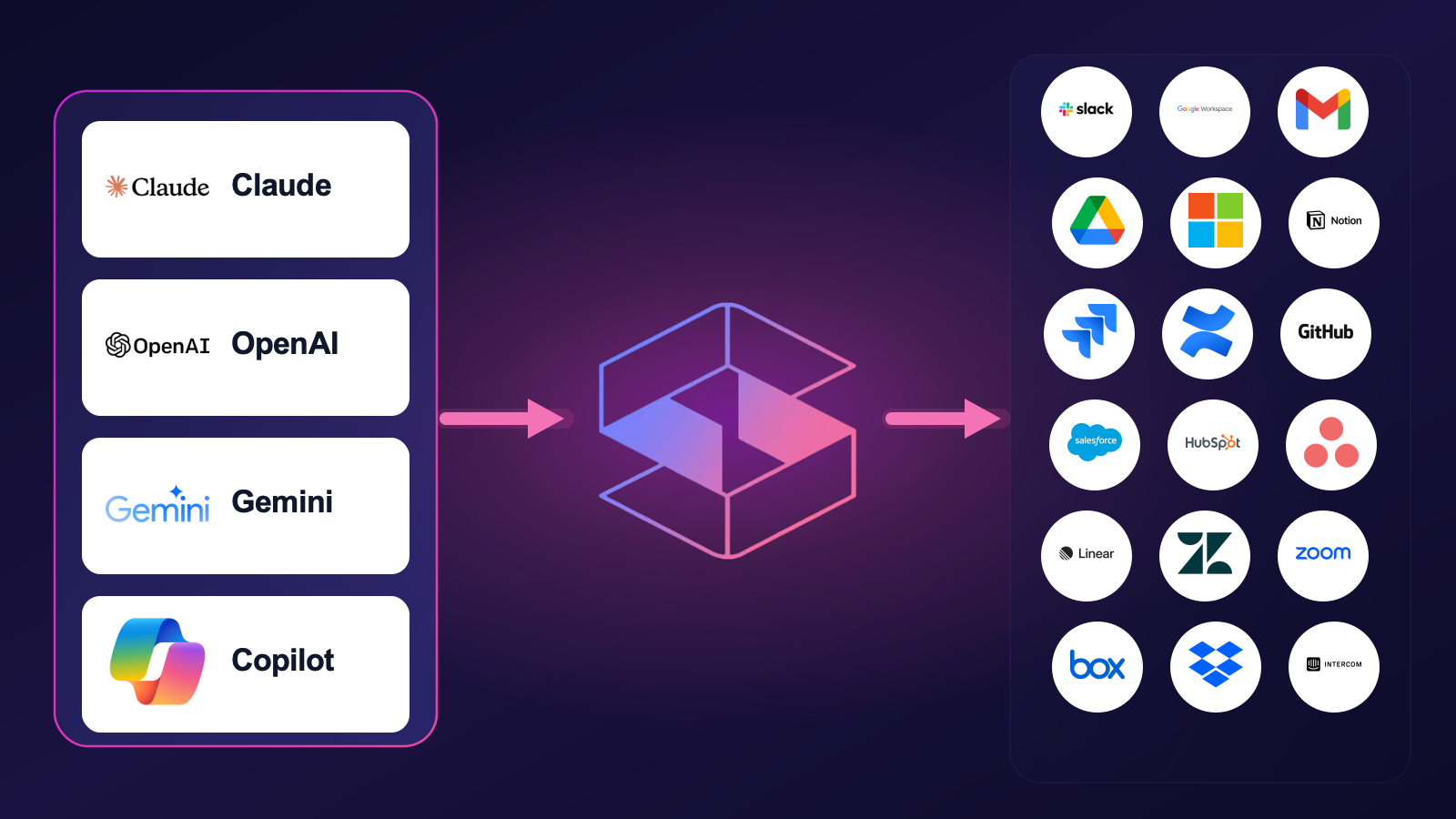
Strac has shipped MCP DLP integrations for the SaaS apps your AI agents actually touch — Slack, Gmail, Google Drive, Google Workspace, Microsoft 365, Notion, Jira, Confluence, GitHub, Salesforce, HubSpot, Asana, Linear, and Zendesk. Each one wraps the official MCP server with Strac’s redaction engine: PII, PHI, PCI, secrets, and source code get masked before they ever reach the model context.
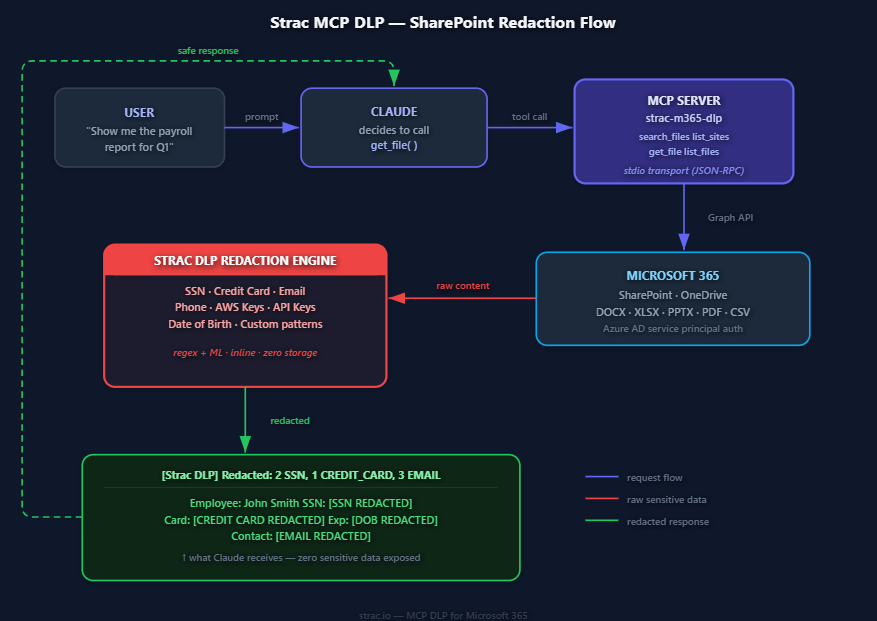
Strac redacts PII, PHI, PCI, secrets, and source code in the tool-call response — before Claude's context window sees it
The 2026 truth about AI DLP: the most consequential leaks no longer happen at the browser tab where a human pastes a customer record into ChatGPT. They happen quietly, at machine speed, when an AI agent calls a Model Context Protocol (MCP) tool that returns ten years of accumulated PII from a Salesforce custom field, a Slack thread, a Notion page, a Confluence runbook, a Jira ticket, a Drive shared drive, or a Box diligence folder. None of that traffic crosses a traditional DLP choke point.
Strac has shipped this layer as MCP DLP across the SaaS apps where AI agents actually live: Slack, Google Workspace, Gmail, Drive, Microsoft 365, Notion, Jira, Confluence, GitHub, Salesforce, HubSpot, Asana, Linear, Zendesk, Zoom, Box, Dropbox, and Intercom. Each integration wraps the official MCP server and inspects every tool-call response before the AI agent writes it into context. The detection runs on text bodies, custom fields, image attachments (OCR), and structured field values. The remediation is configurable per data class: redact in place, mask, tombstone, quarantine, or vault with RBAC re-identification.
The vendor-BAA picture matters most for healthcare orgs. ChatGPT Enterprise, Microsoft 365 Copilot, and Gemini for Workspace all have BAA-eligible paths and Strac complements them. The outlier is Claude Cowork — the desktop product most knowledge workers actually open — which Anthropic does not currently cover under a BAA. A clinical analyst using Cowork against EHR-derived data via MCP places PHI in a non-BAA processing surface. Strac's redaction at the tool-call boundary closes that gap independent of vendor BAA status. The full comparison is in Is Claude HIPAA compliant?
MCP DLP for every SaaS surface AI agents reach. The same tool-call inspection applies to each connected MCP server. Deep-dive guides — with the specific tool calls, real exfiltration risks, and deployment steps — live in the MCP DLP pillar and per-platform:
AI Agent DLP vs. Prompt DLP: Two Paths, Two Controls
AI agent DLP is data loss prevention for the way agents move data — not the way people do. It’s worth separating from prompt-level AI DLP, because sensitive data now leaks on two very different paths, and each is caught in a different place:
Path
Who moves the data
How it leaks
Where DLP has to sit
Human path
A person
Pastes or uploads PII, PHI, or secrets into a chat like ChatGPT or Claude
Browser + endpoint — before the text is submitted
Agent path
An autonomous agent
Pulls records and writes them into context through MCP tool calls, no human clicking anything
The MCP tool-call layer — request and response legs
Prompt DLP covers the human path; AI agent DLP covers the agent path. You need both, because an agent acts at machine speed with standing credentials, and its traffic never appears in a browser tab, an email gateway, or a network proxy. That’s why network, CASB, and legacy endpoint DLP are structurally blind to it — and why MCP DLP exists as its own control.
The Four Risks Unique to AI Agent DLP
Agents introduce failure modes a chat window never had. A complete AI agent DLP program has to answer all four:
Risk
What happens
Deep dive
Confused deputy
The agent calls a system with one shared service account, so a user reaches data their own permissions would never allow
None of these are caught by redaction alone — they need identity, discovery, and drift detection working together. That is the difference between “we redact AI prompts” and a real AI agent DLP layer.
✨ How Strac Delivers AI Agent DLP
Strac protects the agent path with five controls that run at the MCP layer, in present-tense production today:
Control
What it does
Redact on tool calls
Detects and redacts, masks, tokenizes, or blocks PII, PHI, PCI, and secrets on both the request and response legs of every tools/call
Per-user identity
Passes each user’s identity through so the downstream system enforces its own permissions — no shared god-mode account
Server discovery + allow/deny
Reads MCP client configs on the endpoint to inventory every server and block unapproved, typosquatted, or drifted ones
Tool-result inspection
Scans returning tool results for injected instructions before the model acts on them
Audit ledger
Logs every invocation by user, tool, resource, and data class — evidence for SOC 2, HIPAA, and GDPR
Each control maps to one of the four risks above: identity stops the confused deputy, inspection stops indirect injection, discovery stops shadow MCP and rug pulls, and redaction protects the data that legitimately flows. Enforcement runs in block, warn, or audit mode per data type, so you can stage rollout from monitoring to hard-block. Watch it live in monitor AI agents.
Strac’s AI agent DLP: every MCP server and agent tool call inventoried, redacted, and logged — the agent path legacy DLP can’t see.
How to Implement AI DLP Step by Step (ChatGPT, GenAI, Gemini)
AI DLP implementation works best when it is treated as a phased rollout plan, not a one-time policy project. The fastest way to fail with AI DLP is to start with aggressive blocking before you understand where sensitive data is actually flowing across ChatGPT, GenAI tools, and Gemini usage. The goal is to move from policy on paper to enforcement in the prompt path, with measurable coverage, reduced noise, and audit-ready logs that prove governance is real.
Discover AI usage and sensitive data flows. Identify which GenAI tools are being used, which domains are accessed, which teams and users drive usage, and the most common prompt patterns that may contain regulated data or IP.
Define classification scope. Establish what AI DLP must detect in your environment; typically PII, PHI, PCI, credentials and secrets, source code, and internal documents; and align that scope to your compliance obligations and internal risk thresholds.
Start with “warn” mode to tune policies. Launch in warning-only mode to validate detection quality, understand false positives, and refine rules based on real user behavior before you introduce hard enforcement.
Move to inline enforcement before submission. Implement prompt-path controls that can block or redact sensitive content in real time so regulated data cannot be pasted into ChatGPT or Gemini in the first place.
Add output inspection where applicable. Inspect model responses and generated artifacts when feasible, because outputs can echo or transform sensitive content; apply redaction, blocking, or escalation when responses violate policy.
Integrate alerts into SIEM/SOAR and define escalation paths. Route high-severity events to your existing security workflows, set ownership by incident type, and define what triggers human review versus automated remediation.
Operationalize with dashboards and a monthly review cadence. Track coverage, top violation types, repeat offenders, high-risk apps, and policy drift; then update policies and training as GenAI usage evolves.
Done this way, AI DLP is implementable in phases and improves over time. You can start with visibility and warnings, then progress to targeted enforcement without derailing productivity.
AI DLP for ChatGPT: What to Enforce
AI DLP for ChatGPT must be grounded in how people actually use the tool day to day. Most risk does not come from exotic API integrations; it comes from simple copy and paste, iterative prompt refinement, and document uploads for summarization, debugging, or analysis. Effective AI DLP focuses on these high-frequency workflows and enforces controls directly in the prompt path, while producing interaction-level audits that compliance teams can rely on and security teams can tune over time.
Strac GhatGPT AI DLP solution
Prompt inspection and sensitive data detection
The foundation of AI DLP for ChatGPT is real-time prompt inspection. Every prompt and pasted text block should be analyzed for sensitive content before submission, including PII, PHI, PCI, credentials, secrets, source code, and internal documents. This detection must work on unstructured language, not just patterns, because prompts often mix natural language with data fragments. If prompt content cannot be inspected inline, ai dlp coverage collapses at the most critical control point.
Inline remediation and interaction auditing
Detection alone does not stop leakage. AI DLP must support inline remediation actions such as block, warn, or redact before sensitive data reaches ChatGPT. At the same time, every decision should be logged; who submitted what, which policy triggered, what action was taken, and when. These interaction audits are essential for investigations, compliance reviews, and proving that ai data loss prevention controls are enforced consistently.
Policy examples that balance risk and productivity
AI DLP policies for ChatGPT should combine data categories with behavior patterns. Common examples include blocking prompts that contain raw PII or secrets, allowing masked email addresses, warning users when internal documents are pasted, and redacting sensitive fields while letting the rest of the prompt through. This flexibility is what keeps controls effective without breaking productivity.
The success metric for AI DLP in ChatGPT is simple and measurable. Sensitive data should be blocked or redacted before it ever reaches ChatGPT, not detected after the fact.
AI DLP for Gemini: What Changes and What Stays the Same
At the control layer, AI DLP for Gemini looks familiar. The same principles apply; inspect prompts, govern uploads, enforce inline, and log everything. What changes is how users share data. Gemini usage is deeply tied to Google ecosystem workflows, including Sheets, CSV exports, screenshots, and documents pulled from Drive. This means AI DLP must account for both conversational prompts and rich file-based inputs without relying solely on storage-level scanning.
Slack Redaction: Detect and Redacr sensitive messages and files
Real-time detection for prompts and uploads
Gemini DLP must inspect prompt text and uploaded files in real time. Users frequently paste tables from Sheets, upload CSVs for analysis, or attach screenshots and PDFs. AI DLP needs to classify structured and unstructured content inline and apply policy before the data is processed by the model.
Remediation modes; audit, warn, and block
As with ChatGPT, Gemini controls should start with audit and warn modes to tune policies, then progress to blocking or redaction for high-risk data. These remediation modes must be configurable by data type, user group, and use case to avoid unnecessary friction.
Logs and SIEM or SOAR integrations
Gemini interactions must generate the same level of evidence as any other regulated workflow. AI DLP should produce detailed logs and integrate with SIEM or SOAR systems so security teams can correlate AI events with broader incident response and compliance reporting.
The key differentiator to understand is this. Workspace-only DLP that scans files at rest is not enough for Gemini. Gemini requires prompt-path controls that operate inline, at the browser or interaction layer, because that is where sensitive data actually moves.
How to Evaluate an AI DLP Solution
Evaluating AI DLP is not about feature depth; it is about whether the tool survives real daily AI usage. If it cannot enforce controls inline, stay accurate at scale, and fit into existing security operations, it will be ignored or turned off.
What an AI DLP solution must prove:
Prompt, upload, and output coverage Prompts, pasted text, file uploads, and AI-generated responses must all be inspected and controlled. Partial coverage creates predictable gaps.
Inline enforcement Block, warn, or redact actions must occur before data reaches the model or before outputs are returned. Post-event alerts do not reduce risk.
Low-noise accuracy on unstructured data Conversational language and transformed content must be understood without driving false positives that kill adoption.
Centralized policy control Policies should be defined once and enforced consistently across ChatGPT, Gemini, and other GenAI tools.
Audit-ready evidence Logs must clearly show what data was submitted, what policy applied, and what action was taken.
Operational integration Events must flow into SIEM and SOAR so ownership, triage, and response are part of normal operations.
Fast deployment, low overhead Heavy agents, long rollout cycles, or complex tuning increase the likelihood the project stalls.
Spicy take; if an AI DLP tool can’t enforce inline on day one, it won’t be enforcing six months later either.
🎥 Strac and AI DLP: A Unified Protection
AI DLP buyers are no longer looking for isolated controls bolted onto individual chatbots. They need a single control plane that governs how sensitive data moves across ChatGPT,Gemini,Claude, and other GenAI tools, without fragmenting policy management or operational visibility. Just as importantly, AI DLP must move beyond alerting. In production environments, teams need real-time enforcement and remediation that stop leaks as they happen, while producing evidence that stands up in audits. This is where a unified, enforcement-first approach becomes essential.
Strac approaches AI DLP as an end-to-end control layer that operates inline across GenAI workflows, rather than as a collection of point solutions. The focus is on consistent policy enforcement, real-time inspection, and audit-ready outcomes across tools and teams.
ChatGPT DLP; configurable protection and interaction audits. Strac enforces AI DLP directly in the ChatGPT prompt path, inspecting pasted text, prompts, and uploads in real time. Policies can block, warn, or redact sensitive content before submission, while detailed interaction audits record who submitted what, which policy applied, and what action was taken.
Generative AI DLP; discover → classify → redact → monitor. Strac follows a practical rollout model for generative AI DLP. Teams start with discovery of AI usage and sensitive data flows, apply classification across structured and unstructured content, enforce inline redaction or blocking, and continuously monitor activity through dashboards and logs. This makes AI DLP operational rather than theoretical.
Gemini DLP; real-time detection, remediation, and integrations. For Gemini, Strac applies the same policy framework to prompts and file uploads common in Google-centric workflows such as Sheets, CSVs, screenshots, and PDFs. Controls operate at the browser and interaction layer, not just storage, and all events integrate with SIEM and SOAR systems for escalation and compliance reporting.
The outcome is clear and measurable. AI DLP with Strac enables teams to adopt AI confidently, stops regulated data from leaking in real time, and produces the audit evidence security and compliance programs require; without slowing down how people actually work.
Bottom Line
AI DLP is quickly becoming the minimum viable control set for any enterprise adopting GenAI at scale. Prompts, uploads, and AI-generated outputs are no longer edge cases; they are now mainstream data exfiltration paths woven into everyday work. Treating AI risk as an extension of legacy DLP leaves organizations exposed precisely where sensitive data moves fastest and with the least friction.
The winning approach to AI DLP is not policy-only. It is visibility plus inline enforcement plus auditability. Security teams must be able to see how AI tools are used, enforce controls in real time before data reaches ChatGPT or Gemini, and produce clear evidence that policies were applied consistently. Without all three, AI governance collapses under real-world pressure.
The test is simple. If an AI DLP solution cannot inspect prompts, uploads, and outputs and remediate risk before sensitive data is submitted or returned, it will not meaningfully reduce exposure; and it will not hold up in compliance or audit reviews.
Strac inspects and redacts PII, PHI, and secrets in every prompt before it reaches ChatGPT, Claude, Gemini, or any MCP tool — across browser, SaaS, and endpoint. Watch it run on your own data.
Strac's AI DLP isn't tied to one model or one app — it works with every major MCP client through the same set of remote connectors that front your connected SaaS (Slack, Google Drive, GitHub, Salesforce, and more). Whichever AI tool your team reaches for, detection and the who-accessed-what audit log stay on, and your configured enforcement policy (redact, mask, block, or alert) travels with the data.
Does Strac's AI DLP Work With Claude (Claude.ai, Claude Code & Cowork)?
Yes. Strac's AI DLP works with Claude as a remote custom connector, so the same protection applies whether someone is in Claude.ai on the web, Claude Desktop, Claude Code, or Cowork — and across all plans, since Anthropic's connectors run from its cloud. When an engineer asks Claude Code to pull a customer record from Salesforce or a contractor asks Cowork to summarize a Google Drive folder, every prompt and tool response is scanned before it reaches the model, and Strac applies your configured policy (redact, mask, block, or alert) on any SSNs, API keys, or PHI it finds. The detection layer and the audit trail of who accessed what are always on, so you can prove exactly which Claude surface touched which sensitive field. See how the connector model works in our MCP DLP writeup.
Does Strac's AI DLP Work With OpenAI ChatGPT & Codex?
Yes — with one nuance worth stating plainly. ChatGPT speaks MCP through Developer Mode, currently a beta for Plus, Pro, Business, and Enterprise rather than the default consumer experience, and Strac's AI DLP registers there as a connector so a GPT pulling a GitHub pull request or a Slack thread runs through the same inspection path. On the developer side, Codex connects over stdio or streaming HTTP from both the CLI and the IDE, which means code-completion sessions reaching into your repos or ticketing data get the identical treatment. In both surfaces, Strac always logs the access and applies your configured action — redact, mask, block, or alert — instead of letting an account number or secret flow back into the context window. Our AI DLP overview covers the policy model in depth.
Does Strac's AI DLP Work With Google Gemini?
Yes, and the fit is strongest where Gemini is actually used as an agent. Both the Gemini CLI and Google's agent and enterprise platform act as MCP clients, so a developer running Gemini CLI against a Drive export or an enterprise agent querying a BigQuery-backed customer table connects to Strac as a registered connector rather than reaching your data raw. Whatever it requests, Strac inspects in flight and applies your chosen enforcement — mask the PII, block the call, or alert your security team — while recording the access for later review. The consumer Gemini app is less of an MCP surface today, so we frame this around the CLI, agent, and enterprise contexts where it genuinely lands. More on the threat model in our MCP security post.
Does Strac's AI DLP Work With Microsoft Copilot?
Yes. Microsoft Copilot consumes MCP servers through Copilot Studio and GitHub Copilot, with enterprise allowlist governance built in, and Strac's AI DLP slots in as one of those approved servers. A Copilot Studio agent pulling a Salesforce opportunity or a GitHub Copilot session reaching into a private repo passes through Strac first, where your configured policy (redact, mask, block, or alert) is applied to any credentials, PII, or source secrets — and the admin allowlist means security decides which connectors are even reachable. Detection and the access log never switch off, so every Copilot retrieval is attributable. The connector mechanics carry over from what we describe in MCP DLP.
Does Strac's AI DLP Work With Perplexity & Other MCP Clients?
Yes, with honest scope. Perplexity added custom MCP connectors for Pro, Max, and Enterprise in March 2026, so Strac's AI DLP works as a client-side connector when a researcher points Perplexity at your connected SaaS — though we won't oversell it, since Perplexity has signaled it's stepping back from MCP in its own backend. The same Strac connector also works across other MCP clients your team may run, including Cursor, Windsurf, Cline, and Grok, so a coding agent in Cursor or a query in Cline hits the same inspection and audit path. Regardless of which client makes the call, Strac keeps detection and the who-accessed-what log always on and applies your configured action — redact, mask, block, or alert — before sensitive data lands in the answer. See our AI DLP post for the full picture.
GenAI DLP is one surface a modern data security platform has to cover — alongside SaaS, cloud, and endpoint.
For the large-language-model angle specifically, see our guide to LLM data security.
Best DLP for AI Agents
Strac is the best DLP software for AI agents because agent traffic doesn't look like user traffic: agents pull data server-to-server through MCP connectors, assemble prompts programmatically, and act at machine speed. Strac inspects every agent tool call at the MCP gateway layer, redacts PII, PHI, PCI, and secrets in both directions, blocks risky writes, and logs each call as audit evidence — protection that network and endpoint DLP structurally cannot see. For prompt-level protection in the browser, the same policies run in Strac's browser DLP.
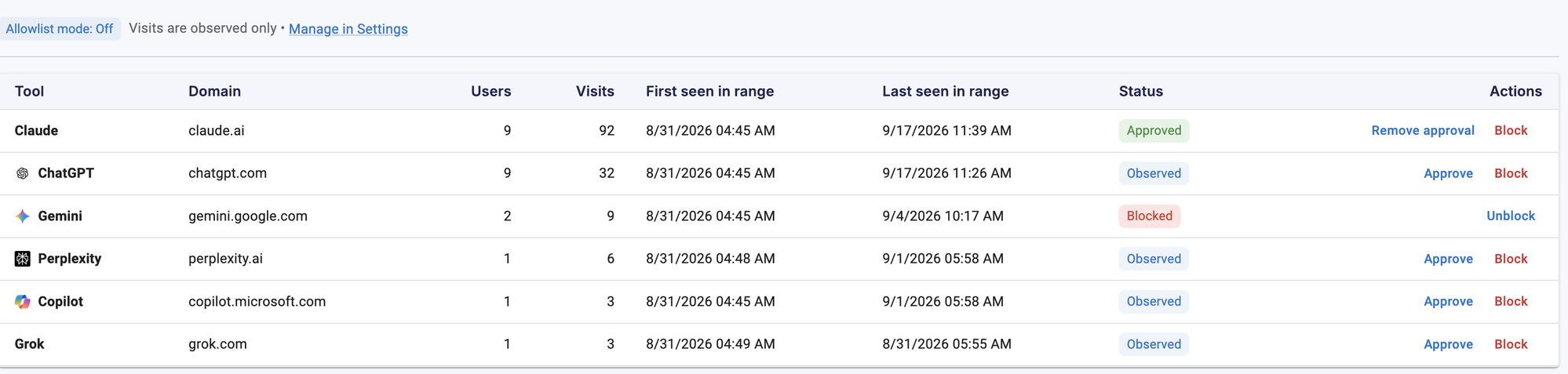
AI DLP is more than redaction; it is knowing which AI tools are in play. Strac's Shadow AI discovery and AI data governance surface every GenAI app employees reach and let you observe, approve, or block each one. See Shadow AI and AI data governance.
Strac AI data governance: Claude approved, Gemini blocked, governed per tool and per user
AI DLP, or AI data loss prevention, is a set of controls designed to prevent sensitive data from being exposed through generative AI systems. It governs how data enters and exits AI workflows by inspecting prompts, contextual memory, and model outputs in real time. Unlike legacy approaches, AI DLP is built for unstructured, conversational data and enforces protection before information is consumed by or emitted from AI models.
How is AI DLP different from traditional DLP?
The difference between traditional DLP vs AI DLP comes down to context, timing, and data structure. Traditional DLP focuses on static objects such as files, emails, and databases, using deterministic rules and regex patterns. AI DLP operates inline within AI interactions, evaluates semantic meaning and intent, and enforces controls in real time. This makes it effective in environments where data is dynamic, unstructured, and continuously transformed.
Can AI DLP prevent leaks in ChatGPT and copilots?
Yes, AI DLP can prevent data leaks in tools like ChatGPT and enterprise copilots when it is integrated inline with those workflows. Effective AI DLP can:
Inspect prompts before they are sent to an AI model
Redact or block sensitive data in real time
Inspect and sanitize AI-generated outputs before they are shared or stored
This approach prevents sensitive information from being exposed rather than simply detecting it after the fact.
Does AI DLP help with GDPR or HIPAA compliance?
AI DLP supports GDPR and HIPAA compliance by enforcing controls on how regulated data is handled inside AI workflows. While regulations do not mandate specific AI DLP tools, they require organizations to prevent unauthorized disclosure of personal and health data. AI DLP provides the visibility, enforcement, remediation, and audit evidence needed to demonstrate that sensitive data is protected when AI systems are used.
How long does it take to deploy AI DLP?
Deployment time depends on architecture and integration depth, but modern AI DLP platforms are designed for rapid rollout. Many SaaS-native AI DLP solutions can be deployed in days rather than months by integrating directly with existing SaaS and GenAI tools. Faster deployment is critical, as AI adoption often outpaces traditional security implementation timelines.
How is Generative AI DLP different from a secure AI gateway or proxy?
A gateway sits between the user and the model and inspects API traffic. That works for sanctioned, API-routed usage (a fine-tuned internal LLM, a vendor integration) but misses the dominant 2026 leak path: an employee pasting customer data into ChatGPT in their browser, or uploading a contract to Claude. Generative AI DLP has to operate at the data layer — the browser, the endpoint, the SaaS app, the email — not just at the network layer. A gateway is a useful complement, not a substitute.
Do ChatGPT Enterprise, Copilot for M365, and Gemini for Workspace already include DLP?
They include partial controls — tenant isolation, training opt-outs, data residency commitments, and some prompt logging. None of them inspect or redact the regulated data inside the prompt before it leaves the user's device, and none cover the other AI tools the same employee will paste into ten minutes later. Enterprise tiers are necessary; they are not a Generative AI DLP program on their own.
What about MCP servers and AI agents — does Generative AI DLP cover those?
It has to. MCP servers and AI agents act on data on behalf of users — reading files, calling APIs, writing back. A Generative AI DLP program in 2026 inventories MCP servers, scopes their permissions, logs every tool invocation with the data accessed, and decommissions them when employees leave. Generative AI DLP that stops at the chat box is already out of date.
Will deploying Generative AI DLP slow down employees?
If the policy is configured as block-everything, yes. The pattern that works is warn-then-redact: regulated data is silently redacted before it reaches the model, the prompt still goes through, the user gets a non-blocking notification. Employees keep working; the regulated data never leaves. Most enterprises see redactions on roughly 2–5% of prompts within the first month and outright blocks on under 0.5%.
How does Generative AI DLP map to SOC 2, HIPAA, EU AI Act, and GDPR?
Generative AI DLP produces evidence for SOC 2 CC6.6 (unauthorized data exposure) and CC6.7 (restricted transmission to external systems), HIPAA's minimum-necessary standard and accounting-of-disclosures, EU AI Act Article 10 (data governance and quality), and GDPR Articles 5, 25, and 35. The same control — an inspected, logged, redacted prompt — generates evidence for all four. See our AI Data Governance framework for the full mapping.
AI DLP, or AI data loss prevention, is a set of controls designed to prevent sensitive data from being exposed through generative AI systems. It governs how data enters and exits AI workflows by inspecting prompts, contextual memory, and model outputs in real time. Unlike legacy approaches, AI DLP is built for unstructured, conversational data and enforces protection before information is consumed by or emitted from AI models.
How is AI DLP different from traditional DLP?
The difference between traditional DLP vs AI DLP comes down to context, timing, and data structure. Traditional DLP focuses on static objects such as files, emails, and databases, using deterministic rules and regex patterns. AI DLP operates inline within AI interactions, evaluates semantic meaning and intent, and enforces controls in real time. This makes it effective in environments where data is dynamic, unstructured, and continuously transformed.
Can AI DLP prevent leaks in ChatGPT and copilots?
Yes, AI DLP can prevent data leaks in tools like ChatGPT and enterprise copilots when it is integrated inline with those workflows. Effective AI DLP can:
Does AI DLP help with GDPR or HIPAA compliance?
AI DLP supports GDPR and HIPAA compliance by enforcing controls on how regulated data is handled inside AI workflows. While regulations do not mandate specific AI DLP tools, they require organizations to prevent unauthorized disclosure of personal and health data. AI DLP provides the visibility, enforcement, remediation, and audit evidence needed to demonstrate that sensitive data is protected when AI systems are used.
How long does it take to deploy AI DLP?
Deployment time depends on architecture and integration depth, but modern AI DLP platforms are designed for rapid rollout. Many SaaS-native AI DLP solutions can be deployed in days rather than months by integrating directly with existing SaaS and GenAI tools. Faster deployment is critical, as AI adoption often outpaces traditional security implementation timelines.
Discover & Protect Data on SaaS, AI, MCP, Endpoints & Cloud
Strac provides end-to-end data loss prevention for all SaaS and Cloud apps. Integrate in under 10 minutes and experience the benefits of live DLP scanning, live redaction, and a fortified SaaS environment.


.webp)





.avif)




.gif)
