October 1, 2026

7
min read
Data Loss Prevention Server Solutions
Data loss prevention server solutions find and fix sensitive data on file servers, databases, and cloud storage. See how Strac protects every server in 2026.

Data loss prevention server solutions find and fix sensitive data on file servers, databases, and cloud storage. See how Strac protects every server in 2026.

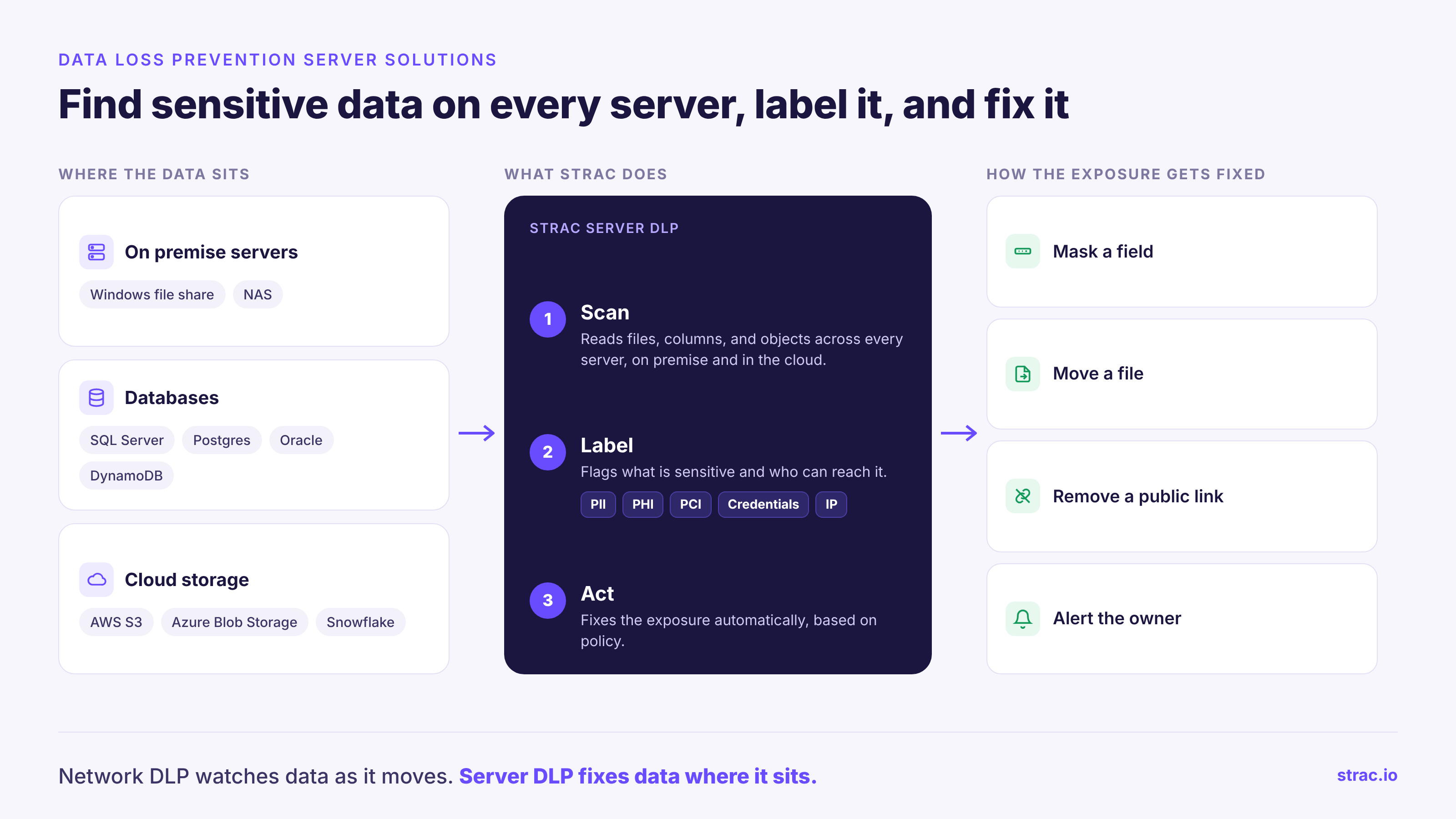
Data loss prevention server solutions are tools that scan the data stored on your servers, label what is sensitive, and act on it. The scan looks for PII, PHI, PCI data, credentials, and intellectual property. The action is masking a field, moving a file, removing a public link, or alerting the owner.
"Server" covers more ground in 2026 than it used to. It includes the classic Windows file share and NAS in the office, databases such as SQL Server, Postgres, and Oracle, and cloud stores such as AWS S3, Azure Blob Storage, DynamoDB, and Snowflake.
Network DLP watches data as it moves. Server DLP fixes data where it sits.
Every other system eventually writes to a server. Support tickets get exported to a share. Payment data lands in a database table. Application logs capture full request bodies, including emails and card numbers. Backups copy all of it again.
Three things make this data risky.
It is old. Files from a project that ended five years ago still hold customer exports. Nobody owns them, so nobody deletes them.
It is over-shared. Shares get opened to "Everyone" to fix a problem once and are never closed. S3 buckets get a public policy for a demo. Service accounts get read access to every table.
It is read by more systems than ever. Reporting tools, data pipelines, and now AI agents connect to the same databases. Every new reader is a new way for records to leave.
The data does not need to move to be at risk. It only needs to be reachable.
Traditional server DLP was designed for one building and one network. It runs from an on premise appliance, crawls file shares on a slow schedule, and reports matches in a separate console from your other controls.
That model leaves four gaps.
Cloud storage. Data now lives in S3, Azure Blob, Snowflake, and managed databases. An appliance in the data center cannot see them.
Structured data. Many older tools read files well but treat a database as a black box. Sensitive columns in a production table go unflagged.
Remediation. Finding 40,000 files with Social Security numbers is not the same as fixing them. Without automated masking or access cleanup, the report becomes a backlog.
AI access. An AI agent connected over MCP can query a database and send the results to a model in seconds. Server DLP that only scans at rest never sees that read. This is the same reason why legacy DLP fails for AI: the control watches storage, and the data leaves through a channel it was never built to inspect.
A server DLP solution earns its place by doing six things well.
A finance team keeps a share called "Q-Reports" on an old Windows server. It is open to every employee. Inside are exports with bank account numbers and tax IDs. The same exports were also copied to an S3 bucket for a reporting job.
Strac scans both. It flags the files, shows that the share is open to the whole company and the bucket has a public read policy, and ranks them as the top risk. The security team applies one policy: restrict the share to the finance group, remove public access on the bucket, and mask account numbers in the reporting copy. The reporting job keeps running on masked data. Nobody had to open 3,000 files by hand.
Strac is a DLP, Data Discovery, and DSPM platform that protects data on servers, in SaaS, in the cloud, in the browser, in GenAI tools, on endpoints, and inside AI agents, with one console and one set of policies.
DSPM for cloud servers. DSPM scans AWS and Azure storage and databases, including AWS S3, Azure Blob Storage, DynamoDB, and Snowflake. It shows what sensitive data sits where, who can reach it, and which exposures to fix first.
On premise servers. Data discovery on premise scans Windows file shares, NAS, and local databases. Teams that need data to stay inside their own network can run DLP on premise, so content is inspected without leaving the environment.
Databases and logs. Strac classifies sensitive columns in SQL Server, Postgres, and Oracle, and masks them for analytics and test copies. Logs DLP and CloudWatch coverage redact PII and secrets that applications write into log lines.
Data lineage. Data lineage fingerprints files from servers and storage such as SharePoint, OneDrive, Box, and Egnyte. A renamed or edited copy of a sensitive file is still recognized when someone tries to upload it to personal storage or an AI tool.
MCP DLP for agents that read your servers. MCP DLP inspects every query and result an AI agent passes through MCP and redacts sensitive fields before they reach the model. An agent with database access gets masked records, not raw ones.
Endpoint, browser, and AI DLP. When data leaves the server for a laptop, Strac's endpoint DLP agent for Windows, macOS, and Linux controls USB, printing, clipboard, and uploads. The browser extension and AI DLP redact the same data from prompts to ChatGPT, Claude, Gemini, and Copilot.
Detection and API. Detectors for PII, PHI, PCI, secrets, and source code come from Strac's catalog of sensitive data elements, with custom detectors for your own formats. Developers can call the same detection and redaction through the Strac API.
[PRODUCT SCREENSHOT · Strac console listing sensitive findings across a file share, an S3 bucket, and a Postgres table, ranked by exposure]Three server types, one list, ranked by who can reach the data. That is where a fix starts.
Remediation follows the same order on every server:
Servers hold the largest and oldest store of sensitive data in most companies, and more systems read from them every year. Access controls, network rules, and perimeter tools each fail at some point. The data layer is what still protects you: find the sensitive data, mask what does not need to be raw, and close what should never have been open.
They overlap. Server DLP focuses on finding and fixing sensitive data on servers. DSPM adds posture: who can reach the data, how it is configured, and what to fix first across cloud and SaaS. Strac does both in one platform.
Because most server data no longer lives on premise. S3, Azure Blob, Snowflake, and managed databases sit outside the data center, and AI agents query them directly. Strac scans on premise and cloud servers and inspects agent access too.
No. Strac scans through APIs and read replicas where possible, runs on a schedule you set, and does incremental scans after the first pass. Masking for analytics and test copies leaves the production database untouched.
Not perfectly. Custom formats and free-text fields will always produce some misses. That is why the data layer matters: Strac also inspects data when it moves to SaaS, browsers, endpoints, and AI agents, so a missed file still gets caught on the way out.
It protects data at rest. Pair it with network, endpoint, SaaS, and AI controls that protect data in motion and in use. See types of DLP and data exfiltration prevention for the full picture.
“Don’t just alert on problems, fix them.”
Scott Roberts, Chief Information Security Officer, UiPath









Customers include