September 24, 2026

5
min read
Top Data Classification Products
Data classification products find and label sensitive data. Compare the 5 categories and top tools of 2026, and see how Strac pairs DLP and DSPM to act on it.
Data classification products are software that discovers where data lives, inspects its content and context, and assigns a sensitivity label such as public, internal, confidential or restricted.
The label is only the midpoint. A classification product earns its budget when that label drives something: a redaction in a Slack DLP policy, a revoked external share in Google Drive DLP, a retention rule, or an audit report for HIPAA or PCI DSS.
Classification is also distinct from discovery. Discovery answers where sensitive data is; classification answers what it is and how much it matters. The difference is covered in depth in data discovery vs data classification, and the labeling mechanics are in data classification and tagging.
Most "top data classification products" lists written in 2024 and 2025 mixed three unrelated markets: security classification, data quality, and marketing analytics. An ETL tool that tags columns for a dashboard and a security platform that finds a passport scan in a Zendesk ticket are not the same product.
Three shifts make the difference obvious in 2026.
Data stopped sitting still. A customer export lands in Google Drive, gets shared into Slack, attached to a Zendesk ticket, and summarized in a browser AI tool, all inside a minute. Classification on a crawl schedule sees yesterday.
Generative AI became a data store. Prompts, uploads and chat histories in ChatGPT, Copilot, Gemini and Claude now hold regulated data. Shadow AI tools arrive without procurement, which means without classification coverage.
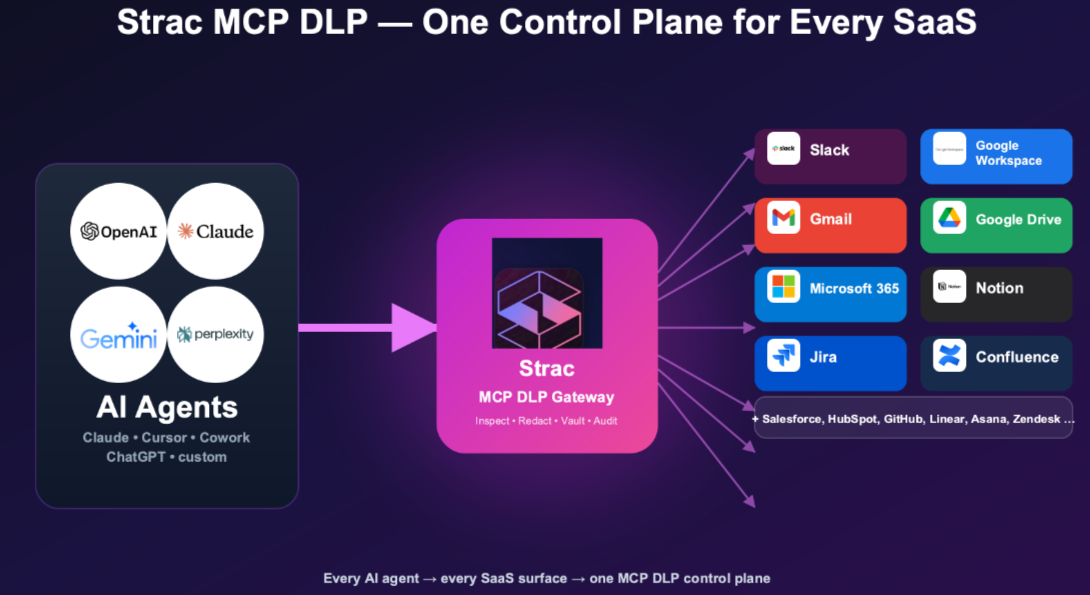
Agents read data on a user's behalf. An AI agent connected over MCP can pull a CRM record into a model context the user never sees. That tool response is a new data path, and MCP DLP is the only control that inspects it.
A label in a catalog tells you data is sensitive. A label enforced at the moment of action keeps it from leaking.
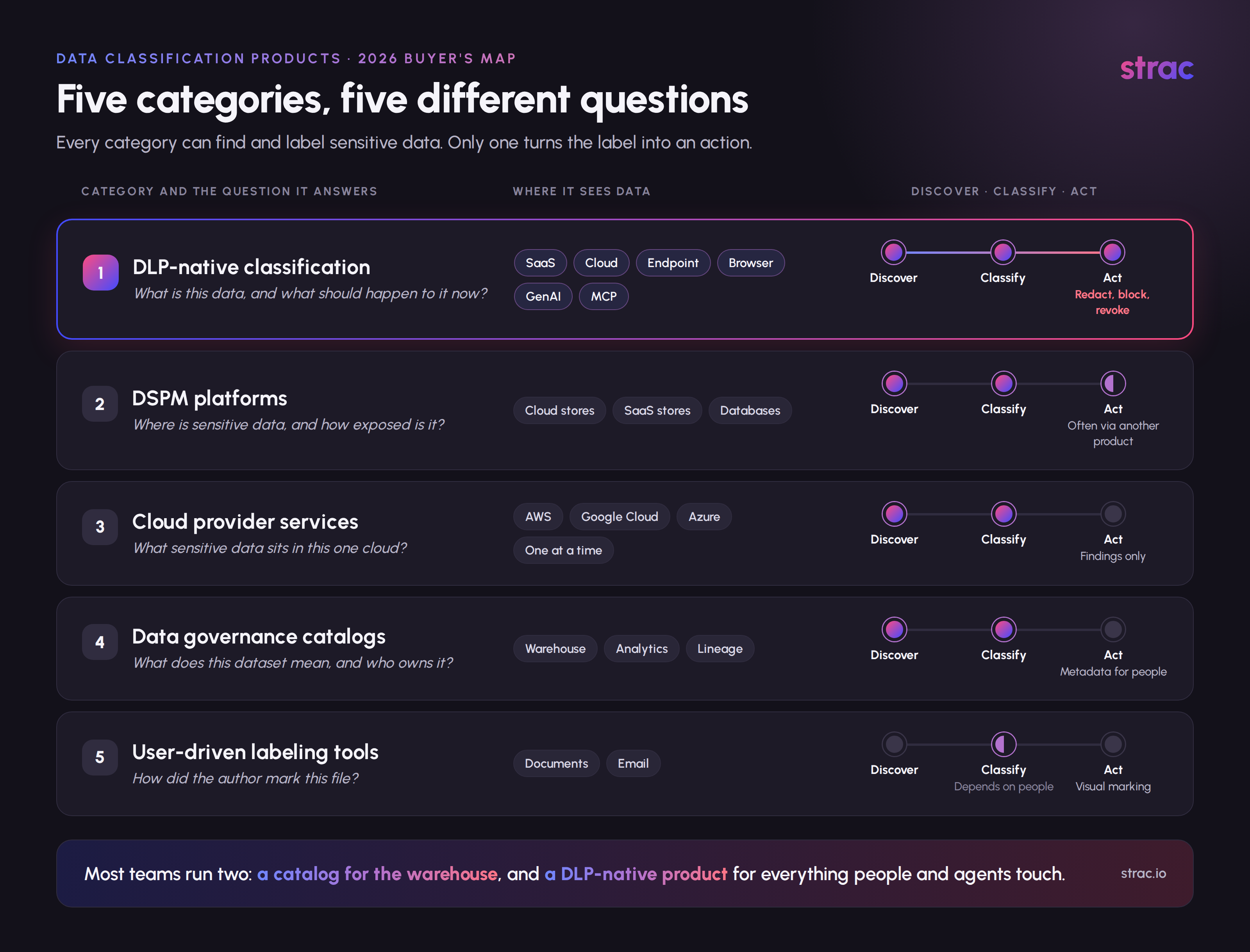
Before comparing vendors, decide which category you are buying. Each one answers a different question.
1. DLP-native classification. Classifies data at rest and in motion and remediates on the same pass: redact, mask, block, label or revoke. Built for security teams that need the label to change an outcome. See sensitive data discovery and classification.
2. DSPM platforms. Map sensitive data across cloud and SaaS stores, then score exposure through permissions, sharing and misconfiguration. Strong on posture; enforcement often depends on another product. See DSPM.
3. Cloud provider services. Native scanners inside AWS, Google Cloud or Azure that classify data in that provider's storage. Low friction inside one cloud, blind outside it.
4. Data governance catalogs. Tag columns and datasets with business and sensitivity metadata for lineage, stewardship and privacy programs. Built for data teams and analytics, not for stopping a leak in Slack.
5. User-driven labeling tools. Prompt employees to label documents and emails at creation, often as visual markings and metadata. Useful for defense and regulated workflows; accuracy depends on people.
Most organizations end up with two categories: a governance catalog for the warehouse, and a DLP-native product for everything people and agents touch.
The products below are the ones security and data teams most often shortlist this year, grouped by category. Each entry covers the approach, the buyer it fits, and where it stops short.
Strac is a DLP, data discovery and DSPM platform that classifies sensitive data across SaaS, cloud, endpoint, browser, generative AI and MCP, then remediates it automatically. It reads images and PDFs through OCR, supports custom detectors, and deploys SaaS connectors by API in minutes.
Best fit: cloud-first and hybrid companies that want one policy for classification and protection, with redaction instead of an alert queue.
Purview applies sensitivity labels and trainable classifiers across Microsoft 365, Windows endpoints and Copilot interactions, and those labels feed Purview DLP.
Best fit: organizations standardized on Microsoft 365 E5. Coverage thins outside the Microsoft estate, and label taxonomy design takes dedicated administrator time.
Forcepoint pairs AI-assisted classification with its DLP and DSPM products and risk-adaptive enforcement that weighs user behavior.
Best fit: large enterprises running Forcepoint across endpoint, web and email. Deployment and tuning are usually services-led.
Cyera discovers and classifies data across cloud, SaaS and databases with an AI-based classification engine, and has added DLP capabilities on top of its posture platform.
Best fit: security teams whose first problem is an unknown cloud data estate. In-place remediation inside collaboration apps is narrower than its discovery story.
Varonis classifies data across file shares, Microsoft 365 and cloud stores and focuses on permissions, access analytics and threat detection around that data.
Best fit: organizations with large unstructured file estates and overexposed permissions. It is strongest on who can access data, less on inspecting prompts or agent traffic.
BigID combines discovery, classification and correlation of personal data to identities, and extends into privacy, retention and AI data governance workflows.
Best fit: privacy and data teams running data subject requests and retention programs across many sources. Enforcement usually runs through integrations with other controls.
Macie uses managed and custom data identifiers to find sensitive data in Amazon S3 and reports findings into AWS security tooling.
Best fit: AWS-heavy teams that need S3 coverage quickly. It does not reach SaaS apps, endpoints or other clouds.
Formerly Cloud DLP, Sensitive Data Protection inspects and de-identifies data in BigQuery, Cloud Storage and custom pipelines through built-in infoTypes.
Best fit: engineering teams building classification into Google Cloud data pipelines. It is an API to build on, not a finished program for Workspace or SaaS; for that, see Google Workspace DLP.
Collibra catalogs datasets with business glossary, lineage and stewardship, and applies classification to columns and assets for privacy and governance programs.
Best fit: chief data officers building a governed warehouse and analytics estate. It labels data for people to manage rather than protecting it on the move.
Informatica, now part of Salesforce, uses its CLAIRE AI engine to profile and classify data across warehouses and applications, alongside data quality and master data management.
Best fit: enterprises already running Informatica for integration and data quality. It is a data management product with classification inside it, not a security control.
Fortra Data Classification, which combines the former Titus and Boldon James products, prompts users to label emails and documents in Outlook and Office and writes that label into metadata.
Best fit: defense, government and regulated firms that require visible markings. Accuracy depends on users choosing the right label every time.
A catalog labels data for the people who manage it; a DLP-native product labels data for the systems that protect it.
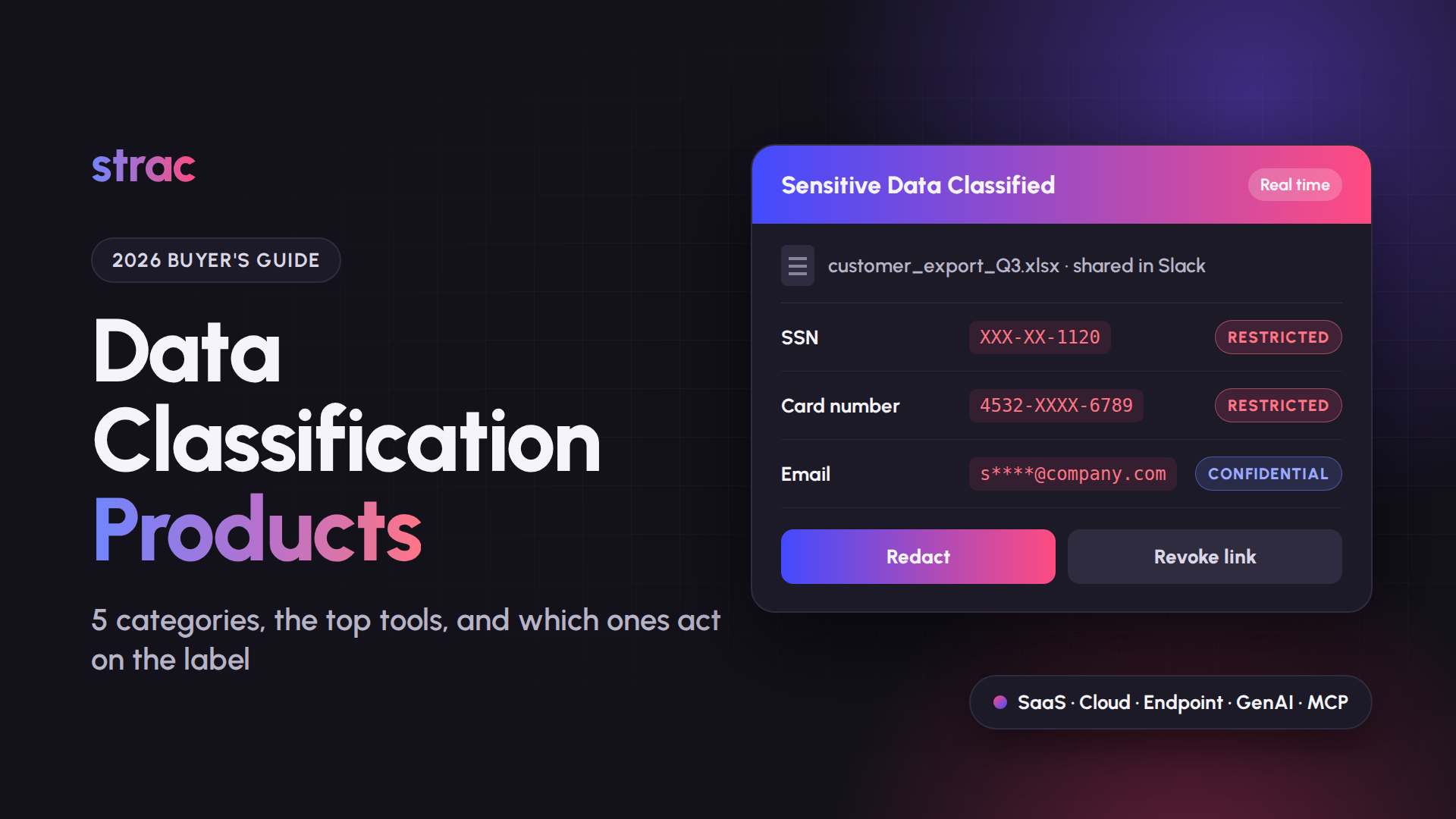
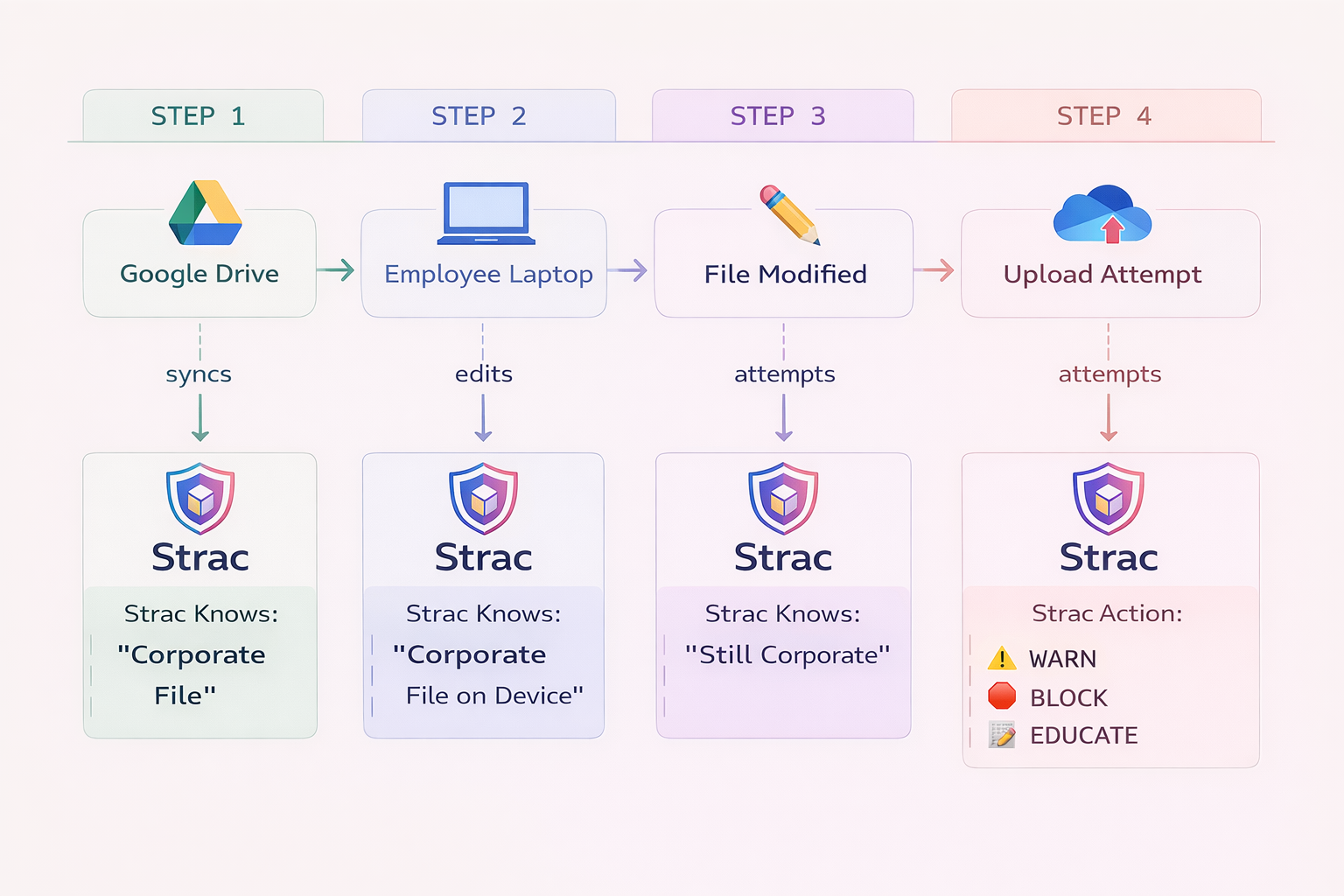
Watch Strac classify a customer record in a Slack message, redact the card number in place, revoke a public SharePoint link on a file holding the same record, and strip it from a ChatGPT prompt before it is sent.
One classification, three surfaces, three actions: the label matters only because something happens next.
Strac runs classification and remediation as a single pipeline, from one console and one policy set.
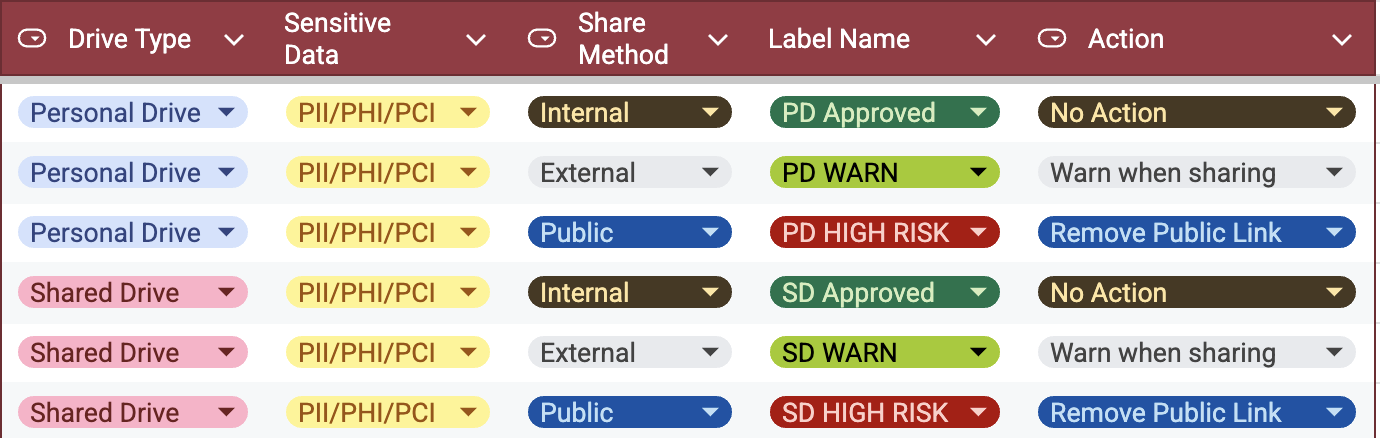
SaaS. SaaS DLP connects by API to Slack, Google Drive, Gmail, Office 365, Microsoft Teams, OneDrive, SharePoint, Box, Zendesk, Salesforce, Jira, Confluence, Notion and HubSpot. The full list lives on the integrations page.
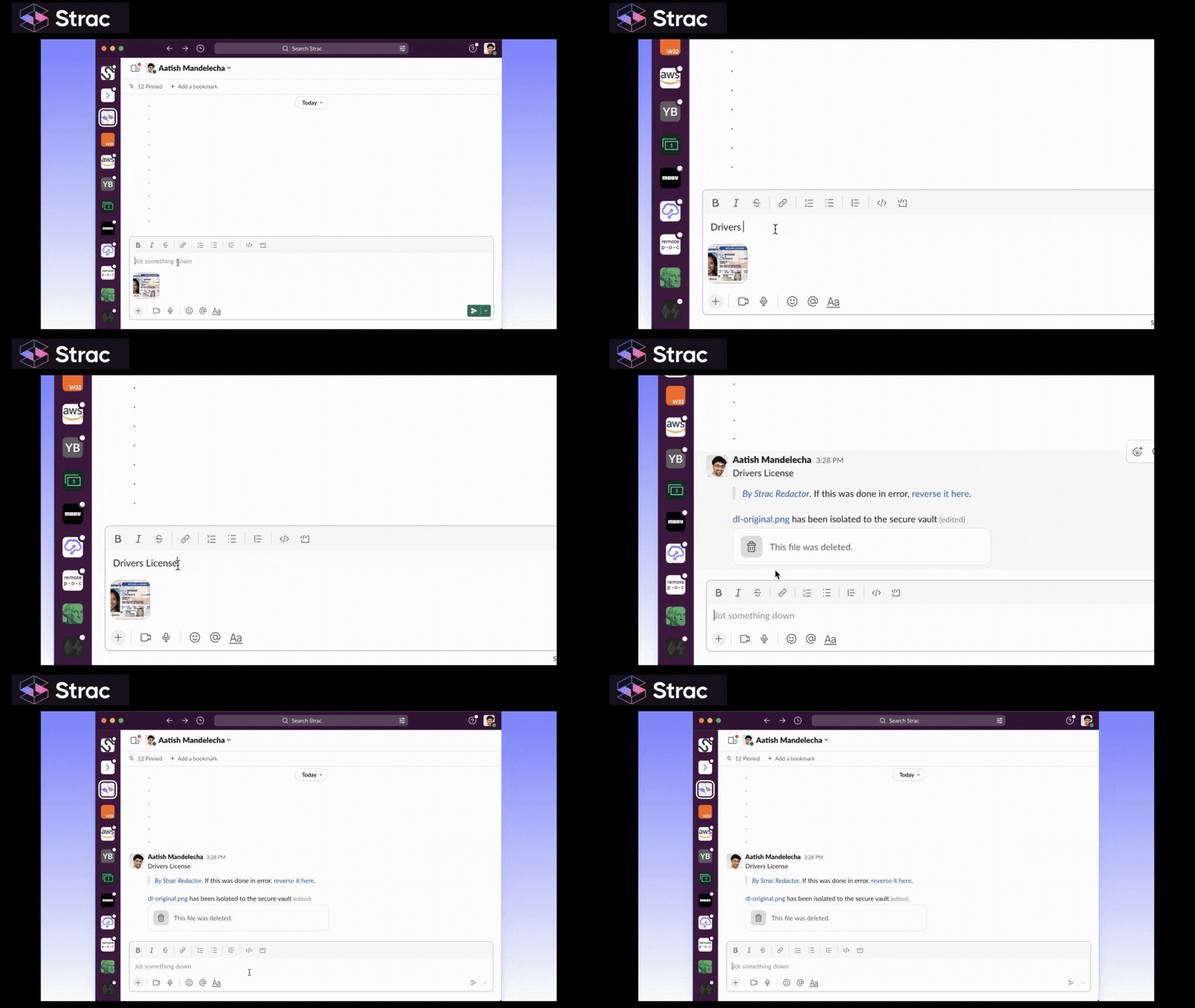
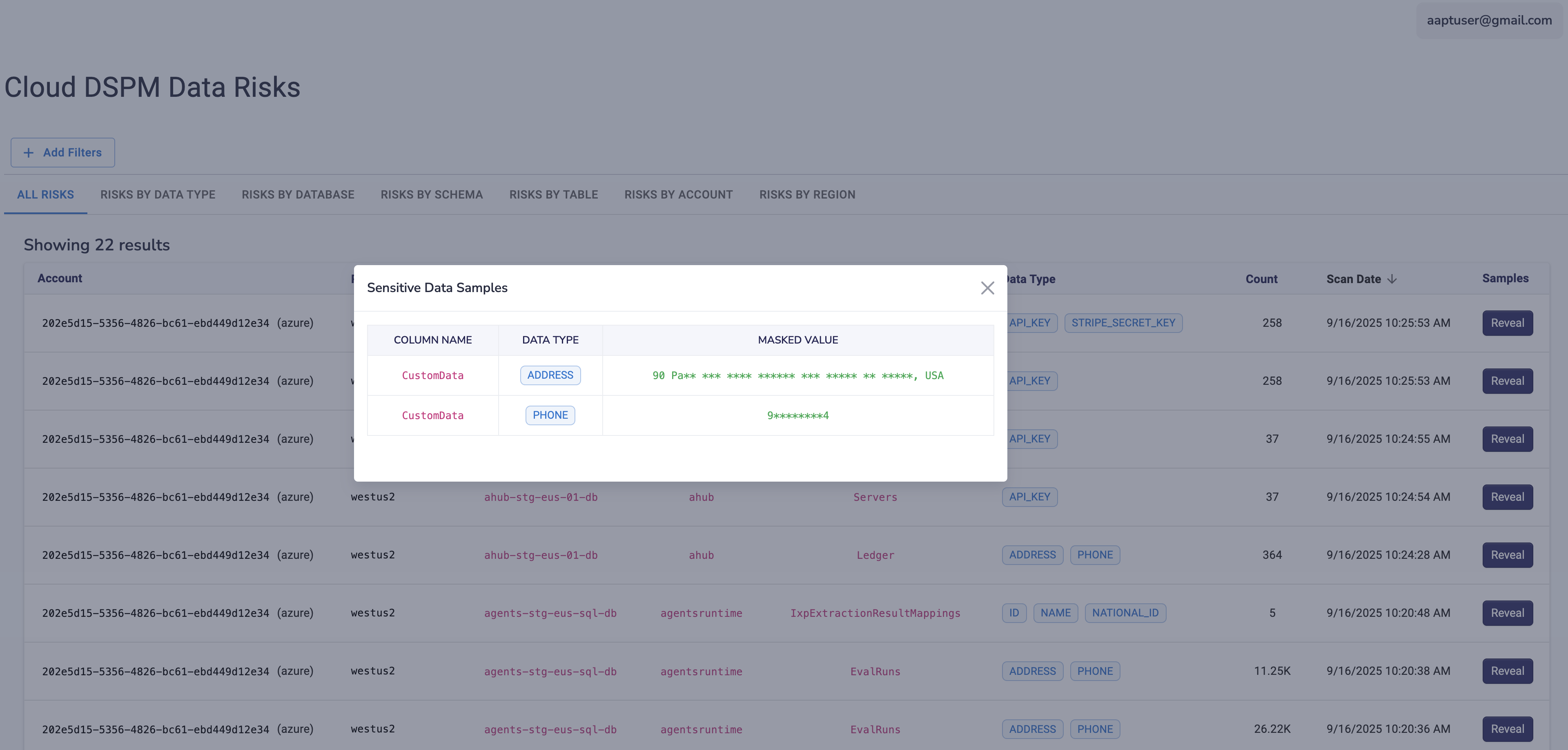
Cloud and databases. Strac classifies data in AWS S3, AWS, Azure, Snowflake, SQL databases and Oracle, and on premises through NAS data classification and on-premise data discovery. DSPM flags overexposed storage and misconfigured sharing on the same findings.
Endpoint and browser. Endpoint DLP classifies files on Windows, Mac and Linux devices. Browser DLP in Chrome and Edge classifies pastes, uploads and form submissions at the moment of the action, with no keystroke logs or screenshots.
Generative AI and MCP. Generative AI DLP classifies and redacts prompts and uploads in ChatGPT, Copilot, Gemini and Claude. MCP DLP inspects every agent tool call and response. The strategy behind both is in AI DLP and AI data classification.
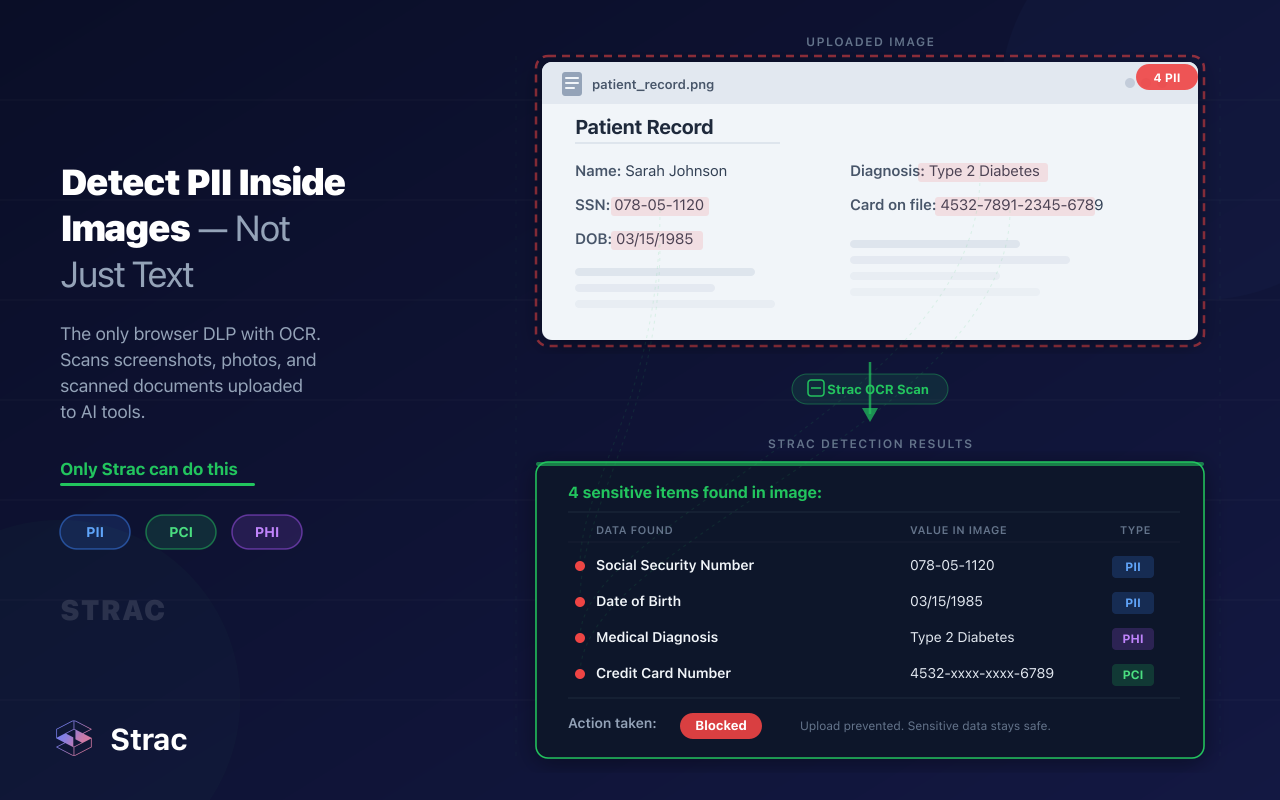
Detection. Trained detectors cover PII, PHI, PCI data and secrets, custom detectors cover your own identifiers, and the PII scanner reads screenshots and scanned documents through OCR. Data lineage tracks where a classified file came from as it moves.
Remediation, in this order:
Compliance. Findings map to HIPAA, SOC 2, ISO 27001, PCI DSS, GDPR and CCPA, so the classification inventory doubles as audit evidence.
Other data classification products tell you what your data is; Strac changes what happens to it.
Related reading:
Every product on this list can label data; far fewer can do anything with the label. Identity, network and model controls all fail eventually, and the data layer is the backstop: classify sensitive data on every surface, redact it on every action, and a compromise never becomes a breach. Book a demo to see Strac classify and redact the data in your own environment.
No. DSPM maps where sensitive data lives and how exposed it is; classification decides what the data is. Most DSPM platforms include classification, but posture alone does not redact anything. Strac runs DSPM and remediation on the same findings.
Because a catalog was built to help people find and govern datasets, not to act on data in motion. It can tag a column as PII, but it will not see that value pasted into a Slack thread or a ChatGPT prompt.
Yes. Classification that ends in redaction lets the message send, the ticket resolve and the prompt run, with the sensitive values removed. Blocking and mandatory manual labeling are the approaches that slow people down, and they push work to unmanaged tools.
No. Unstructured language and images are ambiguous, and every detector has false positives and false negatives. That is why the label must drive an action: redacting on high-confidence matches contains the damage even when a borderline case is scored wrong.
It is the foundation. You cannot govern what a model or agent touches until you know what the data is. Start from the AI data governance pillar, then see MCP DLP for the agent layer.
.avif)


.gif)


.webp)