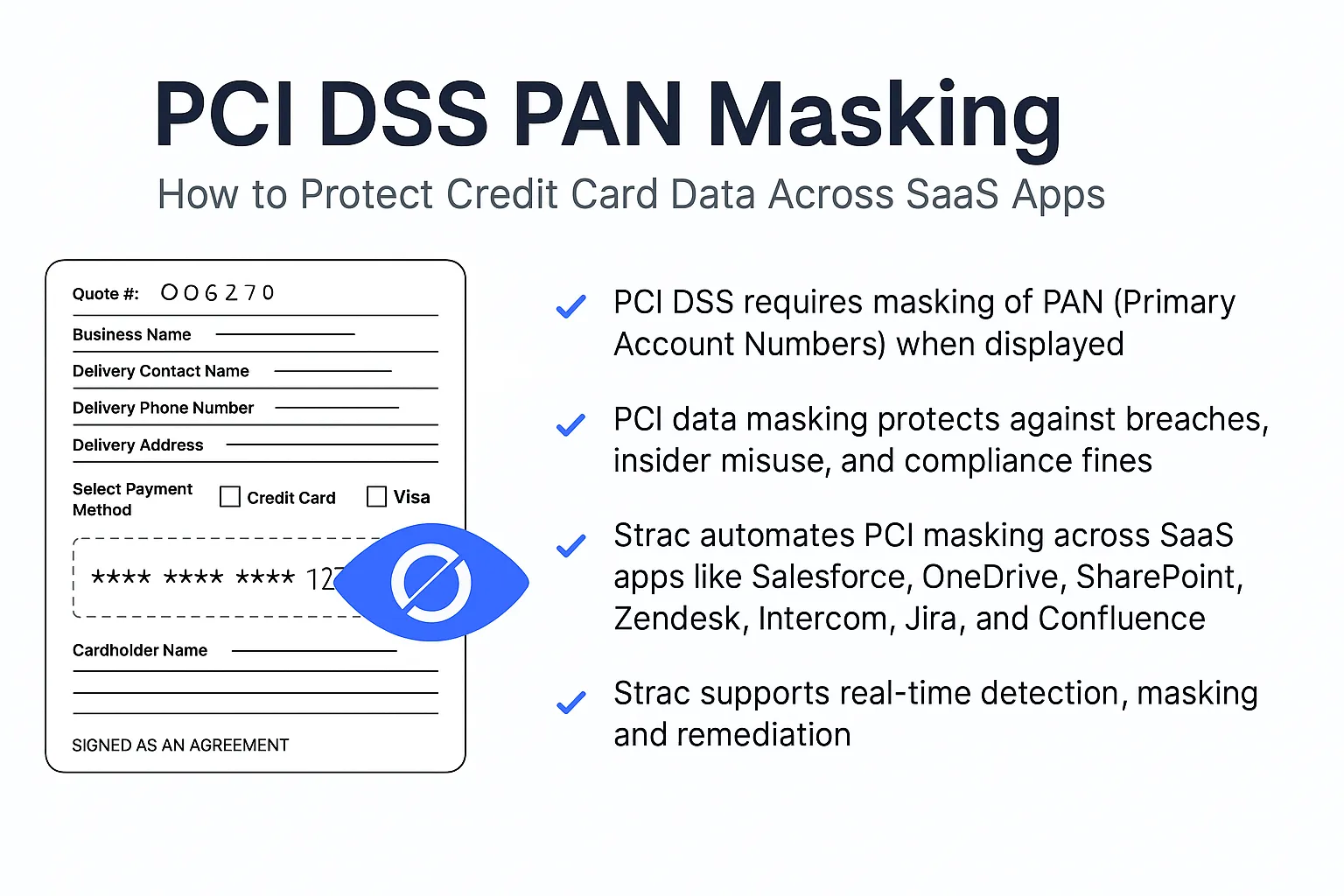
PCI DSS PAN masking is the practice of hiding the Primary Account Number so that no more than the first six and last four digits are shown — required by PCI DSS Requirement 3.4 to limit who can view full card numbers on screens, reports, and documents.
What must be masked: the full PAN anywhere it is displayed to anyone without a business need to see it.
Masking vs. storage: masking controls display; truncation, tokenization, and encryption protect stored data.
How Strac helps: automatically detects and masks PAN across Salesforce, Zendesk, SharePoint, and more.
TL;DR
PCI DSS requires masking of PAN (Primary Account Numbers) when displayed, ensuring only the last 4 digits are visible.
PCI data masking protects against breaches, insider misuse, and compliance fines.
Strac automates PCI masking across SaaS apps like Salesforce, OneDrive, SharePoint, Zendesk, Intercom, Jira, and Confluence.
Strac supports real-time detection, masking, and remediation for PCI DSS compliance.
Companies can avoid manual, error-prone processes and ensure PCI DSS 4.0 alignment.
PAN Protection Methods Compared
PCI DSS 4.0 accepts several ways to keep the PAN out of the wrong hands. Masking governs what is shown; the rest govern what is stored. Most programs combine them.
Method
How it works
Reversible?
Best for
Masking
Hides all but the first 6 / last 4 digits on display
No (display only)
Meeting Req. 3.4 on screens and reports
Truncation
Permanently removes digits from the stored PAN
No
Storage where the full PAN is never needed
Tokenization
Replaces the PAN with a non-sensitive token
Yes, via a secure vault
Systems that must reference a card later
Encryption
Converts the PAN to ciphertext with a managed key
Yes, with the key
Data at rest and in transit
Redaction
Removes the PAN from the record entirely
No
Tickets, chats, and docs that should not hold PAN
✨ What is PCI DSS PAN Masking?
Strac detects the PAN and applies a masking or remediation policy automatically across connected apps.
PCI DSS (Payment Card Industry Data Security Standard) mandates that when displaying credit card numbers (PANs), organizations must mask them so only the last four digits are visible. This is outlined in PCI DSS requirement 3.3.
Example: ************1234
Only personnel with legitimate business needs should ever see the full PAN.
Data masking applies whether the PAN is stored in files, shown in SaaS apps, or transmitted in logs.
This is often called PCI DSS PAN masking, PCI data masking, or PCI DSS credit card number masking.
What is PCI DSS PAN masking vs. PCI DSS encryption?
Masking is about hiding PANs when displayed, while encryption is about securing stored data. Both are required for PCI DSS compliance. Strac handles masking in SaaS apps, complementing encryption at storage.
Do I need PCI DSS masking if I already tokenize card numbers?
Yes. Even if you tokenize, some systems may still log/display PANs. PCI DSS requires masking when displaying, regardless of tokenization.
Can I manually configure PCI DSS masking in Salesforce, OneDrive, or Zendesk?
You could, but it’s error-prone and partial. Strac automates masking across all SaaS apps consistently, reducing risk and compliance overhead.
How does Strac compare to legacy DLP for PCI DSS compliance?
Legacy DLP often fails in SaaS apps (like Zendesk or Intercom). Strac is SaaS-first, agentless, and real-time, designed for modern collaboration tools.
Does Strac support PCI DSS 4.0?
Yes. Strac aligns with PCI DSS 4.0 masking requirements and provides reports to simplify audit preparation.
Discover & Protect Data on SaaS, AI, MCP, Endpoints & Cloud
Strac provides end-to-end data loss prevention for all SaaS and Cloud apps. Integrate in under 10 minutes and experience the benefits of live DLP scanning, live redaction, and a fortified SaaS environment.




.avif)


.gif)


.webp)