Essentials of Data Classification and Data Loss Prevention
Learn how modern Data Classification and Data Loss Prevention (DLP) protect sensitive data across SaaS, cloud, AI, browsers, endpoints, and MCP servers. Discover best practices and how Strac helps prevent data leaks in 2026..
· Modern data classification goes far beyondlabeling files—it continuously discovers, classifies, and protects sensitivedata across SaaS applications, cloud infrastructure, endpoints, browsers, andAI tools.
· Traditional DLP built around email and regexrules struggles with unstructured data, GenAI, browser uploads, and AI agentsconnected through MCP servers.
· Organizations need unified Data Security PostureManagement (DSPM) and Data Loss Prevention (DLP) to know where sensitive datalives and prevent it from leaving.
· Effective data protection requires content-awaredetection, real-time remediation, AI governance, and protection across moderncollaboration platforms.
· Strac combines automated data discovery,classification, DSPM, and real-time DLP into a single agentless platform thatprotects data wherever work happens.
What is Data Classification and Data Loss Prevention?
Every organization generates enormous amounts of sensitive data—from customer records and source code to financial reports, support tickets, healthcare records, contracts, and AI prompts. The challenge is no longer simply storing this information securely. It's knowing where it lives, who can access it, and preventing it from leaving through hundreds of modern collaboration tools.
Data Classification identifies and categorizes sensitive information based on its business value, regulatory requirements, and level of confidentiality. Instead of manually labeling documents, modern platforms automatically discover sensitive information across cloud storage, SaaS applications, databases, endpoints, AI conversations, images, PDFs, spreadsheets, and unstructured files.
Data Loss Prevention (DLP) builds on that intelligence by continuously monitoring how classified data moves. It detects risky activity and can automatically redact, mask, block, quarantine, encrypt, or delete sensitive information before it leaves your organization.
In 2026, these technologies have evolved into much more than compliance tools. They are essential for protecting organizations against accidental data exposure, insider threats, SaaS misconfigurations, shadow AI, browser uploads, and AI agents.
✨Why Traditional Data Classification Is No Longer Enough
For years, organizations classified documents into categories such as Public, Internal, Confidential, and Restricted.
While that worked when data mostly lived inside file servers and email, today's data is constantly moving.
A customer support representative copies payment information into Slack.
A developer pastes proprietary source code into ChatGPT.
An employee uploads a spreadsheet to Google Drive and shares it publicly by mistake.
A sales representative attaches customer records inside Salesforce.
An AI agent connected through an MCP server retrieves sensitive information from multiple business systems.
None of these situations are solved by simply labeling a document as "Confidential."
Modern organizations need continuous visibility into where sensitive data exists and real-time protection whenever that data moves.
✨The Biggest Data Security Risks Organizations Face Today
SaaS Application Sprawl
Businesses now rely on dozens of SaaS applications every day. Customer data flows between Google Workspace, Microsoft 365, Slack, Salesforce, Jira, Zendesk, Notion, Confluence, Dropbox, Box, and many others.
Without automated discovery and classification, security teams lose visibility into where regulated information resides.
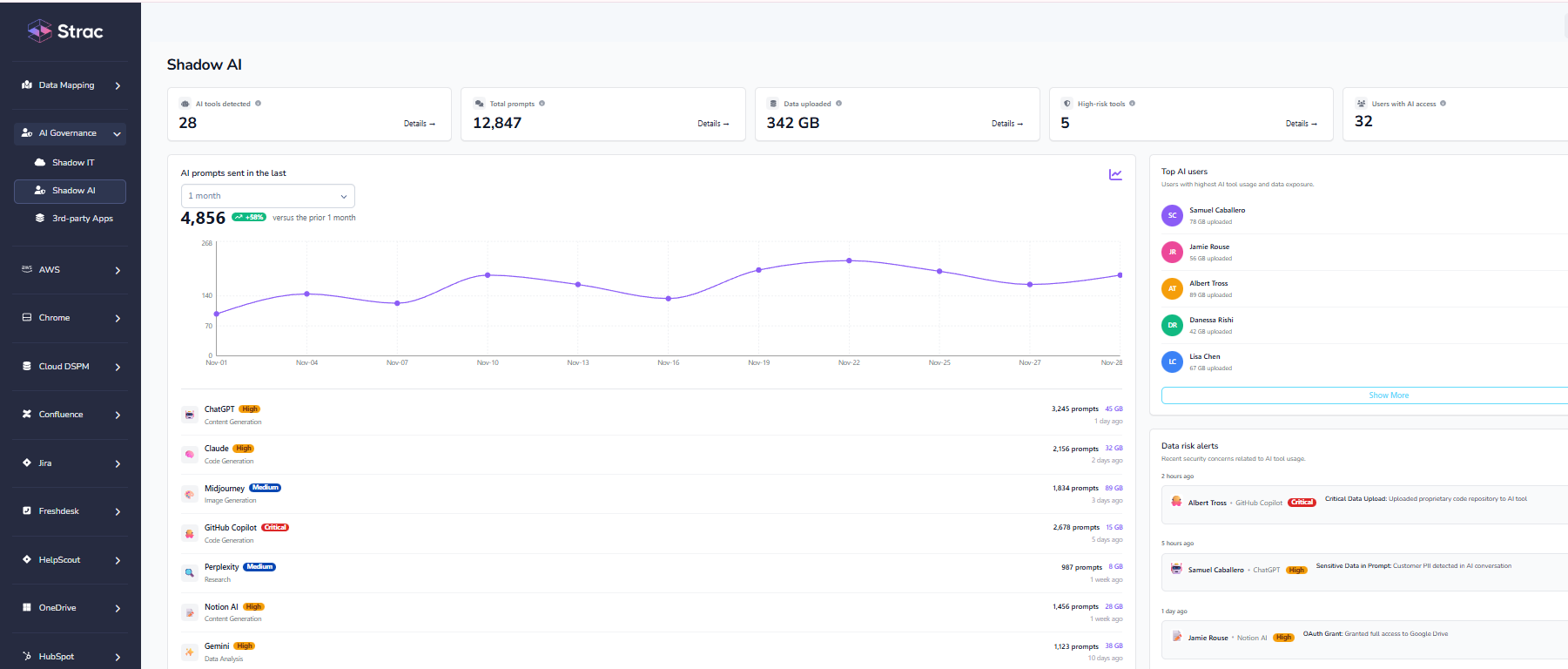
Generative AI and Shadow AI
Employees increasingly use ChatGPT, Claude, Copilot, Gemini, Cursor, Lovable, Replit, Windsurf, and other AI platforms to improve productivity.
While these tools accelerate work, they also create entirely new data leakage paths through prompts, responses, uploaded files, generated code, and browser sessions.
Organizations need AI-aware DLP that understands prompts—not just uploaded files.
Browser-Based Data Movement
Modern work happens inside browsers.
Copying sensitive information into AI tools, uploading confidential documents, downloading regulated files, and sharing cloud links all occur within browser sessions.
Traditional network DLP rarely sees these interactions, making browser-level protection increasingly important.
AI Agents and MCP Servers
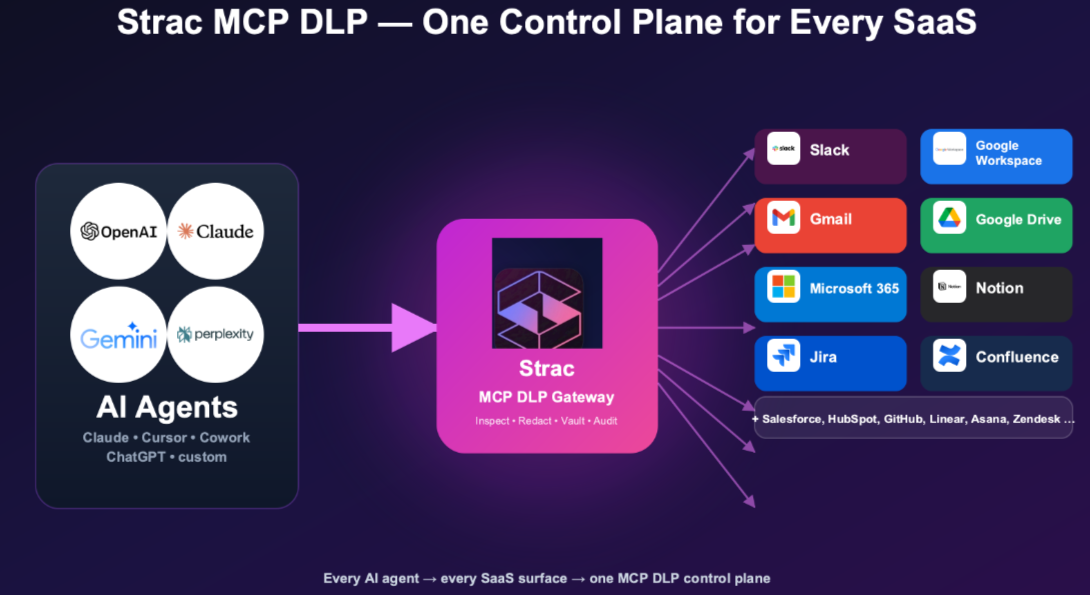
AI agents are becoming deeply integrated with enterprise workflows through Model Context Protocol (MCP) servers.
These agents can access internal documentation, customer databases, cloud storage, CRM systems, development repositories, and collaboration platforms.
Without proper governance, a single AI workflow can unintentionally expose highly sensitive business information.
Protecting MCP-connected workflows has become one of the newest challenges in enterprise data security.
What an Ideal Data Classification and DLP Platform Looks Like in 2026
The best platforms don't simply classify data—they actively protect it.
Key capabilities include:
Continuous discovery across SaaS, cloud, databases, endpoints, browsers, and AI platforms
Automatic classification of structured and unstructured data
Machine Learning, OCR, and content-aware detection rather than relying solely on regex
Deep inspection of PDFs, Word documents, spreadsheets, ZIP archives, screenshots, and images
Real-time monitoring of data movement
Inline remediation through redaction, masking, blocking, quarantine, encryption, or deletion
Browser and GenAI protection
AI governance for prompts, uploads, responses, and AI agents
Unified DSPM and DLP in one platform
Built-in compliance templates for PCI DSS 4.0, HIPAA, GDPR, SOC 2, ISO 27001, and NIST
Low false positives with highly accurate content detection
Why Modern Organizations Are Moving Toward Unified DSPM and DLP
Knowing where sensitive data exists is only half the challenge.
Security teams also need to understand:
Who has access
Where data is moving
Which SaaS applications contain regulated information
Which AI tools employees are using
Which files are publicly exposed
Which workflows create unnecessary risk
DSPM provides the visibility.
DLP provides the protection.
Together they create a complete data security strategy that continuously discovers, classifies, monitors, and protects sensitive information.
🎥 How Strac Modernizes Data Classification and Data Loss Prevention
Modern organizations need protection that extends far beyond email and endpoint monitoring.
Strac combines automatedData Discovery, Data Classification, DSPM, andData Loss Prevention into a single agentless platform designed for today's SaaS-first and AI-driven environments. Rather than relying on complex rule sets or regex matching alone, Strac uses content-aware machine learning and OCR to accurately identify sensitive information across structured and unstructured data while reducing false positives.
Organizations can automatically discover sensitive information across cloud platforms, business applications, databases, endpoints, browsers, and AI tools while enforcing consistent security policies from a single platform.
Key capabilities include:
Agentless deployment with rapid onboarding
Unified DSPM and DLP
Content-aware ML and OCR detection
Deep inspection of PDFs, Office documents, images, screenshots, and compressed files
Real-time inline remediation through redaction, masking, blocking, deletion, encryption, and quarantine
Browser DLP for uploads, downloads, copy/paste, and AI interactions
AI DLP for ChatGPT, Claude, Copilot, Gemini, and other GenAI platforms
Protection for AI agents and MCP-connected workflows
Coverage across Google Workspace, Microsoft 365, Slack, Salesforce, Jira, Zendesk, Notion, Confluence, Snowflake, AWS, Azure, endpoints, and many other SaaS applications
Hundreds of built-in detectors for PII, PHI, PCI, credentials, secrets, source code, financial information, and custom data elements
Built-in compliance templates for HIPAA, PCI DSS, GDPR, SOC 2, ISO 27001, and NIST
APIs that allow developers to integrate sensitive data detection directly into custom applications and workflows.
Instead of simply generating alerts after sensitive information has already been exposed, Strac helps organizations stop data loss before it happens while giving security teams complete visibility into where sensitive data exists across their environment.
Bottom Line
Data classification has evolved from assigning labels to documents into continuously understanding where sensitive information exists and how it moves throughout an organization. As businesses increasingly adopt SaaS applications, AI assistants, browser-based workflows, and AI agents, protecting data requires far more than legacy DLP built around email and predefined rules. Organizations that combine intelligent data classification with modern, content-aware DLP and DSPM gain the visibility to understand their data estate and the controls to automatically prevent sensitive information from being exposed. That combination is quickly becoming the foundation of enterprise data security in 2026.
🌶️Spicy FAQs on Data Classification and DLP
1. What is the difference between Data Classification and Data Loss Prevention (DLP)?
Data Classification identifies and labels sensitive information based on its content, sensitivity, and regulatory requirements. Data Loss Prevention (DLP) uses that classification to monitor, detect, and prevent unauthorized access, sharing, or exfiltration of sensitive data. In modern environments, the two work together to protect information across SaaS applications, cloud platforms, AI tools, browsers, endpoints, and AI agents.
2. Why is traditional data classification no longer enough in 2026?
Traditional data classification relied on manually labeling files and applying static policies. Today's organizations generate sensitive data across Slack, Microsoft 365, Google Workspace, Salesforce, ChatGPT, Claude, cloud storage, and AI-powered workflows. Modern data classification must automatically discover, classify, and continuously protect structured and unstructured data in real time while integrating with DLP and DSPM.
3. How does AI change Data Classification and Data Loss Prevention?
AI introduces new data leakage risks through prompts, uploaded files, generated code, browser sessions, and AI agents connected via MCP servers. Modern AI DLP solutions inspect prompts and responses, classify sensitive information before it reaches an LLM, and automatically redact, block, or mask confidential data without disrupting productivity.
4. What features should the best Data Classification and DLP solution include?
The best Data Classification and DLP platforms provide automated data discovery, content-aware AI and OCR detection, real-time monitoring, inline remediation, browser DLP, endpoint protection, SaaS and cloud integrations, AI governance, support for MCP-connected workflows, and built-in compliance templates for GDPR, HIPAA, PCI DSS, SOC 2, and ISO 27001.
5. How does Strac improve Data Classification and Data Loss Prevention?
Strac combines Data Discovery, Data Classification, DSPM, and DLP into a single agentless platform. It automatically discovers sensitive data across SaaS, cloud, endpoints, browsers, and GenAI applications, then protects it with real-time detection and inline actions such as redaction, masking, blocking, encryption, quarantine, and deletion. With content-aware machine learning, AI governance, and support for modern AI workflows, Strac helps organizations secure sensitive data wherever work happens.
Discover & Protect Data on SaaS, AI, MCP, Endpoints & Cloud
Strac provides end-to-end data loss prevention for all SaaS and Cloud apps. Integrate in under 10 minutes and experience the benefits of live DLP scanning, live redaction, and a fortified SaaS environment.


.webp)









.avif)



.gif)
