September 17, 2026

7
min read
Benefits of Data Loss Prevention
The real benefits of Data Loss Prevention in 2026: fewer breaches, faster audits, and redaction at the data layer across SaaS, cloud, browser, AI and MCP.
· Data Loss Prevention is the practice ofdiscovering sensitive data across SaaS, cloud, browser, endpoint, generative AIand MCP surfaces, then blocking, masking or redacting it before it leaves theorganization.
· The benefit list has changed. Data no longerleaks mainly through email attachments and USB sticks; it leaves through apaste into a chatbot, a public Google Drive link, a Slack channel with a guestaccount, or an AI agent calling a tool over MCP.
· Legacy DLP was built for files at rest and mailin transit, so it reports on surfaces it cannot act on and misses the ones thatmatter now. Detection alone buys nothing.
· Modern DLP pays off in five measurable ways:fewer incidents that become breaches, audit evidence that already exists whenthe auditor asks, less manual triage, safe adoption of generative AI instead ofa ban, and a single policy that follows the data instead of one tool persurface.
· Strac delivers those benefits as one platformacross browser, endpoint, SaaS, cloud, AI DLP and MCP DLP. Start from the pillar on AI data governance.
Data Loss Prevention is a set of controls that discover sensitive data, classify it, and enforce an action on it at the moment it moves. The sensitive data is the familiar list: PII, PHI, PCI cardholder data, credentials and API keys, source code, and customer records. The action is one of four: redact or mask, block, warn and coach, or revoke access.
DLP is not a report. A tool that tells you a Social Security number sat in a Slack channel for eleven days has described a breach, not prevented one. The benefit comes from enforcement, and enforcement only counts on the surface where the data actually moved.
That distinction is the whole argument of this post. Detection tells you the data left; DLP is what keeps it from leaving in readable form.
For a decade the pitch for DLP was email scanning, USB control, and a compliance checkbox. Those controls still matter, and they are also no longer where the loss happens.
Three things changed. Work moved into the browser, so the exfiltration path is a paste and an upload rather than an attachment. Collaboration became the default, so a single sharing setting in Google Drive or SharePoint can expose a folder to the public internet in one click. And generative AI arrived on every endpoint, so an analyst summarizing a customer export in a free chatbot moves regulated data to a third party in under a second, with no network event a proxy would flag as unusual.
Legacy DLP watched the channels that were easy to instrument. Modern DLP watches the ones people actually use. Same objective, different surfaces, and the gap between them is where most of today's incidents live. That gap is covered in more depth in why legacy DLP fails for AI.
This is the benefit that justifies the program on its own. Identity controls fail, phishing works, tokens get stolen, and prompt injection remains unsolved. When the data itself is redacted at the point of every action, the attacker who gets through inherits masked values rather than raw records. The incident becomes an access event you investigate instead of a notification you file with a regulator.
SOC 2, HIPAA, PCI DSS, GDPR, ISO 27001 and ISO 42001 all ask variations of the same three questions: what sensitive data do you hold, where does it live, and what stops it from leaving. A DLP platform with continuous discovery answers all three from a live inventory. The benefit is not that you pass the audit; it is that preparing for it stops being a six-week project.
Accurate detection is the difference between a queue an analyst works and a queue an analyst ignores. High false-positive rates are the main reason DLP programs get switched to monitor-only mode and quietly abandoned. Detectors tuned to your data, plus automated remediation on the common cases, leave the human with the exceptions only.
Blocking ChatGPT, Claude and Gemini at the firewall does not stop shadow AI; it moves it to personal devices where nothing is visible. Redaction changes the trade-off. The prompt goes through with the customer name and card number stripped, the employee keeps the productivity, and the regulated data never reaches the model provider. See shadow AI and how to detect shadow AI for the discovery half of that problem.
Most data loss is not malicious. It is a well-meaning employee forwarding a spreadsheet to a personal address before a trip or dropping a file into the wrong channel. Warn-and-coach prompts at the moment of the action cut those events without keystroke logs or screen recording. A program that records content is a liability; one that records destinations and data classes is an asset.
Separate point products for mail, cloud storage, endpoints and AI produce four policies, four consoles and four sets of gaps at the seams. A single platform that applies the same classification and the same four remediation actions everywhere is cheaper to run and, more importantly, consistent. The data does not change its sensitivity when it moves from Slack to a browser tab, so neither should the policy.
SaaS DLP. Scans Slack, Google Workspace, Microsoft 365, Zendesk, Jira, Salesforce and Box for sensitive data at rest and in new messages, then redacts in place. See Slack DLP and Google Workspace DLP.
Browser DLP. Inspects pastes, uploads and form submissions in the tab, which is where generative AI tools, personal webmail and unsanctioned SaaS are reached.
Endpoint DLP. Covers files, removable media, printing and local AI clients on macOS and Windows. Start with endpoint DLP.
Cloud and DSPM. Discovers and classifies data in S3, storage buckets and databases, and flags public exposure and over-permissioned access.
AI DLP. Redacts sensitive values in prompts and in model outputs across web and desktop AI tools. Start with AI DLP.
MCP DLP. Inspects every tool call an AI agent makes and strips sensitive data from the payload, so a hijacked agent cannot exfiltrate raw PII, PHI or secrets. Start with MCP DLP.
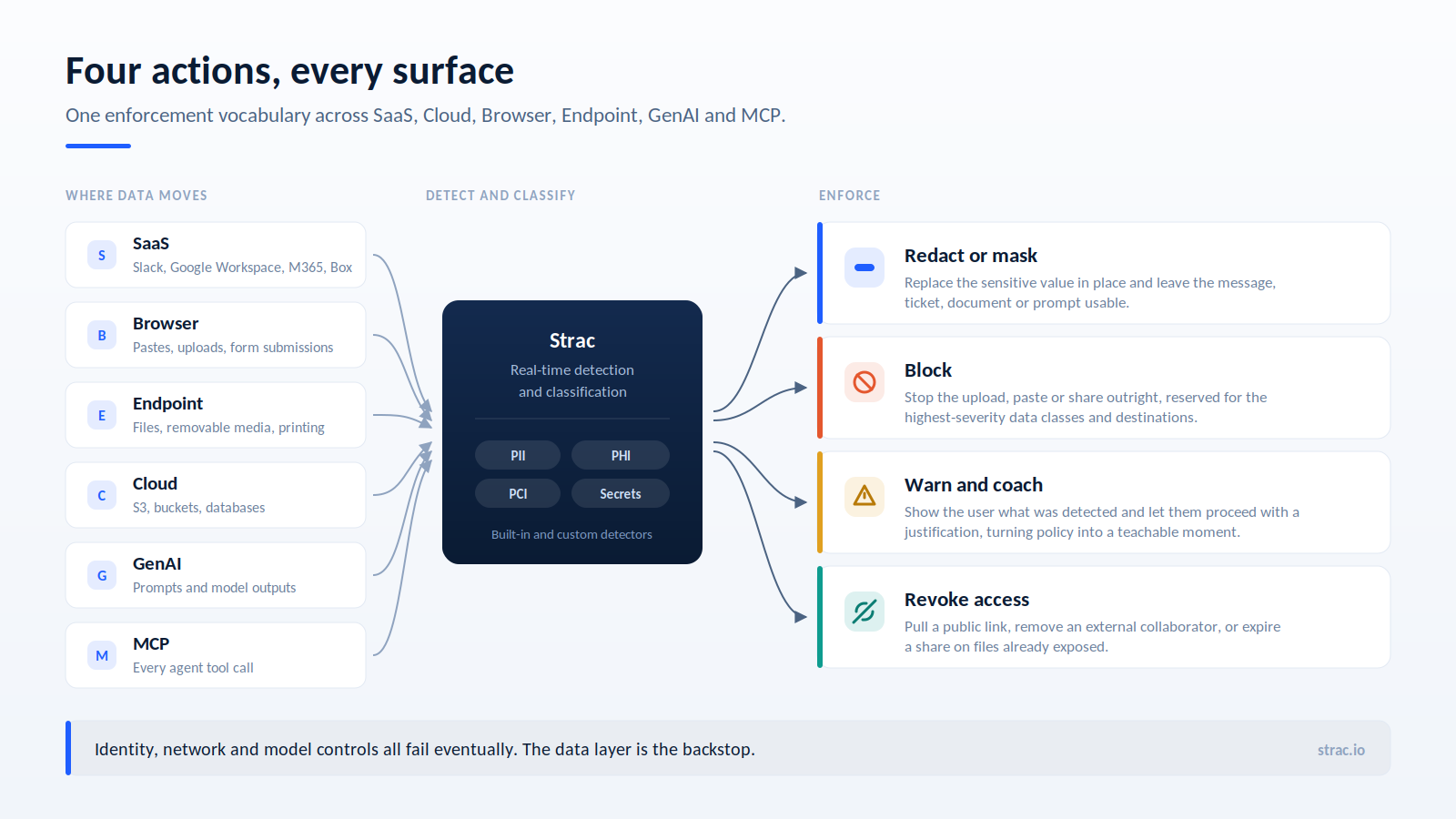
Whatever the surface, the enforcement vocabulary stays the same. This is what keeps a modern DLP program comprehensible to an auditor and to the people it governs.
Redact or mask. Replace the sensitive value in place while leaving the message, ticket, document or prompt usable. Applies to Slack, email, tickets, docs, Google Drive, SharePoint and Box.
Block. Stop the upload, paste or share outright, reserved for the highest-severity data classes and destinations.
Warn and coach. Show the user what was detected and let them proceed with a justification, which converts a policy document into a teachable moment.
Revoke access. Pull a public link, remove an external collaborator, or expire a share on files already exposed.
Strac detects and redacts sensitive data in real time, the backstop for when identity, network and model controls fail.
Strac is a Data Loss Prevention, Data Discovery and DSPM platform covering SaaS, Cloud, Browser, GenAI and MCP with automated remediation.
What that buys you in practice:
Identity, model, prompt and network controls all fail eventually. The data layer is the backstop. Redact sensitive data on every action and a compromise never becomes a breach.
Days 0 to 30, discover. Connect the SaaS apps and cloud stores that hold regulated data, run classification, and produce the inventory. Turn on browser and endpoint visibility in monitor mode to see which generative AI tools are already in use.
Days 30 to 60, protect. Enable redaction on the two or three highest-value flows, usually Slack, the browser paste into AI tools, and public Google Drive or SharePoint links. Start with warn-and-coach on everything else.
Days 60 to 90, prove and scale. Move the top flows from warn to enforce, extend to endpoints and MCP, and export the incident and remediation history as audit evidence for SOC 2, HIPAA, PCI DSS or the EU AI Act.
The benefits of Data Loss Prevention in 2026 are not the ones in a 2018 buyer's guide. Fewer incidents that escalate, audits that draw on evidence you already have, analysts working exceptions instead of noise, and generative AI adopted rather than banned. All four depend on the same thing: enforcement at the data layer, on every surface where data actually moves. Identity and network controls fail eventually; redacted data stays worthless to whoever takes it. Book a demo to see Strac discover and protect the sensitive data across your SaaS, cloud, browser, endpoints, AI tools and MCP agents.
Containment. Other controls try to keep attackers out, and eventually one of them fails. DLP redacts the sensitive data itself, so the incident becomes an unauthorized access event rather than a reportable breach of customer records.
Legacy DLP was built for email and file shares. It rarely inspects browser pastes, generative AI prompts or MCP tool calls, so it reports on surfaces it cannot enforce and misses the ones where data leaves today. See why legacy DLP fails for AI.
No. Blocking pushes usage to personal devices where nothing is visible. Strac redacts sensitive values inside the prompt instead, so the employee keeps the tool and the regulated data never reaches the model provider.
No. A determined insider photographing a screen is outside any software control, and prompt injection remains an open problem. That is exactly why the data layer matters: if the value was already masked, what leaks is worthless.
Discovery answers the data inventory requirement, enforcement answers the control requirement, and remediation history answers the evidence requirement across SOC 2, HIPAA, PCI DSS, GDPR, ISO 27001 and ISO 42001. For the AI-specific mapping, see AI data governance.
.avif)


.gif)


.webp)