Best AI Agent Security Platforms in 2026 (Top 8 Compared)
A practical comparison of the best AI agent security platforms and tools in 2026. How they secure ChatGPT, Claude, and MCP agents across the agent path and the human path, and which one fits your stack.
AI agents like ChatGPT, Claude, and MCP-connected assistants now read your deals, tickets, code, and customer records to do their jobs. That creates two ways sensitive data leaks: the agent path (an agent pulls raw data through MCP tool calls) and the human path (an employee pastes or uploads sensitive data into an AI tool in the browser). Most platforms secure one path. The best AI agent security platform for you depends on which paths you need to cover, whether you need real remediation or just alerts, and how fast you can deploy. This guide compares the top 8, starting with Strac, which covers both paths agentlessly with redaction built in.
Best AI Agent Security Platforms in 2026 (Top 8 Compared)
AI agents stopped being a demo and became infrastructure. Employees run ChatGPT and Claude in the browser all day, and teams are wiring agents into Salesforce, Jira, GitHub, and internal data through the Model Context Protocol (MCP). Every one of those connections is a new way for PII, PHI, source code, and confidential records to leave the building.
An AI agent security platform is the control layer that sits between your AI tools and your sensitive data. This guide compares the best ones in 2026, what each is genuinely good at, and how to pick.
✨ The two paths an AI agent leaks data
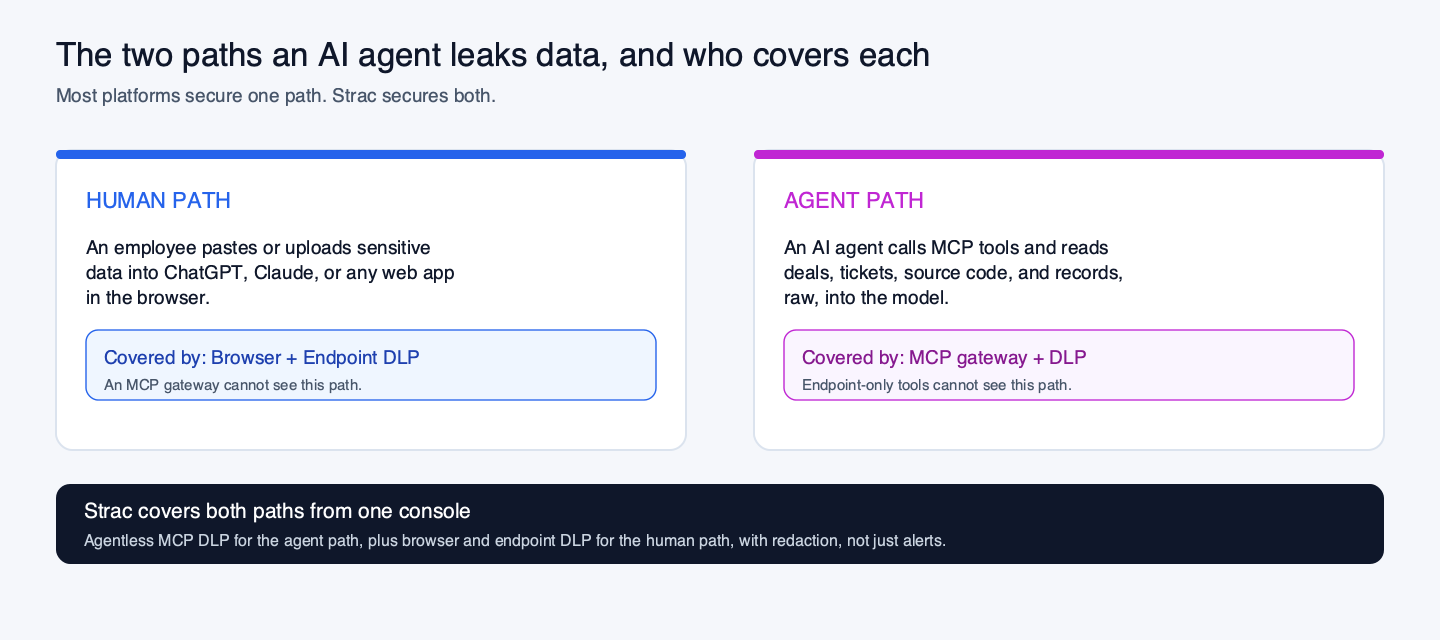
The single most useful lens for evaluating these platforms is coverage of two paths:
The human path — an employee pastes a customer list into ChatGPT or uploads a file to Claude in the browser. Secured by browser and endpoint DLP.
The agent path — an AI agent calls MCP tools and reads raw deals, tickets, and records into the model. Secured by an MCP gateway with DLP.
An MCP gateway cannot see what a human pastes. An endpoint-only DLP cannot see what an agent retrieves. The platforms below differ mostly in which of these paths they cover, and whether they remediate (redact, mask, block) or only alert.
📋 What to look for in an AI agent security platform
Covers both paths, or at least the ones you actually use.
Remediation, not just detection — can it redact the SSN in an MCP response or block the paste, or does it only log it?
MCP support — does it inspect and control MCP tool calls, including tool responses and prompt injection?
Per-user identity — does an agent inherit only what the underlying user is allowed to see?
Deployment — agentless and fast, or a heavy rollout?
Coverage breadth — how many SaaS, cloud, browser, and endpoint surfaces?
Compliance evidence — does it produce audit logs mapped to SOC 2, HIPAA, PCI, and GDPR?
1. Strac (best overall for covering both paths)
Strac is an agentless AI data security platform that secures both the agent path and the human path from one console, with remediation built in.
Core capabilities. Strac detects PII, PHI, PCI, secrets, and source code and then redacts, masks, or blocks it, rather than only alerting. On the human path, its browser DLP and endpoint DLP catch sensitive data as it is pasted or uploaded into ChatGPT, Claude, Gemini, or any web app. On the agent path, its MCP DLP inspects MCP tool calls and redacts sensitive values in the response before they reach the model, and enforces per-user identity.
MCP support. Strac acts as an MCP gateway that can front any MCP server, or provide a first-class one where an app has none. It handles prompt injection, tool-description drift, and shadow MCP discovery from the endpoint.
Deployment. Agentless, with 50+ integrations across SaaS, cloud, browser, and endpoint. Most teams are live in under a day.
Best for. Teams that want one platform to cover employees using AI tools and agents connected to their data, with real redaction and compliance evidence, not a separate point tool for each path.
2. Nightfall AI
Nightfall is an AI-native DLP platform with strong machine-learning detectors, delivered primarily through APIs and SaaS integrations.
Where it fits. Nightfall is a solid choice for SaaS DLP and GenAI content detection, particularly if you want to embed detection into your own apps via API. Its heritage is cloud and SaaS data classification.
How it compares to Strac. Nightfall is detection-strong and cloud-focused. Strac leans harder into remediation at the point of use (redaction in the MCP response and at the browser) and into endpoint coverage of the human path. If you want both the agent path and the human path with redaction in one console, that is Strac's core design.
3. Zenity
Zenity focuses on security and governance for enterprise AI agents, especially agents built on low-code platforms like Microsoft Copilot Studio.
Where it fits. If your primary risk is internally built agents and copilots (posture, AppSec, and governance for the agents your teams create), Zenity is purpose-built for that surface.
How it compares to Strac. Zenity is agent-posture and governance oriented. Strac is data-layer oriented: it protects the sensitive data flowing through agents and through humans, with DLP-grade redaction. Many enterprises run one for agent governance and one for data protection.
4. Prompt Security
Prompt Security offers a GenAI security gateway focused on the prompt and LLM layer, including prompt-injection defense and shadow-AI visibility.
Where it fits. Strong for organizations that want an LLM firewall and prompt-layer controls in front of their AI usage.
How it compares to Strac. Prompt Security concentrates on the prompt/LLM layer. Strac's differentiator is the data layer underneath it: classifying and redacting the actual PII, PHI, and PCI, across the browser, endpoint, and MCP paths, with the audit evidence auditors ask for.
5. Cyberhaven
Cyberhaven is a data detection and response platform built around data lineage and insider-risk analytics.
Where it fits. If your priority is tracing where data came from and where it went (lineage) and insider-risk investigation, Cyberhaven's lineage model is its distinctive strength.
How it compares to Strac. Cyberhaven emphasizes lineage and visibility. Strac emphasizes inline remediation and agent-path coverage (MCP), redacting sensitive data before it reaches an AI model rather than reconstructing its path afterward.
6. Palo Alto Networks (Prisma AIRS)
Palo Alto's Prisma AIRS brings AI runtime security into its broader enterprise security platform.
Where it fits. A natural option for large enterprises already standardized on Palo Alto that want AI security consolidated under one vendor.
How it compares to Strac. Prisma AIRS is part of a large enterprise suite with the rollout and pricing that implies. Strac is a focused, agentless data-security layer that deploys fast and specializes in redaction across the agent and human paths.
7. Lakera (Check Point)
Lakera, now part of Check Point, focuses on LLM security, guardrails, and red-teaming for AI applications.
Where it fits. Strong for teams building AI applications that need guardrails and adversarial testing at the model layer.
How it compares to Strac. Lakera secures the model and application layer. Strac secures the enterprise data layer around AI usage, employees and agents touching real regulated data, which is a different job most companies also need.
8. CrowdStrike
CrowdStrike is an endpoint and EDR leader extending into AI and data protection.
Where it fits. Sensible for existing CrowdStrike customers who want to consolidate AI-related endpoint coverage with their current agent.
How it compares to Strac. CrowdStrike's center of gravity is endpoint security. Strac is purpose-built for data classification and redaction across AI surfaces, including the MCP agent path that endpoint tools do not see.
🔍 AI agent security platforms compared
Platform
Agent path (MCP)
Human path (browser/endpoint)
Remediation (redact)
Deployment
Best for
Strac
Yes
Yes
Yes
Agentless
Both paths, with redaction
Nightfall AI
Partial
Partial
Detection-led
API / SaaS
SaaS DLP + GenAI detection
Zenity
Agent posture
No
Governance-led
SaaS
Internally built agents / Copilot Studio
Prompt Security
Prompt layer
Partial
Prompt-layer
Gateway
LLM firewall
Cyberhaven
Limited
Yes
Lineage-led
Agent
Data lineage + insider risk
Palo Alto Prisma AIRS
Yes
Partial
Platform-led
Enterprise suite
Large Palo Alto shops
Lakera (Check Point)
Model layer
No
Guardrails
SDK / API
Building AI apps
CrowdStrike
Limited
Yes
EDR-led
Agent
Existing CrowdStrike customers
Positioning reflects each platform's primary focus as of 2026; every vendor's roadmap moves quickly, so validate against your own use case.
What is the best AI agent security platform in 2026?
It depends on which paths you need to cover. If you want one platform that secures both employees using AI tools (the human path) and agents connected to your data through MCP (the agent path), with real redaction rather than just alerts, Strac is the strongest all-round choice. If your risk is narrower, for example only internally built copilots, a focused tool like Zenity may fit that slice better.
How is AI agent security different from traditional DLP?
Traditional DLP watches email, endpoints, and network egress. AI agent security has to watch two new surfaces: what humans paste into AI tools in the browser, and what agents pull through MCP tool calls. The best platforms apply DLP-grade classification and redaction to both, which is why coverage of the agent path and the human path is the key evaluation criterion.
Do these platforms stop prompt injection?
Some focus on it (Prompt Security, Lakera), while data-layer platforms like Strac address it as part of MCP inspection, catching injected instructions and redacting sensitive data in tool responses. If prompt injection is your top concern, weight the prompt-layer tools; if data leakage is, weight the data-layer ones.
Can an AI agent security platform help with HIPAA or PCI compliance?
Yes. The ones that redact PII, PHI, and PCI and produce per-event audit logs give you the technical safeguard and the evidence auditors ask for. Detection-only tools help you find exposure but leave remediation and evidence to you.
What is MCP and why does it matter here?
The Model Context Protocol is how AI agents connect to tools and data. An MCP tool call returns raw data into the model, so without an MCP DLP layer, every sensitive record the user can access flows to the agent. MCP support is now a core requirement for any serious AI agent security platform.
How fast can I deploy one?
It ranges from a same-day agentless setup (Strac) to multi-month enterprise rollouts for suite-based platforms. If speed matters, prioritize agentless options and ask each vendor for time-to-first-policy, not just time-to-install.
What is the best AI agent security platform in 2026?
It depends on which paths you need to cover. If you want one platform that secures both employees using AI tools (the human path) and agents connected to your data through MCP (the agent path), with real redaction rather than just alerts, Strac is the strongest all-round choice. If your risk is narrower, for example only internally built copilots, a focused tool like Zenity may fit that slice better.
How is AI agent security different from traditional DLP?
Traditional DLP watches email, endpoints, and network egress. AI agent security has to watch two new surfaces: what humans paste into AI tools in the browser, and what agents pull through MCP tool calls. The best platforms apply DLP-grade classification and redaction to both, which is why coverage of the agent path and the human path is the key evaluation criterion.
Do these platforms stop prompt injection?
Some focus on it (Prompt Security, Lakera), while data-layer platforms like Strac address it as part of MCP inspection, catching injected instructions and redacting sensitive data in tool responses. If prompt injection is your top concern, weight the prompt-layer tools; if data leakage is, weight the data-layer ones.
Can an AI agent security platform help with HIPAA or PCI compliance?
Yes. The ones that redact PII, PHI, and PCI and produce per-event audit logs give you the technical safeguard and the evidence auditors ask for. Detection-only tools help you find exposure but leave remediation and evidence to you.
What is MCP and why does it matter here?
The Model Context Protocol is how AI agents connect to tools and data. An MCP tool call returns raw data into the model, so without an MCP DLP layer, every sensitive record the user can access flows to the agent. MCP support is now a core requirement for any serious AI agent security platform.
Discover & Protect Data on SaaS, AI, MCP, Endpoints & Cloud
Strac provides end-to-end data loss prevention for all SaaS and Cloud apps. Integrate in under 10 minutes and experience the benefits of live DLP scanning, live redaction, and a fortified SaaS environment.


.webp)



.avif)



.gif)
