October 1, 2026

4
min read
Strac Redaction API
Learn how to redact PII and other sensitive data in text, documents and audio
Sensitive data no longer lives in a single database.
Today it moves constantly between SaaS applications, cloud storage, AI assistants, endpoints, browsers, and MCP-connected AI agents.
That is why organizations need more than simple detection. They need the ability to automatically remove sensitive information before it becomes a security incident.
The Strac Redaction API gives developers a fast, scalable way to identify and remediate sensitive data across text, documents, audio, AI workflows, and modern SaaS environments.
Most organizations already know where sensitive data should live.
The problem is where it actually ends up.
Customer support tickets contain credit card numbers. Slack messages contain secrets and API keys. Screenshots contain employee data. AI prompts contain confidential company information. Documents shared externally contain regulated data that should never leave the organization.
Traditional security tools typically stop at detection.
Strac goes further by enabling real-time remediation, allowing organizations to automatically redact, mask, block, delete, encrypt, tokenize, or otherwise protect sensitive information before it is exposed.

Unlike legacy DLP solutions that rely heavily on regex rules and alerts, Strac combines AI-powered detection, OCR, DSPM, and DLP into a single platform.
Key advantages include:
The Strac Redaction API enables developers to redact sensitive information directly from text using a simple API request.
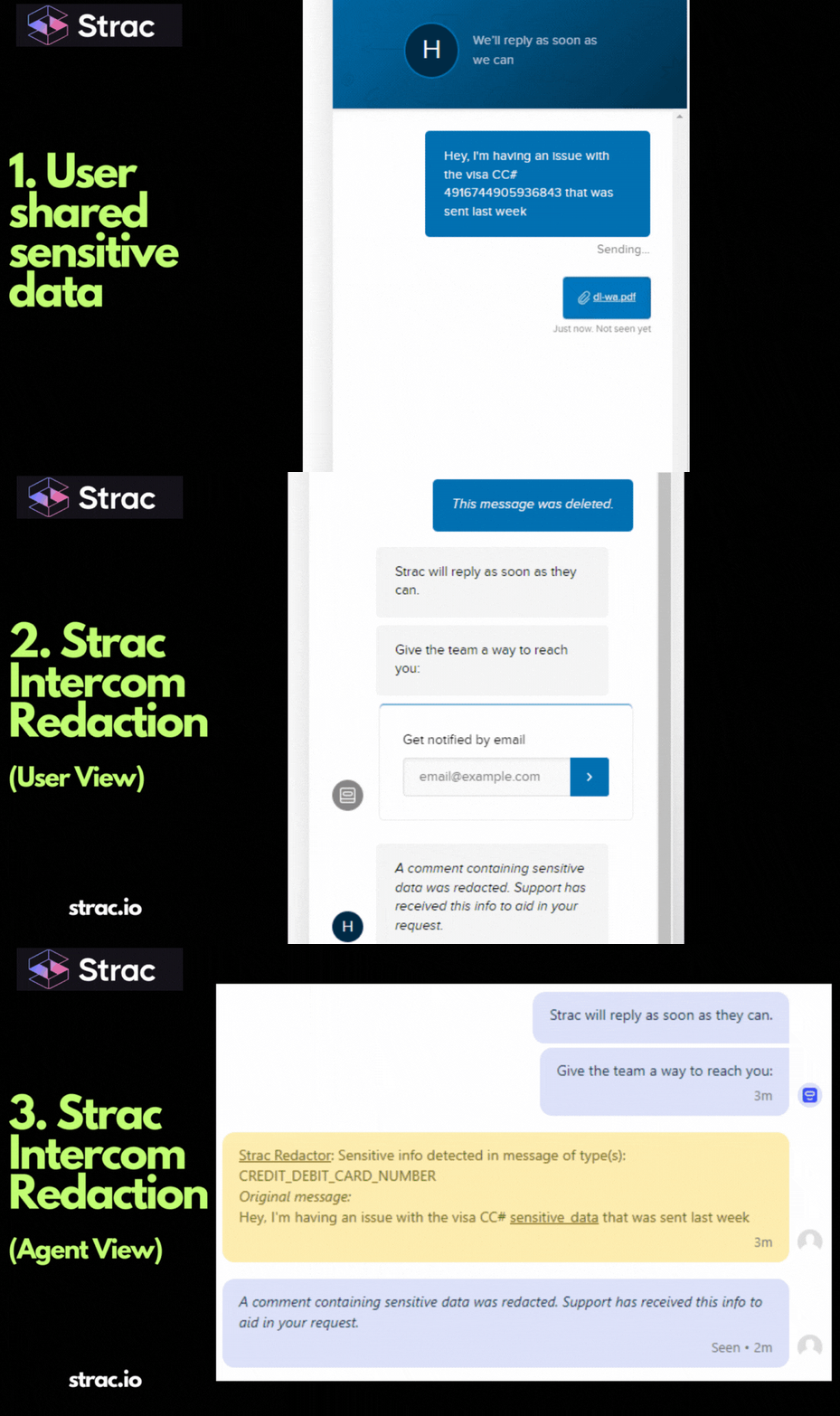
Organizations commonly use text redaction for:
Sensitive information such as names, email addresses, phone numbers, credit card numbers, Social Security numbers, healthcare data, and custom business identifiers can be automatically detected and removed before data is shared or processed.
Documents remain one of the largest sources of data exposure.
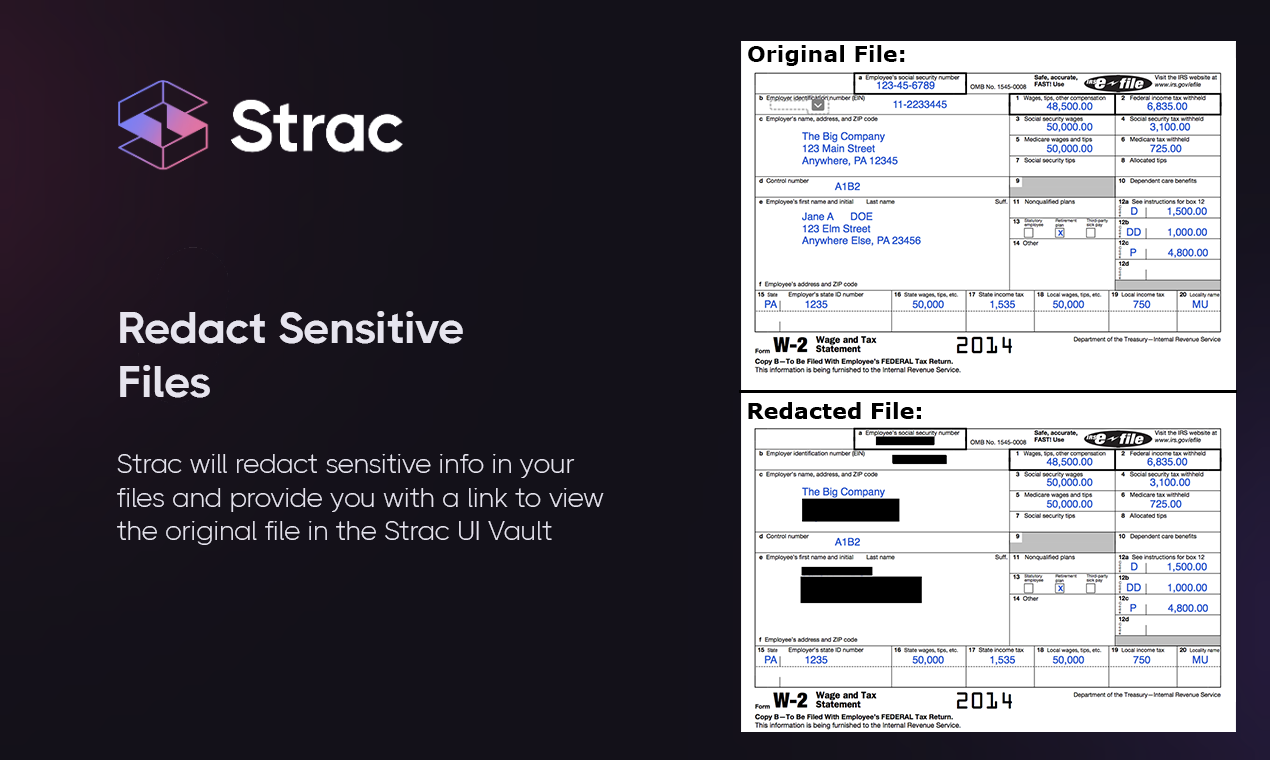
The Strac Redaction API supports automatic redaction of:
Unlike many traditional tools, Strac combines OCR and machine learning to identify sensitive information inside both native and image-based documents.
Organizations can automatically protect data while preserving document structure and usability.
One of the biggest blind spots in modern security programs is image-based data.
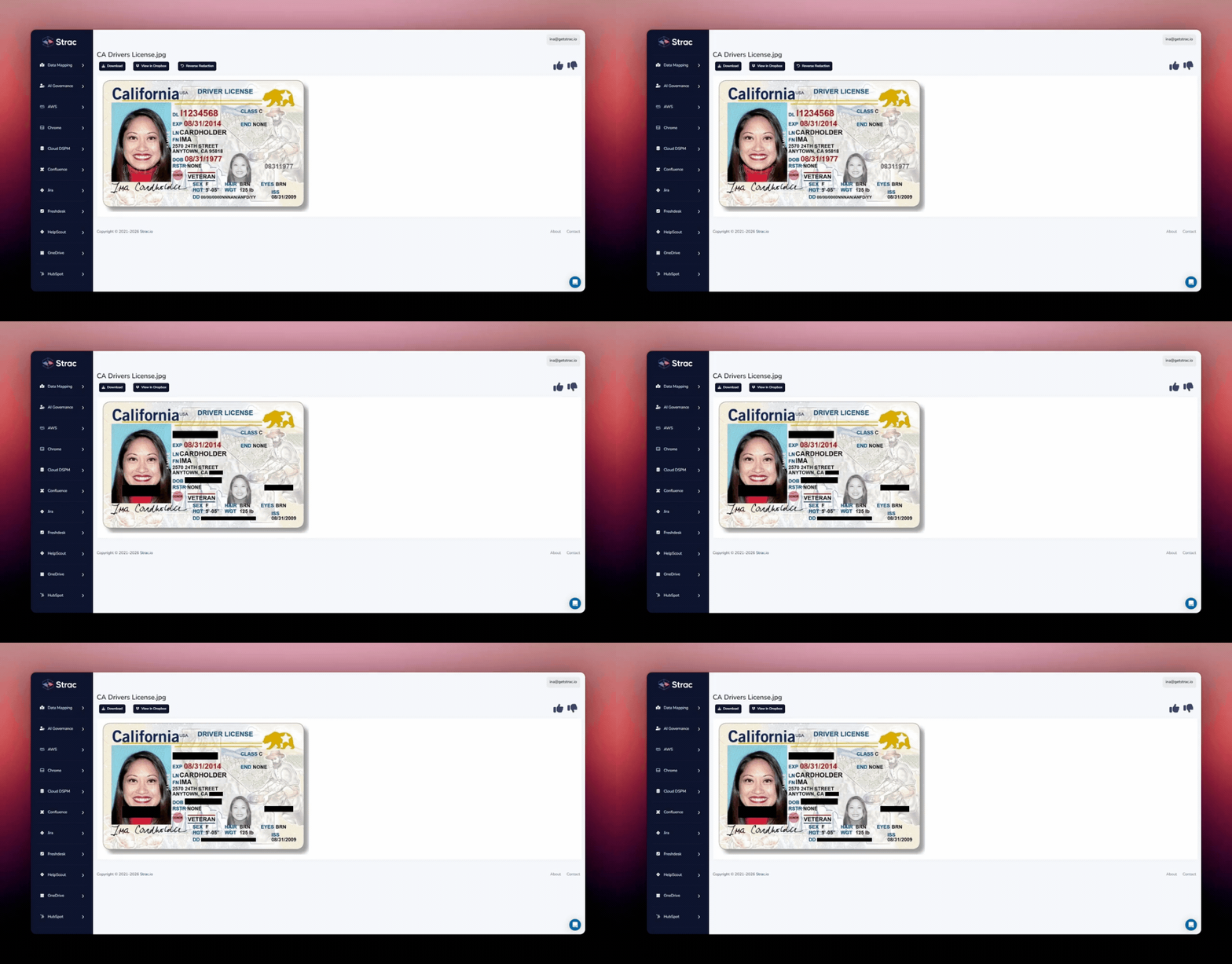
Employees regularly upload screenshots containing:
Strac uses OCR and AI-powered classification to discover and redact sensitive information inside images before it spreads across SaaS applications, cloud storage, or AI systems.
Sensitive information often appears in customer calls, support recordings, interviews, and meeting transcripts.
The Strac Redaction API uses speech recognition and AI-driven redaction capabilities to identify and remove regulated information from audio files while preserving the overall listening experience.
This helps organizations reduce compliance risk without manually reviewing every recording.
Generative AI has introduced an entirely new data security challenge.
Employees frequently paste confidential information into tools such as ChatGPT, Claude, Gemini, Copilot, and other AI assistants.
Strac helps organizations identify, redact, mask, or block sensitive information before it reaches an LLM.
This enables teams to safely leverage AI while maintaining compliance requirements and reducing the risk of data leakage.
As Model Context Protocol (MCP) adoption accelerates, AI agents can now access data directly from SaaS applications such as Slack, Google Drive, Jira, Notion, Salesforce, Zendesk, Confluence, and Microsoft 365.
This creates an entirely new security surface.
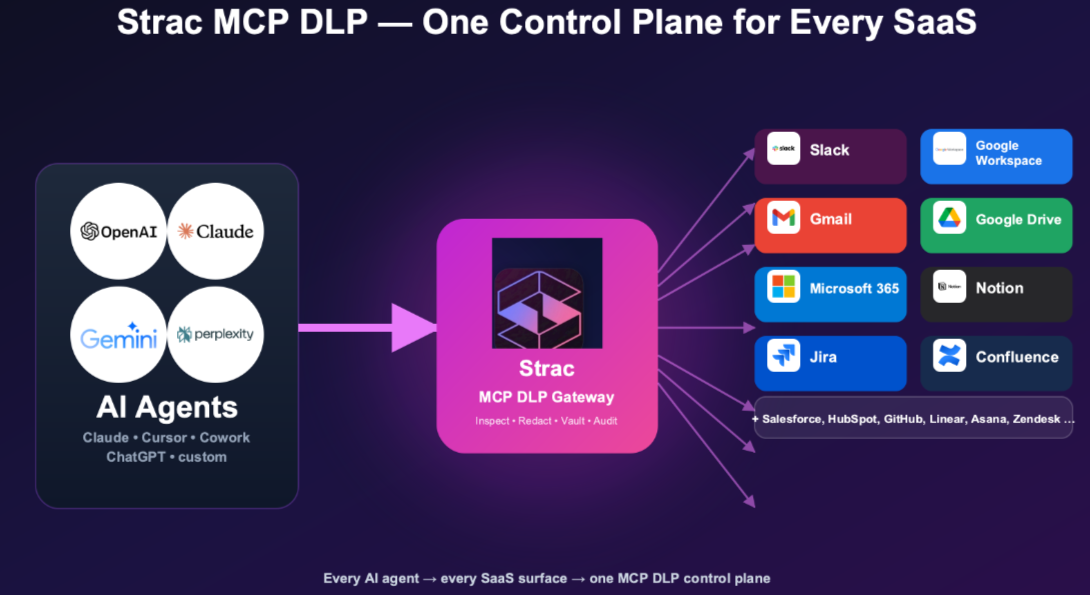
👉 Read our blog on MCP DLP and How to Prevent Data Loss in Model Context Protocol Deployments
Strac MCP DLP sits between AI agents and enterprise applications to inspect, classify, redact, and block sensitive information before it reaches AI systems.
Organizations can confidently deploy AI agents without exposing customer, employee, financial, healthcare, or intellectual property data.
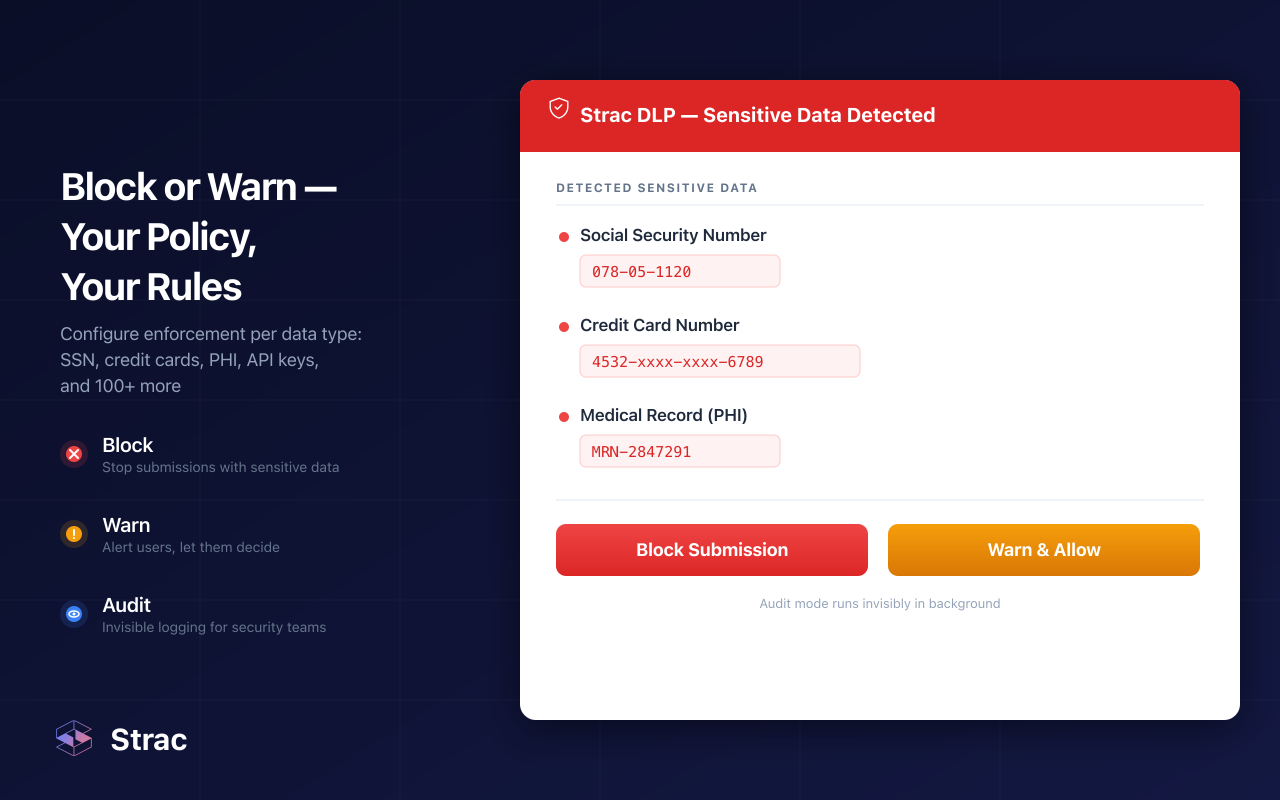
Most security tools generate alerts.
Strac focuses on fixing the problem.
Beyond redaction, organizations can automatically:
The result is faster risk reduction with significantly less manual effort.
Modern organizations need a single platform capable of protecting sensitive data wherever it exists.
Strac combines DSPM, DLP, AI security, SaaS security, Cloud security, Endpoint protection, and MCP security into one unified platform.
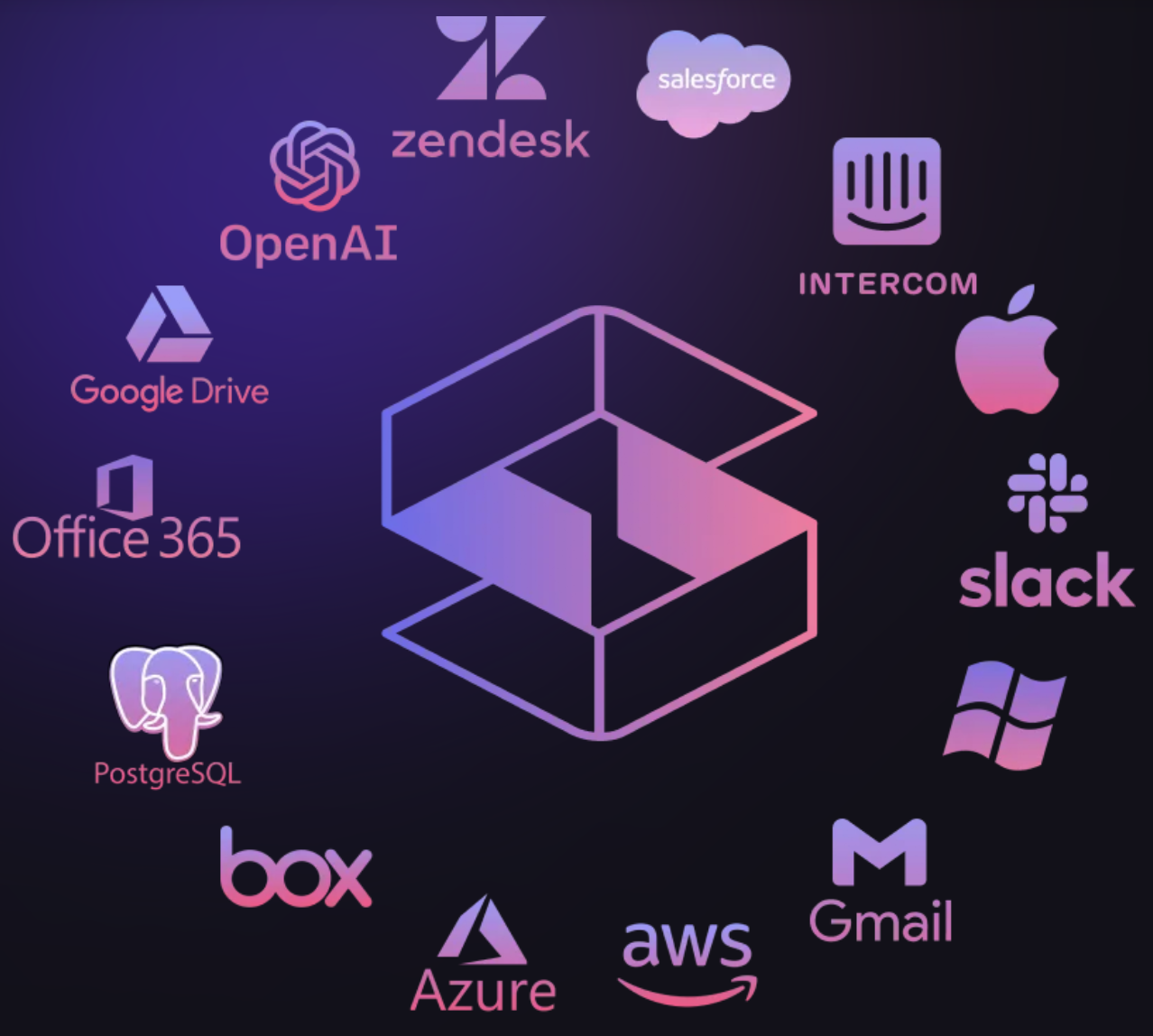
Whether data is moving through Slack, Salesforce, Google Workspace, ChatGPT, cloud storage, customer support systems, documents, screenshots, audio files, or AI agents, Strac helps organizations discover, classify, and remediate risk in real time.
The future of data security is not simply finding sensitive data. It is automatically protecting it before it becomes a breach.
The Strac Redaction API gives developers and security teams a powerful way to secure text, documents, images, audio, SaaS applications, AI systems, and MCP workflows through a single API-driven experience.
As organizations adopt more AI, more SaaS applications, and more autonomous workflows, redaction becomes just one part of a broader strategy: real-time data protection everywhere sensitive information travels.
Related reading:
Not anymore. A redaction API is an important layer, but modern organizations need much more than text masking. Sensitive data now moves across SaaS applications, cloud storage, endpoints, AI assistants, and MCP-connected agents. The most effective approach combines data discovery, classification, redaction, blocking, and remediation across the entire data ecosystem.
Yes. Employees can accidentally paste customer records, source code, financial data, PHI, or intellectual property into AI tools. This is why many organizations are deploying GenAI DLP and MCP DLP controls that inspect, redact, or block sensitive information before it reaches AI models.
A redaction API typically focuses on removing sensitive information from text, documents, images, or audio. A DLP platform goes much further by continuously discovering sensitive data, monitoring where it moves, enforcing policies, and automatically remediating risks through actions such as redaction, blocking, labeling, deletion, encryption, and access revocation.
Traditional pattern-matching tools often struggle with image-based content. Modern platforms use OCR and AI-powered classification to detect sensitive information inside PDFs, screenshots, scanned documents, photos, and attachments before automatically redacting or securing the exposed data.
As AI agents gain direct access to tools like Slack, Google Drive, Salesforce, Jira, Notion, Zendesk, and Microsoft 365 through MCP, organizations need controls between the AI agent and the data source. MCP DLP solutions inspect tool calls in real time and can detect, redact, mask, or block sensitive information before it reaches the AI model, reducing the risk of AI-driven data exposure.
.avif)


.gif)


.webp)