An honest look at Strac in 2026: its 4.9/5 G2 rating, the full platform (SaaS DLP, browser and endpoint, GenAI and MCP DLP, DSPM, shadow AI, data lineage, Comply), who it is best for, and how it compares.
Strac is an AI-native data security and compliance platform rated 4.9 out of 5 on G2. It covers what most tools split across five vendors: SaaS DLP across 50+ integrations, browser and endpoint DLP, GenAI and MCP DLP, DSPM data discovery with historical scanning, shadow AI, data lineage, and Strac Comply for SOC 2, HIPAA, PCI, ISO, and GDPR. This page is an honest review: what Strac does, what customers value, who it fits, and how it stacks up against alternatives.
If you are evaluating Strac, you have probably landed on a competitor page telling you what Strac is not. This is a straight review of what Strac actually is in 2026: the ratings, the full platform, the strengths customers point to, the honest trade-offs, and how it compares. Whether you searched Strac reviews or Strac data security posture management reviews, you will find the complete picture here, with the actual product on screen.
⭐ Strac's G2 rating: 4.9/5
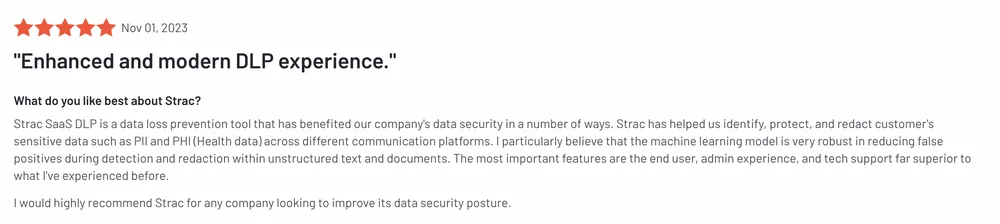
⭐ 4.9/5 on G2 · 28 reviews · G2 Momentum Leader in Data Loss Prevention — read the reviews
Strac holds a 4.9 out of 5 rating on G2 across 28 reviews and is a G2 Momentum Leader. Because Strac is listed under both the DLP and Data Security Posture Management (DSPM) categories, searches like "Strac data security posture management reviews" surface the same 4.9/5 profile. Reviewers consistently highlight three things: how fast it deploys, the breadth of what one platform covers, and responsive support.
Strac G2 review: sensitive data discovery and DLP, rated 4.9/5
🧩 What is Strac?
Strac is an AI-native data security and compliance platform. It finds sensitive data everywhere it lives and moves, and remediates it: redact, mask, block, revoke, or delete, across SaaS, cloud, the browser, endpoints, and AI agents. Where most programs stitch together a DLP tool, a DSPM tool, a browser extension, an endpoint agent, and a separate GRC product, Strac does it from one console. That consolidation is the single most common reason teams choose it.
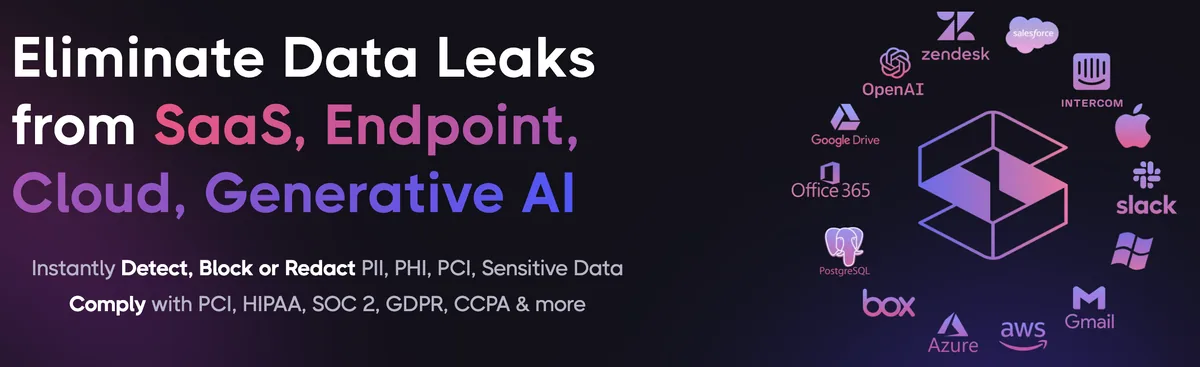
Strac unifies SaaS, Cloud, Generative AI, and Endpoint DLP in one platform
🎥 See Strac in action
A two-minute look at Strac discovering and remediating sensitive data across SaaS, cloud, GenAI, and browsers.
🛠️ Everything Strac does (the full platform)
A fair review has to cover the whole platform, because breadth is Strac's defining trait. Here it is, systematically, with the product on screen.
1. SaaS DLP across 50+ integrations
Strac connects to the SaaS apps where regulated data actually lives, Slack, Google Workspace, Microsoft 365, Gmail, Google Drive, Zendesk, Salesforce, Jira, Confluence, Box, ServiceNow, and dozens more, plus AWS, Azure, and GCP, and detects PII, PHI, PCI, secrets, and source code inside messages, tickets, and attachments.
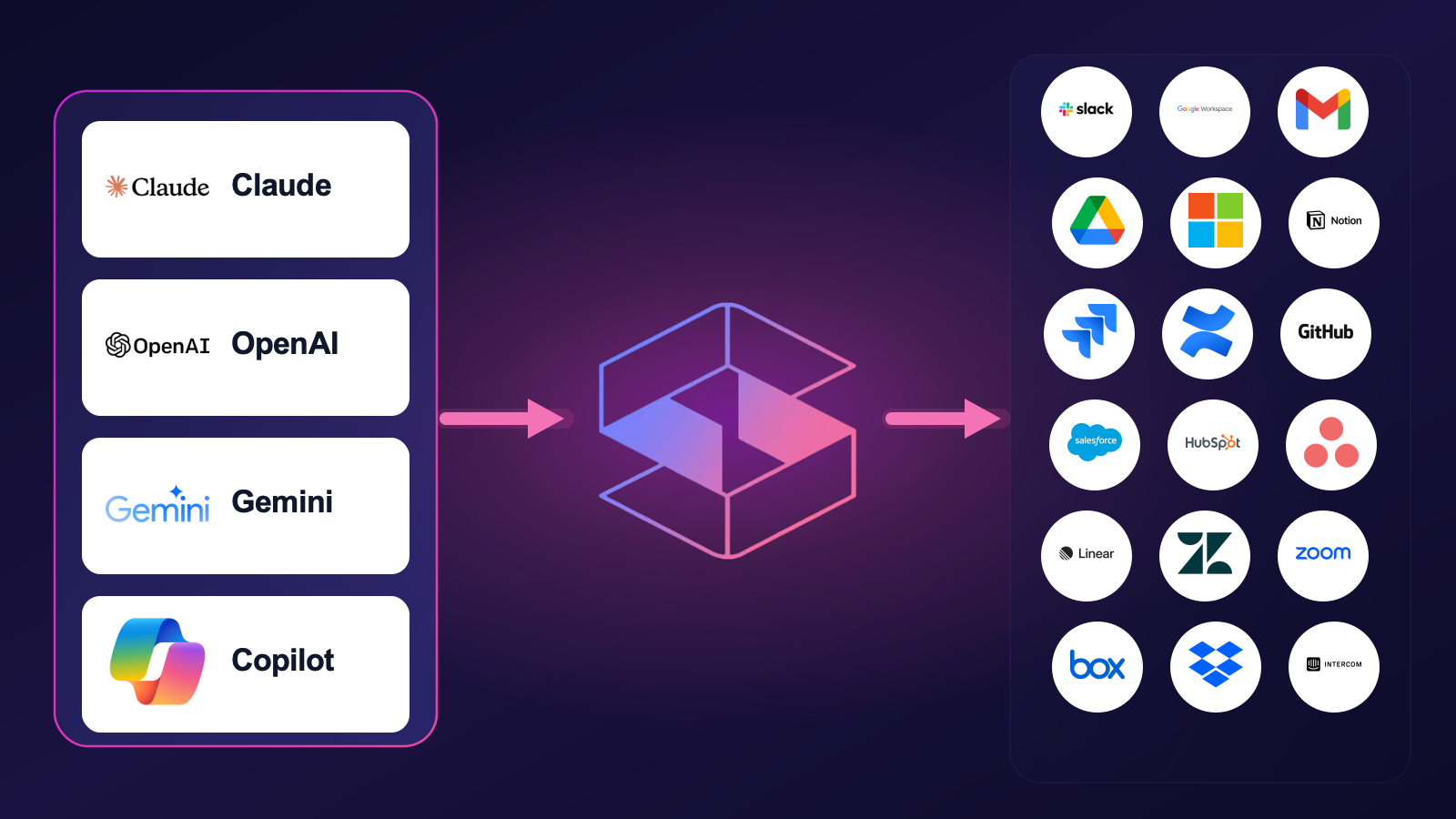
Strac's SaaS, cloud, browser, and endpoint integrations
2. Redaction and remediation, not just alerts
The difference reviewers call out most: Strac does not stop at flagging. It redacts, masks, deletes, blocks, or revokes access in place, across every file format including PDFs, images, and screenshots via OCR, so exposure is actually fixed, not logged. See the live Slack redaction below.
Strac Slack DLP: live redaction of sensitive data in a message
3. Browser DLP with GenAI blocking
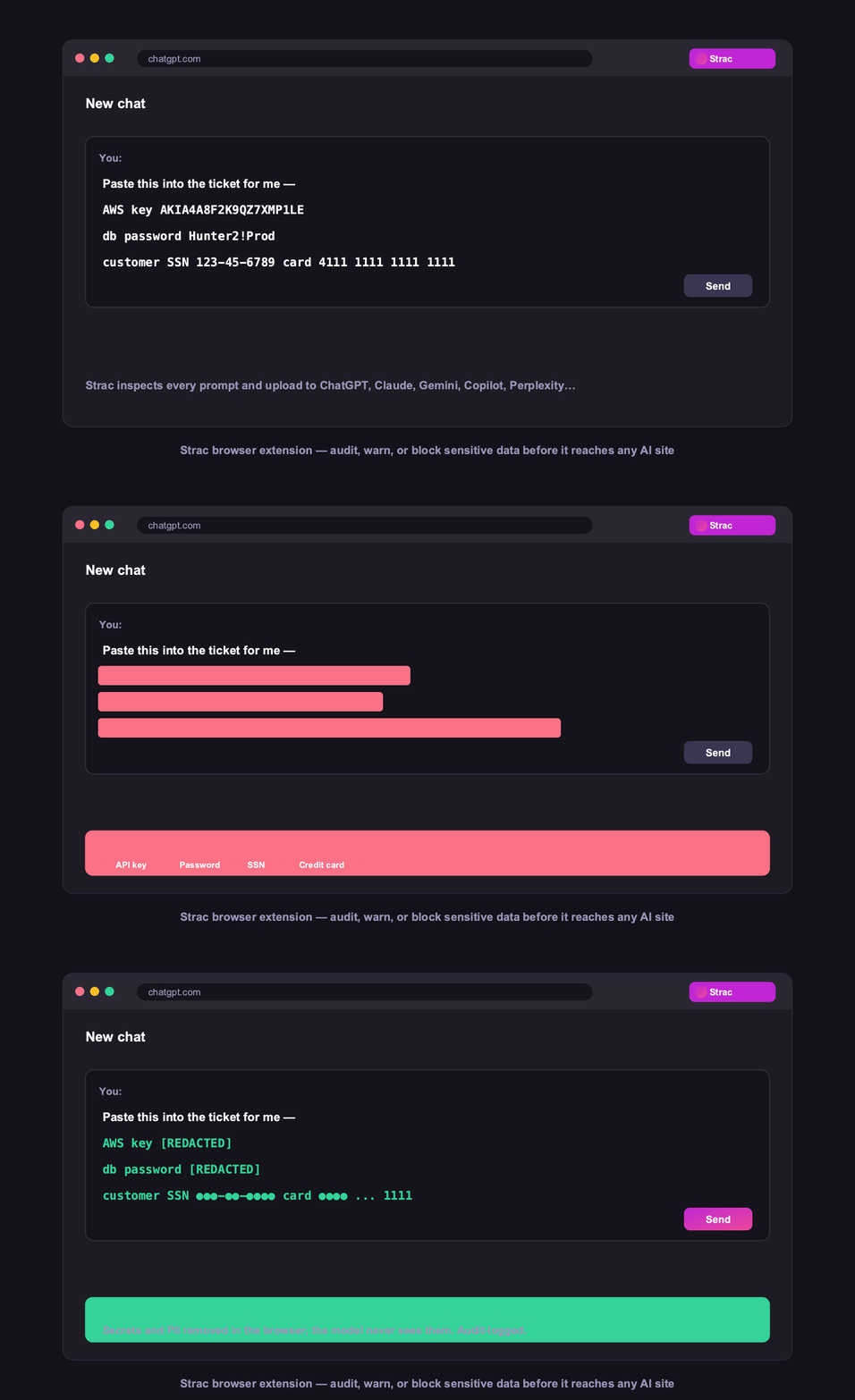
Strac's browser DLP covers Chrome, Edge, Firefox, and Safari, detecting and blocking sensitive data at the point of paste and upload, including into ChatGPT, Claude, Gemini, and Copilot.
Strac GenAI DLP: blocking sensitive data before it reaches an AI tool in the browser
4. Endpoint DLP (Mac, Windows, Linux)
The endpoint agent covers the exit channels a browser cannot see, downloads, USB, printing, and file movement, with block, warn, and audit modes across Mac, Windows, and Linux.
5. GenAI and Claude DLP
Strac's AI DLP and Claude DLP redact PII, PHI, and secrets inside AI conversations and prompts, so employees can use generative AI without leaking regulated data into it.
Strac blocking sensitive data from being pasted into a generative AI tool
6. MCP DLP for AI agents
As teams connect AI agents to their data over the Model Context Protocol, MCP DLP inspects every MCP tool call and redacts PII, PHI, PCI, and secrets before the model sees them, with per-user identity and a full audit trail. Strac can front any MCP server or provide a first-class one. See the MCP integrations.
Strac MCP DLP governs data across 41+ MCP connectors, redacting before it reaches Claude, ChatGPT, or any agent
7. Shadow AI discovery
Strac's shadow AI discovery surfaces which GenAI tools employees actually use, from the browser, so you can approve, block, or govern each one.
8. Data lineage
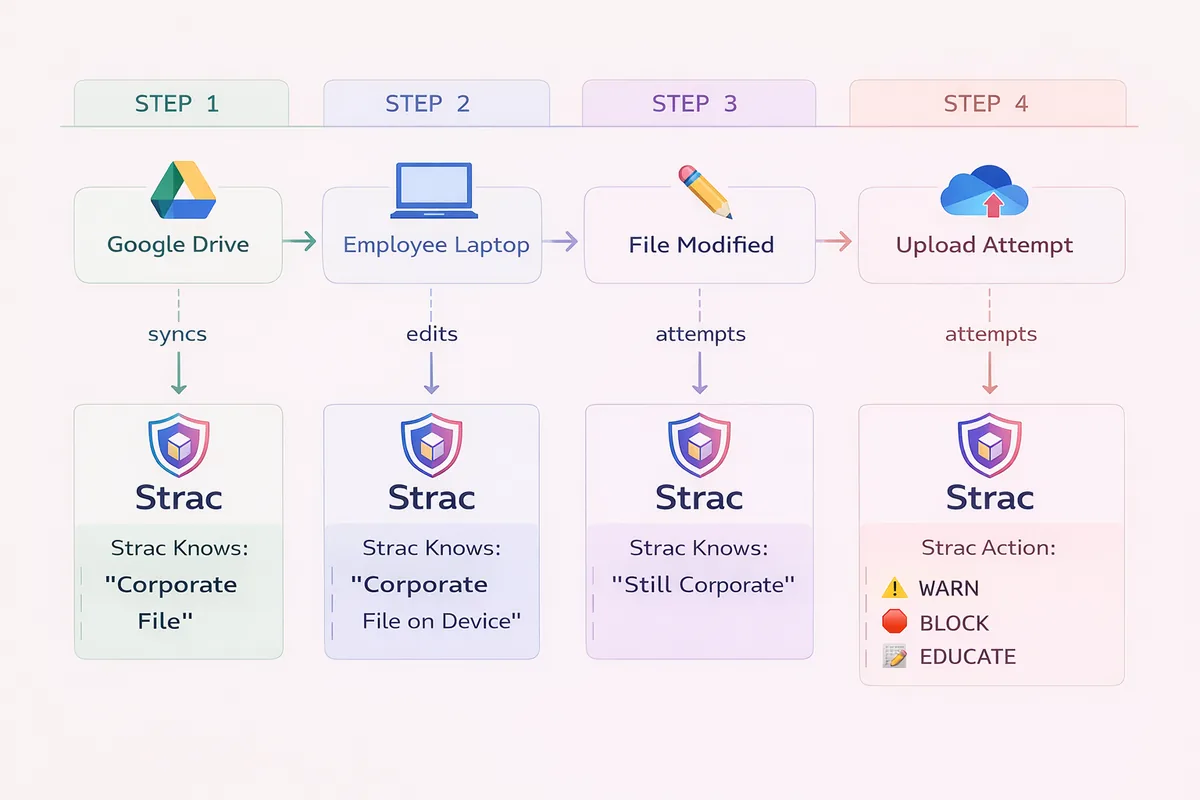
Strac maps where sensitive data comes from and where it flows, tying data flow mapping and data inventory to real scans rather than a hand-drawn diagram.
Strac endpoint data lineage: tracing where sensitive data comes from and where it goes
9. DSPM: discovery, classification, and historical scanning
Strac's DSPM continuously discovers and classifies sensitive data across cloud and SaaS, and runs historical scans to find regulated data that has been sitting in your systems for years, the exposure most tools never look back far enough to catch.
10. Claude Compliance API and Strac Comply
Beyond data security, Strac Comply automates SOC 2, HIPAA, PCI, ISO 27001, and GDPR, and the Claude Compliance API lets teams build compliance and data governance into their own AI workflows. Because Strac is a DSPM/DLP underneath, it auto-generates the data-centric evidence, data inventory, RoPA, classification, that GRC-only tools make you produce by hand. Built-in and custom detectors cover every framework; see the full catalog of sensitive data elements.
💬 What customers value in Strac
Across its 4.9/5 G2 profile, and in production at companies like UiPath, Crypto.com, and Underdog Fantasy (see the customer wall of love), the themes are consistent:
Speed to value. Agentless deployment means live and catching real exposure in under a day.
One platform, many surfaces. Replacing several point tools with one console is the recurring reason for switching.
Real remediation. Redaction and blocking that fixes exposure, not an alert queue nobody clears.
Low false positives. Contextual ML and tunable rules, praised repeatedly in reviews.
Responsive support. A frequently cited strength during rollout and tuning.
AI-era coverage. GenAI, shadow AI, and MCP support legacy DLP simply does not have.
⚖️ Who Strac is best for (and honest considerations)
Strac is the strongest fit for mid-market and growing enterprises that want broad, modern data security without running five tools, and for any team whose data-loss risk now runs through AI, especially healthcare, fintech, and AI-first companies. Honest note: Strac is a focused modern platform, not a decades-old megasuite, so if you specifically want one legacy vendor for every security function outside data security and compliance, scope that directly. The upside of modern is the AI-era coverage and deployment speed the legacy suites cannot match.
🧐 Honest cons
A fair review names the trade-offs. The most common historical gripe on G2 was manual invoicing during early onboarding; Strac has since moved invoices online. As a focused, modern platform, Strac is not a decades-old megasuite, so if you specifically need one legacy vendor for every security function outside data security and compliance, scope that directly. The flip side is the AI-era coverage and same-day deployment the legacy suites cannot match.
💵 Pricing
Strac offers multiple pricing tiers for teams of all sizes and a 30-day free trial, so you can measure real exposure found before you commit. Talk to the team for a scoped quote.
🚀 How to evaluate Strac
The fastest way to judge Strac is to run it against your own data. Because it is agentless, connect a surface, turn on monitor mode, and see the real exposure it finds within a day, before enforcing a single policy. Book a demo to scope it against your stack, and browse the demo videos.
What is Strac's G2 rating?
Strac is rated 4.9 out of 5 on G2 across 28 reviews, among the highest in the data security category. It appears under both the DLP and Data Security Posture Management (DSPM) categories, which is why searches like "Strac data security posture management reviews" surface the same rating.
Is Strac a DLP or a DSPM tool?
Both, plus more. Strac combines DLP (detect and remediate data in motion and in use), DSPM (discover and classify data at rest, including historical scans), browser and endpoint coverage, GenAI and MCP DLP, and Strac Comply for compliance automation. That consolidation is its main draw.
What makes Strac different from Nightfall or other DLP tools?
Strac remediates rather than only alerting, and it covers both the human path (browser and endpoint) and the agent path (MCP), plus GenAI, DSPM, and compliance, from one agentless platform. Many competitors specialize in one of those and leave the rest to other tools.
Does Strac cover AI tools like ChatGPT and Claude, and AI agents?
Yes. Strac blocks sensitive data going into ChatGPT, Claude, Gemini, and Copilot in the browser, redacts it inside AI conversations, discovers shadow AI usage, and applies MCP DLP to AI agents connected to your data.
How fast can Strac be deployed?
It is agentless, so most teams connect a surface and are catching real exposure the same day. You can start in monitor mode and tune policies before enforcing.
Discover & Protect Data on SaaS, AI, MCP, Endpoints & Cloud
Strac provides end-to-end data loss prevention for all SaaS and Cloud apps. Integrate in under 10 minutes and experience the benefits of live DLP scanning, live redaction, and a fortified SaaS environment.


.webp)





.avif)



.gif)
