August 21, 2026

13
min read
14 Best AI Governance Tools and Software (2026 Comparison)
Compare the 14 best AI governance tools for 2026 — Strac, Credo AI, IBM watsonx, Netskope, OneTrust and more — split by usage governance vs model governance.

Last updated: June 2026
“AI governance” means two different things, and buying the wrong category is the most common mistake we see:
Short answers: Best for AI usage governance and data protection — Strac. Best for model governance and regulatory documentation — Credo AI or IBM watsonx.governance. Best if you already run a SASE stack — Netskope or Zscaler. Best inside a Microsoft-only estate — Microsoft Purview. Best if you own OneTrust for privacy — OneTrust AI Governance.
Most companies asking about AI governance today actually have a usage problem, not a model problem — they are not training models, they are trying to stop an employee pasting a patient record into a chatbot.
Before the list: the most important question is "which kind of AI governance do I need?" Almost every shortlist mistake comes from confusing the two subcategories.
AI Usage Governance tools govern how your employees use third-party AI (ChatGPT, Microsoft Copilot, Claude, Gemini). They do real-time prompt inspection, shadow AI discovery, policy enforcement, and audit evidence. If your AI risk is employees pasting sensitive data into AI tools — this is your category.
AI Model Governance tools govern models your company builds and deploys. They do model registry, bias evaluation, model cards, AI bill of materials, and evaluation pipelines. If your AI risk is ML/LLM systems going to production with inadequate documentation or evaluation — this is your category.
A minority of enterprises need both. Most only need usage governance. See AI usage governance vs model governance for the decision framework.
| Tool | Category | What it governs | Enforcement | Best for |
|---|---|---|---|---|
| Strac | Usage | SaaS, browser, endpoint, MCP, cloud | Redact, mask, block, vault, warn | Teams whose risk is data leaving into AI tools |
| Netskope AI | Usage | Inline cloud/web via SSE | Block, coach | Existing Netskope SASE customers |
| Zscaler AI | Usage | Inline web/cloud | Block, isolate | Existing Zscaler customers |
| Palo Alto (AI Access Security) | Usage | Inline network/SASE | Block, alert | Palo Alto network stack |
| Microsoft Purview (AI controls) | Usage | Microsoft 365 + Copilot | Block, label, warn | Microsoft-only estates |
| Forcepoint ONE | Usage | Cloud, web, endpoint | Block, alert | Forcepoint incumbents |
| Credo AI | Model | Model registry & policy | Document, assess, attest | Regulated AI product builders |
| IBM watsonx.governance | Model | Model lifecycle & risk | Document, monitor, report | Enterprises building models on IBM |
| Cranium | Model | AI supply chain & model inventory | Assess, monitor | AI/ML security teams |
| Monitaur | Model | Model assurance & audit | Document, evidence | Insurance and financial services |
| Fairly AI | Model | Model risk & compliance | Assess, attest | Smaller regulated teams |
| Collibra | Hybrid | Data catalog + AI extensions | Catalog, govern | Existing Collibra data-governance shops |
| OneTrust AI Governance | Hybrid | Privacy + AI registry | Assess, document | OneTrust privacy incumbents |
| Dataiku | Hybrid | MLOps + governance module | Document, monitor | Dataiku ML platform users |
The column that decides most deals is Enforcement. Model-governance tools document and attest; they do not stop anything in real time. Usage-governance tools act — and only some of them can redact rather than merely block, which is the difference between an employee getting their work done safely and an employee finding a workaround.
⭐ Rated 5/5 on G2 · Deployed at UiPath, Crypto.com, Underdog Fantasy, and 50+ enterprises.
Best for: Enterprises that want complete AI usage governance — real-time enforcement, shadow AI discovery, cross-SaaS controls, and audit evidence — in a single platform with agentless deployment.
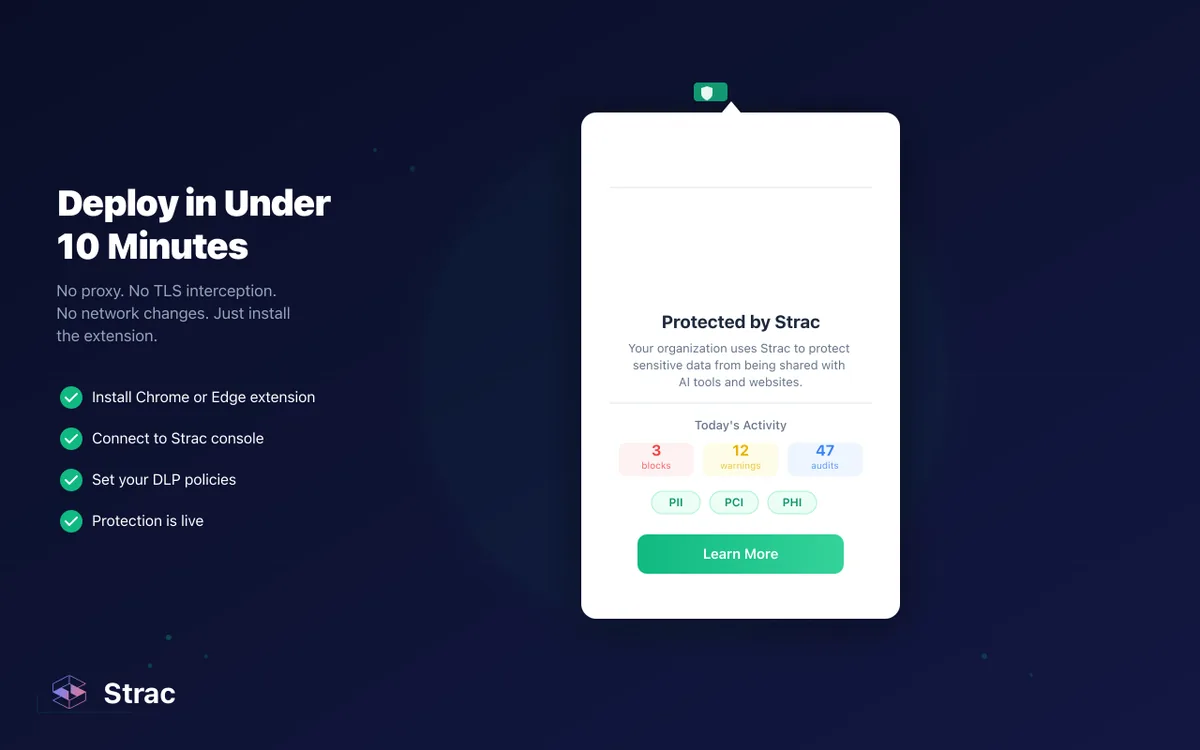
What it does well: - Real-time prompt DLP across 50+ AI tools (ChatGPT, Copilot, Claude, Gemini, Perplexity, and more) via browser extension - Shadow AI discovery on the endpoint — finds personal ChatGPT Plus, local LLMs (Ollama, LM Studio), unsanctioned extensions - Only platform that does image/document OCR redaction before content reaches AI - MCP DLP for agentic workflows — inspection at the Model Context Protocol boundary - Cross-SaaS redaction (Slack, Jira, Zendesk, Salesforce, Google Drive, SharePoint, Box) so data is clean before it reaches AI connectors - Copilot oversharing remediation — scans and remediates SharePoint/OneDrive permissions before M365 Copilot amplifies them - Deploys in under 10 minutes with no proxy and no TLS break
Weaknesses to know: Not a model governance platform. If you're training your own foundation models and need model registry / bias evaluation, pair Strac with Credo AI or IBM watsonx.
Pricing: $30–50 per user per year (starts), modular by product line (SaaS / Cloud / GenAI / Endpoint).
Verdict: If you're in the 95% of enterprises whose AI risk is employees using third-party AI, Strac is the most complete platform for the job.
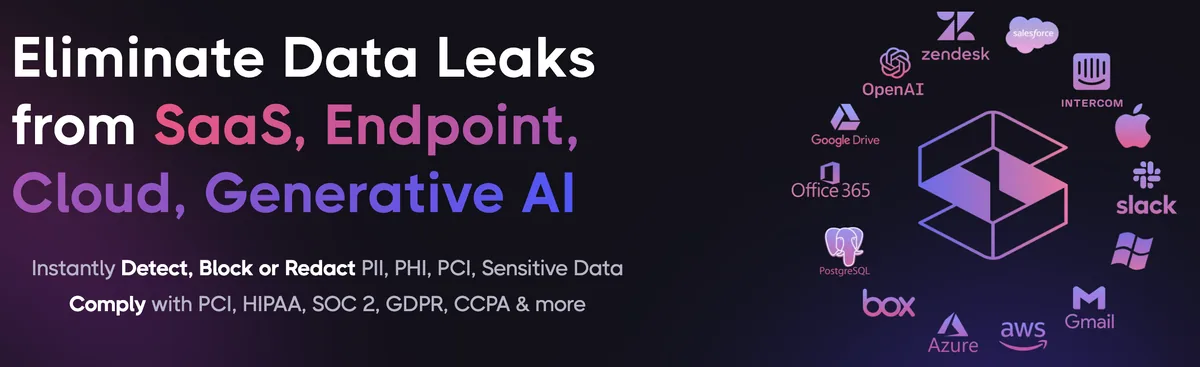
Usage governance isn't one product category — it's four surfaces AI touches. Strac covers all of them in one platform: Browser / GenAI (ChatGPT, Microsoft Copilot, Claude, Gemini, Perplexity, and 50+ AI tools via extension), SaaS (Slack, Gmail, Google Drive, Zendesk, Salesforce, SharePoint, OneDrive, Notion, Intercom — 50+ integrations), Cloud (AWS S3 / RDS / CloudWatch, Azure Blob, GCP), and Endpoint (Mac, Windows, Linux). When ChatGPT Enterprise pulls from a SharePoint connector, the data is already clean. When a Copilot agent retrieves an Excel file, the PII inside is already redacted. Point tools at each layer can't deliver that coherence.
Strac is the only AI governance tool that redacts sensitive content inline inside attachments (PDF, DOCX, XLSX, JPEG, PNG, screenshots) as well as in text prompts, Slack messages, Gmail threads, Zendesk tickets, and Salesforce records. That's what catches the sensitive data OCR-hidden in an uploaded W-2 or a screenshot of a Salesforce record — not just the text a user types. Detection runs on custom ML models tuned with customer feedback loops, which keeps false positives low. Scanning runs in real time and retroactively across historical data, with remediation actions spanning redact, mask, revoke access, delete, quarantine, and alert.
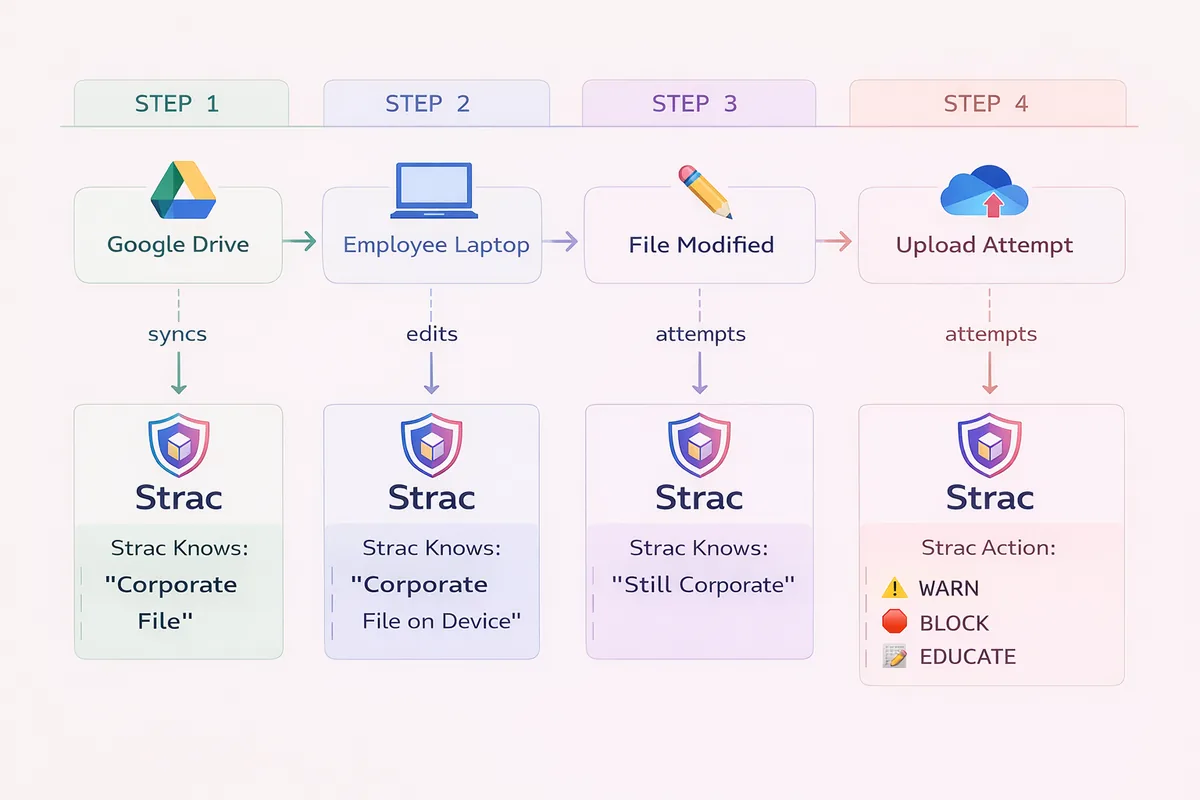
Browser extensions only see what happens in the browser. Strac's endpoint agent for Mac, Windows, and Linux sees everything else: personal ChatGPT Plus on corporate devices, local LLMs (Ollama, LM Studio), unsanctioned Chrome extensions, and the full lineage of sensitive files from origin to AI tool. That combination — browser + endpoint + SaaS + cloud — is what turns "we have an AI policy" into provable enforcement.
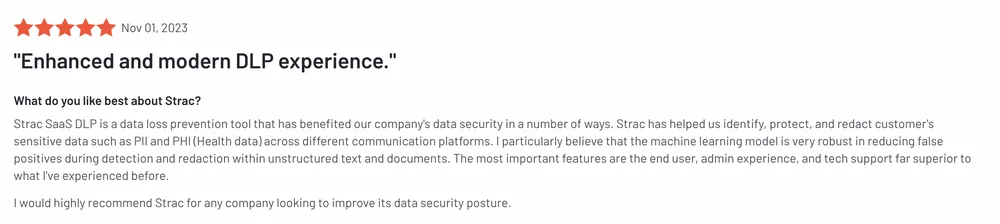
Strac is deployed at UiPath, Crypto.com, Underdog Fantasy, and 50+ other enterprises. Evidence is pre-mapped to NIST AI RMF, EU AI Act, ISO 42001, PCI DSS, SOC 2, HIPAA, ISO 27001, CCPA, and GDPR — continuously generated, not rebuilt per audit. Developer APIs, custom detectors, and a 30-day free trial let security teams pilot before procurement.
Best for: Enterprises already running Netskope's network security and wanting to extend to AI.
What it does well: - Bundled with an existing CASB/SSE deployment — no additional integration project - Network-layer visibility into AI tool usage - Decent prompt inspection on traffic flowing through the Netskope cloud
Weaknesses: Requires a TLS-breaking proxy (architecturally opinionated). Doesn't see traffic that bypasses the proxy (BYOD, some remote scenarios). Less granular than endpoint-native approaches. Shadow AI discovery limited to what transits the proxy.
Best for: Enterprises already on Zscaler ZIA/ZPA who want AI risk coverage in the existing stack.
What it does well: - Native integration with Zscaler's zero-trust fabric - Bundled licensing can reduce vendor count - Reasonable AI tool inventory via proxy traffic analysis
Weaknesses: Same proxy-architecture limitations as Netskope. Less depth than specialized platforms on prompt-level redaction and audit evidence generation.
Best for: Enterprises already standardized on Palo Alto (Prisma Access, Prisma SASE, NGFW) wanting AI risk coverage without adding a vendor.
What it does well: - AI Access Security adds visibility and control over 800+ GenAI apps for customers on Prisma Access / SASE - Prisma AIRS extends coverage to AI-app runtime protection (prompt injection, model abuse, data exfiltration) - Integrated with existing Palo Alto zero-trust, SASE, and NGFW telemetry — one pane across network and AI - Enterprise-grade scale, RBAC, and compliance posture
Weaknesses: Value is strongest when you're already a Palo Alto customer; standalone procurement is expensive and slower than specialized platforms. Same SASE/proxy architecture limits as Netskope and Zscaler — what bypasses the proxy (BYOD, some remote paths) isn't seen. Less depth on endpoint-native shadow AI discovery and prompt-level redaction than Strac.
Best for: Microsoft-heavy organizations standardizing on M365 Copilot as the primary AI tool.
What it does well: - Native Copilot DLP integration - Sensitivity label enforcement on Copilot grounding and responses - Audit logs inside Purview for M365-scoped AI usage
Weaknesses: Coverage is M365 only — doesn't govern ChatGPT, Claude, Gemini, or any AI tool outside Microsoft's ecosystem. For multi-AI environments, Purview is incomplete.
Best for: Large enterprises with existing Forcepoint relationships consolidating AI risk.
What it does well: - Extends mature network DLP to AI tool categories - Enterprise-grade RBAC, audit, deployment options
Weaknesses: Network/proxy architecture. Less real-time browser-native enforcement than specialized tools.
Best for: Organizations building ML/LLM systems that need a mature model governance and responsible AI platform.
What it does well: - Most mature model governance platform - Comprehensive AI risk management workflows - Strong NIST AI RMF, EU AI Act mapping - Model registry, AI bill of materials, evaluation documentation
Weaknesses: Not a usage governance tool — doesn't govern ChatGPT/Copilot usage, doesn't do real-time prompt DLP, doesn't discover shadow AI. Expensive relative to usage-focused alternatives.
Pricing: Enterprise-only, typically $100+ per user per year or annual flat fees.
Best for: IBM-shop enterprises deploying AI within the IBM ecosystem.
What it does well: - Integrated with IBM's broader AI/ML platform (watsonx.ai, Cloud Pak for Data) - Comprehensive model lifecycle governance - Strong compliance mapping and audit evidence
Weaknesses: Best value for IBM-committed customers. Not designed for usage governance scenarios. Complex deployment and long procurement cycles.
Best for: Enterprises wanting AI security (supply chain, adversarial) plus model governance in one tool.
What it does well: - Model discovery and AI supply chain visibility - Adversarial testing and red-teaming capabilities - Growing compliance mapping
Weaknesses: Relatively new category mix — combines AI security and governance which can be both a feature and a complexity. Less focused on employee AI usage.
Best for: Financial services and insurance firms with heavy model risk management (MRM) requirements.
What it does well: - Strong fit for regulated model risk management (SR 11-7, Fed guidelines) - Detailed model documentation and audit workflows - Financial services domain expertise
Weaknesses: Vertical-specific. Less useful for organizations outside regulated finance/insurance.
Best for: Organizations with fairness and bias as a primary AI governance concern.
What it does well: - Specialized fairness, bias, and discrimination evaluation - Good fit for HR tech, lending, and consumer AI use cases
Weaknesses: Narrower scope than full-platform model governance tools. Needs to be paired with other governance capabilities for a complete program.
Best for: Organizations with existing Collibra data governance wanting AI governance in the same tool.
What it does well: - Integrates AI governance with data catalog and lineage - Strong data-side controls - Mature enterprise deployments
Weaknesses: Thinner on real-time AI usage enforcement. Better for documentation and cataloging than operational controls.
Best for: Organizations already on OneTrust privacy/GRC seeking AI governance in the same vendor.
What it does well: - GRC-style AI governance (policy, assessment, workflow) - Native integration with broader OneTrust privacy stack - Strong for documentation and audit prep
Weaknesses: Classical GRC approach — less operational / real-time than platforms built for AI specifically. Doesn't enforce at the prompt level.
Best for: Enterprises using Dataiku for data science wanting governance in the same platform.
What it does well: - Integrated with Dataiku's data science and ML ops - Good fit for governance of internally-built models on the Dataiku platform
Weaknesses: Limited scope outside the Dataiku ecosystem. Not a general-purpose AI governance platform.
Skip the "pick based on analyst rankings" approach. Use this:
Step 1: Identify your subcategory. - If your AI risk is primarily employees using third-party AI → usage governance (Strac, Netskope AI, Zscaler AI, Palo Alto, Purview, Forcepoint) - If your AI risk is primarily models your company builds → model governance (Credo AI, IBM watsonx, Cranium, Monitaur) - If both → you'll need both categories; don't expect one tool to do both well
Step 2: Evaluate by your actual usage pattern. - Are employees using multiple AI tools (ChatGPT + Copilot + Claude + Gemini)? You need multi-tool coverage. Purview is M365-only; Strac covers all. - Are you regulated (HIPAA / PCI / GDPR / EU AI Act)? Pre-built framework mapping matters. Strac, Credo AI, IBM have the most complete coverage. - Are you building agentic AI with MCP? Only Strac currently offers MCP DLP.
Step 3: Match to deployment tolerance. - No proxy / no TLS break needed? Strac. - Comfortable with proxy / SASE architecture? Netskope, Zscaler, Palo Alto, Forcepoint. - Microsoft-only acceptable? Purview.
Step 4: Match to budget and procurement. - Fast deployment and modular pricing? Strac. - Already on a network security incumbent? Netskope, Zscaler, Palo Alto, or Forcepoint bundled. - Enterprise procurement with IBM/Microsoft relationship? IBM watsonx, Purview.
Among AI governance platforms, Strac's unique position is full coverage of the five surfaces where data actually flows in the AI era — most vendors on this list cover one or two:
Strac's browser extension intercepts every prompt before it reaches the LLM API and redacts PII, PHI, PCI (cardholder data), source code, and secrets inline. The model still works — it never sees the raw sensitive data. Coverage extends to claude.ai, ChatGPT, Gemini, Microsoft Copilot, Perplexity, Mistral, DeepSeek, plus Anthropic and OpenAI APIs. See Strac Generative AI DLP and Strac Claude DLP.
When a Claude, Cursor, or ChatGPT agent calls a Slack, Gmail, Google Drive, GitHub, Notion, or any other MCP server, Strac sits inline and redacts sensitive data in every tool-call response. Strac is the first DLP with native Model Context Protocol policy enforcement — most enterprise DLP vendors still have no MCP support at all. Full background: MCP DLP guide.
The same redaction and labeling policies apply to every SaaS surface where data lives — Slack, Google Drive, Gmail, M365, OneDrive, SharePoint, Salesforce, Notion, Jira, Confluence, GitHub, Linear, HubSpot, Asana, Zendesk, Intercom, Box, ServiceNow, and 30+ more. Continuous data discovery and classification (DSPM) inventories every personal data type across your environment and automatically applies the right sensitivity label.
Strac continuously scans AWS (S3, RDS, EBS, CloudWatch), Azure (Blob Storage, SQL), and GCP (Cloud Storage, BigQuery) for sensitive data at rest. Not point-in-time scans — continuous discovery with automatic classification. The output powers compliance evidence for GDPR, HIPAA, PCI DSS, SOC 2, and ISO 27001 audits.
For data egress outside the SaaS perimeter — local file shares, USB drives, screenshots, terminal output, IDE clipboards. Strac's endpoint agent enforces the same policies as the SaaS, browser, and MCP layers, with full audit logs for any sensitive data movement.
For the cross-vendor view, see Top 10 AI Data Security Companies in 2026 — Strac is the only vendor on the list with native coverage across all five surfaces. For the regulatory mapping, see GDPR for AI Systems: 2026 Compliance Guide.
For 95% of enterprises, the AI governance problem worth solving first is usage governance — the employees already using ChatGPT, Copilot, Claude, and Gemini with your data. Strac is built for exactly this, with depth (MCP DLP, image redaction, cross-SaaS) that matters for regulated industries.
If you're in the 5% building foundation models or custom ML, pair usage governance with model governance (Credo AI, IBM watsonx, Cranium).
If you're shopping "AI governance" and the products look like GRC tools — you're probably shopping the wrong subcategory. See Strac's AI governance platform or book a demo to compare in a 15-minute walkthrough.
Related reading: AI Usage Governance vs Model Governance · What Is AI Governance? · ChatGPT Security Risks · Microsoft Copilot Security
Governance starts with knowing which AI is already in use. See shadow AI.
For the posture-management side of the AI estate specifically, see AI-SPM.
Governance that cannot enforce is documentation. Strac governs at the point data actually moves:
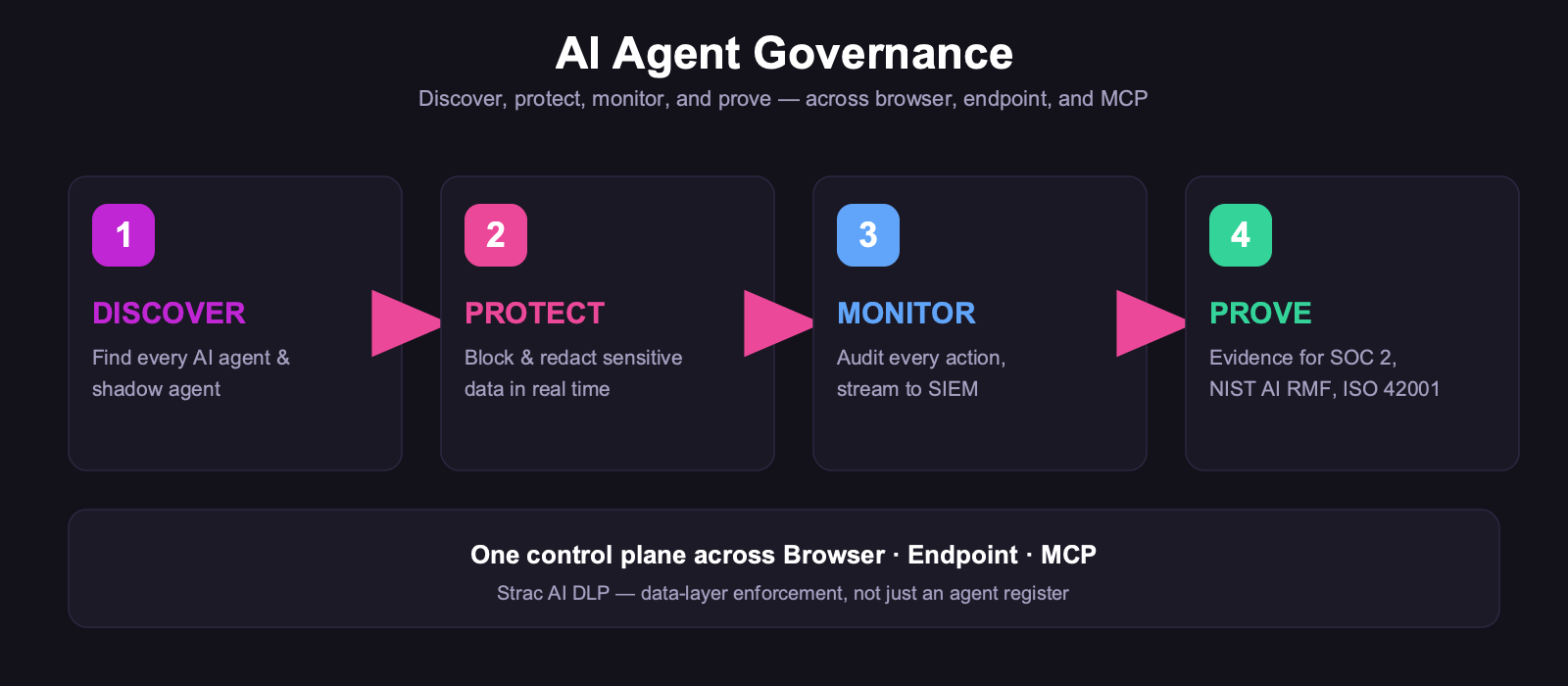
For AI agents specifically: AI agent identity governance, AI agent security, and enterprise AI agent governance.
It depends on which AI governance subcategory you need. For AI usage governance (controlling how employees use third-party AI like ChatGPT and Copilot), Strac leads on capability breadth — real-time prompt DLP across 50+ tools, shadow AI discovery, MCP coverage, image OCR redaction. For AI model governance (managing models your company builds), Credo AI and IBM watsonx.governance are the most mature options.
AI governance tools manage risk through policy, process, and controls — they're about ongoing compliance and enforcement. AI security tools focus on protecting AI systems from attacks (prompt injection, model extraction, training data poisoning, adversarial inputs). There's overlap — usage governance tools like Strac include security-relevant capabilities like DLP and shadow AI discovery. Model security tools like Cranium span both.
Some vendors offer free tiers or pilot programs (Strac offers a short pilot with starter pricing). Open-source AI governance options exist for narrow use cases (fairness evaluation libraries like AI Fairness 360, basic model registries). A complete AI governance program typically requires commercial software given the scope of enforcement, discovery, and evidence generation required.
AI usage governance tools: typically $30–100 per user per year. Strac starts around $30–50 per user per year (modular pricing). Network-layer platforms (Netskope, Zscaler, Palo Alto, Forcepoint) are usually bundled into broader SASE/SSE subscriptions rather than sold as standalone AI SKUs. AI model governance tools: typically enterprise-only pricing, starting at $100+ per user per year or annual flat fees (Credo AI, IBM watsonx.governance).
Small businesses typically need usage governance, not model governance. For small teams (<100 people), Strac is the most accessible option — modular pricing scales down and deployment is under 10 minutes with no proxy. Microsoft Purview is an option for Microsoft-heavy small businesses, though it's M365-only and limited outside the Microsoft ecosystem. Network-layer incumbents (Netskope, Zscaler, Palo Alto, Forcepoint) are typically over-scoped and over-priced for small teams.
Usage governance tools deploy fastest. Strac is under 10 minutes to live enforcement via browser extension and SaaS OAuth connections — no proxy, no TLS break. Network-layer tools like Netskope, Zscaler, Palo Alto, and Forcepoint require weeks for proxy/SASE deployment (longer if you're not already a customer). Microsoft Purview deploys fast inside existing M365 tenants. Model governance tools (Credo AI, IBM watsonx) typically take months given enterprise deployment and model inventory scope.
.avif)


.gif)


.webp)