ISO 42001: AI Management System Standard & Certification (2026)
ISO 42001 is the international standard for AI management systems (AIMS). Here's what it requires, how certification works, how it maps to NIST AI RMF and the EU AI Act, and how Strac evidences the data-protection controls.
ISO/IEC 42001 is the world's first international standard for an AI Management System (AIMS) — the AI equivalent of what ISO 27001 is for information security. It gives organizations a certifiable framework to govern AI responsibly.
It's risk-based and lifecycle-oriented: policies, roles, risk and impact assessments, controls (Annex A), and continual improvement across the AI lifecycle.
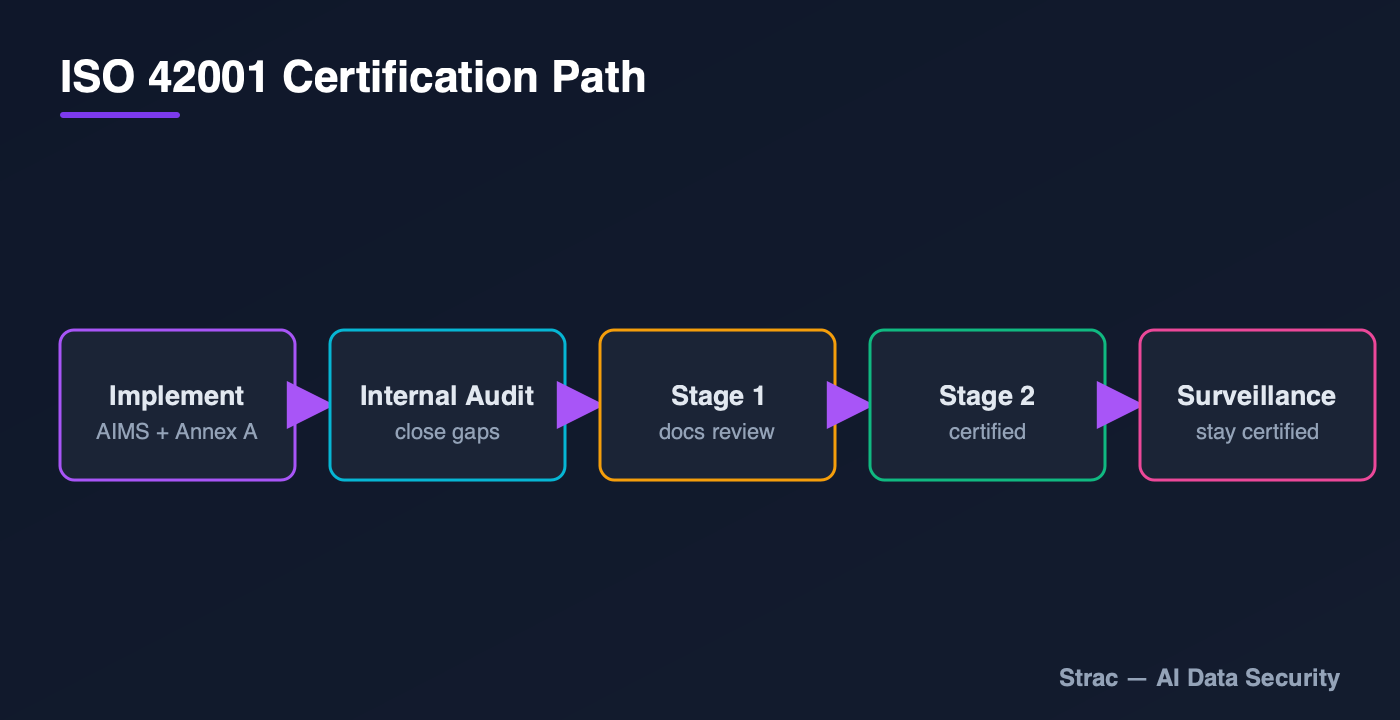
Certification follows the ISO model: implement the AIMS, run an internal audit, then a two-stage external audit by an accredited body.
ISO 42001 pairs with NIST AI RMF and the EU AI Act; together they're the AI-governance stack auditors and enterprise customers now ask about. Strac evidences the data-and-access controls.
✨ What Is ISO 42001?
ISO/IEC 42001:2023 specifies requirements for establishing, implementing, maintaining, and continually improving an Artificial Intelligence Management System. Like ISO 27001, it's a management-system standard — it governs how you manage AI risk across the organization, not a single technical control. It applies to any organization that develops, provides, or uses AI.
Annex A controls — a catalog spanning AI policies, data for AI systems, resources, lifecycle management, and third-party/customer responsibilities.
The control that trips teams up most is data governance for AI systems — proving the data used by and reachable by AI is classified, controlled, and protected.
The ISO 42001 clause structure — Annex A and data governance for AI systems are where teams stall.
✨ ISO 42001 Certification — How It Works
Implement the AIMS — scope, policies, risk and impact assessments, Annex A controls.
Internal audit & management review — confirm the system works and close gaps.
Stage 1 external audit — an accredited certification body reviews your documentation and readiness.
Stage 2 external audit — the body audits the AIMS in operation and issues certification.
Surveillance audits — periodic audits maintain certification over a multi-year cycle.
It mirrors ISO 27001 certification, so teams with an ISO 27001 program have a head start.
The ISO 42001 certification path mirrors ISO 27001 — implement, audit, two external stages, then surveillance.
✨ ISO 42001 vs NIST AI RMF vs EU AI Act
ISO 42001 — a certifiable management system for AI (the "how to run AI governance").
NIST AI RMF — a voluntary risk-management framework (Govern, Map, Measure, Manage).
EU AI Act — regulation with binding obligations for higher-risk AI.
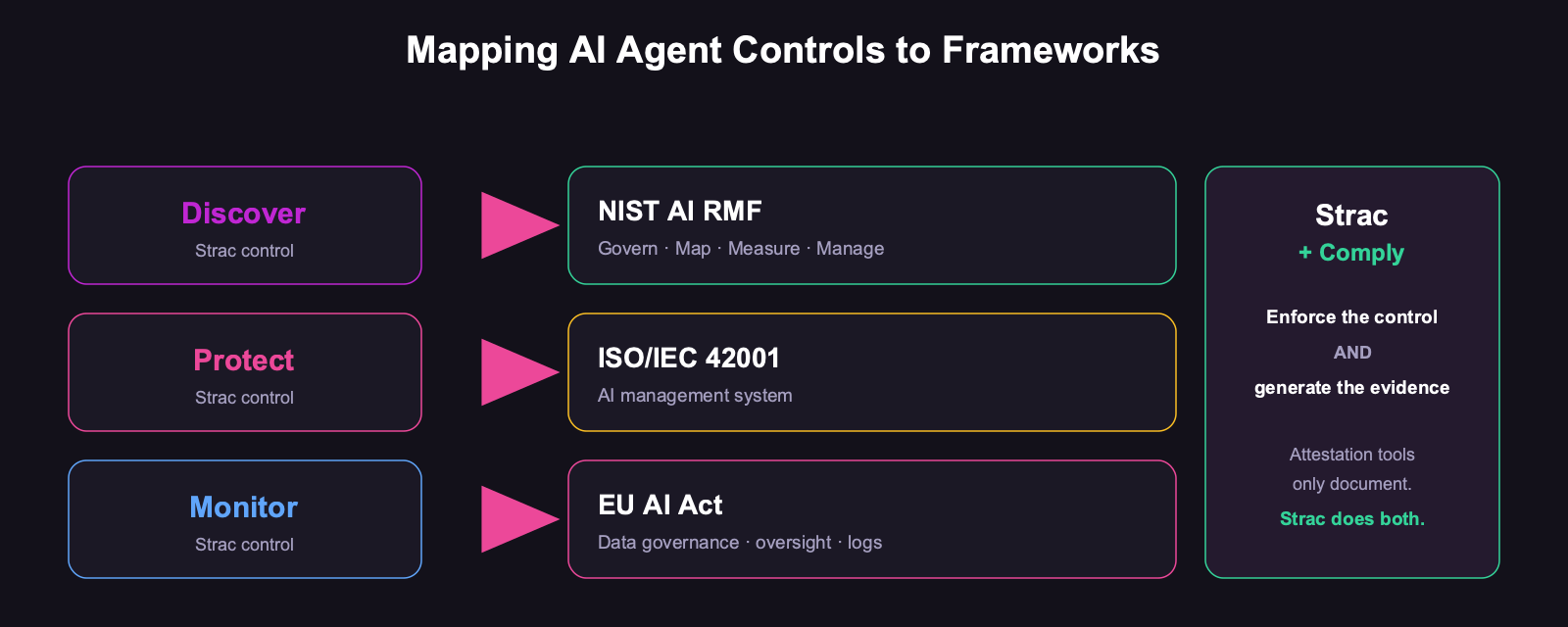
They overlap and reinforce each other; mapping your controls once and reusing the evidence across all three is the efficient path. See how Strac maps to all three.
One set of data-and-access controls, mapped to every AI framework.
✨ How Strac Evidences ISO 42001's Data Controls
ISO 42001's hardest requirements are the data ones — proving you know where AI is used, what data it consumes, and that sensitive data is actually controlled. Policy documents don't satisfy an assessor; operating controls with records do. Strac's AI data governance platform runs those controls and produces the evidence as a by-product:
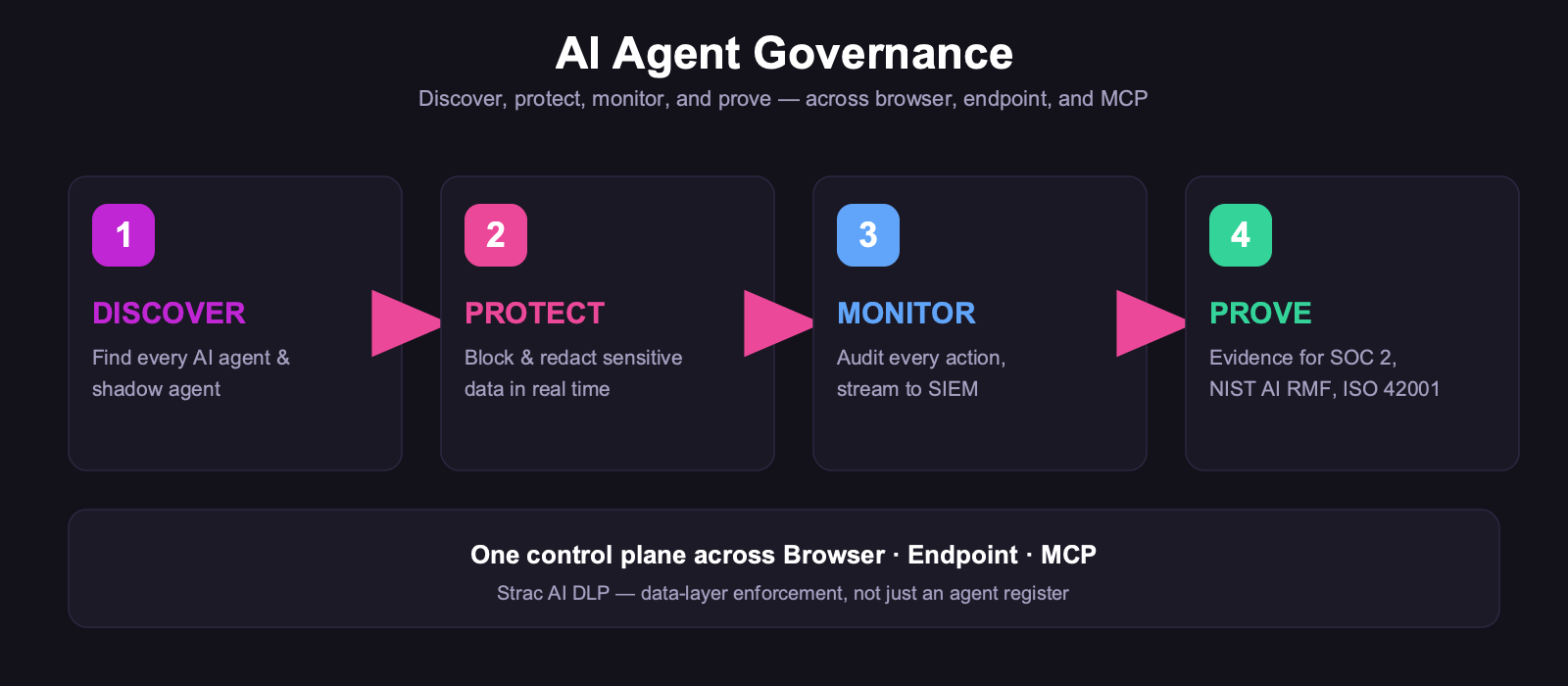
The same Discover → Protect → Monitor → Prove program an assessor walks through — mapped to the standard.
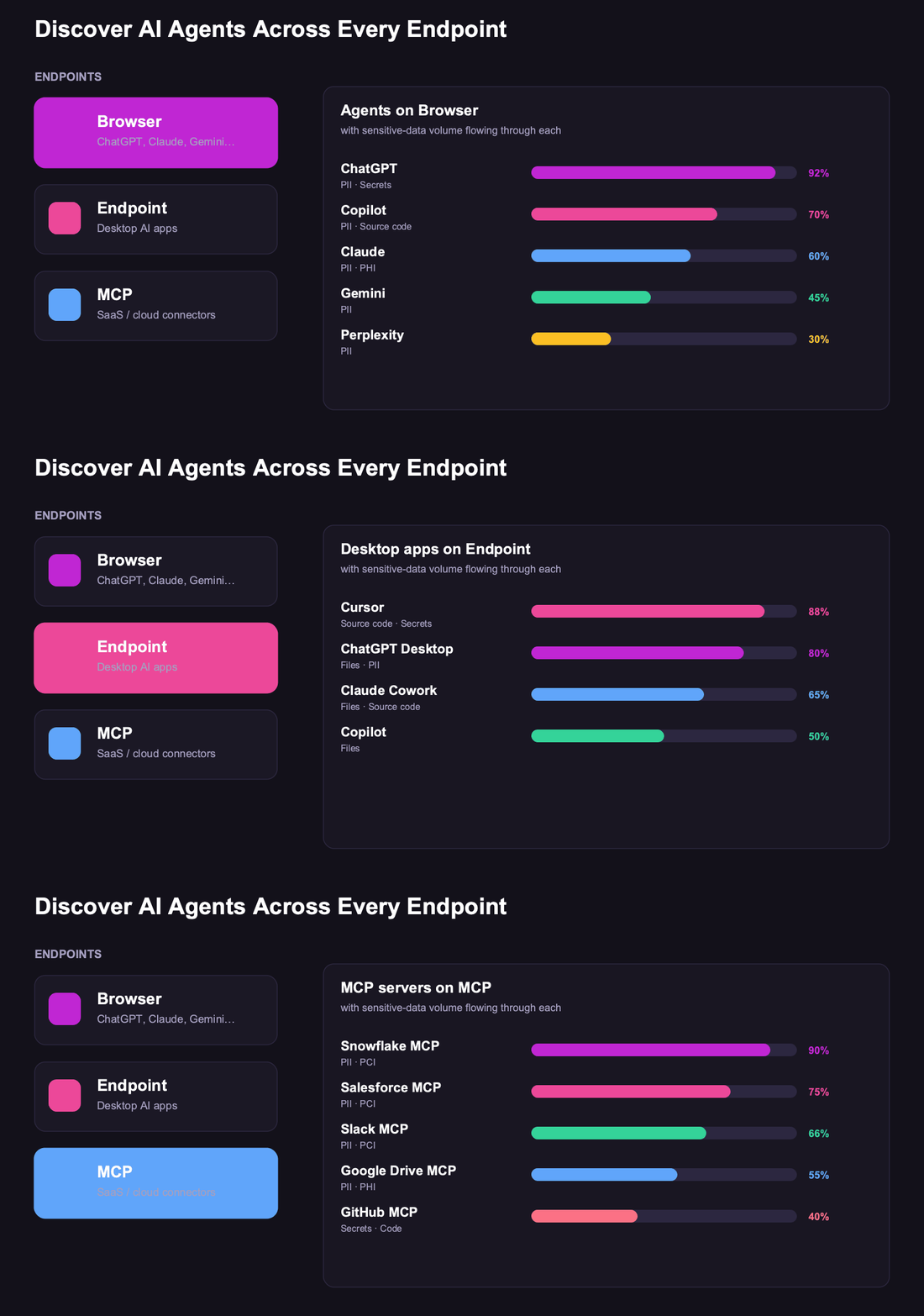
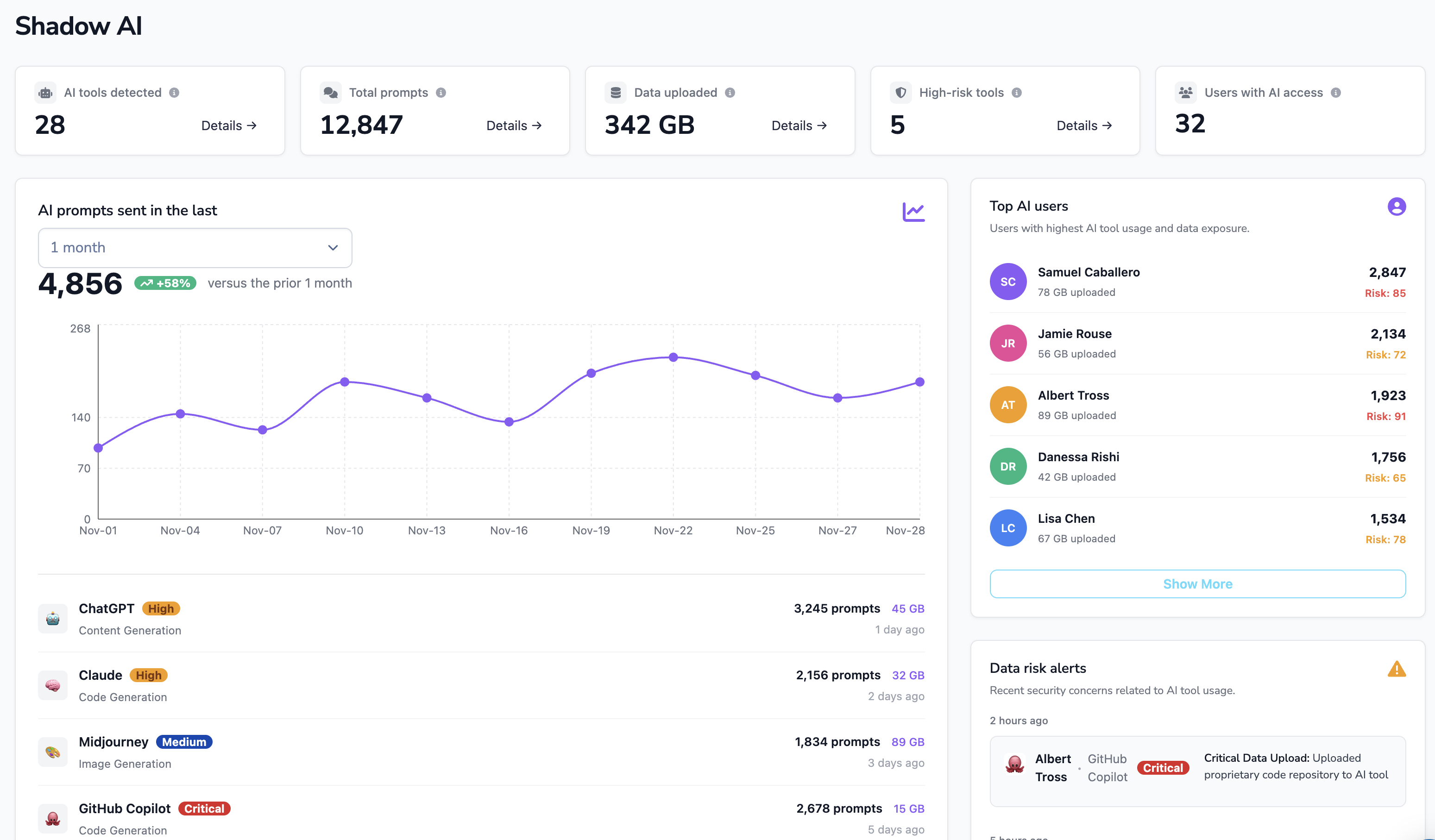
1. The AI system inventory (the first thing an auditor asks for). Strac discovers every AI tool, agent, and MCP server in use across browser, endpoint, and SaaS — including the shadow AI nobody registered — with the sensitive-data volume flowing through each. That is your Annex A asset and resource evidence, live instead of a stale spreadsheet.
Discovery in motion: every agent and MCP server, ranked by the sensitive data flowing through it.
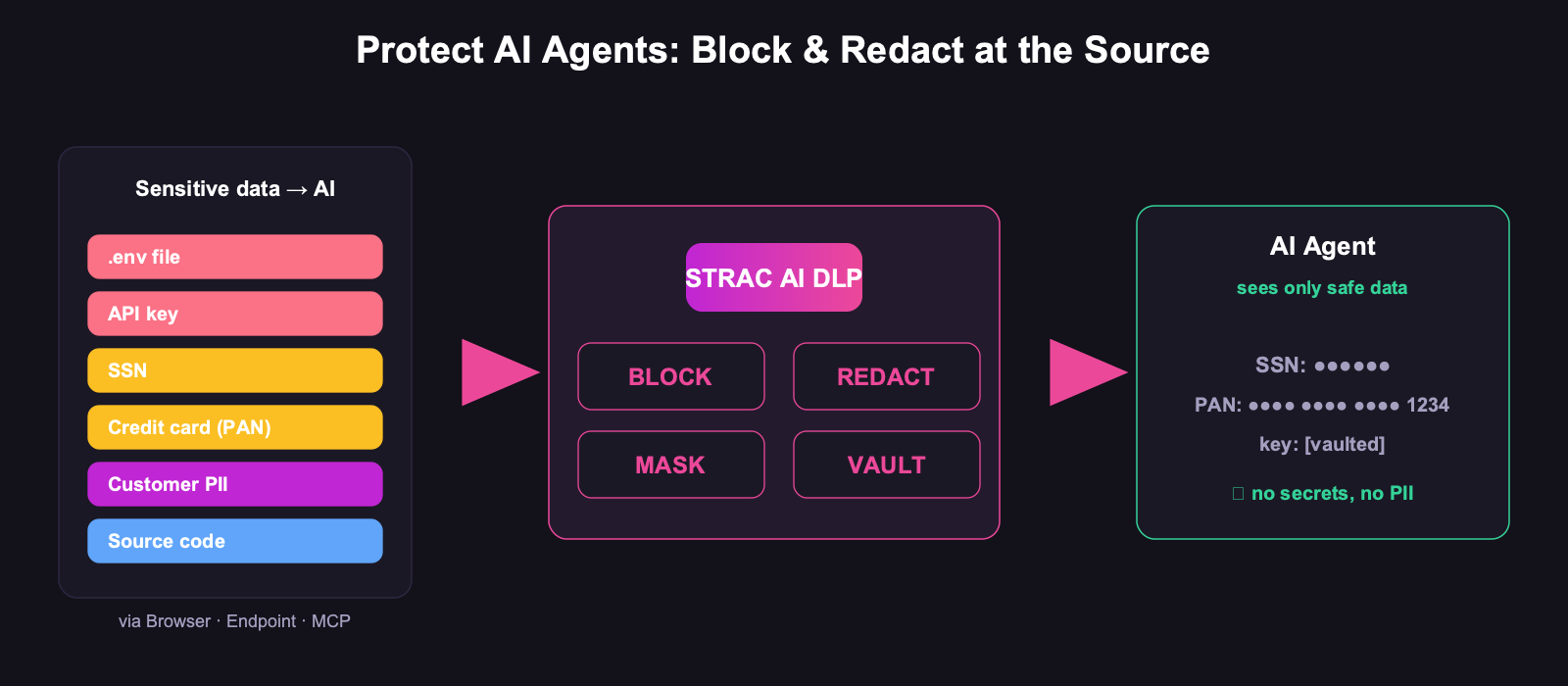
2. Data governance that enforces, not advises. 42001's data controls expect sensitive data in AI systems to be governed. Strac classifies data in the flow and remediates inline — redact, mask, block, vault — in browser prompts, on endpoints, and inside every MCP tool call, so regulated data never reaches the model ungoverned.
Enforcement at the source: the AI sees only safe data — and every action is a logged control event.
3. Least-privilege agent access. Per-tool, per-action allow/block rules and approval gates on agent access to SaaS and databases — the human-oversight and access-control story 42001 expects for AI systems that act autonomously.
4. The audit trail, produced automatically. Every detection, redaction, block, and access decision is logged with the user, agent, data class, and action, and streams to your SIEM. When the assessor samples your data-governance controls, the records already exist.
The per-action ledger an ISO 42001 assessor samples — collected continuously, not screenshotted quarterly.
Running the controls is half the job; ISO 42001 also asks you to manage AI as a system — policy, risk and impact assessments, internal audits, and a binder of evidence that stays current. Strac Comply operationalizes that layer:
Controls mapped to the standard — the data-security events above land in the binder pre-mapped to ISO 42001's clauses and Annex A, alongside your policies and assessments.
Cross-framework reuse — the same control evidence satisfies ISO 27001, SOC 2, and EU AI Act readiness once instead of four times; see ISO 27001 AI compliance for how the two standards share the load.
The last mile automated — Strac's AI Evidence Agent captures the residual manual evidence other platforms leave to screenshots.
Certification-ready — when the Stage 2 auditor samples controls, the operating records are already attached; the full path is in our ISO 42001 certification guide.
One platform: AI data governance doing the enforcing, Strac Comply turning it into an ISO 42001 binder.
Net effect: the protection is the evidence. Teams that run enforcement-first programs walk into certification with the audit trail already written — typically in weeks, not the quarters a documentation-first program takes.
🌶️ Spicy FAQs for ISO 42001
What is ISO 42001?
ISO/IEC 42001 is the first international standard for an AI Management System (AIMS) — a certifiable framework for governing AI responsibly across its lifecycle, analogous to ISO 27001 for information security.
How do you get ISO 42001 certified?
Implement the AIMS (scope, policies, risk and impact assessments, Annex A controls), run an internal audit, then pass a two-stage external audit by an accredited certification body, followed by periodic surveillance audits.
What's the difference between ISO 42001 and ISO 27001?
ISO 27001 manages information security; ISO 42001 manages AI specifically — adding AI risk and impact assessments and AI-lifecycle controls. They share the same management-system structure, so an ISO 27001 program accelerates ISO 42001.
How does ISO 42001 relate to the EU AI Act and NIST AI RMF?
ISO 42001 is a certifiable management system, NIST AI RMF is a voluntary risk framework, and the EU AI Act is binding regulation. Map your controls once and reuse the evidence across all three — see AI governance frameworks.
What are the hardest ISO 42001 controls?
The data-governance controls — proving the data AI systems use and reach is classified, access-controlled, and protected. Strac automates that evidence.
To produce the evidence an ISO 42001 assessor wants, Strac Comply's AI Evidence Agent captures it auditor-ready from any system you can log into, and its headless compliance MCP server lets an AI agent write evidence into your binder — mapped across ISO 42001, NIST AI RMF, and your other frameworks. See Strac Comply.
The Bottom Line
ISO 42001 is becoming the de facto way to prove responsible AI, the way ISO 27001 became the proof for security. The framework is straightforward; the data-governance controls are the hard part. Strac evidences them automatically — discover, control, remediate, and audit AI's access to your data.
ISO/IEC 42001 is the first international standard for an AI Management System (AIMS) — a certifiable framework for governing AI responsibly across its lifecycle, analogous to ISO 27001 for information security.
How do you get ISO 42001 certified?
Implement the AIMS (scope, policies, risk and impact assessments, Annex A controls), run an internal audit, then pass a two-stage external audit by an accredited certification body, followed by periodic surveillance audits.
What's the difference between ISO 42001 and ISO 27001?
ISO 27001 manages information security; ISO 42001 manages AI specifically — adding AI risk and impact assessments and AI-lifecycle controls. They share the same management-system structure, so an ISO 27001 program accelerates ISO 42001.
How does ISO 42001 relate to the EU AI Act and NIST AI RMF?
ISO 42001 is a certifiable management system, NIST AI RMF is a voluntary risk framework, and the EU AI Act is binding regulation. Map your controls once and reuse the evidence across all three — see AI governance frameworks.
What are the hardest ISO 42001 controls?
The data-governance controls — proving the data AI systems use and reach is classified, access-controlled, and protected. Strac automates that evidence.
Discover & Protect Data on SaaS, AI, MCP, Endpoints & Cloud
Strac provides end-to-end data loss prevention for all SaaS and Cloud apps. Integrate in under 10 minutes and experience the benefits of live DLP scanning, live redaction, and a fortified SaaS environment.


.webp)







.avif)



.gif)
