Agentic AI Security: Risks, Controls, and How to Secure AI Agents (2026)
Agentic AI security keeps autonomous AI agents safe and under control. The core risks, how to secure an agent's data access with a gateway, and where Strac fits.
Short answer: Agentic AI security is how you keep autonomous AI agents, software that plans and acts by calling tools and pulling data, safe and under control. The hardest part is the data: what an agent can reach and what it sends out. Strac governs that data layer with a reverse-proxy MCP gateway that redacts tool responses before they reach the model.
Agentic AI security starts with the data path: what an agent can access and send.
✨ What is agentic AI security?
Agentic AI security is the set of controls that keep autonomous AI agents operating safely and within policy. Unlike a chatbot that only responds, an agent plans and takes actions: it calls APIs, queries databases, writes code, and chains steps together to finish a task. That autonomy is powerful, and it is exactly what makes agents risky, because a single over-permissioned or hijacked agent can move or expose data at machine speed.
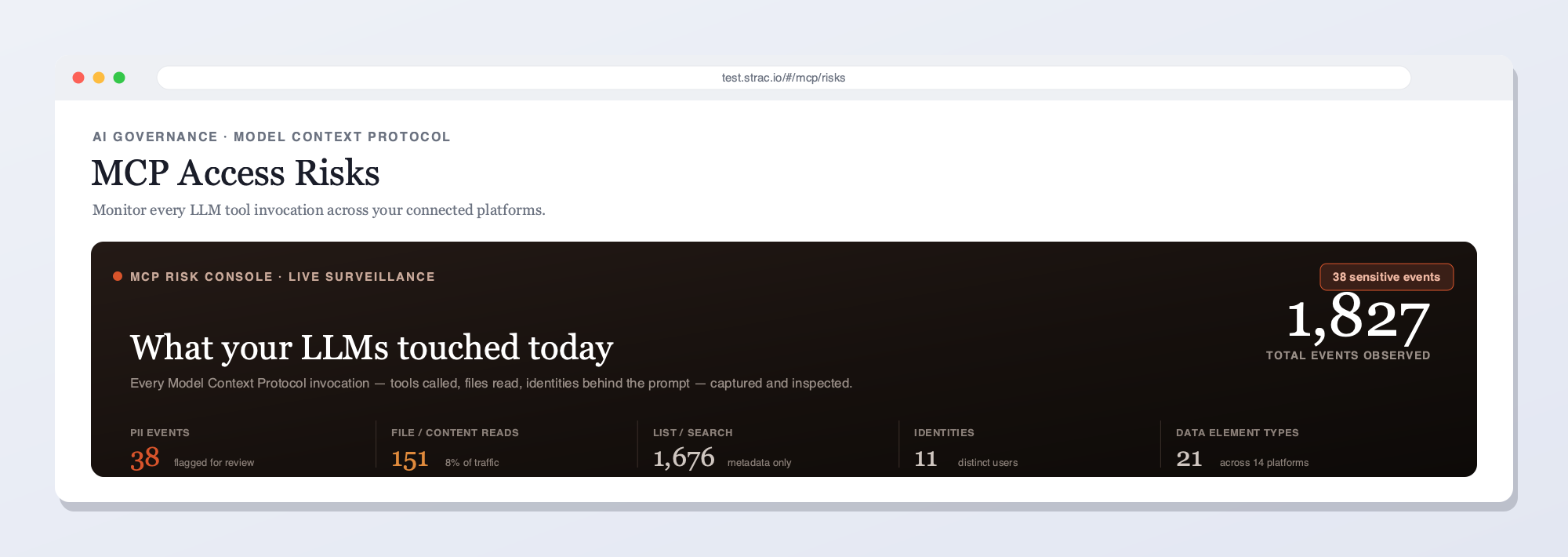
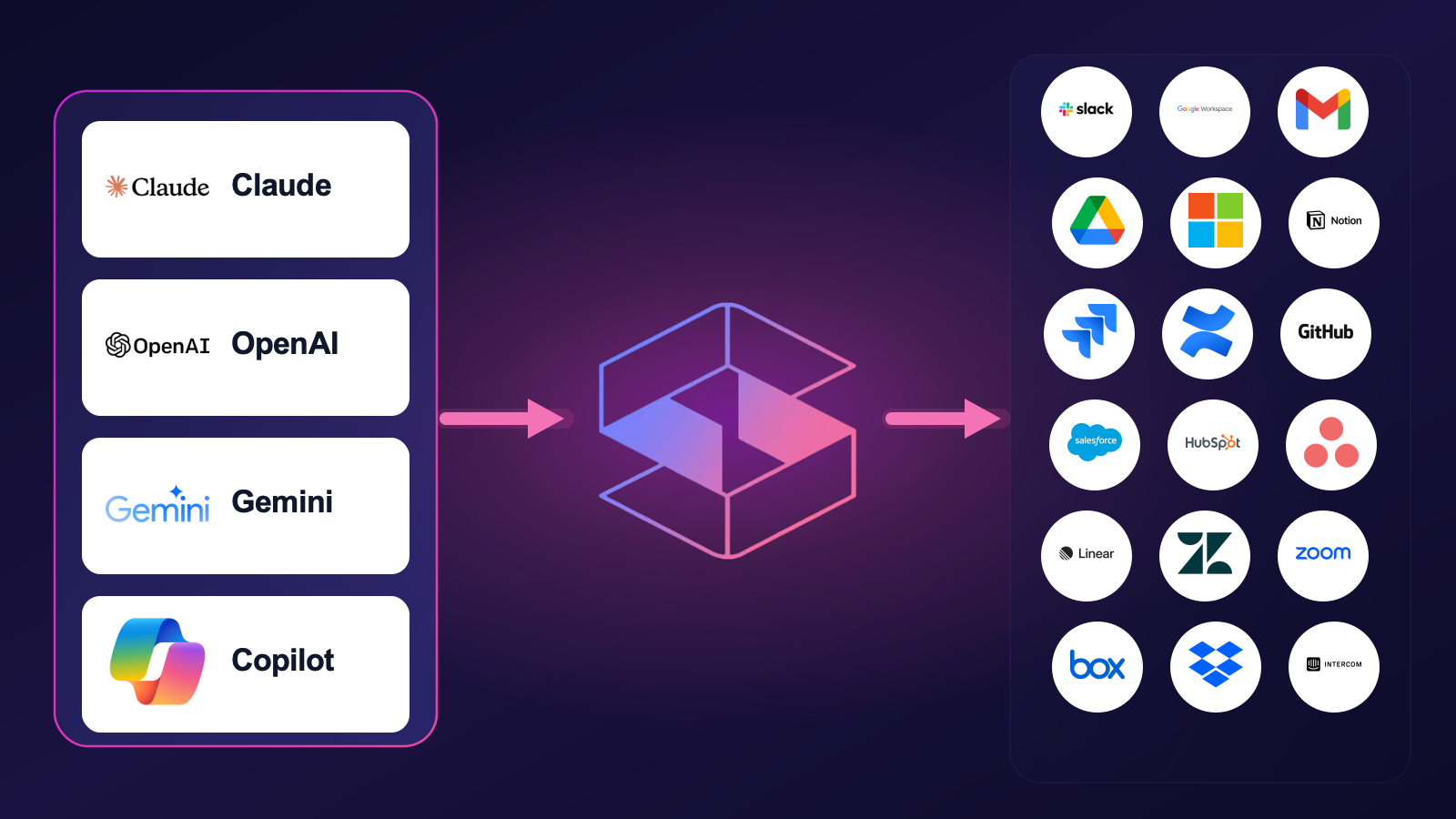
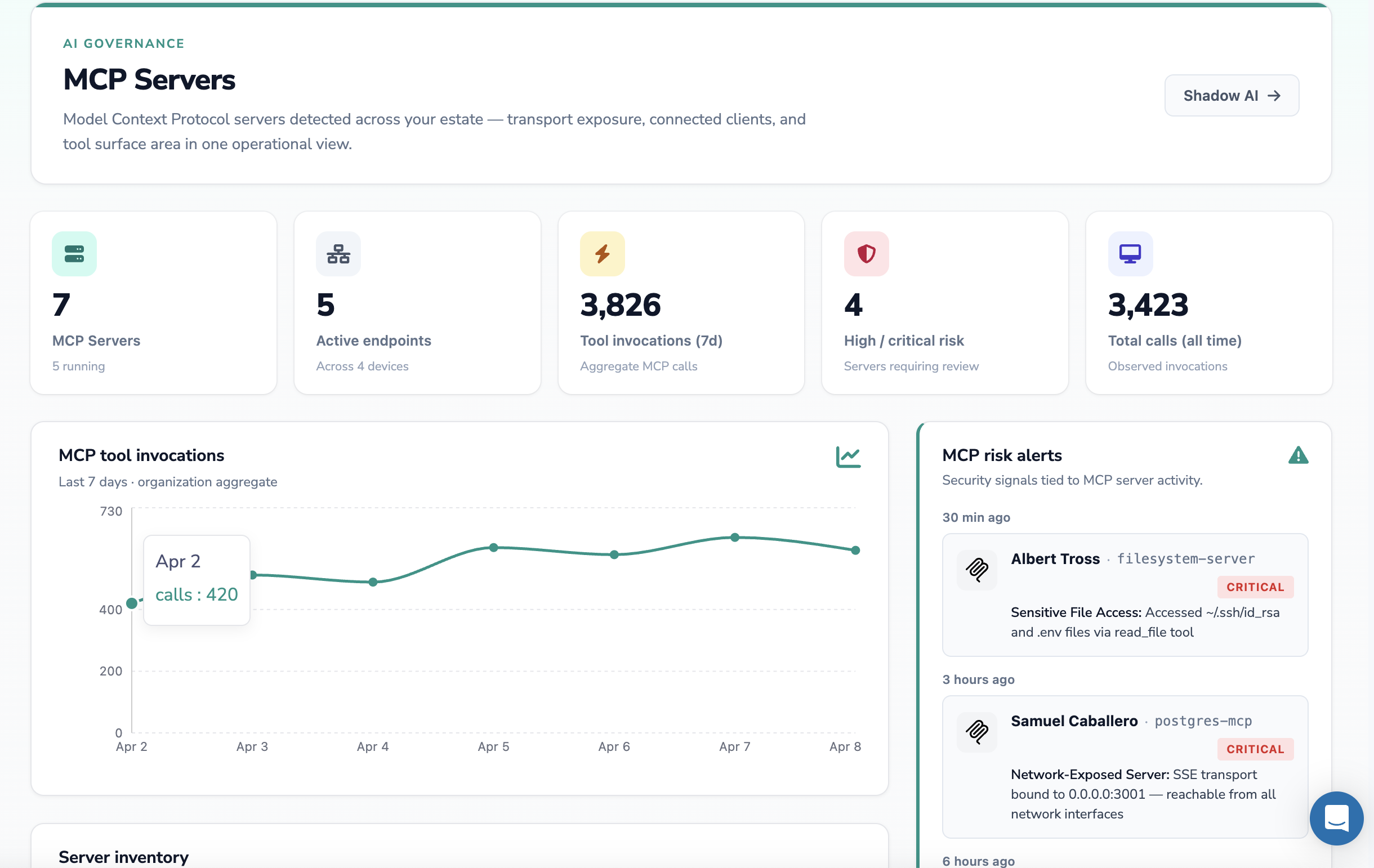
Strac MCP console: AI agent DLP across servers and tool calls.
✨ Why agents are harder to secure than chatbots
Every tool call is a path out; Strac redacts at the MCP tool-call boundary.
A chatbot has one surface: the text it returns. An agent has many: every tool it can call, every system it can reach, and every action it can trigger. Security has to move from filtering output to governing the data path, the connection between the agent and your tools, because that is where sensitive data actually flows.
✨ The core risks of agentic AI
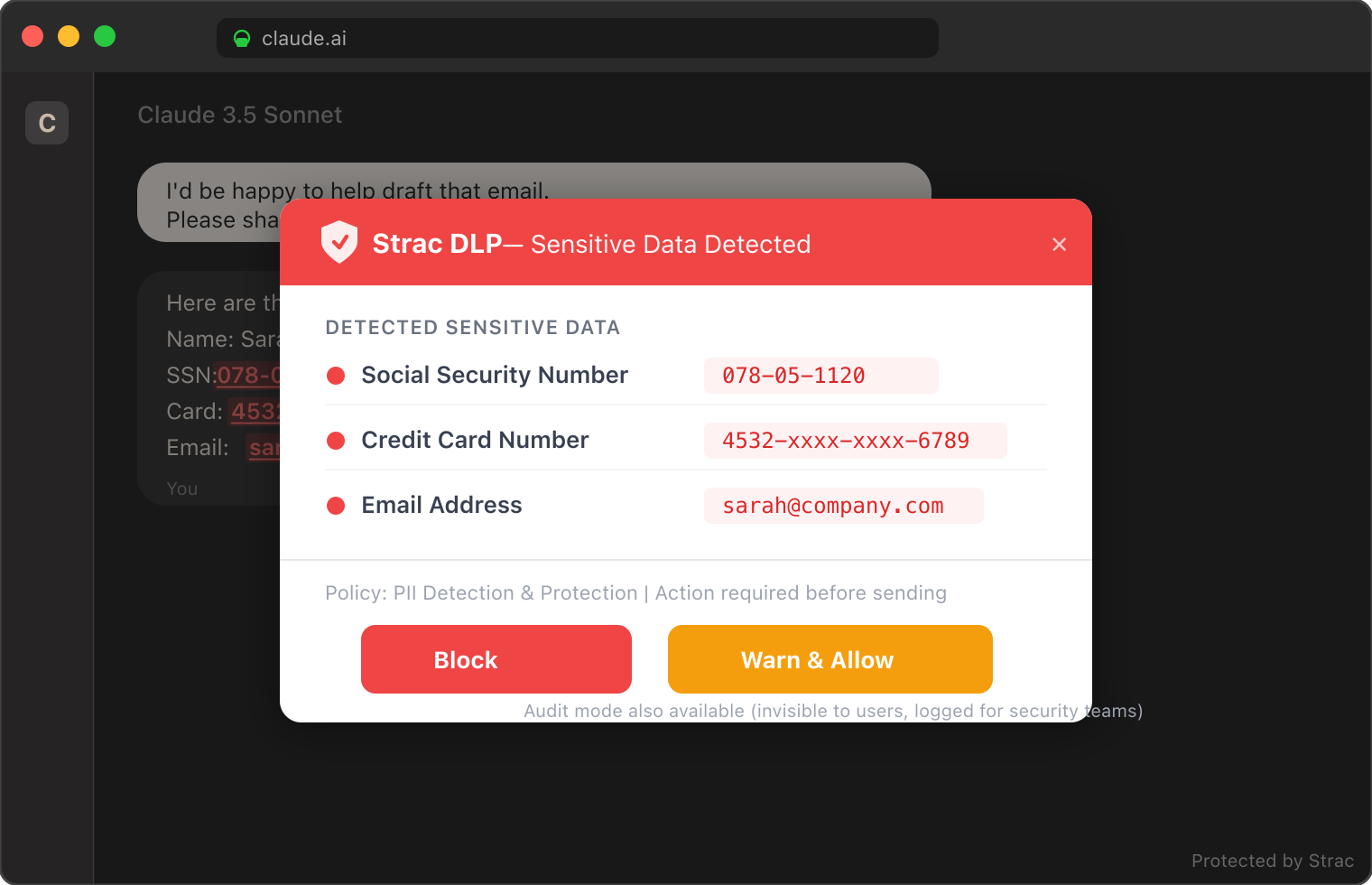
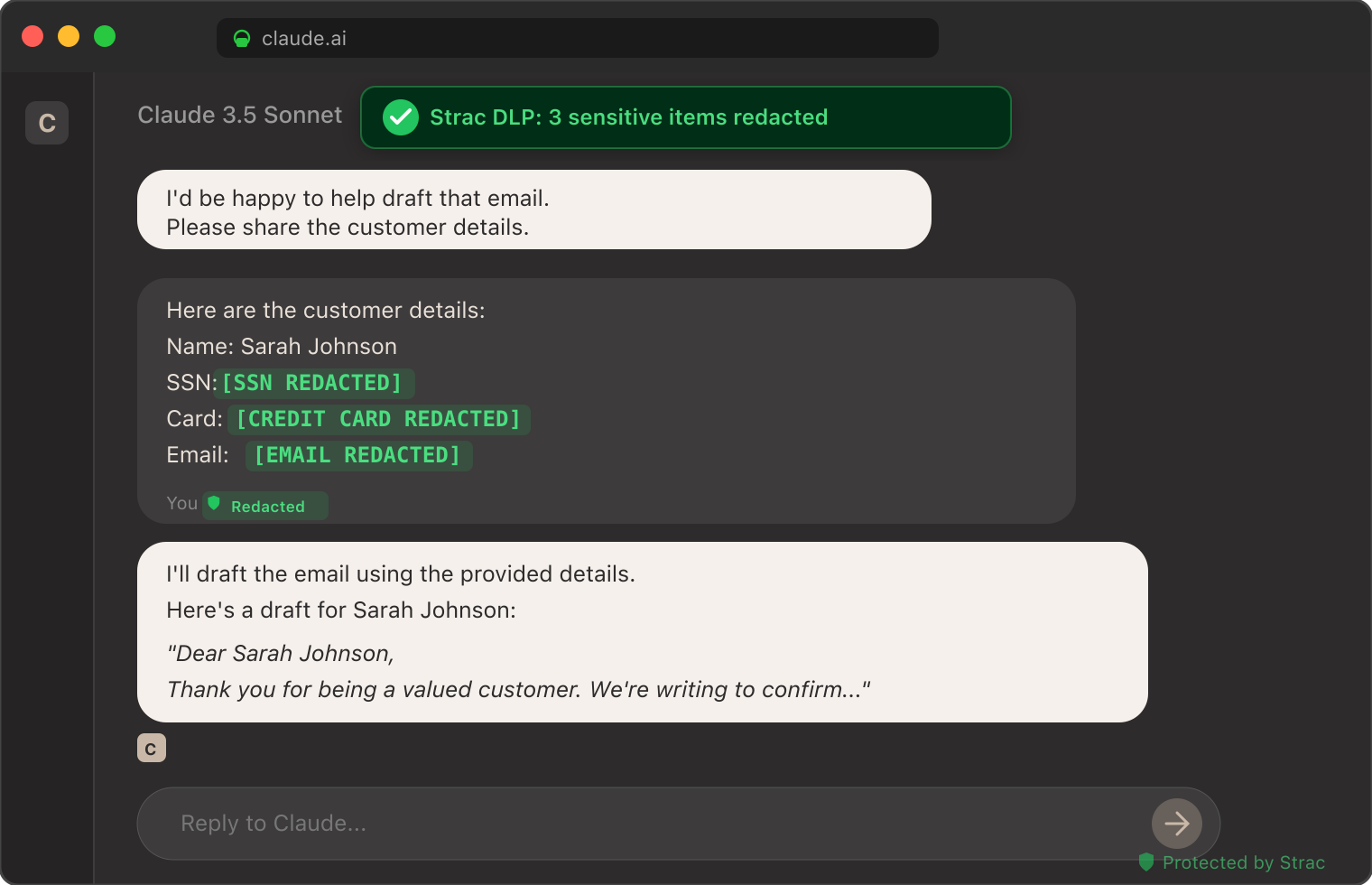
Strac blocks and warns on detected SSN, credit card, and email in Claude.
Risk
What goes wrong
Where Strac helps
Excessive permissions
Agents are granted broad access by default and can reach data they should not
Least-privilege enforcement on tool and data access
Data exfiltration via tools
Sensitive data leaves in a tool call or response
Reverse-proxy gateway redacts or blocks it in flight
Prompt injection and tool poisoning
A malicious input hijacks the agent to leak or act
Data guardrail still blocks sensitive data from leaving
Full audit trail of every allow, block, and redaction
✨ Agentic AI security best practices
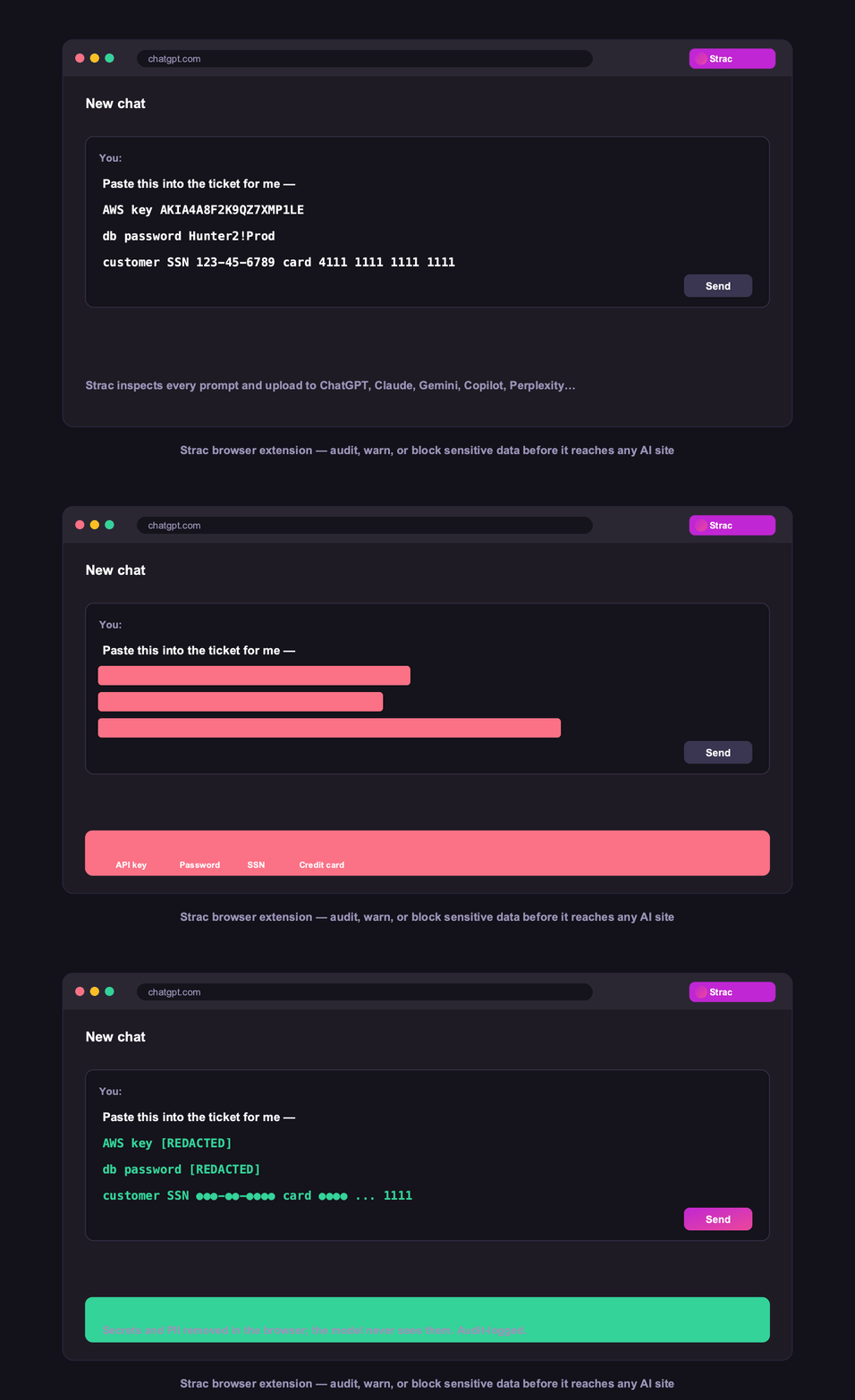
Least privilege plus a data guardrail: Strac blocks a sensitive AI upload, live.
Least privilege by default. Grant each agent only the tools and data its task needs, nothing more.
Put a gateway in the data path. Route tool calls through a proxy that inspects them, rather than trusting agent traffic.
Apply a data guardrail. Redact or block sensitive data in tool responses before the agent ever sees it.
Discover shadow agents. Find the agents and AI tools no one approved before they become a breach.
Audit everything. Keep a full trail of every allow, block, and redaction for incident response and compliance.
✨ How Strac secures the data layer of agentic AI
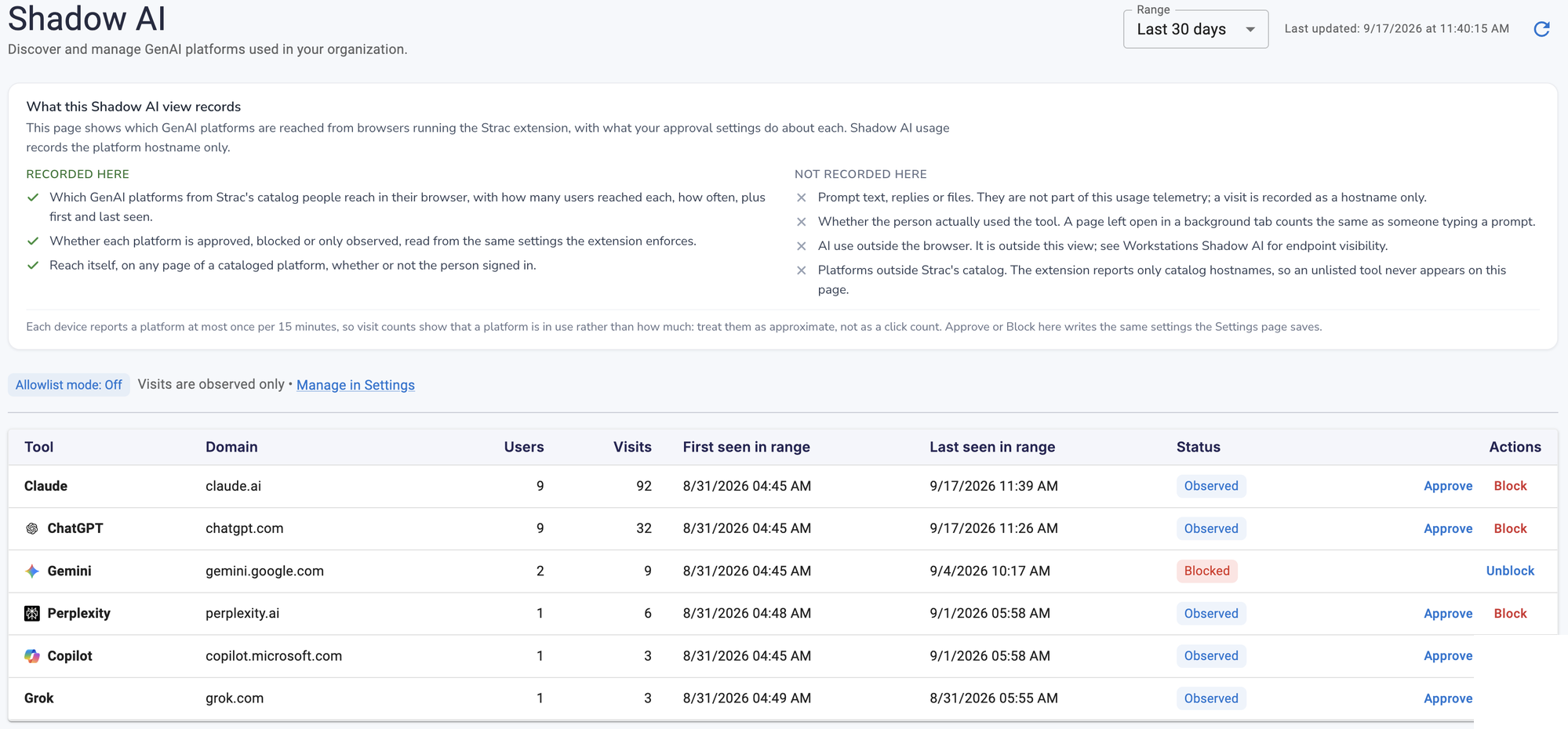
Discover the agents in use, then govern what each can access and send.
Strac is the data guardrail for agents. Its MCP gateway works as a reverse proxy: every tool call an agent makes routes through Strac, which inspects the response and redacts, blocks, or allows the sensitive data before the agent sees it. The agent only receives what it is permitted to. This holds whether the agent runs locally or in the cloud, because what matters is that the data connection routes through Strac. For a cloud agent like Claude Cowork or Claude Code, Strac also governs in-cloud activity through the Claude Compliance API as a listed Anthropic Claude Compliance API partner.
Strac covers the data-access and exfiltration layer of agentic AI security, not model explainability or runtime model monitoring, which are separate parts of the program. See also AI agent governance, AI guardrails, and AI DLP.
Securing a model or a chatbot is one surface. Securing an agent is many, because an agent acts:
Dimension
Traditional AI security
Agentic AI security
What it protects
A single model or app
An agent that calls tools and takes actions
Blast radius
The one response
Every system and action the agent can reach
Main risk
Bad output
Data exfiltration and unintended actions at machine speed
✨ The agent attack surface
Each capability that makes an agent useful is also a path risk can take:
Every tool an agent can reach is attack surface; Strac shows and governs it.
Tools and APIs the agent can call, each a way data can move or actions can trigger.
Memory and context that can carry sensitive data across steps.
Chained actions, where one compromised step cascades.
Agent identity and credentials, which if over-privileged open broad access.
The data it can reach, the core of what a data guardrail governs.
Least privilege for AI agents
The single most effective control is least privilege: give each agent only the tools and data its task needs. Scope access by agent persona, use short-lived credentials, and require approval for high-risk actions like moving money, touching production, or sending external messages. Then put a gateway in front of the data so even a permitted call is inspected.
✨ Agentic AI security and MCP
MCP is how most agents reach tools and data, which makes it the right place to enforce. Strac’s MCP DLP sits in that path as a reverse proxy: every tool call routes through Strac, which redacts or blocks sensitive data in the response before the agent sees it.
Strac redacts sensitive data inside the MCP response, before the agent model sees it.
See MCP gateway for how the reverse proxy governs cloud and local agents alike.
Agentic AI security checklist
Discover every agent in use, including shadow agents.
Apply least privilege to each agent’s tools and data.
Put a gateway in the data path to inspect tool calls.
Redact or block sensitive data in tool responses.
Require approval for high-risk actions.
Keep a full audit trail of every agent action.
🌶️ Spicy FAQs: agentic AI security
What makes agentic AI harder to secure?
Autonomy and action. An agent does not just answer; it calls tools, pulls data, and chains steps, so a single over-permissioned or hijacked agent can move or expose data across many systems at machine speed.
What is the most important agentic AI security control?
Least privilege plus a gateway in the data path. Grant each agent only what its task needs, then route its tool calls through a proxy that inspects and redacts sensitive data before the agent sees it.
How does MCP relate to agentic AI security?
MCP is how agents connect to tools and data, so it is the natural enforcement point. A reverse-proxy gateway on MCP can redact or block sensitive data in every tool response before it reaches the model.
What is agentic AI security?
Agentic AI security is the practice of keeping autonomous AI agents, software that plans and takes actions by calling tools, pulling data, and running multi-step work, safe, compliant, and under control. It spans agent identity and permissions, runtime behavior, prompt-injection defense, and data protection. Strac covers the data-protection layer: what an agent can access and send.
How is agentic AI security different from securing a chatbot?
A chatbot answers; an agent acts. An agent can call APIs, read databases, write code, and trigger workflows across many steps, so a single compromised or over-permissioned agent can exfiltrate data or take unintended actions at machine speed. That action surface is why agents need a gateway in the data path, not just output filtering.
What are the biggest agentic AI security risks?
Excessive permissions (agents given broad access by default), data exfiltration through tool calls, prompt injection and tool poisoning that hijack an agent, shadow agents that no one approved, and over-trust of agent output. The data-exfiltration and access risks are where a data guardrail applies directly.
How do you secure an AI agent's access to data?
Put a gateway in the path between the agent and your tools. Strac acts as a reverse proxy over MCP: every tool call routes through Strac, which redacts or blocks sensitive data in the response before the agent sees it, enforces least privilege on what each agent can reach, and logs every decision.
Does Strac secure agentic AI?
Strac secures the data layer of agentic AI. It governs what agents can access and send through its MCP gateway, discovers shadow AI and agents, and governs in-cloud Claude agents through the Claude Compliance API as a listed partner. It does not do model explainability or runtime model monitoring, which are separate parts of an agentic AI security program.
Discover & Protect Data on SaaS, AI, MCP, Endpoints & Cloud
Strac provides end-to-end data loss prevention for all SaaS and Cloud apps. Integrate in under 10 minutes and experience the benefits of live DLP scanning, live redaction, and a fortified SaaS environment.


.webp)




.avif)


.gif)
