AI Governance Policy: What to Include, Who Writes It, and How to Enforce It
A realistic AI governance policy is enforceable — not aspirational. Here's what to include, who should write it, and how to enforce it with modern platforms. Free downloadable template included.
An AI governance policy is the written document that says what AI usage is allowed, what's prohibited, and what's conditionally permitted. It's the scaffold your technical controls enforce.
A policy without enforcement is theater. Most AI policies fail because they're written in conference rooms disconnected from actual usage and have no technical backing.
Good policies are short, specific, and data-informed. Draft after shadow AI discovery, not before. Per-team rules where risk profiles differ. Clear on personal accounts, regulated data, and consequences.
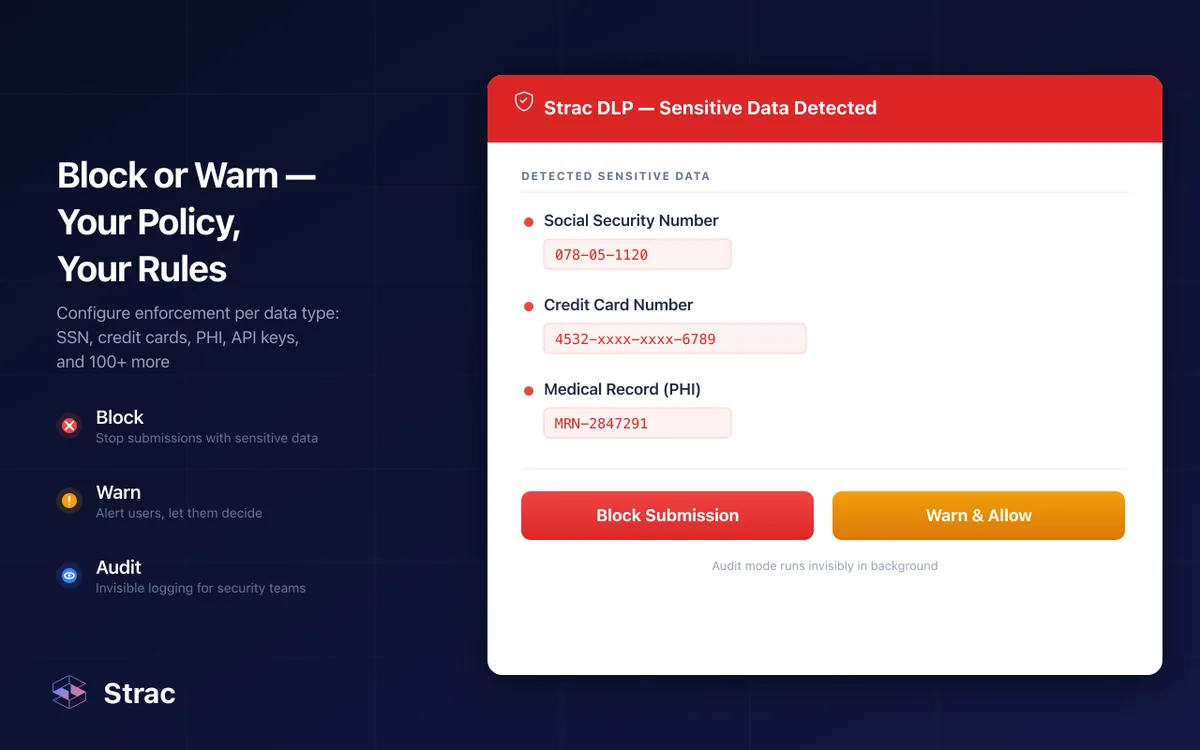
Modern enforcement is real-time. Browser and endpoint DLP that blocks, warns, or audits prompts live — turning policy into a control. Strac's AI governance platform is purpose-built for this.
AI Governance Policy: What to Include, Who Writes It, and How to Enforce It
Good AI policies are short, data-informed, and paired with real-time enforcement across every AI tool employees use
✨ What Is an AI Governance Policy?
An AI governance policy (often called AI acceptable use policy, GenAI policy, or AI usage policy) is the written document that defines:
Which AI tools employees are allowed to use
What data may be submitted to those tools
What approvals or reviews are required for specific use cases
What consequences apply to violations
How the policy is reviewed and updated as AI evolves
The policy is the top of the governance stack. Below it sit standards (more specific technical requirements), procedures (how people execute), and technical controls (what actually enforces). Without a policy, the whole stack lacks an anchor.
Without technical enforcement under the policy, the policy is decoration.
Policy text + technical enforcement = a working control. Without enforcement, the policy is aspirational text in a shared drive.
Why Most AI Policies Fail
The failure pattern is consistent:
A cross-functional committee is formed after an AI incident or board inquiry.
The committee drafts a policy over 60–90 days. Legal and HR tighten the language. Security adds aspirational controls.
The policy is published to SharePoint. An all-hands meeting announces it. Employees sign an annual attestation.
Nothing changes operationally. Employees still use ChatGPT with sensitive data; they still have personal accounts; shadow AI keeps growing.
Six months later, another incident. The committee blames insufficient training. Cycle repeats.
Three reasons this fails:
Policies are written aspirationally, not based on actual usage data.
Enforcement is assumed to be human (employees will read and comply), not technical (systems detect and prevent).
There's no feedback loop — no dashboard showing policy adherence, no trend data on shadow AI, no evidence for auditors.
The fix is to invert the sequence: deploy discovery and technical enforcement first, then write a policy grounded in actual data.
What to Include in a Working AI Governance Policy
Seven sections. Keep them short.
1. Scope and purpose
Who does this apply to (employees, contractors, vendors with system access) and what does it govern (AI systems used, AI systems built).
Two sentences. No legalese. Example: "This policy applies to all employees, contractors, and third parties with access to [Company] systems. It governs the use of AI tools — both those [Company] provides and external AI systems accessed from [Company] devices or accounts."
2. Sanctioned, conditional, and prohibited tools
A short list — named tools, with status:
Sanctioned: ChatGPT Enterprise, Microsoft Copilot E5, Claude for Enterprise. Approved for general use.
Conditional: Perplexity Enterprise (finance and legal use only, approval required), GitHub Copilot (developers only, no proprietary code).
Prohibited: Consumer-tier ChatGPT / Claude / Gemini on personal accounts, unsanctioned AI coding tools.
Keep this list alive — add new tools as they're reviewed, don't let it ossify.
Permitted: public information, marketing copy, general business questions, anonymized data.
The policy should say this. Technical controls should enforce it.
4. Personal accounts
Explicit prohibition on using personal AI accounts (personal ChatGPT Plus, personal Claude, personal Gemini) for work. This is the single highest-leverage rule — it closes the shadow AI backdoor.
Example language: "Employees may not use personal AI accounts for [Company] business. When a corporate alternative is available, employees must use it. Where no corporate alternative exists, requests for sanctioned access go through [AI review process]."
5. Approval workflow
How to request new AI tool access, including what's evaluated (security, data handling, vendor BAA status, cost). Keep the workflow lightweight — if it takes 90 days to approve a tool, employees go around it.
Severe violations (willful regulated-data exfiltration): HR review, potentially termination
Integrated with existing HR/discipline policy — don't create a parallel system.
7. Review cadence
Policy review every 6–12 months, or whenever a new significant AI tool emerges (e.g., when a new model provider becomes relevant to your employee base). Named policy owner (usually the CISO or Chief AI Officer).
✨ A Short, Effective Policy Template
Here's a compact working policy — treat it as a starting skeleton, not legal advice. Customize for your organization, legal jurisdiction, and regulatory profile.
AI Acceptable Use Policy — [Company Name]
Effective: [Date] | Owner: [Name/Role] | Review: Annually

1. SCOPE
This policy applies to all [Company] personnel using AI tools for work.

2. SANCTIONED TOOLS
- ChatGPT Enterprise (company SSO only)
- Microsoft 365 Copilot
- Claude for Enterprise
- GitHub Copilot Business (developers only)
[Update quarterly]

3. PROHIBITED DATA IN AI PROMPTS
Never paste the following into any AI tool:
- Payment card numbers, CVVs, bank account numbers
- Protected health information (medical records, patient data)
- Passwords, API keys, access tokens, private keys
- Social Security numbers unless specifically authorized
- Confidential M&A, legal, or HR matters

4. CONDITIONALLY ALLOWED (request approval)
- Customer PII → request via [channel]
- Internal financial data → request via [channel]
- Proprietary source code → developer-specific policy

5. PERSONAL ACCOUNTS
Do not use personal AI accounts (ChatGPT Plus, Claude, Gemini Free) for work.

6. APPROVAL FOR NEW TOOLS
Submit [AI tool review form] for new AI tools. Review typically 5 business days.

7. VIOLATIONS
Progressive: coaching → formal warning → discipline. Integrated with [HR policy reference].

8. QUESTIONS
Contact [email] or #ai-governance in Slack.
This fits on two pages. Employees will actually read it. Your technical controls enforce it.
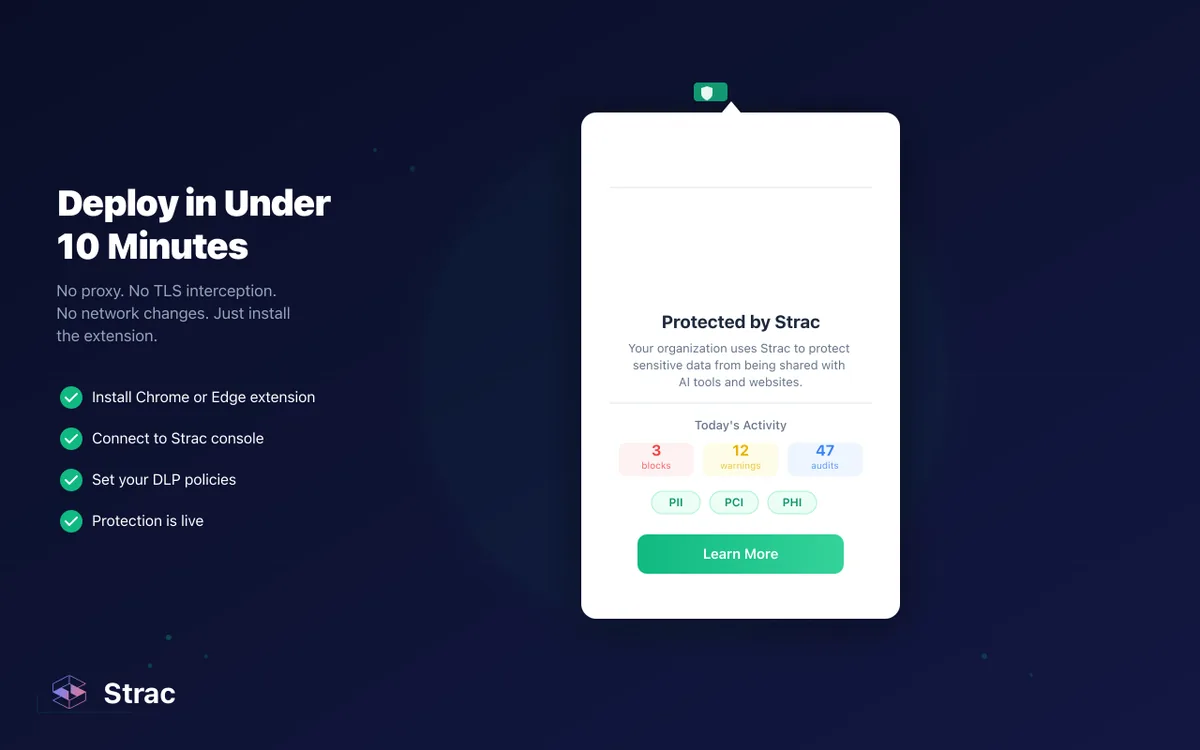
Under-10-minute deployment means policy can ship with enforcement, not months ahead of it
🎥 Making the Policy Enforceable
Browser-level enforcement turns every sentence in your AI policy into a live control — blocking prohibited data before it leaves the endpoint
The gap between policy and reality is closed by technical enforcement. Four layers:
Layer 1: Real-time prompt inspection
Browser extension and endpoint agent inspect every AI prompt before submission. Sensitive data (PCI, PHI, credentials) is blocked. Borderline data generates a warning. Everything else passes. Logs capture the entire event stream.
This enforces sections 3 and 4 of the policy automatically.
Layer 2: Shadow AI discovery
Endpoint agent maps every AI tool running locally. Identifies personal-account usage. Generates reports for the AI review committee.
This enforces section 5 of the policy (personal account ban) and feeds section 6 (tool review workflow).
Layer 3: Cross-SaaS controls
Redaction in Slack, Jira, Zendesk, Salesforce, Google Drive, SharePoint — the tools feeding AI connectors. If sensitive data is redacted before it reaches an AI tool, the prompt-level rules compound in effectiveness.
Layer 4: Evidence and audit trail
Every detection, block, warning, and override logged with full context. Mapped to NIST AI RMF, EU AI Act, ISO 42001, HIPAA, PCI, SOC 2. Exportable to SIEM. Auditor-ready.
This enforces section 7 (review and improvement) and makes the entire program auditable.
Who Should Own the Policy?
Three roles typically co-own AI governance policy:
CISO (primary operational owner): drafts the security-technical sections, owns enforcement platform, reports metrics to executives.
General Counsel / Chief Privacy Officer: reviews for legal/regulatory soundness, especially around regulated data (HIPAA, GDPR, CPRA) and employment law implications.
Chief AI Officer (where the role exists): strategic coordination, business use case approvals, AI council leadership.
HR: integration with existing conduct/discipline policies, training, communication.
Cross-functional AI council: exceptions, emerging tool review, escalations.
The anti-pattern is a security-only policy written by security without legal or HR input — it won't survive contact with actual violations.
Policy Maintenance: The 90-Day Cadence
AI tools change fast. Policy that's static is stale.
Monthly: policy owner reviews incident data. New AI tools in use (from discovery reports). Emerging risks (e.g., new Copilot feature, prompt injection technique). Update sanctioned/conditional/prohibited list.
Quarterly: executive review of AI risk metrics, policy exceptions, enforcement trends. Update policy if patterns suggest changes.
Annually: full policy review with legal, HR, business stakeholders. Align to updated regulatory expectations (EU AI Act phases, NIST RMF updates, ISO 42001 adoption). Re-publish and re-train.
Ad-hoc: significant new regulatory obligation (new state law, new EU AI Act phase), significant new AI tool category (e.g., agentic AI mainstream), significant incident.
Where to Go Next
If you need to implement AI governance policy with technical enforcement behind it — book a 15-minute demo. We'll show you the platform that turns policy into a real-time control across ChatGPT, Copilot, Claude, Gemini, and 50+ AI tools.
🎥 ✅ How Strac covers AI data security across every surface
A policy that can't be enforced in software is a policy that gets ignored. Strac is the technical enforcement layer for AI governance policy — every surface where employees and agents touch AI is covered:
1. Browser DLP — every prompt to Claude, ChatGPT, Gemini, Copilot, Perplexity
Strac's browser extension intercepts every prompt before it reaches the LLM API and redacts PII, PHI, PCI (cardholder data), source code, and secrets inline. The model still works — it never sees the raw sensitive data. Coverage extends to claude.ai, ChatGPT, Gemini, Microsoft Copilot, Perplexity, Mistral, DeepSeek, plus Anthropic and OpenAI APIs. See Strac Generative AI DLP and Strac Claude DLP.
2. MCP DLP — for AI agents acting on enterprise data
When a Claude, Cursor, or ChatGPT agent calls a Slack, Gmail, Google Drive, GitHub, Notion, or any other MCP server, Strac sits inline and redacts sensitive data in every tool-call response. Strac is the first DLP with native Model Context Protocol policy enforcement — most enterprise DLP vendors still have no MCP support at all. Full background: MCP DLP guide.
3. SaaS DLP and Data Discovery — across 47+ integrations
The same redaction and labeling policies apply to every SaaS surface where data lives — Slack, Google Drive, Gmail, M365, OneDrive, SharePoint, Salesforce, Notion, Jira, Confluence, GitHub, Linear, HubSpot, Asana, Zendesk, Intercom, Box, ServiceNow, and 30+ more. Continuous data discovery and classification (DSPM) inventories every personal data type across your environment and automatically applies the right sensitivity label.
4. Cloud DSPM — AWS, Azure, GCP
Strac continuously scans AWS (S3, RDS, EBS, CloudWatch), Azure (Blob Storage, SQL), and GCP (Cloud Storage, BigQuery) for sensitive data at rest. Not point-in-time scans — continuous discovery with automatic classification. The output powers compliance evidence for GDPR, HIPAA, PCI DSS, SOC 2, and ISO 27001 audits.
5. Endpoint DLP — Mac, Windows, Linux
For data egress outside the SaaS perimeter — local file shares, USB drives, screenshots, terminal output, IDE clipboards. Strac's endpoint agent enforces the same policies as the SaaS, browser, and MCP layers, with full audit logs for any sensitive data movement.
Seven core sections: scope and purpose, sanctioned/conditional/prohibited tools list, data handling rules (what's prohibited, what requires approval, what's permitted), personal account rules, approval workflow for new tools, consequences for violations, and review cadence. Keep it short — two pages is enough. Detail lives in standards and procedures below the policy.
How do I write an AI acceptable use policy?
Start with shadow AI discovery, not a blank page. Deploy a discovery tool for 10–15 days to baseline what AI tools your employees actually use with what data. Draft the policy based on the data — pragmatic allowances for legitimate use, clear prohibitions on regulated data and personal accounts. Review with legal, HR, and business leaders. Publish, train, and pair with technical enforcement.
Is an AI policy legally required?
It depends on jurisdiction and industry. The EU AI Act imposes documented policy requirements on deployers of high-risk AI. HIPAA, PCI DSS, GDPR, and SOC 2 all have implicit documentation requirements for any technology handling regulated data — AI falls under those. Many enterprise customers now require vendor AI policies as part of security reviews. Practically, yes — you need one, whether the law names it explicitly or not.
Who should write the AI policy?
A cross-functional team: CISO or security leadership (drafts technical sections), Legal or Privacy Officer (regulatory review), HR (integration with conduct policies, training, discipline), and business stakeholders (use case validation). A policy written by security alone usually fails stakeholder adoption. A policy written by legal alone is usually unenforceable.
How long should an AI governance policy be?
Two to four pages for the main policy document. Details (data classification rules, approval workflow steps, audit procedures) belong in supporting standards and procedures, not in the policy itself. Long policies don't get read; concise policies with linked detail get adopted.
How do I enforce an AI governance policy?
Technical enforcement via a modern AI governance platform. Real-time prompt inspection blocks prohibited data. Shadow AI discovery finds personal accounts. Cross-SaaS DLP prevents sensitive data from reaching AI connectors. Evidence generation produces audit-ready logs. Strac combines all four in one platform, deployable in under 10 minutes. Policies without technical enforcement are aspirational; with enforcement, they're controls.
🌶️ Spicy FAQs for AI Governance Policy
What must an AI governance policy actually contain?
Scope (which AI and agents it covers), roles and ownership, acceptable-use rules, data-handling requirements, approval and review gates, monitoring, and enforcement. A policy no one enforces is theater — pair it with data-layer controls that make the rules real.
Who owns the AI governance policy?
Usually security or GRC drafts it with legal, data/privacy, and engineering. But ownership without enforcement fails — the policy has to connect to controls that block or redact sensitive data automatically.
How is an AI governance policy enforced in practice?
Through controls, not documents: DLP that redacts sensitive data on AI actions, identity that scopes agents, and logging that proves it. Strac supplies the enforcement and the evidence.
How often should the policy be reviewed?
At least quarterly while AI adoption is moving fast — and immediately when you add a new agent, MCP connection, or AI feature that touches regulated data.
What should an AI governance policy include?
Seven core sections: scope and purpose, sanctioned/conditional/prohibited tools list, data handling rules (what's prohibited, what requires approval, what's permitted), personal account rules, approval workflow for new tools, consequences for violations, and review cadence. Keep it short — two pages is enough. Detail lives in standards and procedures below the policy.
How do I write an AI acceptable use policy?
Start with shadow AI discovery, not a blank page. Deploy a discovery tool for 10–15 days to baseline what AI tools your employees actually use with what data. Draft the policy based on the data — pragmatic allowances for legitimate use, clear prohibitions on regulated data and personal accounts. Review with legal, HR, and business leaders. Publish, train, and pair with technical enforcement.
Is an AI policy legally required?
It depends on jurisdiction and industry. The EU AI Act imposes documented policy requirements on deployers of high-risk AI. HIPAA, PCI DSS, GDPR, and SOC 2 all have implicit documentation requirements for any technology handling regulated data — AI falls under those. Many enterprise customers now require vendor AI policies as part of security reviews. Practically, yes — you need one, whether the law names it explicitly or not.
Who should write the AI policy?
A cross-functional team: CISO or security leadership (drafts technical sections), Legal or Privacy Officer (regulatory review), HR (integration with conduct policies, training, discipline), and business stakeholders (use case validation). A policy written by security alone usually fails stakeholder adoption. A policy written by legal alone is usually unenforceable.
How long should an AI governance policy be?
Two to four pages for the main policy document. Details (data classification rules, approval workflow steps, audit procedures) belong in supporting standards and procedures, not in the policy itself. Long policies don't get read; concise policies with linked detail get adopted.
Discover & Protect Data on SaaS, AI, MCP, Endpoints & Cloud
Strac provides end-to-end data loss prevention for all SaaS and Cloud apps. Integrate in under 10 minutes and experience the benefits of live DLP scanning, live redaction, and a fortified SaaS environment.


.webp)





.avif)




.gif)
