AI-Native Compliance Automation Software: The 2026 Guide
AI-native compliance automation software explained: how AI closes the last-mile evidence, runs headless compliance, and fixes failing controls with a human in the loop.
Strac even captures evidence from AI tools: it integrates with the Claude Compliance API, streaming Claude Enterprise usage data into your compliance program automatically.
✨ What Is AI-Native Compliance Automation Software?
Compliance automation software collects the evidence, runs the tests, and maps the controls that prove you meet a framework like SOC 2, ISO 27001, HIPAA, PCI DSS, or GDPR. The first generation of these tools , built around 2018 , automated roughly 70% of that work and left the rest to humans: the admin-panel screenshots, the monthly access reviews, the custom-app evidence, and every failing control that needs a person to actually fix it.
AI-native compliance automation is different in where the AI sits. It is not a chat assistant bolted onto a 2018 platform. The AI does the last-mile evidence humans were still collecting by hand, it drives the platform through your own AI agent, and , with a human in the loop , it remediates the controls that fail instead of just flagging them. That is the line between “automation with a chatbot on top” and genuinely AI-native.
Security-first compliance, run by AI: one platform that tests your security and proves your compliance across every framework.
AI-Native vs Traditional Compliance Automation
Capability
Traditional (2018-era)
AI-native (Strac Comply)
Evidence collection
~70% automated; last-mile left to humans
The last-mile 30% too , if you can log into it, the agent can capture it
AI interface
Chat assistant bolted on
Headless: your AI agent reads posture and writes evidence via MCP
Failing controls
Flagged for a human to fix manually
AI drafts the fix; a human approves; the change is logged
Security testing
Orchestrates a third-party pentest, once or twice a year
Native, continuous AI penetration testing, mapped to controls
Data-security evidence
Screenshots and attestations
Built-in DLP and DSPM , the data control is the evidence
Multiple frameworks
Re-collect per framework
Collect once, reuse across frameworks (cross-framework dedup)
The rest of this guide walks through the modules that make a compliance platform AI-native, the frameworks they cover, and how the human-in-the-loop remediation actually works.
✨ The Modules That Make Compliance Software AI-Native
1. AI Evidence Agent , the last-mile 30%
The AI Evidence Agent is a Chrome extension that captures the evidence other tools leave to humans: admin-panel configuration screenshots, monthly and quarterly access reviews, and workflows inside custom or internal apps that no API integration covers. The rule is simple , if you can log into it, the agent can capture it , and every capture comes out auditor-ready. This is the work that keeps a compliance program alive between audits, and it is the part traditional automation never closed.
2. Headless Compliance , run it from your AI agent
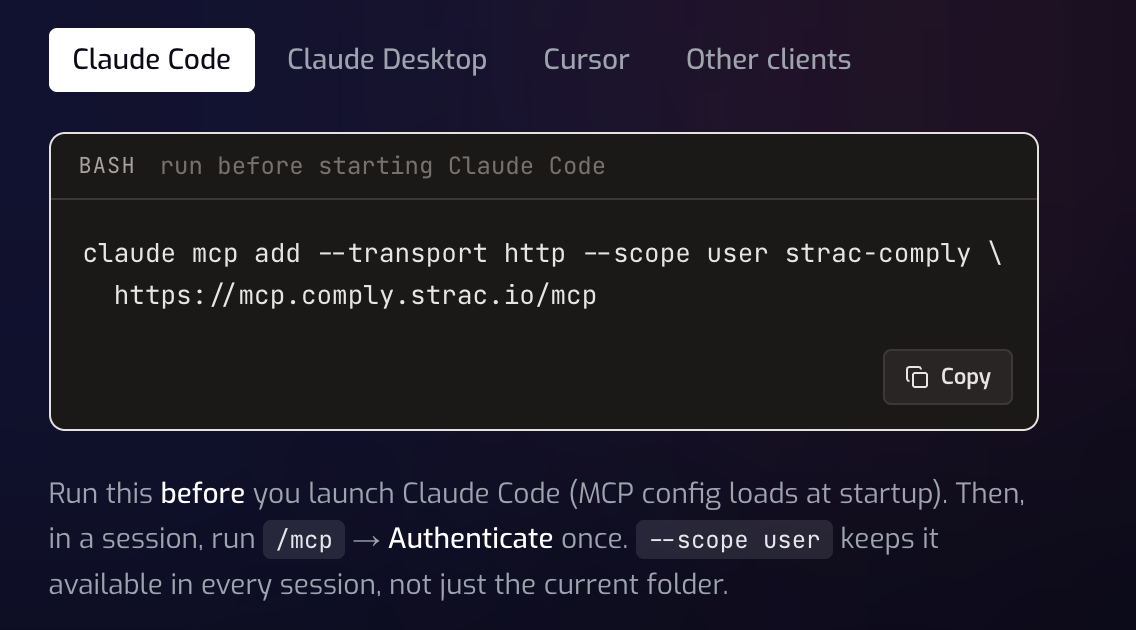
Headless Compliance means compliance runs as the backend your AI agent drives, with no dashboard clicking. Strac Comply exposes your live compliance tenant to any MCP client , Claude Code, Claude Desktop, Cursor, and others , as first-class tools. The agent reads your posture (controls, policies, tests, audits, frameworks) and writes evidence back: drafting and uploading policies, attaching evidence, marking controls not-applicable, and answering questions grounded on your real posture. Every write lands in an append-only audit log stamped with the AI’s identity, under OAuth 2.1 with granular, revocable scopes.
Headless compliance in practice: connect your AI agent to your live Comply tenant, and it writes auditor-grade evidence into your binder.
3. AI remediation , fixing failing controls with a human in the loop
Detecting a failing control is easy; most tools stop there and hand you a red flag. Strac Comply’s AI remediation goes a step further: when a control or a continuous test fails, the AI diagnoses the cause and drafts the actual fix , an updated policy, a configuration change, the specific evidence to capture, or a vendor action to take. Nothing is applied silently. A human reviews and approves every change before it takes effect, and the applied remediation is written to the same append-only audit log, stamped with who (or which agent) did what.
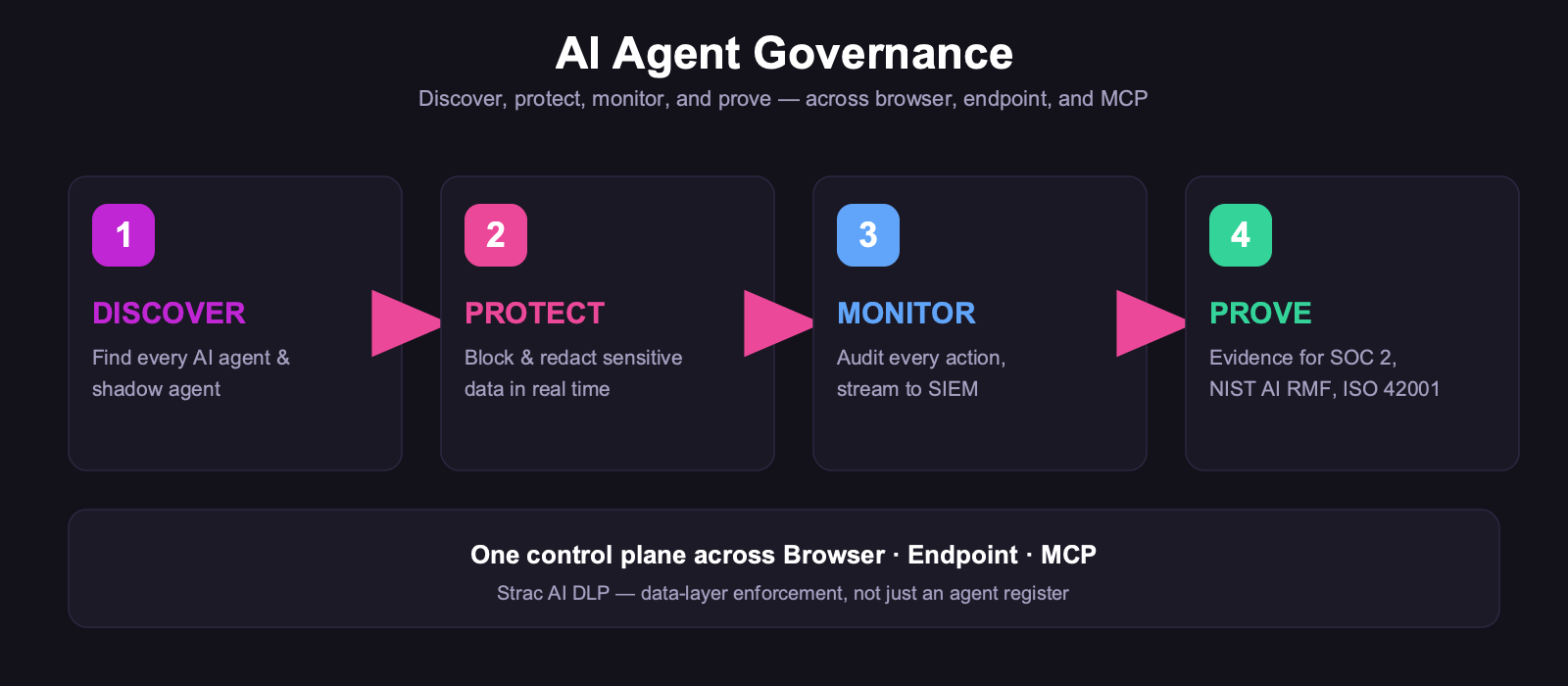
That human-in-the-loop design is the point. An auditor will never accept “the AI changed it” as a control; they will accept “the AI proposed it, a named owner approved it, and here is the timestamped record.” You get the speed of AI remediation with the accountability an audit requires. See how this fits the broader picture of AI agent governance.
Human in the loop: the AI proposes the remediation, a named owner approves, and every action is logged for the auditor.
4. Data security, built in , the control is the evidence
Most compliance tools prove your data controls with a screenshot of a settings page. Strac Comply includes real data security , DLP and DSPM that discover and remediate sensitive data across SaaS, cloud, endpoints, and AI tools. For a control like SOC 2 CC6.7 (restricting the transmission and movement of sensitive data), the DLP doing the work is itself the evidence. Security built in, not bolted on.
5. Native continuous penetration testing
Vanta and Drata orchestrate a third-party pentest; Strac Comply runs one. Built on the PentestMate platform Strac acquired, autonomous AI agents run continuous penetration testing rather than an annual snapshot, verify every finding with an executable proof-of-concept (a zero-false-positive posture), and map findings to ISO 27001 Annex A objectives and SOC 2 Trust Services Criteria , so your security testing and your compliance evidence are the same system. See ISO 27001 penetration testing.
6. TPRM and Shadow AI , your vendors are your attack surface
Third-party risk management auto-discovers every vendor, sub-processor, and OAuth grant , plus the AI tools your employees adopted without telling anyone (shadow AI). Each vendor gets a risk score backed by real evidence, not a self-attestation, and runs a full lifecycle: discover, assess, monitor, retire.
7. Cross-framework deduplication
A single access-review control can satisfy requirements in SOC 2, ISO 27001, and HIPAA at once. Strac Comply collects that evidence once and reuses it across every framework you pursue, so adding your second and third framework is a fraction of the work of the first.
Security built in, not bolted on: the same 60+ integrations that protect your data produce the evidence for every framework.
🎥 How Strac Comply Compares to Vanta and Drata
Vanta and Drata are capable platforms that automate the well-trodden 70% of a compliance program. The gap they leave , and the reason AI-native matters , is the last mile: the manual evidence, the failing controls someone has to fix, the third-party pentest, and the data-security proof that ends up as a screenshot. Strac Comply is built to close that last mile with the AI Evidence Agent, headless compliance, human-in-the-loop remediation, native pentest, and built-in data security. For a direct comparison, see Vanta alternatives and Vanta vs Drata.
Get compliance with Strac Comply
Compliance automation software should remove the manual work, not add a sales cycle. Strac Comply runs 100+ tests the day you connect your stack, covers every major framework at one price, and is the only platform you can run from your AI agent.
✨ See exactly what passes and what is left
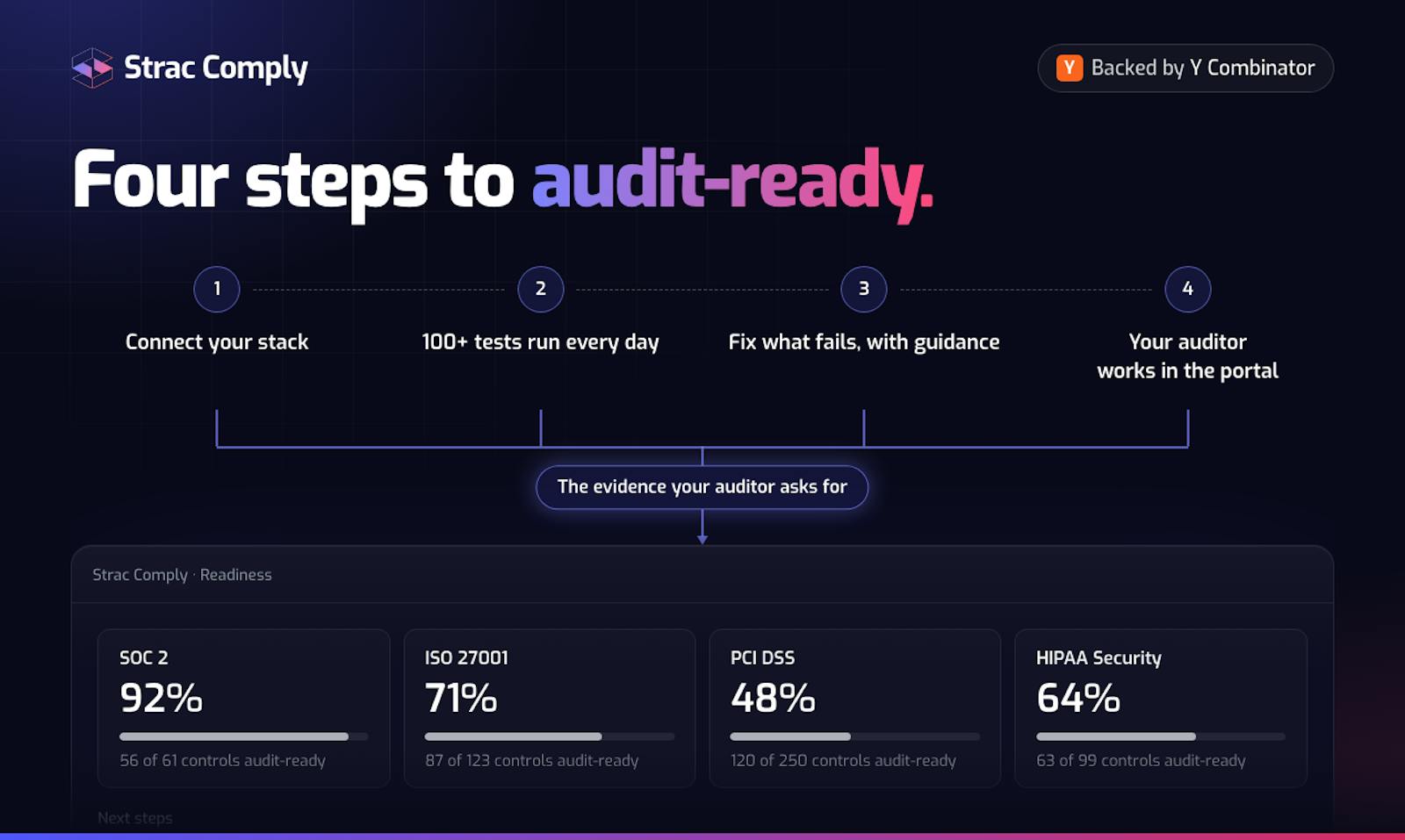
Connect your stack and Strac Comply scores your compliance readiness in four steps, with the next task always in front of you and your auditor working in the same portal.
Four steps to audit-ready, with a live readiness score.
✨ 100+ automated tests that name exactly what to fix
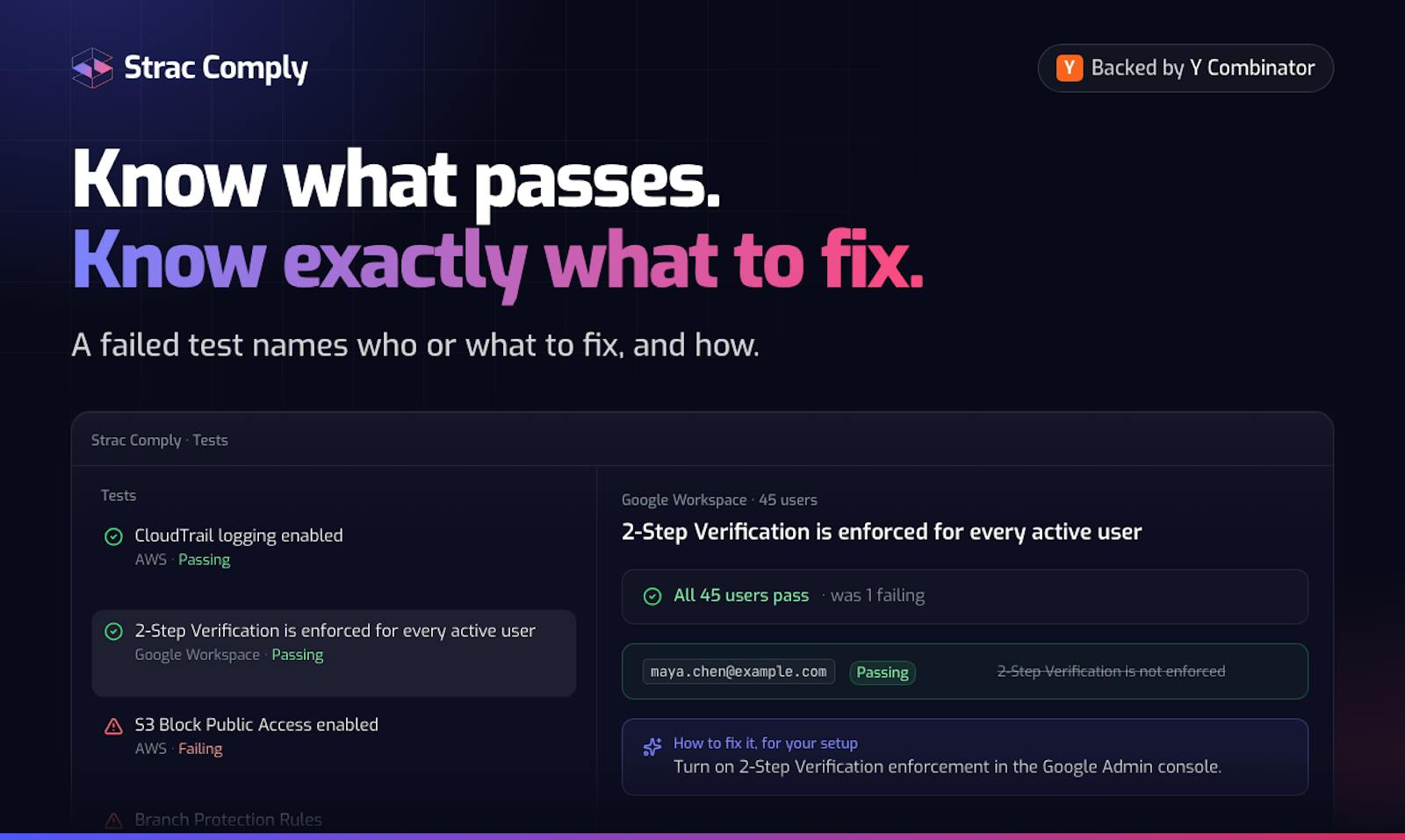
Strac Comply runs 100+ tests daily against your real systems and maps them to compliance. When one fails, it names who or what to fix and how, so the work is a short list, not a hunt.
A failed test names who or what to fix, and how.
✨ Run your compliance from your AI agent
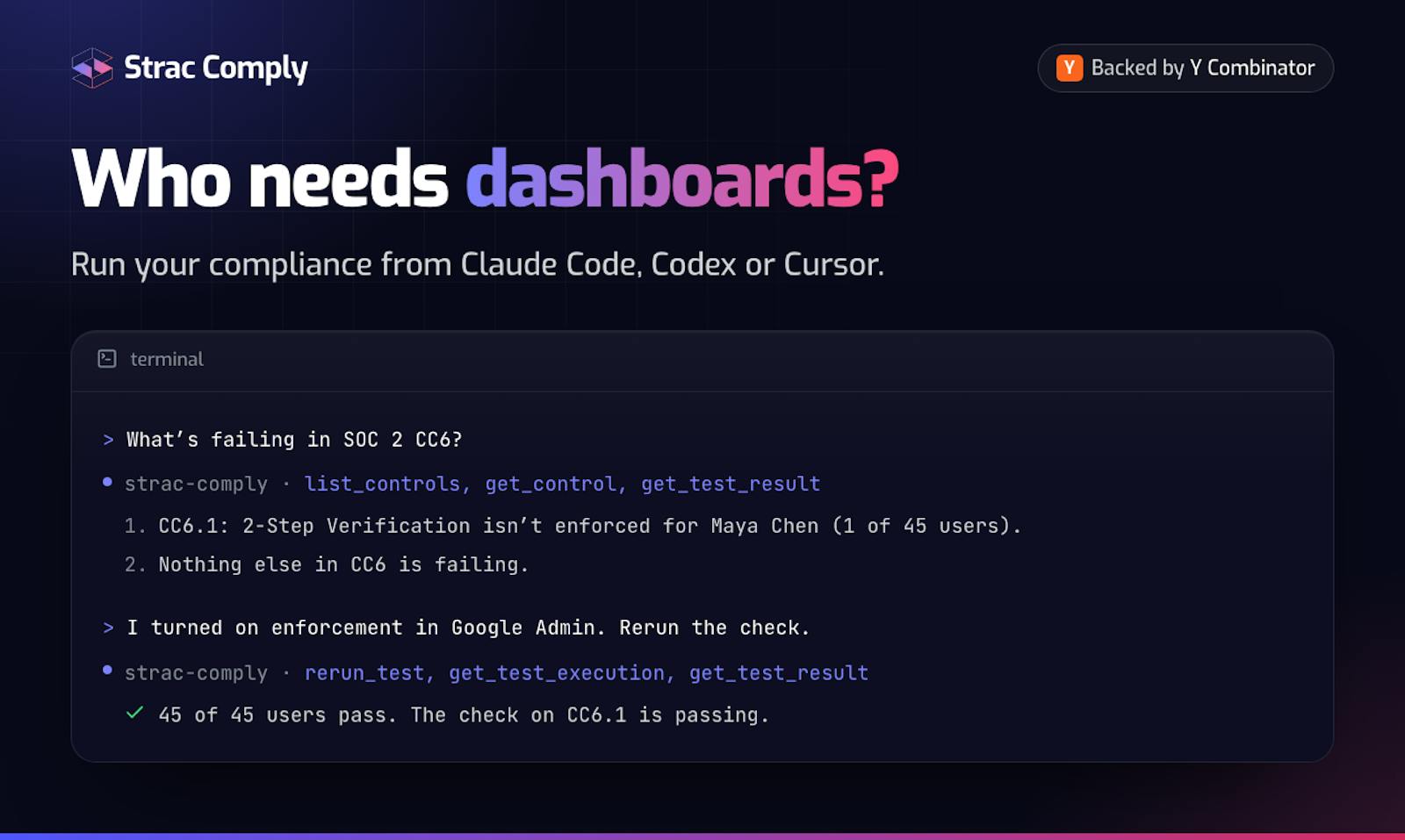
Strac Comply ships an MCP server, so you can ask Claude Code, Codex, or Cursor what is failing in compliance, fix it, and rerun the check without leaving your terminal.
Ask your AI agent what is failing, fix it, and rerun the test.
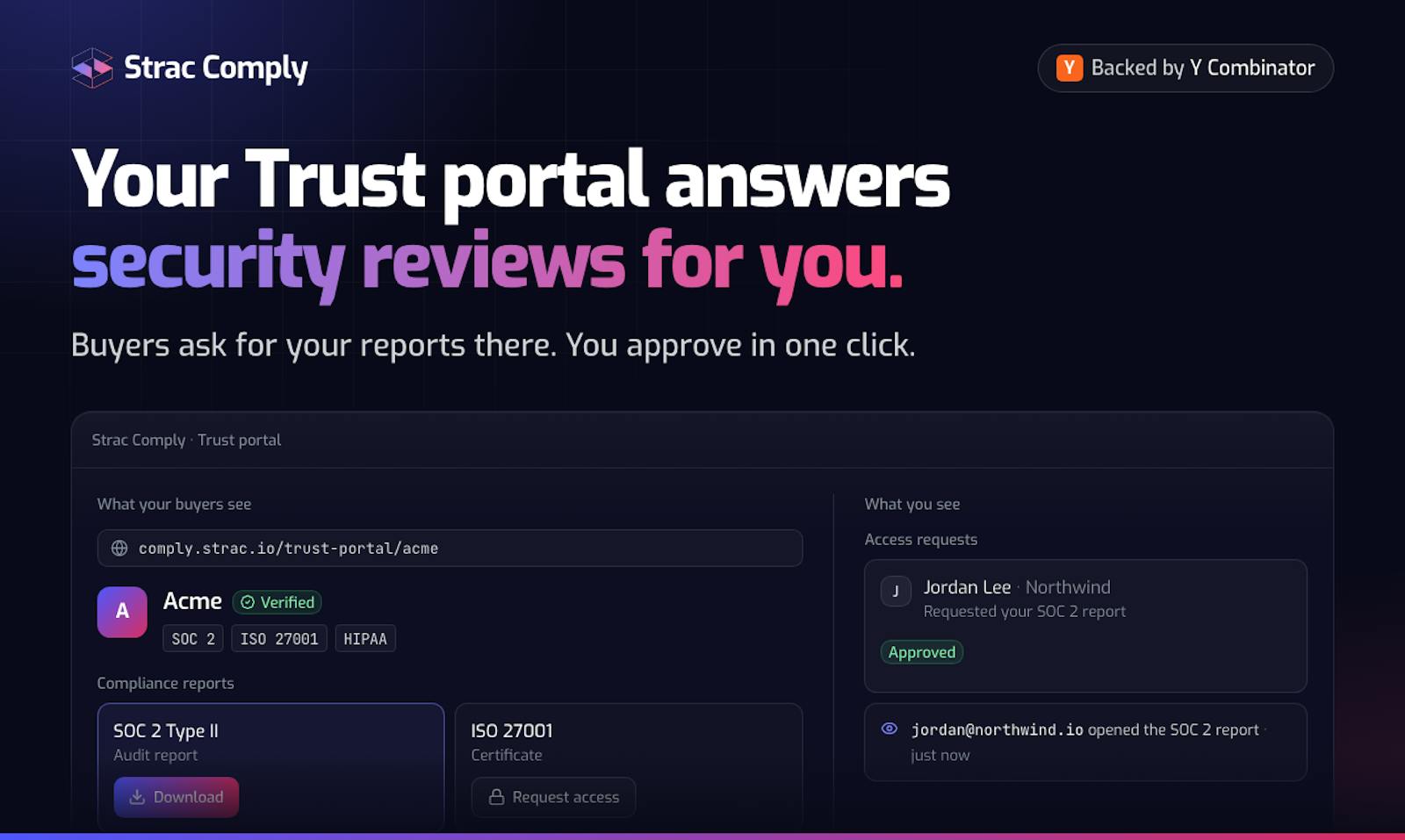
✨ A trust portal that answers security reviews for you
Buyers request your compliance report in your trust portal and you approve access in one click, instead of emailing PDFs around.
Buyers ask for your reports in the trust portal. You approve in one click.
✨ Strac Comply pricing: transparent, no sales call
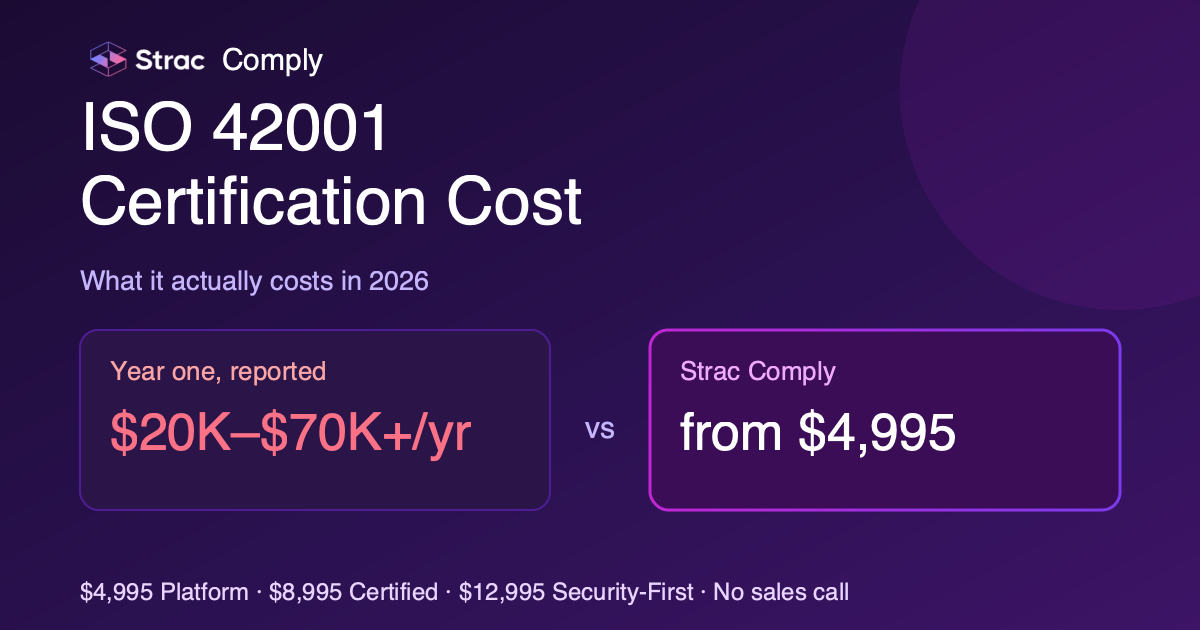
Strac Comply is the transparent, self-serve option: $4,995/yr for the Platform (bring your own auditor) or $8,995/yr for Certified (audit by an independent licensed CPA firm on one invoice), or $12,995/yr for Security-First (adds a human-led penetration test and Strac DLP for Slack, Google Workspace, and AI tools). All five frameworks (SOC 2, ISO 27001, PCI DSS, HIPAA, NIST CSF 2.0) are included at one price, no per-framework fees, on plans for up to 10 employees, with a free trial and no credit card. Note: these are Strac Comply prices. Comply is the automation platform; Strac’s enterprise DLP and DSPM is a separate line item, not included in $4,995 to $12,995.
Published pricing, a free trial, and no sales call.
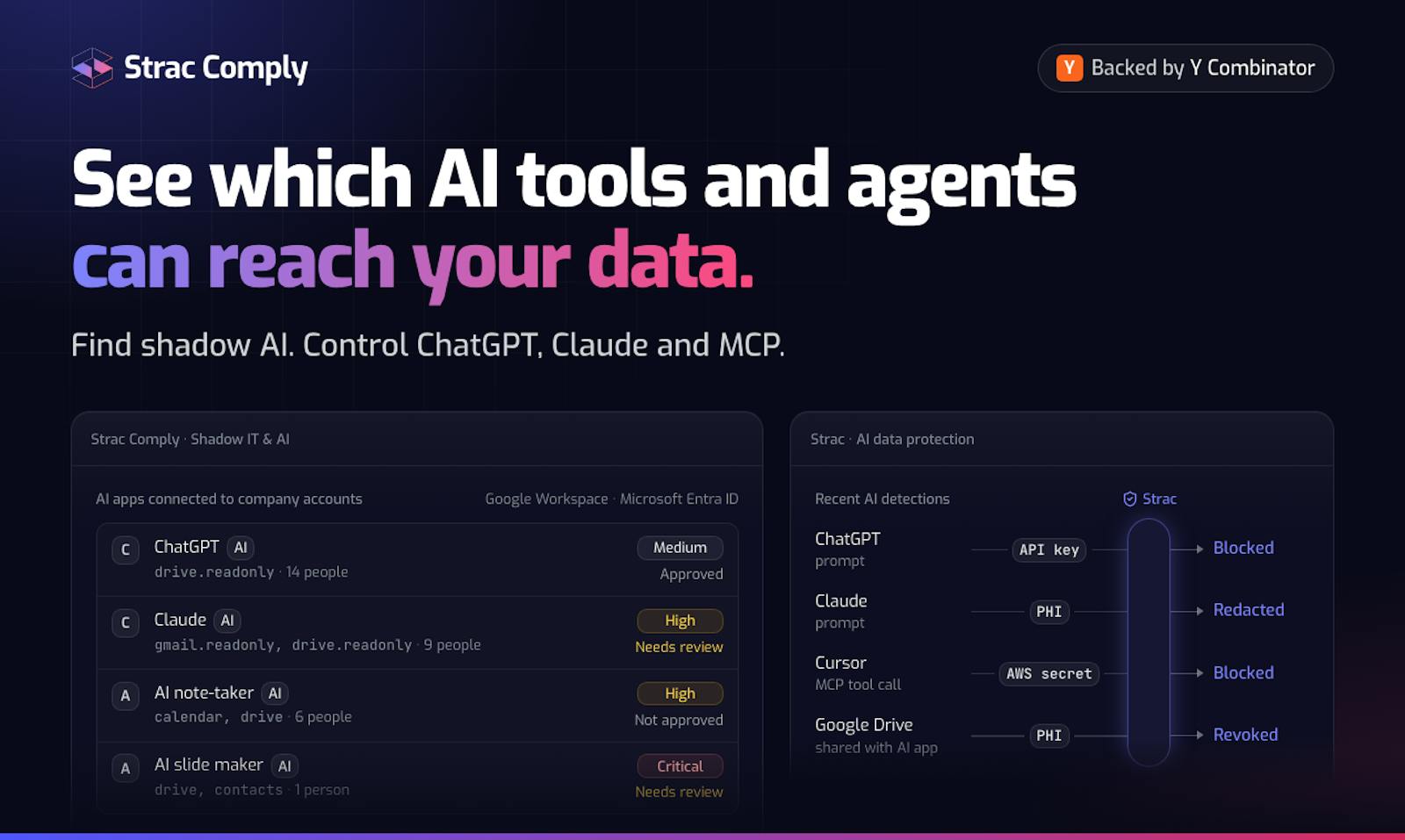
✨ Shadow IT and AI across every framework
Strac Comply finds the unmanaged SaaS and AI tools your team uses, so unapproved apps do not widen scope for any of your five frameworks at once.
Shadow IT and AI across every framework.
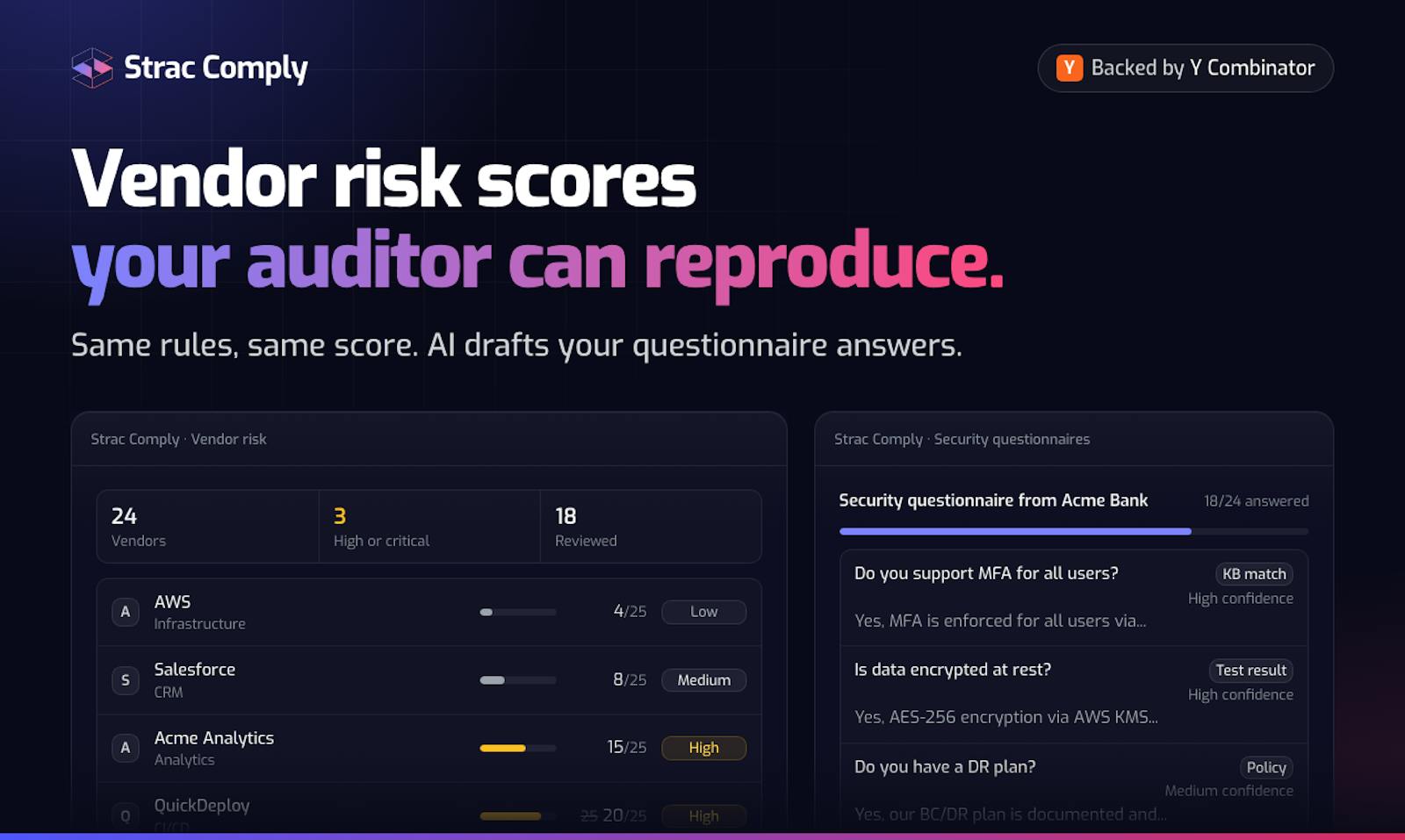
✨ One vendor-risk module for all frameworks
Reproducible vendor scoring and AI-drafted questionnaires serve SOC 2, ISO, PCI, and HIPAA together, instead of a separate TPRM tool.
One vendor-risk module for all frameworks.
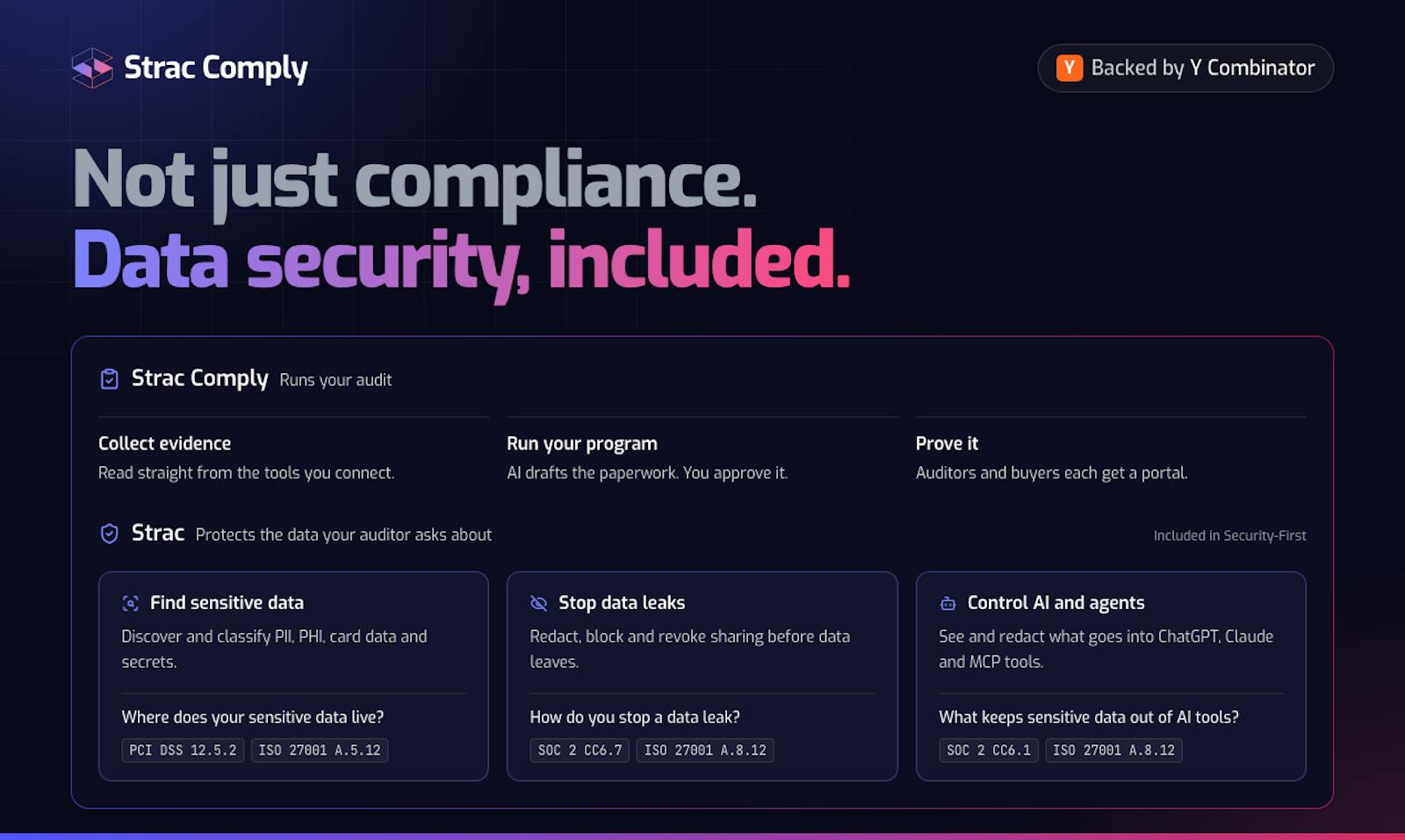
✨ Data security most automation tools skip
Comply discovers sensitive data and governs AI access mapped to specific controls like SOC 2 CC6.7 and PCI 12.5.2, which Vanta and Drata do not offer.
Data security most automation tools skip.
🎥 Watch Strac Comply get you to compliance without the sales call
🌶️ Spicy FAQs for AI-Native Compliance Automation
What is AI-native compliance automation software?
It is compliance software where AI does the work humans still do in older tools , capturing last-mile evidence, driving the platform through your own AI agent (headless compliance), and remediating failing controls with human approval , rather than a chat assistant bolted onto a 2018-era platform. The test of “AI-native” is whether the AI can read your posture and write auditor-grade evidence, not just answer questions about it.
Can an AI agent actually complete my compliance evidence?
Yes, with the right guardrails. Strac Comply exposes your live compliance tenant to MCP clients like Claude Code, so your agent can draft policies, attach evidence, and update controls , each write recorded in an append-only audit log stamped with the AI’s identity, under OAuth with revocable scopes. The AI Evidence Agent additionally captures the admin-panel screenshots and access reviews that no API covers.
Does the AI fix failing controls automatically?
It drafts the fix; a human approves it. When a control or continuous test fails, the AI diagnoses the cause and proposes the specific remediation , a policy change, a configuration fix, evidence to capture, or a vendor action , and a named owner approves before anything is applied. Every applied change is logged. This human-in-the-loop model is what keeps AI remediation auditor-safe.
Is AI-native compliance software just Vanta with a chatbot?
No. A chatbot answers questions about your posture; an AI-native platform lets your agent change it, closes the last-mile evidence humans were still collecting, runs a native continuous pentest, and includes real data-security controls as evidence. The difference is architectural, not a feature you add on top.
Which frameworks does it support?
Strac Comply covers SOC 2, ISO 27001, HIPAA, PCI DSS, GDPR, and NIST CSF, with cross-framework deduplication so a control collected once satisfies every framework it maps to. Adding frameworks after the first is a fraction of the effort.
How is data-security evidence different here?
Instead of proving a data control with a screenshot, Strac Comply includes the DLP and DSPM that actually enforce it , so for a control like SOC 2 CC6.7, the tool doing the data protection is itself the evidence. Security is built in rather than attested to.
See It Run
Strac Comply is security-first compliance, run by AI , every framework on one platform, with the last mile automated. Explore Strac Comply or book a demo to see the AI Evidence Agent, headless compliance, and human-in-the-loop remediation on your own stack.
Discover & Protect Data on SaaS, AI, MCP, Endpoints & Cloud
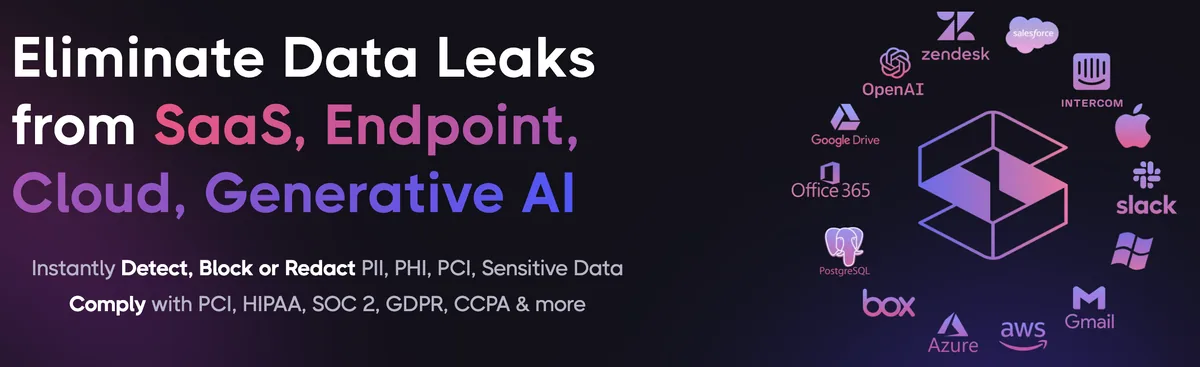
Strac provides end-to-end data loss prevention for all SaaS and Cloud apps. Integrate in under 10 minutes and experience the benefits of live DLP scanning, live redaction, and a fortified SaaS environment.


.webp)







.avif)




.gif)
