MCP Gateway: What It Is & How to Choose One (2026)
An MCP gateway is the control plane in front of your MCP servers — routing, auth, observability, and data security for AI agents. Here's how MCP gateways work, the 2026 landscape, and what to look for in regulated industries.
An MCP gateway is the control-plane layer that sits in front of your MCP servers — it routes agent requests, authenticates them, adds observability, and governs what data and tools each AI agent can reach. Think of it as an API gateway, but for the Model Context Protocol.
It is not the same as an MCP server. An MCP server connects one data source or tool (Slack, GitHub, Snowflake) to an agent. An MCP gateway sits above many servers and controls access to all of them.
The 2026 landscape splits into two camps: gateways built for routing, auth, and observability (Docker, Kong, AWS AgentCore, Cloudflare, IBM ContextForge, Portkey, LiteLLM), and a smaller set focused on security and governance (MintMCP, Lasso, Strac).
The gap almost nobody fills is data-layer security — inspecting the actual data flowing through each tool call and redacting PII, PHI, and secrets in real time. That, plus per-tool access control and a full audit ledger, is what an MCP gateway needs in a regulated industry — and it is where Strac is built differently.
Last updated: June 2026
✨ What Is an MCP Gateway?
An MCP gateway is a single entry point that sits between your AI agents and all of your MCP servers. Instead of every agent connecting directly to every MCP server, requests flow through the gateway, which handles cross-cutting concerns: authentication, routing, rate limiting, logging, and — increasingly — security and data governance.
It is the same pattern an API gateway brought to microservices, applied to the Model Context Protocol. As soon as an organization runs more than a couple of MCP servers, connecting agents to each one directly stops scaling: there is no central place to enforce who can call what, to see what is happening, or to stop sensitive data from leaving. The gateway is that central place.
An MCP gateway is the control plane between your AI agents and your MCP servers — see MCP DLP and the full MCP connector cluster.
A capable MCP gateway typically provides four things:
1. Routing & discovery — a single endpoint and registry for all your MCP servers, so agents do not hardcode connections.
2. Authentication & access control — verify which agent or user is calling, and govern which tools and actions they are allowed to use.
3. Observability — logs, metrics, and tracing for every tool call.
4. Security & data governance — inspect the data moving through each call and remediate sensitive data before it reaches a model. This is the newest and least-served layer.
MCP Gateway vs API Gateway vs MCP Server
These three get conflated constantly. They are different things:
MCP server
MCP gateway
API gateway
What it is
a connector to one data source / tool
a control plane in front of many MCP servers
a control plane in front of REST/HTTP APIs
Speaks
Model Context Protocol
Model Context Protocol
HTTP / REST
Job
expose Slack, GitHub, Snowflake to an agent
route, authenticate, govern agent access to all MCP servers
route, authenticate, rate-limit API traffic
Analogy
a single microservice
API gateway, but for AI agents
the original pattern
An MCP gateway is purpose-built for how AI agents actually behave — non-deterministic, pulling data in through tool calls — which a traditional API gateway was never designed for. That is why "MCP gateway" emerged as its own category rather than teams reusing their existing API gateway.
✨ Why You Need an MCP Gateway
Direct agent-to-server connections work for a demo. In production they create four problems an MCP gateway solves:
No central access control. Without a gateway, every MCP server enforces its own access rules — or none. A gateway gives you one place to set least-privilege per agent, per tool, per action.
No visibility. When an agent does something it should not, you need to know which agent, which tool, what data, what action. A gateway is where that audit trail lives.
No data protection. This is the big one. AI agents pull sensitive data in through tool calls — the ingress shift that legacy DLP never watched. A gateway is the one chokepoint where you can inspect and redact that data before it reaches a model.
No scale. Ten agents times ten servers is a hundred connections to manage. A gateway collapses that to one.
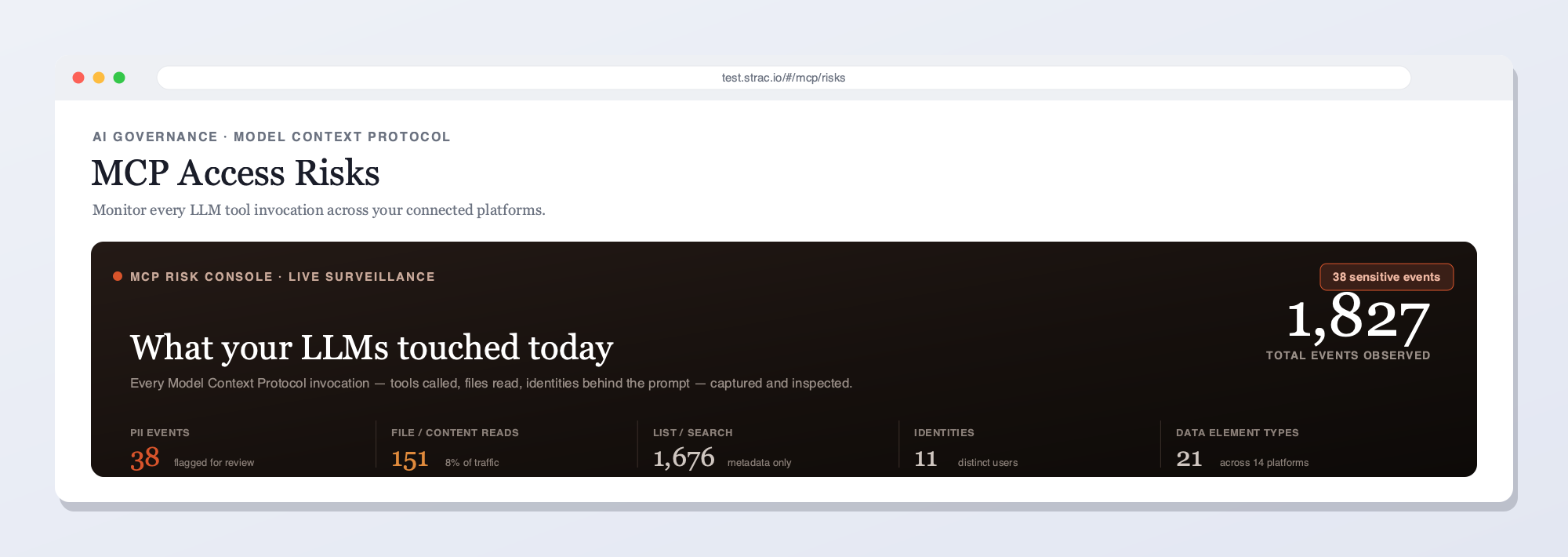
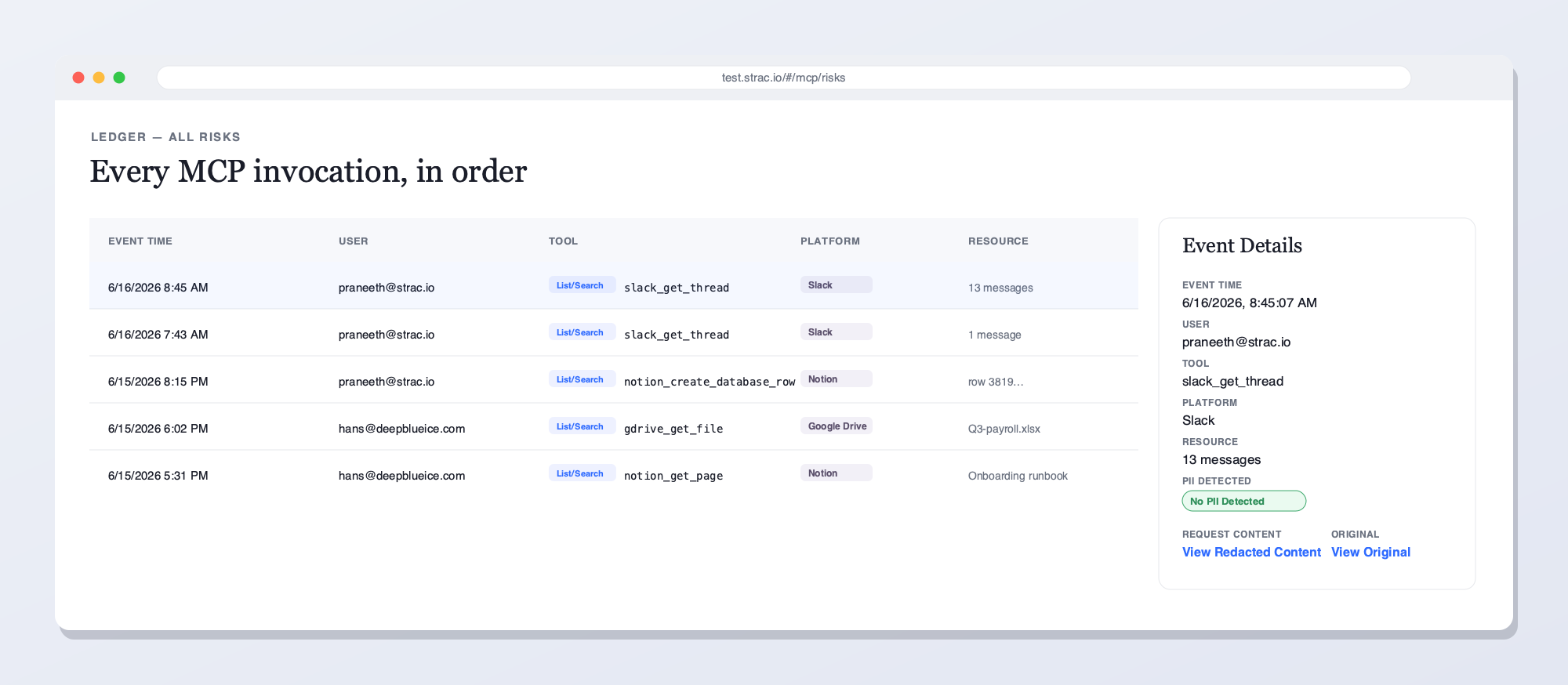
A routing-only gateway can tell you a call happened; the data layer tells you what the agent touched. Strac's MCP console surfaces every tool invocation, the PII in it, and the identity behind the prompt.
The MCP Gateway Landscape (2026)
The market moves fast, and most MCP gateways are less than a year old. They fall into two groups: infrastructure gateways built for routing, auth, and observability, and security gateways built to govern what agents can do and protect the data they touch.
Yes — managed, contextual DLP: redact, mask, or block PII, PHI, PCI, secrets in every tool call
Regulated teams needing data protection plus audit
The pattern worth noticing: nearly every gateway handles routing, auth, and observability well, but only four — IBM ContextForge, Lasso, LiteLLM, and TrueFoundry — actually inspect and redact the data inside each tool call. And three of those four lean on self-managed open-source engines (Microsoft Presidio) or plugin frameworks you wire up yourself, rather than a managed, contextual data-security service with built-in compliance evidence. For most teams that DIY redaction is a nice-to-have. For a regulated one, managed data protection with an audit-ready trail is the requirement.
What to Look for in an MCP Gateway for Regulated Industries
If you handle PII, PHI, PCI, or regulated records, the checklist for an MCP gateway is stricter than "does it route requests." Look for:
Inline data inspection and redaction. The gateway should detect and redact PII, PHI, PCI, and secrets in the tool-call payload itself — not just control which server an agent can reach. Access control without data control still lets an over-permissioned agent pull a million SSNs.
Per-tool, per-action governance. Allow read, block write, require human approval for exports — granular enough to enforce least privilege on each tool call, with approval gates for high-risk actions.
A complete audit ledger. Who, which agent, which tool, what data, what action — pinned as auditor-ready evidence for SOC 2, HIPAA, PCI, and ISO 42001.
Compliance mapping. The gateway's logs should translate directly into compliance evidence, not just raw telemetry. When the data-security gateway is your compliance evidence, you collect once and reuse it — see Strac Comply.
Coverage beyond MCP. Agents reach data through the browser and endpoint too. The strongest posture governs MCP and those surfaces with one policy — see AI data governance.
✨ Strac: The Data-Security MCP Gateway
Most MCP gateways stop at access and identity. Strac is the gateway built for the data layer. It sits in front of every MCP server as a proxy that inspects every tool call, and applies the same See → Control → Protect → Prove model Strac uses across the browser, endpoint, and SaaS:
See — every tool call an agent makes, across all your MCP servers.
Control — per-tool, per-action allow/block rules and approval gates, so an agent gets least privilege, not blanket access.
Protect — redact, mask, or block PII, PHI, PCI, and secrets in the tool-call payload, in real time, before the data reaches a model.
Prove — a complete audit ledger that doubles as compliance evidence for SOC 2, HIPAA, PCI, and ISO 42001.
See, Control, Protect and Prove in one view: every MCP invocation logged with the identity, the tool, the data class, and a redacted-vs-original record — audit-ready evidence for SOC 2, HIPAA, PCI and ISO 42001.
Two requirements surface in every “scrubbing gateway” evaluation. First, it has to cover the MCP tools you build yourself — the ones you ship to employees and expose to customers — not only public, third-party connectors. Second, the redaction has to be yours to shape: redact, mask, tokenize, or match your own regex per field, run by a managed classifier rather than a Microsoft Presidio or AWS Bedrock pipeline you stand up and babysit.
Because the data-security layer is the product — not a tab bolted onto a routing proxy — the protection itself becomes the evidence. It is the MCP DLP gateway and the compliance binder in one, with connectors across Slack, GitHub, Snowflake, Salesforce and more.
To see the data-security gateway applied to specific connectors, the Slack MCP server and Google Workspace MCP server guides walk through how each tool call is scoped and redacted at the boundary.
🌶️ Spicy FAQs for MCP Gateway
What is an MCP gateway?
An MCP gateway is the control-plane layer that sits in front of your MCP servers and governs how AI agents reach them — handling routing, authentication, observability, and data security from one central point. It is the API-gateway pattern applied to the Model Context Protocol.
What is the difference between an MCP gateway and an MCP server?
An MCP server connects a single data source or tool (Slack, GitHub, Snowflake) to an AI agent. An MCP gateway sits above many MCP servers and controls access to all of them — authenticating agents, enforcing per-tool rules, logging activity, and protecting the data flowing through. One server = one connector; one gateway = the control plane for all your connectors.
What is the best MCP gateway for regulated industries?
For regulated data (PII, PHI, PCI), the best MCP gateway is one that does data-layer security — inspecting and redacting sensitive data inside each tool call, enforcing per-tool access control, and producing an audit ledger that maps to SOC 2, HIPAA, PCI, and ISO 42001. Most gateways stop at routing and auth; Strac is built for the data and compliance layer.
Are there open-source MCP gateways?
Yes — IBM's ContextForge and several community projects (LiteLLM, others) offer open-source MCP gateways focused on routing and proxying. They are a good fit for developers who want a self-hosted proxy. They generally do not include data-layer DLP or compliance evidence, which is where commercial security gateways differ.
Does an MCP gateway stop data leaks?
Only if it inspects the data. Many MCP gateways control which servers and tools an agent can reach but never look at the data inside the call — so an authorized agent can still pull sensitive data. A data-security MCP gateway like Strac inspects each tool-call payload and redacts PII, PHI, PCI, and secrets before they reach the model, which is what actually prevents the leak.
The MCP Security Threat Cluster
Shadow MCP — find and control unapproved MCP servers on the endpoint.
The MCP gateway is becoming the control plane for agentic AI — the one place to route, authenticate, observe, and secure how agents reach your data. Most of the 2026 field handles the first three well. The fourth — protecting the data inside each tool call and turning it into compliance evidence — is the gap, and it is the one that matters most in a regulated industry. That is the gateway Strac is built to be.
An MCP gateway is the control-plane layer that sits in front of your MCP servers and governs how AI agents reach them — handling routing, authentication, observability, and data security from one central point. It is the API-gateway pattern applied to the Model Context Protocol.
What is the difference between an MCP gateway and an MCP server?
An MCP server connects a single data source or tool (Slack, GitHub, Snowflake) to an AI agent. An MCP gateway sits above many MCP servers and controls access to all of them — authenticating agents, enforcing per-tool rules, logging activity, and protecting the data flowing through. One server = one connector; one gateway = the control plane for all your connectors.
What is the best MCP gateway for regulated industries?
For regulated data (PII, PHI, PCI), the best MCP gateway is one that does data-layer security — inspecting and redacting sensitive data inside each tool call, enforcing per-tool access control, and producing an audit ledger that maps to SOC 2, HIPAA, PCI, and ISO 42001. Most gateways stop at routing and auth; Strac is built for the data and compliance layer.
Are there open-source MCP gateways?
Yes — IBM's ContextForge and several community projects (LiteLLM, others) offer open-source MCP gateways focused on routing and proxying. They are a good fit for developers who want a self-hosted proxy. They generally do not include data-layer DLP or compliance evidence, which is where commercial security gateways differ.
Does an MCP gateway stop data leaks?
Only if it inspects the data. Many MCP gateways control which servers and tools an agent can reach but never look at the data inside the call — so an authorized agent can still pull sensitive data. A data-security MCP gateway like Strac inspects each tool-call payload and redacts PII, PHI, PCI, and secrets before they reach the model, which is what actually prevents the leak.
Discover & Protect Data on SaaS, AI, MCP, Endpoints & Cloud
Strac provides end-to-end data loss prevention for all SaaS and Cloud apps. Integrate in under 10 minutes and experience the benefits of live DLP scanning, live redaction, and a fortified SaaS environment.


.webp)




.avif)




.gif)
