AI Governance Implementation: The 90-Day Playbook for Enterprise Security Teams
How to implement AI governance in 90 days — from shadow AI discovery baseline to real-time enforcement to audit-ready evidence. The practical playbook for CISOs and IT leaders.
AI governance implementation is a 90-day project, not a two-year initiative — when you focus on the subset of capabilities that actually prevent incidents.
The four phases: Discover (days 1–15), Policy (days 16–45), Enforce (days 46–75), Evidence (days 76–90).
Start with audit mode, not block mode. You need to know what's actually happening before you can govern it. Starting with blocks generates pushback without data.
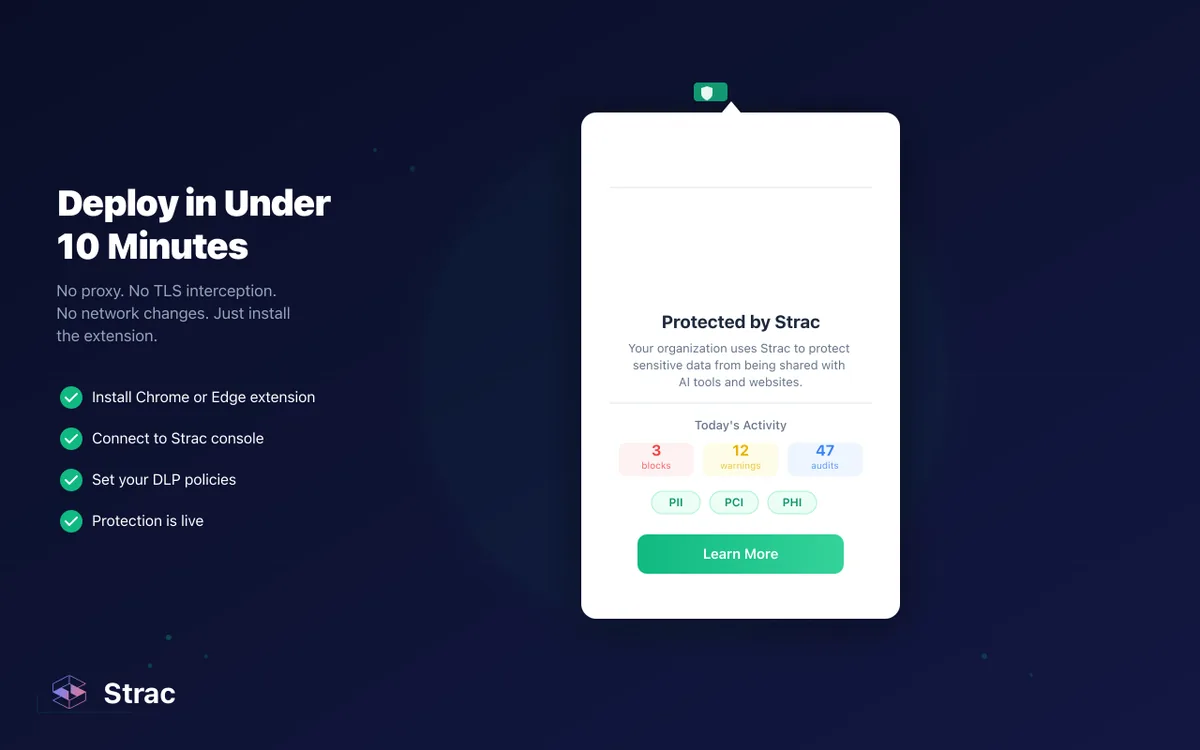
Strac deploys in under 10 minutes and gives you full shadow AI discovery in 24 hours — so the 90-day plan is about policy, rollout, and evidence, not platform deployment.
AI Governance Implementation: The 90-Day Playbook for Enterprise Security Teams
A realistic implementation timeline: discovery in 24 hours, policy in 30 days, enforcement by day 60, evidence by day 90
Why Most AI Governance Implementations Stall
The pattern is consistent across hundreds of programs we've seen:
A CISO or Chief AI Officer announces "AI governance" as an initiative.
A cross-functional committee is formed (security, GRC, legal, HR, IT, procurement).
The committee drafts an AI acceptable use policy over 60–90 days.
The policy is distributed via an all-hands meeting.
Nothing technically changes. Employees continue using ChatGPT, Copilot, and personal Claude accounts exactly as before. The policy is unenforceable.
Six months later, an incident happens. The committee reconvenes.
This fails because governance without enforcement is theater. The policy is aspirational; the behavior is unchanged; the risk is unchanged; the audit exposure grows.
A working implementation inverts the order: start with discovery and enforcement, then write policy based on what you actually see.
The 90-Day Plan at a Glance
Phase
Days
Goal
Output
Discover
1–15
Baseline actual AI usage across the fleet
Shadow AI inventory, data flow map
Policy
16–45
Draft a realistic, data-informed AI policy
Signed AUP, team-level guidelines
Enforce
46–75
Move from audit to warn to block incrementally
Live enforcement on highest-risk data types
Evidence
76–90
Wire logs to SIEM, generate first exec report, map to frameworks
Monthly risk report, audit-ready evidence
Let's walk each phase.
🎥 Phase 1: Discover (Days 1–15)
Day 1: Deploy the platform
Strac's browser extension pushes via Chrome Enterprise, Edge Group Policy, or Firefox Enterprise. The endpoint agent deploys via Jamf, Intune, Kandji, or any standard MDM. SaaS connections (Microsoft 365, Google Workspace, Slack, Salesforce) happen via OAuth.
Actual elapsed time: under 10 minutes. Your users see nothing — the extension and agent run silently in audit mode.
Days 1–3: Baseline collection
Over the first 72 hours, the platform establishes a full inventory:
Every AI tool accessed from corporate devices (ChatGPT, Copilot, Claude, Gemini, Perplexity, Jasper, Cursor, Replit, and more)
Whether each session is corporate or personal account
Every SaaS tool connected to an AI connector
Every MCP server running locally on developer machines
Sensitive data patterns flowing into each AI tool (without blocking — just measuring)
Days 4–10: Analysis
Review the data with key stakeholders:
Security leadership: which AI tools are being used, by how many users, with what sensitive data
IT: how many users are on corporate versus personal accounts (expect the personal count to surprise everyone)
Department heads: legitimate business use cases vs. casual experimentation vs. shadow tool risk
Legal: regulatory scope — any AI tools grounding on PHI, cardholder data, or EU personal data
Days 11–15: Inventory report
Publish the baseline to executive stakeholders. Expect reactions:
"We have a ChatGPT Enterprise contract — why are 40% of users on personal Plus?"
"There are 17 different AI coding tools in use. We thought it was just Copilot."
"Marketing has been putting customer data into a tool I've never heard of."
These reactions are the value of discovery. You now have data; opinions are now informed.
Deliverable: Shadow AI inventory report, data flow map, executive brief.
Phase 2: Policy (Days 16–45)
Days 16–25: Draft the policy
Now write the AI acceptable use policy — informed by actual data, not aspirational prohibitions. A good policy is pragmatic:
Which AI tools are sanctioned, conditionally allowed, or prohibited
Which data types are prohibited in any AI tool (PCI, PHI, credentials, source code)
Which data types require approval (customer PII, internal financial data)
Which data types are allowed with defaults (public info, marketing copy)
Consequences for violations (progressive — coaching first, discipline later)
Personal account handling (typically: sanctioned corporate account mandatory, personal blocked)
Avoid blanket prohibitions. "Employees may not use any generative AI" is unenforceable and actively harmful to productivity. Real policy enables AI with guardrails.
Days 26–35: Stakeholder review
Route the draft through:
Legal (regulatory, employment, HR implications)
HR (acceptable use and discipline integration with existing policies)
Procurement (which AI tools have gone through security review, which haven't)
Manager enablement (talking points for team meetings)
Visible policy portal (easy to find, searchable, updated)
Deliverable: Signed AUP, distributed to all employees, training completed.
✨ Phase 3: Enforce (Days 46–75)
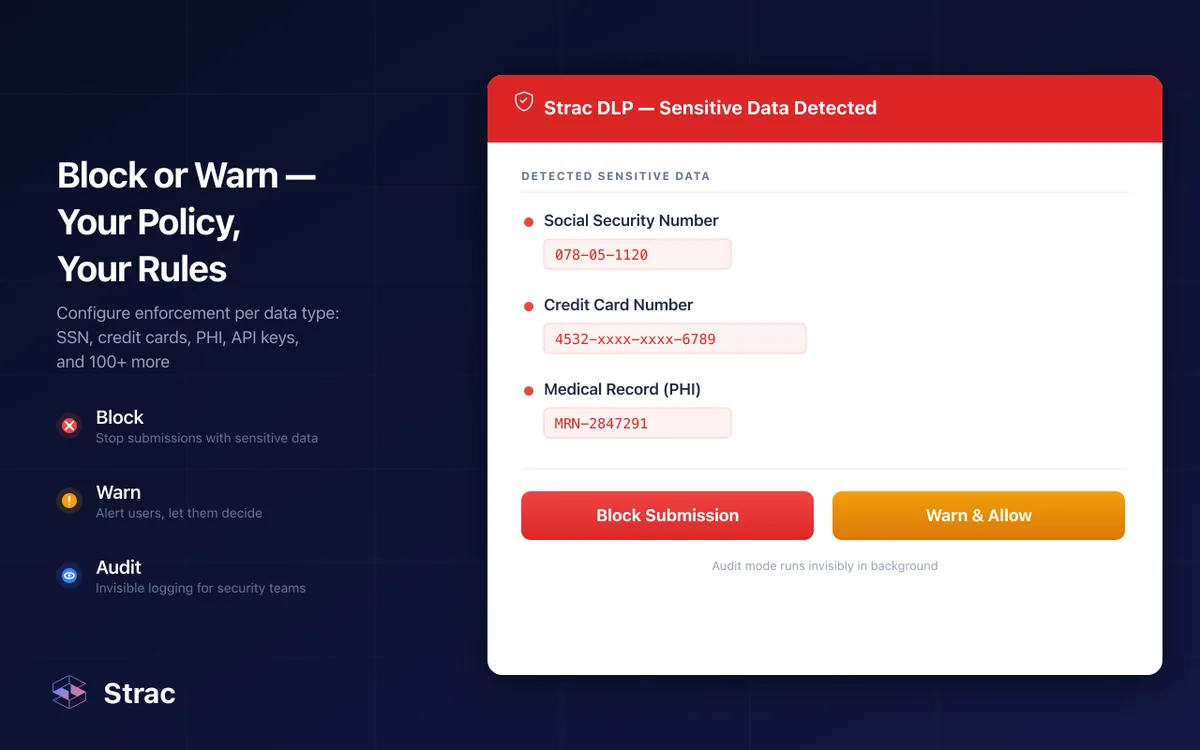
The progressive enforcement model: Audit first (learn), Warn next (educate), Block last (enforce) — each phase builds user trust and data
Enforcement ramps incrementally. Skip the big-bang block announcement — it generates pushback and help-desk tickets without changing behavior smoothly.
Days 46–55: Warn mode
Keep audit logging on; turn on warning modals for the highest-risk data categories:
PCI (credit card numbers, CVVs, bank account numbers)
PHI (medical record numbers, health plan IDs, diagnosis codes)
When a user pastes one of these into a prompt, they see a modal: "This looks like [data type]. Policy says don't send this to ChatGPT. Continue anyway?" Most users cancel. A fraction proceed and are logged.
This phase is the learning layer. Users are educated in context; the policy becomes real.
Days 56–65: Block mode for critical data
Move PCI, PHI, and credentials from Warn to Block. The modal still appears but "Continue" is disabled. Legitimate exceptions go through a request workflow (manager + security approval).
Expected outcome: a 60–80% drop in sensitive data reaching AI tools. Shadow AI personal-account usage typically drops 50–70% as users migrate to sanctioned alternatives.
Days 66–75: Expand coverage
Extend enforcement to additional data types:
Customer PII (names + other identifiers)
Source code (if the organization considers it IP-critical)
Custom patterns (matter IDs for legal, case numbers for support, project codenames)
Image/document upload DLP — prevent sensitive PDFs and screenshots from reaching AI
Different enforcement modes per team where needed: marketing has permissive policy on public content; finance blocks on PCI; healthcare redacts PHI by default.
Deliverable: Live enforcement across all sanctioned AI tools and all regulated data types.
✨ Phase 4: Evidence (Days 76–90)
Evidence generation starts from the moment enforcement is live — by day 90, you have 30+ days of audit-grade data for every framework
Enforcement generates the raw evidence auditors care about. Days 76–90 wire that evidence into operational systems.
Days 76–80: SIEM integration
Configure log export from the AI governance platform into your SIEM (Splunk, Datadog, Sumo Logic, Elastic). Structured JSON events, OCSF-aligned where possible. Enable alerting on:
Block events on highest-risk data (PCI, PHI) — security team visibility
Mass prompt attempts by a single user (potential insider threat)
New AI tools appearing on endpoints (discovery alert)
Policy override requests (approval workflow)
Days 81–85: Executive and board reporting
Generate the first monthly AI risk report:
Total blocks, warnings, audits this period
Top AI tools by volume and by risk event
Shadow AI trend (improving or degrading)
Policy exceptions granted
Compliance framework coverage (NIST AI RMF, EU AI Act, ISO 42001, HIPAA, PCI, SOC 2)
Executives want three things: is this getting better? are we covered for audits? what's the biggest remaining risk?
Days 86–90: Framework mapping and audit prep
Map the evidence to the frameworks your auditors care about:
NIST AI RMF: GOVERN, MAP, MEASURE, MANAGE function coverage
EU AI Act: Article 26 deployer obligations evidence
ISO 42001: Clause 7.5, 8.2, 8.3 operational evidence
A good AI governance platform generates this mapping continuously — you should be able to produce an auditor-ready report on demand, not assembled manually each quarter.
The 90-day plan gets you to operational AI governance. Beyond that:
Months 4–6: Expand coverage
- Cross-SaaS DLP on tools feeding AI connectors (Slack, Jira, Zendesk, Salesforce, Google Drive, SharePoint, Box)
- Copilot oversharing remediation (if M365 Copilot is deployed)
- Custom detection patterns for company-specific data (matter IDs, project codenames, M&A codewords)
Months 6–12: Advanced scenarios
- MCP DLP for agentic workflows
- Vertical use cases (healthcare PHI redaction, financial PCI enforcement)
- Regulatory audit cycles (SOC 2 Type II, HITRUST, PCI DSS annual)
Ongoing: Governance of governance
- Quarterly policy review as AI tools evolve
- New framework adoption (ISO 42001 certification, EU AI Act Article-specific compliance)
- Board-level AI risk reporting cadence
Common Implementation Mistakes
From 50+ AI governance deployments, the patterns that derail programs:
Mistake 1: Starting with Block mode. Users flood the help desk, leadership reverses the policy, program credibility collapses. Start with Audit, then Warn, then Block.
Mistake 2: Writing policy before discovery. The policy drafted in a conference room is always disconnected from actual usage. Baseline first, draft second.
Mistake 3: One-size-fits-all policies. Finance, marketing, engineering, and customer support have different AI risk profiles. Per-team policies generate less pushback and tighter control.
Mistake 4: Treating this as IT-only. AI governance needs legal, HR, comms, and business leaders. A security-only program gets less buy-in and less adoption.
Mistake 5: Measuring the wrong thing. "Number of blocks" is a lagging indicator. "Time-to-policy from new AI tool detection," "shadow AI trend," and "audit-ready framework coverage" are leading indicators.
The Shortest Path
If you want to skip the theory and see what a 90-day AI governance implementation looks like in practice — book a 15-minute demo. We'll walk through shadow AI discovery, the enforcement rollout sequence, and the evidence package, with your specific regulatory profile in mind.
🎥 ✅ How Strac covers AI data security across every surface
Implementation is where most AI governance programs stall — policies in PDFs, no controls in production. Strac is the control plane: every surface where AI processes sensitive data is enforced in software, with auditor-grade logs:
1. Browser DLP — every prompt to Claude, ChatGPT, Gemini, Copilot, Perplexity
Strac's browser extension intercepts every prompt before it reaches the LLM API and redacts PII, PHI, PCI (cardholder data), source code, and secrets inline. The model still works — it never sees the raw sensitive data. Coverage extends to claude.ai, ChatGPT, Gemini, Microsoft Copilot, Perplexity, Mistral, DeepSeek, plus Anthropic and OpenAI APIs. See Strac Generative AI DLP and Strac Claude DLP.
2. MCP DLP — for AI agents acting on enterprise data
When a Claude, Cursor, or ChatGPT agent calls a Slack, Gmail, Google Drive, GitHub, Notion, or any other MCP server, Strac sits inline and redacts sensitive data in every tool-call response. Strac is the first DLP with native Model Context Protocol policy enforcement — most enterprise DLP vendors still have no MCP support at all. Full background: MCP DLP guide.
3. SaaS DLP and Data Discovery — across 47+ integrations
The same redaction and labeling policies apply to every SaaS surface where data lives — Slack, Google Drive, Gmail, M365, OneDrive, SharePoint, Salesforce, Notion, Jira, Confluence, GitHub, Linear, HubSpot, Asana, Zendesk, Intercom, Box, ServiceNow, and 30+ more. Continuous data discovery and classification (DSPM) inventories every personal data type across your environment and automatically applies the right sensitivity label.
4. Cloud DSPM — AWS, Azure, GCP
Strac continuously scans AWS (S3, RDS, EBS, CloudWatch), Azure (Blob Storage, SQL), and GCP (Cloud Storage, BigQuery) for sensitive data at rest. Not point-in-time scans — continuous discovery with automatic classification. The output powers compliance evidence for GDPR, HIPAA, PCI DSS, SOC 2, and ISO 27001 audits.
5. Endpoint DLP — Mac, Windows, Linux
For data egress outside the SaaS perimeter — local file shares, USB drives, screenshots, terminal output, IDE clipboards. Strac's endpoint agent enforces the same policies as the SaaS, browser, and MCP layers, with full audit logs for any sensitive data movement.
With a modern AI governance platform, a complete implementation takes about 90 days — 15 days for discovery, 30 for policy development, 30 for enforcement rollout, 15 for evidence wiring. Platform deployment itself is under 10 minutes with Strac. The 90 days are almost entirely policy, stakeholder alignment, and rollout sequencing — not technology.
What's the first step in implementing AI governance?
Shadow AI discovery. Before writing any policy, deploy an endpoint agent and browser extension in audit mode. Run 7–15 days to establish what AI tools your employees actually use, with what data, on what accounts. Most organizations discover 3–5× more AI usage than IT believed existed. That baseline informs every subsequent decision.
Do we need a policy before deploying an AI governance tool?
No. Deploy the tool in audit mode first, baseline actual behavior, then write the policy based on data. Organizations that write policy before deployment end up with aspirational rules disconnected from actual usage patterns, and those policies are generally unenforceable. Deploy → baseline → policy → enforce.
Who should lead AI governance implementation?
Typically the CISO owns technical implementation (discovery, enforcement, SIEM integration). GRC owns policy and evidence. A cross-functional AI council makes strategic decisions (which tools to sanction, policy exceptions, escalations). Some organizations appoint a Chief AI Officer to span all three. What matters is that technical enforcement actually happens — not just policy and documentation.
How do we measure success of AI governance implementation?
Leading indicators: shadow AI trend (decreasing), time-to-policy for new AI tools, percentage of users on sanctioned vs personal accounts, framework coverage for audits. Lagging indicators: incidents prevented, audit findings reduced, regulatory citations avoided. Don't over-rely on "number of blocks" — that number going up or down depends on factors beyond governance effectiveness.
What if we have a regulatory audit in 30 days?
Compress the 90-day plan. Deploy the platform day 1 (under 10 minutes). Run audit mode days 1–10 to establish the evidence baseline. Enable warn + block modes days 11–20 to demonstrate operational controls. Days 21–30: wire SIEM, generate the framework-mapped evidence package, rehearse the auditor walkthrough. You won't have 90 days of historical data, but you will have operational governance and evidence of a 30-day active program — which is better than most organizations going into their first AI-scoped audit.
🌶️ Spicy FAQs for AI Governance Implementation
Where do most AI governance programs stall?
At enforcement. Teams write a policy and build an inventory, then stop before wiring controls that actually block or redact sensitive data. Start enforcement early — even on one high-risk data path.
What is a realistic first 90 days?
Discover AI and agents in use, protect the highest-risk data paths with DLP, then wire evidence to your frameworks. Depth on one path beats shallow coverage everywhere.
How do we implement governance without slowing teams down?
Use redaction and vaulting instead of hard blocks where possible, so work continues on non-sensitive content while sensitive values are protected.
How do we prove the program works?
Log every detection and remediation and map it to SOC 2, ISO 42001, or the EU AI Act. Evidence is the difference between a policy and a program.
How long does AI governance implementation take?
With a modern AI governance platform, a complete implementation takes about 90 days — 15 days for discovery, 30 for policy development, 30 for enforcement rollout, 15 for evidence wiring. Platform deployment itself is under 10 minutes with Strac. The 90 days are almost entirely policy, stakeholder alignment, and rollout sequencing — not technology.
What's the first step in implementing AI governance?
Shadow AI discovery. Before writing any policy, deploy an endpoint agent and browser extension in audit mode. Run 7–15 days to establish what AI tools your employees actually use, with what data, on what accounts. Most organizations discover 3–5× more AI usage than IT believed existed. That baseline informs every subsequent decision.
Do we need a policy before deploying an AI governance tool?
No. Deploy the tool in audit mode first, baseline actual behavior, then write the policy based on data. Organizations that write policy before deployment end up with aspirational rules disconnected from actual usage patterns, and those policies are generally unenforceable. Deploy → baseline → policy → enforce.
Who should lead AI governance implementation?
Typically the CISO owns technical implementation (discovery, enforcement, SIEM integration). GRC owns policy and evidence. A cross-functional AI council makes strategic decisions (which tools to sanction, policy exceptions, escalations). Some organizations appoint a Chief AI Officer to span all three. What matters is that technical enforcement actually happens — not just policy and documentation.
How do we measure success of AI governance implementation?
Leading indicators: shadow AI trend (decreasing), time-to-policy for new AI tools, percentage of users on sanctioned vs personal accounts, framework coverage for audits. Lagging indicators: incidents prevented, audit findings reduced, regulatory citations avoided. Don't over-rely on "number of blocks" — that number going up or down depends on factors beyond governance effectiveness.
Discover & Protect Data on SaaS, AI, MCP, Endpoints & Cloud
Strac provides end-to-end data loss prevention for all SaaS and Cloud apps. Integrate in under 10 minutes and experience the benefits of live DLP scanning, live redaction, and a fortified SaaS environment.


.webp)




.avif)


.gif)
