AI Usage Governance vs. AI Model Governance: Why the Split Matters
The AI governance category is splitting in two. Here's why understanding usage governance vs model governance determines whether your investment protects you — or ships a dashboard while risk walks out the door.
The AI governance category is splitting in two. AI model governance (Credo AI, IBM watsonx.governance) manages risk in models your company builds. AI usage governance (Strac, Nightfall, Metomic) manages risk in how your employees use third-party AI tools.
Most enterprises need usage governance, not model governance. Roughly 5% of enterprises train their own foundation models. 100% have employees pasting data into ChatGPT, Copilot, and Claude.
Confusing the two is the most expensive mistake in AI security right now. Budget spent on model governance when your actual risk is employee prompt leakage is budget that doesn't protect you.
Strac is the usage governance layer. Real-time prompt DLP, shadow AI discovery, enforcement on ChatGPT/Copilot/Claude/Gemini, and compliance evidence aligned to NIST AI RMF, EU AI Act, ISO 42001, HIPAA, PCI, and SOC 2.
AI Usage Governance vs. AI Model Governance: Why the Split Matters
Understanding the split between usage governance and model governance determines whether your AI security investment actually protects your business
✨ The AI Governance Category Is Splitting in Two
In 2023, "AI governance" was one category. Every analyst, vendor, and buyer meant roughly the same thing: manage the risk from AI.
By 2026, it isn't one category anymore. Two distinct product markets have emerged, with different vendors, different buyers, different capabilities, and different use cases. Most enterprise security teams haven't caught up to the split yet — which means a lot of AI governance investment is going to the wrong layer.
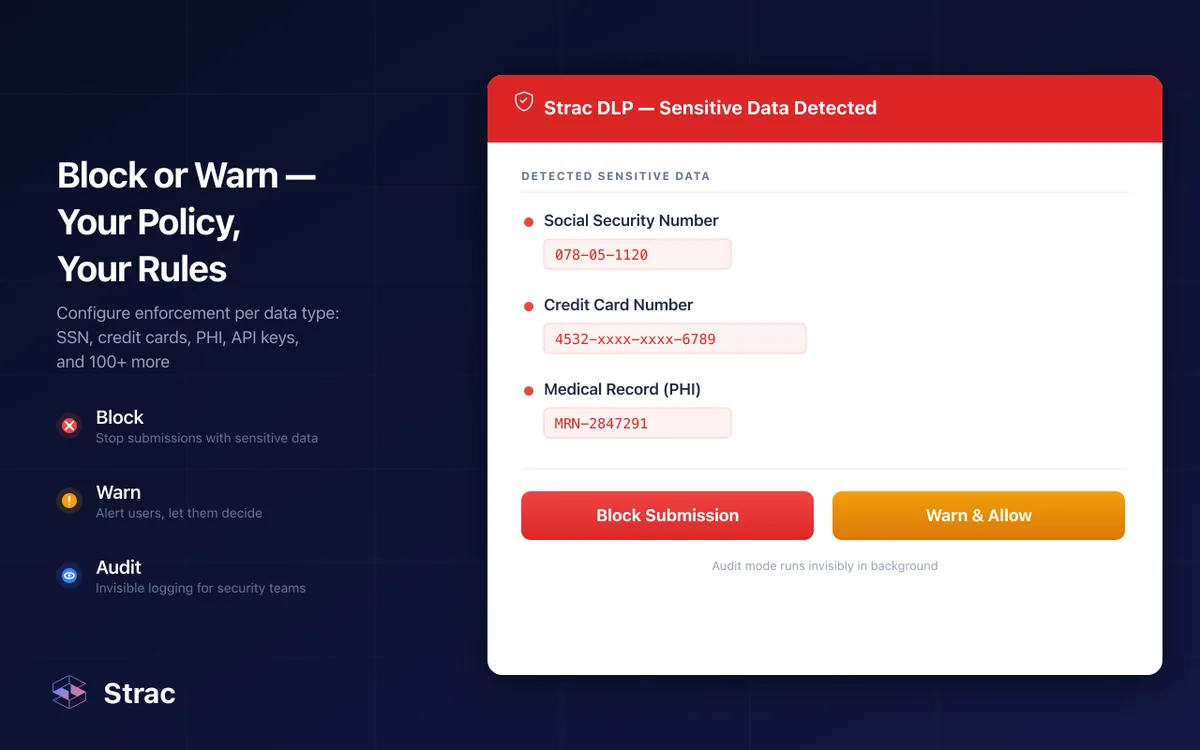
Real-time enforcement at the prompt — the defining capability of usage governance (not model governance)
The two sub-categories:
AI Model Governance
- Governs models your company builds
- Core capabilities: model registry, AI bill of materials (AI-BOM), bias scoring, evaluation pipelines, NIST AI RMF mapping, model cards
- Representative vendors: Credo AI, IBM watsonx.governance, Cranium, Monitaur, Fairly AI
- Who needs it: roughly 5% of enterprises — those training their own ML/LLMs
AI Usage Governance
- Governs AI tools your employees use
- Core capabilities: prompt inspection, shadow AI discovery, data redaction, policy enforcement, cross-SaaS controls
- Representative vendors: Strac, Nightfall AI, Metomic, Netskope AI, Zscaler AI
- Who needs it: roughly 100% of enterprises — any organization with employees using ChatGPT, Copilot, Claude, or Gemini
Both categories are legitimate. Both are growing. But they solve different problems and buying the wrong one doesn't partially solve yours — it mostly doesn't solve it at all.
How to Tell Which One You Actually Need
Start with three questions:
Question 1: Does your company train foundation models or custom ML models for production?
If yes — you're in the model governance market. You need a registry, bias evaluation, model cards, and evidence of responsible AI development. Credo AI, IBM watsonx.governance, or equivalent. You probably also need usage governance for employee AI tool use, but model governance is non-optional if you ship AI products.
If no — you don't need model governance. You might still need to document that you use third-party models, but a full model governance platform is overkill.
Question 2: Do your employees use ChatGPT, Microsoft Copilot, Claude, Gemini, or similar AI tools?
If yes (which is 99.9% of enterprises today) — you need usage governance. Full stop. A written policy is not a control. Model governance doesn't help you here.
If no — check again. Shadow AI detection studies consistently find 3–5× more tools in use than IT believes exist. Run a discovery scan before concluding "no."
Question 3: Does your company have regulatory obligations (HIPAA, PCI DSS, GDPR, SOC 2, EU AI Act) that touch AI usage?
If yes — you need both layers if you build models, and at minimum usage governance if you don't. Compliance evidence for AI usage is the fastest-growing audit scope in 2026.
Most enterprises answer: no to #1, yes to #2, yes to #3. That means you need usage governance, not model governance. Or if you do need both, usage governance is the one with more urgent, higher-volume risk.
✨ Why Enterprises Keep Buying the Wrong Layer
Three reasons the wrong-layer investment keeps happening:
1. The vendors optimized for model governance got there first
Credo AI (2018), IBM watsonx (2023), Cranium (2022), Monitaur (2019) — the model governance vendors are older, better funded, and better-covered by analysts. A CISO searching "ai governance platform" today still sees model governance products in the top Gartner and Forrester lists.
Usage governance as a distinct category is newer (2023–2024). Gartner added it as its own MQ dimension in mid-2025. The analyst lag is real.
Real-time prompt inspection at the browser — what AI usage governance actually looks like in practice
2. "AI governance" is a loaded term
"Governance" in the pre-AI world meant policies and evidence. Most enterprise governance platforms were document repositories, questionnaires, and attestation workflows. That's what model governance looks like at the surface — a registry of models, a catalog of evaluations, evidence for auditors.
Usage governance looks nothing like that. It's real-time, content-inspection, enforcement-heavy, and operational. It looks more like endpoint DLP than GRC software.
A buyer shopping for "AI governance" who's thinking in GRC terms naturally gravitates to the vendor whose UI looks like GRC. That vendor is almost always a model governance vendor.
3. The marketing conflates the two
Many model governance vendors now claim "usage governance" capabilities. Usually this means they track which employees have accessed an AI model — not which data flowed into the prompts. It's a checkbox, not a control.
Conversely, some usage governance vendors claim "model governance" capabilities. Usually this means they'll store documentation about the models your employees use, which is also a checkbox.
A buyer reading the marketing can easily conclude both categories are the same. Then they buy based on analyst coverage and brand recognition — which defaults to model governance.
The Clearest Real-World Distinction
A CISO at a 5,000-person fintech asks: "We want to enable ChatGPT Enterprise. How do we govern it?"
A model governance vendor's answer: We'll help you document that you use ChatGPT as a third-party AI system, evaluate OpenAI's model card, track your approval workflow, and store evidence that your employees have acknowledged the AI policy. This sits in our registry alongside any models you build yourself.
A usage governance vendor's answer: We'll inspect every ChatGPT prompt in your browser, block submissions containing PII/PHI/PCI, discover employees using personal ChatGPT Plus on corporate devices, and generate logs you can show PCI auditors.
Both are useful. Only one prevents data leaks.
The Samsung engineers who pasted semiconductor IP into ChatGPT weren't stopped by a model registry entry. They'd have been stopped by a browser extension that detected source code patterns before submit.
That's usage governance.
✨ What a Complete AI Usage Governance Program Looks Like
If you've determined you need usage governance, the complete program has four layers:
Layer 1: Discovery
You cannot govern what you can't see. Most "we don't have a shadow AI problem" statements are wrong — the average enterprise has 3× more AI tools in use than IT has sanctioned.
Endpoint agent inventory of AI apps installed locally
Browser-based detection of AI tool usage (including personal accounts)
Email enforcement identifying signups with personal addresses
Outputs: shadow AI inventory, usage baseline, policy gap report.
Layer 2: Real-time Enforcement
Once you know what's in use, you inspect content and enforce policy at the moment data crosses the boundary.
Browser extension inspecting ChatGPT, Copilot, Claude, Gemini prompts in real time
100+ sensitive data types (PII, PCI, PHI, secrets, custom patterns)
Three modes: Block, Warn, Audit
Policy per team, per tool, per data type
Outputs: real-time blocks, user education prompts, audit-grade logs.
Layer 3: Cross-tool Controls
AI governance doesn't end at the AI tool. Data flows from Slack, Jira, Zendesk, Salesforce, SharePoint, Google Drive into AI — and outputs flow back out.
Slack DLP redaction before data reaches ChatGPT connectors
SharePoint oversharing remediation before Copilot amplifies it
Integration-level inspection on 50+ SaaS tools
Layer 4: Audit and Evidence
Usage governance matters only if you can prove it to auditors, executives, and regulators.
Pre-mapped to NIST AI RMF, EU AI Act, ISO 42001, HIPAA, PCI DSS, SOC 2
Executive dashboards with AI risk metrics
SIEM-native log export for SOC integration
Quarterly business review templates
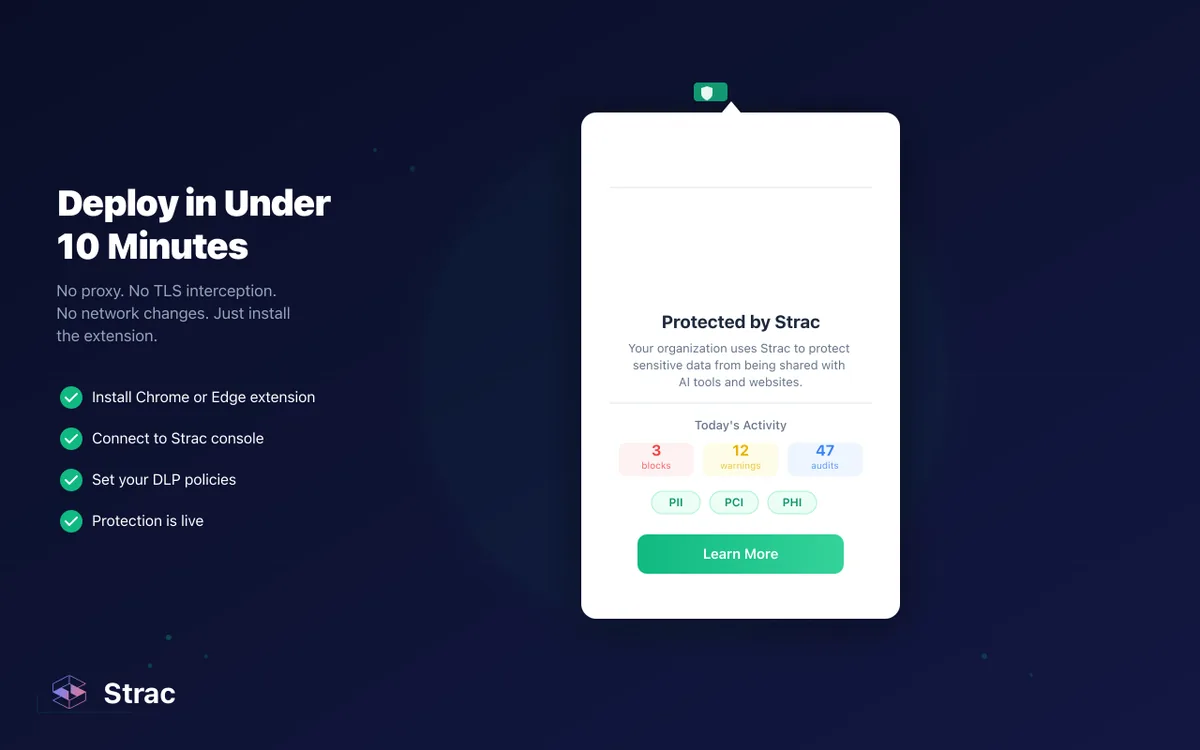
No proxy, no TLS break — full AI usage governance coverage in under 10 minutes of deployment
✨ Why Strac Is Built for Usage Governance
Strac was built from day one as an AI usage governance platform. The architectural decisions reflect that:
No proxy, no TLS break. Content inspection runs locally in the browser and on the endpoint — faster than network-layer alternatives, and works on BYOD and remote devices.
Agentless SaaS integration. OAuth-based connection to 50+ SaaS tools; no network topology changes required.
MCP-aware. Strac inspects data at the Model Context Protocol boundary — the emerging agentic AI control point that traditional DLP doesn't see.
Regulatory framework mapping. Evidence is generated continuously, not built from scratch for every audit.
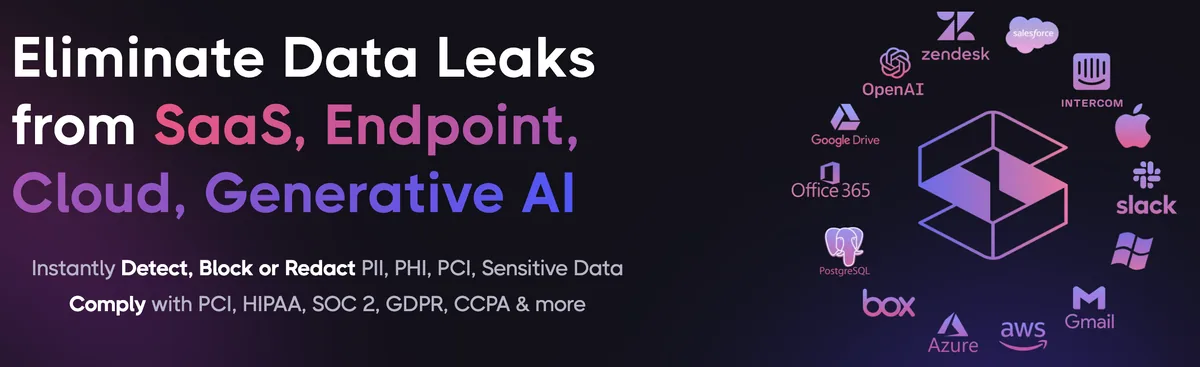
One platform, every place AI touches data
Strac unifies SaaS, Cloud, Endpoint, and Browser/GenAI DLP in a single control plane
Usage governance isn't one product category — it's four surfaces AI touches. Strac covers all of them in one platform: Browser / GenAI (ChatGPT, Microsoft Copilot, Claude, Gemini, Perplexity, and 50+ AI tools via extension), SaaS (Slack, Gmail, Google Drive, Zendesk, Salesforce, SharePoint, OneDrive, Notion, Intercom — 50+ integrations), Cloud (AWS S3 / RDS / CloudWatch, Azure Blob, GCP), and Endpoint (Mac, Windows, Linux). When ChatGPT Enterprise pulls from a SharePoint connector, the data is already clean. When a Copilot agent retrieves an Excel file, the PII inside is already redacted. Point tools at each layer can't deliver that coherence.
Redaction across documents, images, and every SaaS channel
Live Slack redaction — the same engine runs inline on Gmail, Zendesk, Salesforce, and every SaaS channel that feeds AI connectors
Strac redacts sensitive content inline — inside attachments (PDF, DOCX, XLSX, JPEG, PNG, screenshots), Slack messages, Gmail threads, Zendesk tickets, and Salesforce records — not just in text prompts. That's the only DLP layer that handles images and scanned documents before AI ingests them. Detection runs on custom ML models tuned with customer feedback loops, which keeps false positives low. Scanning runs in real time and retroactively across historical data, with remediation actions spanning redact, mask, revoke access, delete, quarantine, and alert.
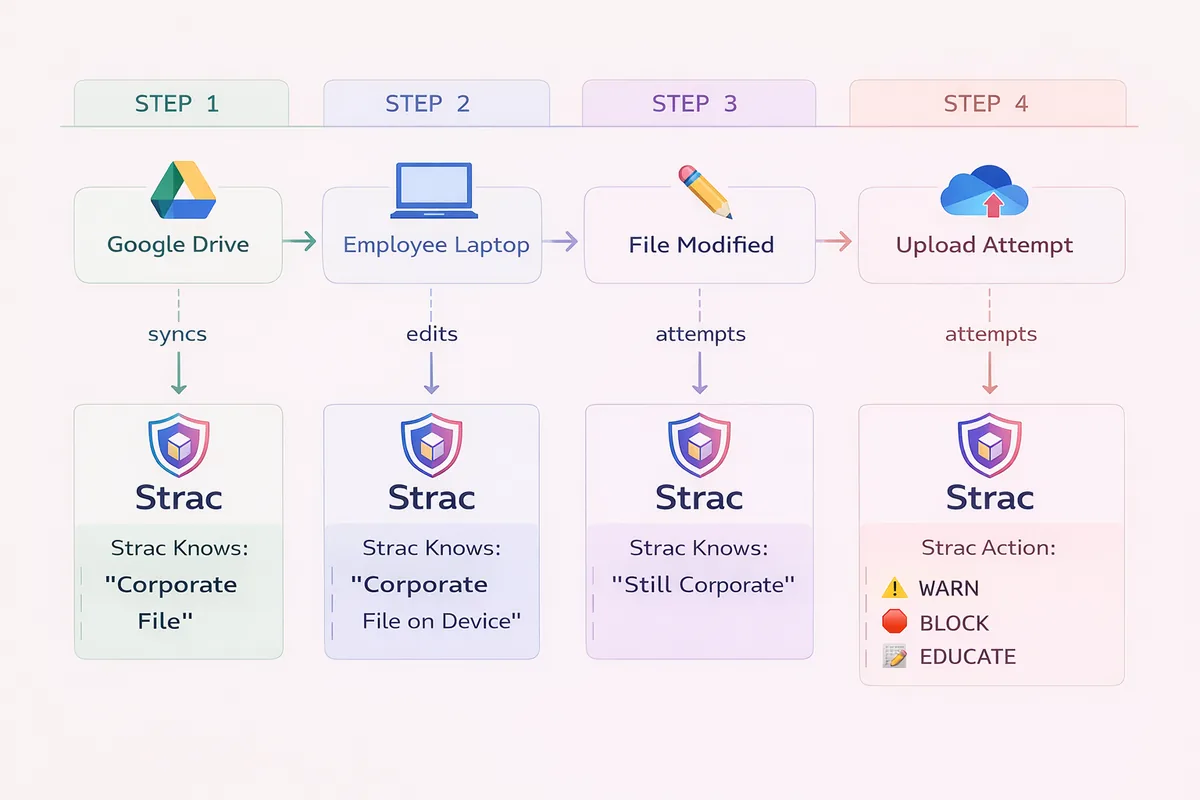
Endpoint data lineage for shadow AI
Endpoint data lineage maps every hop a sensitive file takes before it reaches an AI tool
Browser extensions see what happens in the browser. Strac's endpoint agent for Mac, Windows, and Linux sees everything else: personal ChatGPT Plus accounts on corporate devices, local LLMs (Ollama, LM Studio), unsanctioned Chrome extensions, and the full lineage of sensitive files from origin to AI tool. That combination — browser + endpoint + SaaS + cloud — is what turns "we have an AI policy" into provable enforcement.
Proven at enterprise scale, with compliance mapping built in
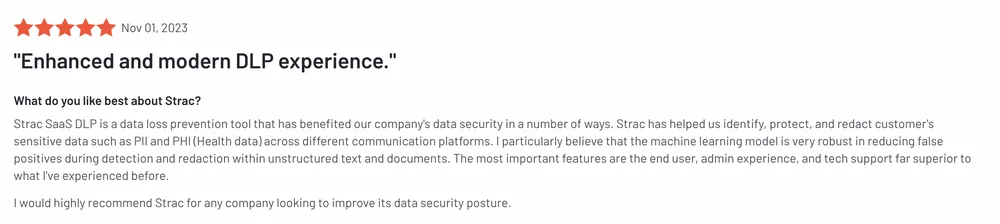
Rated 5/5 on [G2](https://www.g2.com/products/strac/reviews) — see the full [customer wall of love](https://www.strac.io/wall-of-love)
Strac is deployed at UiPath, Crypto.com, Underdog Fantasy, and 50+ other enterprises. Evidence is pre-mapped to NIST AI RMF, EU AI Act, ISO 42001, PCI DSS, SOC 2, HIPAA, ISO 27001, CCPA, and GDPR — continuously generated, not rebuilt per audit. Developer APIs, custom detectors, and a 30-day free trial let security teams pilot before procurement.
Model governance vendors trying to bolt usage governance onto a GRC tool take years to match this. It's a different architecture.
The Decision Tree
If you remember nothing else from this post, remember this decision tree:
Do you build foundation models? → Model governance. Get Credo AI or equivalent.
Do your employees use third-party AI? → Usage governance. Get Strac or equivalent.
Both? → Both. They don't overlap.
Neither? → Run a discovery scan first. You probably have #2 and don't know it.
Most enterprises will end up at #2, buying usage governance. A minority will buy both. Very few only need model governance.
If you've been shopping "AI governance" and the products all look like GRC tools — you've been shopping the wrong subcategory. See what usage governance looks like at /ai-governance, or book a demo to compare in a 15-minute walkthrough.
✅ How Strac covers AI data security across every surface
Usage governance — the day-to-day where employees and agents actually touch AI — happens across five distinct surfaces. Strac is the only DLP platform covering all five; most legacy DLP vendors cover one or two:
1. Browser DLP — every prompt to Claude, ChatGPT, Gemini, Copilot, Perplexity
Strac's browser extension intercepts every prompt before it reaches the LLM API and redacts PII, PHI, PCI (cardholder data), source code, and secrets inline. The model still works — it never sees the raw sensitive data. Coverage extends to claude.ai, ChatGPT, Gemini, Microsoft Copilot, Perplexity, Mistral, DeepSeek, plus Anthropic and OpenAI APIs. See Strac Generative AI DLP and Strac Claude DLP.
2. MCP DLP — for AI agents acting on enterprise data
When a Claude, Cursor, or ChatGPT agent calls a Slack, Gmail, Google Drive, GitHub, Notion, or any other MCP server, Strac sits inline and redacts sensitive data in every tool-call response. Strac is the first DLP with native Model Context Protocol policy enforcement — most enterprise DLP vendors still have no MCP support at all. Full background: MCP DLP guide.
3. SaaS DLP and Data Discovery — across 47+ integrations
The same redaction and labeling policies apply to every SaaS surface where data lives — Slack, Google Drive, Gmail, M365, OneDrive, SharePoint, Salesforce, Notion, Jira, Confluence, GitHub, Linear, HubSpot, Asana, Zendesk, Intercom, Box, ServiceNow, and 30+ more. Continuous data discovery and classification (DSPM) inventories every personal data type across your environment and automatically applies the right sensitivity label.
4. Cloud DSPM — AWS, Azure, GCP
Strac continuously scans AWS (S3, RDS, EBS, CloudWatch), Azure (Blob Storage, SQL), and GCP (Cloud Storage, BigQuery) for sensitive data at rest. Not point-in-time scans — continuous discovery with automatic classification. The output powers compliance evidence for GDPR, HIPAA, PCI DSS, SOC 2, and ISO 27001 audits.
5. Endpoint DLP — Mac, Windows, Linux
For data egress outside the SaaS perimeter — local file shares, USB drives, screenshots, terminal output, IDE clipboards. Strac's endpoint agent enforces the same policies as the SaaS, browser, and MCP layers, with full audit logs for any sensitive data movement.
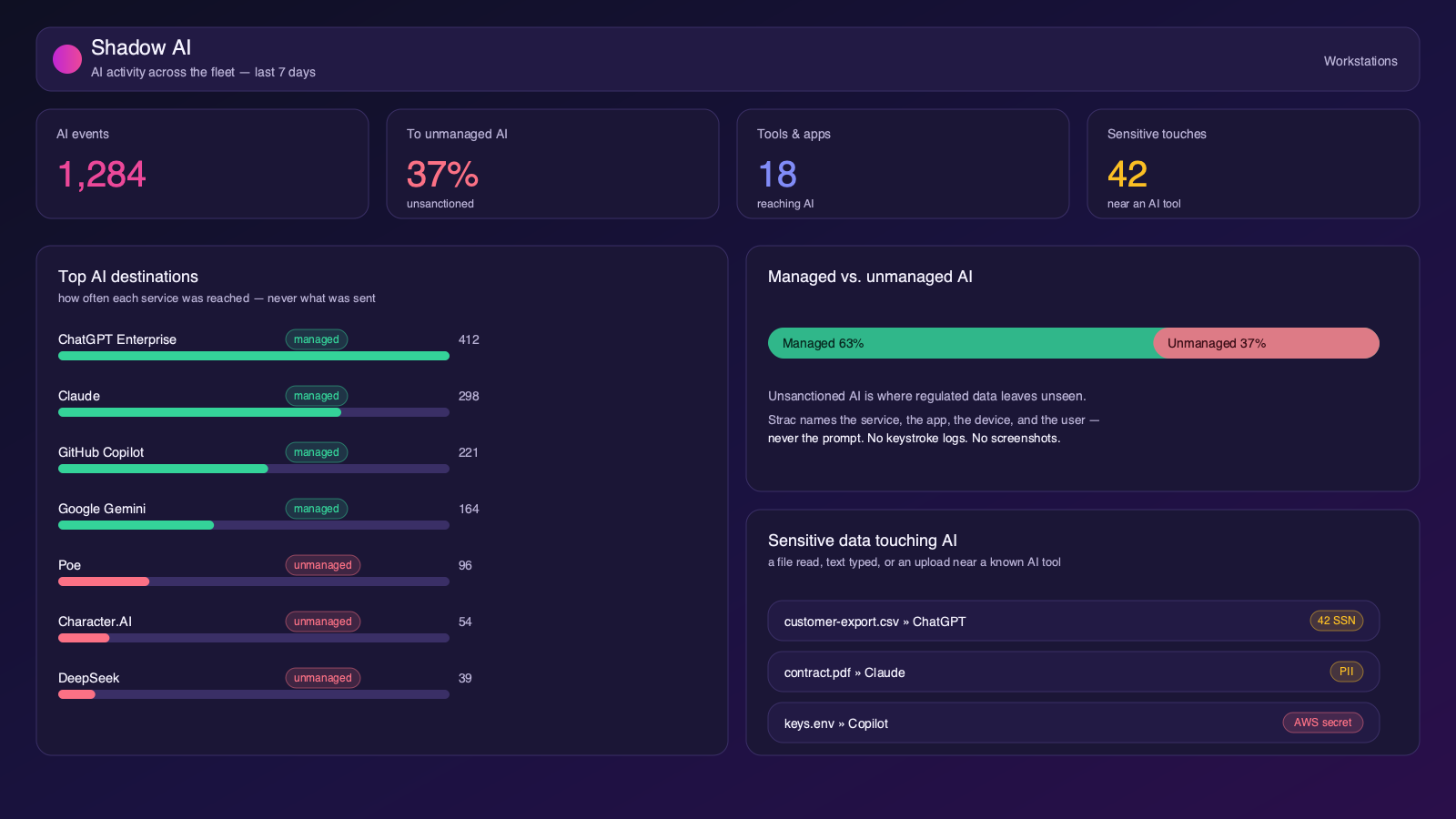
Model governance is about the models you build; AI-usage governance is about the tools your people actually use. Strac operates on the usage side: it shows which AI services the fleet reaches, whether they’re sanctioned, and when sensitive data touches them — the visibility an AI-usage policy needs to be enforceable rather than aspirational.
Strac Shadow AI: which services the fleet reaches, managed vs. unmanaged, and sensitive data touching AI — never the prompt.
How do you detect shadow AI? On the endpoint. Strac watches which AI services each device reaches — browser and desktop — names managed vs. unmanaged tools, and flags when sensitive data comes near them, without reading prompts or logging keystrokes.
What is the difference between AI usage governance and AI model governance?
AI model governance manages risk in models your company builds — bias, drift, training data provenance, evaluation pipelines, model cards. AI usage governance manages risk in how your employees use third-party AI tools — prompt data leakage, shadow AI, policy enforcement, regulatory evidence. They solve different problems with different capabilities; roughly 95% of enterprises need usage governance, while only enterprises training their own foundation models need model governance.
Do I need both AI usage governance and AI model governance?
Only if you build models AND have employees using third-party AI tools. Most enterprises only train custom models in narrow departments (ML/AI teams), while every department uses ChatGPT, Copilot, and Claude. If you fit that pattern, prioritize usage governance (the broader, higher-volume risk) and add model governance as needed for the ML team's specific work.
Is AI usage governance the same as AI security?
Usage governance is a subset of AI security. AI security also includes model security (protecting the models themselves from attack — prompt injection, model extraction, training data poisoning), infrastructure security (protecting the systems AI runs on), and output security (validating AI-generated content). Usage governance specifically addresses how third-party AI tools are used inside your organization.
Which AI governance category does Strac fit into?
Strac is an AI usage governance platform. We govern ChatGPT, Microsoft Copilot, Claude, Gemini, Perplexity, and 50+ other AI tools your employees use — inspecting prompts in real time, discovering shadow AI, enforcing policy, and generating compliance evidence. We don't do model registry or bias evaluation; for that, consider Credo AI, IBM watsonx.governance, or Cranium.
How do I decide between a usage governance and a model governance vendor?
Ask: "What actually happens in my tenant every day?" If the answer is "500 employees paste data into ChatGPT, Copilot, and Claude" — you need usage governance. If the answer is "our ML team ships 2 models per quarter to production" — you also need model governance. Start with the higher-volume, higher-frequency risk. For most enterprises, that's usage.
What is the difference between AI usage governance and AI model governance?
AI model governance manages risk in models your company builds — bias, drift, training data provenance, evaluation pipelines, model cards. AI usage governance manages risk in how your employees use third-party AI tools — prompt data leakage, shadow AI, policy enforcement, regulatory evidence. They solve different problems with different capabilities; roughly 95% of enterprises need usage governance, while only enterprises training their own foundation models need model governance.
Do I need both AI usage governance and AI model governance?
Only if you build models AND have employees using third-party AI tools. Most enterprises only train custom models in narrow departments (ML/AI teams), while every department uses ChatGPT, Copilot, and Claude. If you fit that pattern, prioritize usage governance (the broader, higher-volume risk) and add model governance as needed for the ML team's specific work.
Is AI usage governance the same as AI security?
Usage governance is a subset of AI security. AI security also includes model security (protecting the models themselves from attack — prompt injection, model extraction, training data poisoning), infrastructure security (protecting the systems AI runs on), and output security (validating AI-generated content). Usage governance specifically addresses how third-party AI tools are used inside your organization.
Which AI governance category does Strac fit into?
Strac is an AI usage governance platform. We govern ChatGPT, Microsoft Copilot, Claude, Gemini, Perplexity, and 50+ other AI tools your employees use — inspecting prompts in real time, discovering shadow AI, enforcing policy, and generating compliance evidence. We don't do model registry or bias evaluation; for that, consider Credo AI, IBM watsonx.governance, or Cranium.
How do I decide between a usage governance and a model governance vendor?
Ask: "What actually happens in my tenant every day?" If the answer is "500 employees paste data into ChatGPT, Copilot, and Claude" — you need usage governance. If the answer is "our ML team ships 2 models per quarter to production" — you also need model governance. Start with the higher-volume, higher-frequency risk. For most enterprises, that's usage.
Discover & Protect Data on SaaS, AI, MCP, Endpoints & Cloud
Strac provides end-to-end data loss prevention for all SaaS and Cloud apps. Integrate in under 10 minutes and experience the benefits of live DLP scanning, live redaction, and a fortified SaaS environment.


.webp)




.avif)




.gif)
