What a web application penetration test covers, how it runs step by step, how API penetration testing differs, and how to choose a web application penetration testing service.
For a SaaS company the web app is the attack surface that matters most: it is where customer data lives and where every user can poke at it. This guide covers what a web application penetration test checks, how it runs, and what a good finding actually looks like.
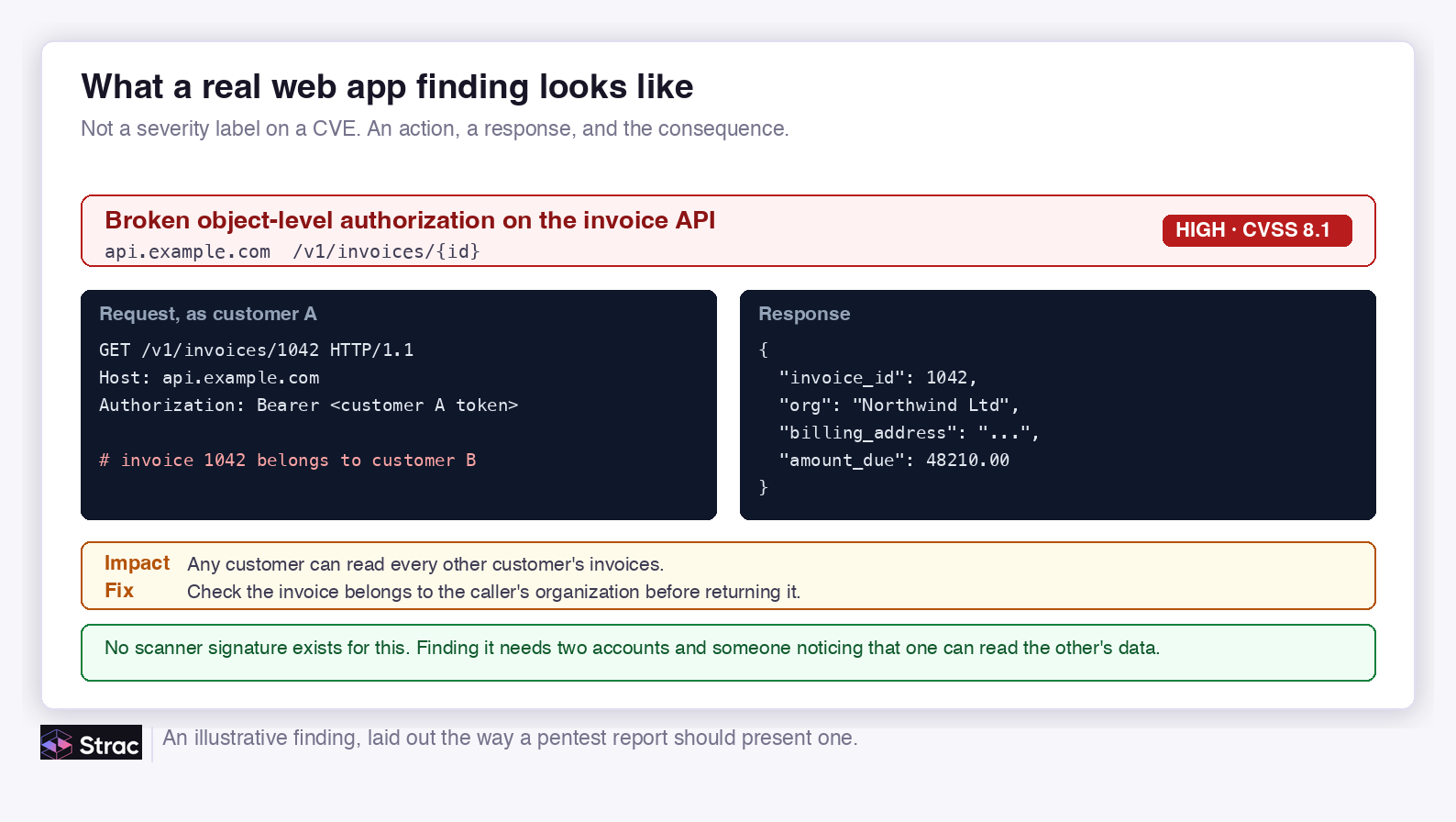
An illustrative finding, laid out the way a pentest report should present one: the request, the response, the impact and the fix.
What is web application penetration testing?
A web application penetration test is an authorized, simulated attack on your app by someone trying to break its security: get data they should not see, act as another user, or take over the server. Unlike a scan, it uses real accounts and real workflows.
Login, password reset, MFA, SSO and session handling.
Access control
Can user A read or change user B's data (IDOR), and can a regular user reach admin functions?
Injection
SQL, command and template injection; cross-site scripting.
Server-side request forgery
Can the app be tricked into calling internal services or cloud metadata?
Business logic
Skipping payment steps, abusing invites, racing limits.
Data exposure
Secrets in responses, verbose errors, open storage links.
API penetration testing
Most modern apps are a frontend on top of an API, and the API is where the access-control bugs hide. An API penetration test works from your OpenAPI or GraphQL schema and tests every endpoint with every role. The OWASP API Security Top 10 is the usual checklist, led by broken object-level authorization, which is the finding in the example above.
The reason it leads that list is arithmetic: every endpoint that takes an id is a place where the check can be forgotten, and a typical API has hundreds. Testing it properly means every endpoint against every role, which is exactly the kind of exhaustive, boring work that gets sampled rather than completed when a human is billing by the day.
Application penetration testing step by step
Step
What happens
1. Scoping
URLs, API specs, roles and test accounts, and what is out of bounds.
2. Reconnaissance
Map pages, endpoints, parameters and roles.
3. Exploitation
Attempt attacks and chain them for impact.
4. Validation
Confirm each finding is real and reproducible.
5. Reporting
Severity, proof, and how to fix each issue.
6. Retest
Confirm the fixes hold.
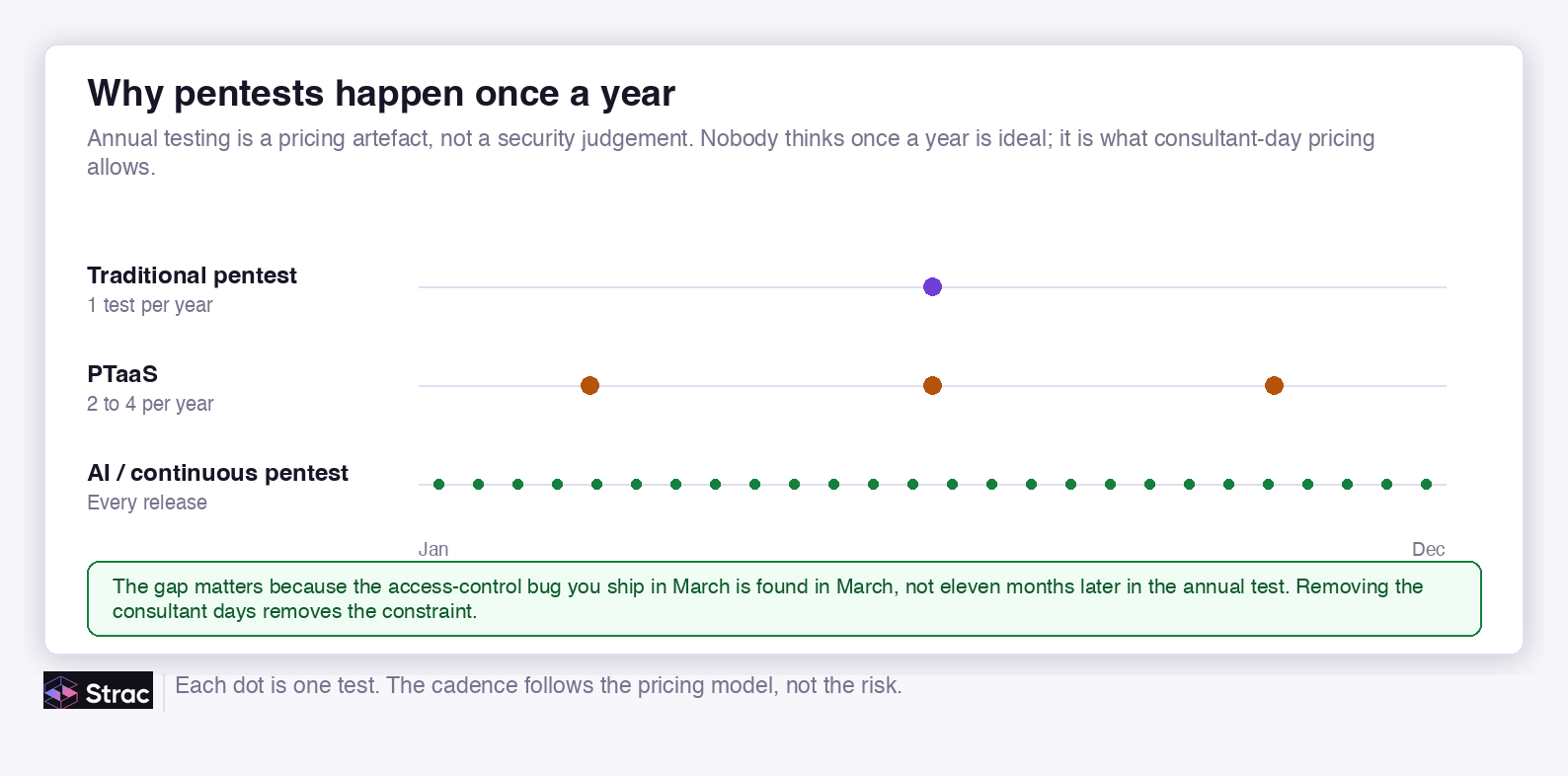
Steps 2 through 5 are what consultants bill by the day. AI agents now run them in hours, which is the entire reason the price moved. What has not changed is step 1: scoping is still a human conversation, and a bad scope produces a useless test at any price.
Choosing web application penetration testing services
Ask to see a sample report. Make sure retests are included. Confirm they test with authenticated roles, not just from outside. And check that the report is accepted by your auditor, because that is the thing you are actually buying. For how those choices move the quote, see penetration testing cost; for the vendor landscape, see penetration testing companies.
Strac AI Pentest covers web apps and their APIs with unlimited retests, at $1,995 per application per year.
Get an auditor-ready pentest report
The web app and its API are one scope, not two. Strac AI Pentest runs the test with AI agents rather than consultant days: $1,995 per application per year, unlimited retests for twelve months, and a report built for the auditor who asks. See pricing.
An authorized, simulated attack on your application by someone trying to break its security: get data they should not see, act as another user, or take over the server. Unlike a scan, it uses real accounts and real workflows, so it finds the access-control and business-logic flaws that have no vulnerability signature.
What does a website penetration test cover?
Authentication (login, password reset, MFA, SSO, session handling), access control (can user A read user B's data, can a regular user reach admin functions), injection (SQL, command, template, XSS), server-side request forgery, business logic (skipping payment steps, abusing invites, racing limits) and data exposure (secrets in responses, verbose errors, open storage links).
How is API penetration testing different?
Most modern apps are a frontend on top of an API, and the API is where the access-control bugs hide. An API penetration test works from your OpenAPI or GraphQL schema and tests every endpoint with every role. The OWASP API Security Top 10 is the usual checklist, led by broken object-level authorization.
How long does a web application penetration test take?
A traditional test is usually one to three weeks for a single application, most of it tester time. An AI pentest runs reconnaissance through reporting in hours, which is why it can rerun on a release rather than once a year.
What should I look for in a web application penetration testing service?
Ask to see a sample report and check it shows proof of exploit rather than scanner output. Make sure retests are included. Confirm they test with authenticated roles, not just from outside. And check your auditor accepts the report, because that is what you are actually buying.
Does an application penetration test include the API and the cloud?
Not automatically. Scope is usually priced per target, so the app, its APIs and the cloud environment can be three line items. Ask explicitly. Strac AI Pentest covers the web app and its APIs together at $1,995 per application per year.
Last updated: November 28, 2026
Customer story
“Don’t just alert on problems, fix them.”
Scott Roberts, Chief Information Security Officer, UiPath
Discover & Protect Data on SaaS, AI, MCP, Endpoints & Cloud
Strac provides end-to-end data loss prevention for all SaaS and Cloud apps. Integrate in under 10 minutes and experience the benefits of live DLP scanning, live redaction, and a fortified SaaS environment.