Automated Penetration Testing: How It Works in 2026
Automated and continuous penetration testing explained: how autonomous pentesting differs from scanning and from PTaaS, when it satisfies an auditor, and what it costs.
Automated penetration testing means software, rather than a consultant, does the reconnaissance, exploitation and reporting. The interesting part is not the automation itself but what it changes: when a test costs no consultant days, there is no reason to run it only once a year.
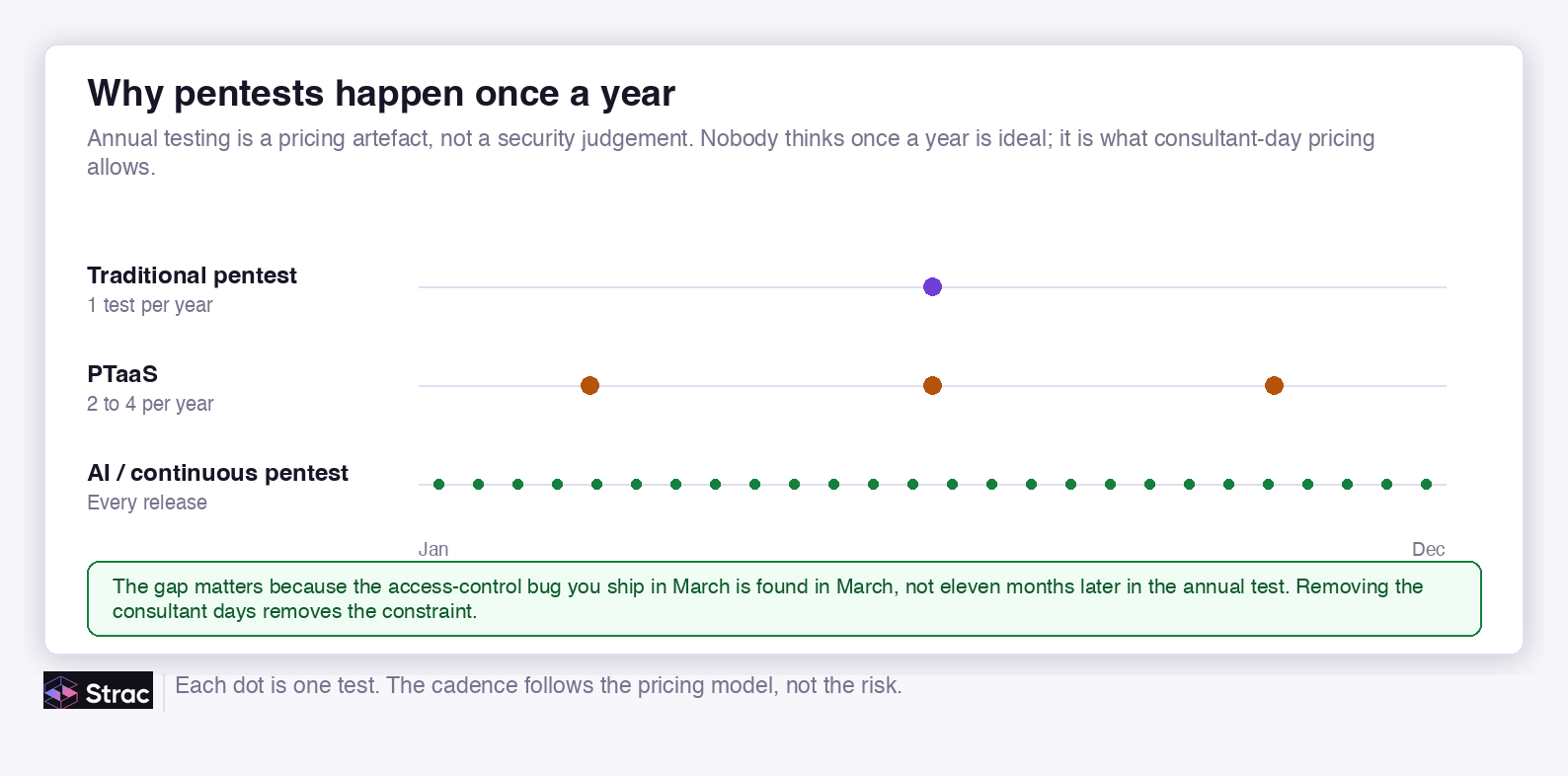
Each dot is one test. The cadence follows the pricing model rather than the risk.
What is automated penetration testing?
Autonomous pentesting uses AI agents that log in, explore the application and chain steps together to prove impact. That last part is what separates it from a vulnerability scanner, which matches your systems against known signatures and stops there. A scanner tells you a library is outdated; an automated pentest tells you that a logged-in customer can read another customer's invoices.
Automated penetration testing vs vulnerability scanning
They are different categories that get sold interchangeably. The detailed comparison is in penetration testing vs vulnerability scanning; the short version is that a scan produces many unproven findings and a pentest produces few proven ones, and only the second satisfies an auditor asking for a penetration test.
Continuous penetration testing
Annual testing is a pricing artefact rather than a security judgement. Nobody believes once a year is the right frequency for code that ships weekly; it is simply what consultant-day pricing allows. The practical cost of that gap is that an access-control bug shipped in March gets found in the following January, after eleven months of exposure and long after the engineer who wrote it has moved on.
Continuous penetration testing reruns on a schedule or on every release. It only makes economic sense when retests are free at the margin, which is why subscription pricing and continuous testing arrive together.
Penetration testing as a service (PTaaS)
PTaaS platforms book vetted freelance or in-house testers and deliver findings in a dashboard rather than a PDF. They shorten time to start and make findings easier to track and retest. The pricing model is still human hours, so the cadence constraint largely remains. The three vendor types are compared in penetration testing companies.
Where automated testing is strong, and where it is not
Automated / autonomous
Human-led
Coverage of every endpoint and role
Exhaustive. This is the boring work humans sample.
Sampled, because days are finite.
Novel business logic
Improving, but patterned.
Still better. A human understands what your product is for.
Speed
Hours.
One to three weeks.
Cadence
Every release.
Annually, or when budget allows.
PCI DSS Requirement 11.4
Does not meet it alone.
Required: a qualified, organizationally independent tester.
Will an auditor accept it?
For SOC 2 and ISO 27001, generally yes, if the test is independent, documented and shows exploited findings rather than raw scanner output. Several vendors already sell AI-only pentests with SOC 2 reports, so the category is established rather than experimental. Ask your auditor first; they are the ones accepting the evidence. What they check is in SOC 2 penetration testing.
PCI DSS remains the exception, and it is worth being blunt about it: Requirement 11.4 expects a qualified and organizationally independent tester, so plan a human-led test for PCI scope and confirm it with your QSA.
Strac AI Pentest is $1,995 per application per year with unlimited retests for twelve months, which is what makes rerunning it on each release free at the margin.
Get an auditor-ready pentest report
Annual testing is a pricing constraint, not a security decision. Strac AI Pentest runs the test with AI agents rather than consultant days: $1,995 per application per year, unlimited retests for twelve months, and a report built for the auditor who asks. See pricing.
Penetration testing where software, rather than a consultant, performs the reconnaissance, exploitation and reporting. Modern autonomous pentesting uses AI agents that log in, explore the application and chain steps to prove impact, which is what separates it from a vulnerability scanner matching known signatures.
Is automated penetration testing as good as manual?
For the work most startups buy, it is close and far faster. Automated testing is exhaustive where humans sample: every endpoint against every role is boring work that a consultant billing by the day will cover partially. Humans remain better at novel business logic and at the creative chaining a bespoke application invites. The honest answer is that they are good at different things.
What is continuous penetration testing?
Testing that reruns on a schedule or on every release instead of once a year. The annual cadence is a pricing artefact: it exists because each engagement costs consultant days. Remove the consultant days and the natural cadence becomes whenever the code changes.
What is penetration testing as a service (PTaaS)?
A platform that books vetted testers and delivers findings in a dashboard rather than a PDF at the end. It shortens time to start and makes findings easier to track, but pricing is still based on human hours. It sits between traditional firms and fully autonomous tools.
Will an auditor accept an automated penetration test?
For SOC 2 and ISO 27001, generally yes, provided the test is independent, follows a documented method and shows exploited findings rather than scanner output. Ask your auditor before you buy. PCI DSS is the exception: Requirement 11.4 expects a qualified, organizationally independent tester, so an AI-only test does not meet it on its own.
How much does automated penetration testing cost?
It is priced by subscription rather than by tester-day, which is the whole difference. Strac AI Pentest is $1,995 per application per year with unlimited retests for twelve months. Traditional web application tests typically run $5,000 to $30,000 per engagement.
Last updated: November 28, 2026
Customer story
“Don’t just alert on problems, fix them.”
Scott Roberts, Chief Information Security Officer, UiPath
Discover & Protect Data on SaaS, AI, MCP, Endpoints & Cloud
Strac provides end-to-end data loss prevention for all SaaS and Cloud apps. Integrate in under 10 minutes and experience the benefits of live DLP scanning, live redaction, and a fortified SaaS environment.