November 28, 2026

7
min read
Penetration Testing vs Vulnerability Scanning Explained
Vulnerability scanning finds known weaknesses. Penetration testing proves what an attacker can do with them. When you need each, and why auditors want both.
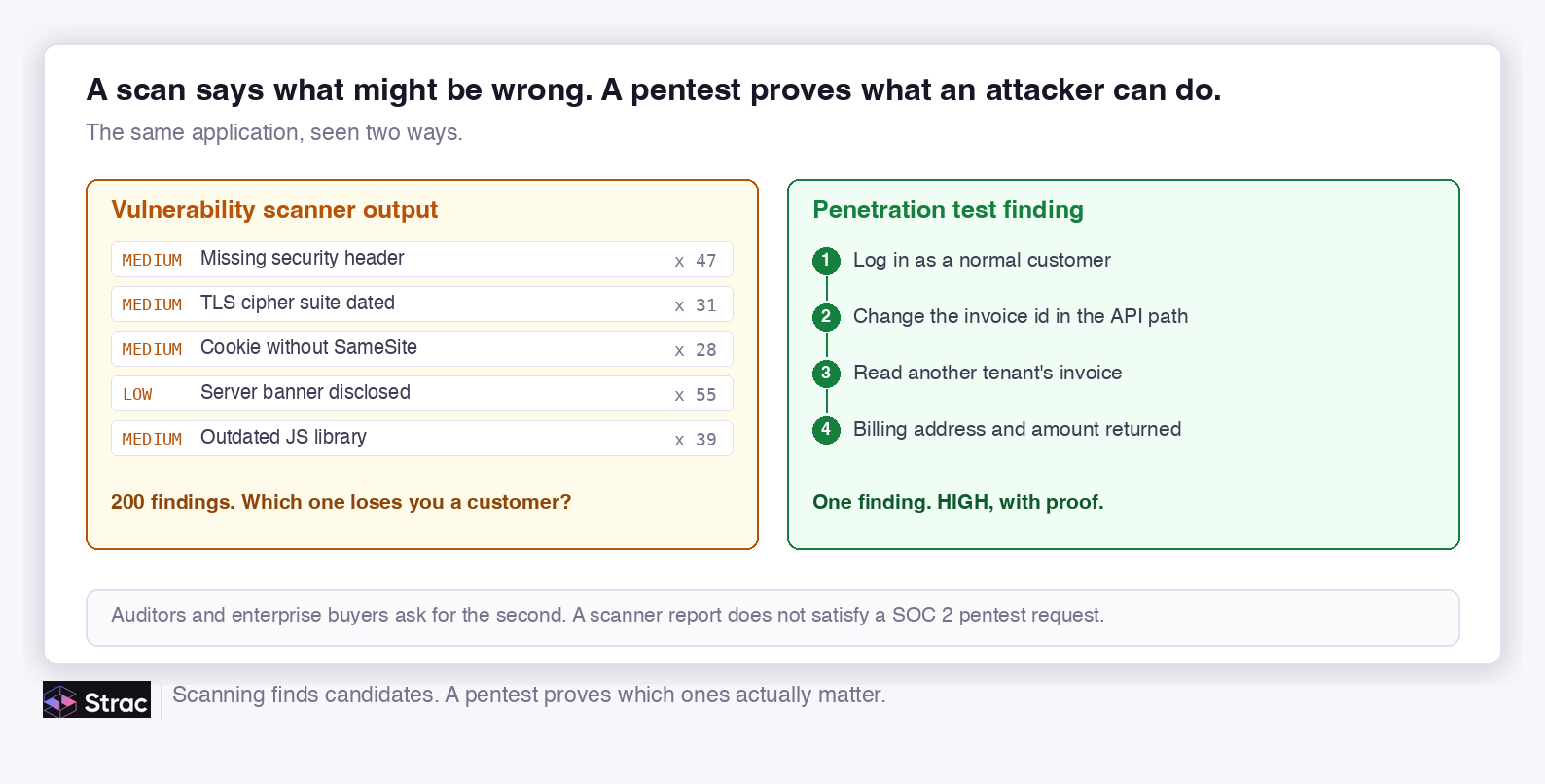
A vulnerability scanner tells you what might be wrong. A penetration test tells you what an attacker can actually do. Startups often buy the first and believe they have the second, until an auditor or an enterprise customer asks for the pentest report.
| Vulnerability scanning | Penetration testing | |
|---|---|---|
| What it does | Matches your systems against known vulnerability signatures | Attempts to exploit weaknesses and chain them together |
| Finds logic and access-control flaws | Rarely | Yes |
| False positives | Many | Few; each finding is proven |
| Frequency | Weekly or continuous | Yearly and after major changes; continuous with AI |
| Satisfies a SOC 2 pentest request | No | Yes |
VAPT bundles both: a scan finds candidates, and a pentest proves which ones matter. Most compliance programmes want both kinds of evidence, scans for ongoing vulnerability management and a pentest for independent validation, which is why buying one and calling it the other causes trouble at audit time.
| Your situation | What you need |
|---|---|
| Keeping dependencies and servers patched | Scanning. Continuous, cheap, and the right tool for known CVEs. |
| A report for SOC 2, ISO 27001 or a customer review | Penetration testing. See SOC 2 penetration testing for what the auditor checks. |
| Shipping weekly and want both | AI penetration testing reruns on every release rather than once a year. |
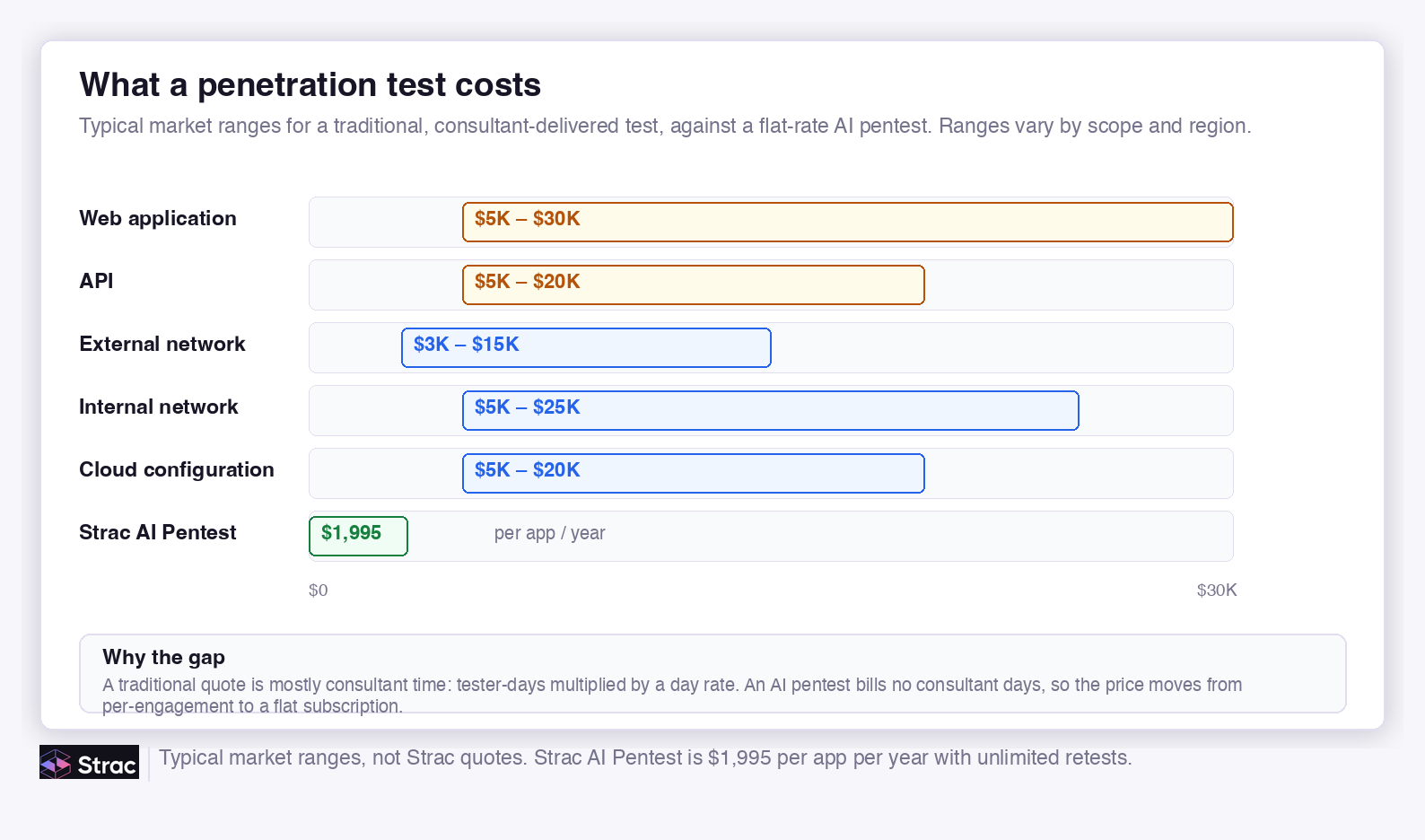
AI pentesting sits between the two. It runs as often as a scanner but behaves like a tester: it logs in, explores, and chains steps to prove impact. The practical consequence is that the test stops being an annual event tied to the audit calendar and starts being something that runs when the code changes. Strac AI Pentest is $1,995 per application per year with unlimited retests, which is what makes rerunning it free at the margin.
For what a quote should contain either way, see penetration testing cost.
The fastest way to tell which one you are being sold is to ask for a sample finding. A scan finding names a signature and a version: "jQuery 3.4.1, known XSS, CVE-2020-11022". A pentest finding names an action and a consequence: "as a logged-in customer, changing the invoice id in the API path returns another tenant's invoice, with billing address and amount".
If every finding in the sample is a version number, you are buying a scan. If the findings describe steps a person took and what came back, you are buying a pentest. The giveaway is the word "proof": a pentest report has a proof section per finding, a scan report does not.
| Flaw class | Why a scanner misses it |
|---|---|
| Broken object-level authorization (IDOR) | There is no signature for it. It requires two accounts and someone noticing that one can read the other's data. |
| Business logic abuse | Skipping a payment step or abusing an invite flow is valid traffic. Nothing about it matches a known pattern. |
| Privilege escalation between roles | Requires understanding what each role is supposed to do, which is specific to your application. |
| Chained exploits | Three medium findings that combine into a critical look like three mediums to a scanner. |
This is the whole argument for the second column in the graphic above: the flaws that actually lose customer data are the ones that have no signature.
Scanning runs weekly or continuously, because new signatures land constantly and the marginal cost of a run is near zero. Traditional pentests run yearly and after major changes, because each one costs consultant days. That cadence is a pricing artefact rather than a security judgement: nobody thinks testing once a year is ideal, it is just what the engagement model allows.
Removing the consultant days removes the constraint. A test that reruns on a release cadence catches the access-control bug introduced in the sprint that shipped it, rather than eleven months later.
A scan report will not satisfy an auditor asking for a pentest. Strac AI Pentest runs the test with AI agents rather than consultant days: $1,995 per application per year, unlimited retests for twelve months, and a report built for the auditor who asks. See pricing.
A vulnerability scanner matches your systems against known vulnerability signatures and tells you what might be wrong. A penetration test attempts to exploit weaknesses and chain them together, and tells you what an attacker can actually do. A scan produces many findings with many false positives; a pentest produces few findings, each one proven.
No. Auditors and enterprise customers asking for a penetration test want evidence of exploitation by an independent tester, not scanner output. Scans are good evidence for ongoing vulnerability management, which is a different control.
Vulnerability assessment and penetration testing, bundled. The scan finds candidates and the pentest proves which ones matter. Most compliance programmes want both kinds of evidence: scans for continuous vulnerability management, and a pentest for independent validation.
If you need to keep dependencies and servers patched, scanning. If you need a report for SOC 2, ISO 27001 or a customer security review, penetration testing. If you ship weekly and want both, AI penetration testing reruns on every release instead of once a year.
Scanning runs weekly or continuously, because new signatures land constantly. Traditional pentests run yearly and after major changes, because they cost consultant days. AI penetration testing removes that constraint, so the test can run on a release cadence rather than an audit cadence.
Last updated: November 28, 2026
“Don’t just alert on problems, fix them.”
Scott Roberts, Chief Information Security Officer, UiPath









Customers include