


Claude Code Security

Claude Code Security

See every Claude Code install and MCP server, protect secrets, and govern the agent.

ChatGPT
Perplexity
Grok
Google AI
Claude
Summarize and analyze this article with:

Strac shows every Claude Code install and MCP server across your company, flags the risky setups, and keeps sensitive data and credentials out of places they should not go. Deployed through your MDM in a day.
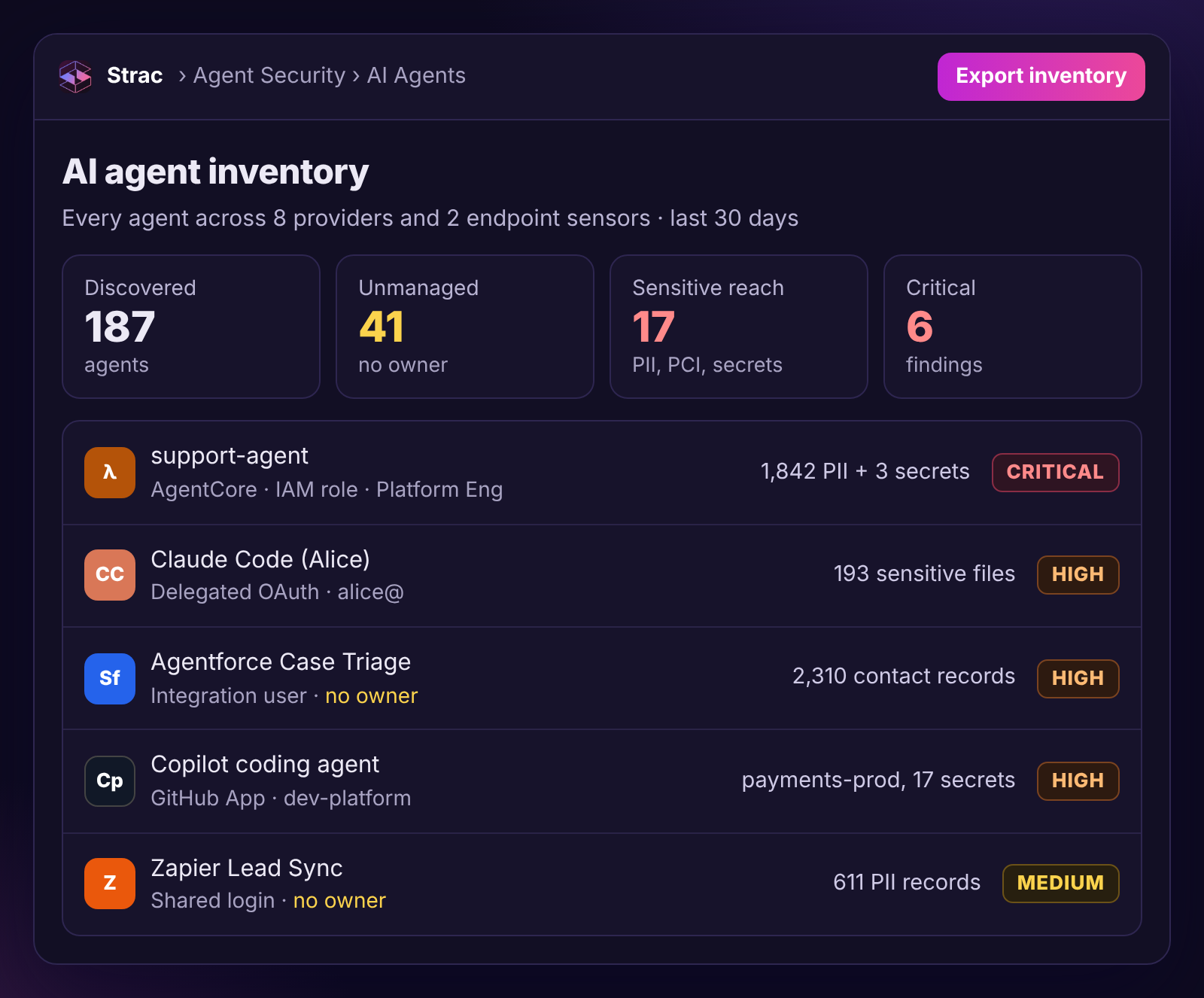
Claude Code security dashboard in Strac showing Claude Code installs, MCP servers and risk findings

✨ Why Claude Code security is now a security team problem

Claude Code is not a chat window. It reads your repositories, runs shell commands, and connects to databases, ticketing systems and cloud accounts through MCP servers. Anthropic gives each developer strong controls: permission prompts, sandboxing, hooks and managed settings. What a security team still lacks is the view across the whole company:

  • Which developers run Claude Code, and on which devices?
  • Which MCP servers has each one connected, and what can those servers reach?
  • Are credentials sitting in plain text in config files?
  • Did customer data or secrets pass through an agent session?

Strac answers those questions from one agent on the laptop.
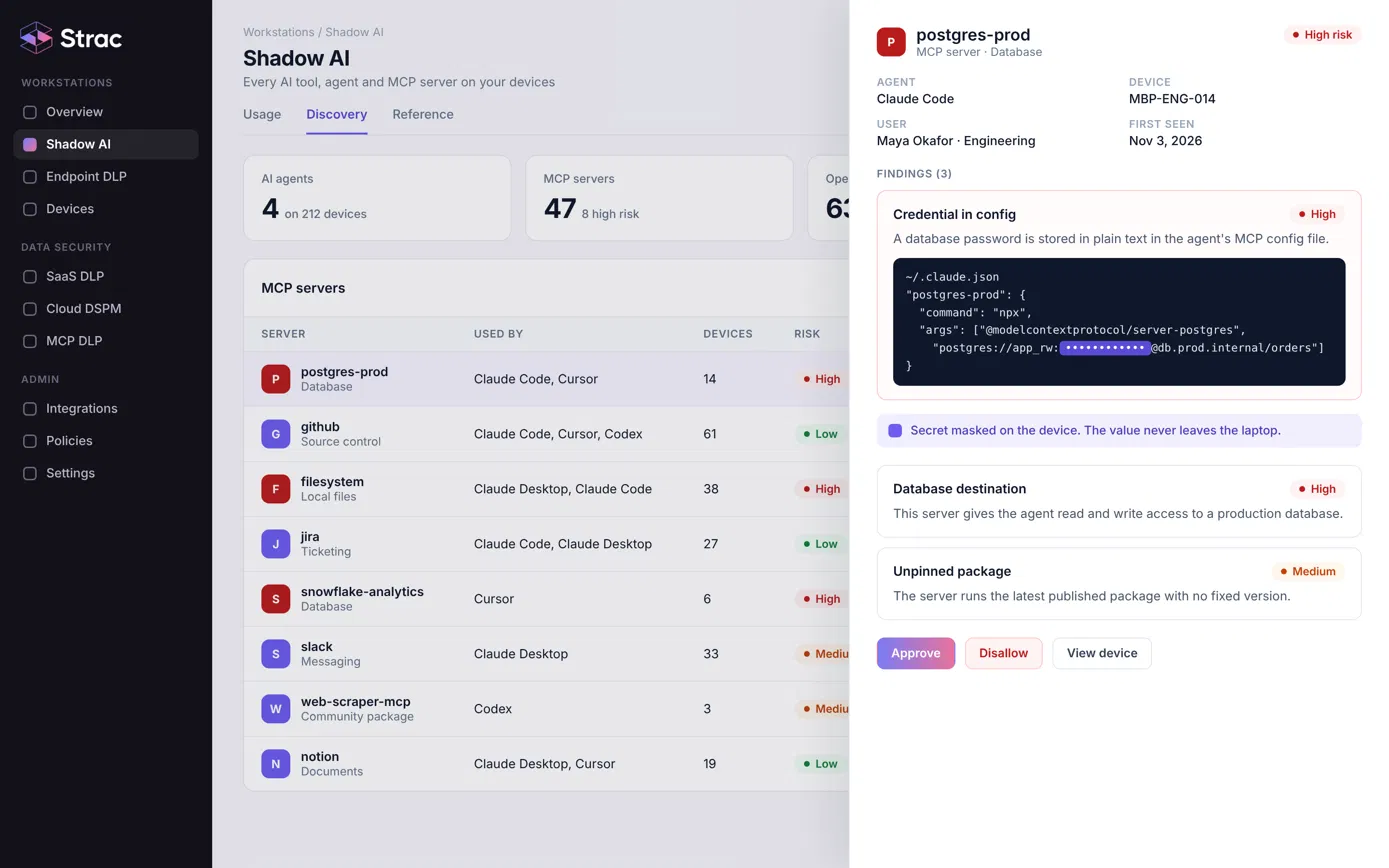
Claude Code MCP security finding showing a masked credential in an MCP server config

✨ The Claude Code security risks that actually show up

In practice the findings cluster into four shapes, and only one of them is what people expect before they look.

  • Credentials in config files. An MCP server needs a database or API credential, and the quickest way to make it work is to paste the value into the config. It then sits in plain text in a file that is often inside a git repository.
  • Servers with far more reach than the task needs. A filesystem server scoped to the home directory rather than one project. A database server pointed at production because that was the connection string to hand.
  • Unpinned community packages. An MCP server run straight from a package registry with no fixed version, so what executes tomorrow is whatever was published overnight.
  • Sensitive data moving through sessions. Customer records pulled into context to debug something, then sitting in logs and history.

None of these are attacks. They are ordinary shortcuts taken by competent engineers trying to ship, which is exactly why policy alone does not catch them and why the inventory has to come from the device.

✨ Claude Code enterprise visibility: inventory, MCP security and DLP

Fleet inventory of every Claude Code install

Strac reads Claude Code settings on every Mac and Windows device and builds one list: who runs it, which projects, which MCP servers, which permissions. It also covers Claude Desktop, Cursor and Codex, so you see every coding agent in one place.
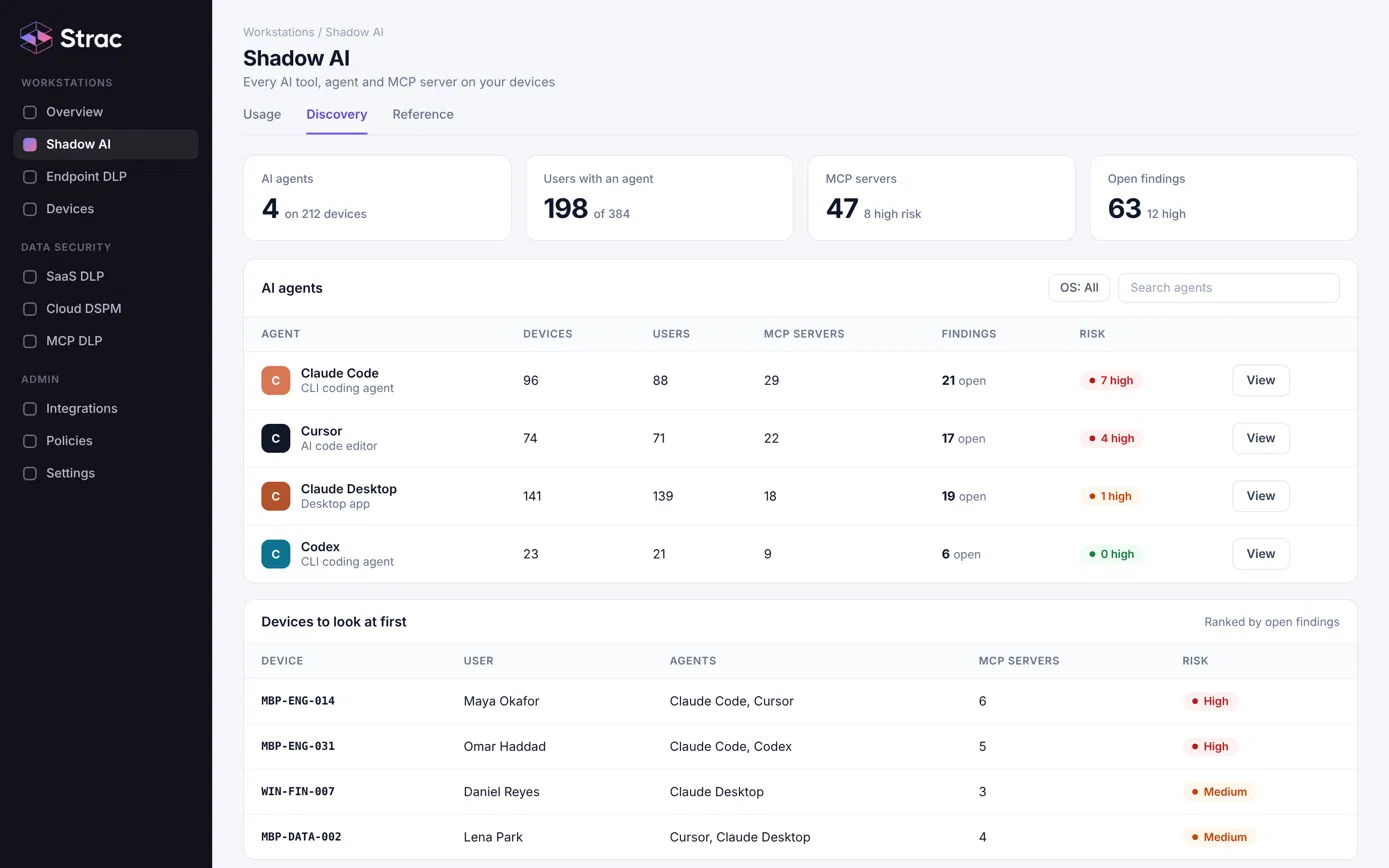
Claude Code enterprise inventory by device and user, showing MCP servers and open findings

Claude Code MCP security findings

Every MCP server gets a risk reason in plain words: it connects to a database, it stores a credential in the config, it has broad file system access, or it runs a package that is not pinned to a version. Secrets are masked on the device. Approve the servers you trust and mark the rest as disallowed.

More on this surface in our guide to MCP security.
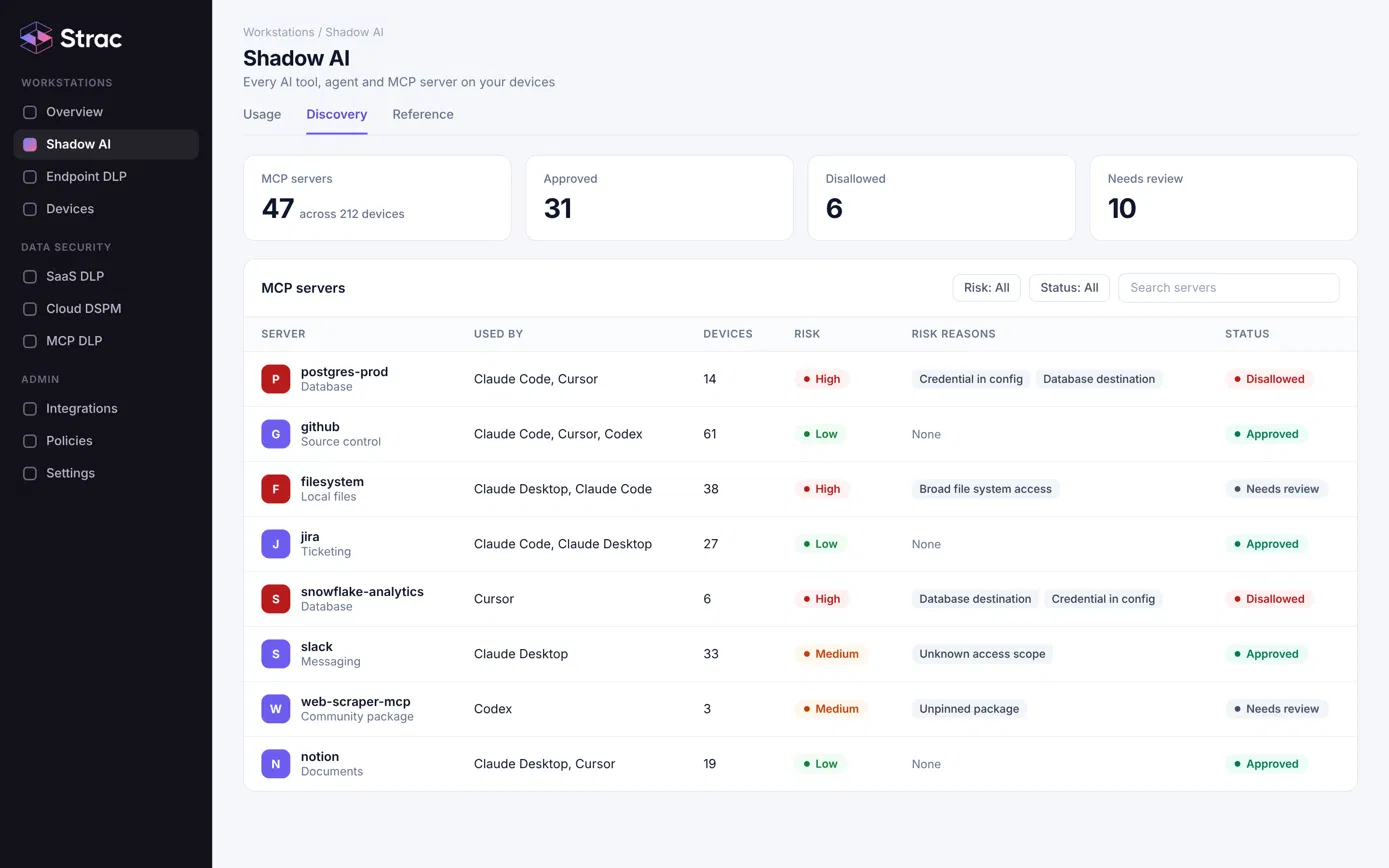
Claude Code MCP security: approved and disallowed MCP servers with risk reasons

Claude Code DLP for sensitive data and secrets

Strac detects PII, PHI, card data, API keys and other secrets with the same detectors that protect your SaaS apps and endpoints. With the Strac MCP DLP connector, sensitive data in MCP tool results is redacted before the model sees it.
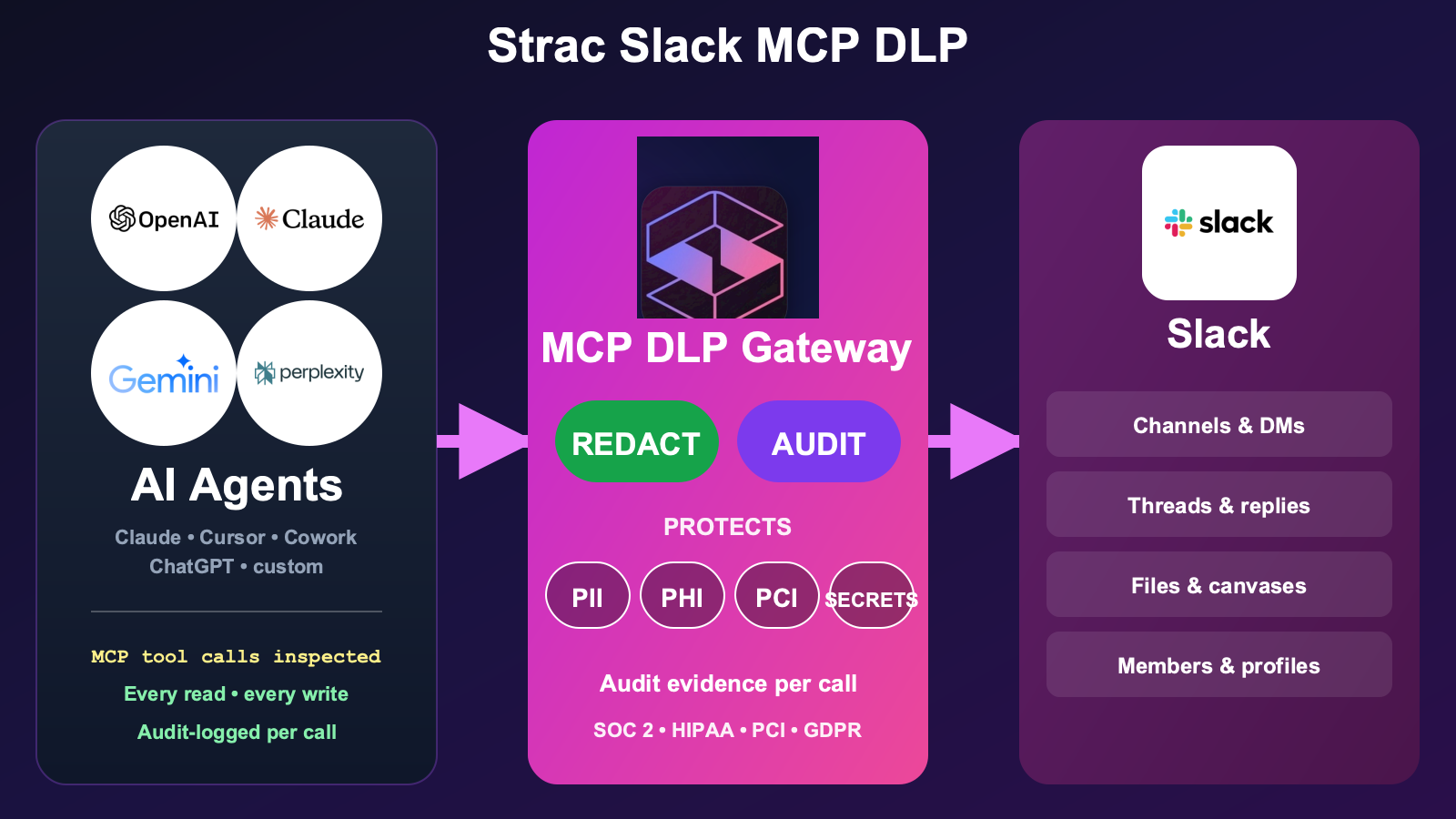
Claude Code DLP redacting sensitive data in an MCP tool result

Claude audit trail through the Claude Compliance API

For Claude Enterprise customers, Strac connects to the Claude Compliance API and scans conversations and files for sensitive data, so the audit trail covers Claude on the web, on the desktop and in the terminal.
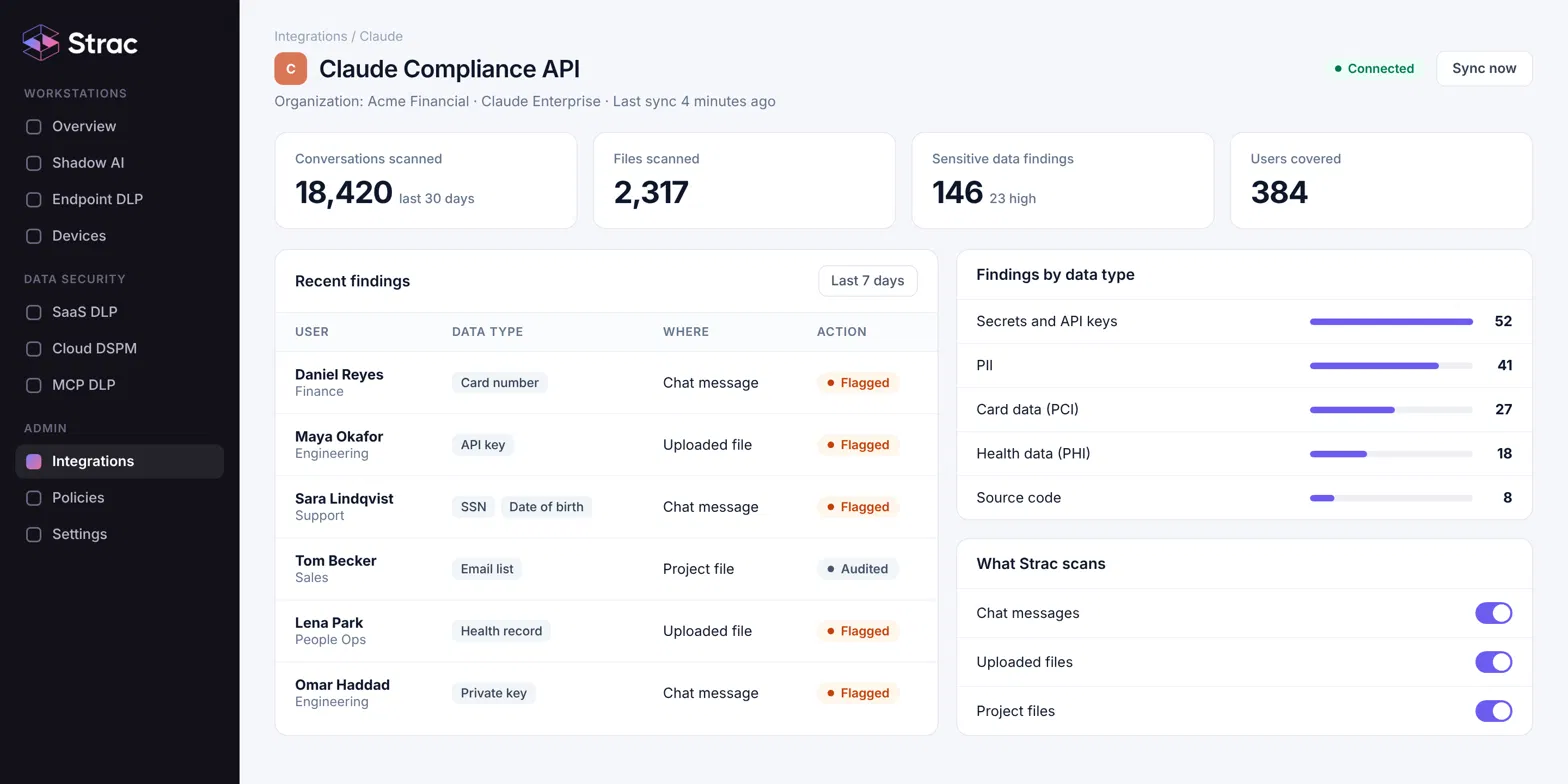
Strac Claude Compliance API integration showing sensitive data findings by type

✨ How Strac Claude Code security works

  1. Deploy. Push the Strac agent through your MDM. Nothing for developers to install.
  2. Discover. See every Claude Code install, MCP server and risk finding within hours.
  3. Protect. Approve or disallow servers, clean up exposed credentials, and turn on DLP.
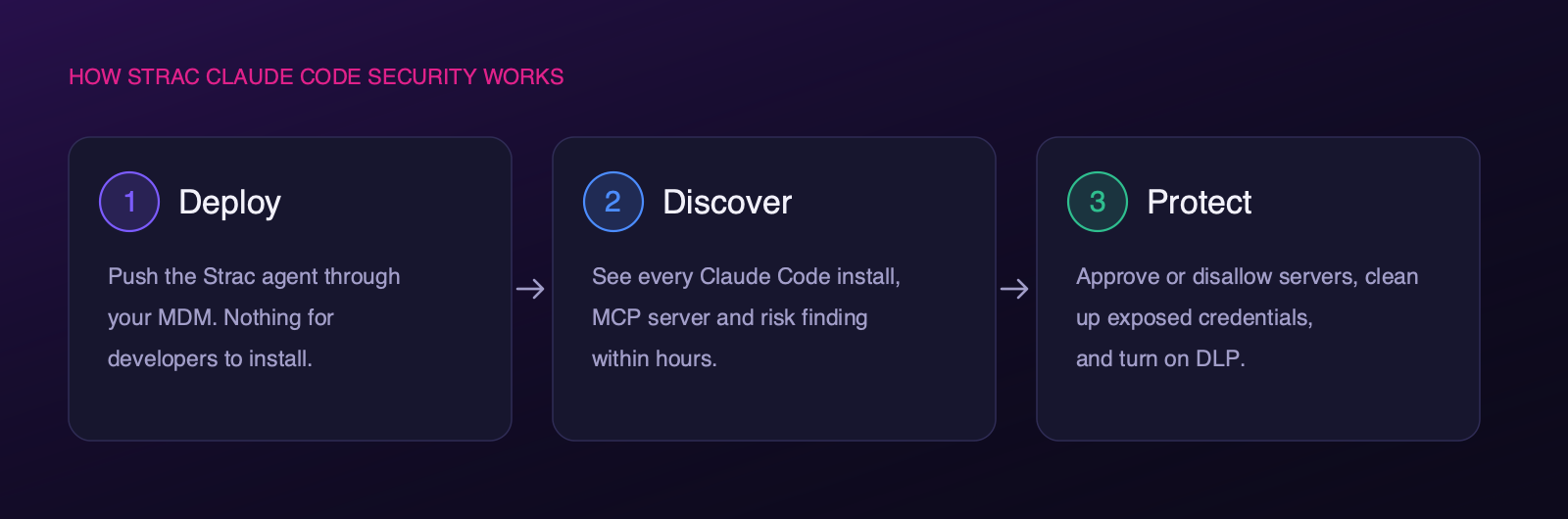
How Strac Claude Code security works: deploy through MDM, discover every install and MCP server, then protect

✨ Rolling out Claude Code security across a developer fleet

The failure mode for agent governance is announcing a policy before you can see anything, then asking developers to self-report. That produces a spreadsheet that is wrong within a week.

A rollout that holds up looks like this. Push the agent through MDM to a pilot group, usually one or two teams, and leave everything in audit. Within hours you have the real inventory: which developers run Claude Code, which MCP servers they have connected, and which of those hold credentials or reach production. Fix the handful of genuinely risky setups with the owners directly, because there are usually fewer than people fear. Only then turn on warn or block, and only on the specific channels where regulated data must not leave.

Most teams are through the pilot inside a week. The reason it moves quickly is that nothing is installed by developers and no workflow changes during the audit phase.

✨ Claude Code permissions and built-in security vs Strac

Strac does not replace Claude Code's own controls. It adds the company-wide view and the data layer on top of them.

NeedClaude Code built inStrac adds
Control what one developer's agent may doPermission prompts, allow and deny rules, sandboxingNothing to replace. Keep using them.
Company-wide policyManaged settings pushed by ITA console that shows whether every device follows the policy
Know which MCP servers are in usePer-device config filesOne inventory across all devices with risk findings
Find exposed credentialsNot coveredFlags credentials in configs, masked on device
Detect sensitive dataNot coveredPII, PHI, card data and secrets detection, with redaction
Cover Cursor, Codex and other agentsNot applicableSame inventory and findings for each

✨ Beyond Claude Code: Cursor, Codex and Claude Desktop

Almost nobody runs a single agent. A typical developer laptop has Claude Code in the terminal, Cursor as the editor, Claude Desktop for longer work, and sometimes Codex as well. Each keeps its own configuration and its own MCP servers, so governing one and ignoring the others leaves most of the surface untouched.

Strac reads all four from the same agent and puts them in one inventory, so the question "which agents can reach production data" has a single answer rather than four partial ones. The risk findings are the same across them, because the risk is a property of the MCP server and the credential, not of which editor happens to be in front of it.

✨ Claude Code governance built on data security

An agent is only as risky as the data it can touch. Strac started with data: finding and protecting sensitive data in SaaS, cloud and endpoints. The same classification now tells you which Claude Code setups matter, such as the one with a production database password, so your team fixes those first and leaves the rest of your developers alone.

Related reading: endpoint DLP, AI security posture management, Claude DLP and AI agent security.

✨ What Strac does not do

Worth being direct, because agent security is a noisy category.

  • Strac does not read your code or your prompts by default. The inventory and the risk findings come from settings and configuration files. Content inspection happens only where you switch on DLP, and you choose which data types it looks for.
  • Strac does not replace Claude Code's own controls. Permission prompts, allow and deny rules, sandboxing and managed settings are Anthropic's, they work, and you should keep using them. Strac adds the fleet view and the data layer on top.
  • Strac is not an identity product. Okta and Entra govern which credentials exist. Strac governs what those credentials can reach and whether the data behind them is regulated.
  • Secrets are masked on the device. When a finding reports a credential in a config file, the value never leaves the laptop. You see that a secret is there and where, not the secret itself.

Trusted by security teams, and an Anthropic partner

Strac is listed on Anthropic's Claude Compliance API integrations page as a security and compliance partner. Security and compliance teams use Strac to find and protect sensitive data across SaaS, cloud, endpoints and AI tools. See the Claude Compliance API integration.

🌶️ Claude Code Security FAQ

Is Claude Code safe for enterprise use?

Claude Code ships with real security controls, including permission prompts, sandboxing and managed settings. The open risk for most companies is not the tool but the lack of visibility: which MCP servers are connected, where credentials are stored, and what data the agent can reach.

What are the main Claude Code security risks?

Credentials stored in config files, MCP servers with broad access to databases or files, sensitive data passing through agent sessions, and developers approving actions without review.

Does Strac read developers' prompts or code?

No. Inventory and findings come from settings and config files. Content inspection only happens where you turn on DLP, and secrets are masked on the device.

Does Strac work with existing Claude Code hooks and managed settings?

Yes. Strac reads the setup that is there and does not change developers' own hooks.

Does Strac cover Cursor, Codex and other coding agents?

Yes. The same inventory and findings cover Claude Desktop, Cursor and Codex.

How does Strac use the Claude Compliance API?

For Claude Enterprise customers, Strac connects to the Compliance API to scan Claude activity for sensitive data and keep an audit record.

How long does it take to deploy?

Most teams push the agent through MDM in a day and see findings within hours.

✨ See your Claude Code security posture in 48 hours

Deploy Strac to a pilot group of developers and get a report of every Claude Code install, MCP server and exposed credential.

Trusted by enterprises
Discover & Remediate PII, PCI, PHI, Sensitive Data

Sharepoint DLP Use Cases

Practical Scenario

A hospital’s billing and administrative teams use SharePoint Online to store patient invoices, medical reports, and insurance forms. While collaborating with external insurance providers, a staff member accidentally updates the permissions on a SharePoint document library to “Anyone with the link,” exposing potentially thousands of patient files containing PHI.

Industry Challenge

Healthcare organizations must meet HIPAA requirements for patient privacy. Even a single unauthorized access to PHI can trigger non-compliance, steep fines, and damage to the hospital’s reputation.

How Strac Helps

  • Continuous Data Discovery: Strac automatically scans existing and newly uploaded documents, identifying PHI (e.g., medical record numbers, Social Security Numbers).
  • Classification & Labeling: Once identified, files are labeled (e.g., “HIPAA Sensitive”), ensuring that administrators know which documents require the highest level of protection.
  • Visibility into Access: Strac provides real-time insight into who has access to these sensitive documents. Administrators can instantly see if unauthorized users or broad groups have viewing rights.
  • Revoke Public Links: If a file is publicly accessible, Strac immediately revokes those links and restores restricted access.
  • Alerts & Quarantines: When someone attempts to share PHI externally, Strac can alert admins, quarantine the file for review, or completely block the action.
  • Audit-Ready Reports: All actions are logged, enabling quick incident response and demonstrating HIPAA compliance for audits.
Screenshot of an email draft in Superhuman showing a message with sensitive personal data including an SSN and a PDF attachment, with a person visible in the bottom corner during a screen share
Seamless Integration & Scalability Showcase
Machine Learning & Customization Showcase
This is some text inside of a div block.

Practical Scenario

A hospital’s billing and administrative teams use SharePoint Online to store patient invoices, medical reports, and insurance forms. While collaborating with external insurance providers, a staff member accidentally updates the permissions on a SharePoint document library to “Anyone with the link,” exposing potentially thousands of patient files containing PHI.

How Strac's Sharepoint DLP Helps

  • Continuous Data Discovery: Strac automatically scans existing and newly uploaded documents, identifying PHI (e.g., medical record numbers, Social Security Numbers).
  • Classification & Labeling: Once identified, files are labeled (e.g., “HIPAA Sensitive”), ensuring that administrators know which documents require the highest level of protection.
  • Visibility into Access: Strac provides real-time insight into who has access to these sensitive documents. Administrators can instantly see if unauthorized users or broad groups have viewing rights.
  • Revoke Public Links: If a file is publicly accessible, Strac immediately revokes those links and restores restricted access.
  • Alerts & Quarantines: When someone attempts to share PHI externally, Strac can alert admins, quarantine the file for review, or completely block the action.
  • Audit-Ready Reports: All actions are logged, enabling quick incident response and demonstrating HIPAA compliance for audits.

Practical Scenario

A mid-sized investment firm uses SharePoint to collaborate on various client files, including:
  • Credit card statements (subject to PCI-DSS)
  • ID documents (Driver’s Licenses, Passports, etc.) used for KYC (Know Your Customer) verification
  • Banking information such as account and routing numbers
An associate accidentally shares a SharePoint folder containing these files with a newly onboarded client who does not require access to all confidential documents. This folder is also accessible to several internal teams outside the immediate project, creating multiple potential exposure points.

Industry Problem

Financial organizations must adhere to strict regulations like PCI-DSS for payment card data and various KYC/AML (Anti-Money Laundering) standards that mandate secure handling of personally identifiable information (PII). Exposing client ID documents, bank details, or credit card data can lead to fraud, legal liabilities, and erode customer trust.

How Strac Helps

  • Comprehensive Data Discovery: Strac scans both existing and newly uploaded documents in SharePoint for sensitive information such as credit card numbers, bank account details, and ID documents (Driver’s License, Passport formats).
  • Classification & Automated Labeling: Once identified, Strac applies meaningful labels (e.g., “PCI-DSS Sensitive,” “PII – ID Documents,” “Banking Info”) to ensure these files stand out and are subject to stricter security rules.
  • Visibility into Access: Strac provides an immediate view of who currently has access to these sensitive files. This allows admins to spot situations where external clients or internal teams unnecessarily have permissions.
  • Public Access Revocation: If a labeled document (e.g., containing card data or ID scans) is found to be publicly shared or too broadly accessible, Strac automatically revokes these links or permissions, aligning access with the principle of least privilege.
  • Alerts, Quarantines, and Blocks: When a user attempts to share a labeled document with outside domains—or with an entire department—Strac alerts administrators or quarantines/blocks the file share, depending on policy settings.
    In cases where the share is intentional but needs review, admins can approve or deny the request within Strac’s dashboard.
  • Audit & Compliance: Every sharing event, label assignment, and access revocation is logged, creating a detailed audit trail. This helps demonstrate compliance with PCI-DSS, KYC, AML, and other regulatory requirements.
    Automatic reporting simplifies any regulatory or internal compliance audit, reducing the administrative burden on security and compliance teams.
Screenshot of an email draft in Superhuman showing a message with sensitive personal data including an SSN and a PDF attachment, with a person visible in the bottom corner during a screen share
Seamless Integration & Scalability Showcase
Machine Learning & Customization Showcase
This is some text inside of a div block.

Practical Scenario

A mid-sized investment firm uses SharePoint to collaborate on various client files, including:
  • Credit card statements (subject to PCI-DSS)
  • ID documents (Driver’s Licenses, Passports, etc.) used for KYC (Know Your Customer) verification
  • Banking information such as account and routing numbers
An associate accidentally shares a SharePoint folder containing these files with a newly onboarded client who does not require access to all confidential documents. This folder is also accessible to several internal teams outside the immediate project, creating multiple potential exposure points.

How Strac's Sharepoint DLP Helps

  • Comprehensive Data Discovery: Strac scans both existing and newly uploaded documents in SharePoint for sensitive information such as credit card numbers, bank account details, and ID documents (Driver’s License, Passport formats).
  • Classification & Automated Labeling: Once identified, Strac applies meaningful labels (e.g., “PCI-DSS Sensitive,” “PII – ID Documents,” “Banking Info”) to ensure these files stand out and are subject to stricter security rules.
  • Visibility into Access: Strac provides an immediate view of who currently has access to these sensitive files. This allows admins to spot situations where external clients or internal teams unnecessarily have permissions.
  • Public Access Revocation: If a labeled document (e.g., containing card data or ID scans) is found to be publicly shared or too broadly accessible, Strac automatically revokes these links or permissions, aligning access with the principle of least privilege.
  • Alerts, Quarantines, and Blocks: When a user attempts to share a labeled document with outside domains—or with an entire department—Strac alerts administrators or quarantines/blocks the file share, depending on policy settings.
    In cases where the share is intentional but needs review, admins can approve or deny the request within Strac’s dashboard.
  • Audit & Compliance: Every sharing event, label assignment, and access revocation is logged, creating a detailed audit trail. This helps demonstrate compliance with PCI-DSS, KYC, AML, and other regulatory requirements.
    Automatic reporting simplifies any regulatory or internal compliance audit, reducing the administrative burden on security and compliance teams.

Practical Scenario

A software company keeps source code, product roadmaps, and design specs in SharePoint. Several teams—including external contractors—use the same SharePoint site. A developer accidentally grants a large group, including some non-disclosure–exempt contractors, access to a folder containing patent-pending code.

Industry Problem

Leaking IP can destroy a firm’s competitive advantage, trigger legal disputes, and cause immense reputational harm.

How Strac Helps

  • Holistic File Scanning: Strac inspects documents, PDFs, and archives for code snippets, system designs, and proprietary business terms to detect potential IP.
  • Intelligent Labeling: Documents identified as containing IP or trade secrets are automatically classified (e.g., “Proprietary IP”), reinforcing the need for restricted sharing.
  • Real-Time Access Insights: With Strac, administrators can instantly see who has access to IP-tagged files, enabling them to remove unauthorized users or reduce permission scopes.
  • Immediate Link Removal: If a contractor or external partner is mistakenly granted access to IP, Strac revokes public or unauthorized sharing before the files can be downloaded.
  • Alerts & Blocking: Strac’s policies can be configured to alert security teams or block external sharing attempts for files containing proprietary content.
  • Incident Response & Auditing: Detailed logs of every share request, label change, and access revocation aid in quick incident resolution and help prove due diligence if legal issues arise.
Screenshot of an email draft in Superhuman showing a message with sensitive personal data including an SSN and a PDF attachment, with a person visible in the bottom corner during a screen share
Seamless Integration & Scalability Showcase
Machine Learning & Customization Showcase
This is some text inside of a div block.

Practical Scenario

A software company keeps source code, product roadmaps, and design specs in SharePoint. Several teams—including external contractors—use the same SharePoint site. A developer accidentally grants a large group, including some non-disclosure–exempt contractors, access to a folder containing patent-pending code.

How Strac's Sharepoint DLP Helps

  • Holistic File Scanning: Strac inspects documents, PDFs, and archives for code snippets, system designs, and proprietary business terms to detect potential IP.
  • Intelligent Labeling: Documents identified as containing IP or trade secrets are automatically classified (e.g., “Proprietary IP”), reinforcing the need for restricted sharing.
  • Real-Time Access Insights: With Strac, administrators can instantly see who has access to IP-tagged files, enabling them to remove unauthorized users or reduce permission scopes.
  • Immediate Link Removal: If a contractor or external partner is mistakenly granted access to IP, Strac revokes public or unauthorized sharing before the files can be downloaded.
  • Alerts & Blocking: Strac’s policies can be configured to alert security teams or block external sharing attempts for files containing proprietary content.
  • Incident Response & Auditing: Detailed logs of every share request, label change, and access revocation aid in quick incident resolution and help prove due diligence if legal issues arise.