AI Data Leaks: How They Happen & How to Prevent Them (2026)
A complete guide to AI data leaks in 2026: the four paths sensitive data leaks into AI (browser paste, endpoint, AI agents/MCP, and shadow AI), real incidents, and how to prevent each with DLP built for AI.
An AI data leak is any time sensitive data, PII, PHI, PCI, secrets, or source code, escapes into an AI tool where you no longer control it. It happens four ways: an employee pastes customer data into ChatGPT in the browser, a sensitive file moves to a desktop AI app on the endpoint, an AI agent reads raw records through an MCP tool call, or someone uses a shadow-AI tool nobody approved. Traditional DLP sees none of these. This guide breaks down all four paths, the real incidents that prove them, and how Strac prevents each from one agentless platform: browser DLP, endpoint DLP, MCP DLP, and shadow-AI discovery and governance.
AI Data Leaks: How They Happen & How to Prevent Them (2026)
An AI data leak is simple to define and hard to stop: it is any moment sensitive data, PII, PHI, PCI, secrets, or source code, leaves your control and lands inside an AI tool. Once it is in a public model's context window, a third-party agent's logs, or an unsanctioned chatbot, you cannot pull it back.
The uncomfortable part is that AI data leaks almost never look like a breach. There is no attacker. It is a support rep pasting a customer record into ChatGPT to write a reply, an engineer dropping source code into an AI coding tool, or a sales team quietly adopting an AI notetaker that records every deal call. Traditional DLP, built for email and network egress, sees none of it.
This guide covers the four paths an AI data leak actually takes, the real incidents that prove each one, and how to prevent them.
✨ The four paths an AI data leak takes
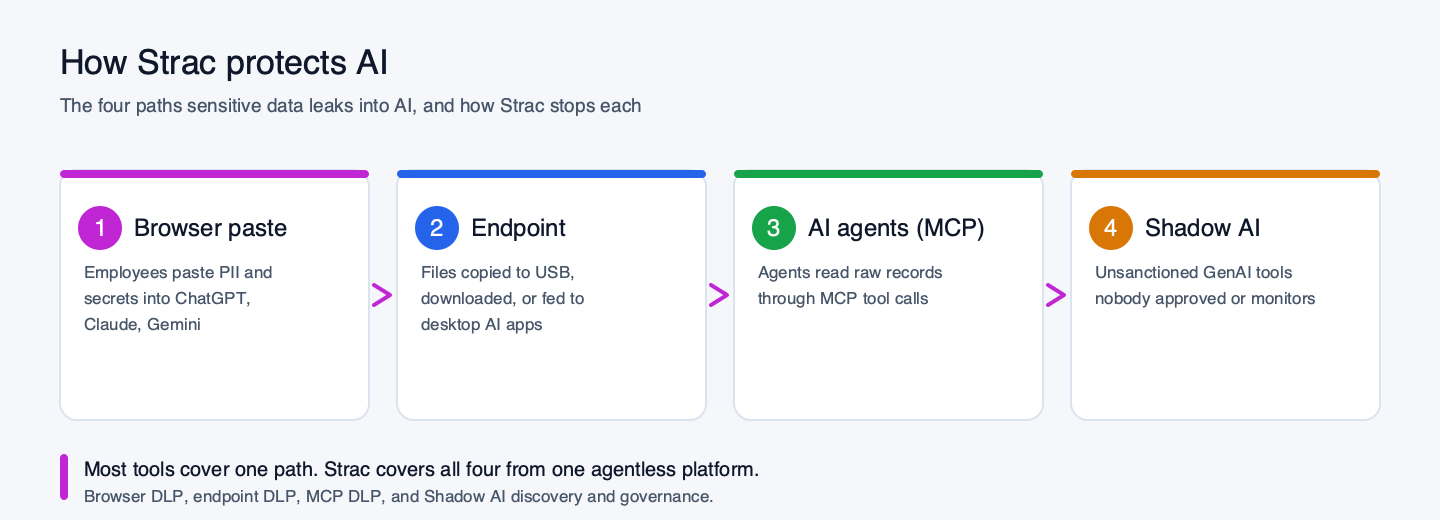
Every AI data leak travels one of four routes. A complete defense has to cover all four, because employees and agents use all four:
The browser / paste path — data typed, pasted, or uploaded into an AI tool in the browser.
The endpoint path — files downloaded, copied to USB, or fed into a desktop AI application.
The AI-agent / MCP path — agents reading raw records through Model Context Protocol tool calls.
Shadow AI — unsanctioned AI tools nobody approved, inventoried, or governs.
The rest of this guide walks through each, with the real Strac product that stops it.
✨ Path 1: The browser (paste and upload)
This is the most common AI data leak by far. An employee opens ChatGPT, Claude, Gemini, or Copilot in the browser and pastes or uploads exactly the data you spend millions protecting everywhere else: a customer's SSN pasted to draft a letter, a block of source code to debug, or an entire spreadsheet of card numbers uploaded to "clean up." The moment it is sent, that data is in a third-party model.
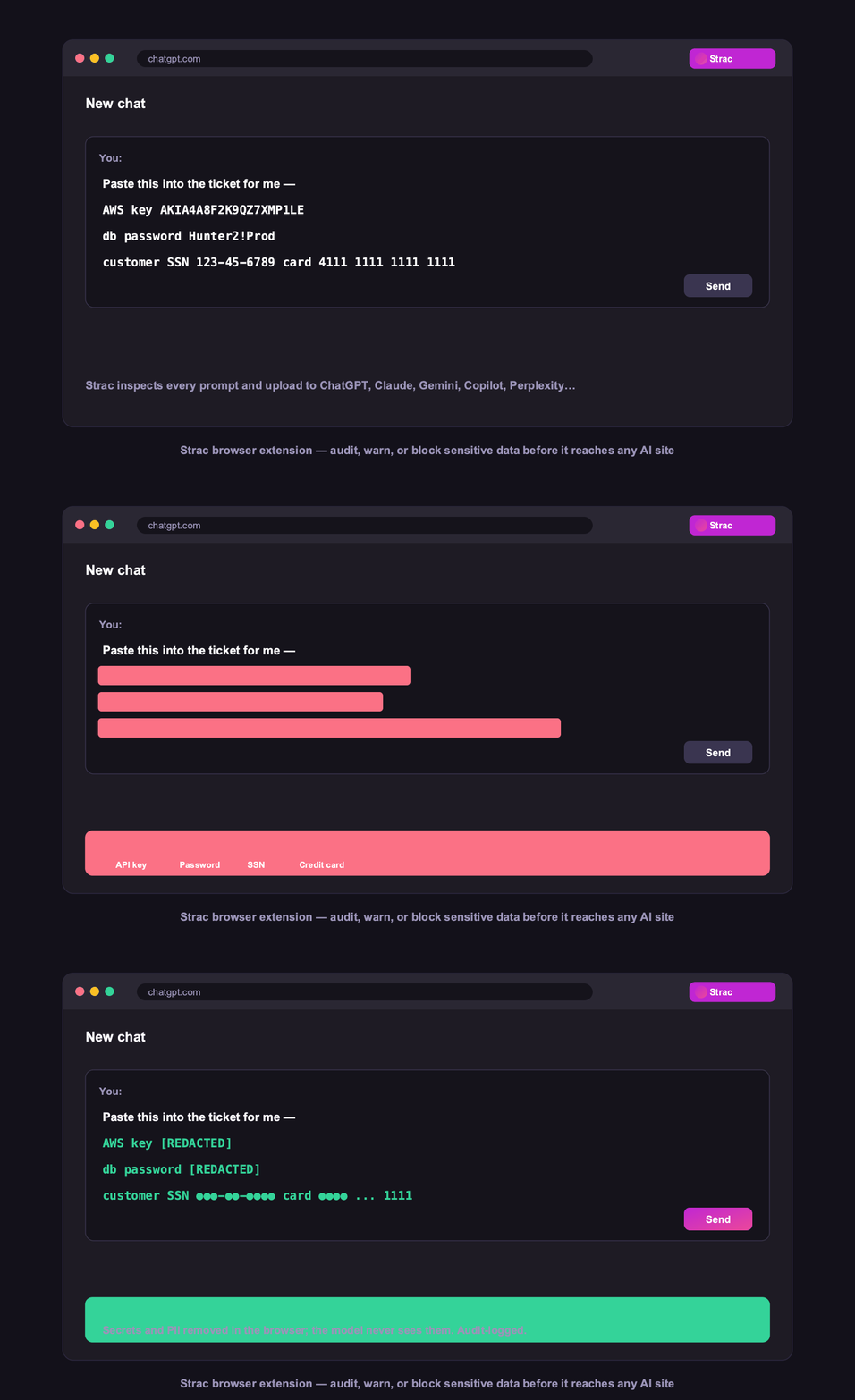
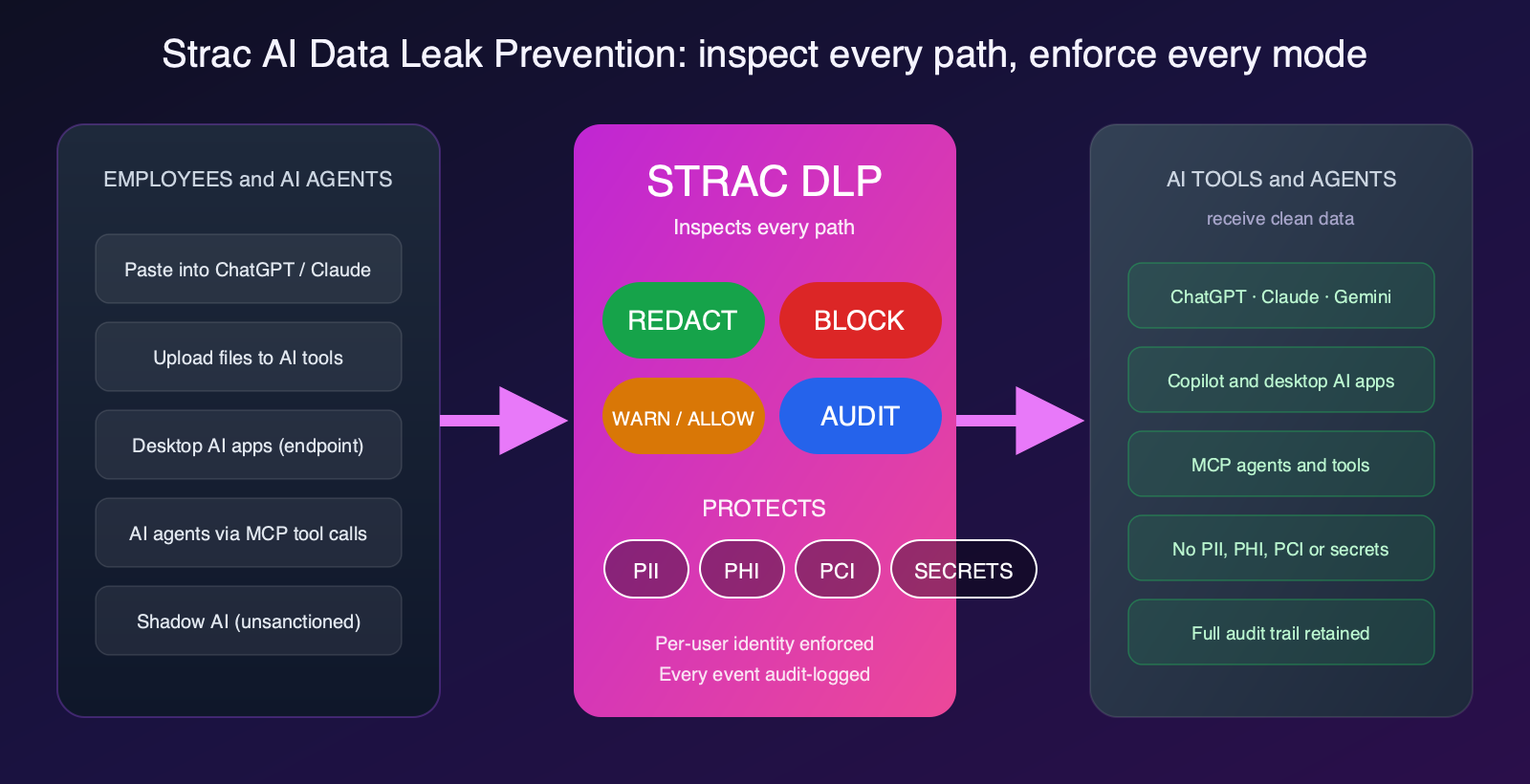
Strac also redacts sensitive data inside the prompt itself, so the useful request goes through and the SSN or secret does not
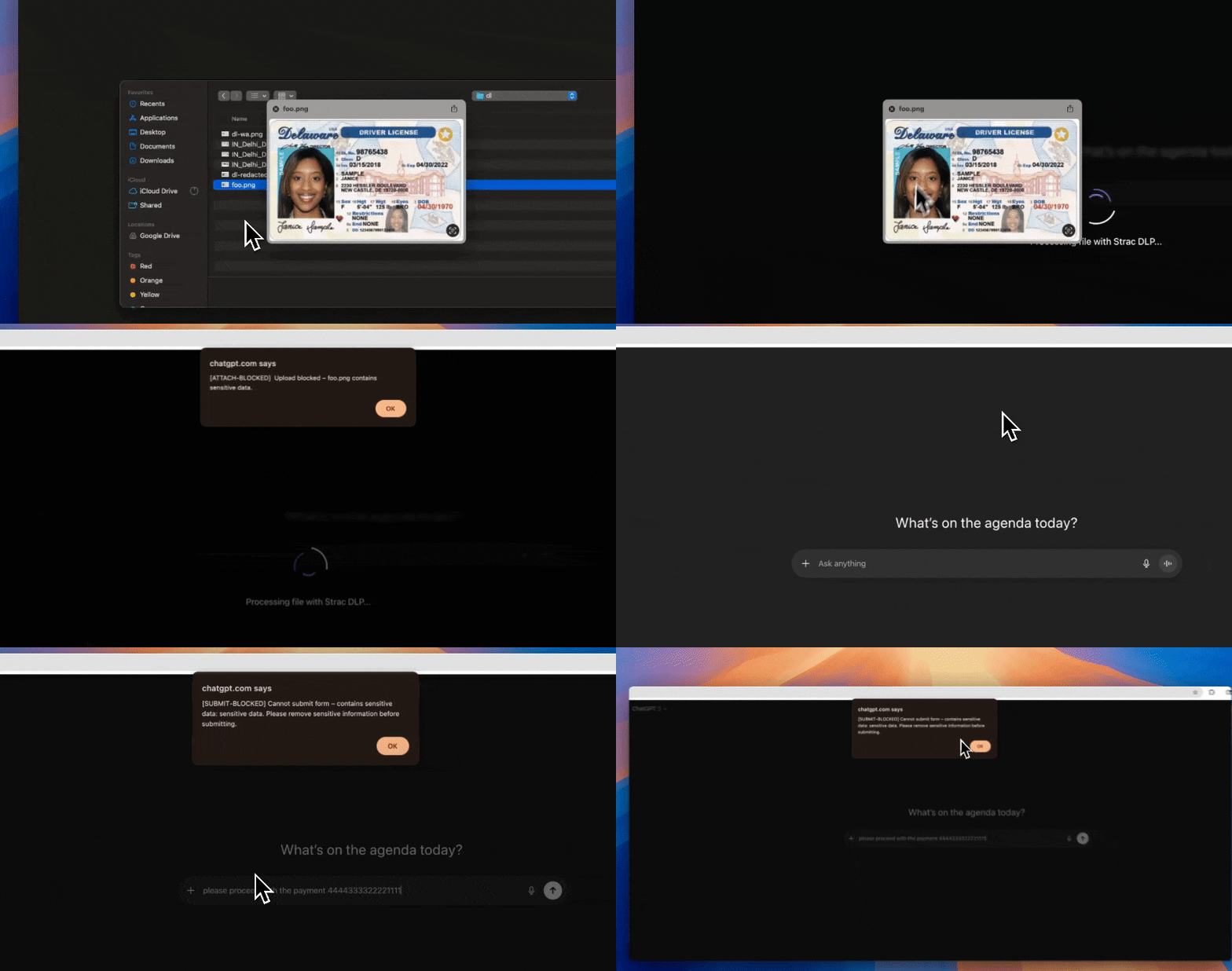
Strac's browser DLP inspects the prompt and any attached file before it is sent, and blocks, warns, or redacts the sensitive parts in real time, while letting the legitimate prompt through. It covers Chrome, Edge, Firefox, and Safari, and recognizes the AI destinations specifically. See how to block sensitive data in ChatGPT.
The real incident: In 2023, Samsung engineers pasted confidential source code and internal meeting notes into ChatGPT on three separate occasions within weeks of allowing the tool, leaking proprietary data into a public model. It became the textbook browser-paste AI data leak, and the reason many enterprises first banned, then learned to govern, generative AI.
✨ Path 2: The endpoint
Not every AI data leak happens in a browser tab. Sensitive files get downloaded from SaaS apps, copied to USB drives, synced to personal devices, and increasingly fed directly into desktop AI applications, the ChatGPT desktop app, Claude Desktop, local copilots, and AI-enabled productivity tools that read whatever file you point them at.
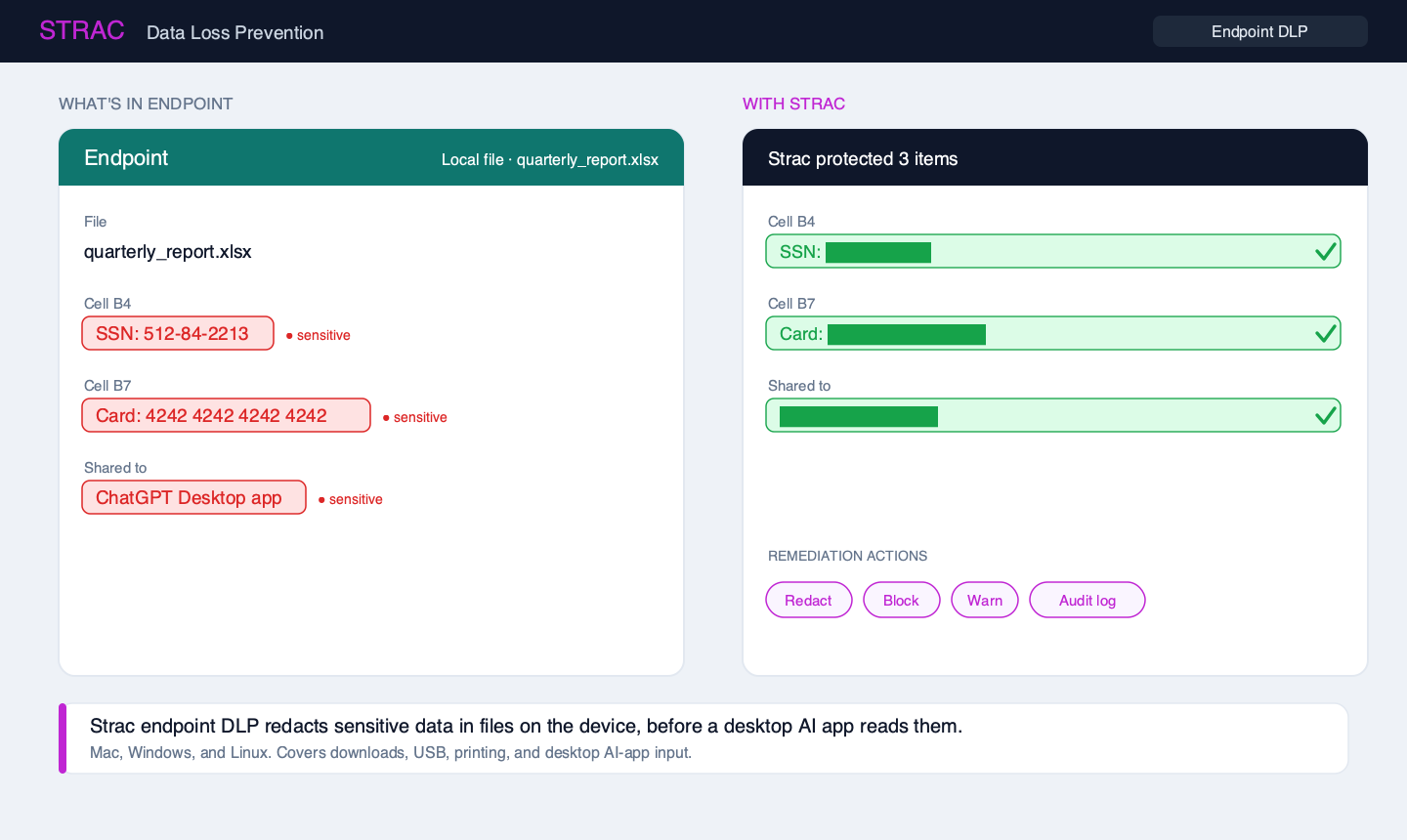
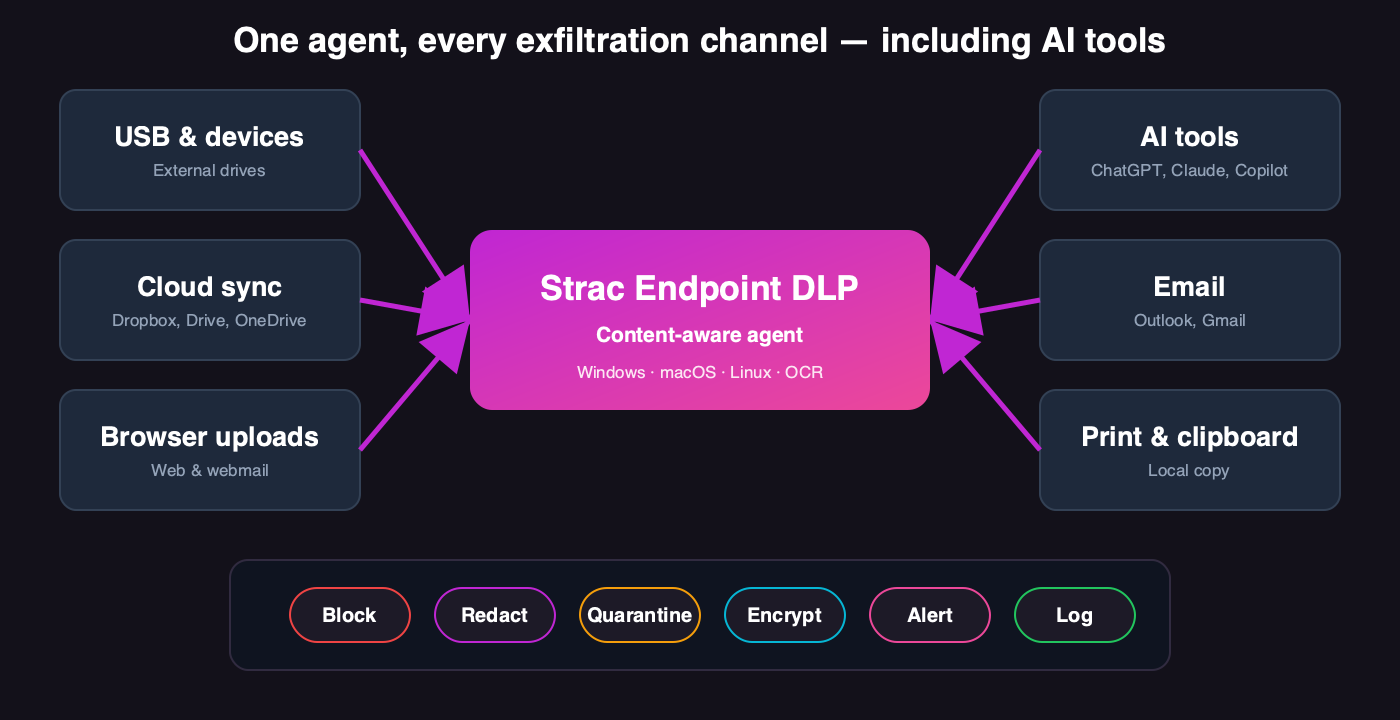
Strac's endpoint DLP covers the exit channels a browser extension cannot see: downloads, USB, printing, file moves, and the input to desktop AI apps. It detects PII, PHI, PCI, secrets, and source code on the device and can block, warn, redact, or audit, across Mac, Windows, and Linux.
Strac endpoint DLP detects sensitive data on the device and can redact, block, warn, or audit, before a desktop AI app reads it
Why it matters for AI: a desktop AI assistant that can read local files is an endpoint data-leak path that no browser or SaaS control will ever catch. The data never crosses a network gateway. Only an endpoint agent sees it.
✨ Path 3: The AI agent (MCP)
The newest and fastest-growing AI data leak is the agent path. As teams connect AI agents to their data through the Model Context Protocol (MCP), every tool call returns raw records, tickets, files, and database rows straight into the model's context. An agent asked for a "payroll summary" reads the actual payroll table. An agent asked to "triage support tickets" reads every SSN in them.
Strac's MCP DLP sits inline on the agent path. It inspects every MCP tool call and redacts PII, PHI, PCI, and secrets before the response reaches the model, enforces per-user identity so an agent only retrieves what the underlying user may see, and logs every call for audit. It works across the MCP ecosystem, from Microsoft 365 and SharePoint to Slack, Salesforce, and dozens more.
The real incident: the "ShadowLeak" class of attacks in 2026 showed AI agents connected to Gmail and other tools being manipulated into exfiltrating data through their own tool calls, no malware, just the agent doing what it was asked with data it should never have seen in the raw. The agent path is a data-leak surface traditional DLP was never designed to watch.
✨ Path 4: Shadow AI
You cannot prevent an AI data leak through a tool you do not know exists. Shadow AI, the GenAI apps employees adopt on their own, AI notetakers, writing assistants, code helpers, image tools, is where much of the risk now hides. Security teams routinely discover dozens of AI tools in use that were never approved, inventoried, or assessed.
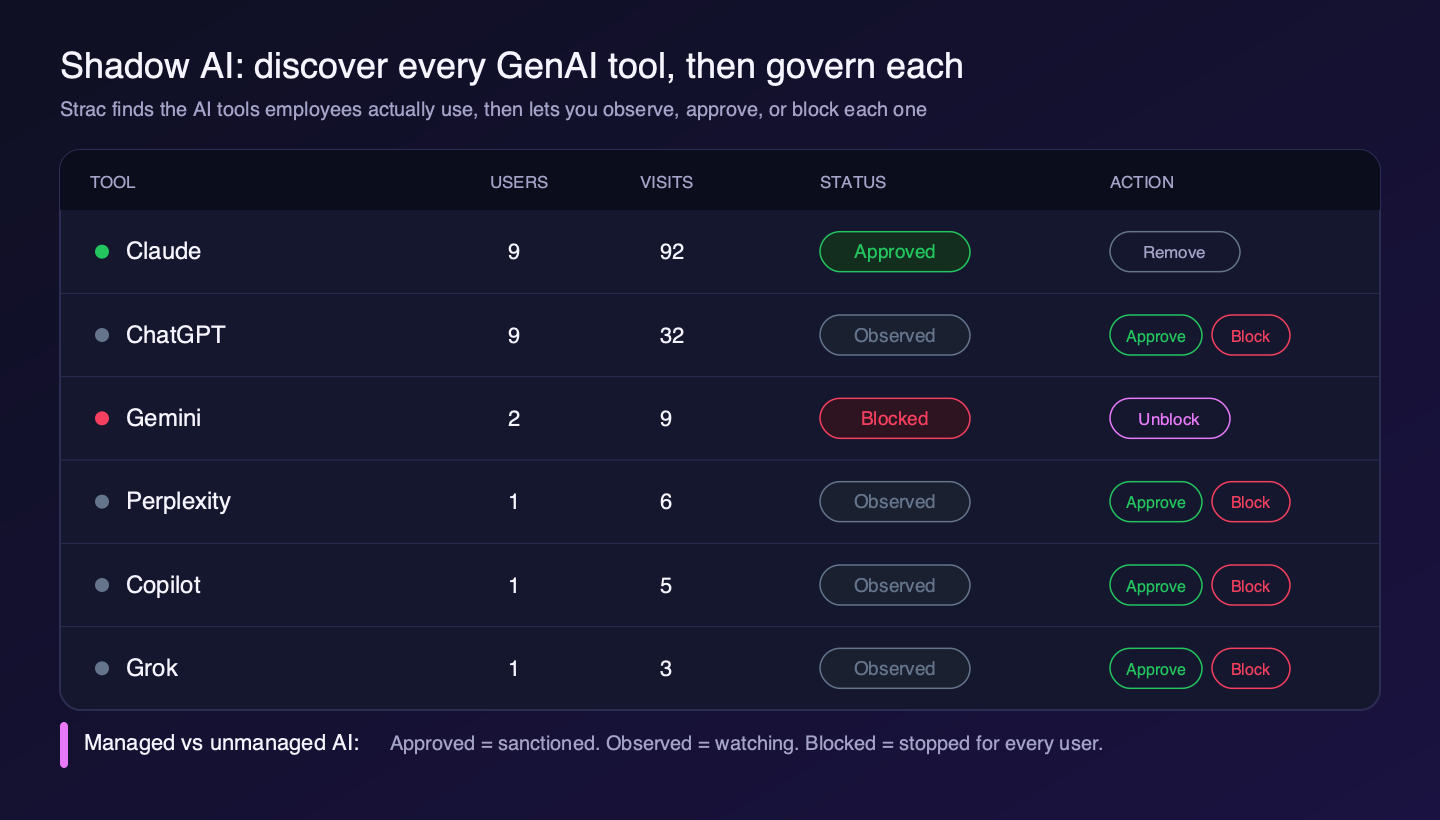
Strac's Shadow AI discovery surfaces every GenAI tool employees reach in the browser, with users, visit counts, and first and last seen. Then AI data governance lets you decide, per tool, whether to observe, approve, or block, turning unmanaged AI into managed AI.
This is the difference between managed and unmanaged AI. Without discovery, every unsanctioned tool is an invisible data-leak path. With it, you make a deliberate decision about each one, and enforce it.
A fifth risk: training-data exposure
Beyond the four paths, there is a quieter risk: data pasted into a consumer AI tool may be retained and used to train future models, depending on the tool and tier. That is why the enterprise question is not only "did data leave" but "can it resurface." Strac's answer is to prevent the sensitive data from entering the tool in the first place, across all four paths above. For the vendor specifics, see does ChatGPT save your data and does Claude train on your data.
How to prevent AI data leaks: one platform, four paths
Preventing AI data leaks is not about banning AI. It is about covering every path employees and agents actually use. Here is how the four map to a single control plane:
Leak path
How the data escapes
Strac control
Browser paste
Into ChatGPT/Claude/Gemini in the browser
Browser DLP: block, warn, redact at the prompt
Endpoint
Downloads, USB, desktop AI apps
Endpoint DLP: block, warn, redact on the device
AI agent (MCP)
Raw records via agent tool calls
MCP DLP: redact in the response, per-user identity
Shadow AI
Unsanctioned GenAI tools
Shadow AI discovery + governance: observe, approve, block
Because Strac is agentless and covers all four from one console, you do not need four separate tools, and you do not leave a path uncovered. For the broader approach, see AI DLP and the practical steps in how to prevent AI data leaks.
AI data leaks and compliance
An AI data leak is often also a reportable event. PHI pasted into ChatGPT is a potential HIPAA violation. Card data fed to an AI tool pulls you out of PCI scope. Personal data sent to a model is a GDPR transfer. Preventing the leak, and logging that you did, is what turns an AI governance policy into audit evidence.
✨ On the endpoint: the channels that catch AI leaks
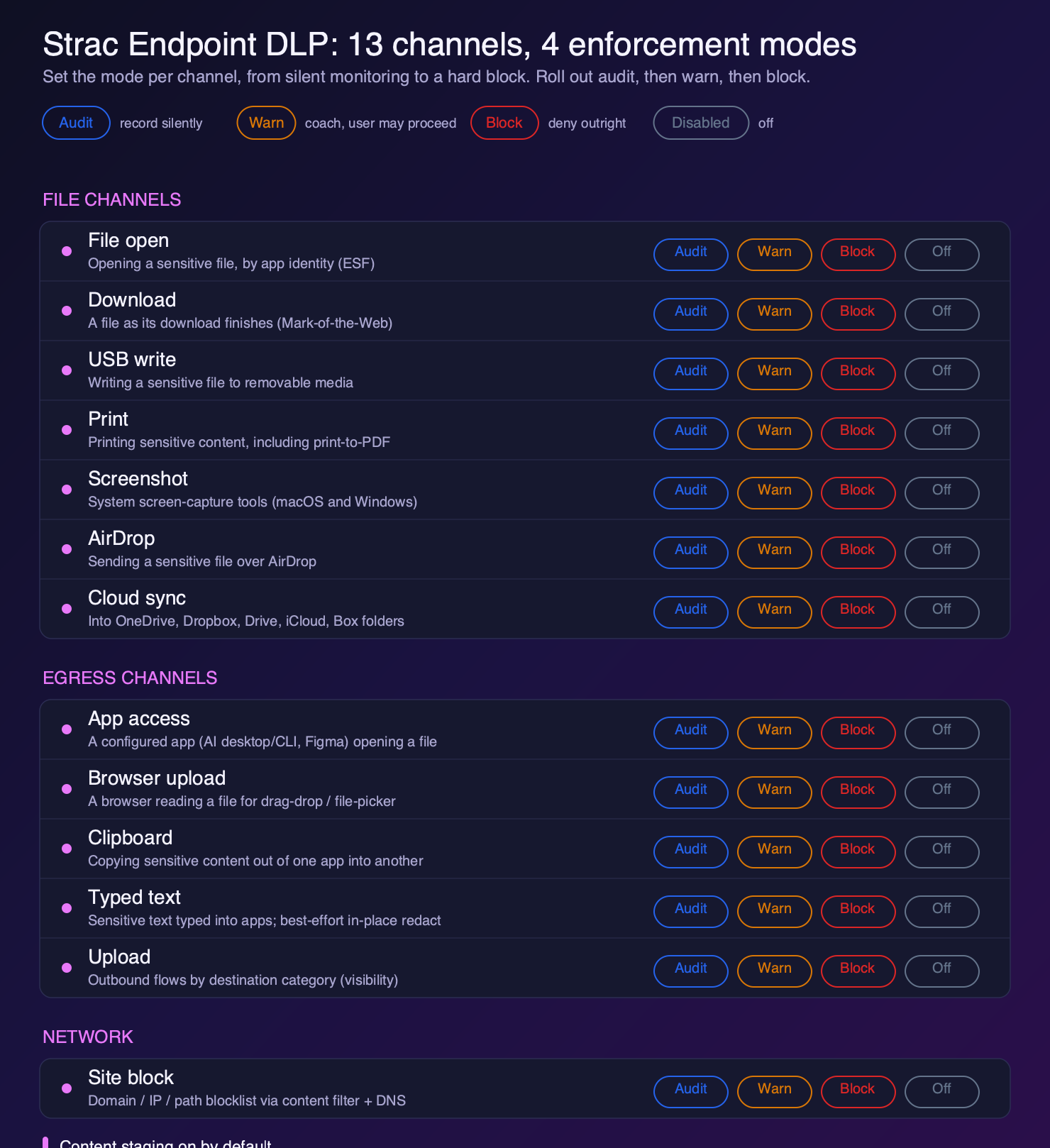
The endpoint is where AI data leaks that never touch a browser get caught. A desktop AI app reading a local file, a sensitive snippet typed into a chatbot window, a clipboard paste, a screenshot of a dashboard, a file synced into a folder an AI tool watches, none of these cross a network gateway. Strac governs each as its own channel.
The ones that matter most for AI are app access (stops the ChatGPT or Claude desktop app from opening a sensitive file, matched by signing ID and process tree), clipboard and typed text (the paste-and-type paths into AI tools, with best-effort in-place redaction), and screenshot and cloud sync. Set each to audit, warn, or block.
The endpoint channels that catch AI data leaks: app access, clipboard, typed text, screenshot, and more
🌶️ Spicy FAQs on AI data leaks
What is an AI data leak?
An AI data leak is any time sensitive data, PII, PHI, PCI, secrets, or source code, leaves your control by entering an AI tool: pasted into a chatbot, fed to a desktop AI app, read by an AI agent, or sent to an unsanctioned shadow-AI tool. Unlike a classic breach, there is usually no attacker, just an employee or agent using AI with data it should not see.
How do AI data leaks actually happen?
Four ways: (1) an employee pastes or uploads sensitive data into an AI tool in the browser; (2) a file is moved to USB, downloaded, or fed to a desktop AI app on the endpoint; (3) an AI agent reads raw records through MCP tool calls; (4) someone uses a shadow-AI tool nobody approved. Most organizations have all four happening at once.
Can traditional DLP stop AI data leaks?
Mostly no. Legacy DLP watches email and network egress, not the browser prompt, the endpoint input to a desktop AI app, the MCP agent path, or shadow-AI adoption. Preventing AI data leaks requires DLP built for those surfaces, which is what browser DLP, endpoint DLP, MCP DLP, and shadow-AI discovery provide.
What was the Samsung ChatGPT data leak?
In 2023, Samsung engineers pasted confidential source code and internal notes into ChatGPT multiple times shortly after permitting the tool, leaking proprietary data into a public model. It is the best-known example of the browser-paste path, and why enterprises moved from banning AI to governing it.
How do I stop employees pasting sensitive data into ChatGPT?
Use browser DLP that recognizes AI destinations and inspects the prompt before it sends. Strac detects PII, PHI, PCI, and secrets in the prompt or attached file and blocks or redacts them in real time, so employees can use AI without leaking regulated data. See how to block ChatGPT.
Do AI agents cause data leaks?
Yes, increasingly. When an AI agent reads your Slack, Jira, SharePoint, or a database through MCP, each tool call returns raw data into the model. Without an MCP DLP layer, every call is an uninspected leak path. Strac redacts sensitive data in the response before the agent sees it.
What is shadow AI and why does it matter for data leaks?
Shadow AI is the GenAI tools employees adopt without approval. You cannot prevent a leak through a tool you do not know exists, so the first step is discovery, then deciding per tool whether to observe, approve, or block. Strac's Shadow AI discovery and governance makes unmanaged AI managed.
An AI data leak is any time sensitive data, PII, PHI, PCI, secrets, or source code, leaves your control by entering an AI tool: pasted into a chatbot, fed to a desktop AI app, read by an AI agent, or sent to an unsanctioned shadow-AI tool. Unlike a classic breach, there is usually no attacker, just an employee or agent using AI with data it should not see.
How do AI data leaks actually happen?
Four ways: (1) an employee pastes or uploads sensitive data into an AI tool in the browser; (2) a file is moved to USB, downloaded, or fed to a desktop AI app on the endpoint; (3) an AI agent reads raw records through MCP tool calls; (4) someone uses a shadow-AI tool nobody approved. Most organizations have all four happening at once.
Can traditional DLP stop AI data leaks?
Mostly no. Legacy DLP watches email and network egress, not the browser prompt, the endpoint input to a desktop AI app, the MCP agent path, or shadow-AI adoption. Preventing AI data leaks requires DLP built for those surfaces, which is what browser DLP, endpoint DLP, MCP DLP, and shadow-AI discovery provide.
What was the Samsung ChatGPT data leak?
In 2023, Samsung engineers pasted confidential source code and internal notes into ChatGPT multiple times shortly after permitting the tool, leaking proprietary data into a public model. It is the best-known example of the browser-paste path, and why enterprises moved from banning AI to governing it.
How do I stop employees pasting sensitive data into ChatGPT?
Use browser DLP that recognizes AI destinations and inspects the prompt before it sends. Strac detects PII, PHI, PCI, and secrets in the prompt or attached file and blocks or redacts them in real time, so employees can use AI without leaking regulated data. See how to block ChatGPT.
Discover & Protect Data on SaaS, AI, MCP, Endpoints & Cloud
Strac provides end-to-end data loss prevention for all SaaS and Cloud apps. Integrate in under 10 minutes and experience the benefits of live DLP scanning, live redaction, and a fortified SaaS environment.


.webp)



.avif)



.gif)
