October 1, 2026

4
min read
AI Data Leak Prevention: How to Stop AI Data Leaks (2026)
Learn about Generative AI Data Leaks and how to prevent them
· AI data leaks happen when sensitive informationis exposed through AI models, prompts, connected apps, agents, or outputs.
· Modern AI creates new leak paths acrossbrowsers, endpoints, Shadow AI, APIs, and MCP-connected agents.
· MCP DLP protects sensitive data when AI agentsaccess SaaS apps, databases, and internal systems.
· Strac detects sensitive data such as PII, PHI,PCI, credentials, and secrets, then redacts or blocks it before exposure.
· AIDLP should protect both human-to-AI interactions and agent-to-data interactionswithout stopping legitimate AI use.
AI data leak refers to situations where the sensitive information used for training, validating, or operating AI systems is unintentionally exposed or maliciously accessed. Such leaks can occur at any stage of the data life cycle, from collection and storage to processing and disposal. Data leaks can expose personally identifiable information (PII), confidential business data, or proprietary information about the AI system itself. The term also encompasses situations where the AI inadvertently reveals sensitive information in its output or behavior due to overfitting or other machine learning issues.
Several key issues are associated with AI data leaks:
Addressing AI data leaks involves various strategies:
Strac is a DLP (Data Leak Prevention) software that automatically detects and redacts sensitive data. Check out all integrations here: Strac integrations

Redact PII before submitting to any AI model or LLMs: Strac exposes API to redact a document or text. Strac also exposes proxy API that will perform redaction before sending to any AI model (Open AI or AWS or anyone)
Prevention has to sit where the leak happens — the core of AI DLP — which is one of four places:
AI data does not leak through one channel anymore. Sensitive information can move through prompts, local files, autonomous agents, and AI tools security teams may not even know employees are using. Effective AI DLP needs to cover each of these paths.
.gif)
The browser is one of the easiest places for sensitive data to leave the organization. An employee can paste customer records, source code, financial data, credentials, or internal documents into ChatGPT or another GenAI tool in seconds.
Strac Browser DLP detects sensitive data at the point of interaction and can enforce policies before that information is submitted. This gives teams control over AI usage without having to block productive AI tools entirely. See ChatGPT DLP.
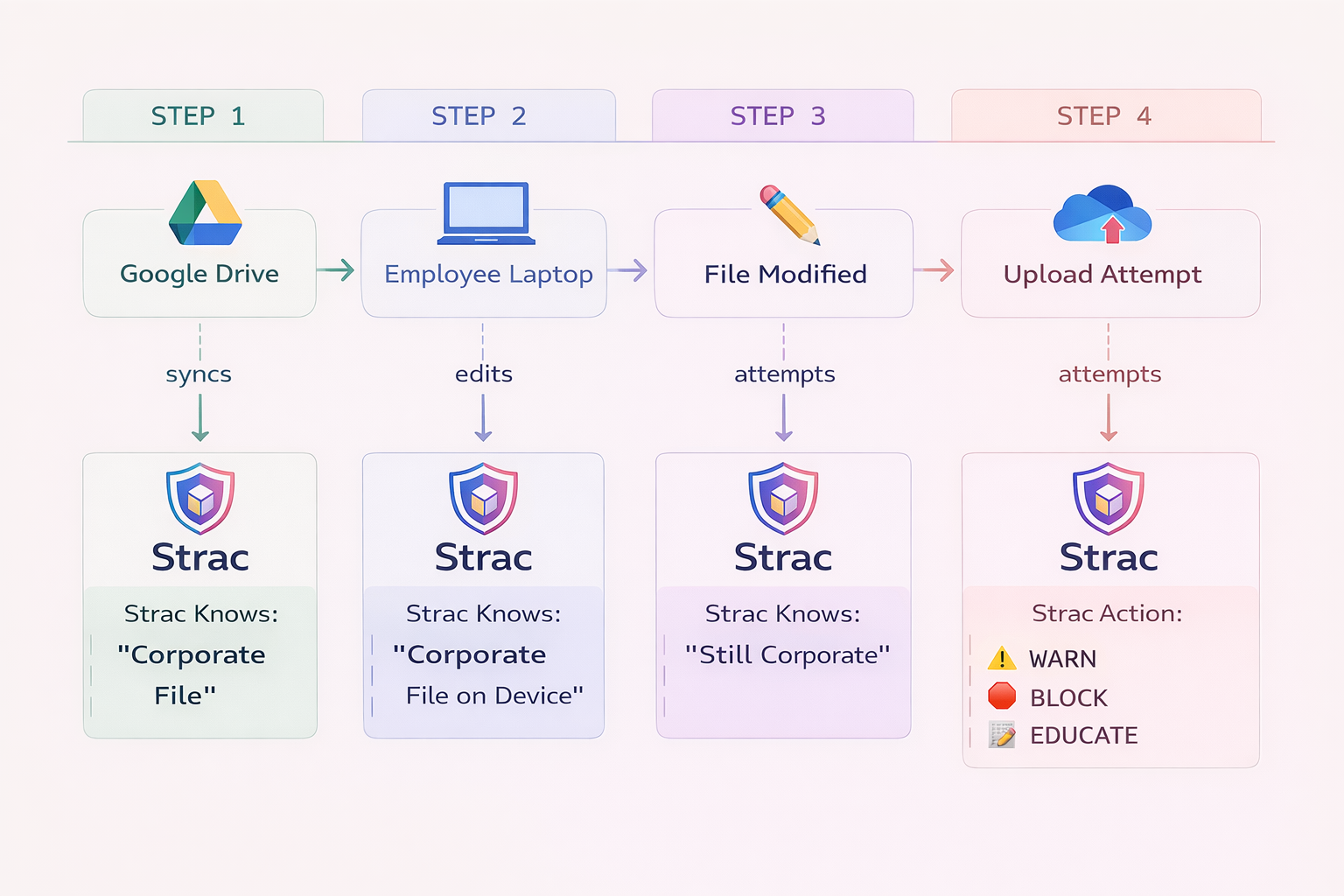
Not every AI leak starts with a browser prompt. Sensitive files already live on employee devices and can move through desktop AI applications, uploads, copy-and-paste actions, removable storage, and other endpoint workflows.
Strac Endpoint DLP extends protection to the device itself, helping security teams understand where sensitive data is moving and enforce policies when users or applications attempt to send it somewhere they should not.
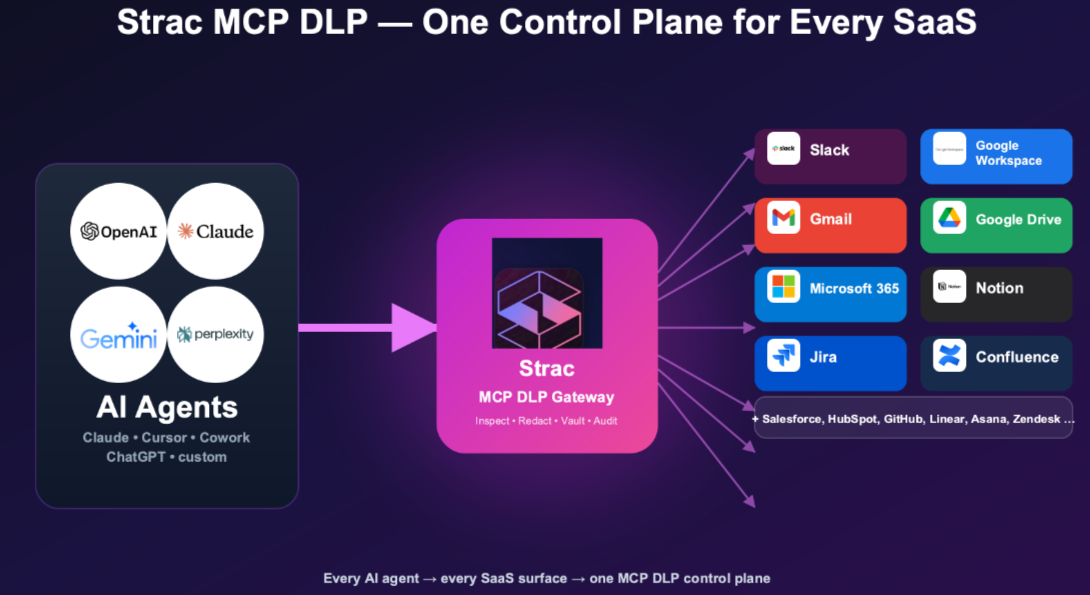
MCP changes the AI data-leak problem because the user does not necessarily have to move the data themselves. AI agents can connect directly to SaaS applications, internal tools, and data sources and retrieve information on the user's behalf.
Strac MCP DLP puts controls between the agent and those connected systems. Sensitive data such as PII, PHI, PCI, credentials, and secrets can be detected and redacted or blocked before an agent sends it to an AI model or another destination.
This becomes increasingly important as organizations move from employees simply using AI to AI agents taking actions and accessing company data. See MCP security and protecting AI agents.
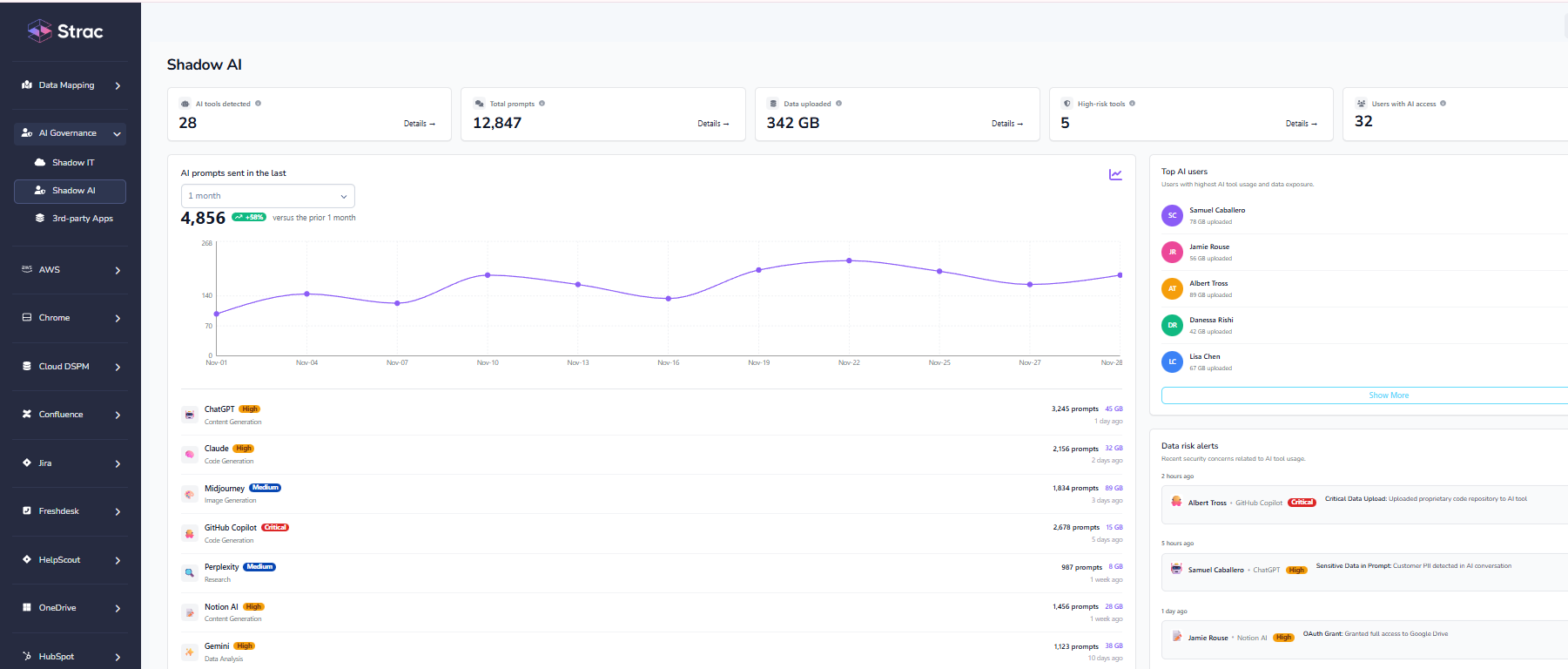
The hardest AI tool to secure is often the one security does not know exists. Employees can adopt new AI assistants, browser tools, SaaS features, and embedded copilots without going through an official security review.
Shadow AI protection helps organizations identify and control these unapproved AI interactions before sensitive company data disappears into unmanaged tools. Instead of relying only on an approved-app list, teams can enforce data protection around how sensitive information is actually being used.
Together, these controls protect both sides of the AI data flow: the data people intentionally give AI and the data AI systems and agents can access themselves.

Finally, Strac helps you comply with PCI-DSS, HIPAA, SOC 2, ISO-27001, and privacy laws like GDPR, CCPA with its DLP and Tokenization products.
AI data leaks have moved beyond employees copying sensitive data into ChatGPT. Today, data can also leave through browser prompts, file uploads, endpoints, Shadow AI, and AI agents connected to business systems through MCP.
That means AI security needs to protect both what users send to AI and what AI agents can retrieve on their own.
Strac brings these controls together with DLP across GenAI, browsers, endpoints, SaaS, cloud, and MCP workflows. Sensitive data can be detected and redacted or blocked before it reaches the wrong model, agent, application, or destination.
Related reading:
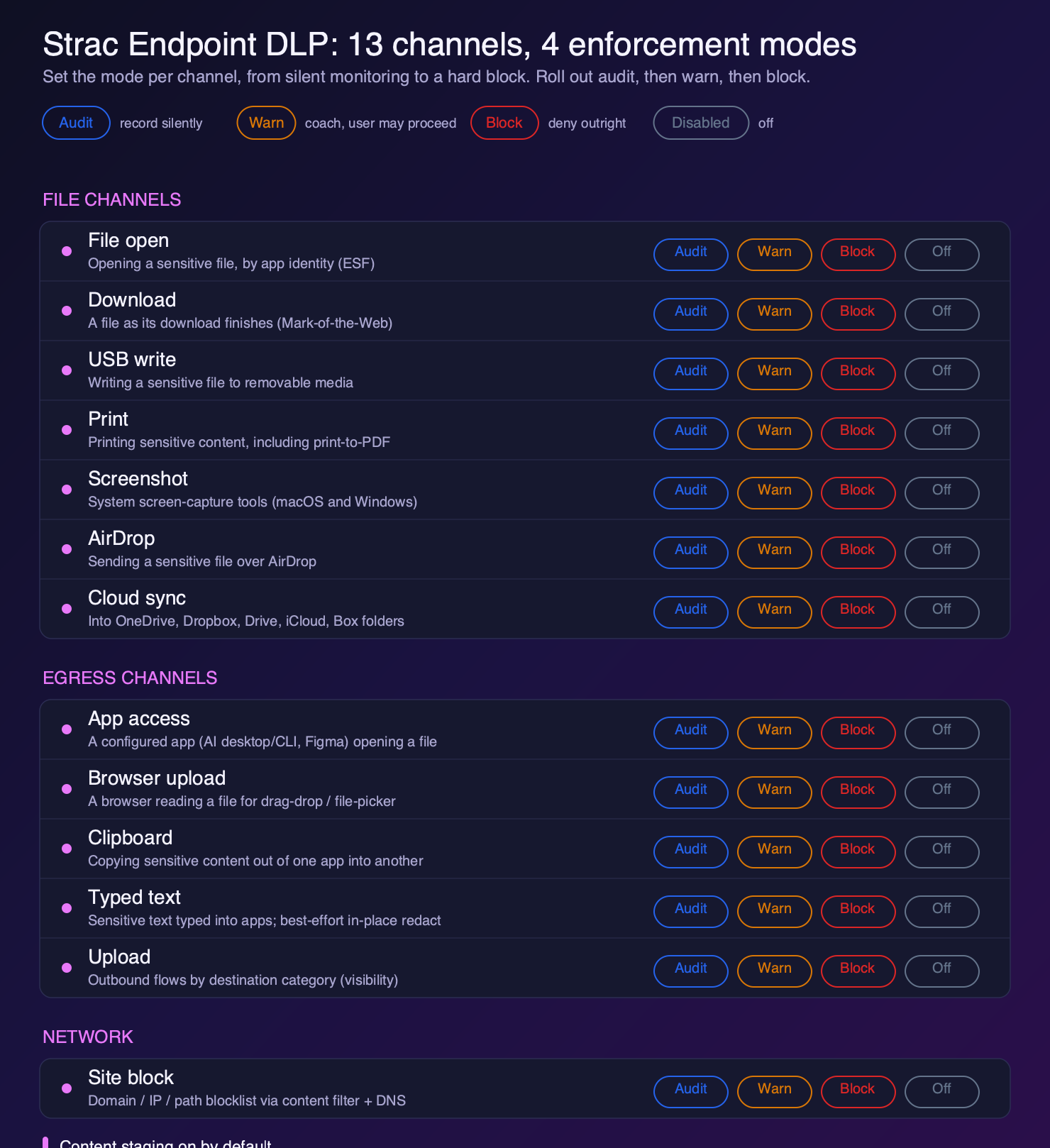
The reason AI bans fail is that they are binary, and employees route around them. Strac makes prevention a dial instead of a switch. Every enforcement channel, the clipboard and typed-text paths into chatbots, the desktop-app and browser-upload paths, the screenshot and cloud-sync paths, can be set to audit, warn, or block on its own.
The proven rollout is to start every channel in audit to see real exposure, move the risky ones to warn so users are coached but not stopped, then block only where the data or destination demands it. Policy reaches every device in about 30 seconds, so you can tighten gradually without a disruptive cutover.
Yes. Sensitive data can be exposed when employees paste information into prompts, upload files, use unapproved AI tools, or allow AI agents to access connected business applications. AI DLP adds controls around these interactions.
MCP DLP applies Data Loss Prevention controls to Model Context Protocol connections. It inspects data moving between AI agents and connected tools so sensitive information can be detected, redacted, or blocked before exposure.
MCP allows AI agents to access external tools and data sources directly. That means sensitive information can leave systems such as Salesforce, Google Drive, Slack, or internal databases without an employee manually copying it into an AI prompt.
GenAI DLP protects interactions with AI models, including prompts, responses, uploads, and browser activity. MCP DLP focuses specifically on data moving between AI agents and the applications, tools, and data sources connected through MCP.
Strac applies sensitive-data detection and DLP controls across GenAI, browsers, endpoints, SaaS, cloud, and MCP workflows. Depending on the policy, sensitive data can be detected, redacted, masked, or blocked before it reaches an unauthorized destination.
For the full breakdown of how AI data leaks happen across the browser, endpoint, AI-agent, and shadow-AI paths, see our guide to AI data leaks.
.avif)


.gif)


.webp)