AI Agent Data Leak: How Agents Leak Data & How to Prevent It (2026)
How AI agents leak sensitive data through MCP tool calls, and how to prevent it. Real risks, the confused-deputy problem, and how Strac MCP DLP redacts data before an agent can leak it.
An AI agent data leak happens when an agent connected to your tools reads raw sensitive data and surfaces or exfiltrates it. The moment an agent calls an MCP tool, it pulls real records, tickets, files, and database rows into the model, no inspection, no redaction. This guide covers how AI agents leak data, the confused-deputy and prompt-injection risks, and how Strac MCP DLP redacts sensitive data on every tool call and enforces per-user identity, so agents stay useful without becoming a leak path.
AI Agent Data Leak: How Agents Leak Data & How to Prevent It (2026)
An AI agent data leak is the newest and fastest-growing way sensitive data escapes. It is not an employee pasting into a chatbot; it is an autonomous agent, connected to your Slack, Jira, SharePoint, or database, reading raw data as part of doing its job, and leaking it into the model, the logs, or an attacker's hands.
As teams connect agents through the Model Context Protocol (MCP), every tool call becomes a potential leak. This guide covers how it happens and how to stop it.
✨ How an AI agent leaks data
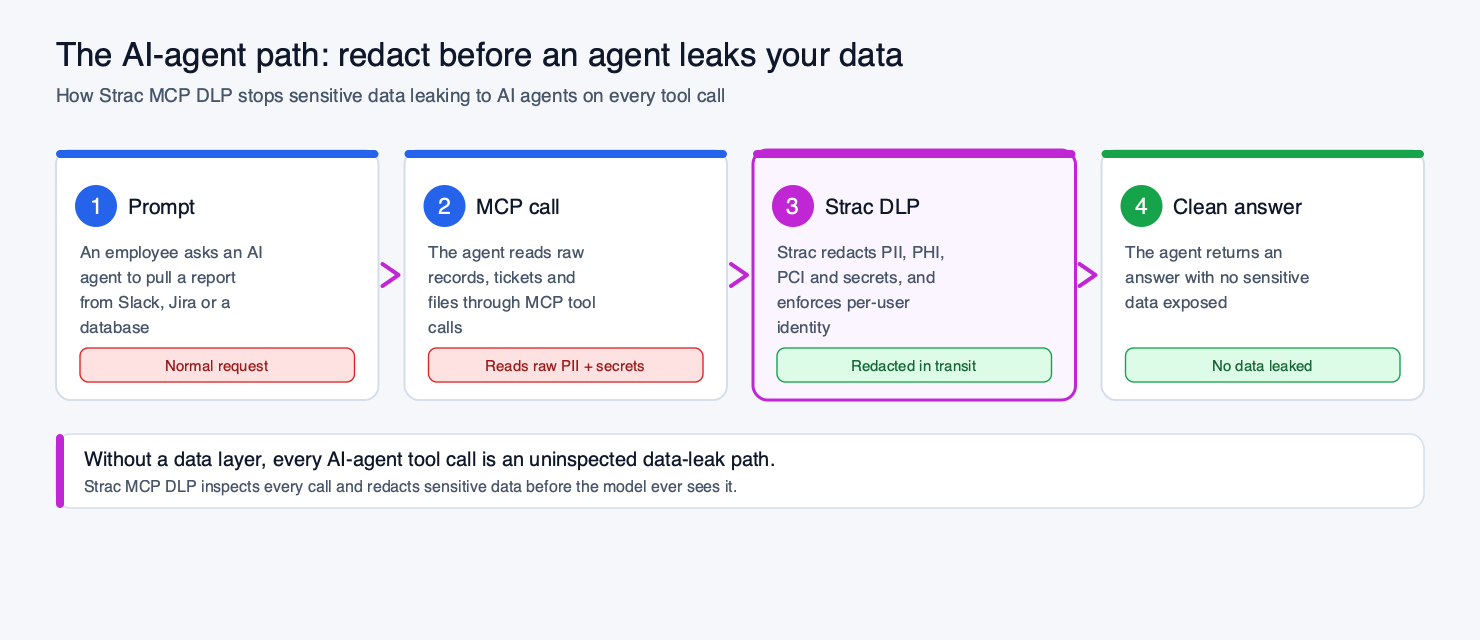
When an AI agent calls an MCP tool, the tool returns raw data into the model's context window. Ask an agent for a "payroll summary" and it reads the actual payroll table. Ask it to "triage support tickets" and it reads every SSN in them. That data is now in the model, and from there it can flow into prompts, logs, and downstream tools you do not control.
Three risks make the agent path uniquely dangerous:
Over-broad retrieval — agents read everything the connected identity can see, which is usually far more than any single task needs.
Prompt injection — hidden instructions in a document or ticket can hijack an agent into exfiltrating data through its own tool calls. See MCP prompt injection.
The confused deputy — an agent acting with broad permissions can be tricked into retrieving data on behalf of a user who should not have access. See MCP confused deputy.
✨ How to prevent AI agent data leaks
The fix is not to stop using agents; it is to put a data layer in the agent path. Strac's MCP DLP sits inline on every tool call and:
Redacts PII, PHI, PCI, and secrets in the tool response before it reaches the model.
Enforces per-user identity, so an agent only retrieves what the underlying user is permitted to see, closing the confused-deputy gap.
Inspects for injection across the response leg, catching hijacked tool calls.
Logs every call for a complete audit trail of what agents read.
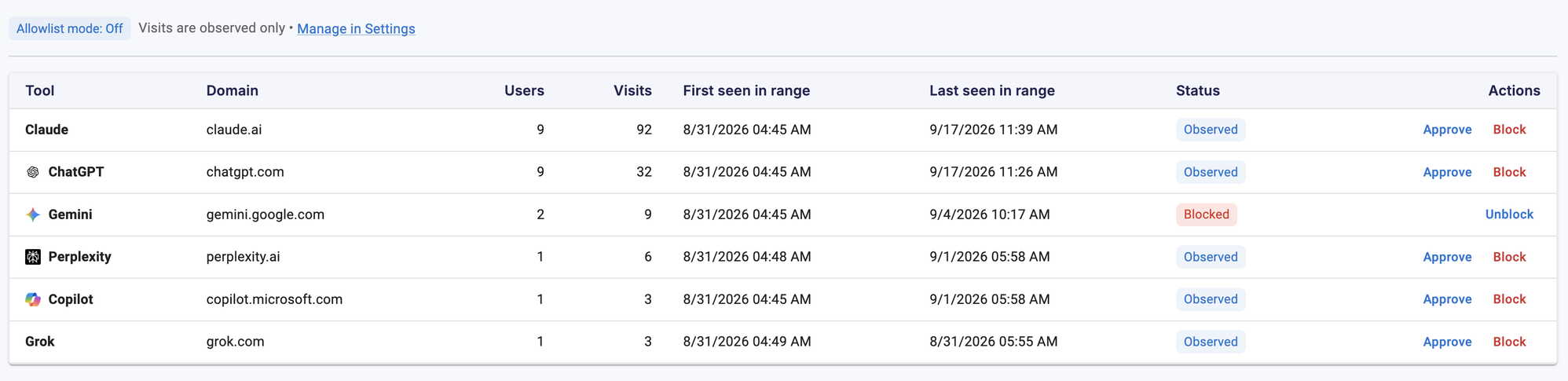
It also starts with visibility: Strac's Shadow AI discovery surfaces which AI tools and agents are actually in use, so you can govern each one. For the full picture of every way data escapes into AI, see our guide to AI data leaks and AI DLP.
🌶️ Spicy FAQs on AI agent data leaks
What is an AI agent data leak?
It is when an AI agent connected to your tools reads raw sensitive data through MCP tool calls and surfaces or exfiltrates it, into the model, logs, or downstream systems. Unlike a human pasting into a chatbot, the agent does it automatically as part of a task.
How do AI agents leak data?
Three main ways: they retrieve far more than a task needs (over-broad access), they can be hijacked by prompt injection hidden in a document or ticket, and they can be tricked into acting as a confused deputy, pulling data for someone who should not have it. Each returns raw records into the model with no inspection.
Can I prevent AI agent data leaks without blocking agents?
Yes. Strac MCP DLP sits inline on the agent path and redacts sensitive data in the tool response before the model sees it, while enforcing per-user identity. Agents stay fully functional; they just never receive raw regulated data.
How is this different from browser AI DLP?
Browser DLP covers the human path, what an employee pastes into a chatbot. AI agent DLP covers the agent path, what an autonomous agent reads through MCP tool calls. Both are needed; see AI data leaks for how the paths fit together.
Does prompt injection cause agent data leaks?
Yes. A malicious instruction hidden in content an agent reads can redirect it to exfiltrate data through its own authorized tool calls. Strac inspects the response leg for injection and redacts sensitive data regardless, so a hijacked agent still cannot leak regulated data.
What is an AI agent data leak?
It is when an AI agent connected to your tools reads raw sensitive data through MCP tool calls and surfaces or exfiltrates it, into the model, logs, or downstream systems. Unlike a human pasting into a chatbot, the agent does it automatically as part of a task.
How do AI agents leak data?
Three main ways: they retrieve far more than a task needs (over-broad access), they can be hijacked by prompt injection hidden in a document or ticket, and they can be tricked into acting as a confused deputy, pulling data for someone who should not have it. Each returns raw records into the model with no inspection.
Can I prevent AI agent data leaks without blocking agents?
Yes. Strac MCP DLP sits inline on the agent path and redacts sensitive data in the tool response before the model sees it, while enforcing per-user identity. Agents stay fully functional; they just never receive raw regulated data.
How is this different from browser AI DLP?
Browser DLP covers the human path, what an employee pastes into a chatbot. AI agent DLP covers the agent path, what an autonomous agent reads through MCP tool calls. Both are needed; see AI data leaks for how the paths fit together.
Does prompt injection cause agent data leaks?
Yes. A malicious instruction hidden in content an agent reads can redirect it to exfiltrate data through its own authorized tool calls. Strac inspects the response leg for injection and redacts sensitive data regardless, so a hijacked agent still cannot leak regulated data.
Discover & Protect Data on SaaS, AI, MCP, Endpoints & Cloud
Strac provides end-to-end data loss prevention for all SaaS and Cloud apps. Integrate in under 10 minutes and experience the benefits of live DLP scanning, live redaction, and a fortified SaaS environment.


.webp)



.avif)



.gif)
