AI Agent Governance: The Operating Model for Agents That Act (2026)
AI agent governance gives every AI agent an owner, a sanctioned identity, least privilege, and a record of what it did and which sensitive data it touched.
AI agent governance is the operating model that keeps AI agents accountable: an inventory of every agent, an owner for each one, a sanctioning decision, least-privilege credentials, continuous monitoring of what the agent actually did, bounded remediation, and exceptions that expire. A program that cannot answer what an agent did and which sensitive data it touched is a policy document, not governance. Strac runs that operating model on one graph (Agent → Principal → Permissions → Resources → Sensitive data) across Google Workspace, AWS Bedrock AgentCore, GitHub Copilot, Slack, Salesforce Agentforce, Claude, ChatGPT and Cursor, turning each policy rule into a finding with proof and a fix.
AI Agent Governance: The Operating Model for Agents That Act (2026)
Most companies already have an AI policy. It says which models are approved, what employees may paste into a chatbot, and who signs off on new vendors. Almost none of those policies say anything useful about the Claude Code session an engineer connected to Google Drive last Tuesday, the Agentforce bot that runs as an integration user nobody remembers creating, or the Bedrock agent whose IAM role can read production secrets and invoke Lambda.
AI agent governance is the operating model that closes that gap. It is the set of decisions, controls and measurements that keep every AI agent in the business accountable to a named owner, limited to the access it needs, observed while it works, and fixable when it drifts. It sits on top of the four questions that define AI agent security: what is acting and as which identity, what can it do, what did it actually do, and what sensitive data can it reach and did it touch.
The test for whether you have governance or just a document is simple. Pick any agent in the company and ask what it did yesterday and which sensitive data it touched. If the answer is a shrug, the policy is not enforced, and an auditor will reach the same conclusion in ten minutes.
This guide lays out the operating model end to end: the definition, why agents are a different problem from the SaaS apps and service accounts you already govern, the seven-stage lifecycle, the policy rule by rule with the finding each rule produces, the metrics that prove the program, how it maps to NIST AI RMF, ISO 42001, the EU AI Act and your existing SOC 2 and ISO 27001 controls, and what to skip in year one.
The program view a CISO reports from: ownership rate, sensitive reach, open findings by severity, and where the agents live. Google Workspace leads with 61, then GitHub and Copilot 38, Slack 28, AWS AgentCore 23, Salesforce 15, and Claude, ChatGPT and Cursor together 22.
What is AI agent governance?
AI agent governance is the practice of maintaining an accurate inventory of every AI agent and AI-enabled automation in an organization, assigning each one an accountable owner, deciding which agents are sanctioned for which data, scoping each agent's credentials to least privilege, monitoring what agents actually do, remediating findings through bounded and reversible actions, and recording exceptions with an expiry date.
That definition has two halves, and most programs only build the first.
The first half is posture: inventory, ownership, sanctioning and permissions. It answers what could happen. The second half is activity and data: what the agent actually did, which resources it touched, and which of those resources contain PII, PHI, PCI, secrets, source code or financial data. It answers what did happen and what it exposed.
Posture alone is where identity-security, SaaS-posture and non-human-identity tools stop, and it is where a governance program quietly fails. An agent with a perfectly scoped credential can still be prompt-injected into exporting a customer list, and an inventory that says the agent "can read Drive" says nothing about whether it read payroll.xlsx at 10:04 this morning. Governance that cannot distinguish can from did cannot verify that its own rules are being followed.
A useful shorthand: AI governance decides which AI systems the company builds and buys. AI agent governance decides how each agent, once it exists, is identified, permissioned, watched and corrected. The first is a committee. The second is an operating model that runs every day.
✨ Why 2026 is a different governance problem
The company already governs service accounts, OAuth apps and SaaS integrations. Why does an agent need a different model?
Because an agent chooses its own next action. A SaaS integration does what its code says. An agent interprets an instruction in natural language, picks tools, chains calls, and reads or writes whatever its credential allows. Its blast radius is the union of every permission behind every credential it can borrow, and its behavior changes with every prompt it receives, including prompts injected by the data it reads. You cannot review the code and sign it off, because the instructions arrive at runtime.
Three things follow, and each one breaks the governance model inherited from SaaS and NHI programs.
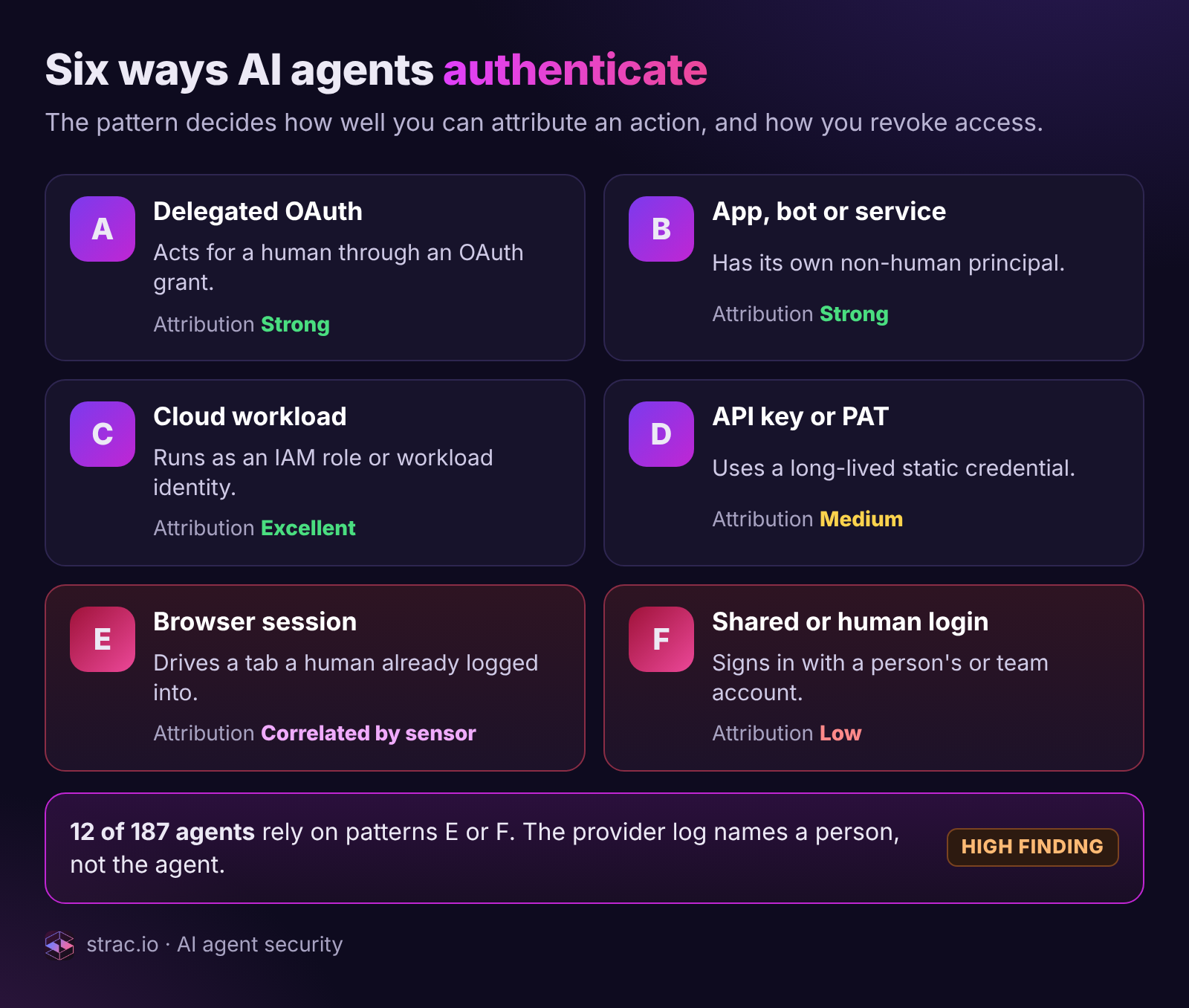
Agents do not have one kind of identity. They have six. How well you can attribute an action to an agent, and revoke its access, depends entirely on which pattern it uses:
Pattern
What it means
Example
Governance consequence
A. Delegated OAuth
The agent acts on behalf of a human through an OAuth grant
Claude → OAuth → Alice → Google Drive
Strong attribution and one-click revoke, if you know the client_id and user
Excellent for permissions and CloudTrail; shared roles blur which agent acted
D. API key, PAT or static secret
The agent authenticates with a long-lived credential
GitHub PAT, vendor API key
Weak ownership; staleness is the common finding
E. Browser or session identity
The agent drives a browser session a human already logged into
Cowork or computer-use → Alice's Salesforce tab
The provider sees Alice; attribution needs browser or endpoint evidence
F. Shared or human login
The agent signs in with a human or team account
An automation with shared CRM credentials
Low confidence unless another sensor correlates it
Patterns A through D leave a footprint in a provider's admin API. Patterns E and F do not, and in this inventory 12 of 187 agents use them, which is why the governance policy treats a shared human identity as a High finding rather than a note.
The fastest-growing agents leave no footprint in any admin API. A computer-use agent that drives Alice's open Salesforce tab creates no OAuth grant and no service account. A local Claude Code or Cursor session with an MCP server on a laptop never appears in a SaaS posture scan. Salesforce's audit log says Alice exported the report, and it is correct, and it is useless for governance. The only way to govern patterns E and F is evidence from where the agent runs: the browser and the endpoint. This is the same reason shadow AI programs that rely on SSO logs alone undercount badly.
Permission is not behavior. A grant tells you what the provider would allow. Only the audit log, the compliance API, or an MCP, browser or endpoint sensor tells you what the agent did. Programs that infer did from can alarm on agents that never touch sensitive data and miss the agent whose narrow scope was enough to export the one file that mattered. The deeper treatment of attribution confidence is in AI agent identity governance.
✨ The AI agent governance operating model
Governance is a loop, not a list. These seven stages run continuously, and each one feeds the next. The sequence mirrors how a mature program is built and how a platform should expose it.
Every stage reads from and writes to the same Agent → Principal → Permissions → Resources → Sensitive data graph. An expired exception reopens its finding, which sends the loop around again.
Stage
The decision it forces
What "done" looks like
Common failure
1. Inventory
What agents exist, across SaaS, cloud, AI vendors, browser and endpoint
Every agent discovered, with discovery source, first and last seen, and identity pattern
A registry of what people registered
2. Ownership
Who is accountable for each agent
A named human owner on every agent and credential; owner requests routed automatically
Owner is "Platform Eng" or blank
3. Sanctioning
Is this agent approved, and for which data categories
Sanctioned, unsanctioned or under review, recorded with reviewer and date
A ticket nobody can query
4. Least privilege
Does the credential match what the agent uses
Granted versus used over a 30-day window; unused write, delete and admin capability removed
Scopes copied from a human admin
5. Monitoring
What did the agent do, and which sensitive data did it touch
Activity attributed per agent, joined to classifications, with confidence shown
Logs in seven consoles, never joined
6. Remediation
What changes, who approves, is it reversible
Bounded actions where a safe admin API exists; exact policy delta and console link elsewhere
Tickets to other teams; weeks to close
7. Exceptions
When may a rule be broken, and for how long
Owner, reason and expiry on every exception; expiry reopens the finding
Snoozed alerts that never return
Three notes on running the loop.
Inventory decides whether the rest is real. Discovery has to cover the systems where agents, credentials and sensitive data overlap most: Google Workspace OAuth grants, AWS and Bedrock AgentCore runtimes, GitHub Apps and Copilot agent sessions, Slack apps, Salesforce connected apps and Agentforce bots, the Anthropic and OpenAI compliance feeds, and Cursor. It also has to cover the laptop, because that is where local agents and MCP servers live. The playbook is in how to discover AI agents.
Ownership before permissions. Teams often start by arguing about scopes. Start by finding the owner. An agent with no accountable owner cannot be scoped, sanctioned or safely turned off, because there is nobody to ask what it is for.
Separate "is an agent" from "is a non-human identity." In the inventory used throughout this guide, 4,112 non-human identities existed and 214 were used by AI agents. Treat every CI bot and backup service account as an agent and the real risk disappears into noise, and owners stop answering requests.
✨ AI agent governance controls and policy, rule by rule
A policy that cannot be evaluated against the inventory is a wish. Each rule below is written so that a platform can check it continuously, and each one maps to a specific finding with a default severity. The severity logic is deterministic and visible: sensitivity × action capability × breadth × sanctioning × observed use × attribution confidence. No opaque score.
Rule
Finding it produces
Default severity
What triggers it
Every agent has an accountable owner
Ownerless live agent or credential
High
No owner, plus recent activity or a valid credential
Agents that can reach regulated data must be sanctioned
Unsanctioned agent can access sensitive data
High
Is an agent, sanctioning state is unsanctioned or unknown, reachable sensitive resources > 0
No principal may both read secrets and execute
Agent can read secrets and execute
Critical
Secret retrieval or KMS decrypt capability plus an execute capability on the same principal
Unused write, delete or admin capability is overprivilege
Overprivileged agent
Medium to High, by blast radius
Capability granted and not observed over the 30-day policy window
Stale credentials are revoked
Stale agent with active credential
Medium
No activity for 45 days, credential still valid
Agents do not use shared or human identities
Shared human credential used by agent
Medium to High
Attribution relies on a shared login or a human browser session instead of a dedicated identity
Agents with sensitive reach do not hold wildcard access
Agent has broad wildcard access
High when sensitive data is present
All repos, all channels, or * resources behind the credential
Sensitive data does not leave to unsanctioned destinations
Sensitive data sent to external destination
Critical
Observed send, export or tool response carrying classified data to an external or untrusted destination
One further finding is less a rule than the evidence that the rules are working. Agent observed accessing sensitive data (High; Critical for secrets or highly regulated data combined with a risky capability) is what monitoring produces when a sanctioned agent does its job on classified resources. It is the record the sanctioning decision was supposed to anticipate, and the row an auditor will ask to see.
Each rule is toggled, parameterized and previewed against the current inventory before it goes live. Here the preview shows what enabling the full policy would produce: 41 owner requests, 11 High and 4 Critical findings, 31 reversible permission reductions, 6 auto-revocable stale credentials and 12 identity migrations, with the data-layer block rule left in monitor mode.
Some practical guidance on tuning these rules:
Preview before you enforce. The first run against a real inventory produces more findings than the team can work in a week. Run it in preview, look at the distribution, and turn rules on in order of severity. A policy that opens 400 Medium findings on day one trains owners to ignore it.
Set the overprivilege window to match your telemetry. Thirty days is a reasonable default where activity coverage is complete. If S3 data events are not enabled, or an audit edition is missing, "never observed" does not mean "never used." A good platform marks that coverage as not configured and withholds the finding.
Put the data-layer block in monitor mode first. The last rule in the editor above blocks unsanctioned agents from receiving sensitive data at the enforcement point, through the same browser, endpoint and MCP controls described in AI DLP and MCP DLP. Run it in monitor mode for two weeks, sanction the legitimate agents it would have blocked, then enforce.
Decide what "regulated data" means before writing the sanctioning rule. PII, PHI, PCI and secrets are the usual set. Source code and financial data are the ones teams forget.
✨ AI agent governance metrics that prove the program works
A governance program is measured by a small number of outcomes, not by the number of rules it has. If you report three numbers to the board, report these.
The three board metrics and their direction, using the same inventory as the dashboard and policy preview above. The four supporting metrics below them explain why the headline numbers move.
1. Percentage of agents with an accountable owner. The single most predictive metric for whether anything else works. A program that starts at 40 percent and reaches 90 percent in a quarter has done the hardest part. One stuck at 60 percent has a discovery problem or an org-chart problem, and both are fixable.
2. Median time to remediate a High or Critical finding. Measured from the finding's creation to the provider resync that confirms the change. This separates a platform with bounded remediation from one that files tickets. In the program dashboard at the top of this guide, the median fell from 9.4 days to 2.1 days once one-click revocation and policy deltas replaced manual tickets.
3. Count of unsanctioned agents with sensitive reach. The number that should trend to zero and stay there. It combines the inventory, the sanctioning decision and the data join in one figure, which is why it is hard to fake.
Four supporting metrics belong on the same dashboard: the share of agents found only by browser or endpoint sensors (if it is zero, the inventory is missing patterns E and F); the granted-versus-used ratio per agent, which should rise as reductions land; the count of agents on shared human identities, which should fall to zero; and exceptions past expiry, which should always be zero.
One rule for all of these: show coverage alongside the number. Seventeen agents with sensitive reach means something different when Drive, GitHub and S3 classifications are complete than when half the S3 buckets have never been scanned. A number without its coverage is a guess with a decimal point.
✨ How AI agent governance maps to compliance frameworks
No framework names "AI agents" as a control category yet. Every one of them already covers agents through the identities they use and the data they touch, and auditors have started asking for the agent inventory first because it is the fastest way to see whether the identity and logging controls are real. The mapping below is intentionally generic. The detailed crosswalk is in AI agent governance frameworks.
A summary of the table below. ISO 42001 touches every control because the loop itself is the management system; every framework asks for owners and an activity record.
Framework
What it expects
Governance stages that satisfy it
Artifact to produce
NIST AI RMF
Govern (accountability and policy), Map (inventory and context), Measure (tracking risk and behavior), Manage (response)
Ownership and policy; inventory; monitoring and metrics; remediation and exceptions
Agent inventory with owners, finding history, remediation records
ISO 42001
An AI management system: roles, an inventory of AI systems, impact assessment, logging, continual improvement
Every stage; the loop is the management system
Policy with evidence it is evaluated continuously
EU AI Act
Record-keeping, human oversight, transparency and risk management, scaled to the system's risk class
Inventory, sanctioning, monitoring, remediation
Per-agent activity record and the sanctioning decision with rationale
SOC 2
Logical access controls, least privilege, access reviews, monitoring of activity
Least privilege, monitoring, stale and ownerless findings
Access review evidence and activity logs per agent identity
ISO 27001:2022
Access control, access rights, privileged access rights, logging and monitoring
Least privilege, sanctioning, monitoring
Granted-versus-used review per credential
GDPR, HIPAA, PCI DSS
Controls and records on who and what may access personal, health and cardholder data
Sanctioning against regulated data, the data join, monitoring
Which agents can reach regulated data, and which did
The frameworks differ in vocabulary and agree on substance: an inventory, an owner, a least-privilege credential, a log of what happened, and a documented way to fix it. None of them accept "we cannot see that agent" as a control. The identity and logging requirements apply to a computer-use agent driving a browser session exactly as they apply to a service account, which is why governance has to be built on sensors as well as APIs.
For companies that also run a broader AI data governance program, the agent inventory is a new set of principals pointed at the same classified-data map. The two programs share the data layer and should share the platform.
AI agent governance mistakes to avoid in year one
Governance programs fail from ambition about as often as from neglect. These are the traps we see most, and the ones we chose not to build first.
Do not try to model every permission before you have an inventory. A universal effective-access engine for every SaaS and cloud is a multi-year project. Direct and delegated access, plus a curated set of high-risk actions in AWS (secret retrieval, data export, execute), covers the findings a CISO acts on.
Do not keep the agent registry in a spreadsheet. A registry of what people registered is a list of the agents that were never the problem. The inventory has to be discovered, continuously, from provider APIs and sensors.
Do not count every non-human identity as an agent. You will quadruple the finding volume and lose the owners who have to work it.
Do not automate IAM mutation on day one. Automate only where the provider offers a bounded, well-understood admin write API: revoking a user's third-party app tokens in Google Workspace, restricting or uninstalling a Slack app. For AWS, generate the exact policy delta and the console link, and let a human apply it.
Do not block agents outright as a governance strategy. Blocking produces shadow AI agents that carry the same risk with no inventory. The goal is to make it safe to say yes.
Do not accept an opaque risk score. If the severity cannot be explained from six visible factors, an owner cannot argue with it and an auditor cannot verify it.
Do not allow exceptions without an expiry. An exception with no end date is a policy change nobody approved.
Do not collect prompts and content by default. Metadata answers most governance questions. Where the data layer needs content, it should run under the same data-handling controls as the rest of your DLP program.
Strac's AI agent governance platform
Strac already runs the data layer for AI at hundreds of companies: browser and endpoint AI DLP, MCP DLP for agent tool calls, shadow AI discovery, and a classified inventory of sensitive data across SaaS, cloud and endpoints. AI agent governance runs the seven-stage operating model on top of that inventory, on one graph: Agent → Principal → Permissions → Resources → Sensitive data, with activity joined through evidence.
What the operating model looks like in the product:
Inventory. Every agent, bot and AI-enabled automation across Google Workspace, AWS and Bedrock AgentCore, GitHub and Copilot, Slack, Salesforce and Agentforce, Claude, ChatGPT and Cursor, plus the local agents and MCP servers only an endpoint can see. "Is an agent" is stored separately from "is a non-human identity."
Ownership and sanctioning. Owner required is a policy toggle. Missing owners generate requests routed to the likely owner from OAuth, installation and session evidence. Sanctioning state is recorded per agent with reviewer and date.
Least privilege. Granted versus used, measured over the policy window per scope, role and repo grant. Every recommended reduction states what will change and whether it is reversible.
Monitoring. Activity attributed per agent from provider audit logs, the Anthropic and OpenAI compliance APIs, and Strac's own MCP, browser and endpoint sensors, each line tagged with evidence source and confidence. Detail in how to monitor AI agents.
Remediation. Read-only by default; write access opt-in per provider and per action. One-click where the provider API is bounded (Google token revoke, Slack restrict or uninstall), exact policy delta and console link elsewhere, and provider resync confirms the change before the finding closes. The control catalogue is in how to protect AI agents.
Exceptions and metrics. Owner, reason and expiry on every exception, and the program dashboard above with coverage shown beside every number.
For larger organizations the same model extends to multiple tenants, business units and approval chains, covered in enterprise AI agent governance. Deploy it read-only in an afternoon. The first policy preview is usually the moment the program stops being a document.
👉 Book a demo and we will run the agent inventory read-only against your Google Workspace or GitHub tenant on the call, then preview the full governance policy against it so you can see the owner requests, findings and reductions before anything changes.
🌶️ Spicy FAQs on AI agent governance
What is AI agent governance?
AI agent governance is the operating model that keeps every AI agent in an organization accountable: an inventory of all agents, a named owner for each, a sanctioning decision per agent and data category, least-privilege credentials, continuous monitoring of what each agent actually did and which sensitive data it touched, bounded remediation, and exceptions that expire. It is built on top of AI agent security's four questions (identity, authorization, activity, data) and turns them into rules, findings and metrics.
What is the difference between AI governance and AI agent governance?
AI governance decides which AI systems the company builds and buys, how they are evaluated, and who is responsible for them at the portfolio level. AI agent governance is the day-to-day control of each agent once it exists: who owns it, what identity it runs as, what it may reach, what it did, and how it is corrected. The first is typically a committee and a set of documents. The second has to be a continuously evaluated policy, because agents change behavior with every instruction they receive.
What should an AI agent governance framework include?
At minimum: a discovered inventory covering SaaS, cloud, AI vendors and endpoints; an owner on every agent; sanctioning tied to data categories; a least-privilege rule measured against observed use; activity monitoring joined to a sensitive-data inventory; a remediation model that states what changes and whether it is reversible; exceptions with expiry; and three reported metrics (ownership rate, median time to remediate, unsanctioned agents with sensitive reach). If the framework cannot say what a given agent did yesterday, it is incomplete.
What does an AI agent governance platform do that an identity or SSPM tool does not?
Identity-security, SSPM and NHI tools inventory principals and permissions, which answers what an agent could do. An AI agent governance platform adds what the agent actually did, which sensitive data it touched, and attribution for agents that never appear in an admin API, such as computer-use agents driving a human's browser session or local agents with MCP servers on a laptop. It joins all of that to a classified-data inventory so every finding comes with proof.
How do you govern AI agents that run on employee laptops or inside browsers?
Through sensors, because nothing else can see them. A local Claude Code, Cursor or Codex session, its MCP configuration, and a computer-use agent controlling a logged-in SaaS tab produce no OAuth grant and no service account. Endpoint and browser evidence (process, session, domain, file movement, timing, AI session ID where available) is correlated with the provider's audit log, and the attribution is labeled as correlated rather than provider-native. Shadow MCP servers are the most common thing this surfaces in the first week.
How long does it take to stand up AI agent governance?
Read-only discovery across Google Workspace, AWS, GitHub, Slack, Salesforce, Claude and ChatGPT takes an afternoon, and the first inventory and policy preview follow in the same session. Reaching a high ownership rate and working the first wave of High and Critical findings is a quarter of work for most teams, driven mostly by how quickly owners respond. Enforcement rules should run in monitor mode for a couple of weeks before being turned on.
What is AI agent governance?
AI agent governance is the operating model that keeps every AI agent in an organization accountable: an inventory of all agents, a named owner for each, a sanctioning decision per agent and data category, least-privilege credentials, continuous monitoring of what each agent actually did and which sensitive data it touched, bounded remediation, and exceptions that expire. It is built on top of AI agent security's four questions (identity, authorization, activity, data) and turns them into rules, findings and metrics.
What is the difference between AI governance and AI agent governance?
AI governance decides which AI systems the company builds and buys, how they are evaluated, and who is responsible for them at the portfolio level. AI agent governance is the day-to-day control of each agent once it exists: who owns it, what identity it runs as, what it may reach, what it did, and how it is corrected. The first is typically a committee and a set of documents. The second has to be a continuously evaluated policy, because agents change behavior with every instruction they receive.
What should an AI agent governance framework include?
At minimum: a discovered inventory covering SaaS, cloud, AI vendors and endpoints; an owner on every agent; sanctioning tied to data categories; a least-privilege rule measured against observed use; activity monitoring joined to a sensitive-data inventory; a remediation model that states what changes and whether it is reversible; exceptions with expiry; and three reported metrics (ownership rate, median time to remediate, unsanctioned agents with sensitive reach). If the framework cannot say what a given agent did yesterday, it is incomplete.
What does an AI agent governance platform do that an identity or SSPM tool does not?
Identity-security, SSPM and NHI tools inventory principals and permissions, which answers what an agent could do. An AI agent governance platform adds what the agent actually did, which sensitive data it touched, and attribution for agents that never appear in an admin API, such as computer-use agents driving a human's browser session or local agents with MCP servers on a laptop. It joins all of that to a classified-data inventory so every finding comes with proof.
How do you govern AI agents that run on employee laptops or inside browsers?
Through sensors, because nothing else can see them. A local Claude Code, Cursor or Codex session, its MCP configuration, and a computer-use agent controlling a logged-in SaaS tab produce no OAuth grant and no service account. Endpoint and browser evidence (process, session, domain, file movement, timing, AI session ID where available) is correlated with the provider's audit log, and the attribution is labeled as correlated rather than provider-native. Shadow MCP servers are the most common thing this surfaces in the first week.
Discover & Protect Data on SaaS, AI, MCP, Endpoints & Cloud
Strac provides end-to-end data loss prevention for all SaaS and Cloud apps. Integrate in under 10 minutes and experience the benefits of live DLP scanning, live redaction, and a fortified SaaS environment.


.webp)









.avif)


.gif)
