AI Security Posture Management (AI-SPM): Complete Guide (2026)
AI security posture management (AI-SPM) explained — what it covers, how it differs from DSPM and CSPM, what it misses, and how to govern the data your AI actually touches.
AI-SPM (AI Security Posture Management) is posture management for your AI estate — an inventory of every model, agent, prompt path, and data connection, plus the risks attached to each: which model has access to production data, which agent can reach the CRM, which prompt path leaks PII.
It's the fourth acronym in the posture family: CSPM secures cloud infrastructure, DSPM secures the data, SSPM secures SaaS configuration, and AI-SPM secures the AI layer that now sits on top of all three.
The uncomfortable truth: AI-SPM is mostly inventory. It tells you an agent can reach Salesforce. It does not stop the agent pulling 4,000 customer records out of it. Posture is not enforcement.
The pairing that actually works: AI-SPM to see the estate, data-layer DLP to control what moves through it.
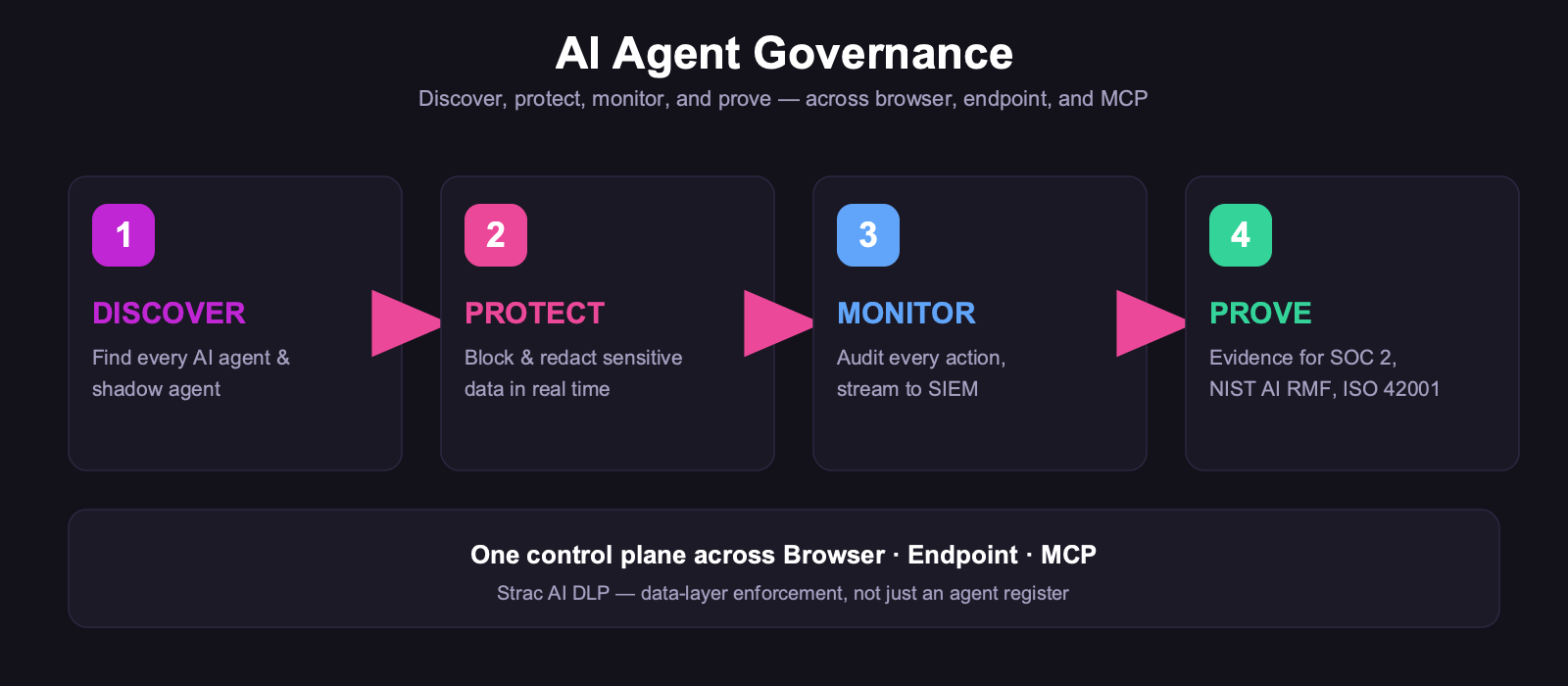
The AI estate, mapped: discover what AI is running, protect the data it can reach, monitor every action, and prove it to an auditor.
✨ What Is AI Security Posture Management?
AI security posture management (AI-SPM) is the practice of continuously discovering, inventorying, and risk-scoring everything in your organization that is AI: models in production, third-party AI services employees use, AI agents connected to internal systems, the data those systems can reach, and the permissions that let them reach it.
Strac extends AI security posture to production LLMs by integrating with the Claude Compliance API, surfacing and remediating sensitive-data exposure across Claude Enterprise.
If DSPM answers "where is my sensitive data?", AI-SPM answers "what AI can touch it, and should it be able to?"
A typical AI-SPM finding looks like this:
A fine-tuned model in staging was trained on a dataset containing live customer PII
An internal AI agent holds an API token with write access to production Salesforce
Forty-one employees are using an AI coding assistant that was never reviewed
A retrieval pipeline indexes a SharePoint site that includes HR compensation files
Every one of those is a governance failure, and none of them shows up in a CSPM, a DSPM, or an SSPM.
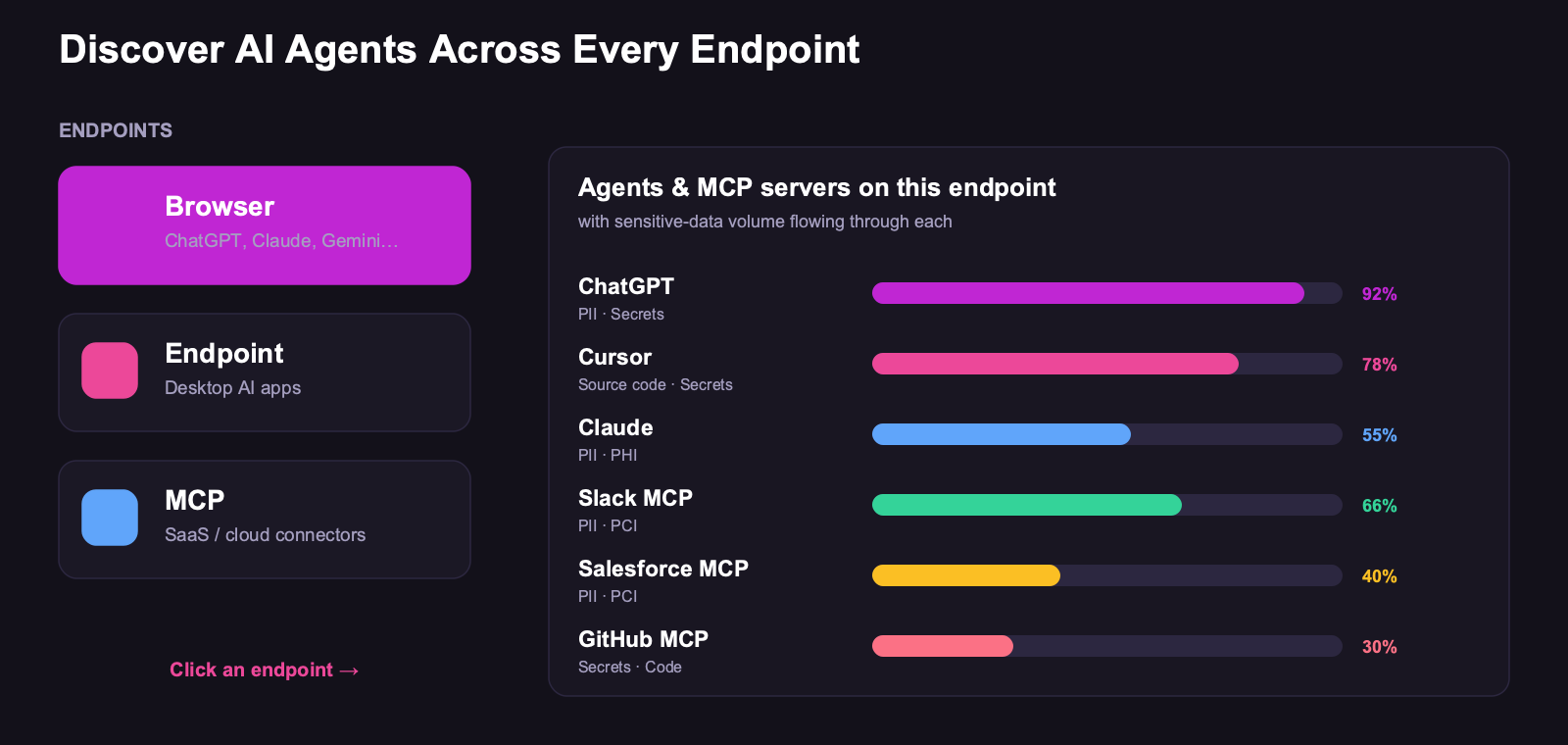
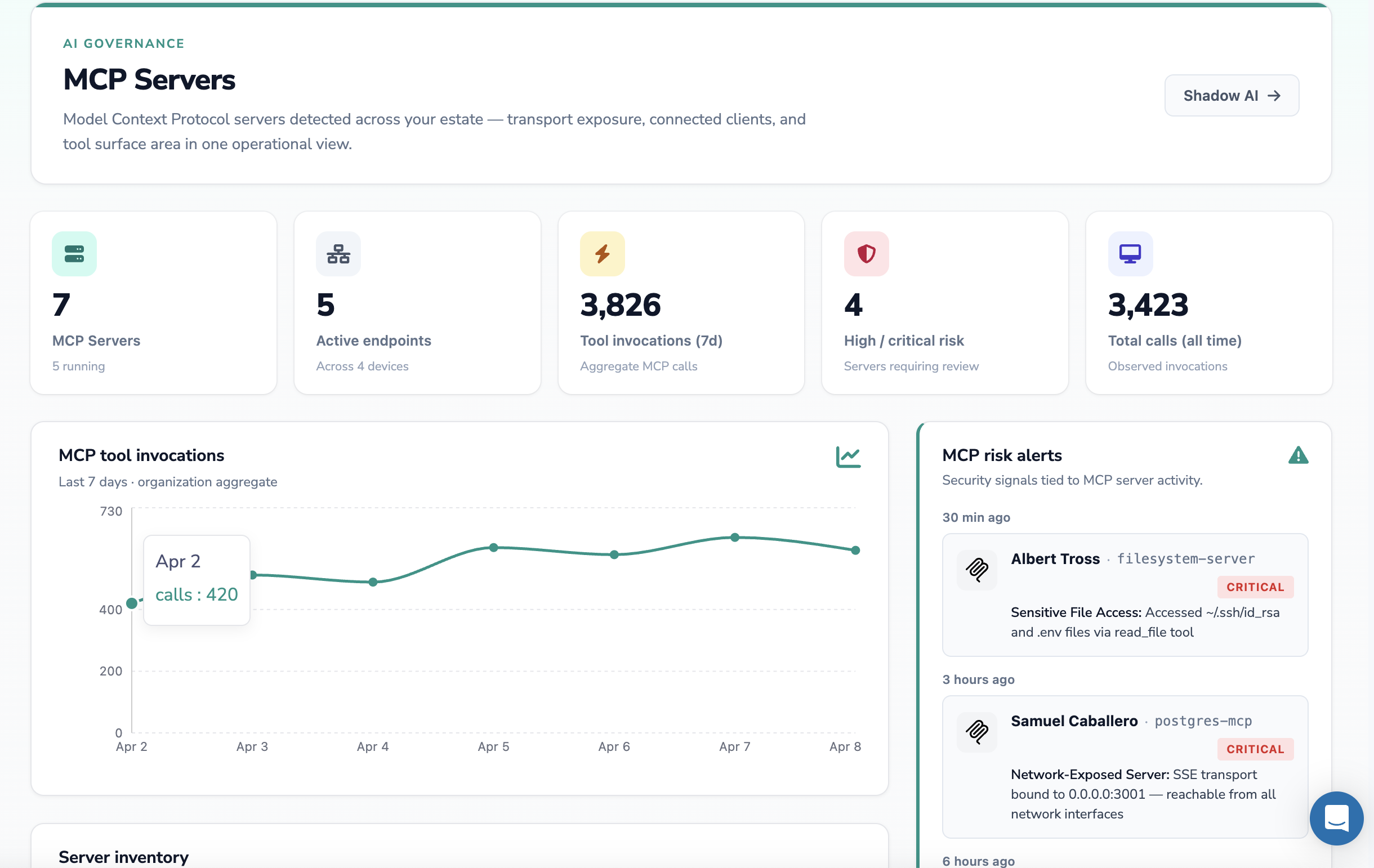
AI-SPM starts with inventory: every agent, model, and MCP server actually running — including the ones nobody registered.
AI-SPM vs DSPM vs CSPM vs SSPM
What it secures
Core question
Typical finding
CSPM
Cloud infrastructure
Is my cloud configured safely?
Public S3 bucket, over-permissive IAM role
DSPM
The data itself
Where is my sensitive data and who can reach it?
Unencrypted SSNs in a bucket, PHI in an overshared file
SSPM
SaaS configuration
Are my SaaS apps configured safely?
Over-broad Salesforce profile, risky OAuth grant
AI-SPM
The AI layer
What AI exists, what can it reach, what is it exposing?
Agent with production DB access; model trained on live PII
✨ What AI-SPM Actually Covers
1. AI asset inventory. Every model, agent, AI service, and connector — including the ones nobody told security about. This is the shadow-AI problem, and inventory is genuinely where AI-SPM earns its keep.
2. Data-access mapping. Which systems can each AI reach, and through what identity. When an AI agent connects to Slack, Salesforce, or a database over the Model Context Protocol, it inherits a set of permissions — usually a service account's, usually broader than anyone intended.
3. Model and pipeline risk. Training data lineage, model provenance, and whether a model was trained on data it should never have seen.
4. Configuration and guardrail drift. Whether the controls you set are still in place.
5. Compliance mapping. Evidence for the EU AI Act, ISO 42001, and NIST AI RMF.
Posture shows you the agent has access. It does not stop the pull.
✨ The Gap in Every AI-SPM Tool
Here is the part vendors gloss over. AI-SPM is a posture category, and posture means visibility, not control.
AI-SPM will tell you that your customer-support agent has read access to a Salesforce object containing 40,000 records with card numbers in the case comments. That's a genuinely useful thing to know. But on the day that agent actually pulls those records into a context window and ships them to a model provider, posture management does nothing. It described the risk; it did not stand in the way of it.
This is the same lesson the DSPM market learned. Discovery without remediation is a report, and reports do not stop breaches. The organizations getting this right are pairing posture (see the estate) with enforcement at the data layer (control what moves):
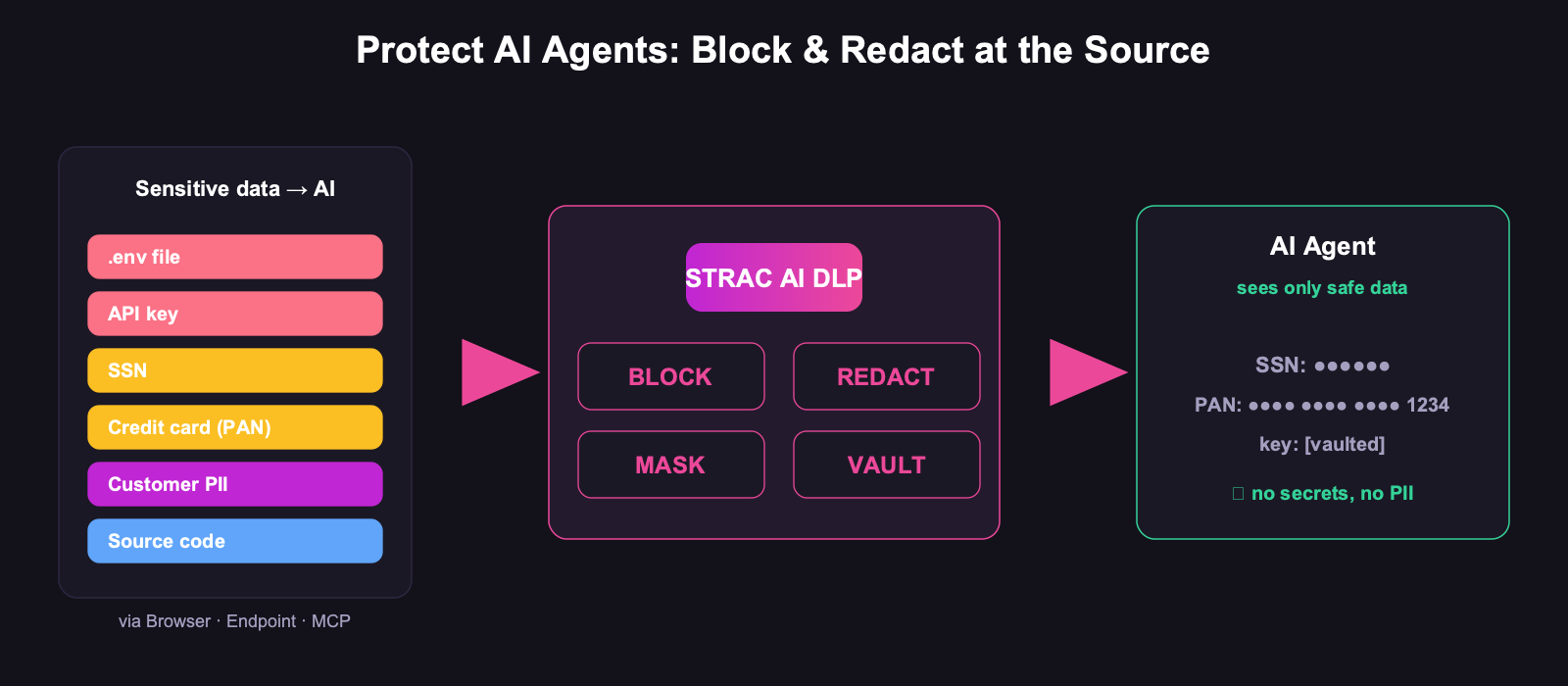
In the browser — an employee pastes a patient record into ChatGPT, Claude, or Gemini, and it is redacted before submission
In the agent path — an AI agent queries Salesforce over MCP, and PII is stripped from the response before it reaches the model
In the data at rest — the sensitive values sitting in the systems AI can reach are masked, tokenized, or vaulted, so a broad permission is no longer a broad exposure
That last one is the quiet unlock: if the SSN isn't in the record, no amount of over-permissioned AI access can leak it.
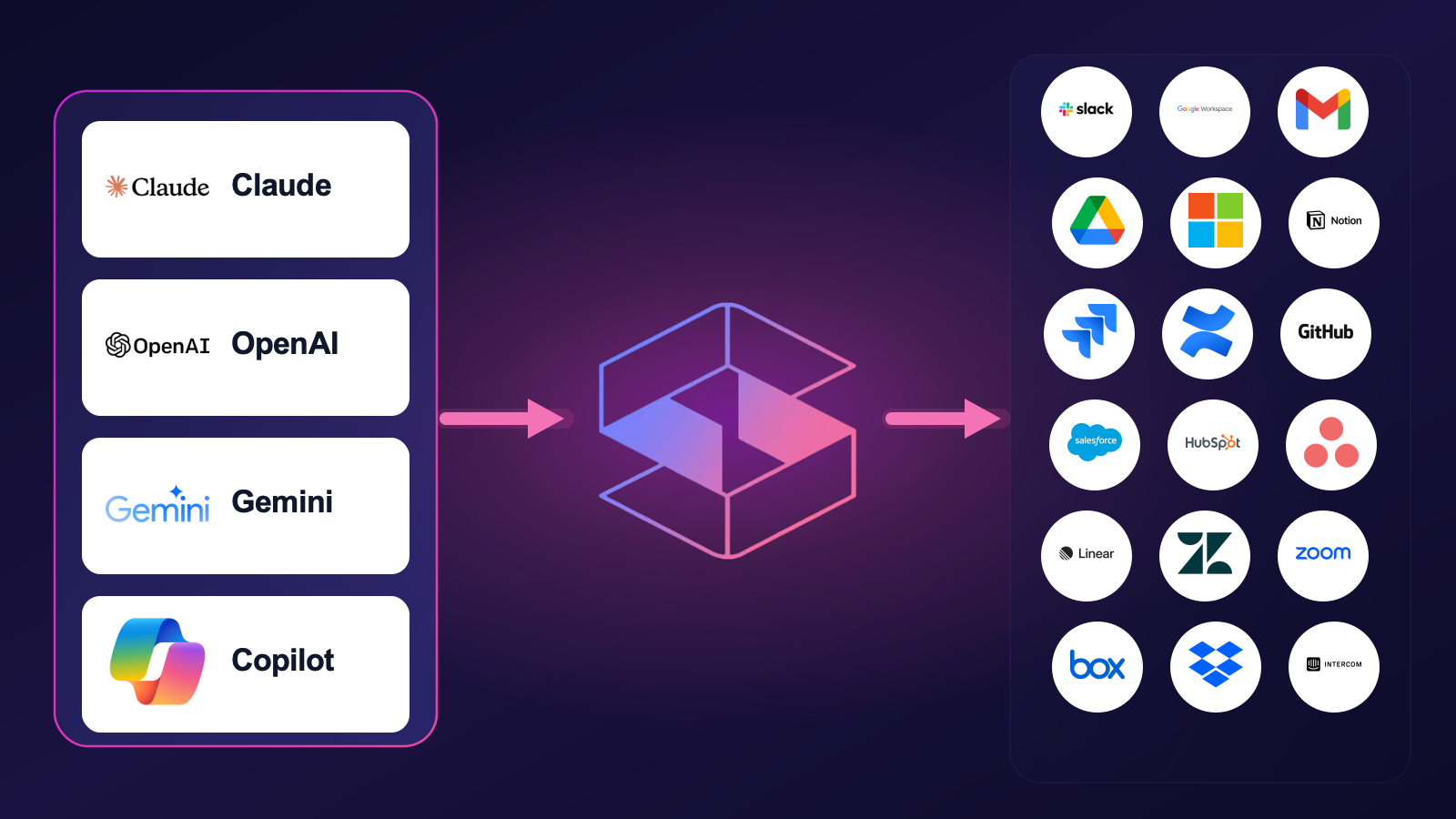
The enforcement half: every AI agent on the left, every system it can reach on the right, and Strac inspecting and redacting in between.
How to Get Started with AI-SPM
Inventory first. You cannot govern an estate you have not enumerated — including the AI tools employees adopted without asking.
Map the data, not just the models. The question that matters is not "which models do we run" but "what data can they reach."
Fix the data underneath. Reduce what AI can leak by redacting, masking, or vaulting sensitive values in the systems agents connect to.
Enforce at the point of use — browser, agent, and connector — because that is where the data actually moves.
Turn it into evidence. Log every detection and action against ISO 42001, the EU AI Act, and NIST AI RMF.
Strac covers the enforcement half: AI DLP in the browser across ChatGPT, Claude, Gemini and Copilot; MCP DLP for AI agents reaching enterprise systems; and DSPM for the data those systems hold.
✨ How Strac Covers Every AI Surface
AI-SPM maps the estate. Enforcement is what changes the outcome, and it lives on four surfaces:
Browser DLP for what employees type into AI tools.
Enforcement across surfaces: secrets, .env files, PII and card data stopped before they reach an AI tool or agent.
🌶️ Spicy FAQs for AI Security Posture Management
What is AI security posture management (AI-SPM)?
AI-SPM is the continuous discovery, inventory, and risk assessment of an organization's AI estate — models, agents, AI services, and the data and permissions each can reach. It answers "what AI do we have, what can it touch, and what is it exposing?" It is the AI-layer equivalent of what CSPM does for cloud infrastructure and DSPM does for data.
What is the difference between AI-SPM and DSPM?
DSPM finds and assesses your sensitive data — where it lives, who can access it, how exposed it is. AI-SPM finds and assesses your AI systems — which models and agents exist, what they can reach, and what risk they create. They meet in the middle: AI-SPM tells you an agent can reach a database, and DSPM tells you that database holds 40,000 unencrypted SSNs. You need both halves to understand the actual risk.
Is AI-SPM the same as AI governance?
No, though they overlap. AI governance is the broader discipline — policy, accountability, model documentation, regulatory conformity. AI-SPM is the technical, continuous, security-focused slice of it: the live inventory and risk posture of your AI estate. Governance sets the rules; AI-SPM tells you whether reality matches them. See AI governance tools.
Does AI-SPM stop data leaks?
Generally not on its own, and this is the most important thing to understand before you buy. AI-SPM is a posture category: it identifies risk, it does not enforce against it. It will tell you an agent has access to sensitive data; it will not intercept the moment that data leaves. Preventing the leak requires enforcement at the point of use — redacting sensitive data out of a prompt, or out of an agent's tool response, before it reaches the model.
Which tools do AI-SPM?
The category is young and contested. Cloud security vendors (Wiz, Palo Alto, Microsoft) have added AI-SPM modules to existing CNAPP platforms; AI-native vendors like Cranium focus on model inventory and AI supply chain. Most are inventory- and posture-first. When evaluating, ask one question that cuts through the marketing: when you find an over-permissioned agent, what does the product actually do about it?
How does AI-SPM relate to the EU AI Act and ISO 42001?
Both require you to know what AI systems you operate, classify their risk, and demonstrate ongoing controls. An AI inventory with risk classification is effectively the first deliverable of either framework, which is why AI-SPM tooling is often bought under a compliance budget rather than a security one. See ISO 42001.
The Bottom Line
AI security posture management is a genuinely necessary category — you cannot govern an AI estate you have never enumerated, and most organizations have no idea how many agents, models, and connectors are quietly running with production access.
But do not mistake the map for the territory. AI-SPM shows you that an agent can reach your customer database. Only enforcement at the data layer decides what happens when it does. Buy posture to see the problem, and buy control to stop it.
Book a demo to see sensitive data redacted from AI prompts, agents, and MCP connectors in real time.
AI-SPM is the continuous discovery, inventory, and risk assessment of an organization's AI estate — models, agents, AI services, and the data and permissions each can reach. It answers "what AI do we have, what can it touch, and what is it exposing?" It is the AI-layer equivalent of what CSPM does for cloud infrastructure and DSPM does for data.
What is the difference between AI-SPM and DSPM?
DSPM finds and assesses your sensitive data — where it lives, who can access it, how exposed it is. AI-SPM finds and assesses your AI systems — which models and agents exist, what they can reach, and what risk they create. They meet in the middle: AI-SPM tells you an agent can reach a database, and DSPM tells you that database holds 40,000 unencrypted SSNs. You need both halves to understand the actual risk.
Is AI-SPM the same as AI governance?
No, though they overlap. AI governance is the broader discipline — policy, accountability, model documentation, regulatory conformity. AI-SPM is the technical, continuous, security-focused slice of it: the live inventory and risk posture of your AI estate. Governance sets the rules; AI-SPM tells you whether reality matches them. See AI governance tools.
Does AI-SPM stop data leaks?
Generally not on its own, and this is the most important thing to understand before you buy. AI-SPM is a posture category: it identifies risk, it does not enforce against it. It will tell you an agent has access to sensitive data; it will not intercept the moment that data leaves. Preventing the leak requires enforcement at the point of use — redacting sensitive data out of a prompt, or out of an agent's tool response, before it reaches the model.
Which tools do AI-SPM?
The category is young and contested. Cloud security vendors (Wiz, Palo Alto, Microsoft) have added AI-SPM modules to existing CNAPP platforms; AI-native vendors like Cranium focus on model inventory and AI supply chain. Most are inventory- and posture-first. When evaluating, ask one question that cuts through the marketing: when you find an over-permissioned agent, what does the product actually do about it?
Discover & Protect Data on SaaS, AI, MCP, Endpoints & Cloud
Strac provides end-to-end data loss prevention for all SaaS and Cloud apps. Integrate in under 10 minutes and experience the benefits of live DLP scanning, live redaction, and a fortified SaaS environment.


.webp)



.avif)



.gif)
