Insider Risk Management: Stop Data Loss From the Inside (2026)
Insider risk management explained: the channels insiders use to move data — USB, cloud sync, AI tools — and how to stop sensitive data leaving without surveilling employees.
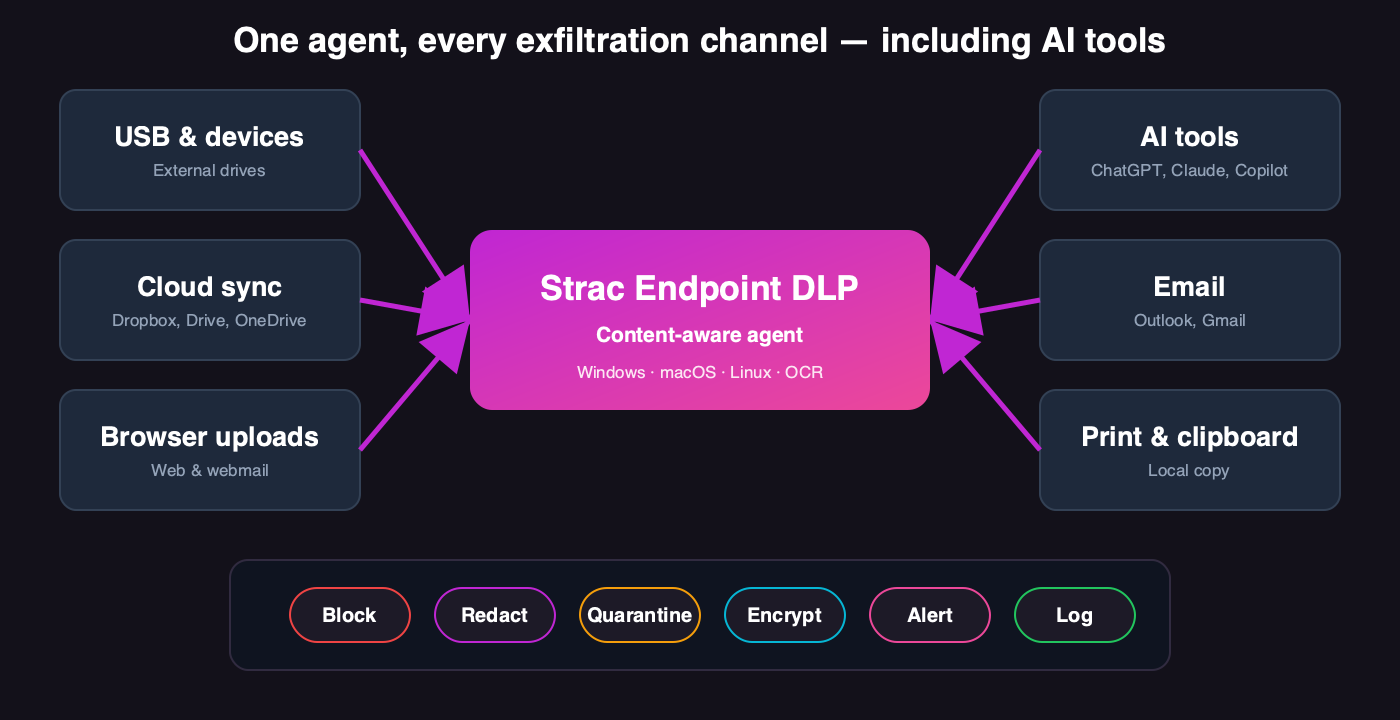
Insider risk ultimately shows up as data leaving through the device. Strac gives an insider-risk program the enforcement to match its analytics: it inspects each exit by content and coaches or stops the user in the moment — not a report after the data is gone.
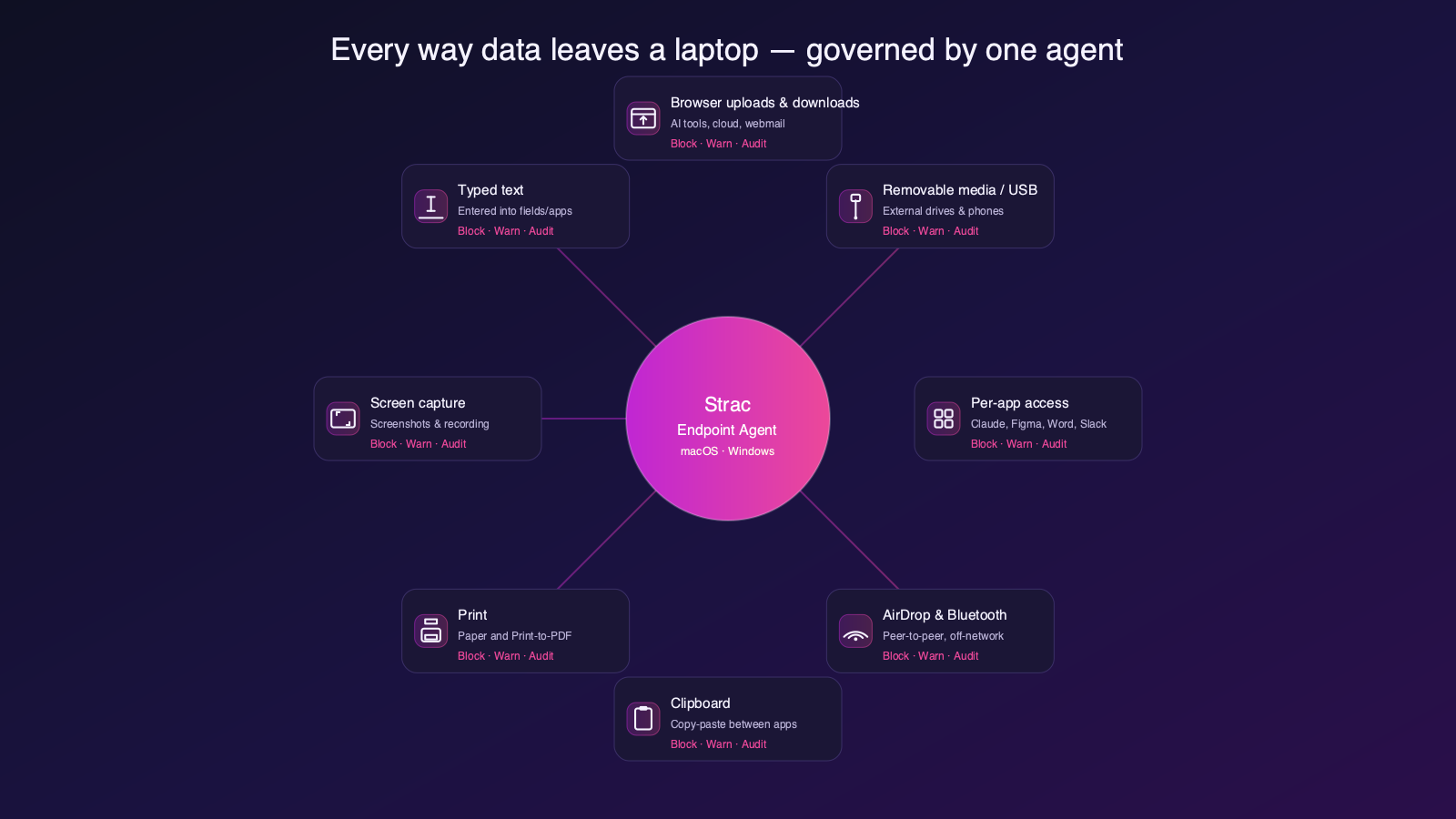
Every exit on a laptop, governed by one content-aware agent — Block, Warn, or Audit.
Cover the exits insiders actually use: USB, personal cloud, AirDrop, print, AI tools.
Warn mode coaches in real time and captures a justification; Block stops the highest-risk classes.
Audit everything for investigations, with data-class and destination context.
Block, Warn, or Audit — per data type, per channel. See the full eight-channel breakdown in the endpoint DLP agent guide.
Effective insider threat solutions combine two things: behavior analytics to spot risky people, and data controls to stop the actual leak. Most insider threat software and UEBA tools do the first well and the second barely — they alert on the behavior but do not stop the data from leaving.
The gap: UEBA tools flag anomalies; they rarely redact, block, or revoke the data movement itself.
Data-centric coverage: Strac watches the data an insider touches across SaaS, cloud, endpoint, and GenAI — and acts inline.
Discovery + real-time: a scan finds what an insider could reach; live controls stop misuse the moment it happens.
✨ What Is Insider Risk Management?
✨ Covering Every Surface an Insider Can Touch
An insider does not leak data from one place — they use whatever surface is in front of them. Insider threat solutions that only watch the endpoint, or only send alerts, miss most of the risk. Strac pairs a discovery scan with real-time enforcement on every surface an insider can reach.
Strac covering every surface an insider can touch, with detection and inline remediation.
Surface an insider uses
Discovery (what they can reach)
Real-time control
Action
SaaS apps
Scans data they can access or over-share
Inspects their uploads and shares
Redact, mask, delete, revoke sharing, alert
Cloud stores
Scans buckets and data at rest
Monitors their transfers
Redact, mask, quarantine, revoke access, alert
Endpoint & USB
Local disk scan
Watches file, USB, and print activity
Block, warn, encrypt, alert
GenAI (browser, endpoint, MCP)
Connector and prompt exposure scan
Inspects prompts and agent calls
Redact, block, warn, revoke, alert
Insider risk management is the practice of preventing sensitive data from leaving through the people who already have access to it — employees and contractors — whether the intent is malicious (a departing employee taking customer lists) or accidental (pasting a spreadsheet into an AI tool to summarize it). The insider does not need to break in; they are already inside. That makes insider risk fundamentally a data movement problem, and the endpoint is where most of that movement happens.
Insider risk is a data-movement problem: the channels an insider uses to move data out, and the controls that stop each one.
✨ The Channels Insiders Use
Channel
Example
Control
USB & devices
Copying a client database to a thumb drive before leaving
Content-aware device control
Personal cloud sync
Dragging files into personal Dropbox/Drive
Cloud-sync monitoring
AI tools
Pasting customer data into ChatGPT to draft an email
On-device AI redaction
Personal email & webmail
Emailing documents to a personal address
Upload & email monitoring
Screenshots & print
Capturing a screen of sensitive records
Content inspection with OCR
Two things stand out. First, most of these channels never touch the corporate network, so network monitoring misses them — the control has to live on the endpoint. Second, the newest channel, AI tools, is also the fastest-growing, because it feels harmless: an employee pasting a record into a chatbot to save time rarely thinks of it as exfiltration.
The redaction experience: sensitive data removed in place — the same remediation applied on the endpoint and across every connected app.
The Three Types of Insider Threat
Type
What it looks like
Example
Malicious insider
Deliberate theft or sabotage
A departing rep exporting the customer list to a personal drive
Negligent insider
Well-meaning but careless
Pasting a spreadsheet of PII into ChatGPT to summarize it
Compromised insider
Account taken over by an attacker
Stolen credentials used to exfiltrate data as a trusted user
The majority of real incidents are negligent, not malicious — and the negligent category is growing fastest because AI tools make careless data sharing feel productive. All three, though, share one signature: sensitive data moving somewhere it should not. That is what a program watches for.
✨ Warning Signs of Insider Risk
Insider risk rarely appears out of nowhere. The signals worth monitoring — focused on data, not on people’s behavior — include:
Unusual volumes of sensitive files copied to USB or personal cloud
Sensitive data pasted or uploaded into AI tools, especially on personal accounts
Bulk downloads from Salesforce, a database, or a file share
Documents emailed to personal addresses
Activity spikes in the notice period after a resignation
Every sensitive-data action logged with user, data class, and outcome — the visibility a program needs, focused on the data rather than surveilling the person.
🎥 Building an Insider Risk Management Program
A working program is five steps, in order:
Discover where sensitive data lives — across endpoints, SaaS, and cloud.
Set policy for what may leave, to where, and how — by data class, not blanket bans.
Enforce at every egress — USB, cloud sync, browser, AI tools, email — with content-aware controls.
Monitor and investigate with full data lineage, so an incident is a clear story, not a guess.
Prove it — log every event as evidence for SOC 2, HIPAA, PCI DSS, and GDPR.
Insider Risk and Compliance
Insider risk management is not just a security concern; it is a compliance requirement. SOC 2 (CC6.7) expects controls over the transmission and movement of sensitive data; HIPAA requires safeguards against unauthorized disclosure of PHI; PCI DSS mandates protection of cardholder data wherever it moves. A content-aware program that logs every enforcement action produces exactly the evidence these frameworks ask for — and, run through compliance automation, that evidence flows straight into your audit.
✨ How to Manage Insider Risk Without Surveilling Employees
Effective insider risk management is not about watching keystrokes or reading employees’ screens — that erodes trust and creates its own compliance problems. It is about watching the data: detecting when sensitive information is about to leave, and stopping that specific action while leaving normal work untouched.
Watch the data, not the person: the control acts on the sensitive transfer and leaves normal work untouched.
Detect at the point of egress — USB, cloud sync, browser, AI tools — with content inspection, not blanket blocks.
Redact or block the sensitive part, so the employee keeps working and the regulated data does not leave.
Log every event as evidence, mapped to SOC 2, HIPAA, PCI DSS, and GDPR — the audit trail an investigation needs.
Cover departure risk — the weeks around resignation are the highest-risk window for data theft.
Strac runs this from an endpoint DLP agent plus API-based coverage of your SaaS and cloud — watching data movement across the endpoint and the apps, and acting on the sensitive part only.
Insider risk spans every app your people touch — Strac watches data movement across 60+ integrations plus the endpoint, from one platform.
Insider Threat Software vs. UEBA Tools: Where Strac Fits
UEBA tools (user and entity behavior analytics) build a baseline of normal activity and flag deviations — a login at 3 a.m., a sudden bulk download, access to files outside someone's role. That signal is valuable, but on its own it is an alert, not a save. By the time a UEBA tool fires, the data may already be gone.
Strac complements insider threat software and UEBA tools with the layer they lack: data-centric enforcement. Where UEBA says "this person is behaving strangely," Strac says "this specific sensitive record cannot leave" — and redacts, blocks, or revokes it inline. Run them together and you get both the behavioral signal and the control that actually stops the loss.
Insider risk management is the practice of preventing data loss caused by people who already have legitimate access — employees and contractors — whether malicious or accidental. Because the insider is already authorized, the focus is on data movement: detecting when sensitive information is about to leave through USB, cloud sync, email, or AI tools, and stopping that specific action.
How is insider risk different from external threats?
External threats have to break in; insiders are already inside with valid credentials. That means access controls and perimeter defenses do not help — the person is permitted to open the data. Insider risk management instead watches what happens to the data after access: is it being copied to a drive, synced to personal cloud, or pasted into an AI tool it should never reach?
Does insider risk management require monitoring employees?
It should focus on data, not people. Effective insider risk management detects sensitive-data movement and acts on that specific event — it does not require logging keystrokes or reading screens, which harm trust and raise their own privacy and compliance issues. Watching the data rather than the person is both more effective and more defensible.
What is the biggest insider risk today?
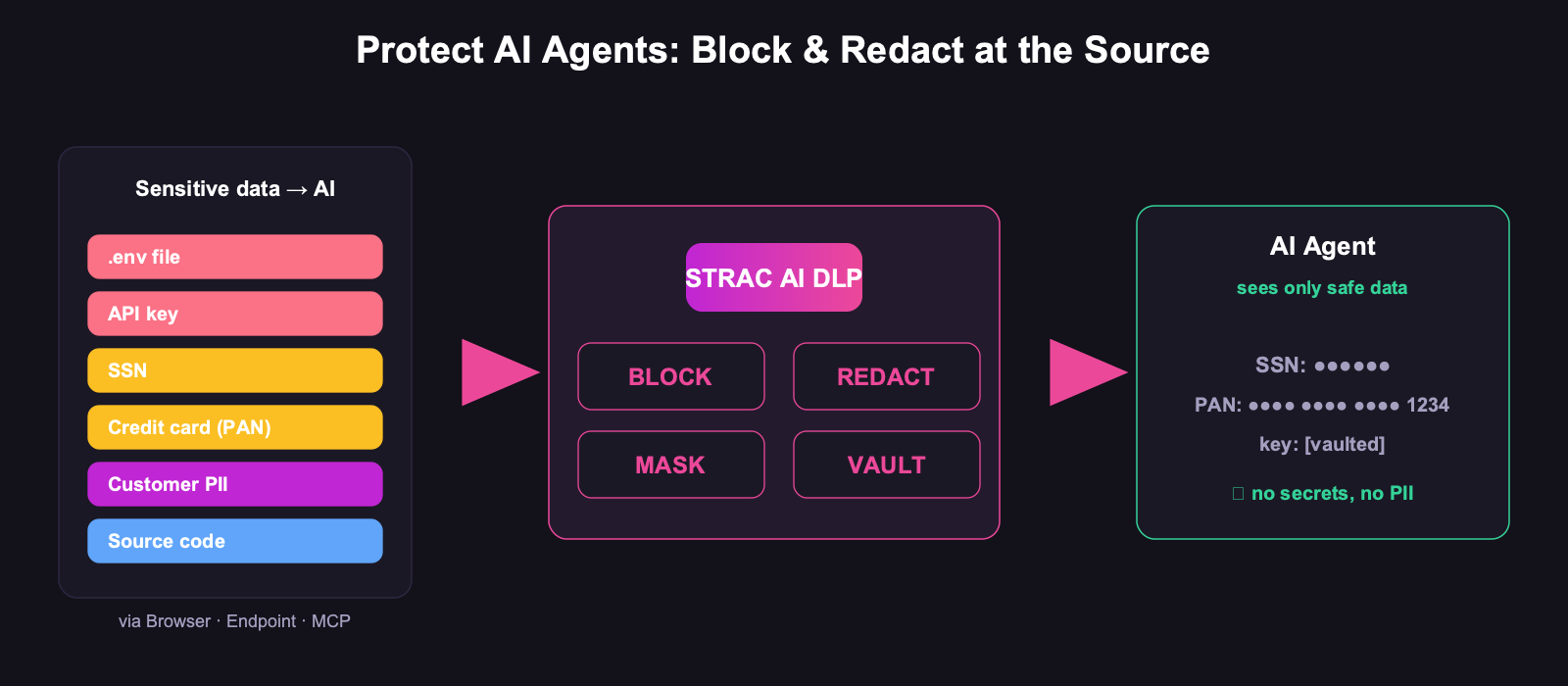
Accidental exposure through AI tools is the fastest-growing insider risk. Employees paste customer records, source code, and financial data into ChatGPT, Claude, and Copilot to work faster, rarely thinking of it as data exfiltration. Because it feels routine, it happens constantly — and it requires on-device detection to catch, since it often occurs on personal accounts. See shadow AI.
How do you stop data theft by departing employees?
The weeks around a resignation are the highest-risk window. Content-aware endpoint controls block sensitive files from being copied to USB, synced to personal cloud, or emailed to a personal address — and log every attempt as evidence. The key is that the control inspects content, so it stops the client database from leaving while letting the employee finish legitimate work.
What are the three types of insider threat?
Malicious insiders who deliberately steal or sabotage; negligent insiders who cause exposure through carelessness, such as pasting data into an AI tool; and compromised insiders whose accounts have been taken over by an attacker. Most real incidents are negligent, and that category is growing fastest as AI tools make careless data sharing feel routine and productive.
What are the warning signs of an insider threat?
Data-focused signals are the most reliable: unusual volumes of sensitive files copied to USB or personal cloud, sensitive data pasted into AI tools, bulk downloads from SaaS or databases, documents emailed to personal addresses, and activity spikes during a resignation notice period. Watching data movement is both more effective and more privacy-respecting than watching employee behavior.
How do you build an insider risk management program?
Five steps: discover where sensitive data lives across endpoints, SaaS, and cloud; set policy by data class rather than blanket bans; enforce at every egress channel with content-aware controls; monitor and investigate with data lineage; and log every action as compliance evidence. The enforcement layer is what turns a policy document into an actual control.
Is insider risk management a compliance requirement?
Effectively, yes. SOC 2 CC6.7 expects control over sensitive-data movement, HIPAA requires safeguards against unauthorized PHI disclosure, and PCI DSS mandates protection of cardholder data in motion. A program that enforces and logs data-movement controls produces the evidence these frameworks require.
Discover & Protect Data on SaaS, AI, MCP, Endpoints & Cloud
Strac provides end-to-end data loss prevention for all SaaS and Cloud apps. Integrate in under 10 minutes and experience the benefits of live DLP scanning, live redaction, and a fortified SaaS environment.


.webp)








.avif)




.gif)
