Data Flow Mapping: Trace Sensitive Data Across Your Systems
Data flow mapping traces how sensitive data moves through your organization - a core input to GDPR RoPAs, PCI scoping, and risk assessments. Why manual diagrams fail and how Strac discovers real data flows.
Data flow mapping traces how sensitive data moves into, through, and out of your organization — across systems, teams, and third parties.
It’s a core input to GDPR RoPAs, PCI DSS scoping, and security risk assessments, because you can’t protect a flow you can’t see.
Hand-drawn flow diagrams go stale fast and miss the flows nobody documented.
Strac discovers real data flows by scanning your systems, so your flow map reflects how data actually moves.
✨ What Is Data Flow Mapping?
Data flow mapping is the practice of documenting how sensitive data travels through your environment: where it enters (forms, APIs, uploads), where it’s stored and processed (apps, databases, warehouses), who it’s shared with (teams, vendors, sub-processors), and where it leaves (exports, integrations, cross-border transfers). A good data flow map answers a deceptively hard question — where does our sensitive data actually go? — which underpins nearly every privacy and security control.
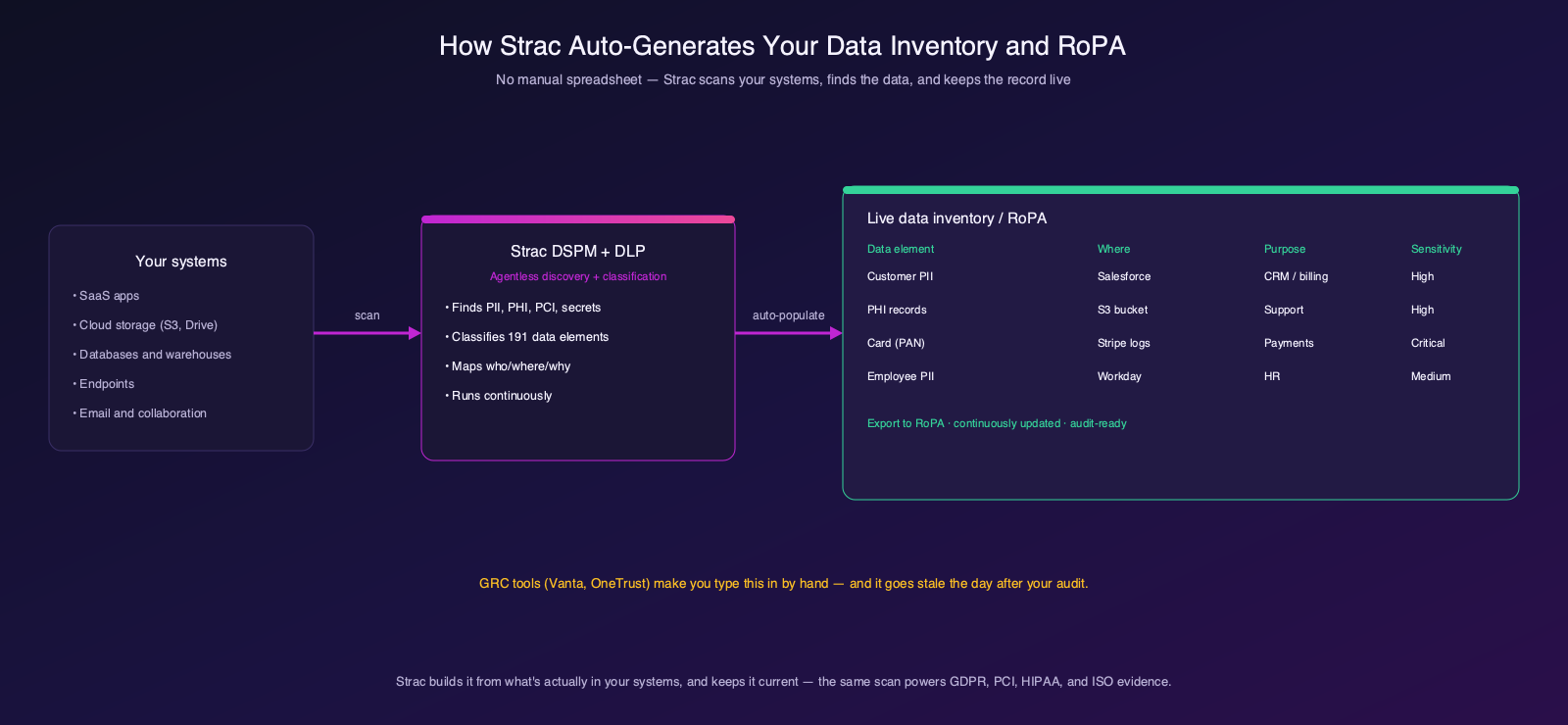
Data flow mapping done by discovery: Strac traces where sensitive data lives and moves across your systems.
Why Data Flow Mapping Matters for Compliance
Use case
Why the flow map is required
GDPR RoPA (Art. 30)
Documenting recipients, transfers, and cross-border flows of personal data
PCI DSS scoping
Tracing cardholder-data flows to define and reduce audit scope
Security risk assessment
Finding where sensitive data is exposed in transit or to third parties
Vendor / third-party risk
Knowing what data leaves to which sub-processors
Breach readiness
Understanding blast radius when an app or vendor is compromised
✨ Manual Flow Diagrams vs. Discovered Flows
Most data flow maps are drawn by hand in a diagramming tool during an audit, based on how people believe data moves. They’re useful as a starting point but share the weaknesses of any manual artifact: they miss undocumented integrations and shadow flows, and they don’t update when engineering ships a new pipeline. Discovery-based flow mapping — deriving the flows from actual scans of where data lives and moves — catches what the diagram misses.
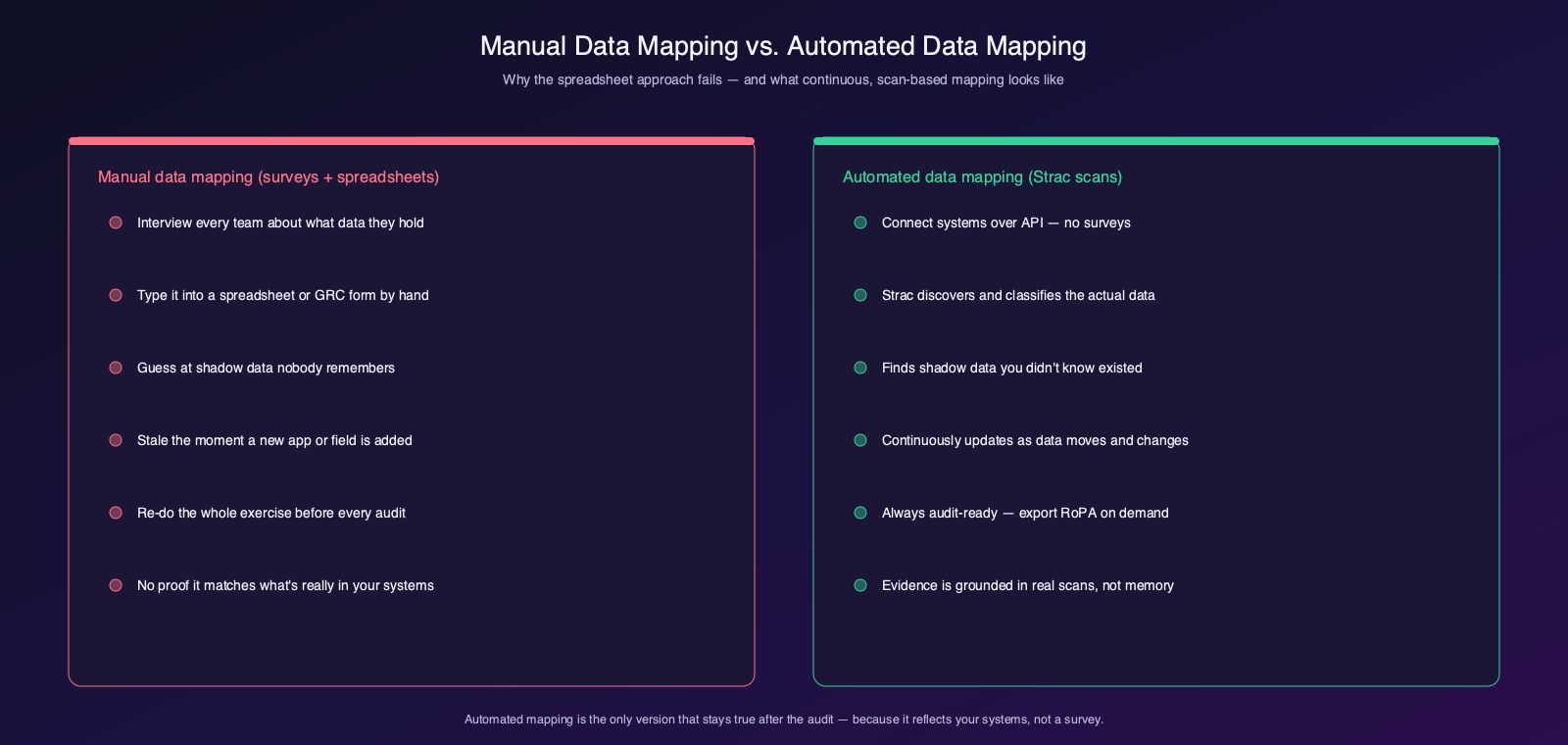
Hand-drawn flows reflect what people remember; discovered flows reflect what the systems actually do.
✨ How Strac Maps Data Flows
Because Strac discovers and classifies sensitive data across your SaaS, cloud, endpoints, and email, it can show where each data type lives and how it moves — the raw material of a data flow map — without a survey. That feeds directly into your data inventory and RoPA guide and your PCI scope. It also connects to GDPR data mapping for the GDPR-specific record. The result is a flow view grounded in your real environment, kept current as data moves.
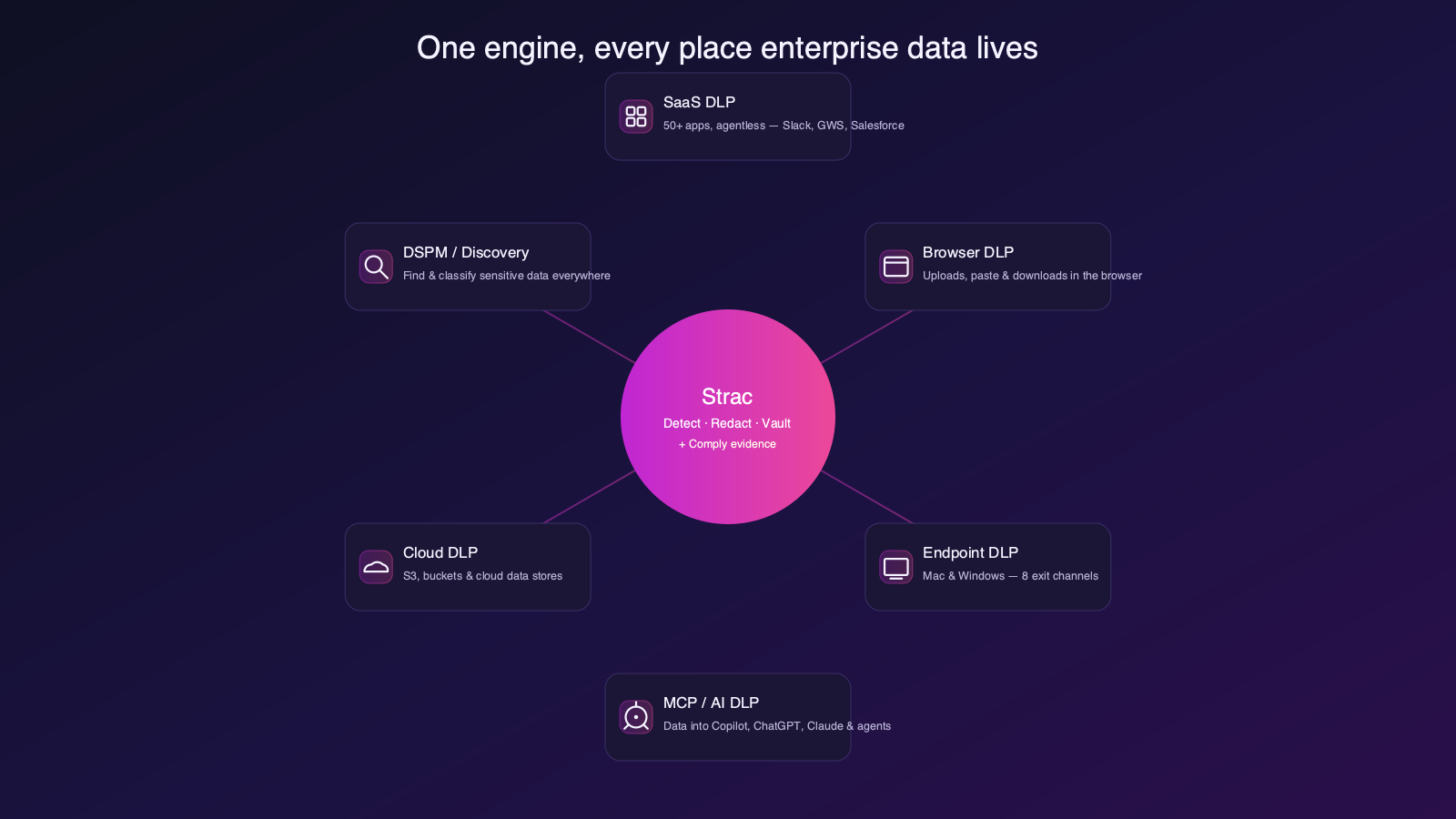
Strac sees sensitive data across every surface, so the flows it maps reflect your whole environment.
🌶️ Spicy FAQs on Data Flow Mapping
What is data flow mapping?
Data flow mapping traces how sensitive data moves into, through, and out of your organization - where it enters, where it’s stored and processed, who it’s shared with, and where it leaves. It underpins GDPR RoPAs, PCI scoping, and risk assessments.
How is data flow mapping different from data mapping?
Data mapping is the broad record of what data you hold and where; data flow mapping focuses specifically on the movement of that data between systems, teams, and third parties. Flow mapping is a key part of a complete data map.
Why is data flow mapping required for PCI DSS?
You can’t scope a PCI assessment without knowing where cardholder data flows. Mapping those flows defines which systems are in scope - and lets you reduce scope by eliminating unnecessary flows.
Can data flow mapping be automated?
Yes. Rather than hand-drawing diagrams, a DSPM/DLP platform like Strac discovers where sensitive data lives and moves and derives the flows from real scans, keeping the map current as systems change.
What’s the risk of an outdated data flow map?
An outdated map hides exposure - a new integration or vendor that moves sensitive data you didn’t account for. That’s a compliance gap and a breach blast-radius you can’t see.
You can’t protect a data flow you can’t see, and a hand-drawn diagram only shows the flows people remembered. Strac derives your data flows from real scans and keeps them current, feeding your RoPA, PCI scope, and risk assessments. Book a demo to map your data flows automatically.
What is data flow mapping?
Data flow mapping traces how sensitive data moves into, through, and out of your organization - where it enters, where it’s stored and processed, who it’s shared with, and where it leaves. It underpins GDPR RoPAs, PCI scoping, and risk assessments.
How is data flow mapping different from data mapping?
Data mapping is the broad record of what data you hold and where; data flow mapping focuses specifically on the movement of that data between systems, teams, and third parties. Flow mapping is a key part of a complete data map.
Why is data flow mapping required for PCI DSS?
You can’t scope a PCI assessment without knowing where cardholder data flows. Mapping those flows defines which systems are in scope - and lets you reduce scope by eliminating unnecessary flows.
Can data flow mapping be automated?
Yes. Rather than hand-drawing diagrams, a DSPM/DLP platform like Strac discovers where sensitive data lives and moves and derives the flows from real scans, keeping the map current as systems change.
What’s the risk of an outdated data flow map?
An outdated map hides exposure - a new integration or vendor that moves sensitive data you didn’t account for. That’s a compliance gap and a breach blast-radius you can’t see.
Discover & Protect Data on SaaS, AI, MCP, Endpoints & Cloud
Strac provides end-to-end data loss prevention for all SaaS and Cloud apps. Integrate in under 10 minutes and experience the benefits of live DLP scanning, live redaction, and a fortified SaaS environment.


.webp)






.avif)


.gif)
