A data inventory (or GDPR RoPA) records what sensitive data you hold, where, and why. What it must capture, why frameworks require it, and how Strac auto-generates it from real scans instead of manual spreadsheets.
A data inventory is a living record of what sensitive data your organization holds, where it lives, who can access it, and why — the foundation of GDPR, PCI DSS, HIPAA, and ISO 27001 compliance.
Under GDPR it takes a specific form: the Record of Processing Activities (RoPA) required by Article 30.
The usual way to build one — surveys and spreadsheets — is slow, incomplete, and stale the day after your audit.
Strac generates and continuously updates your data inventory from real scans of your systems, so the record reflects what you actually hold, not what someone remembered to write down.
✨ What Is a Data Inventory?
A data inventory (also called a data map or, under GDPR, a Record of Processing Activities) is a structured record of the sensitive and personal data your organization collects, processes, and stores. For each category of data it captures the essentials: what the data is, where it lives, how it got there, who has access, why you process it, and how long you keep it. It is the single artifact almost every privacy and security framework assumes you have — because you cannot protect, report on, or delete data you haven’t inventoried.
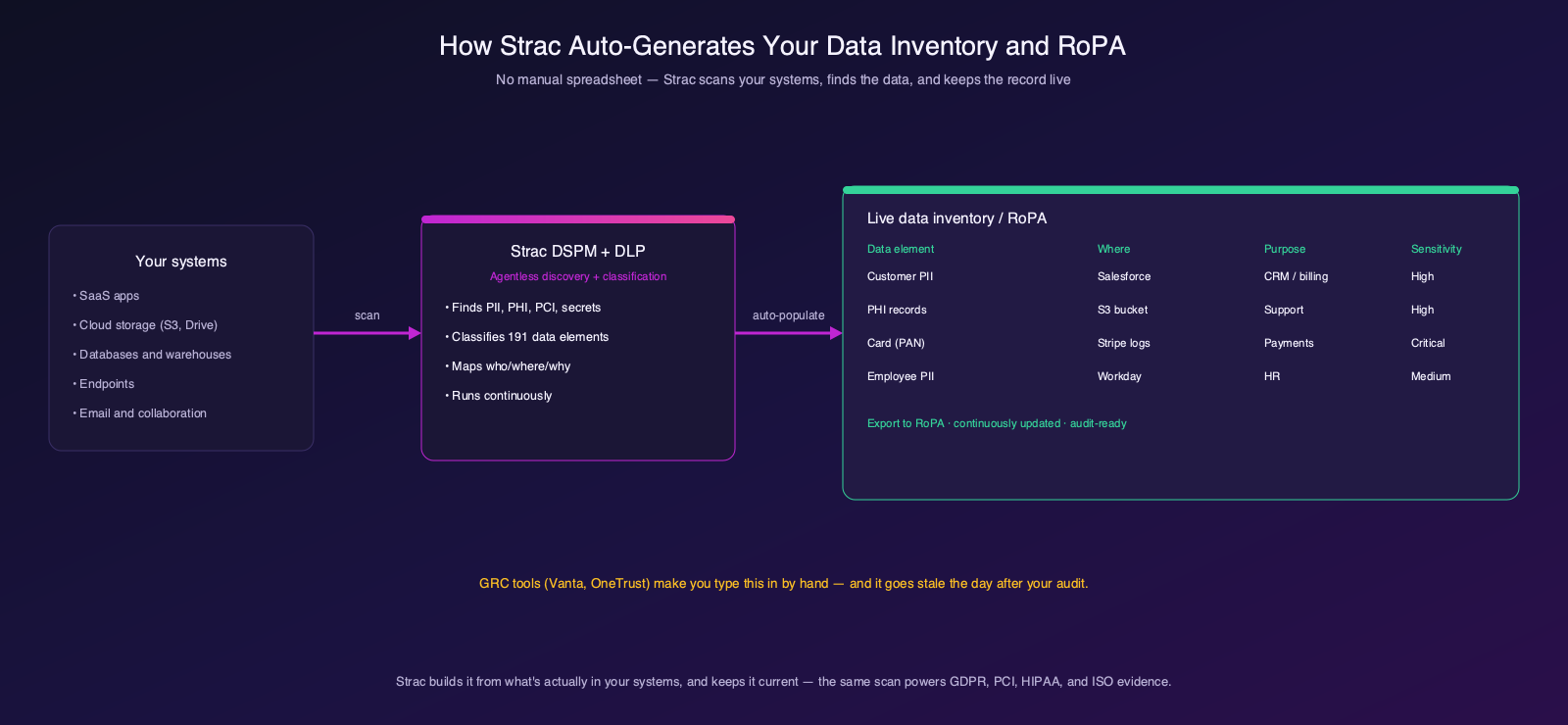
Strac auto-generates your data inventory and RoPA by scanning your systems — no manual spreadsheet, and it stays current.
Data Inventory vs. RoPA vs. Data Map
These terms overlap and are often used interchangeably, but there are useful distinctions:
Term
What it means
Data inventory
The general record of what sensitive data you hold and where — used across all frameworks.
Data map / data mapping
The process (and diagram) of tracing how data flows into, through, and out of your systems.
RoPA (Record of Processing Activities)
The specific inventory GDPR Article 30 requires, with defined fields (purposes, categories, recipients, retention, transfers).
If you handle EU personal data, your data inventory needs to satisfy the RoPA format. See our guide to GDPR data mapping for the GDPR-specific view, and the free RoPA template below.
What a Data Inventory Must Capture
A complete, audit-ready inventory records the following for each data category:
Field
Example
Data category / element
Customer PII, PHI, cardholder data (PAN), employee records, secrets
Location / system
Salesforce, an S3 bucket, a Postgres database, Google Drive
Purpose of processing
Billing, support, HR, analytics
Legal basis (GDPR)
Consent, contract, legitimate interest
Access / recipients
Which teams, roles, vendors, or sub-processors can see it
Sensitivity
Public, internal, confidential, restricted
Retention
How long it’s kept and when it’s deleted
Cross-border transfers
Whether it leaves its region, and under what safeguard
Why Frameworks Require a Data Inventory
It isn’t busywork — a data inventory is an explicit or implicit requirement across the major frameworks:
Framework
The requirement
GDPR
Article 30 — a Record of Processing Activities (RoPA) is mandatory for most organizations.
PCI DSS 4.0
Requirement 12.5.2 — maintain an inventory of system components and cardholder data flows / scope.
HIPAA
A data inventory underpins the required risk analysis of where ePHI is created, received, maintained, and transmitted.
ISO 27001
Control A.5.9 — an inventory of information and associated assets.
CCPA / US privacy laws
Knowing what personal information you collect and share to honor access and deletion rights.
✨ Why Manual Data Inventories Fail
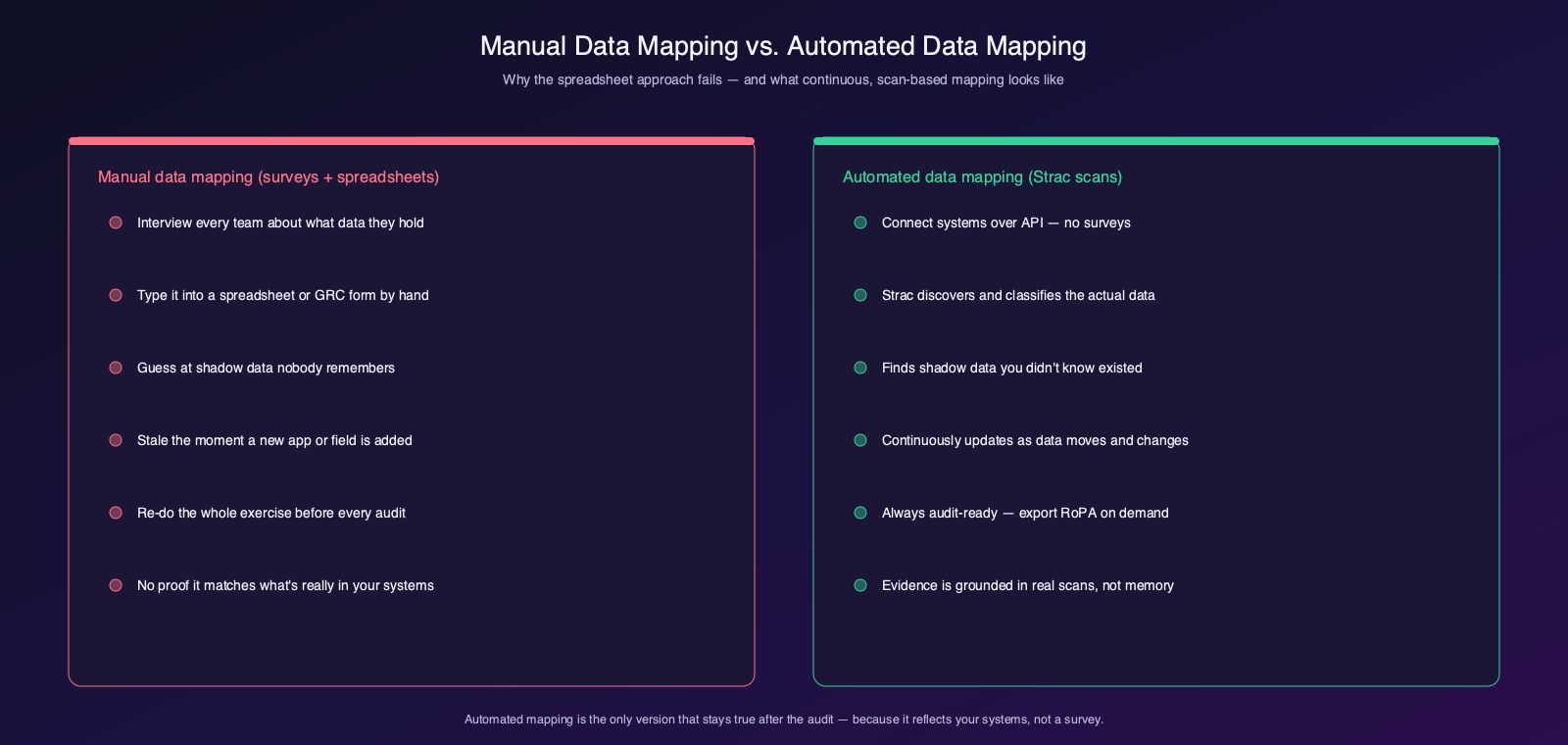
Most teams build the inventory the hard way: send a survey to every department, chase people for answers, and paste it into a spreadsheet or a GRC tool’s form. That approach has three fatal flaws — it’s incomplete (people forget shadow data and old systems), it’s stale immediately (a new app or field added next week isn’t in it), and it’s unverifiable (nothing proves the spreadsheet matches what’s actually in your systems). It becomes a fiction you refresh in a panic before each audit.
Manual data mapping is a survey that’s stale by the next sprint; automated mapping reflects what’s really in your systems.
✨ How Strac Auto-Generates Your Data Inventory
Strac takes the opposite approach: instead of asking people what data they have, it finds it. Strac connects to your SaaS, cloud, databases, endpoints, and email over API, then discovers and classifies the actual sensitive data — PII, PHI, cardholder data, and secrets across 191 data element types. It populates a live inventory with where each data type lives, who can access it, and how sensitive it is, and it keeps that record current as data moves. When an auditor asks for your RoPA or data map, you export it — grounded in real scans, not a survey. This is the same discovery that powers PII data discovery and DSPM.
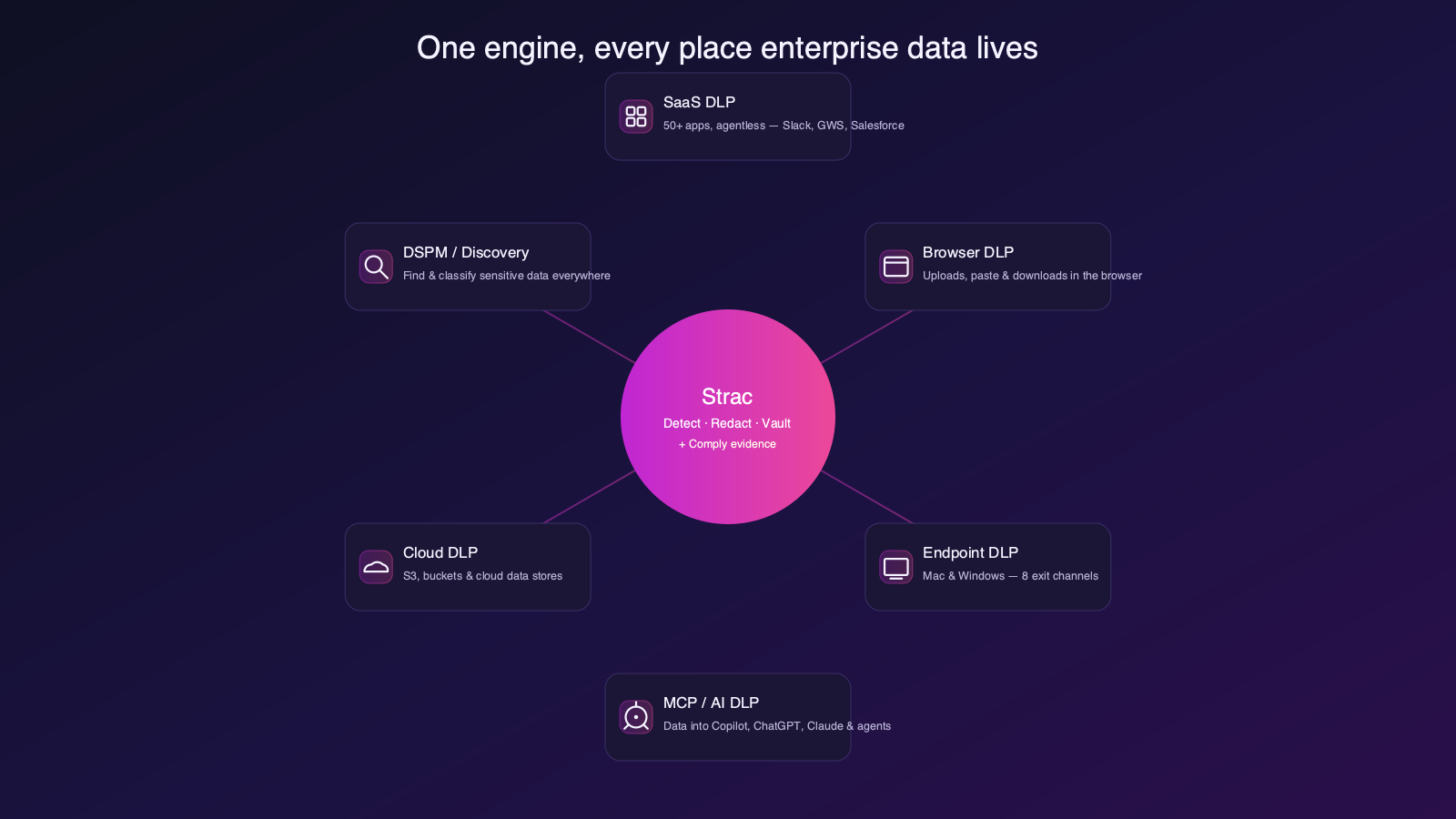
One Strac scan inventories sensitive data across SaaS, cloud, endpoint, email, browser, and AI — and feeds GDPR, PCI, HIPAA, and ISO evidence.
This is the difference between a GRC tool and Strac: GRC platforms give you a form to fill in; Strac gives you the data to fill it with — automatically. For the compliance layer that turns this inventory into audit-ready reporting, see GDPR compliance software.
How to Build a Data Inventory: Step by Step
Connect your data sources. SaaS, cloud storage, databases, endpoints, and email — over API where possible.
Discover and classify. Scan for PII, PHI, PCI, and secrets rather than surveying people.
Record the required fields. Location, purpose, access, sensitivity, retention, and transfers for each category.
Map the flows. Trace how data moves between systems and out to vendors/sub-processors.
Keep it live. Re-scan continuously so the inventory reflects reality, not a point-in-time survey.
Export for each framework. RoPA for GDPR, scope for PCI, ePHI inventory for HIPAA, asset inventory for ISO 27001.
🌶️ Spicy FAQs on Data Inventory
What is a data inventory?
A data inventory is a structured record of the sensitive and personal data your organization holds - what it is, where it lives, who can access it, why you process it, and how long you keep it. It’s the foundation of GDPR, PCI DSS, HIPAA, and ISO 27001 compliance.
Is a data inventory the same as a RoPA?
A RoPA (Record of Processing Activities) is the specific form of data inventory that GDPR Article 30 requires, with defined fields like purposes, categories, recipients, retention, and transfers. A data inventory is the broader concept used across all frameworks.
Is a data inventory required by GDPR?
Yes - GDPR Article 30 requires most organizations to maintain a Record of Processing Activities, which is a data inventory of personal data processing. PCI DSS, HIPAA, and ISO 27001 have equivalent inventory requirements.
Why do manual data inventories fail?
Because they’re built from surveys and spreadsheets: incomplete (people forget shadow data), stale the moment a new app or field is added, and unverifiable against what’s actually in your systems. Automated, scan-based inventories stay accurate.
How does Strac build a data inventory automatically?
Strac connects to your SaaS, cloud, databases, endpoints, and email, discovers and classifies the actual sensitive data across 191 data element types, and populates a live inventory with location, access, and sensitivity - then keeps it current and exports RoPA on demand.
A data inventory is the artifact every framework assumes you have — and the one almost everyone maintains by hand, badly. The fix isn’t a better spreadsheet; it’s discovery. Strac builds your data inventory and RoPA from real scans and keeps it live, so it’s accurate on any day an auditor asks. Book a demo to see your data inventory generated automatically.
What is a data inventory?
A data inventory is a structured record of the sensitive and personal data your organization holds - what it is, where it lives, who can access it, why you process it, and how long you keep it. It’s the foundation of GDPR, PCI DSS, HIPAA, and ISO 27001 compliance.
Is a data inventory the same as a RoPA?
A RoPA (Record of Processing Activities) is the specific form of data inventory that GDPR Article 30 requires, with defined fields like purposes, categories, recipients, retention, and transfers. A data inventory is the broader concept used across all frameworks.
Is a data inventory required by GDPR?
Yes - GDPR Article 30 requires most organizations to maintain a Record of Processing Activities, which is a data inventory of personal data processing. PCI DSS, HIPAA, and ISO 27001 have equivalent inventory requirements.
Why do manual data inventories fail?
Because they’re built from surveys and spreadsheets: incomplete (people forget shadow data), stale the moment a new app or field is added, and unverifiable against what’s actually in your systems. Automated, scan-based inventories stay accurate.
How does Strac build a data inventory automatically?
Strac connects to your SaaS, cloud, databases, endpoints, and email, discovers and classifies the actual sensitive data across 191 data element types, and populates a live inventory with location, access, and sensitivity - then keeps it current and exports RoPA on demand.
Discover & Protect Data on SaaS, AI, MCP, Endpoints & Cloud
Strac provides end-to-end data loss prevention for all SaaS and Cloud apps. Integrate in under 10 minutes and experience the benefits of live DLP scanning, live redaction, and a fortified SaaS environment.


.webp)






.avif)


.gif)
