PitchBook MCP Server: Secure Setup for Claude & AI Agents (2026)
The PitchBook MCP server lets Claude, Cursor, ChatGPT, and AI agents read and act inside PitchBook. Here's the official setup, the real security risks, and how to deploy it with DLP-grade redaction at the MCP layer.
The PitchBook MCP server is the path for AI agents (Claude, Cursor, ChatGPT, Perplexity, custom agents) to read and act inside PitchBook via the Model Context Protocol — covering companies, deals, funds, valuations, financials, comps, and LP data.
PitchBook does not publish an official MCP server. Strac provides a first-class PitchBook MCP server (built on the PitchBook API) that plugs into the Strac MCP gateway - or point the gateway at any PitchBook MCP server you run yourself. Connecting from Claude Desktop requires the Pro/Max/Team/Enterprise plan to add the connector.
The risk: every PitchBook MCP tool call returns the data the authorizing user can see. That data routinely contains PII, PHI, financial records, contracts, source code, secrets, and credentials. None of it is inspected before reaching the AI model's context window.
Strac PitchBook MCP DLP is the layer that closes the gap. Every tool call between the AI agent and PitchBook passes through Strac's MCP-layer inspection. Sensitive content is redacted, tokenized, pseudonymized, or vaulted before reaching the model. One control plane, full surface coverage, audit evidence per call mapped to SOC 2 / HIPAA / PCI / GDPR / EU AI Act / ISO 42001.
Setup is agentless and under 10 minutes per workspace. No application code changes, no agent SDK changes, no PitchBook re-permissioning.
✨ What Is the PitchBook MCP Server?
The PitchBook MCP server is a Model Context Protocol implementation that exposes PitchBook's API as a standardized set of tools to AI agents. Once connected, an agent like Claude can perform look up companies, deals, and funds, pull valuations and financials, and read comps and LP data on the authenticated user's behalf — turning PitchBook's API surface into AI-actionable capabilities.
PitchBook does not publish an official MCP server, so Strac runs a first-class PitchBook MCP server on top of the PitchBook API, and the Strac MCP gateway can equally front a PitchBook MCP server you host yourself. This is the industry-standard gateway pattern (the same shape as MintMCP and MCP Manager): one governance layer in front of any MCP source. The setup pattern is consistent: a custom connector in Claude (or another MCP-aware AI client) pointed at the Strac gateway, and tool calls start flowing through DLP.
From the user's perspective, the AI agent suddenly knows their PitchBook. From the security perspective, the AI agent now has read access — and often write access — to every record the user can touch in PitchBook.
That's the value. It's also where security teams need a control layer.
✨ The Real Security Risks of the PitchBook MCP Server
The risks fall into four categories that every healthcare, fintech, and enterprise security team should price into the deployment.
1. Financials, valuations, and comps get pulled raw. A PitchBook MCP call returns valuations, revenue, EBITDA, and comps straight into the model's context window.
2. LP and fund data is confidential. Fund commitments, LP names, and contacts are among the most sensitive records a firm holds, and MCP tools return them unfiltered.
3. Licensing and redistribution risk. PitchBook data is licensed. Piping it into a third-party model can breach redistribution terms as well as leak the data.
4. Broad search spans your whole watchlist. One agent query can reach every company and deal the user tracks, not just the target.
The traditional DLP a company already runs — at the network edge, on the file share, inside the SaaS-native rule engine — does not sit in the MCP path. The tool response goes straight from PitchBook into the AI agent's context window. That gap is where Strac PitchBook MCP DLP lives.
✨ Strac PitchBook MCP DLP — Production-Ready, With Built-In Redaction
Strac's PitchBook MCP DLP sits between AI agents and the PitchBook MCP server. Every tool call passes through Strac's MCP-layer inspection before content reaches the AI agent's context window. Sensitive content is redacted, tokenized, pseudonymized, or vaulted depending on policy. Non-sensitive content flows through untouched.
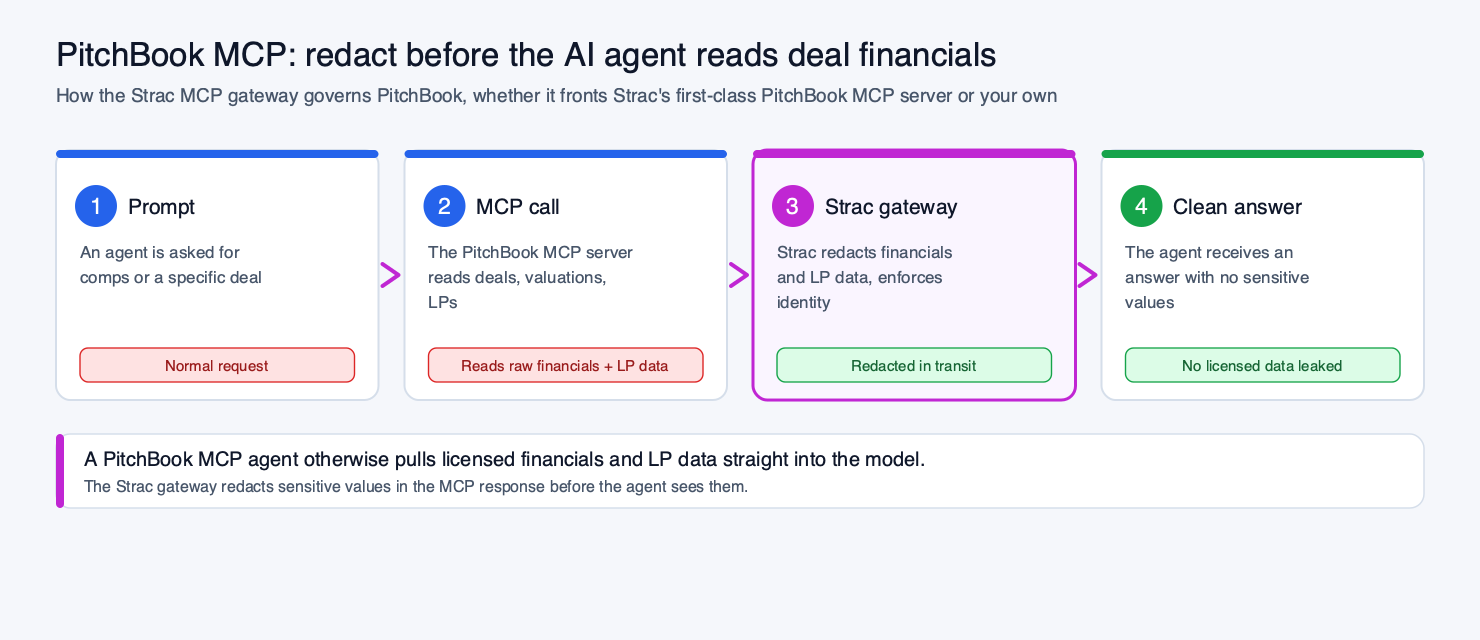
The Strac PitchBook MCP DLP gateway intercepts every tool call between any AI agent (Claude, Cursor, Cowork, ChatGPT, custom) and the PitchBook MCP server. PII, PHI, PCI, secrets, source code, and content inside images are redacted before the AI agent ever reads them.The full data flow: a user prompt triggers an AI agent tool call, the MCP server fetches from PitchBook, and the Strac DLP redaction engine strips SSNs, credit cards, emails, PHI, secrets, and source code before the redacted response ever reaches the model.
What this looks like in practice:
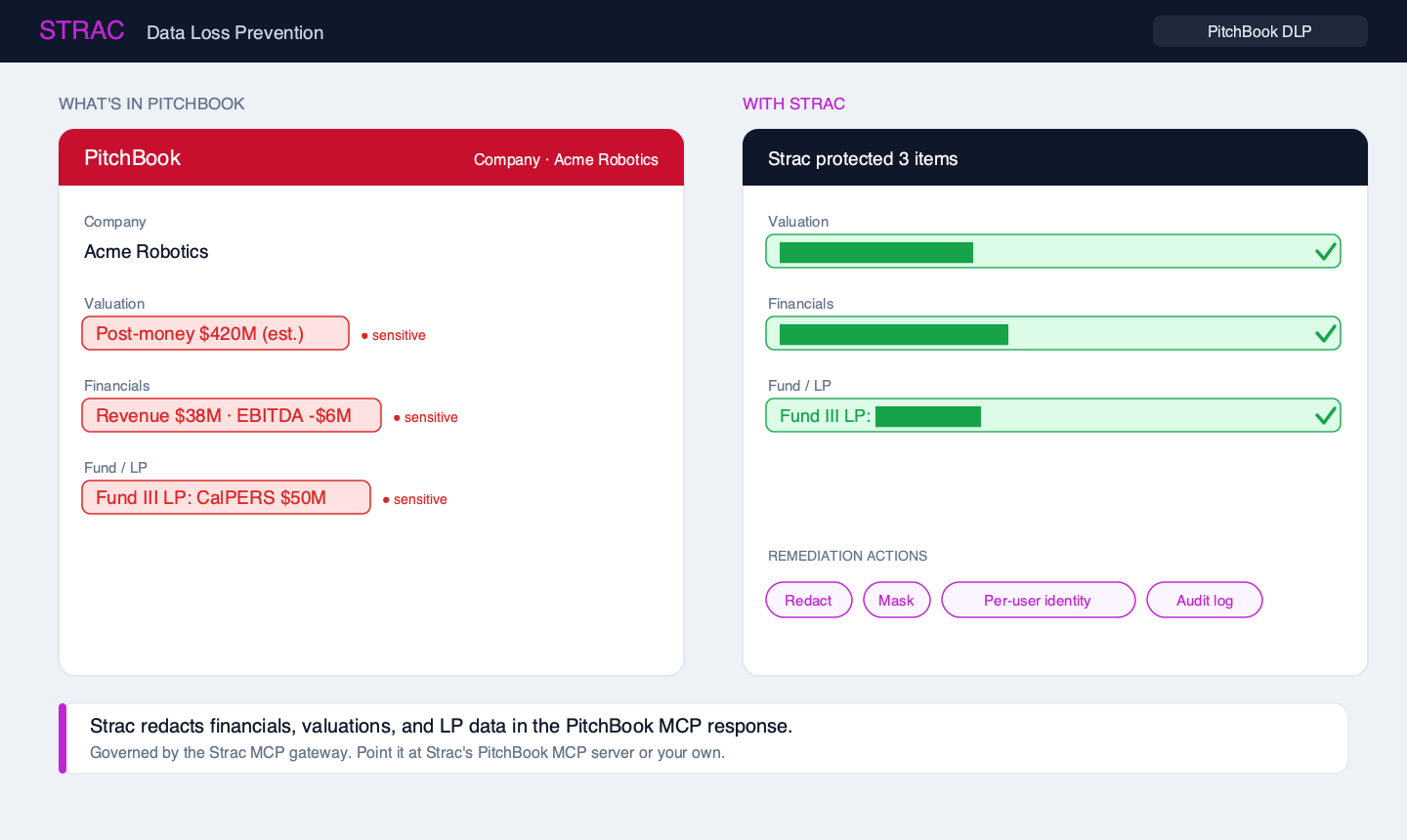
Read tools are filtered. When the agent calls a read tool, Strac inspects the returned payload, redacts SSNs / credit cards / emails / PHI / API keys / secrets / source code inline, and passes the clean payload to the agent. The agent still does its job; the regulated data never enters the model context.
Write tools are guardrailed. When the agent invokes a write/post/create tool with content that contains sensitive data, Strac inspects the outgoing payload and either redacts, vaults, or blocks depending on the channel and the data type.
Files, attachments, images, and documents are inspected at depth. PDFs, DOCX, XLSX, ZIPs, and image attachments are parsed with the same OCR and document-parser pipeline Strac uses across its DLP product line. Sensitive content inside screenshots and scanned PDFs is found and redacted.
Every invocation is logged. AI client, user, tool name, resource accessed, data classes detected, redactions applied, vault references, disposition. The log is the SOC 2 / HIPAA / PCI / GDPR audit evidence — produced automatically.
Policy is contextual. Different resources, different policies. Strac maps to your existing data classification, not an MCP-specific silo.
The same Strac MCP DLP layer covers Claude Cowork, Slack MCP, and other surfaces — one control plane across every place AI agents touch your regulated data.
✨ Strac PitchBook DLP on the Human Path — The Companion to MCP DLP
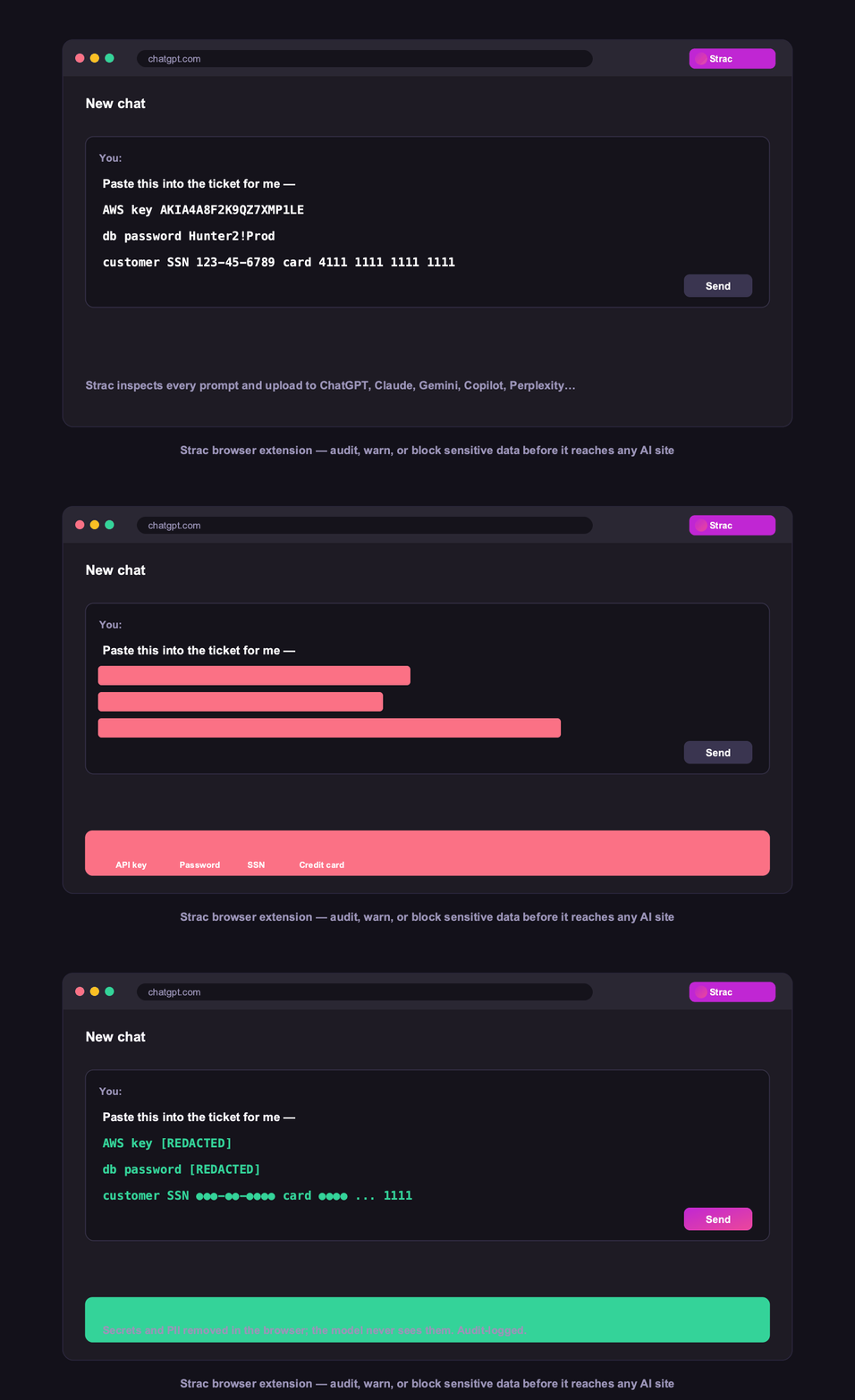
MCP DLP protects the AI-agent surface. Strac's browser and endpoint DLP protects the direct-user surface — the same PitchBook workspace, but inspected at the point where humans share, upload, send, and grant access. Most enterprises run both: native DLP for the user-driven actions, MCP DLP for the agent-driven actions. Together they cover every path regulated data can take in and out of PitchBook.
Strac's browser DLP blocking sensitive data on the human path, the companion to gateway-governed agent access
What Strac's native PitchBook DLP includes:
Real-time detection of sensitive data as users work in the PitchBook web app, via the browser extension and endpoint agent
Block or warn at the point of paste, upload, and export, so regulated data does not leave through a personal device
Detection of financials, valuations, and LP data across records and exports
Per-user identity enforcement, so an agent only ever retrieves what the underlying user is permitted to see
Audit logs of every detection and every agent tool call, mapped to SOC 2 CC6 and GDPR Art. 5/32
For the broader integration catalog — every SaaS, cloud, browser, and endpoint surface Strac covers — see strac.io/integrations.
✨ See Strac MCP DLP in Action
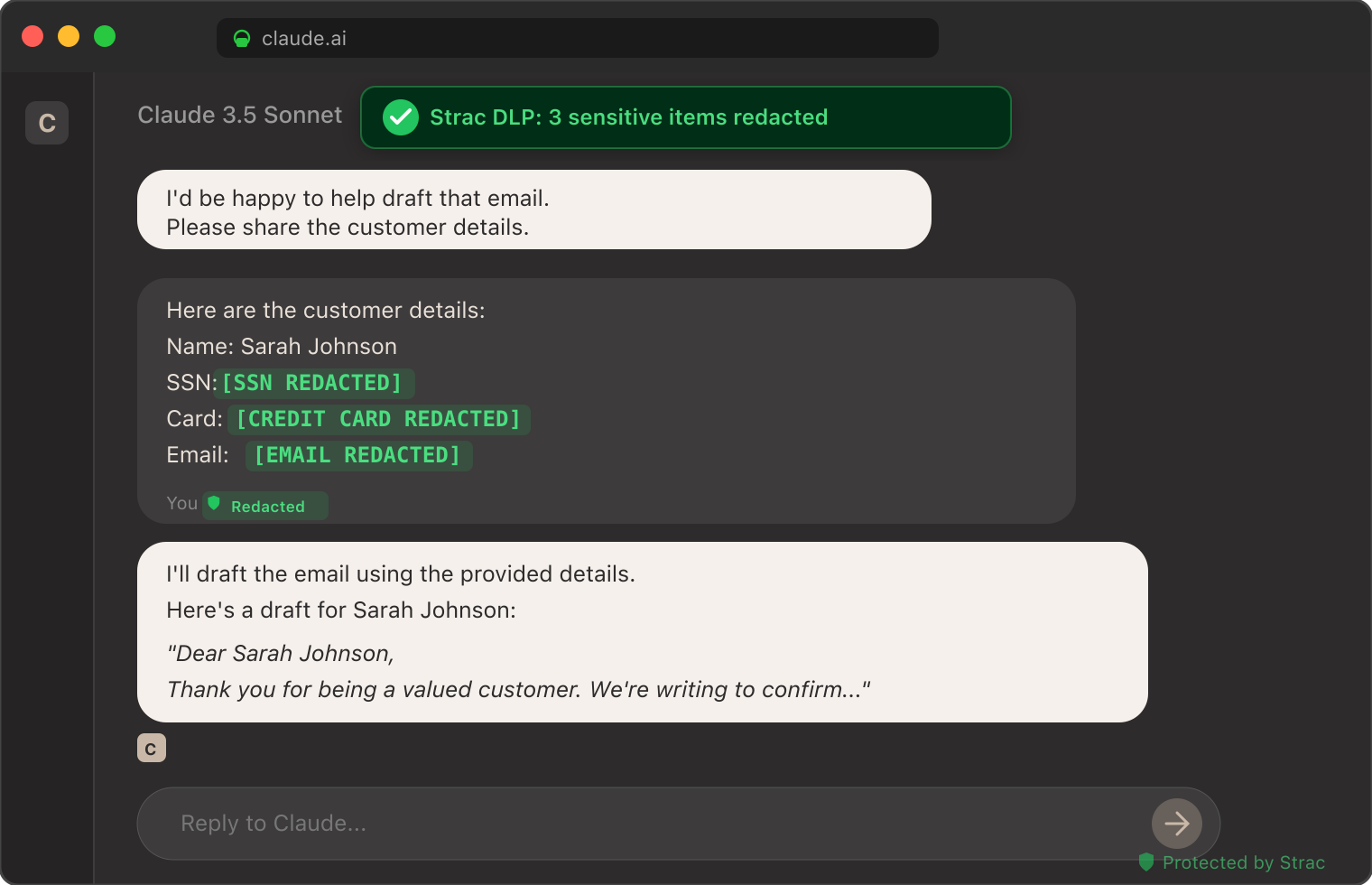
The screenshot below shows Strac's MCP DLP redacting sensitive data from a real Claude session — patient identifiers, customer emails, and credit card numbers tokenized inline before the model received the prompt. The same inspection pattern runs on every PitchBook MCP tool call routed through Strac.
Strac DLP at work inside a Claude conversation: sensitive elements tokenized inline before the model sees them. The same pattern runs at the MCP layer for every PitchBook tool call.
How to Set Up Strac PitchBook MCP DLP
Setup is agentless and takes under 10 minutes.
Authorize Strac with your PitchBook tenant via OAuth. Strac requests the read/write scopes for the products you want covered. Honors PitchBook's permission model — Strac only sees what the authorizing user/bot can see.
Configure the MCP proxy endpoint. Strac issues an MCP server endpoint that drops into your AI client's MCP configuration. For Claude Desktop:
json
   "mcpServers": {
     "pitchbook": {
       "url": "https://mcp.strac.io/pitchbook",
       "auth": { "type": "bearer", "token": "<your-strac-token>" }
     }
   }
For Cursor, OpenAI Agents, custom agents — same endpoint, same auth.
Pick your policy. Out-of-the-box templates for SOC 2, HIPAA, PCI, GDPR. Custom policies (resource-level, data-class-level, action-level) take minutes to configure.
Done. Every MCP tool call between your agent and PitchBook now flows through Strac. No application code changes. No agent code changes. The audit log starts populating immediately.
✨ Compliance Coverage Out of the Box
The same Strac PitchBook MCP DLP control produces evidence mapped to every major compliance framework.
Framework
What Strac PitchBook MCP DLP Satisfies
SOC 2
CC6.6 (unauthorized data exposure), CC6.7 (restricted transmission of data to external systems), CC7.2 (monitoring for anomalies including AI usage)
The PitchBook MCP server is a Model Context Protocol implementation that lets AI agents (Claude, Cursor, ChatGPT, Perplexity, custom agents) read and act inside PitchBook via standardized tool calls. It's how an AI assistant gets contextual access to companies, deals, funds, valuations, financials, comps, and LP data.
Is the PitchBook MCP server safe to use with sensitive data?
By itself, no — not without an additional DLP layer. The PitchBook MCP server honors the authorizing user's permissions but returns whatever that user can see, including PII, PHI, credentials, source code, and other regulated content. For enterprise use with regulated data, you need an MCP-layer DLP control like Strac PitchBook MCP DLP that inspects and redacts every tool response before content reaches the AI model.
How is Strac PitchBook MCP DLP different from PitchBook's built-in protections?
PitchBook's built-in protections operate at the storage and policy layer — sensitivity labels, retention policies, native DLP rules at posting/sharing time. None of those sit in the MCP tool-call path by default. Strac is purpose-built for the MCP layer: it inspects every tool response before content reaches the AI agent's context window, with detection breadth (PII / PHI / PCI / secrets / source code / OCR-in-images) that goes well beyond most native rule engines.
Does Strac PitchBook MCP DLP work with Claude, Cursor, ChatGPT, Cowork, and custom agents?
Yes. Strac exposes a standard MCP endpoint, so any MCP-aware AI client routes tool calls through it with one configuration change. No SDK changes, no application code changes.
What sensitive data types does Strac detect in PitchBook MCP tool responses?
PII (SSN, driver's license, passport, address, phone, email), PHI (clinical notes, MRN co-occurrence, ICD-10 codes adjacent to identifiers, lab values), PCI (full and partial card numbers via Luhn check), credentials (API keys, AWS / GCP / Azure access keys, OAuth tokens, JWTs, SSH keys, private keys — 48+ patterns), proprietary content (M&A keywords, source code fingerprints), and custom detectors trained on your internal data classifications. Detection runs across text, files, images (OCR), and structured fields.
How long does Strac PitchBook MCP DLP take to deploy?
Under 10 minutes for the first workspace. OAuth Strac into PitchBook, paste the Strac MCP endpoint into your AI client's config, pick a policy template, done. No agents to install, no PitchBook re-permissioning, no application code changes.
Where does redacted data go — is it stored?
Redacted content is replaced inline in the tool response. Optionally, sensitive content can be vaulted — replaced with a short-lived retrieval link that only authorized users can resolve, so the original data is retrievable for legitimate use without ever entering the AI context. Vaulted data is stored encrypted at rest in your Strac tenant; you control retention.
Can I see what an AI agent did in my PitchBook workspace?
Yes. Strac produces a per-call audit log: timestamp, AI client identity, user, tool invoked, resource accessed, data classes detected, redactions applied, vault references, disposition. The log is queryable in the Strac console and exportable to your SIEM. This is the evidence trail SOC 2, HIPAA, PCI, and GDPR auditors will ask about for AI-agent activity in PitchBook.
The Bottom Line
The PitchBook MCP server is rapidly becoming the way AI agents read into PitchBook. That surface contains every category of regulated and proprietary data your organization has. Running PitchBook MCP in 2026 without an MCP-layer DLP control is not a question of if the first incident reaches your security team; it's when.
Strac PitchBook MCP DLP gives you the protection layer, the audit evidence, and the framework-agnostic compliance coverage so you can let your team use PitchBook with Claude, Cursor, Cowork, ChatGPT, and any future AI client without making each one a separate security exception.
If you are running — or about to run — PitchBook MCP in production, book a 30-minute demo. We'll walk through the architecture, the policy templates, and a deployment plan for your specific PitchBook workspace and AI clients.
The PitchBook MCP server is a Model Context Protocol implementation that lets AI agents (Claude, Cursor, ChatGPT, Perplexity, custom agents) read and act inside PitchBook via standardized tool calls. It's how an AI assistant gets contextual access to companies, deals, funds, valuations, financials, comps, and LP data.
Is the PitchBook MCP server safe to use with sensitive data?
By itself, no — not without an additional DLP layer. The PitchBook MCP server honors the authorizing user's permissions but returns whatever that user can see, including PII, PHI, credentials, source code, and other regulated content. For enterprise use with regulated data, you need an MCP-layer DLP control like Strac PitchBook MCP DLP that inspects and redacts every tool response before content reaches the AI model.
How is Strac PitchBook MCP DLP different from PitchBook's built-in protections?
PitchBook's built-in protections operate at the storage and policy layer — sensitivity labels, retention policies, native DLP rules at posting/sharing time. None of those sit in the MCP tool-call path by default. Strac is purpose-built for the MCP layer: it inspects every tool response before content reaches the AI agent's context window, with detection breadth (PII / PHI / PCI / secrets / source code / OCR-in-images) that goes well beyond most native rule engines.
Does Strac PitchBook MCP DLP work with Claude, Cursor, ChatGPT, Cowork, and custom agents?
Yes. Strac exposes a standard MCP endpoint, so any MCP-aware AI client routes tool calls through it with one configuration change. No SDK changes, no application code changes.
What sensitive data types does Strac detect in PitchBook MCP tool responses?
PII (SSN, driver's license, passport, address, phone, email), PHI (clinical notes, MRN co-occurrence, ICD-10 codes adjacent to identifiers, lab values), PCI (full and partial card numbers via Luhn check), credentials (API keys, AWS / GCP / Azure access keys, OAuth tokens, JWTs, SSH keys, private keys — 48+ patterns), proprietary content (M&A keywords, source code fingerprints), and custom detectors trained on your internal data classifications. Detection runs across text, files, images (OCR), and structured fields.
Discover & Protect Data on SaaS, AI, MCP, Endpoints & Cloud
Strac provides end-to-end data loss prevention for all SaaS and Cloud apps. Integrate in under 10 minutes and experience the benefits of live DLP scanning, live redaction, and a fortified SaaS environment.


.webp)





.avif)



.gif)
