SOC 2 Compliance: The Complete 2026 Guide for Security-Led Teams
SOC 2 compliance explained for 2026: Trust Services Criteria, Type I vs Type II, controls, cost, timeline, and how to automate evidence collection with Strac Comply.
SOC 2 (Service Organization Control 2) is an audit report defined by the AICPA that evaluates how a service organization manages customer data across five Trust Services Criteria: Security, Availability, Confidentiality, Processing Integrity, and Privacy. Only Security is mandatory.
The audit comes in two flavors: Type I (controls designed correctly at a point in time) and Type II (controls operating effectively over 3-12 months). Enterprise buyers expect Type II.
A typical SOC 2 Type II program runs 3-12 months end-to-end. Cost ranges $15K-$75K in audit fees, plus internal time and tooling.
The work breaks into four phases: scope, gap remediation, observation window, audit. Most teams burn the most time on evidence collection — and that's exactly the part compliance automation platforms solve.
Strac Comply is the AI-native compliance automation platform built for security-led teams. SOC 2 evidence is auto-collected from your live systems (cloud, SaaS, endpoint), continuously monitored, and mapped to each control — with the bonus that the same Strac platform protecting your data is generating the evidence. Start at comply.strac.io →
Skip ahead. If you already know what SOC 2 is and just need a path to compliance, Strac Comply is the AI-native compliance automation platform that combines continuous data security with continuous compliance evidence — SOC 2, HIPAA, ISO 27001, GDPR, and PCI DSS in one control plane. Start at comply.strac.io →
✨ What Is SOC 2 Compliance?
SOC 2 (System and Organization Controls 2) is an audit framework defined by the American Institute of Certified Public Accountants (AICPA) that evaluates how a service organization protects customer data. Unlike SOC 1 (which focuses on financial reporting controls), SOC 2 evaluates a service organization's security and operational controls against the AICPA's Trust Services Criteria.
A SOC 2 audit is performed by a licensed CPA firm. The auditor reviews your control design and operation, then issues an attestation report. That report is what enterprise customers ask for before they sign with you.
SOC 2 is not a certification — there is no "SOC 2 certificate." It is an attestation report that says, in the auditor's professional opinion, your controls met the criteria during the audit period. Vendors and customers commonly say "SOC 2 certified" colloquially; the formally correct term is "SOC 2 attested" or "received a clean SOC 2 report."
✨ The Five Trust Services Criteria (TSC)
SOC 2 audits evaluate controls across up to five Trust Services Criteria:
Criterion
What it covers
Required?
Security (Common Criteria)
Protection against unauthorized access (physical and logical), system compromise, and data theft
Mandatory for every SOC 2
Availability
System uptime, disaster recovery, business continuity
Optional
Confidentiality
Protection of confidential information (NDAs, contracts, proprietary data)
Optional
Processing Integrity
System processing is complete, valid, accurate, timely, and authorized
Optional
Privacy
Personal information collection, use, retention, disclosure aligned with the organization's privacy notice
Optional
Most SaaS companies start with Security only (Type II) — that's the baseline enterprise customers ask for. Healthcare and fintech often add Confidentiality and Availability as well. Companies handling consumer data may add Privacy to cover GDPR / CCPA alignment.
For a full breakdown of the criteria with the underlying Common Criteria (CC1-CC9), see our guide to the SOC 2 Trust Services Criteria.
✨ SOC 2 Type I vs Type II — Which Audit Do You Need?
Attribute
Type I
Type II
What it tests
Control design at a point in time
Control operating effectiveness over time
Observation window
A single date (snapshot)
3-12 months (typically 6 or 12)
Audit duration
4-6 weeks
Window + 4-6 weeks of fieldwork
Cost (audit fees)
$15K-$40K
$25K-$75K
What enterprise customers want
Acceptable for early-stage startups
Expected by mid-market and enterprise
Validity
One year
One year (most teams renew annually)
The rule of thumb: Type I is the trainer-wheels audit you do to learn the process and signal intent. Type II is the audit that closes enterprise deals. Most companies do Type I once (or skip it entirely) and then move to a continuous Type II cadence.
See our dedicated guide to SOC 2 Type II for the deep-dive on the observation window, evidence requirements, and what auditors look for.
✨ SOC 2 Controls — What Auditors Actually Examine
SOC 2 controls are organized by Common Criteria (CC) and per-criterion criteria. The Security TSC alone has 9 Common Criteria categories (CC1-CC9) with 60+ underlying control points. A summary:
CC1 — Control Environment: Governance, board oversight, code of conduct.
CC2 — Communication and Information: Internal/external communication of security objectives.
CC3 — Risk Assessment: How you identify and treat risk.
CC4 — Monitoring Activities: Internal audit, control monitoring.
CC5 — Control Activities: Policies, procedures, control implementation.
CC6 — Logical and Physical Access Controls: Access management, authentication, encryption. The largest section by control count.
CC7 — System Operations: Vulnerability management, incident response, monitoring.
CC8 — Change Management: Production change controls.
CC9 — Risk Mitigation: Business continuity, vendor risk.
For the complete enumeration of controls under each Common Criterion, see SOC 2 controls.
The Security controls auditors most commonly drill into:
Multi-factor authentication on every privileged access (CC6.1)
Encryption at rest and in transit (CC6.7)
Logging and monitoring with retention (CC7.2-7.3)
Vulnerability management and patching cadence (CC7.1)
Incident response playbook + actual tabletop runs (CC7.4-7.5)
Change management with peer review and approval (CC8.1)
Vendor security review for every third party (CC9.2)
Data loss prevention across SaaS, cloud, endpoint (CC6.6, CC6.7)
That last bullet is where Strac's DLP integration with Strac Comply becomes uniquely valuable — Strac's data protection IS the audit evidence for CC6.6 and CC6.7.
✨ How Long Does SOC 2 Take?
A realistic timeline for a first-time SOC 2 Type II at a 50-200 person company:
Total: 6-18 months end-to-end for a first audit. Renewal audits compress to the observation window + 6-8 weeks.
Companies that use Strac Comply from day one routinely compress the gap remediation phase from 3 months to 4-6 weeks, because the platform auto-collects evidence from systems you already run.
✨ How Much Does SOC 2 Cost?
The total cost has three components:
Auditor fees: $25K-$75K for Type II at most SaaS companies (more for larger orgs or multiple TSCs).
Compliance automation platform: $10K-$50K/year — Strac Comply, Drata, Secureframe, Sprinto, or others. See our SOC 2 compliance software comparison.
Internal time: Realistically 2-4 weeks of one full-time engineer's time during gap remediation, plus 1-2 weeks during audit fieldwork. At loaded cost that's $20K-$50K.
Total first-year cost: $55K-$175K. Annual renewal: $40K-$100K.
The biggest variables are auditor selection (boutique CPA firms run cheaper than Big 4), scope (more TSCs = more cost), and how mature your controls are going in (more gaps = more remediation = more time).
For a deeper look at SOC 2 audit pricing patterns, see SOC 2 cost.
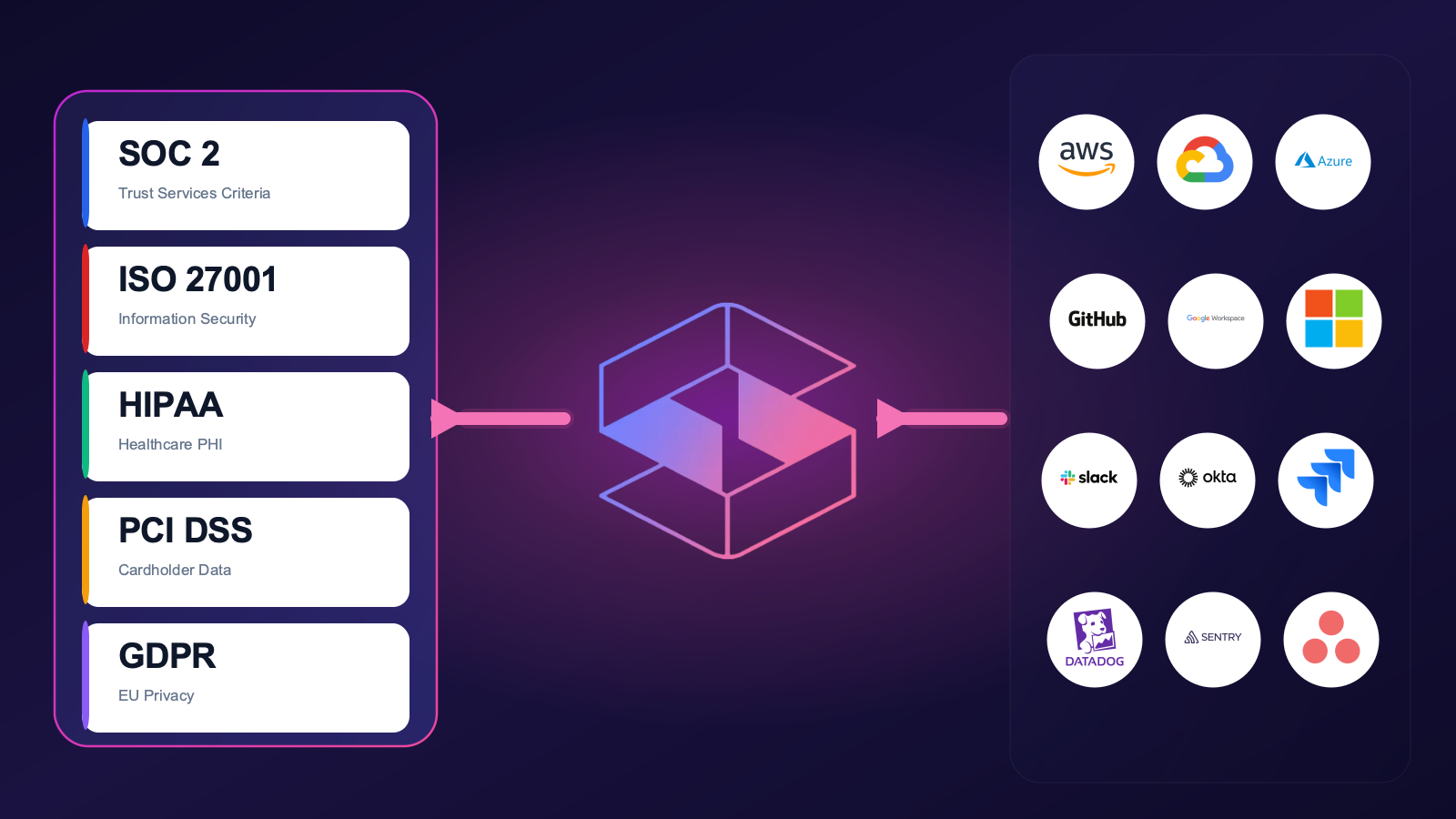
Strac Comply — one platform covering SOC 2, ISO 27001, HIPAA, PCI DSS, and GDPR from a single evidence stream
✨ How Strac Comply Handles SOC 2
Strac Comply is the AI-native compliance automation platform that takes a security-led team from "we should be SOC 2 compliant" to "we have a clean Type II report" with less internal time than any platform in the market.
What makes Strac Comply uniquely useful for SOC 2:
DLP is the evidence. Strac is the only compliance platform that ships with a continuous data security product (Strac DLP, Strac DSPM) at the same time. Your CC6.6 (data classification) and CC6.7 (encryption + DLP) controls are auto-evidenced because the same product is protecting the data.
AI-native, not retrofitted. Built post-LLM, the platform uses AI to map your evidence to the right control, draft policies tailored to your tech stack, and surface gaps before the auditor finds them.
Continuous monitoring across SaaS, cloud, endpoint. Strac pulls evidence directly from your AWS, GCP, Azure, GitHub, Google Workspace, M365, Slack, Jira, and 50+ other systems — the same integrations Strac uses for data security.
MCP-aware compliance. AI agents reading your SaaS via Model Context Protocol (MCP) are a new compliance surface in 2026. Strac Comply maps MCP tool-call audit logs to SOC 2 CC6.1 and CC7.2 automatically.
Pre-built mappings to every framework. SOC 2, HIPAA, ISO 27001, PCI DSS, GDPR, CCPA, EU AI Act, ISO 42001. One platform, every framework.
[ ] Define scope. Which TSCs? Which systems? Which entity?
[ ] Pick your auditor. Get quotes from 3 CPA firms. Confirm they've audited orgs at your stage.
[ ] Deploy compliance automation.Strac Comply or another platform. Without it, evidence collection takes 4-10x longer.
[ ] Write your policies. Information security, access control, change management, incident response, business continuity, vendor management. (Strac Comply auto-drafts most of these from a 10-minute questionnaire.)
[ ] Implement missing controls. MFA on every privileged access, encryption at rest + transit, logging with retention, vulnerability scanning, formal change management.
[ ] Run a tabletop incident response exercise. Document it.
[ ] Complete vendor security reviews for every critical third party.
[ ] Run a readiness assessment. Either the auditor's pre-engagement readiness or an internal gap analysis using your compliance platform.
[ ] Set the observation window in coordination with the auditor.
[ ] Train the team. Every employee should be able to answer basic security questions the auditor may pose.
For the deeper version with control-level cross-references, see SOC 2 checklist.
✨ Common SOC 2 Mistakes
The most common reasons SOC 2 programs go sideways:
Scoping the system too broadly. Every system in scope means more controls, more evidence, more audit hours. Start with what customers actually ask about.
Treating it as a one-time project. SOC 2 Type II demands continuous operation. Companies that compliance-theater pass Type I and then let controls lapse fail Type II.
Manual evidence collection. Screenshots in Google Drive don't scale. By month 6 of the observation window the engineering team has lost a quarter.
Choosing the cheapest auditor. Cheap auditors are often inexperienced auditors. Their qualifications matter when an enterprise customer reviews your report.
Picking the wrong compliance platform. Most platforms are pure compliance automation — they don't ship the underlying data security. That means you buy compliance automation AND DLP AND DSPM separately. Strac Comply ships them as one platform.
✨ SOC 2 for Specific Industries
SaaS: Type II with Security TSC is table stakes for selling above $50K ACV. See SOC 2 for SaaS.
Healthcare: SOC 2 doesn't replace HIPAA — you need both. See SOC 2 vs HIPAA.
Fintech: Type II with Security + Availability + Processing Integrity. PCI DSS often overlaps; see PCI compliance.
AI/ML: SOC 2 + ISO 42001 + EU AI Act readiness. Strac Comply covers all three.
Ready to start SOC 2 with Strac Comply?
Strac Comply is the AI-native compliance automation platform built for security-led teams. SOC 2, HIPAA, ISO 27001, GDPR, PCI DSS — with continuous DLP-grade evidence across every SaaS, cloud, and AI surface. The same Strac platform that protects your data is the platform that proves your compliance.
Technically no — SOC 2 is an attestation report issued by a licensed CPA firm, not a certification from a standards body. Colloquially, people say "SOC 2 certified," but the formal language is "received a SOC 2 attestation report" or "clean SOC 2 report." The distinction matters in formal procurement documents.
How long does SOC 2 take?
For a first Type II at a 50-200 person company, expect 6-18 months end-to-end. The bulk is the observation window (3-12 months) plus 4-6 weeks of auditor fieldwork. Companies on Strac Comply typically compress the gap-remediation phase from 3 months to 4-6 weeks because evidence collection is automated.
How much does SOC 2 cost?
Auditor fees: $25K-$75K for Type II. Compliance platform: $10K-$50K/year. Internal engineering time: $20K-$50K loaded cost. Total first-year: $55K-$175K. Renewal audits drop to $40K-$100K because the observation period rolls forward and the heavy gap-remediation work is done.
Do I need Type I before Type II?
No. Many companies skip Type I entirely and go straight to Type II once their controls are stable. Type I is useful if you need to show enterprise customers a SOC 2 report quickly (before your Type II observation window finishes), but it's not a prerequisite.
What's the difference between SOC 2 and ISO 27001?
SOC 2 is a US-focused attestation report (AICPA framework). ISO 27001 is an international certification (ISO standard). The two overlap on most security controls but evidence requirements differ. Enterprise buyers often want one or the other depending on geography. See SOC 2 vs ISO 27001.
Can a single platform handle SOC 2 + HIPAA + ISO 27001?
Yes — that's exactly what compliance automation platforms are built for. Strac Comply maps each piece of evidence to every applicable framework simultaneously, so the same control evidence covers SOC 2 CC6.7 + HIPAA §164.312(a)(2)(iv) + ISO 27001 Annex A.10.
How is Strac Comply different from Drata, Secureframe, or Sprinto?
The unique angle: Strac is the only compliance automation platform that ships with a continuous data security product (Strac DLP, Strac DSPM). For SOC 2 CC6.6 and CC6.7 (the data protection controls), other platforms send you to integrate a DLP separately. Strac Comply uses Strac DLP's continuous data evidence as the audit input directly. One platform, one vendor, one bill, full SOC 2 coverage. For the broader comparison see our SOC 2 compliance software guide.
What about AI — does SOC 2 cover AI-related controls?
SOC 2 doesn't have explicit AI clauses, but the Trust Services Criteria apply to any system processing customer data — including LLMs, MCP-connected AI agents, and AI-driven workflows. In 2026 auditors increasingly probe AI controls: how is data minimized before reaching the model, how is the model context audited, how is sensitive data redacted in agent tool calls. Strac Comply maps AI agent audit logs (via Strac's MCP DLP) to SOC 2 CC6.1, CC6.6, and CC7.2.
Who chooses the auditor — us or the customer?
You choose. The auditor must be an independent CPA firm licensed to perform SOC 2 audits. Enterprise customers occasionally require an audit by a "Big 4" firm (Deloitte, PwC, EY, KPMG); most accept reputable boutique CPA firms.
How does SOC 2 interact with vendor risk reviews?
Most enterprise customers will accept your SOC 2 Type II report in lieu of a custom security questionnaire (or as the primary evidence for one). That's the practical business value: one audit, many customer reviews satisfied. Strac Comply's trust center lets you share the report securely with customers.
The Bottom Line
SOC 2 is the security attestation enterprise customers ask for before they sign. Type II is what they actually want. The audit itself is straightforward; the work is in continuous control operation and evidence collection. Strac Comply is the compliance automation platform built for security-led teams — the only one that ships with continuous data security as part of the same platform.
Technically no — SOC 2 is an attestation report issued by a licensed CPA firm, not a certification from a standards body. Colloquially, people say "SOC 2 certified," but the formal language is "received a SOC 2 attestation report" or "clean SOC 2 report." The distinction matters in formal procurement documents.
How long does SOC 2 take?
For a first Type II at a 50-200 person company, expect 6-18 months end-to-end. The bulk is the observation window (3-12 months) plus 4-6 weeks of auditor fieldwork. Companies on Strac Comply typically compress the gap-remediation phase from 3 months to 4-6 weeks because evidence collection is automated.
How much does SOC 2 cost?
Auditor fees: $25K-$75K for Type II. Compliance platform: $10K-$50K/year. Internal engineering time: $20K-$50K loaded cost. Total first-year: $55K-$175K. Renewal audits drop to $40K-$100K because the observation period rolls forward and the heavy gap-remediation work is done.
Do I need Type I before Type II?
No. Many companies skip Type I entirely and go straight to Type II once their controls are stable. Type I is useful if you need to show enterprise customers a SOC 2 report quickly (before your Type II observation window finishes), but it's not a prerequisite.
What's the difference between SOC 2 and ISO 27001?
SOC 2 is a US-focused attestation report (AICPA framework). ISO 27001 is an international certification (ISO standard). The two overlap on most security controls but evidence requirements differ. Enterprise buyers often want one or the other depending on geography. See SOC 2 vs ISO 27001.
Discover & Protect Data on SaaS, AI, MCP, Endpoints & Cloud
Strac provides end-to-end data loss prevention for all SaaS and Cloud apps. Integrate in under 10 minutes and experience the benefits of live DLP scanning, live redaction, and a fortified SaaS environment.


.webp)




.avif)




.gif)
