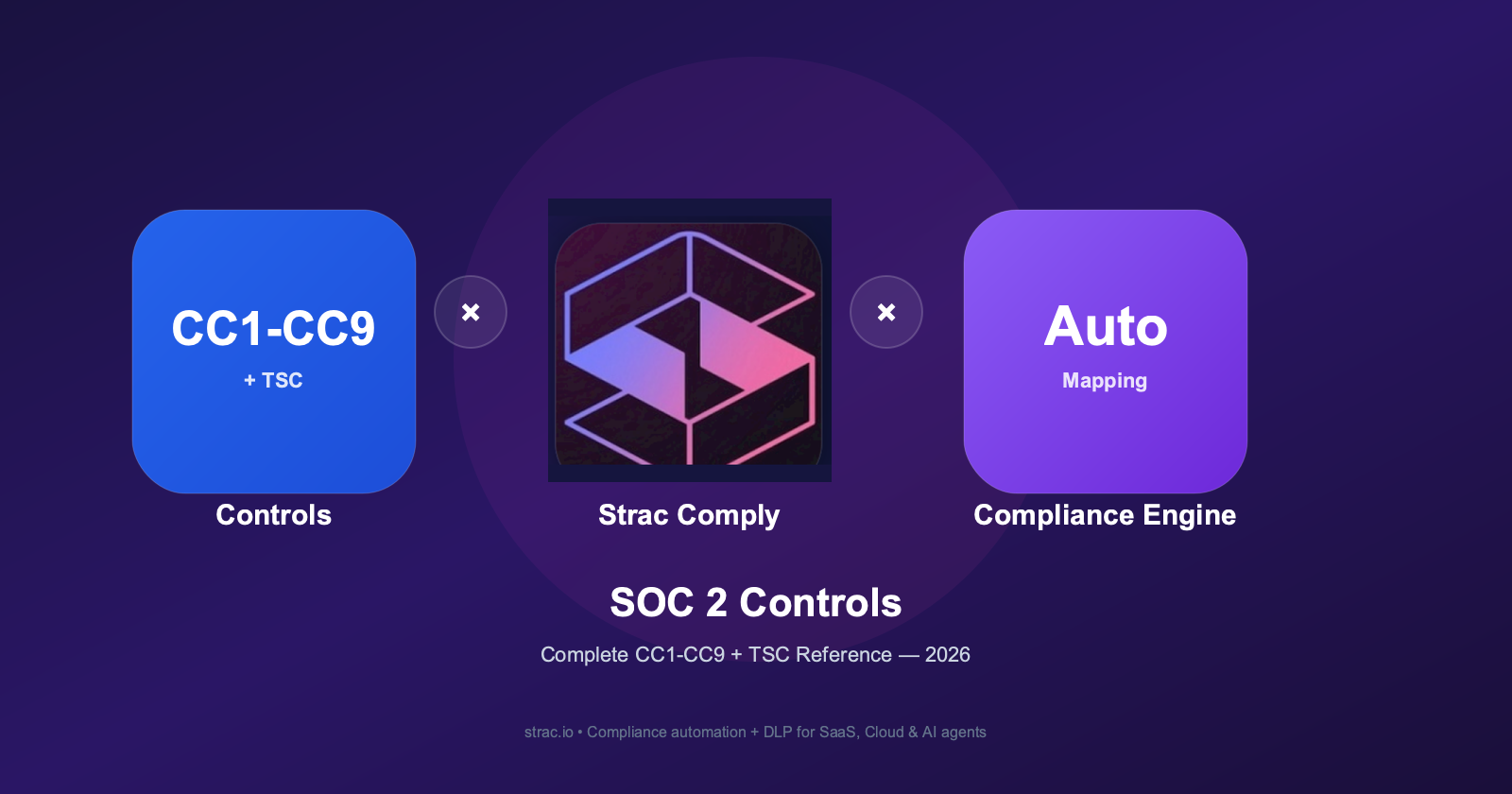
SOC 2 Controls: The Complete 2026 Reference (CC1-CC9 + A, C, PI, P Criteria)
The complete SOC 2 controls reference for 2026: every Common Criterion (CC1-CC9) plus Availability, Confidentiality, Processing Integrity, and Privacy controls, with evidence examples.
SOC 2 controls are organized by Trust Services Criteria (TSC): Security has 9 Common Criteria (CC1-CC9) totaling ~64 underlying control points. Availability adds 3, Confidentiality adds 2, Processing Integrity adds 5, Privacy adds 18.
Auditors evaluate each control on design (does it exist and is it appropriate?) and operating effectiveness (does it work consistently over the observation period?).
The two highest-leverage Common Criteria for security-led teams: CC6 (Logical and Physical Access Controls — 8 control points, the largest section) and CC7 (System Operations — 5 control points, includes incident response and vulnerability management).
Strac Comply maps every piece of live system evidence (cloud config, SaaS audit logs, endpoint posture, DLP events, MCP tool calls) to each SOC 2 control automatically. The same data security platform that protects your environment generates the control evidence.
Looking for SOC 2 control automation?Strac Comply auto-maps live evidence from your cloud, SaaS, endpoints, and AI surfaces to each SOC 2 control — with Strac\'s DLP product providing the underlying data-protection evidence directly. One platform, every framework. Start at comply.strac.io →
✨ How SOC 2 Controls Are Structured
The AICPA's 2017 Trust Services Criteria (the version current auditors use) organizes controls into:
Common Criteria (CC1-CC9): The Security TSC. All SOC 2 audits cover these regardless of which optional TSCs you include.
Availability (A1): 3 control points covering system uptime, disaster recovery, business continuity.
Confidentiality (C1): 2 control points covering protection of confidential information.
Privacy (P1-P8): 18 control points aligned to OECD privacy principles — notice, choice, consent, collection, use, retention, access, disclosure, monitoring.
Each control point has one or more Points of Focus — suggested implementation guidance the auditor uses to evaluate sufficiency. Points of Focus are not mandatory; they inform professional judgment.
✨ CC1 — Control Environment
The foundation. Auditors confirm leadership commitment to security and ethical conduct.
Control
What it covers
Common evidence
CC1.1
Demonstrates commitment to integrity and ethical values
CC6.6 and CC6.7 are where Strac Comply uniquely differentiates — Strac DLP's continuous data classification and redaction across SaaS/cloud/endpoint/AI surfaces produces the audit evidence directly. Most compliance platforms send you to integrate a separate DLP; Strac Comply ships with the DLP product.
✨ CC7 — System Operations
Day-to-day operational security.
Control
What it covers
Typical implementation
CC7.1
Vulnerability identification and remediation
Vulnerability scanning, patch management, SLAs by severity
CC7.2
Anomaly and event monitoring
SIEM, security alerting, on-call rotation
CC7.3
Evaluation and reporting of security events
Incident triage, escalation playbook
CC7.4
Incident response procedures
Documented IR plan, runbooks, tabletop exercises
CC7.5
Recovery from incidents and breaches
Recovery playbook, post-incident review
✨ CC8 — Change Management
Production change controls.
Control
What it covers
CC8.1
Authorized changes to system components
Common evidence: peer-reviewed pull requests, change tickets, deployment automation logs, infrastructure-as-code repositories with approval gates.
✨ CC9 — Risk Mitigation
Business continuity and third-party risk.
Control
What it covers
CC9.1
Business continuity and disaster recovery
CC9.2
Vendor and business-partner risk management
Common evidence: BC/DR plan with tabletop exercise records, vendor security review process with documented assessments per critical vendor.
C1.1 — Identification and protection of confidential information
C1.2 — Disposal of confidential information
Processing Integrity (PI1)
PI1.1 — Definitions of processing objectives
PI1.2 — System inputs are complete, accurate, valid
PI1.3 — System processing is accurate, complete, timely, authorized
PI1.4 — Outputs are complete, accurate, timely
PI1.5 — Stored data remains complete, accurate, available
Privacy (P1-P8)
18 control points aligned to the OECD privacy principles, covering notice (P1), choice and consent (P2), collection (P3), use and retention (P4), access (P5), disclosure (P6), quality (P7), and monitoring (P8). Privacy is the longest optional criterion and requires the most policy documentation.
Every control in CC1-CC9 maps to live evidence Strac Comply already collects from your stack — cloud, IdP, code, and SaaS
✨ How Strac Comply Maps Evidence to Every Control
Strac Comply is the AI-native compliance automation platform built for security-led teams. The platform watches your live systems and auto-maps the right evidence to each SOC 2 control.
Where Strac Comply uniquely covers controls competitors don't:
CC6.6 + CC6.7 (data protection): Strac DLP\'s continuous data classification, OCR inspection on files, and inline redaction across SaaS / cloud / endpoint surfaces produce the evidence directly. No separate DLP integration required.
MCP-aware controls: AI agents using Model Context Protocol (MCP) read your SaaS data directly. Strac\'s MCP DLP audit logs map to CC6.1 (logical access by agents), CC6.6 (data classification at the tool-call boundary), and CC7.2 (anomaly monitoring on agent behavior). Strac\'s 18 SaaS MCP connectors generate this evidence continuously.
AI compliance: AI-system controls map to SOC 2 in 2026 (CC6, CC7) and to ISO 42001 + EU AI Act. Strac Comply\'s mappings cover all three.
What Strac Comply automates per Common Criterion:
CC1-CC5 (governance): policy drafting from a 10-minute questionnaire, training tracking, risk-register management
CC6 (access + data): SSO + MFA evidence pulled from your IdP, access-review automation, DLP event evidence
Strac Comply: SOC 2 controls evidence on autopilot
Strac Comply maps every piece of live evidence to the right SOC 2 control automatically — cloud config, SaaS audit logs, endpoint posture, DLP events, MCP tool calls. The same Strac platform protecting your data is the platform generating your audit evidence.
The Security TSC alone has 9 Common Criteria (CC1-CC9) with approximately 64 underlying control points. Adding all optional TSCs gets you to about 92 total. The exact count depends on which Points of Focus your auditor evaluates as separate controls.
Are SOC 2 controls prescriptive or principles-based?
Principles-based. The AICPA defines the criteria; you design the controls. Two companies can satisfy CC6.7 differently — one with full-disk encryption and a vault, another with DLP plus tokenization — and both pass. The auditor evaluates sufficiency.
Which Common Criteria has the most controls?
CC6 (Logical and Physical Access Controls) with 8 control points. It covers access provisioning, MFA, encryption, DLP, network segmentation, and endpoint protection. Most audit hours land here.
Do I need to implement controls for optional TSCs?
Only if you scope them in. If your audit covers Security only, you don't need Availability, Confidentiality, Processing Integrity, or Privacy controls. Most SaaS companies start Security-only; healthcare and fintech add Confidentiality and Availability.
What's the difference between a control and a Point of Focus?
A control is the requirement (e.g., "Logical access security software, infrastructure, and architectures over protected information assets"). A Point of Focus is the AICPA's suggested implementation example (e.g., "Identifies and Manages the Inventory of Information Assets"). Controls are mandatory; Points of Focus inform auditor judgment but are not themselves required.
How does CC6.7 (encryption + DLP) work with cloud DLP and AI?
CC6.7 reads: "The entity restricts the transmission, movement, and removal of information to authorized internal and external users and processes, and protects it during transmission, movement, or removal to meet the entity's objectives." In 2026 that means DLP coverage on SaaS messages and files, encryption in transit, and increasingly — redaction at the MCP tool-call boundary when AI agents pull data. Strac is the only platform that provides all three from a single product. See MCP security.
Can Strac Comply provide evidence for non-SOC 2 frameworks too?
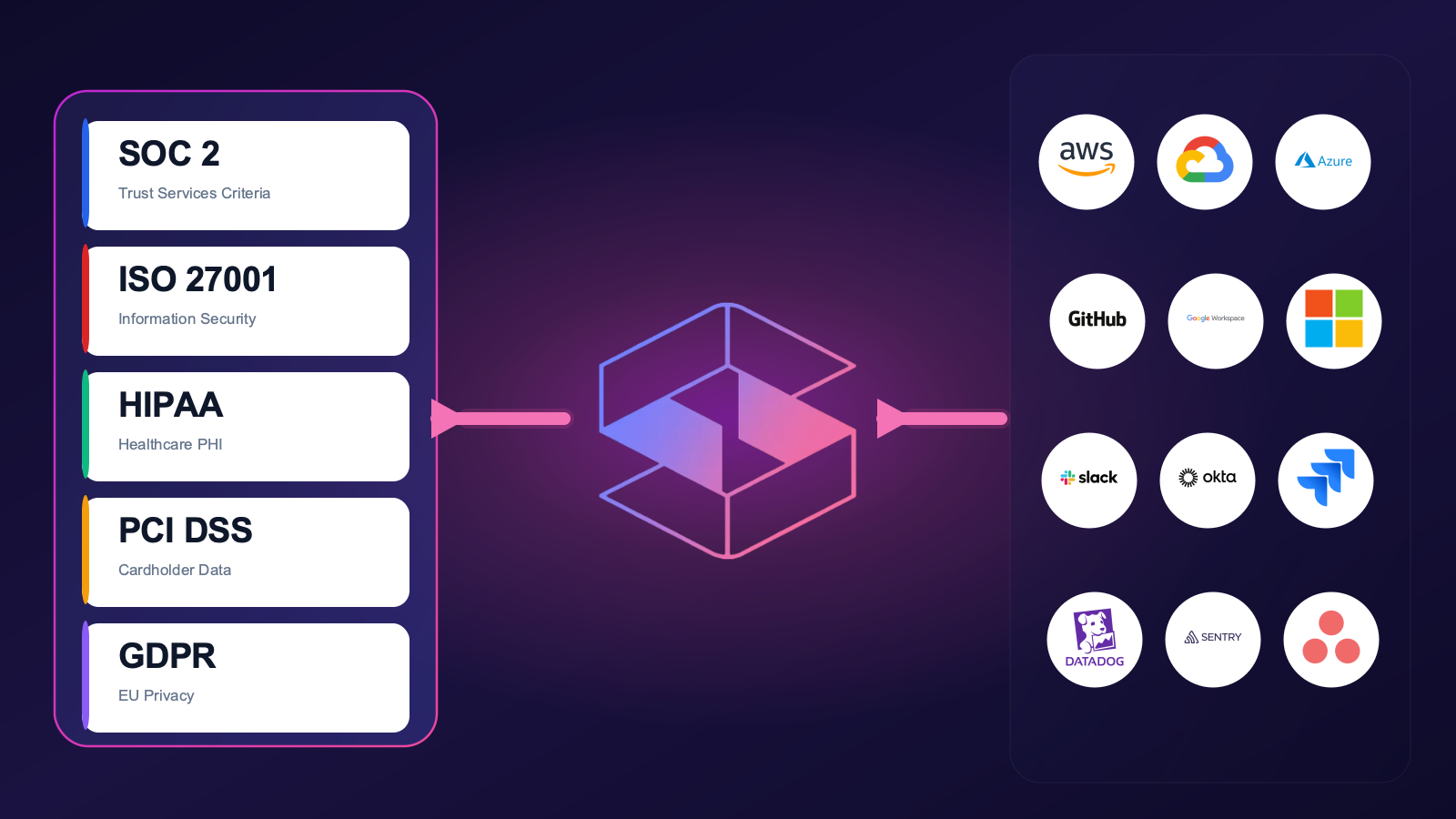
Yes. Every piece of evidence is mapped to all applicable frameworks simultaneously — SOC 2, HIPAA, ISO 27001, PCI DSS, GDPR, CCPA, EU AI Act, ISO 42001. One control evidence covers up to seven frameworks at once.
How long does control implementation take with Strac Comply?
Most controls auto-light up on integration. Policy generation (CC5) takes a 10-minute questionnaire. Access reviews (CC6.3) become quarterly automation. The longest task is human-driven controls — risk assessments (CC3.2), tabletop exercises (CC7.4), vendor reviews (CC9.2) — which still require expert judgment but become tracked workflows in the platform.
Are these the same SOC 2 controls auditors use globally?
The AICPA Trust Services Criteria are US-defined. International audits typically use ISO 27001 instead, though SOC 2 is increasingly accepted globally by US-headquartered customers buying from non-US vendors. See SOC 2 vs ISO 27001 for the cross-framework view.
The Bottom Line
SOC 2 controls are organized into 9 Common Criteria (mandatory) plus optional TSCs. CC6 (access + data protection) is where most evaluation time lands. Strac Comply maps every live system event to the right control automatically — and uniquely covers CC6.6 and CC6.7 with the Strac DLP product directly.
The Security TSC alone has 9 Common Criteria (CC1-CC9) with approximately 64 underlying control points. Adding all optional TSCs gets you to about 92 total. The exact count depends on which Points of Focus your auditor evaluates as separate controls.
Are SOC 2 controls prescriptive or principles-based?
Principles-based. The AICPA defines the criteria; you design the controls. Two companies can satisfy CC6.7 differently — one with full-disk encryption and a vault, another with DLP plus tokenization — and both pass. The auditor evaluates sufficiency.
Do I need to implement controls for optional TSCs?
Only if you scope them in. If your audit covers Security only, you don't need Availability, Confidentiality, Processing Integrity, or Privacy controls. Most SaaS companies start Security-only; healthcare and fintech add Confidentiality and Availability.
What's the difference between a control and a Point of Focus?
A control is the requirement (e.g., "Logical access security software, infrastructure, and architectures over protected information assets"). A Point of Focus is the AICPA's suggested implementation example (e.g., "Identifies and Manages the Inventory of Information Assets"). Controls are mandatory; Points of Focus inform auditor judgment but are not themselves required.
How does CC6.7 (encryption + DLP) work with cloud DLP and AI?
CC6.7 reads: "The entity restricts the transmission, movement, and removal of information to authorized internal and external users and processes, and protects it during transmission, movement, or removal to meet the entity's objectives." In 2026 that means DLP coverage on SaaS messages and files, encryption in transit, and increasingly — redaction at the MCP tool-call boundary when AI agents pull data. Strac is the only platform that provides all three from a single product. See MCP security.
Discover & Protect Data on SaaS, AI, MCP, Endpoints & Cloud
Strac provides end-to-end data loss prevention for all SaaS and Cloud apps. Integrate in under 10 minutes and experience the benefits of live DLP scanning, live redaction, and a fortified SaaS environment.


.webp)



.avif)




.gif)
