The complete SOC 2 audit guide for 2026: how to choose an auditor, audit process, cost, timeline, what auditors actually probe, and how to automate evidence.
A SOC 2 audit is performed by a licensed CPA firm following the AICPA's SSAE-18 attestation standard. The auditor evaluates whether your security controls meet the Trust Services Criteria you've scoped.
The audit has four phases: scoping, readiness, observation (Type 2 only), fieldwork. Total elapsed time: 4-6 weeks for Type 1; 6-18 months for first-time Type 2.
Auditor selection is the highest-leverage early decision. Big 4 firms cost more and may be required by some enterprise customers; reputable boutique CPA firms cost less and are accepted by most.
Audit fees: Type 1 $15K-$40K, Type 2 $25K-$75K. Total program cost with platform and internal time: $55K-$175K first year.
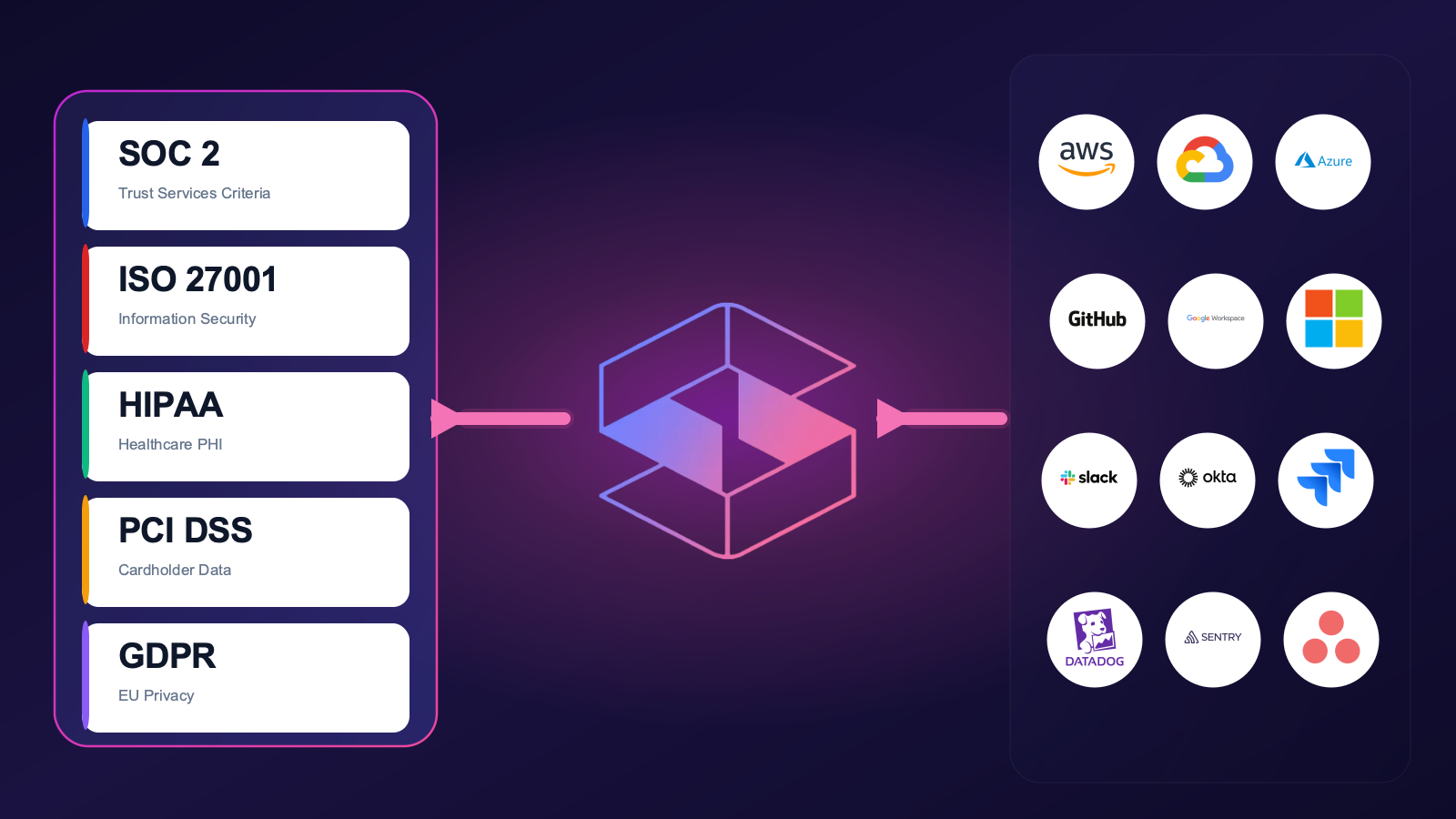
Strac Comply is the AI-native compliance automation platform that compresses audit preparation from months to weeks — continuous evidence collection, control drift alerts, one-click auditor exports, and DLP evidence built into the same platform. Start at comply.strac.io →
Audit fieldwork is 4-6 weeks — preparation is 3-6 months.Strac Comply compresses the preparation phase by continuously collecting evidence from your live systems — cloud, SaaS, endpoint, DLP, MCP — and mapping it to each control. Start at comply.strac.io →
✨ What Is a SOC 2 Audit?
A SOC 2 audit is an independent attestation engagement performed by a licensed CPA firm. Under the AICPA's SSAE-18 (Statement on Standards for Attestation Engagements) standard, the auditor issues a report on whether the service organization's controls meet the Trust Services Criteria.
Critical detail: it's an attestation, not a certification. The CPA firm gives a professional opinion based on evidence sampled during the audit. The output is a report (not a certificate) that the service organization shares with customers under NDA.
✨ Who Can Perform a SOC 2 Audit?
Only licensed CPA firms can issue a SOC 2 report. Three tiers of auditor:
Auditor tier
Examples
Cost range
When to choose
Big 4
Deloitte, PwC, EY, KPMG
$75K-$200K+
Public companies, F500 customers explicitly require Big 4, regulated industries with brand-sensitivity
Practical recommendation: get quotes from 3 firms across the boutique and mid-tier ranges. Big 4 is rarely necessary unless a customer's procurement team explicitly requires it.
Adjacent frameworks: Will you renew with ISO 27001 / HIPAA / PCI later? An auditor experienced in multiple frameworks reduces the cost of bundled audits.
2. Request quotes from 3+ firms
Get fixed-fee quotes (most boutiques do this). Confirm what's included: readiness assessment, walkthrough sessions, draft report iterations, final report delivery.
3. Verify qualifications
CPA license — required (verifiable via state CPA board).
AICPA peer review — required every 3 years; ask for the most recent peer review report.
SOC 2 experience — ask how many SOC 2 audits they've issued in the past 12 months.
Industry experience — auditors who know your industry's risk patterns issue better reports.
4. Review sample reports
Ask for anonymized prior client reports. Read for:
Tone: descriptive without being florid.
Coverage: do they cover the same TSCs you'll need?
Findings sections: how do they document deficiencies?
5. Confirm timing and price
Engagement letter signed with observation window start date (for Type 2).
Fee structure — fixed-fee vs hourly. Fixed-fee is preferred for predictability.
Communication cadence — weekly status calls during fieldwork is reasonable.
✨ The SOC 2 Audit Process — What Actually Happens
Four phases:
Phase 1: Scoping (2-4 weeks)
Define system boundary, TSCs, sub-services treatment.
Auditor reviews and confirms scope.
Engagement letter signed.
Phase 2: Readiness assessment (4-12 weeks)
Some auditors include this; some don't. Optional but recommended for first-time audits.
Gap analysis against the TSCs you've scoped.
Documented findings and remediation plan.
This is when you implement missing controls and deploy compliance automation. See SOC 2 checklist.
CC7.4 (incident response): Sample any incidents during the window. Confirm IR playbook followed. Confirm post-incident review on file. If no incidents, sample the tabletop exercise.
CC9.2 (vendor management): Sample vendor security reviews. Confirm SOC 2 / ISO 27001 / DPA on file for each critical vendor.
For data-protection controls (CC6.6 / CC6.7) specifically, auditors increasingly ask:
Show evidence that DLP detected sensitive data when it should have.
Show evidence of remediation action (redaction, blocking, alert).
Show the audit trail mapping the event to a specific user / agent.
This is where Strac Comply uniquely covers the audit ask: Strac DLP generates the events directly, Strac Comply maps them to the right control automatically.
✨ Audit Cost Breakdown
Cost component
Type 1
Type 2
Audit fees
$15K-$40K
$25K-$75K
Compliance platform
$10K-$50K/year
Same
Internal engineering time
$10K-$25K loaded cost
$20K-$50K loaded cost
Optional readiness assessment
$5K-$15K
Same
Total
$30K-$120K
$55K-$175K first year
Renewal Type 2 audits drop to $40K-$100K because the gap-remediation work is done.
✨ Auditor Communication Best Practices
Things that compress fieldwork:
One point of contact on your side who can coordinate with engineering, security, HR, and legal.
Pre-loaded evidence portal with everything the auditor will likely request. Strac Comply\'s evidence export does this in one click.
Calendar holds on key personnel for walkthrough sessions.
24-48 hour SLA on auditor Q&A.
Single-channel communication (email or the auditor's portal) — don't fork into Slack DMs and forget evidence references.
Things that extend fieldwork:
Evidence collected manually and submitted in batches as questions come up.
Multiple back-and-forth requests for the same control because the first submission was incomplete.
Key personnel unavailable for walkthrough sessions.
Discovering gaps mid-fieldwork that require remediation.
A well-prepared first Type 2 fieldwork: 4-5 weeks. A poorly-prepared one: 8-12 weeks.
Strac Comply streamlines every audit phase — continuous evidence collection, drift alerts, one-click exports to your auditor portal
✨ How Strac Comply Streamlines the Audit
Strac Comply is the AI-native compliance automation platform built for security-led teams. The platform compresses every phase of the audit:
Phase 1 (Scoping): pre-built scope templates per industry.
Phase 2 (Readiness): continuous gap detection. The platform tells you where you're missing controls before the auditor does.
Phase 3 (Observation): continuous evidence collection from cloud, SaaS, endpoint, DLP, MCP. Drift alerts when a control fails inside the window.
Phase 4 (Fieldwork): one-click evidence export per control. Auditor portal access for direct download. Q&A response time drops because everything is already mapped.
The unique angle: Strac Comply ships with Strac DLP and Strac DSPM as part of the same platform. For CC6.6 / CC6.7 evidence (data classification, encryption, DLP remediation) — the controls auditors increasingly drill into — Strac generates the evidence directly. Other platforms send you to integrate a separate DLP. Strac is one vendor, one bill, full coverage.
Continuous evidence collection. Drift alerts inside the observation window. One-click auditor exports. DLP evidence built in. The same Strac platform protecting your data is the platform proving your compliance.
The platform you pick shapes the audit itself — compare the leading SOC 2 compliance software before you engage an auditor.
🌶️ Spicy FAQs for SOC 2 Audit
How long does a SOC 2 audit take?
Type 1: 4-6 weeks of fieldwork after readiness is complete. Type 2: 4-6 weeks of fieldwork after the observation window closes. First-time Type 2 end-to-end (including gap remediation and observation): 6-18 months.
Do I need a Big 4 auditor?
Only if a customer explicitly requires it. Boutique CPA firms with strong SOC 2 reputations (A-LIGN, Schellman, Prescient Assurance, BARR Advisory, Coalfire) are accepted by the vast majority of enterprise procurement teams.
How much does a SOC 2 audit cost?
Type 1: $15K-$40K in audit fees. Type 2: $25K-$75K. Big 4 firms run 2-3x higher. Total program cost (platform + internal time + fees): $55K-$175K first year.
Can I switch auditors year over year?
Yes. Some companies do this for cost reasons; some stick with the same auditor for continuity. Switching adds modest onboarding overhead (new auditor needs to learn your environment).
What's a "qualified" SOC 2 report?
A report where the auditor identifies one or more deficiencies in control design or operating effectiveness. Qualifications are not fatal but require explanation to customers. The goal is a clean (unqualified) report.
What happens if the auditor finds a control deficiency?
Three outcomes: (1) clean report — the deficiency is minor and not worth noting; (2) management response — the deficiency is documented and you describe corrective action; (3) qualified opinion — the deficiency is material and the report is qualified. Most first audits land in (1) or (2).
How often do I need to renew?
Annually. Most companies run a rolling 12-month observation window for Type 2 with continuous evidence and an annual fieldwork cycle.
Can a single audit cover multiple products?
Yes, if all products fall within the system boundary defined at scoping. Be careful: broader scope = more controls = more audit hours = higher cost.
How does Strac Comply differ from Drata, Secureframe, or Sprinto in the audit context?
The unique angle: Strac Comply ships with Strac DLP and Strac DSPM as part of the same platform. For data-protection controls (CC6.6 / CC6.7) the evidence comes from the same product securing your data. Other platforms require a separate DLP integration. One vendor, one bill, full SOC 2 coverage.
What auditor questions catch teams off guard?
Three patterns: (1) "show me the access review for [specific quarter] for [specific system]" — the team can't find it; (2) "walk me through your incident response for [actual incident]" — no post-incident review on file; (3) "what's your data classification for [specific dataset]" — no DLP coverage means no classification evidence. Strac Comply\'s continuous collection eliminates all three.
Should the readiness assessment be done by the same auditor doing the audit?
It depends. Same-firm readiness is convenient but may create independence concerns under AICPA rules. Many auditors offer a "readiness assessment" engagement that is structured to maintain independence. Confirm with the auditor.
The Bottom Line
A SOC 2 audit is a 4-6 week fieldwork engagement at the end of a 3-12 month observation window. Auditor selection is the highest-leverage early decision; preparation quality compresses fieldwork by weeks. Strac Comply is the compliance platform built for the security-led teams running audits today — with the underlying data security product built in.
Only if a customer explicitly requires it. Boutique CPA firms with strong SOC 2 reputations (A-LIGN, Schellman, Prescient Assurance, BARR Advisory, Coalfire) are accepted by the vast majority of enterprise procurement teams.
Can I switch auditors year over year?
Yes. Some companies do this for cost reasons; some stick with the same auditor for continuity. Switching adds modest onboarding overhead (new auditor needs to learn your environment).
What's a "qualified" SOC 2 report?
A report where the auditor identifies one or more deficiencies in control design or operating effectiveness. Qualifications are not fatal but require explanation to customers. The goal is a clean (unqualified) report.
What happens if the auditor finds a control deficiency?
Three outcomes: (1) clean report — the deficiency is minor and not worth noting; (2) management response — the deficiency is documented and you describe corrective action; (3) qualified opinion — the deficiency is material and the report is qualified. Most first audits land in (1) or (2).
How often do I need to renew?
Annually. Most companies run a rolling 12-month observation window for Type 2 with continuous evidence and an annual fieldwork cycle.
Discover & Protect Data on SaaS, AI, MCP, Endpoints & Cloud
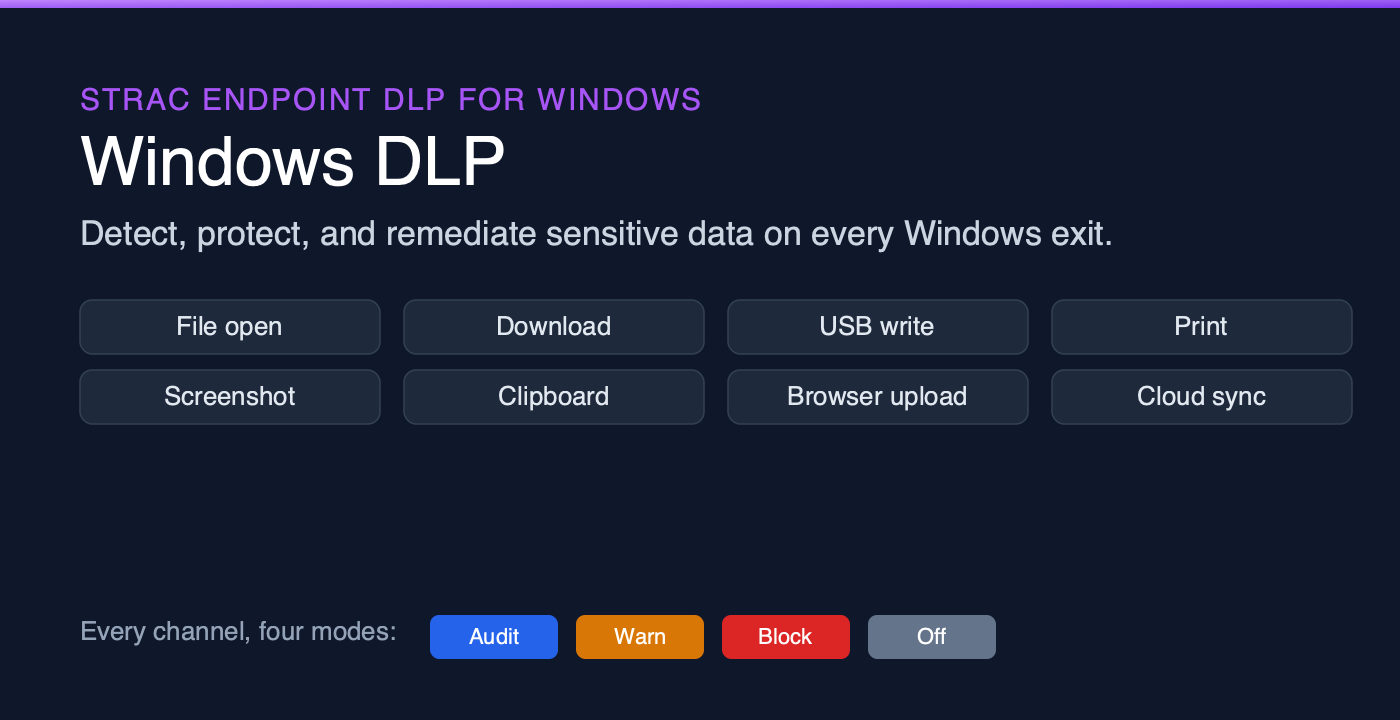
Strac provides end-to-end data loss prevention for all SaaS and Cloud apps. Integrate in under 10 minutes and experience the benefits of live DLP scanning, live redaction, and a fortified SaaS environment.


.webp)



.avif)




.gif)
