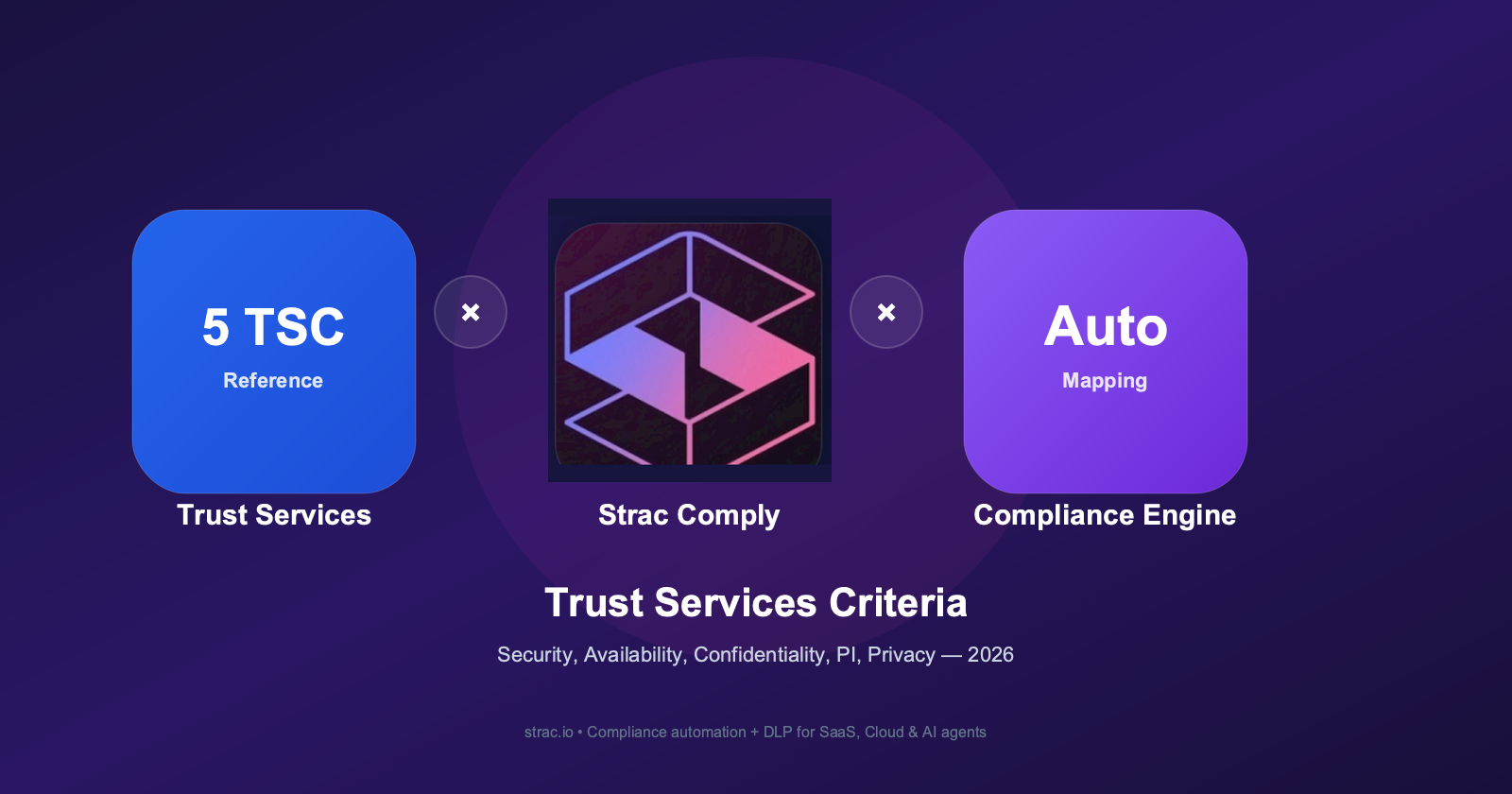
The SOC 2 Trust Services Criteria (TSC) is the AICPA's framework defining what an auditor evaluates during a SOC 2 audit. Five criteria total: Security, Availability, Confidentiality, Processing Integrity, Privacy.
Security is mandatory for every SOC 2 audit. The other four are optional — you include them based on what your customers and regulators expect.
Security is organized into 9 Common Criteria (CC1-CC9). The optional TSCs add their own criteria on top.
Most SaaS companies start with Security only. Healthcare and fintech often add Confidentiality and Availability. Consumer-data businesses sometimes add Privacy to align with GDPR / CCPA.
Strac Comply maps live evidence to every criterion automatically — and uniquely covers the data-protection criteria (CC6.6, CC6.7, Confidentiality) with the Strac DLP product directly. Start at comply.strac.io →
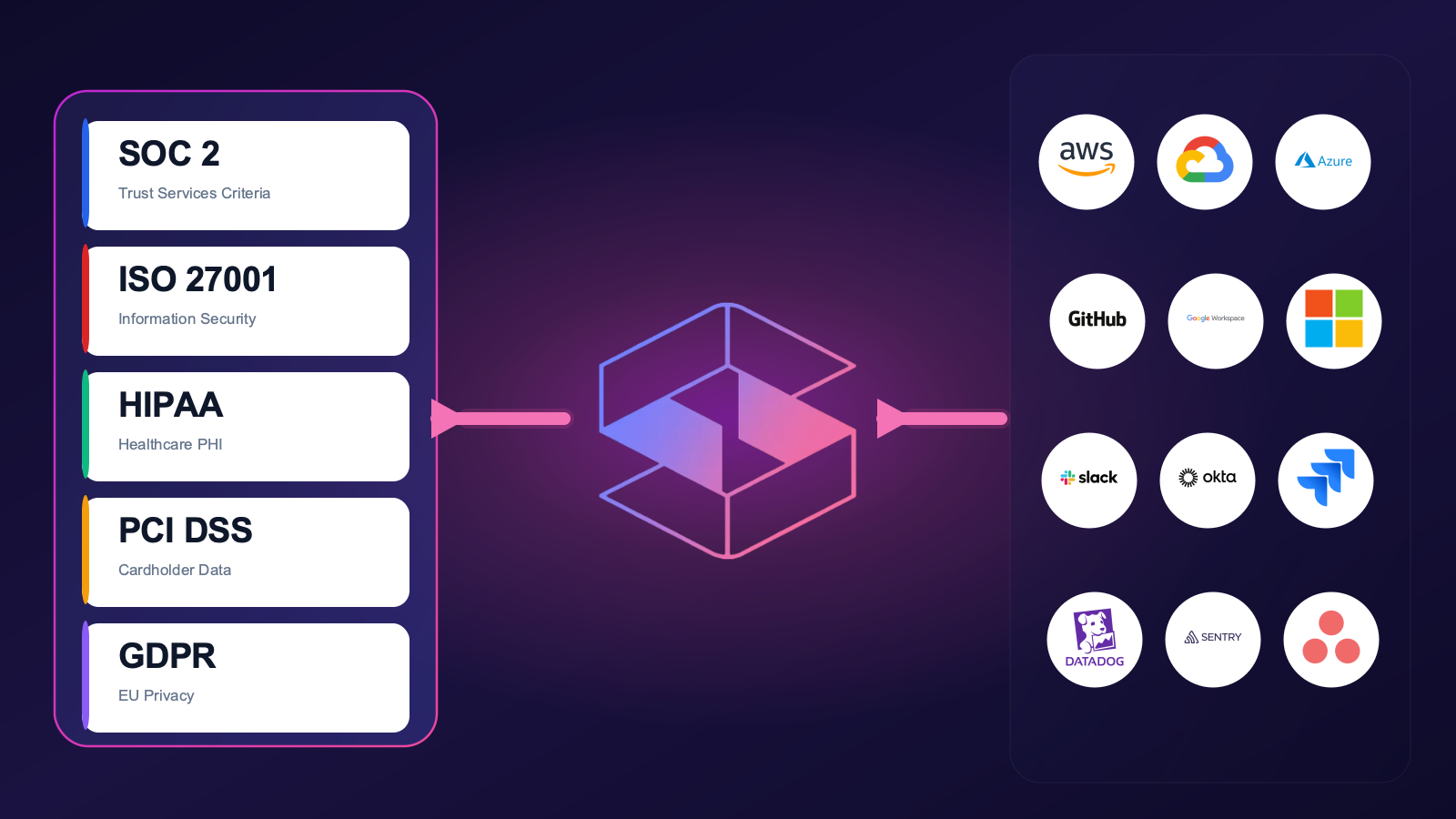
Mapping TSCs to evidence?Strac Comply auto-maps live system events — cloud config, SaaS audit logs, endpoint posture, DLP events, MCP tool calls — to every Trust Services Criterion. The same Strac platform protecting your data generates the audit evidence. Start at comply.strac.io →
✨ What Are the Trust Services Criteria?
The AICPA's 2017 Trust Services Criteria (TSC 2017, the current version) is the framework auditors use to evaluate a service organization's controls. Five criteria total:
Criterion
What it covers
Required?
Security (Common Criteria)
Protection against unauthorized access, system compromise, and data theft
Mandatory
Availability
System uptime, disaster recovery, business continuity
Optional
Confidentiality
Protection of confidential information (contracts, NDAs, proprietary data)
Optional
Processing Integrity
System processing is complete, valid, accurate, timely, and authorized
Optional
Privacy
Personal information collection, use, disclosure aligned with the org's privacy notice
Optional
Each TSC contains specific criteria the auditor will probe. Security alone has 9 Common Criteria (CC1-CC9) with ~64 control points. The four optional TSCs add their own criteria on top.
✨ Security (Common Criteria, CC1-CC9)
The mandatory backbone of every SOC 2 audit.
Common Criterion
Coverage
Control point count
CC1
Control Environment — tone at the top, organizational structure, accountability
5
CC2
Communication & Information — how security info flows internally and externally
Monitoring Activities — ongoing evaluation of controls
2
CC5
Control Activities — policies, procedures, technology general controls
3
CC6
Logical & Physical Access Controls — the largest section — access, encryption, DLP, network
8
CC7
System Operations — vulnerability management, monitoring, incident response
5
CC8
Change Management — production change controls
1
CC9
Risk Mitigation — business continuity, vendor risk
2
CC6 is where most audit time goes. It covers MFA, SSO, RBAC, encryption, DLP, network segmentation, endpoint protection, physical access — basically every meaningful technical control. Two specific sub-criteria deserve attention:
CC6.6 — data classification and protection at boundaries. DLP coverage at the SaaS / cloud / endpoint / AI surface.
CC6.7 — restricted access to information including encryption at rest and in transit + DLP redaction + secret management.
Strac uniquely covers CC6.6 / CC6.7 because Strac DLP ships with Strac Comply as one platform — the data-protection evidence comes from the same product securing the data. For the full controls reference, see SOC 2 controls.
✨ Availability
Optional. Covers system uptime, disaster recovery, business continuity.
Criterion
What it covers
A1.1
Capacity management, performance monitoring
A1.2
Environmental protection, system recovery
A1.3
Recovery infrastructure tested
Common evidence:
Uptime monitoring data and SLA tracking
Auto-scaling configurations
Multi-region or multi-AZ failover architecture
DR plan with annual exercise
RTO / RPO documentation per critical system
Post-incident reviews after any availability incident
When to include Availability: customers whose business depends on your uptime (financial services, healthcare, real-time systems). Skip if you're an early-stage SaaS where customers don't yet ask about availability formally.
✨ Confidentiality
Optional. Covers protection of confidential information — NDAs, contracts, intellectual property, proprietary data.
Criterion
What it covers
C1.1
Identification and protection of confidential information
C1.2
Disposal of confidential information
Common evidence:
Data classification labels applied to confidential datasets
Encryption of confidential data at rest and in transit
DLP policies preventing exfiltration of confidential content
Confidentiality clauses in contracts and NDAs
Secure disposal of confidential data per retention policy
When to include Confidentiality: B2B vendors handling customer IP, M&A diligence rooms, legal services, professional services with confidential client work.
Confidentiality overlaps heavily with the data-protection sub-criteria under Security (CC6.6, CC6.7). Strac\'s DLP product covers both with one set of policies.
✨ Processing Integrity
Optional. Covers system processing accuracy, completeness, timeliness, validity, authorization.
Criterion
What it covers
PI1.1
Definitions of processing objectives
PI1.2
System inputs are complete, accurate, valid
PI1.3
System processing is complete, accurate, timely, authorized
When to include Processing Integrity: payment processors, financial systems, billing platforms, anywhere "incorrect output" is a business risk worth attesting against.
✨ Privacy
Optional. Covers personal information collection, use, retention, and disclosure. The most policy-heavy of the optional TSCs.
Criterion
What it covers
P1
Notice and communication of objectives
P2
Choice and consent
P3
Collection limited to disclosed purposes
P4
Use, retention, and disposal
P5
Access requests honored
P6
Disclosure of personal information to third parties
P7
Quality — accuracy and completeness of personal information
P8
Monitoring and enforcement
Common evidence:
Public privacy notice (kept current and version-controlled)
Consent management for data collection
Data Subject Access Request (DSAR) process with tracking
Retention schedules implemented in systems
Third-party data sharing inventory and DPAs
Privacy training records
When to include Privacy: consumer-data businesses, GDPR / CCPA-exposed orgs that want one report covering compliance with both. Privacy adds 18 control points and significant policy documentation.
Privacy and the broader GDPR / CCPA frameworks overlap. Strac Comply maps the same Privacy evidence to GDPR Articles 5 / 25 / 30 / 32 and CCPA simultaneously.
✨ How to Choose Which TSCs to Include
A practical decision matrix:
Your situation
Minimum TSCs
Early-stage SaaS selling to other SaaS
Security only
SaaS selling to mid-market / enterprise
Security only (Type 2)
Healthcare-adjacent SaaS
Security + Confidentiality
Financial / payments
Security + Availability + Processing Integrity
Consumer-data business (GDPR / CCPA exposed)
Security + Privacy
Critical-infrastructure or real-time systems
Security + Availability
Diligence-heavy services (legal, M&A)
Security + Confidentiality
You can always add TSCs in later years. The Security-only first audit is a strong starting point; you scope up as customer demand and regulatory exposure grow.
Strac Comply maps live evidence to every Trust Services Criterion automatically — one control plane, every framework
✨ How Strac Comply Maps Evidence to Every TSC
Strac Comply is the AI-native compliance automation platform built for security-led teams. The platform watches your live systems and continuously maps evidence to each criterion under every TSC you've scoped.
Per TSC coverage:
Security (CC1-CC9): full continuous evidence collection. DLP evidence built in for CC6.6 / CC6.7 via the Strac DLP product. MCP DLP audit logs for AI-agent controls (CC6.1, CC7.2).
Privacy (P1-P8): privacy notice version control, DSAR workflow with SLA tracking, consent management integration, retention enforcement.
The unique angle: Strac Comply ships with Strac DLP and Strac DSPM as part of the same platform. No separate DLP integration for CC6.6 / CC6.7 / C1.1. One vendor, one bill, full coverage.
Security mandatory? Adding Confidentiality, Availability, or Privacy? Strac Comply maps evidence across every Trust Services Criterion automatically — and uniquely covers the data-protection criteria with the Strac DLP product directly.
No. Only Security is mandatory. The other four (Availability, Confidentiality, Processing Integrity, Privacy) are optional. You include them based on what your customers and regulators expect.
What's the difference between TSC and Common Criteria?
TSC is the umbrella for all five criteria. Common Criteria (CC1-CC9) is specifically the Security TSC, organized into 9 categories. The optional TSCs (A, C, PI, P) have their own criteria letter codes.
Which TSC has the most controls?
Within Security (CC1-CC9), CC6 (Logical and Physical Access Controls) has the most controls — 8 control points covering access, MFA, encryption, DLP, network, and endpoint. Of the optional TSCs, Privacy has the most criteria (18 control points).
Can I add TSCs to a future audit?
Yes. Most companies start with Security only and add Confidentiality, Availability, or Privacy in later audits as customer demand grows. Each addition expands audit scope and cost.
How do Privacy TSC controls overlap with GDPR / CCPA?
The Privacy TSC is principles-based and aligned with OECD privacy principles. GDPR and CCPA are specific legal frameworks. The controls largely overlap — data subject rights, retention, consent — but the legal obligations under GDPR / CCPA are broader. Strac Comply maps Privacy TSC evidence to GDPR Articles and CCPA sections simultaneously.
How do Confidentiality and Security overlap?
Heavily. Both cover data protection. Security (CC6.6 / CC6.7) covers data protection broadly; Confidentiality (C1.1 / C1.2) covers "confidential information" specifically (NDAs, contracts, IP). The same DLP and encryption controls satisfy both. Strac\'s DLP product is the evidence source for both.
What if a customer asks for a specific TSC we don't have?
You have three options: (1) explain that your current report covers Security and the customer accepts it as sufficient, (2) commit to adding the TSC at the next audit cycle, (3) explore a Type 1 audit covering the additional TSC quickly. The right answer depends on the customer's ACV and your audit timeline.
Is there a "lite" version of the TSCs?
No formal lite version, but SOC 3 is the public-facing summary report based on the same TSCs. SOC 3 is shorter, can be made public, but provides less detail. Most companies do SOC 2 Type 2 for the actual audit and optionally produce a SOC 3 summary for marketing.
How does Strac Comply differ from Drata, Secureframe, or Sprinto on TSC coverage?
The unique angle: Strac Comply ships with Strac DLP and Strac DSPM as part of the same platform. For criteria around data classification, encryption, and DLP — CC6.6, CC6.7, C1.1, C1.2, and parts of P3 / P4 — Strac generates the evidence directly. Other platforms require you to integrate a separate DLP and consolidate evidence into the compliance platform manually.
What about EU AI Act, ISO 42001, NIST AI RMF — do they map to TSCs?
Yes, partially. AI-specific controls under EU AI Act Article 12 (logging), Article 13 (transparency), Article 14 (human oversight) map to Security TSC criteria CC6.1 (access), CC6.6 (data), CC7.2 (monitoring). ISO 42001 Annex A controls similarly map. Strac Comply\'s mappings cover this cross-framework projection automatically.
The Bottom Line
The Trust Services Criteria define what auditors actually evaluate. Security is mandatory; the other four are optional and chosen based on business context. Strac Comply covers every criterion automatically and uniquely brings the data-protection evidence in-house with the Strac DLP product.
No. Only Security is mandatory. The other four (Availability, Confidentiality, Processing Integrity, Privacy) are optional. You include them based on what your customers and regulators expect.
Which TSC has the most controls?
Within Security (CC1-CC9), CC6 (Logical and Physical Access Controls) has the most controls — 8 control points covering access, MFA, encryption, DLP, network, and endpoint. Of the optional TSCs, Privacy has the most criteria (18 control points).
Can I add TSCs to a future audit?
Yes. Most companies start with Security only and add Confidentiality, Availability, or Privacy in later audits as customer demand grows. Each addition expands audit scope and cost.
How do Privacy TSC controls overlap with GDPR / CCPA?
The Privacy TSC is principles-based and aligned with OECD privacy principles. GDPR and CCPA are specific legal frameworks. The controls largely overlap — data subject rights, retention, consent — but the legal obligations under GDPR / CCPA are broader. Strac Comply maps Privacy TSC evidence to GDPR Articles and CCPA sections simultaneously.
How do Confidentiality and Security overlap?
Heavily. Both cover data protection. Security (CC6.6 / CC6.7) covers data protection broadly; Confidentiality (C1.1 / C1.2) covers "confidential information" specifically (NDAs, contracts, IP). The same DLP and encryption controls satisfy both. Strac\'s DLP product is the evidence source for both.
Discover & Protect Data on SaaS, AI, MCP, Endpoints & Cloud
Strac provides end-to-end data loss prevention for all SaaS and Cloud apps. Integrate in under 10 minutes and experience the benefits of live DLP scanning, live redaction, and a fortified SaaS environment.


.webp)






.avif)




.gif)
