SOC 2 vs HIPAA: The Complete 2026 Comparison (Differences, Overlap, Which You Need)
SOC 2 vs HIPAA compared: differences, overlap, why healthcare-adjacent SaaS needs both, BAA implications, AI agents and PHI, and how Strac Comply handles both.
SOC 2 and HIPAA are different things. SOC 2 is an audit framework for evaluating security and operational controls (AICPA Trust Services Criteria). HIPAA is a US law that protects Protected Health Information (PHI) in healthcare contexts.
Healthcare-adjacent SaaS typically needs both. SOC 2 satisfies general enterprise security procurement. HIPAA (specifically: a signed Business Associate Agreement plus HIPAA Security Rule compliance) is legally required to handle PHI.
The control sets overlap ~70%. The 30% delta: HIPAA adds specific PHI-handling, BAA / business associate, and breach-notification obligations that SOC 2 doesn't formally require.
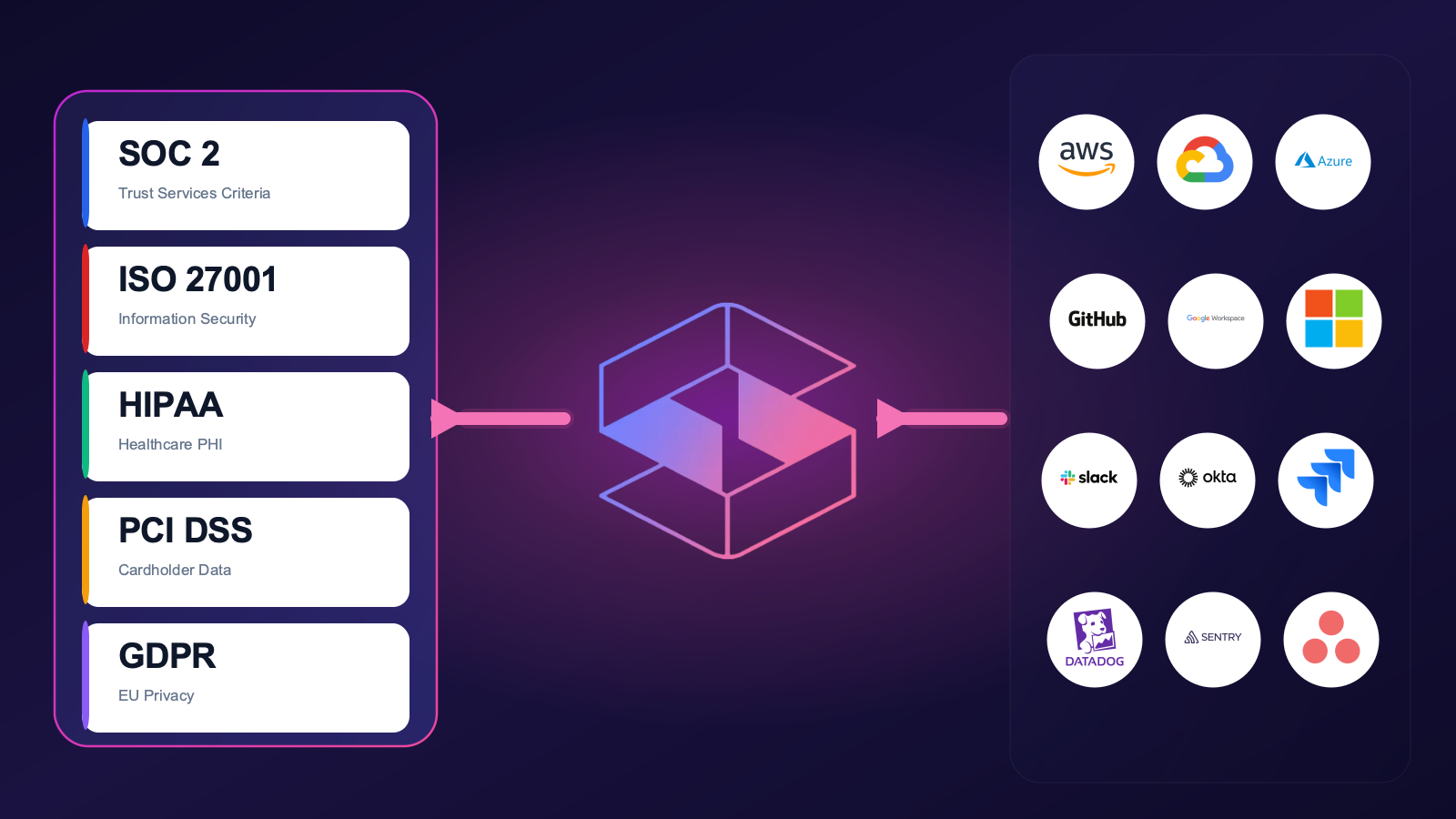
Strac Comply maps every piece of live evidence to both frameworks simultaneously — SOC 2 + HIPAA + ISO 27001 + GDPR + PCI from one platform. Plus the native DLP / DSPM / MCP DLP coverage that uniquely addresses the Claude Cowork BAA gap healthcare orgs face in 2026.
Healthcare-adjacent SaaS need both SOC 2 and HIPAA?Strac Comply maps evidence to both frameworks simultaneously — plus the native DLP that detects PHI across SaaS / cloud / endpoint / AI surfaces and the MCP DLP that closes the Claude Cowork BAA gap. Start at comply.strac.io →
✨ SOC 2 vs HIPAA: The Direct Answer
Dimension
SOC 2
HIPAA
Type
Audit framework / attestation report
US federal law
Governing body
AICPA
HHS Office for Civil Rights (OCR)
Scope
Service organizations handling customer data
Healthcare entities (covered entities + business associates) handling PHI
Civil penalties up to $1.5M per violation per year; criminal penalties; OCR enforcement actions
Required of whom
Voluntary (driven by customer demand)
Mandatory for covered entities and business associates handling PHI
Validity
One year per report
Continuous (no certificate to expire)
The single biggest difference: SOC 2 is voluntary (driven by customer demand). HIPAA is mandatory if you handle PHI. You can pass SOC 2 without ever needing HIPAA. You cannot legally handle PHI without HIPAA-compliant controls and signed BAAs with relevant parties.
✨ What Is SOC 2?
SOC 2 is an attestation report issued by a licensed CPA firm evaluating whether a service organization's controls meet the AICPA's Trust Services Criteria. Two flavors:
Type 1: control design at a point in time
Type 2: design + operating effectiveness over 3-12 months
HIPAA (Health Insurance Portability and Accountability Act, 1996) is a US federal law with four operative rules for healthcare-adjacent organizations:
Privacy Rule: protects individually-identifiable health information.
Security Rule: technical, administrative, physical safeguards for electronic PHI (ePHI).
Breach Notification Rule: requires notification of breaches affecting PHI.
Enforcement Rule: HHS Office for Civil Rights (OCR) enforcement procedures.
Two main HIPAA-covered roles:
Covered Entities: healthcare providers, health plans, healthcare clearinghouses.
Business Associates: vendors processing PHI on behalf of covered entities. This is where SaaS companies most often land.
Every business associate handling PHI must:
Sign a Business Associate Agreement (BAA) with each covered entity (and any subcontractor BAs).
Comply with the HIPAA Security Rule.
Notify the covered entity of breaches per the Breach Notification Rule.
✨ Why Healthcare-Adjacent SaaS Usually Needs Both
Three reasons SaaS companies serving healthcare end up doing both:
HIPAA is mandatory; SOC 2 is the procurement asset. HIPAA gets you legally permitted to handle PHI. SOC 2 Type 2 gets the procurement team's checkbox.
Different audiences. Hospital legal teams ask for the BAA and HIPAA compliance attestations. CTO / CISO / procurement teams ask for the SOC 2 report.
Different controls. SOC 2 evaluates broad security and operational controls; HIPAA mandates specific PHI handling controls (BAA chain, breach notification, minimum-necessary principle).
A practical pattern: SOC 2 Type 2 with Confidentiality (often Availability and Privacy) TSCs scoped in, plus HIPAA compliance with BAAs in place across the data chain.
✨ The 70% Overlap Between SOC 2 and HIPAA
Most security controls map cleanly between the two:
Topic
SOC 2 (CC)
HIPAA Security Rule
Access control / MFA
CC6.1-6.3
§164.308(a)(4), §164.312(a)(1)
Encryption
CC6.7
§164.312(a)(2)(iv), §164.312(e)(2)(ii)
Data classification + DLP
CC6.6, CC6.7
§164.312(a)(2)(iv), §164.312(c)(1)
Logging and monitoring
CC7.2-7.3
§164.312(b)
Vulnerability management
CC7.1
§164.308(a)(8)
Incident response
CC7.4-7.5
§164.308(a)(6), §164.312(c)(2)
Change management
CC8.1
§164.308(a)(8)
Workforce security
CC1.4, CC1.5
§164.308(a)(3)-(4)
Vendor / business associate
CC9.2
§164.308(b), §164.314(a)
Physical security
CC6.4
§164.310
Incident notification
CC7.5
Breach Notification Rule §164.400-414
Where the two frameworks diverge:
BAA chain: HIPAA specifically requires written BAAs through the full data chain. SOC 2 has no equivalent (vendor security reviews under CC9.2 cover similar ground but less prescriptively).
Minimum-necessary principle: HIPAA requires limiting PHI access to the minimum needed for the task. SOC 2 doesn't have an equivalent specific principle.
Breach notification: HIPAA has specific notification timelines (60 days), thresholds (500+ individuals triggers HHS + media notification), and content requirements. SOC 2 expects incident handling but doesn't prescribe notification mechanics.
AI / agent considerations: in 2026, both frameworks increasingly probe AI-system controls, but HIPAA implications are sharper because PHI passing through an AI vendor without a BAA is a breach.
✨ The Claude Cowork BAA Gap (and How Strac Closes It)
In 2026, the single most underestimated HIPAA risk at healthcare-adjacent SaaS is the Claude Cowork BAA gap.
The pattern: Anthropic does not currently offer a Business Associate Agreement (BAA) for Claude consumer or Claude Cowork plans — the plans most knowledge workers use. A clinician or analyst using Claude Cowork against PHI (clinical notes, EHR exports, patient correspondence pulled via MCP) is technically out of HIPAA compliance the moment the data crosses into the chat. There is no after-the-fact remediation; the data has already been processed by a vendor without a BAA.
Strac\'s answer: data-layer redaction at the MCP tool-call boundary. Strac\'s MCP DLP intercepts every AI agent tool call to your SaaS data, redacts PHI inline, and produces audit evidence. The model never sees the unredacted regulated data — closing the BAA gap regardless of vendor.
This is unique to Strac among compliance automation platforms because Strac ships the DLP product with Strac Comply.
Strac Comply produces evidence for SOC 2 and HIPAA in one control plane — plus the data-layer DLP that closes the BAA gap on AI agent surfaces
✨ How Strac Comply Handles Both Frameworks
Strac Comply maps every piece of live evidence to both frameworks simultaneously.
Breach notification workflow with 60-day SLA tracking
Minimum-necessary access analysis
PHI inventory across systems via Strac DLP discovery
The unique architecture: Strac Comply ships with Strac DLP and Strac DSPM. For PHI-handling controls under both frameworks, the evidence comes from the same product detecting and redacting the data. See Strac HIPAA DLP for the broader HIPAA coverage.
Strac Comply maps evidence to both frameworks simultaneously. The same Strac DLP product detecting PHI is the evidence source for both audits. Plus the MCP DLP that closes the Claude Cowork BAA gap for healthcare orgs using modern AI.
No. SOC 2 doesn't trigger HIPAA. HIPAA only applies if you handle PHI as a Covered Entity or Business Associate. Many SOC 2-attested SaaS companies have nothing to do with HIPAA.
Is SOC 2 enough for healthcare customers?
Usually not by itself. Healthcare customers will ask for both: SOC 2 Type 2 for general security assurance + a signed BAA + HIPAA compliance attestation. The BAA + HIPAA piece is legally non-negotiable when PHI is involved.
Is there a "HIPAA certification"?
No. There is no official HIPAA certification body. Compliance is self-attested (or audited by OCR after a complaint or breach). Some third-party HIPAA assessment firms exist (HITRUST is the closest to a formal certification), but a "HIPAA certificate" doesn't exist in the formal regulatory sense.
What is HITRUST and how does it relate?
HITRUST CSF (Common Security Framework) is a third-party-developed framework that bundles HIPAA, SOC 2, ISO 27001, NIST, and PCI controls into a single assessment. HITRUST CSF certification is recognized by many healthcare customers as the highest-bar HIPAA-adjacent attestation. It's overkill for most SaaS; appropriate for large healthcare vendors.
Can a single audit cover both SOC 2 and HIPAA?
The audit reports are separate (SOC 2 is an attestation by a CPA firm; HIPAA has no formal "audit report"). But the underlying evidence and controls overlap heavily. Strac Comply maintains both control sets from a single evidence stream, so one audit cycle effectively covers both frameworks.
What's the BAA chain?
HIPAA requires every party handling PHI in the chain to have signed BAAs with parties upstream and downstream. Example: hospital → SaaS vendor → cloud provider → sub-processor. Each link needs a BAA. Strac Comply tracks the full chain and alerts on expirations or new sub-processors.
What is "minimum necessary"?
HIPAA's minimum-necessary principle requires that only the PHI absolutely required for the task is accessed, used, or disclosed. In practical 2026 terms: Strac DLP\'s redaction-at-source enforces minimum-necessary directly — an analyst pulling a patient cohort gets the de-identified version unless they have explicit broader access.
How does Strac Comply handle MCP / AI agents under HIPAA?
Strac\'s MCP DLP intercepts AI agent tool calls to your SaaS, redacts PHI inline, and produces audit evidence. The redacted version reaches the model context; the unredacted PHI stays in Strac\'s vault with RBAC re-identification. Strac Comply maps the redaction events to HIPAA §164.312(a)(2)(iv).
What about HIPAA Privacy Rule vs Security Rule?
Privacy Rule (§164.500-534): protects PHI in all forms (electronic, paper, oral). Covers use and disclosure.
Most SaaS compliance work targets the Security Rule (ePHI). Privacy Rule compliance is generally satisfied through policies, notice-of-privacy-practices documentation, and individual rights (access, amendment, accounting of disclosures).
How does GDPR interact with HIPAA + SOC 2?
GDPR applies to processing personal data of EU residents. HIPAA applies to PHI in the US. SOC 2 with the Privacy TSC partially overlaps with both. For healthcare SaaS selling in EU + US, all three frameworks apply. Strac Comply maps GDPR Articles 5/25/30/32 to SOC 2 Privacy TSC + HIPAA Security Rule simultaneously.
Is HITRUST the same as SOC 2 + HIPAA?
HITRUST CSF is broader — it bundles HIPAA, SOC 2, ISO 27001, NIST, and PCI into a single certification framework. It's more rigorous than SOC 2 alone and more formalized than HIPAA self-attestation. Strac Comply\'s evidence mapping is compatible with HITRUST CSF assessments, though dedicated HITRUST automation is a separate platform conversation.
The Bottom Line
SOC 2 is a voluntary security attestation; HIPAA is a mandatory US law for PHI. Healthcare-adjacent SaaS needs both: SOC 2 for procurement, HIPAA for legal. The control sets overlap ~70%. Strac Comply maps evidence to both simultaneously and uniquely closes the Claude Cowork BAA gap via MCP DLP — the modern AI risk no other compliance platform covers.
No. SOC 2 doesn't trigger HIPAA. HIPAA only applies if you handle PHI as a Covered Entity or Business Associate. Many SOC 2-attested SaaS companies have nothing to do with HIPAA.
Is SOC 2 enough for healthcare customers?
Usually not by itself. Healthcare customers will ask for both: SOC 2 Type 2 for general security assurance + a signed BAA + HIPAA compliance attestation. The BAA + HIPAA piece is legally non-negotiable when PHI is involved.
What is HITRUST and how does it relate?
HITRUST CSF (Common Security Framework) is a third-party-developed framework that bundles HIPAA, SOC 2, ISO 27001, NIST, and PCI controls into a single assessment. HITRUST CSF certification is recognized by many healthcare customers as the highest-bar HIPAA-adjacent attestation. It's overkill for most SaaS; appropriate for large healthcare vendors.
Can a single audit cover both SOC 2 and HIPAA?
The audit reports are separate (SOC 2 is an attestation by a CPA firm; HIPAA has no formal "audit report"). But the underlying evidence and controls overlap heavily. Strac Comply maintains both control sets from a single evidence stream, so one audit cycle effectively covers both frameworks.
What's the BAA chain?
HIPAA requires every party handling PHI in the chain to have signed BAAs with parties upstream and downstream. Example: hospital → SaaS vendor → cloud provider → sub-processor. Each link needs a BAA. Strac Comply tracks the full chain and alerts on expirations or new sub-processors.
Discover & Protect Data on SaaS, AI, MCP, Endpoints & Cloud
Strac provides end-to-end data loss prevention for all SaaS and Cloud apps. Integrate in under 10 minutes and experience the benefits of live DLP scanning, live redaction, and a fortified SaaS environment.


.webp)






.avif)




.gif)
