SOC 2 Type 2 is the audit report that evaluates whether your security controls operated effectively over a sustained observation period (typically 3-12 months). Enterprise buyers want this report; Type 1 alone is rarely sufficient above mid-market.
The audit covers the same Trust Services Criteria as Type 1 (Security mandatory; Availability, Confidentiality, Processing Integrity, Privacy optional) but evaluates operating effectiveness rather than just design.
Typical observation windows: first audit = 3-6 months, subsequent audits = 12 months. Auditor fieldwork: 4-6 weeks after the window closes.
Total cost: audit fees $25K-$75K, compliance automation platform $10K-$50K/year, internal engineering time $20K-$50K loaded cost. First-year total: $55K-$175K.
Strac Comply is the AI-native compliance automation platform purpose-built for Type 2 — the continuous nature of Type 2 demands continuous evidence collection, which Strac generates from the same SaaS / cloud / endpoint integrations that protect your data. Start at comply.strac.io →
Running a SOC 2 Type 2? Type 2 demands continuous evidence collection across the observation window — the manual approach consumes 2-4 engineer-weeks of internal time. Strac Comply auto-collects evidence from your live SaaS, cloud, and endpoint systems and continuously maps it to each SOC 2 control. Start at comply.strac.io →
✨ What Is SOC 2 Type 2?
SOC 2 Type 2 is an audit report (technically: an SSAE-18 attestation) issued by a licensed CPA firm that evaluates whether a service organization's security controls were designed appropriately AND operated effectively over a defined observation period. Type 2 differs from Type 1 by adding the operating-effectiveness dimension — the auditor samples evidence across the entire observation window to confirm controls didn't just exist on paper but actually worked in practice.
Type 2 is the report enterprise procurement teams ask for. A clean Type 2 with no significant deficiencies signals that the vendor's controls are mature enough to handle real production workloads with customer data.
✨ SOC 2 Type 2 vs Type 1 — The Practical Difference
Attribute
Type 1
Type 2
What it tests
Control design at a point in time
Control design + operating effectiveness over time
Observation window
A single date (snapshot)
3-12 months (typically 6 or 12)
Auditor evidence sampling
Spot-check current state
Sample across the entire window
Audit duration
4-6 weeks total
Window duration + 4-6 weeks fieldwork
Audit cost
$15K-$40K
$25K-$75K
Validity
One year
One year (most companies renew annually)
Enterprise customer expectation
Acceptable for early-stage / sub-$50K ACV
Expected at mid-market and enterprise tiers
The rule of thumb: Type 1 is the proof-of-intent audit. Type 2 is the audit that closes enterprise deals. Most companies skip Type 1 entirely and go straight to Type 2 once their controls are stable.
✨ The SOC 2 Type 2 Observation Window
The observation window is the period during which controls must operate continuously. The auditor samples evidence across the window — access logs, change tickets, incident reports, MFA configurations, vulnerability scans, etc.
Common window choices:
3 months — First audit. Faster path to a report, but tighter sampling.
6 months — Common balance. Sufficient for most enterprise procurement teams.
12 months — Renewal cycle standard. Rolling 12-month coverage.
What "operating effectively" actually means:
A control that exists but ran once during the window is not operating effectively.
A control that ran consistently throughout the window with evidence captured is.
If a control failed during the window, it doesn't automatically fail your audit — what matters is whether you detected the failure, responded appropriately, and adjusted to prevent recurrence.
The continuous nature of Type 2 is why manual evidence collection (screenshots in Google Drive) breaks down by month 4. Compliance automation platforms exist specifically because Type 2 demands continuous collection.
✨ SOC 2 Type 2 Audit Timeline
A realistic timeline for a first-time Type 2 at a 50-200 person company:
Phase
Duration
What happens
Scoping
2-4 weeks
Pick TSCs, define system boundary, choose auditor, sign engagement
Auditor writes the report; you review for accuracy
Report issuance
1-2 weeks
Final report delivered
Total first audit: 6-18 months end-to-end. Renewal audits: observation window + 6-8 weeks.
Companies that deploy Strac Comply from day one typically compress the gap-remediation phase from 3 months to 4-6 weeks — the platform auto-collects evidence and surfaces gaps before the auditor finds them.
✨ What SOC 2 Type 2 Auditors Actually Sample
Auditors don't look at every event in the observation window — they sample. Typical sampling patterns for the highest-leverage controls:
MFA on privileged access (CC6.1): Sample 5-10 user accounts across the window. Confirm MFA was enabled and used consistently.
Access reviews (CC6.3): Sample the quarterly review records. Confirm reviewers were appropriate and evidence retained.
Encryption (CC6.7): Sample cloud storage configuration at multiple points; confirm encryption-at-rest and in-transit settings didn't lapse.
Vulnerability scanning (CC7.1): Sample monthly scan reports; verify findings were tracked and remediated within SLA.
Incident response (CC7.4): Sample any incidents during the window; verify the IR playbook was followed and post-incident review documented.
Change management (CC8.1): Sample production changes; confirm each had peer review, approval, and rollback documented.
Vendor reviews (CC9.2): Sample critical-vendor security reviews completed during the window.
For data-protection controls (CC6.6, CC6.7), auditors increasingly want to see DLP event evidence — specifically, that sensitive data was detected when it should have been and that remediation action was logged. This is where Strac uniquely covers the audit ask, because Strac's DLP product is generating the events Strac Comply hands to the auditor.
✨ How Much Does SOC 2 Type 2 Cost?
Cost component
Range
Notes
Audit fees
$25K - $75K
Big 4 = higher end; boutique CPA firms = lower end
Compliance automation platform
$10K - $50K / year
Strac Comply, Drata, Secureframe, Sprinto, etc.
Internal engineering time
$20K - $50K loaded cost
2-4 weeks during gap remediation + 1-2 weeks during fieldwork
Optional readiness assessment
$5K - $15K
Pre-engagement gap analysis (some auditors include this)
The biggest cost levers: auditor selection (cheapest auditors are often inexperienced — their qualifications matter when enterprise customers review your report), scope (more TSCs = more controls = more audit hours), and compliance platform choice (platforms with better integrations save more engineering time).
✨ Common SOC 2 Type 2 Failure Modes
The most common reasons Type 2 audits go sideways:
Control lapses mid-window. A control that worked when the audit was scoped fails mid-window because someone disabled MFA on a service account or skipped a quarterly access review. Continuous monitoring — not periodic checks — catches these.
Missing evidence retention. Logs purged before the auditor samples them. SOC 2 Type 2 implicitly requires log retention covering the full window plus the audit period.
New scope items not covered. A new AWS account or SaaS app added mid-window that's in scope but not covered by your control set. Compliance platforms with continuous discovery catch this.
Vendor reviews dated outside the window. All critical-vendor security reviews need to be within the window (or with clear continuous-review documentation).
Incident response not actually exercised. A documented IR plan that was never run through a tabletop exercise is a finding waiting to happen.
Manual evidence collection at scale. By month 6, the team can't sustain screenshot-driven evidence. Auditor finds gaps when the team submits incomplete samples.
Strac Comply maintains continuous evidence across the observation window — the same DLP product securing your data is generating your audit evidence
✨ How Strac Comply Powers SOC 2 Type 2
Strac Comply is the AI-native compliance automation platform built for the continuous nature of Type 2 audits. The platform watches your live systems and continuously maps evidence to each SOC 2 control across the observation window.
What Strac Comply uniquely solves for Type 2:
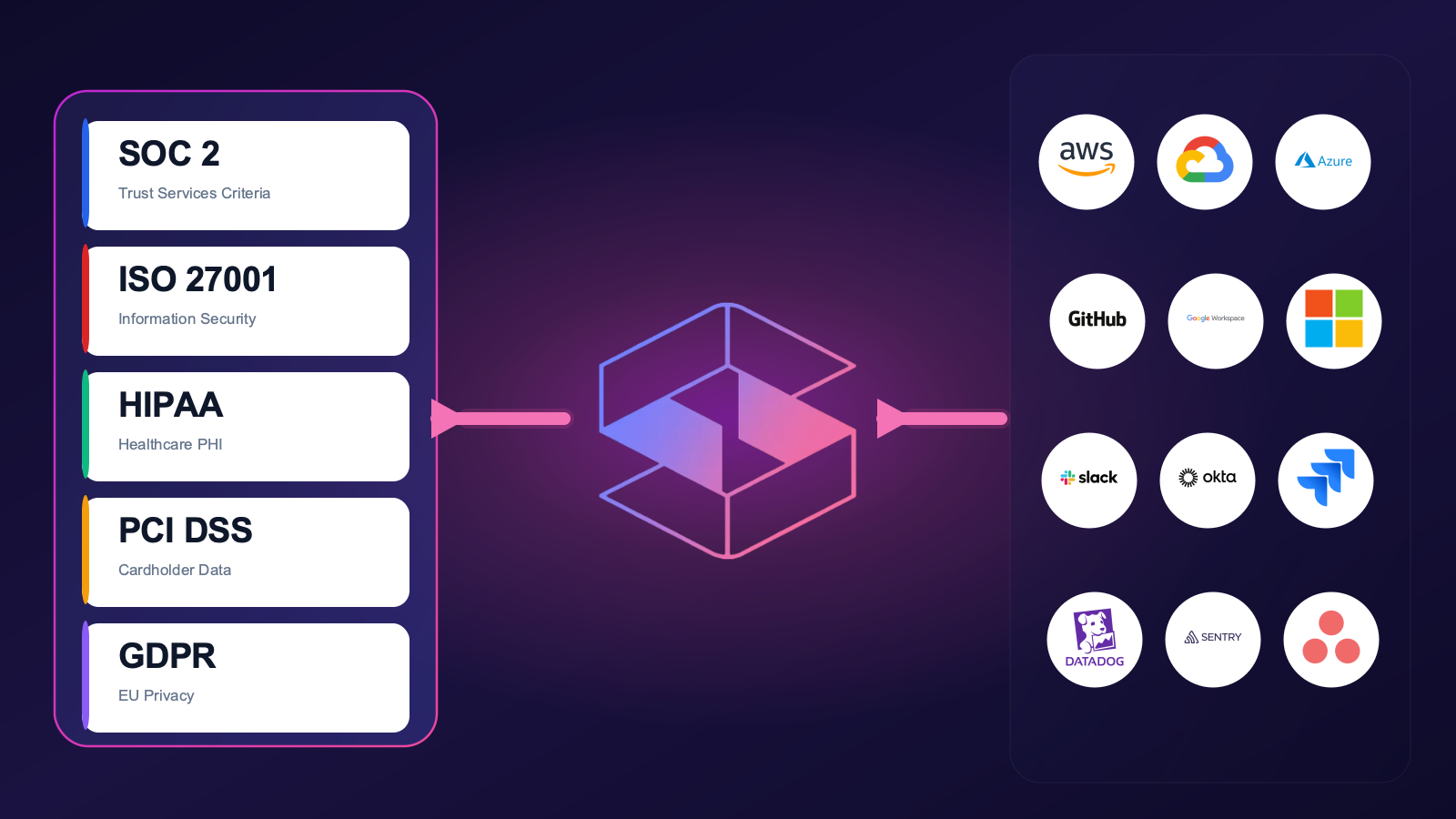
Continuous evidence collection. No screenshots. Strac connects to your AWS, GCP, Azure, Google Workspace, M365, GitHub, Slack, Jira, and 50+ other systems and ingests events continuously. Auditor sampling becomes a one-click export.
DLP evidence built in.SOC 2 controls CC6.6 and CC6.7 cover data classification and protection. Most platforms require a separate DLP integration. Strac ships with Strac DLP — the same product protecting your data generates the audit evidence.
Control drift detection. When a control breaks mid-window (MFA disabled, encryption disabled, a vulnerability scan missed), Strac alerts immediately. The team can remediate inside the window rather than fail the audit at fieldwork.
AI / MCP coverage. AI agents reading your SaaS via Model Context Protocol are a 2026 audit surface. Strac\'s MCP DLP audit logs map to SOC 2 CC6.1 (logical access), CC6.6 (data classification at the tool-call boundary), CC7.2 (anomaly monitoring on agent behavior).
Multi-framework mapping. Same evidence covers SOC 2, HIPAA, ISO 27001, PCI DSS, GDPR, CCPA, EU AI Act, ISO 42001.
[ ] Type 1 done or skipped with clear justification.
[ ] All policies written and acknowledged (information security, access control, change management, incident response, business continuity, vendor management).
[ ] MFA on every privileged account. Sample 10 accounts manually before the window starts.
[ ] Encryption at rest and in transit verified across cloud and SaaS storage.
[ ] Vulnerability scanning running on a documented cadence with SLAs by severity.
[ ] Logging and retention confirmed to cover the full window + audit period.
[ ] Incident response plan documented with at least one tabletop exercise on record.
[ ] Vendor security review process with assessments completed for critical vendors.
[ ] DLP in place across SaaS, cloud, endpoint, and AI surfaces.
[ ] Compliance automation platform deployed (Strac Comply or alternative).
[ ] Auditor engaged with confirmed observation-window start date.
For the deeper version with control-level mapping, see SOC 2 checklist.
SOC 2 Type 2 on autopilot with Strac Comply
Continuous evidence collection across the observation window. DLP evidence built in. Control drift alerts before the auditor finds them. Multi-framework mapping. Strac Comply is the compliance automation platform purpose-built for the security-led teams running Type 2 today.
No. Many companies skip Type 1 and go straight to Type 2 once their controls are stable. Type 1 is useful when you need to hand a SOC 2 report to a customer fast (before your Type 2 window finishes), but it's not a prerequisite.
What's a typical observation window for a first Type 2?
3 to 6 months for a first audit; 12 months for renewals. Shorter windows are acceptable but limit auditor sampling depth, which some enterprise customers notice. 6 months is the common balance for first audits.
What happens if a control fails during the observation window?
A single failure isn't automatically a fatal finding. What matters is whether you detected it, responded appropriately, and adjusted to prevent recurrence. Documented detection + response + corrective action keeps the control "operating effectively" in the auditor's evaluation. Strac Comply\'s drift alerts catch failures within hours so you have time to respond inside the window.
How does Type 2 cost compare to Type 1?
Type 1 audit fees: $15K-$40K. Type 2 audit fees: $25K-$75K. Type 2 is roughly 60% more expensive because of the broader observation window and operating-effectiveness sampling.
How does Strac Comply differ from Drata or Secureframe for Type 2?
The unique angle: Strac Comply ships with Strac DLP and Strac DSPM as part of the same platform. For SOC 2 controls CC6.6 and CC6.7 (data classification and protection), other compliance platforms require you to integrate a separate DLP. Strac generates the data-protection evidence directly. Same vendor, same bill, one control plane covering both data security and compliance evidence.
Can a single SOC 2 Type 2 report cover multiple products?
Yes, if all products fall within the system boundary you defined at scoping. Be careful: broader scope = more controls = more audit hours = higher cost. Many companies scope per product or per business unit.
How long is a SOC 2 Type 2 report valid?
The report covers the specific observation window (e.g., July 1, 2025 - June 30, 2026). Customers generally accept reports up to 12 months past the window close, after which they expect a renewal. Most companies run rolling 12-month Type 2 cycles.
Do AI / LLM workloads need to be in Type 2 scope?
If your service uses or exposes AI — LLM-powered features, AI agents reading your SaaS via MCP, copilots inside your product — auditors increasingly probe AI-system controls under CC6 and CC7. Strac Comply maps Strac DLP and MCP DLP evidence to those controls automatically.
How does Type 2 interact with vendor security questionnaires?
A clean Type 2 report satisfies the bulk of most enterprise security questionnaires. Customers commonly accept the report in lieu of a custom questionnaire (or as the primary evidence backing one). Strac Comply\'s built-in trust center shares your report securely with prospects.
What's the biggest mistake teams make on their first Type 2?
Treating evidence collection as a one-time push at the end of the window. Type 2 is about continuous operation; evidence has to be captured continuously. Companies that wait until month 5 to start collecting end up with sampling gaps the auditor cannot ignore. Continuous automation is non-optional at any reasonable team size.
The Bottom Line
SOC 2 Type 2 is the audit enterprise buyers actually want. The continuous evidence requirement is what separates Type 2 from Type 1 — and what makes compliance automation non-optional. Strac Comply is the only platform that handles compliance evidence and the underlying data security in one product.
No. Many companies skip Type 1 and go straight to Type 2 once their controls are stable. Type 1 is useful when you need to hand a SOC 2 report to a customer fast (before your Type 2 window finishes), but it's not a prerequisite.
What's a typical observation window for a first Type 2?
3 to 6 months for a first audit; 12 months for renewals. Shorter windows are acceptable but limit auditor sampling depth, which some enterprise customers notice. 6 months is the common balance for first audits.
What happens if a control fails during the observation window?
A single failure isn't automatically a fatal finding. What matters is whether you detected it, responded appropriately, and adjusted to prevent recurrence. Documented detection + response + corrective action keeps the control "operating effectively" in the auditor's evaluation. Strac Comply\'s drift alerts catch failures within hours so you have time to respond inside the window.
How does Type 2 cost compare to Type 1?
Type 1 audit fees: $15K-$40K. Type 2 audit fees: $25K-$75K. Type 2 is roughly 60% more expensive because of the broader observation window and operating-effectiveness sampling.
How does Strac Comply differ from Drata or Secureframe for Type 2?
The unique angle: Strac Comply ships with Strac DLP and Strac DSPM as part of the same platform. For SOC 2 controls CC6.6 and CC6.7 (data classification and protection), other compliance platforms require you to integrate a separate DLP. Strac generates the data-protection evidence directly. Same vendor, same bill, one control plane covering both data security and compliance evidence.
Discover & Protect Data on SaaS, AI, MCP, Endpoints & Cloud
Strac provides end-to-end data loss prevention for all SaaS and Cloud apps. Integrate in under 10 minutes and experience the benefits of live DLP scanning, live redaction, and a fortified SaaS environment.


.webp)




.avif)




.gif)
