

September 10, 2026

34
min read
SOC 2 Compliance Software: 10 Platforms Ranked (2026 Guide)
Compare the 10 best SOC 2 compliance software platforms for 2026 — Strac Comply, Vanta, Drata, Secureframe, Sprinto +5 — ranked by real auditor criteria.
Last updated: July 2026
SOC 2 compliance software automates the work of earning and keeping a SOC 2 report — it maps your controls to the Trust Services Criteria, continuously pulls evidence from your cloud, identity, HR, and code systems, and flags gaps before an auditor does.
SOC 2 compliance software is the category of platforms that automate the evidence collection, control monitoring, and policy management required to pass a SOC 2 Type I or Type II audit against the AICPA's Trust Services Criteria. The 2026 market splits into two groups: evidence-only platforms (Vanta, Drata, Secureframe, Sprinto, Thoropass) that satisfy auditors by collecting proof of controls, and evidence-plus-active-security platforms (Strac Comply) that bundle the same evidence layer with the DLP, DSPM, and OAuth governance that actually make the controls effective. This guide compares the 10 leading platforms, the questions auditors will actually ask, what they cost, and how to pick the right one for your team and audit window.
The short answer: the best SOC 2 compliance software in 2026 is Strac Comply (best for SOC 2 plus active data-security evidence in one platform), followed by Vanta (best for a fast first audit), Drata (best for highly automated, multi-framework programs), and Secureframe (best for SMBs that want guided support). Unlike audit-only tools, Strac Comply also runs the DLP that produces your CC6.x data-protection evidence directly — one platform for the audit and the controls it checks.
For buyers who want the fast answer before the deep dive — the top platforms at a glance, with the dimension that actually matters for 2026: does the platform only collect evidence, or does it also perform the data-security work that the controls are supposed to enforce?
If you're shopping for SOC 2 compliance software in 2026, you have already noticed that the first three pages of Google look identical: every platform claims "automated SOC 2 compliance," "continuous control monitoring," and "audit-ready evidence." Most are selling some variation of the same product — a control library bolted onto a few hundred integrations.
That product is real and it works. The problem is that "audit-ready" is not the same as "secure." A platform can collect every piece of evidence your auditor asks for and still leave you exposed to the data leak that triggers the breach disclosure that triggers the next audit.
The traditional compliance automation platforms (Vanta, Drata, Secureframe, Sprinto, Thoropass) were designed for one job: prove that you have a control. They were not designed to verify that the control actually stops anything. The 2017 SOC 2 revision and the 2022 update of the Trust Services Criteria made this gap explicit — auditors are now expected to test the operating effectiveness of controls, not just their existence. The next generation of compliance platforms (Strac Comply being the most fully realized example) bundle evidence collection with active data security: DLP, DSPM, SSPM, OAuth governance, secure share, and vendor questionnaires — all in one platform.
This post compares the 10 most-considered SOC 2 compliance software platforms across both dimensions: the evidence layer (does it generate the audit package?) and the security layer (does it actually find and fix the data exposures the audit will catch?).
Quick answer: The best SOC 2 compliance software in 2026 is Strac Comply (soc 2 + active data security in one platform), Vanta (first soc 2 audit, fastest time to evidence), Drata (highly automated soc 2 + multi-framework programs) — with the full ranked shortlist of 10 platforms, auditor criteria, and a comparison table below.
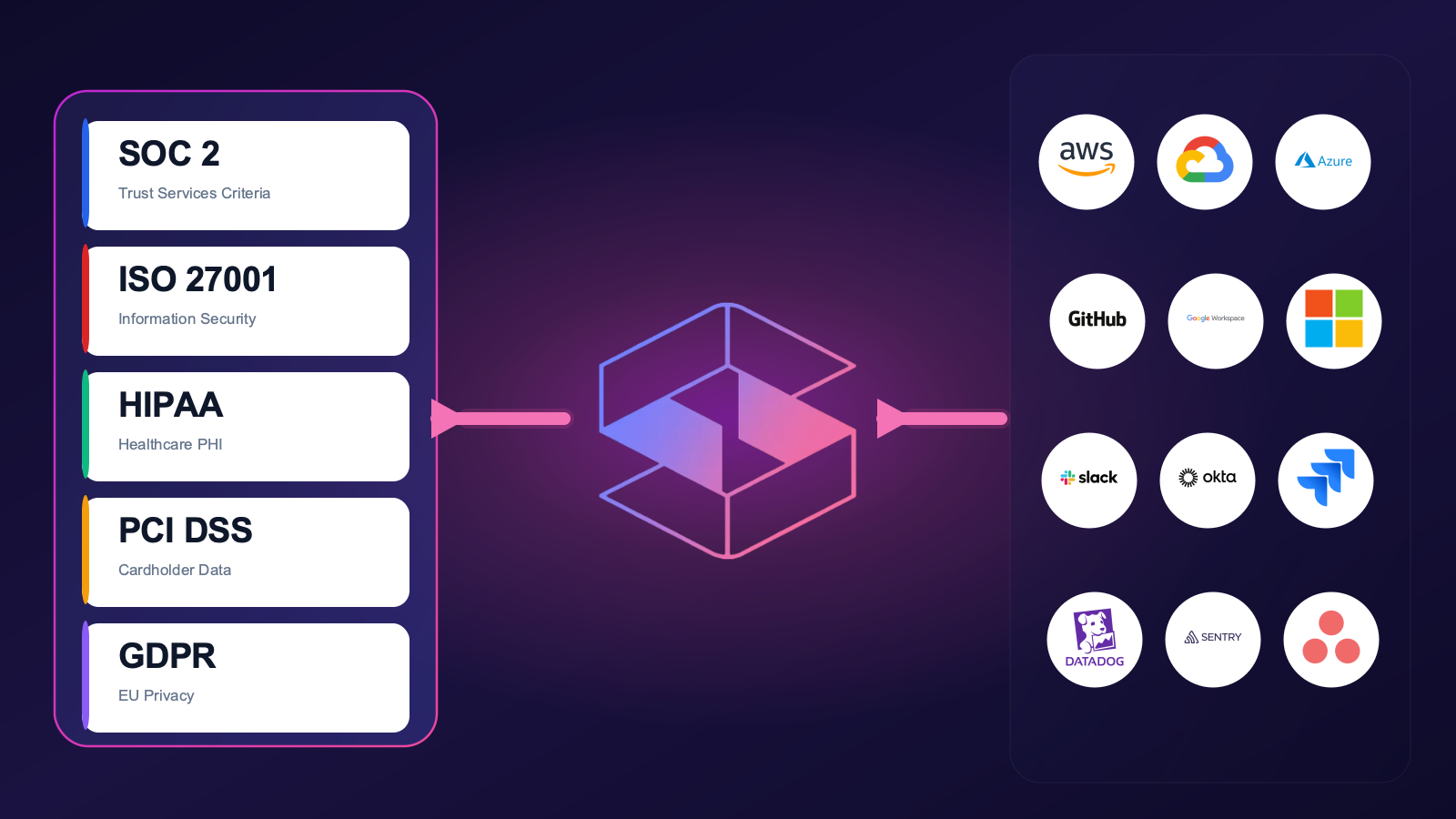
Looking for the fastest path to SOC 2? Strac Comply is the AI-native compliance automation built for SOC 2, HIPAA, ISO 27001, GDPR, and PCI DSS — with the deepest DLP integration in the market (Strac is the only platform that combines compliance automation with continuous data security across SaaS, cloud, endpoint, and AI agents). Start at comply.strac.io →
SOC 2 compliance software is any platform that helps organizations prepare for and continuously maintain a System and Organization Controls 2 examination — the audit framework defined by the AICPA that B2B SaaS, cloud providers, fintech, and most data-handling vendors are now required to pass to sell to enterprise customers. You'll also see this category called SOC 2 compliance automation software, a SOC 2 automation platform, or simply SOC2 software — same tooling, different search terms.
The term itself is broader than most buyers realize. A modern SOC 2 compliance platform should cover:
The first three platforms (Vanta, Drata, Secureframe) cover the first two bullets very well and most of policy/training. The newer generation (Strac Comply) covers all of them — including the data-security layer that's the substance of CC6.x.
A tool that only collects evidence will leave you audit-ready, but it will not stop your auditor from flagging that customer Social Security numbers are sitting unencrypted in a Slack channel that the platform never scanned. That's the gap this comparison is about.
SOC 2 comes in two flavors. They are not interchangeable, and the software requirements differ.
| SOC 2 Type I | SOC 2 Type II | |
|---|---|---|
| What it tests | Design of controls at a single point in time | Design and operating effectiveness over a period (usually 3–12 months) |
| When auditor visits | Once | Twice (at start + during/after the period) |
| Evidence required | Snapshot screenshots, policy docs, system descriptions | Continuous logs, access review records, ticket trails, MFA enforcement evidence, drift alerts |
| Typical timeline | 30–60 days | 3–12 months observation + audit |
| Customer acceptance | Some enterprises, most SMBs | Required by most enterprise procurement teams |
| What software you need | Control mapping + policy generator | Continuous evidence + drift detection + audit trail logging — the full kit |
Most companies start with Type I to land their first contracts, then convert to Type II in the same calendar year. The compliance software you choose at Type I will determine whether the Type II observation window is painful (manual evidence rebuilding) or painless (continuous logs already running).
Every SOC 2 audit covers Security (mandatory). The other four — Availability, Processing Integrity, Confidentiality, Privacy — are optional, chosen based on what your customers ask for.
| TSC | What it covers | Who chooses it |
|---|---|---|
| Security | Protection against unauthorized access (the baseline; always required) | All SOC 2 reports |
| Availability | System uptime and operational performance | Hosting / SaaS customers |
| Processing Integrity | System processing is complete, valid, accurate, timely | Payments, healthcare claims, anyone whose output customers depend on |
| Confidentiality | Data designated confidential is protected | Most B2B SaaS handling customer business data |
| Privacy | Personal information is collected, used, retained, disclosed in line with stated policy | Anyone handling consumer PII |
The Security TSC is implemented through 9 Common Criteria categories (CC1 through CC9). Every SOC 2 audit will examine each:
| # | Common Criteria | What software does for you |
|---|---|---|
| CC1 | Control environment (governance, ethics, oversight) | Org chart, code of conduct, board reporting templates |
| CC2 | Communication and information | Internal policies, security awareness, training records |
| CC3 | Risk assessment | Risk register, treatment plan, ongoing risk monitoring |
| CC4 | Monitoring activities | Continuous control monitoring, internal audits, vuln scans |
| CC5 | Control activities (general) | Policy approvals, change management, segregation of duties |
| CC6 | Logical and physical access controls | IAM, MFA, access reviews, DLP, encryption |
| CC7 | System operations (incident response, monitoring) | SIEM, alerting, IR playbooks, post-mortems |
| CC8 | Change management | Change control workflow, code review, deployment approvals |
| CC9 | Risk mitigation (vendor risk, BCDR) | Vendor questionnaires, BCDR plans, exit testing |
CC6 is where most SOC 2 audits actually drill in. It explicitly covers data protection (CC6.1, CC6.2, CC6.3), data classification (CC6.5), data transmission (CC6.7), and disposal (CC6.5). It is also where most "SOC 2 compliance software" tools quietly leave a gap — they can attest that you have a DLP policy; they cannot prove the policy is working unless you bolt on a real DLP. The newest platforms (Strac Comply) collapse those layers.
We compared each platform on nine dimensions that matter to a working SOC 2 program — based on vendor documentation, public datasheets, customer reviews on G2 and Gartner Peer Insights, and direct hands-on time with the platforms our team has access to:
The pattern that emerges: most legacy compliance platforms cover #1, #2, and parts of #6 well — but not the data-security capabilities (#3–#5, #7) that CC6.x increasingly demands at the operating-effectiveness level. The newest generation (Strac Comply) bundles both layers in one platform.
We tried to be honest about what each platform is and isn't. There's no single platform that's "best at everything" — but there is one new generation that does meaningfully more than collect evidence. Below: ranked by total capability for an active SOC 2 program (not just an audit checkbox).
Strac Comply is the newest generation of compliance automation: instead of stopping at evidence collection, it bundles control mapping + audit reporting with the actual security capabilities your auditor expects to see working — DLP, DSPM, SSPM, third-party OAuth governance, secure share, vendor risk questionnaires, and pen test orchestration. Said differently: traditional compliance platforms tell you what to do; Strac Comply does it.
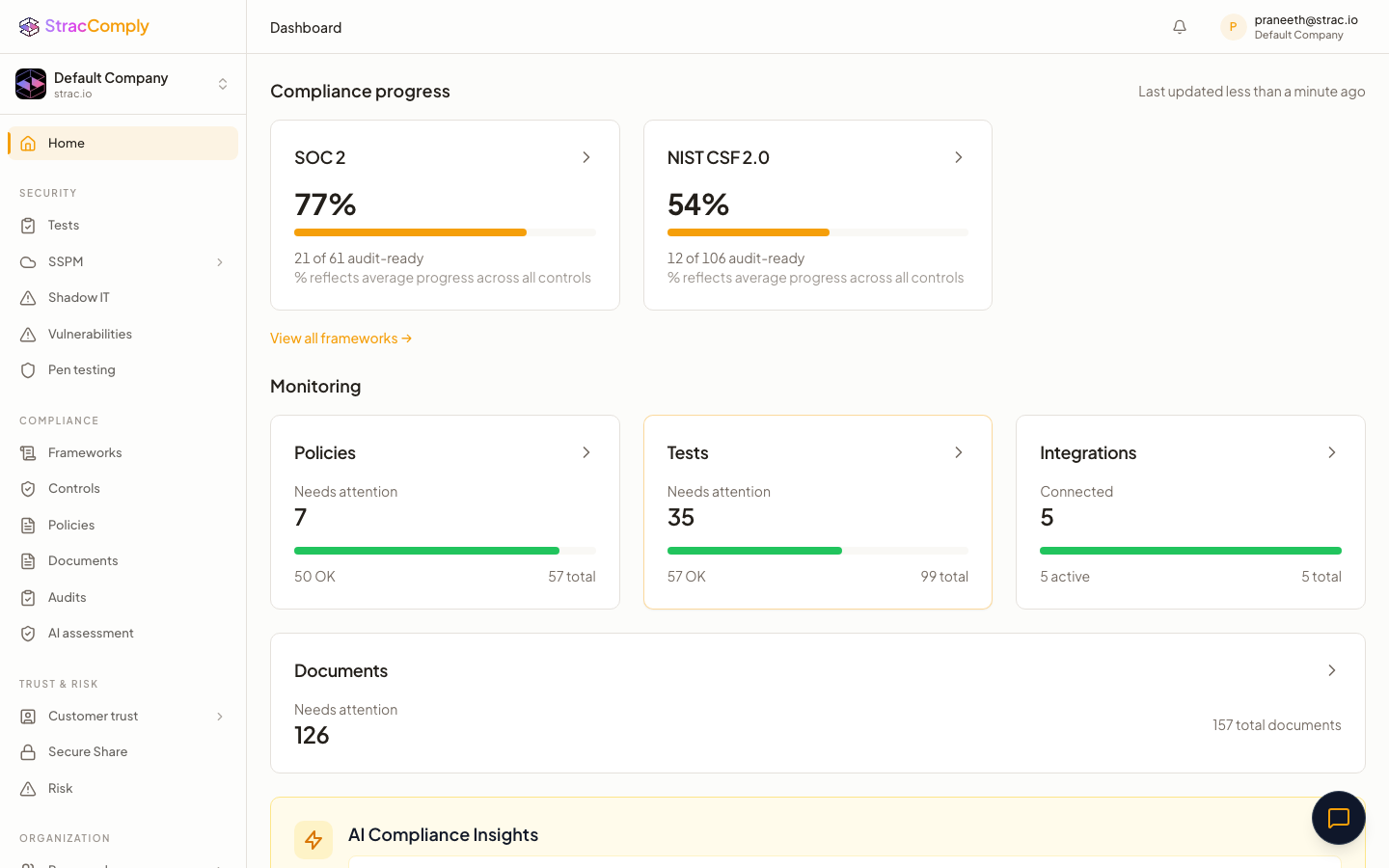
SOC 2 is Strac Comply's flagship framework. The platform ships with the full Common Criteria control library mapped, evidence templates per CC, and continuous tests (146 automated checks at last count) that map directly to the controls your auditor will examine.
What's included in Strac Comply:
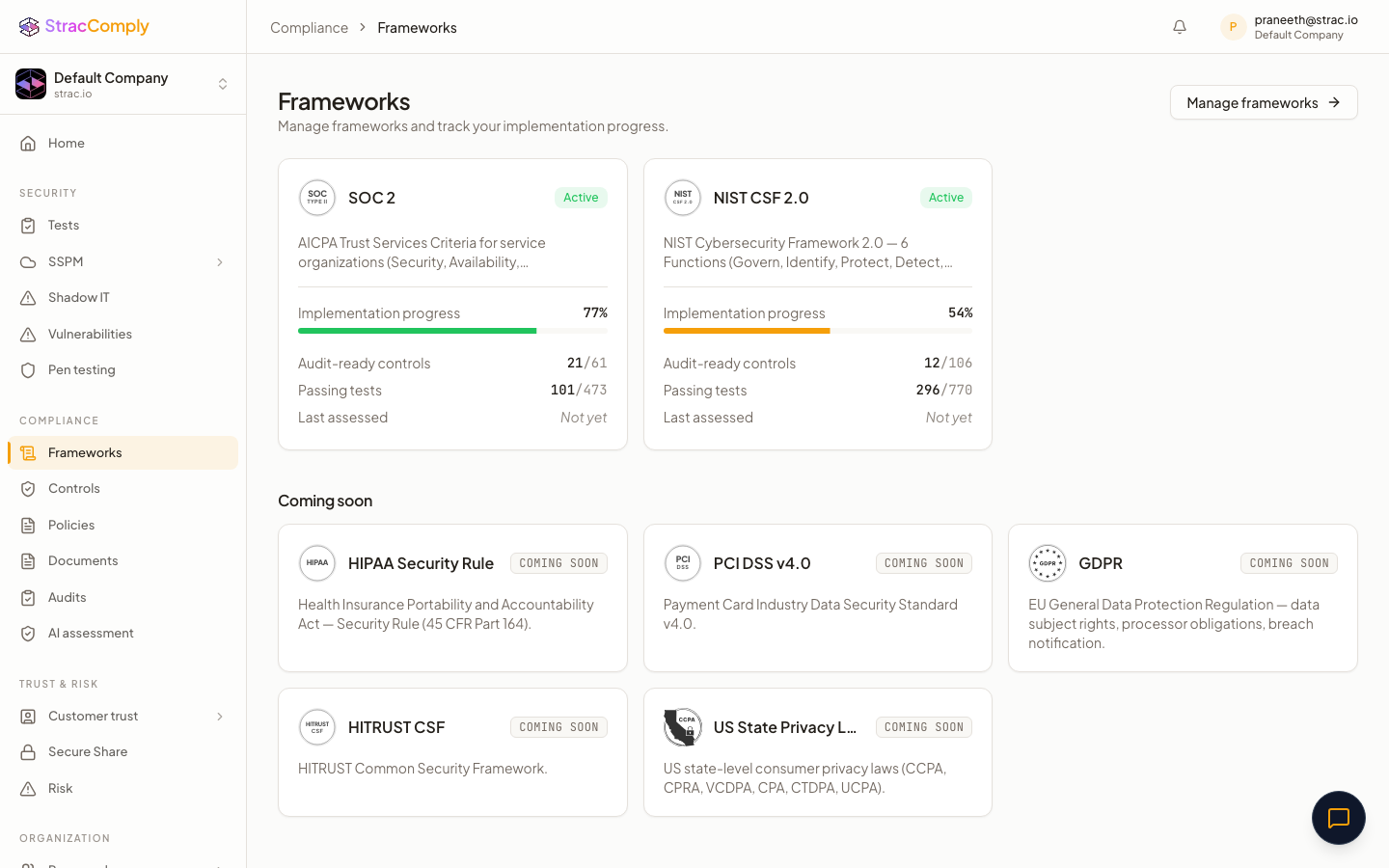
- Control mapping + evidence collection for SOC 2 Trust Service Criteria + Common Criteria, NIST CSF 2.0, and ISO 27001 — with PCI DSS, HIPAA, and GDPR rolling out throughout 2026
- Continuous control monitoring — alerts when MFA is missing, access reviews are overdue, encryption settings drift, audit log retention is misconfigured, root account is used
- DLP + DSPM (built-in, not an add-on) — discovers and classifies PII, PHI, PCI, secrets, and any custom-defined sensitive data across SaaS, cloud, and endpoint sources via 100+ integrations
- Browser DLP for AI tools — blocks employees from pasting customer PII into ChatGPT, Claude, Gemini, Copilot, Perplexity, Cursor at the browser layer in real time
- OCR + ML-based detection inside images, PDFs, DOCX, XLSX, ZIP archives — finds PII inside JPEG screenshots, scanned PDF invoices, embedded Excel attachments, ZIP'd backups
- Full-spectrum remediation — redact, mask, label, alert, delete, revoke OAuth access, remove public-link access, remove external collaborators, all automated
- SSPM (SaaS security posture management) — continuously discovers third-party SaaS apps and risky OAuth permissions connected to your Google Workspace and M365
- Pen test orchestration for CC4.x and vulnerability evidence
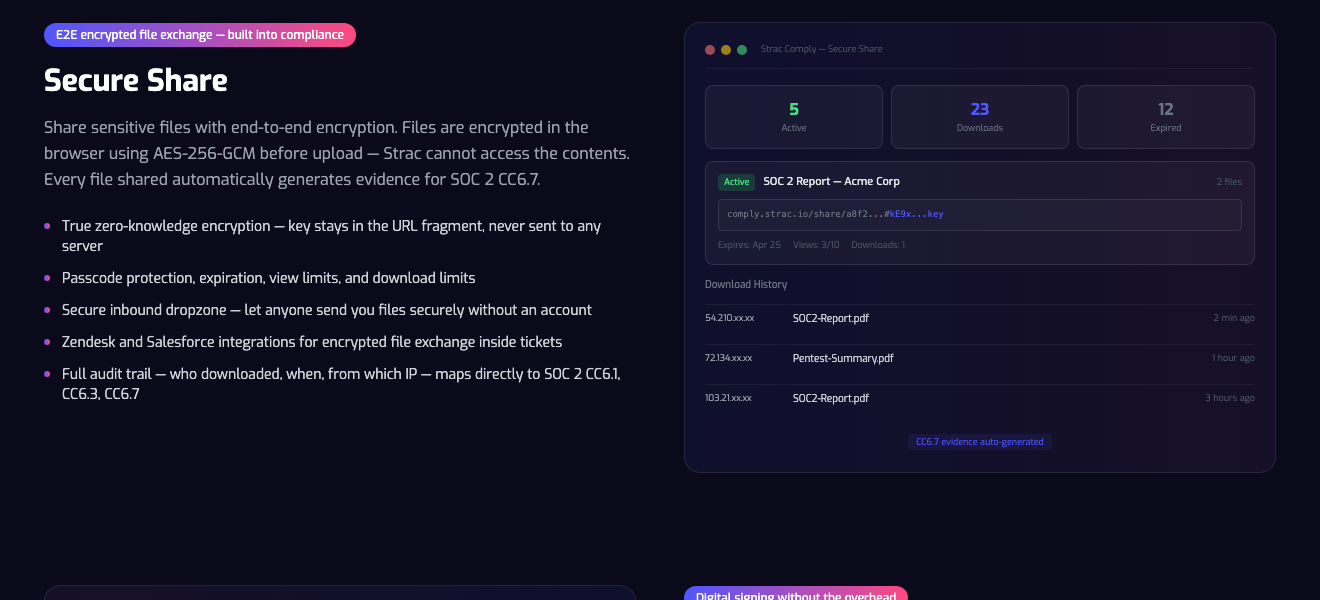
- Secure share — send SOC 2 reports, audit attestations, security packages to customers and auditors with end-to-end encryption (no more Dropbox links)
- Vendor risk + security questionnaires — outbound vendor reviews, inbound customer questionnaires (SIG, CAIQ, custom), AI-drafted answers from your evidence library
- Trust portal — public-facing SOC 2 posture for sales enablement
- AI Compliance Insights — proactive recommendations on which controls to prioritize, which evidence is going stale, and which gaps will block your next audit
Capabilities at a glance:
- SOC 2 framework: ✅ Native — full Common Criteria mapping (CC1–CC9), Trust Service Criteria coverage, 65 controls, 146 tests, 93 required evidence documents tracked
- Evidence automation: ✅ Auto-collected from 100+ integrations with continuous monitoring
- Customer-data discovery: ✅ Slack, Google Workspace, M365, Zendesk, Salesforce, Notion, Jira, GitHub, Box, Dropbox, Intercom, HubSpot, AWS S3, Azure Blob, GCS, endpoint
- Format coverage: ✅ JPEG, PNG, PDF (text + scanned via OCR), DOCX, XLSX, ZIP, embedded files, chat messages, email
- Real-time prevention: ✅ Browser DLP for ChatGPT, Claude, Salesforce, Notion, Jira, custom apps; email DLP for Gmail, M365
- Remediation: ✅ Redaction, masking, labeling, alerting, deletion, OAuth revocation, public-access removal, external-member removal
- SSPM + third-party OAuth: ✅ Native
- Vendor questionnaires: ✅ Inbound + outbound, AI-drafted answers
- Secure share: ✅ E2E encrypted
- Integrations: 100+
- Deployment: agentless API-based; under 10 minutes per integration
Where it covers SOC 2:
- CC1–CC2 (governance + comms): Org charts, code of conduct, employee training acknowledgments, policy versioning
- CC3 (risk): Risk register linked to controls, ongoing risk monitoring, treatment plans
- CC4 (monitoring): 146 continuous tests, internal audit workflows, pen test orchestration
- CC5 (control activities): Change-management evidence pulled from GitHub/GitLab, segregation-of-duties checks
- CC6 (logical access + data protection): IAM evidence + native DLP + DSPM. This is where Strac differentiates most heavily — most "SOC 2 compliance software" tools attest you have a DLP policy; Strac is the DLP, so you get evidence of operating effectiveness, not just policy existence.
- CC7 (operations + IR): Audit log aggregation, alerting integrations, IR runbook templates
- CC8 (change management): GitHub / GitLab / Jira integration evidence
- CC9 (vendor + BCDR): Vendor questionnaires, attestation tracking, BCDR plan templates
Pair with:
- A vulnerability scanner (Qualys, Tenable, Rapid7) for CVE-level scanning, alongside Strac's pen test orchestration
- An EDR (CrowdStrike, SentinelOne, Microsoft Defender) for endpoint malware (CC6.8)
Best for: Mid-market and enterprise SaaS, fintech, healthcare, and any organization that wants its compliance platform to also be its data security platform. Especially powerful for teams that buy DLP, DSPM, GRC, vendor management, and SSPM separately today and want to consolidate.
Vanta is the GRC market leader for SOC 2 — by sheer customer count, the most-purchased platform in the category. It's excellent for the audit-readiness layer: control mapping, automated evidence collection from 375+ integrations, vendor risk reviews, employee training acknowledgments, auditor portal. Most companies that pass their first SOC 2 audit on a tight timeline use Vanta.
Capabilities at a glance:
- SOC 2 framework: ✅ Native (Type I + Type II), with strong auditor-portal handoff
- Evidence automation: ✅ Strong — control mapping, evidence requests, mapped to many auditor templates
- Customer-data discovery (DLP): ❌ Vanta scans configuration metadata, not file or message content
- Real-time prevention: ❌ Not in scope
- SSPM / OAuth governance: ⚠️ Limited — basic third-party app discovery in Google Workspace
- Vendor questionnaires: ✅ Inbound + outbound
- Integrations: 375+ (the largest in the legacy GRC category)
Where it helps SOC 2:
- CC1, CC2, CC3, CC5, CC7, CC8 — strong (collects MFA evidence, access reviews, log retention attestations, policy approvals, change management)
- CC6 — partial (collects metadata about access controls but does not scan the actual content for sensitive data)
- CC9 — strong vendor questionnaire workflow
Best for: Companies on a tight SOC 2 Type I deadline (under 60 days) who want the fastest path to auditor-ready evidence and have a data-security stack already in place to fill the CC6 content-scanning gap.
Drata's strength is the same as Vanta's (GRC + evidence collection) with slightly stronger automation around control monitoring and a cleaner UX. Customers consistently rate Drata's continuous-monitoring workflow as the most polished in the category. Multi-framework users (SOC 2 + ISO 27001 + HIPAA) often prefer Drata's unified control library.
Capabilities at a glance:
- SOC 2 framework: ✅ Native, well-supported Type I + Type II
- Evidence automation: ✅ Strong, with cleanest continuous-monitoring UX in the category
- Data discovery (DLP): ❌ Same architectural category as Vanta — GRC, not DLP
- SSPM: ⚠️ Limited
- Real-time prevention: ❌
- Vendor questionnaires: ✅
- Integrations: 200+
Best for: SOC 2 + ISO 27001 + HIPAA teams that want continuous control monitoring, a single GRC pane, and cleaner UX than Vanta — paired with a separate DLP for CC6.7 and CC6.5.
Secureframe targets SMB and lower mid-market with a focus on bundled employee training, vendor risk, and trust portal. The training experience is the most polished of the major three (Vanta, Drata, Secureframe) — useful when you don't want to operate a separate training LMS.
Capabilities at a glance:
- SOC 2 framework: ✅ Native
- Evidence automation: ✅ Strong
- Data discovery (DLP): ❌ GRC category
- Vendor questionnaires: ✅
- Trust portal: ✅
- Integrations: 175+
Best for: SMB SaaS that needs SOC 2 + ISO 27001 evidence and wants employee training, vendor management, and a polished trust portal bundled in.
Sprinto is positioned for startups (Series A through C) that need SOC 2, HIPAA, and ISO 27001 evidence quickly with an opinionated onboarding flow. Sprinto's first-audit-success metric is one of the highest in the category — they optimize for "your first SOC 2 in 90 days."
Capabilities at a glance:
- SOC 2 framework: ✅ Native (opinionated)
- Evidence automation: ✅ Workflow optimized for first-audit speed
- Data discovery (DLP): ❌ GRC category
- Vendor questionnaires: ✅
- Integrations: 175+
Best for: Founders with no security team who need their first SOC 2 evidence quickly. You'll still need a DLP for CC6.7 content scanning.
Thoropass (formerly Laika) bundles GRC software with auditor services — they help you prepare for and pass the audit, not just collect evidence. Their CPA partner network means the audit firm is part of the platform, which removes the back-and-forth of auditor-vendor handoffs.
Capabilities at a glance:
- SOC 2 framework: ✅ Native + bundled auditor services
- Evidence automation: ✅
- Data discovery (DLP): ❌ GRC, not data scanning
- Vendor questionnaires: ✅
- Integrations: 100+
Best for: Companies that want their compliance software vendor to also be their audit firm. Not a substitute for a DLP — but eliminates one vendor handoff.
AuditBoard is the enterprise GRC heavyweight — used by large enterprises for internal audit, SOX compliance, ESG, and broader enterprise risk programs. SOC 2 is one of dozens of frameworks it supports. The platform is overkill for most mid-market SOC 2 scope but unparalleled when you have an internal audit team running multiple programs in parallel.
Capabilities at a glance:
- SOC 2 framework: ✅ Supported via the broader compliance module
- Evidence automation: ✅ Strong, with deep workflow capabilities
- Data discovery (DLP): ❌ Not in scope
- Vendor questionnaires: ✅ Strong
- Integrations: 200+
Best for: Public companies, regulated enterprises, and anyone with a dedicated internal audit team running SOX + SOC 2 + ESG + ERM in parallel.
Hyperproof is a mid-market GRC platform with strong SOC 2 support and a focus on continuous compliance workflows. Less SaaS-native than Vanta/Drata; more operations-heavy.
Capabilities at a glance:
- SOC 2 framework: ✅ Native
- Evidence automation: ✅ Strong with workflow automation
- Data discovery (DLP): ❌ Not in scope
- Vendor questionnaires: ✅
- Integrations: 70+
Best for: Mid-market companies that already have a security team and want a workflow-heavy GRC platform.
OneTrust acquired Tugboat Logic in 2021 and integrated it into the broader OneTrust platform. Strong overlap between SOC 2 (Confidentiality / Privacy TSCs) and privacy compliance (GDPR / CCPA) — useful when both are in scope.
Capabilities at a glance:
- SOC 2 framework: ✅ Native
- Evidence automation: ✅
- Data discovery (DLP): ❌ (separate OneTrust modules exist for data discovery, but they're sold separately and not included in the GRC bundle)
- Vendor questionnaires: ✅ Industry-leading
- Integrations: 200+
Best for: Companies with significant privacy obligations (GDPR + CCPA + LGPD) that also need SOC 2 in one vendor.
Strike Graph competes in the same SMB / mid-market space as Sprinto and Secureframe with a focus on predictable pricing and bundled audit-readiness services.
Capabilities at a glance:
- SOC 2 framework: ✅ Native
- Evidence automation: ✅
- Data discovery (DLP): ❌
- Vendor questionnaires: ✅
- Integrations: 100+
Best for: SMB SaaS that wants compliance bundled with audit guidance.
| Platform | SOC 2 native | DLP / data discovery | Browser DLP | SSPM + OAuth | Integrations | AI agent (MCP) |
|---|---|---|---|---|---|---|
| Strac Comply | ✅ Native | ✅ Full (OCR + ZIP) | ✅ | ✅ Native | 100+ | ✅ Read + write |
| Vanta | ✅ Native | ❌ | ❌ | ⚠️ Basic | 375+ | ⚠️ Chat only |
| Drata | ✅ Native | ❌ | ❌ | ⚠️ Basic | 200+ | ⚠️ Chat only |
| Secureframe | ✅ Native | ❌ | ❌ | ⚠️ Basic | 175+ | ⚠️ Chat only |
| Sprinto | ✅ Native | ❌ | ❌ | ❌ | 175+ | ❌ |
| Thoropass | ✅ + audit | ❌ | ❌ | ❌ | 100+ | ❌ |
| AuditBoard | ✅ Enterprise | ❌ | ❌ | ❌ | 200+ | ❌ |
| Hyperproof | ✅ Native | ❌ | ❌ | ❌ | 70+ | ❌ |
| OneTrust GRC | ✅ Native | ❌ separate | ❌ | ❌ | 200+ | ❌ |
| Strike Graph | ✅ Native | ❌ | ❌ | ❌ | 100+ | ❌ |
All 10 platforms support evidence automation, vendor questionnaires, and policy/training. The differences above are the capabilities most "SOC 2 compliance software" tools quietly skip — the ones CC6 actually depends on at the operating-effectiveness level.
Use this checklist on every demo. The vendors that don't have good answers are the vendors that fail you in your auditor's CC6 walkthrough.
The 15 questions to ask every vendor before you sign — plus the auditor criteria most teams miss. We’ll email you the scorecard.
No spam. Unsubscribe anytime.
Based on what working CPAs publicly write, post-engagement debriefs, and patterns in AICPA published guidance, the disconnect between what compliance software sells and what auditors actually flag is significant.
What vendors emphasize in marketing:
- Number of integrations (200+, 300+)
- Pre-built control libraries
- Automated evidence collection
- Trust portal as a side benefit
What auditors actually flag in real SOC 2 reports:
1. Customer PII in non-compliant systems — by far the #1 CC6 finding. A customer SSN found in Slack, in a Jira ticket, in a Confluence wiki, in a customer support email reply. The vendor's "automated evidence collection" said nothing about it because the vendor never looked at content.
2. Stale access reviews — quarterly access reviews that "happened" but with no evidence of who reviewed what, or with rubber-stamp approvals.
3. AI tool usage with customer data — agents using ChatGPT, Claude, or Copilot to "summarize this customer issue" and pasting full PII into the prompt. A 2025 audit observation that's now common.
4. Vendor scope drift — your scope at audit time included payment processor X. Two years later, finance also moved a flow to processor Y. Your compliance software didn't know about Y because nobody told it.
5. Backup / archive sprawl — full-disk backups of agent laptops sometimes contain ephemeral customer data the agent saw on screen. Almost nobody scans backup archives.
6. Old crypto — TLS 1.0/1.1 endpoints that weren't decommissioned, weak cipher suites, expired certificates.
7. Unmonitored OAuth grants in Google Workspace / M365 — third-party SaaS apps with broad OAuth scopes ("read all email," "manage calendars") that nobody approved.
8. Pen test findings without remediation evidence — CC4.x expects observable remediation of pen test findings, not just the report.
The pattern: 5 of 8 of the top auditor findings are findings that GRC-only platforms (Vanta, Drata, Secureframe) cannot find because they don't look at content. That's the gap a real DLP fills.
SOC 2 Type II requires continuous operating effectiveness — controls must operate throughout the observation window, not just at audit time. Software helps with monitoring (Drata, Vanta, Strac Comply for the GRC layer; Strac DLP for continuous data scanning).
GRC tools attest that you have a control. They don't attest that the control is working. The auditor finds the gap when they grep for customer SSNs in your Slack history during the CC6 walkthrough.

Confidentiality applies to any data your customer designates confidential — business plans, contracts, internal financials, personnel data. Most B2B SaaS handle plenty of customer Confidential data. Skipping the TSC means your enterprise sales team will lose deals where the prospect requires it.
2024–2025 AICPA guidance has clarified that AI / ML systems handling customer data are in CC6 scope. ChatGPT, Claude, Copilot, Gemini are all common destinations for accidentally-pasted customer PII. Browser DLP is the only practical control.
Customer support agents screenshot customer data to ask a colleague a question. The screenshot ends up in Slack, in Notion, in someone's Google Drive. Most DLP tools cannot OCR a JPEG screenshot. Strac is the exception.
CC1.x and CC2.x training requirements are increasingly evaluated for effectiveness, not just completion. If an employee gets a real-time prompt ("you just tried to paste a customer SSN into ChatGPT — here's why we blocked it"), that's far more effective evidence than the annual e-learning module.
CC6.2 expects evidence of who accessed what customer data and why. Most teams have access controls. Few have logging of every access event tied to a specific user and business purpose, especially for unstructured data in SaaS.
You connect a SaaS app to Google Workspace; it asks for "read all Gmail" or "manage all calendars." Nobody reviewed it. Two years later, your auditor's CC6.1 / CC6.7 walkthrough finds 30 third-party apps with broad scopes that haven't been reviewed since onboarding. The SSPM and OAuth-discovery layer in Strac Comply catches this drift continuously.
SOC 2 reports are not standardized. Two firms can audit the same controls and produce different reports, especially around the qualifications and observations. Modern compliance software helps you produce evidence that any auditor will accept; software alone doesn't.
For full context on Strac's SOC 2 capabilities, see our SOC 2 Compliance & DLP page.
The short version of how Strac Comply approaches SOC 2:
1. Connect every SaaS app, cloud account, and endpoint where customer data could flow. Under 10 minutes per integration, fully agentless: Slack, Google Workspace, M365, Zendesk, Salesforce, Jira, Notion, GitHub, Box, Dropbox, Intercom, HubSpot, AWS S3, Azure Blob, GCS, and more — 100+ integrations in total.
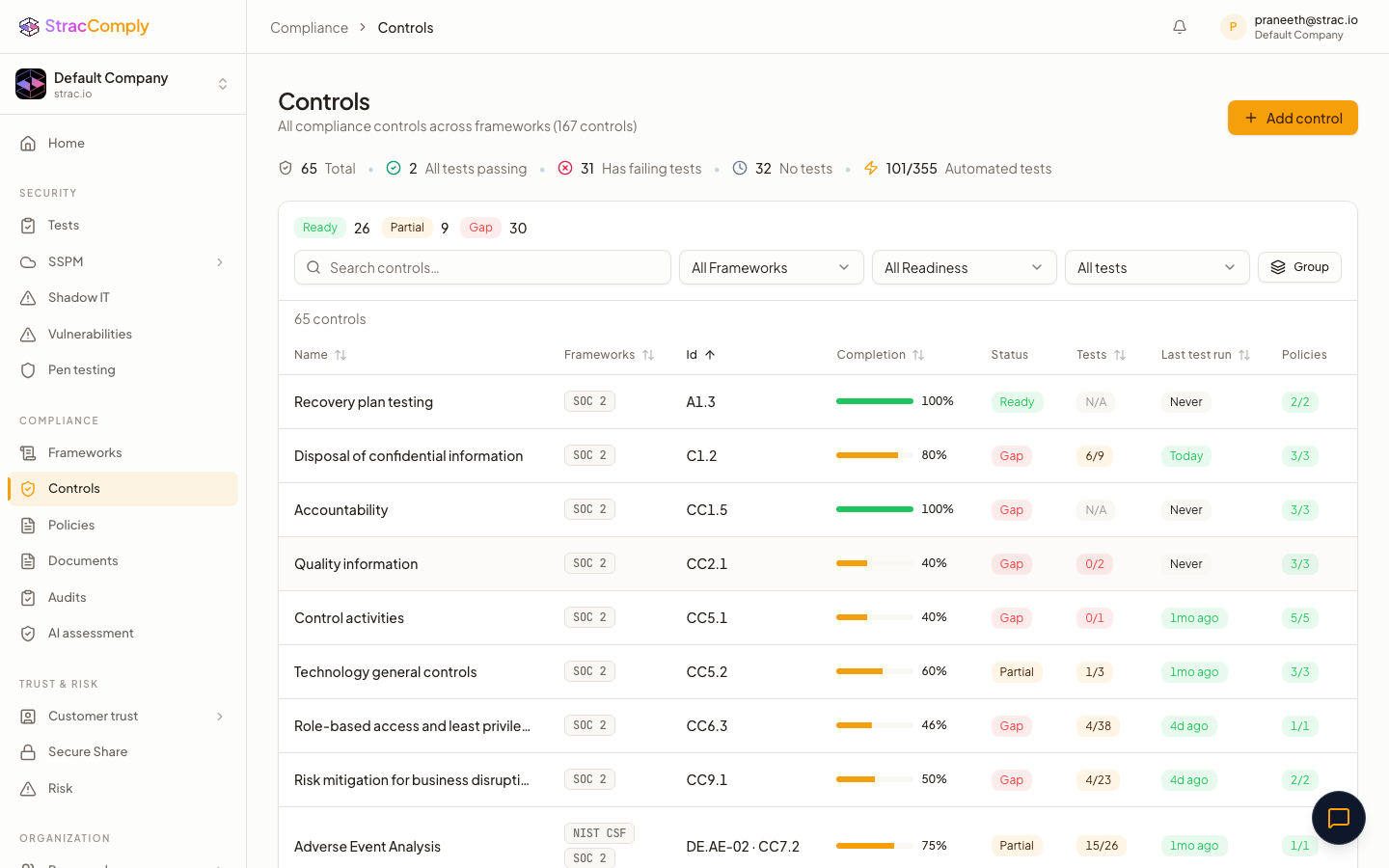
2. Map your controls to the SOC 2 Common Criteria. Strac Comply ships with the full CC1–CC9 + Trust Service Criteria control library — 65 controls, each tied to specific tests and required documents. The platform runs 146 automated tests continuously and shows each control's completion status (Ready / Partial / Gap).
3. Continuous data discovery across every connected source (CC6.5, CC6.7). Strac scans every message, file, ticket, and attachment — including inside PDFs, JPEGs, PNGs, DOCX, XLSX, ZIP archives, and even chat messages and emails — for PII (SSN, credit card, email + name pairs), PHI, secrets, and any custom-defined sensitive data. Detection uses regex + validation logic, an OCR engine, and an ML classifier.
4. Real-time prevention at the entry point (CC6.7). Browser DLP blocks employees from pasting PII into ChatGPT, Claude, Gemini, Copilot, Salesforce, Notion, Jira, custom apps. Email DLP catches PII leaving via Gmail or M365. Slack DLP catches PII in DMs and channels. Endpoint DLP catches PII in copy/paste and file uploads.

5. Full-spectrum automated remediation. When sensitive data is found, Strac can redact, mask, label, alert, delete, revoke OAuth access, remove public-link access, or remove external collaborators — based on policies you set. No manual ticket triage.
6. Audit-ready evidence for every Common Criterion. Strac Comply maps continuous DLP findings, MFA enforcement, access reviews, training completions, vendor attestations, change-management records, and policy approvals against your SOC 2 control library. The platform tracks 93 required documents (org chart, background checks, performance evals, employee agreements, IR runbooks, BCDR plans) with each document tied to specific Common Criteria.


7. SSPM + third-party OAuth governance (CC6.1, CC6.7, CC9.2). Strac continuously discovers third-party SaaS apps and OAuth permissions connected to your Google Workspace and M365 — catching scope creep and risky third-party grants before your auditor does.
8. Vendor risk + security questionnaires (CC9.2). Send outbound questionnaires to your vendors. Receive and respond to inbound customer questionnaires (SIG, CAIQ, custom). Strac Comply's AI drafts answers from your evidence library — your team reviews and approves inline instead of hand-writing every response.


9. Pen test orchestration (CC4.x). Bundled or BYO pen test firm; findings flow directly into your control evidence and remediation tracking — closing the gap auditors flag when remediation evidence is missing.
10. Trust portal + secure share. Public trust portal at comply.strac.io/trust-portal/{slug} for customer-facing security posture. Secure share for sending SOC 2 reports and audit attestations to customers and auditors with end-to-end encryption — no more uploading to Dropbox or attaching to email.
For a deep walkthrough of how the platform handles a real SOC 2 control, see our companion post on PCI DSS compliance software.

Most SOC 2 compliance software makes you click through a dashboard. Strac Comply also runs headless: your AI agent — Claude Code, Cursor, or Claude Desktop — connects directly to your compliance workspace and does the work. Ask it “where are we on SOC 2 CC6?” and it reads your live controls, policies, and test evidence, then answers from your real posture instead of generic advice. Tell it to draft an access-control policy or attach evidence to a control, and it writes straight into your SOC 2 binder — without you leaving your editor.
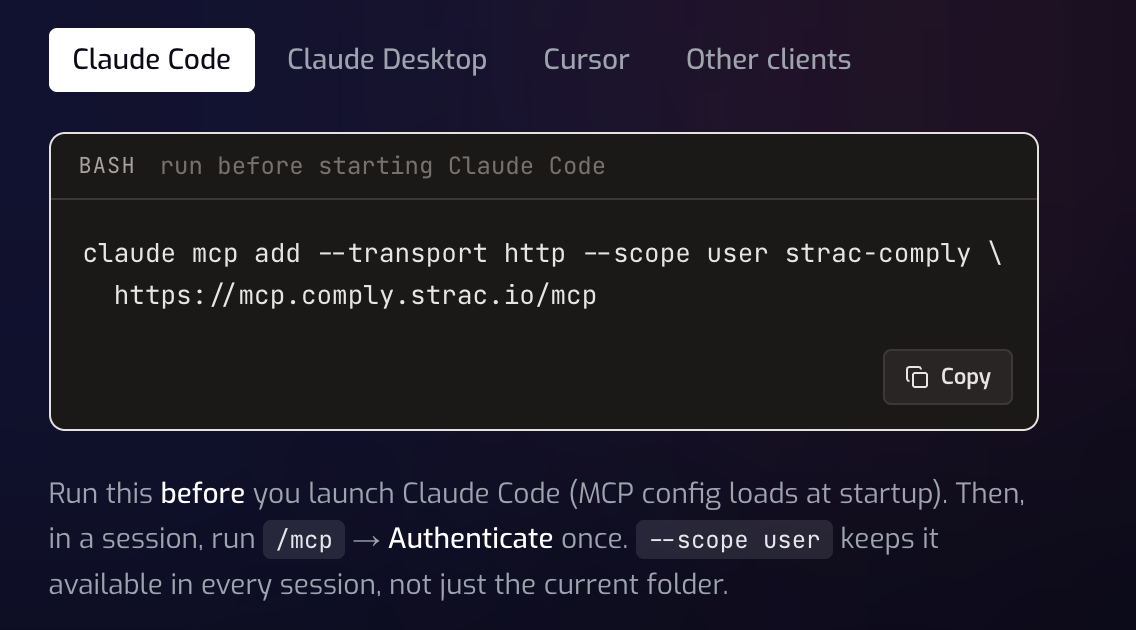
This isn’t a chatbot bolted onto a GRC tool. It’s the Model Context Protocol (MCP) exposing your tenant as real tools your agent can call. Connecting takes one line:
claude mcp add --transport http --scope user strac-comply \
  https://mcp.comply.strac.io/mcp
Every write — a drafted policy, an attached evidence file, a control marked Not Applicable — lands in an append-only audit log stamped with the AI’s own identity. Access is scoped and revocable (OAuth 2.1, with granular permissions like read-only compliance access versus policy-write), so the agent only ever touches what you authorize. That’s the part auditors actually care about: the AI handles the busywork, but every action stays attributable and reversible.
Connect once and your agent takes on the parts of SOC 2 that used to eat a week — evidence collection, policy drafts, and readiness checks — across SOC 2, ISO 27001, GDPR, and HIPAA from the same server. Browse the Strac Comply MCP server, the 27-tool reference, or see how the same AI-native approach extends to ISO 27001 compliance software and MCP security.
The companies that fail SOC 2 Type II almost always tried to pass without continuous evidence — they backfilled the observation window in the last 30 days. The ones that pass have been running continuous controls for the full window.
You have two real options for how to structure your SOC 2 stack:
Option A — Buy a traditional GRC platform + bolt on separate security tools.
- A traditional GRC platform (Vanta, Drata, Secureframe, Sprinto, Thoropass, Hyperproof, etc.) for the evidence layer
- A separate DLP / DSPM platform for actual customer-data discovery (the part the GRC platform can't see)
- A separate SSPM platform for third-party OAuth governance
- A separate vendor-risk platform for inbound and outbound questionnaires
- A separate secure-share tool when your auditor asks for the SOC 2 report
- A vulnerability scanner for CC4.x
- An endpoint EDR for CC6.8
This works, and large enterprises run it. The cost is integration overhead — your team becomes the connective tissue between 6 platforms — and gaps in coverage when one tool's findings don't flow into another's evidence library.
Option B — Buy one platform that does compliance + active data security.
This is what Strac Comply is built for. One platform that maps controls, collects evidence, scans your actual customer data, prevents real-time leaks, governs third-party OAuth access, runs vendor questionnaires, orchestrates pen tests, and lets you secure-share the resulting reports. You still need a vulnerability scanner and an endpoint EDR — but the compliance + data security + vendor + SSPM stack collapses to one tool.
Most fast-growing SaaS companies we work with choose Option B. A typical stack: Strac Comply + an EDR (CrowdStrike, SentinelOne, Microsoft Defender) + a vulnerability scanner (Qualys, Tenable, or Rapid7). Three tools, full SOC 2 coverage including the operating-effectiveness layer of CC6, one pane of glass for everything that requires active security work.
The choice that fails most often is choosing only a traditional GRC platform and assuming that "automated SOC 2 compliance" includes finding the customer data your auditor will examine in CC6. It doesn't — and that's the gap your auditor will close for you, painfully, during your engagement.
Strac Comply is the AI-native compliance automation platform built for security-led teams. SOC 2, HIPAA, ISO 27001, GDPR, PCI DSS — with continuous DLP-grade evidence across every SaaS, cloud, and AI surface. The same Strac platform that protects your data is the platform that proves your compliance.
Configuring a specific stack for SOC 2? See the integration-specific SOC 2 guides: AWS SOC 2, GitHub SOC 2, Google Workspace SOC 2, Microsoft 365 SOC 2.
Mapping your SOC 2 program? These go deeper:
If your shortlist has narrowed to the two incumbents, Vanta vs Drata compares them head to head.
For the broader category and how AI changes it, see AI-native compliance automation software.
Related reading:
With Strac Comply, yes — and safely. Through its MCP server, an AI agent like Claude Code or Cursor reads your live controls and test results and writes evidence, policy drafts, and control decisions back into your binder. Crucially, every write is scoped, revocable, and recorded in an append-only audit log attributed to the AI, so you get the speed of automation without losing the attribution an auditor expects. Most GRC tools can only answer questions about your posture; Strac lets the agent change it — under your control. See the full tool reference.
Technically yes, you can run a SOC 2 program in spreadsheets — companies did it for a decade. Practically, no team gets through Type II without dedicated software. The continuous evidence collection requirement (logs of MFA, access reviews, vendor reviews, training, change management — all timestamped, all retrievable on demand) is what software does in seconds and what spreadsheets break under within 60 days.
SOC 2 compliance software (GRC) generates and collects evidence to satisfy your auditor. DLP scans your actual data to find and protect customer PII. You typically need both — the GRC layer for the audit story, the DLP layer for the underlying CC6 control. Strac Comply is the only platform that bundles both.
Strac Comply is the only compliance automation platform that bundles all of these into one product:
Most traditional compliance vendors are evidence-collection only — and require you to stitch in separate DLP, DSPM, SSPM, vendor-risk, and secure-share tools.
Type I tests the design of controls at a single point in time. Type II tests design and operating effectiveness over a period (typically 3–12 months). Type II is what enterprise procurement teams actually require. Most companies do Type I to land their first deals, then convert to Type II in the same calendar year.
With modern compliance software (continuous evidence collection): Type I in 30–60 days, Type II observation window of 3–12 months plus a 30-day audit. Without software, the calendar is similar but the team-time required is 3–5x — the difference shows up in headcount cost, not calendar time.
Direct: the audit fee plus a remediation cycle (typically $30K–$100K all-in for a re-audit). Indirect: lost enterprise deals (most procurement teams require an unqualified SOC 2 report), brand damage, and customer churn for existing accounts that audit you annually.
SOC 2's Privacy TSC overlaps significantly with GDPR but is not identical. Privacy TSC requires policies, notices, and controls; GDPR adds specific data subject rights (access, deletion, portability), DPIA requirements, and breach notification timelines. Most companies subject to both run a unified program; SOC 2 software that supports the Privacy TSC handles the overlap.
Yes — with the right software stack and either bundled audit services (Thoropass) or a fractional vCISO. The combination of GRC automation (Vanta / Drata / Strac Comply) + automated DLP (Strac) + a focused CPA firm can take a 20-person company through SOC 2 Type I in 60–90 days without a full-time security engineer. Type II requires more discipline but no more headcount.
No. "SOC 2 ready" / "audit-ready" means a vendor or tool has been pre-configured to support SOC 2 controls. "SOC 2 compliant" means a CPA firm has assessed your environment and issued a report. Vendors saying "we make you SOC 2 compliant" are usually sloppy with the term — what they mean is they make you audit-ready.
SOC 1 (financial controls), SOC 2 (security/privacy), and SOC 3 (public-facing summary of SOC 2) share infrastructure but have different control libraries. Most modern compliance platforms support SOC 1 and SOC 2 in the same tool. SOC 3 is typically derived from your SOC 2 report — no separate software needed.
Six things, none of which the traditional GRC-only vendors do:
For a 20–50 person Series A SaaS that needs Type I in 60 days then Type II by year-end, the practical short list is Strac Comply, Vanta, Drata, or Sprinto. Strac Comply is the better choice if customer data sits in unstructured SaaS apps (Slack, Zendesk, Notion, Salesforce, Google Workspace) and the team wants to avoid bolting on a separate DLP. Vanta or Drata is a fine choice if the team already has DLP/DSPM in place and just needs the evidence layer.
Type II reports are valid for 12 months; most enterprise customers expect annual renewals. The work between renewals is "surveillance" — continuous monitoring + an updated audit each year. Compliance software is most valuable here: the platform that ran your continuous controls for the past 12 months becomes the platform that produces the renewal evidence in days, not months.
Yes — most modern platforms support cross-framework mapping. A control that satisfies SOC 2 CC6.1 (logical access) often satisfies ISO 27001 A.9, HITRUST CSF 01.b, NIST CSF 2.0 PR.AC-1, and PCI DSS Req 7.1 simultaneously. Strac Comply, Vanta, Drata, and OneTrust GRC all support shared-evidence cross-framework workflows.
Ready to see what customer data is hiding in your SaaS apps — and how Strac Comply collapses your SOC 2 + DLP + SSPM + vendor risk + secure share stack into one platform?
Most companies find customer PII in 5–12 places they didn't know about within the first 10 minutes of connecting Strac. → Book a 30-minute demo or explore Strac's SOC 2 solution.
.avif)


.gif)


.webp)







.webp)