SOC 2 vs ISO 27001: The Complete 2026 Comparison (Differences, Overlap, Which You Need)
SOC 2 vs ISO 27001 compared: differences, overlap, which to choose for US vs international customers, cost, timeline, and how to do both with Strac Comply.
SOC 2 and ISO 27001 are the two dominant security frameworks for B2B vendors in 2026. SOC 2 is US-focused (AICPA, attestation report). ISO 27001 is international (ISO standard, formal certification).
The control sets overlap ~80%. Most teams can do both with substantially shared evidence. The 20% delta is mostly in audit methodology, scope definition, and certification mechanics.
Choose SOC 2 if your buyers are primarily US enterprises. Choose ISO 27001 if your buyers are primarily European or global. Choose both if your buyers are mixed (most B2B vendors above mid-market).
Strac Comply is the only compliance automation platform that maps every piece of evidence to both frameworks simultaneously — one control event satisfies SOC 2 CC6.7 + ISO 27001 Annex A.10 automatically. Plus the native DLP / DSPM / MCP DLP coverage no other platform ships.
Doing both SOC 2 and ISO 27001?Strac Comply maps every piece of live evidence to both frameworks simultaneously. One audit cycle, one platform, one bill. Plus the native DLP / DSPM / MCP DLP coverage other compliance platforms don't ship. Start at comply.strac.io →
✨ SOC 2 vs ISO 27001: The Direct Answer
Dimension
SOC 2
ISO 27001
Governing body
AICPA (American Institute of CPAs)
ISO (International Organization for Standardization)
The single biggest difference: ISO 27001 requires you to operate a formal Information Security Management System (ISMS) — a continuous risk-management program with documented context, scope, leadership commitment, planning, and improvement cycles. SOC 2 evaluates controls; ISO 27001 evaluates the system that manages those controls.
✨ What Is SOC 2?
SOC 2 is an attestation report issued by a licensed CPA firm under the AICPA's SSAE-18 standard. It evaluates whether a service organization's controls meet the Trust Services Criteria across one or more of: Security (mandatory), Availability, Confidentiality, Processing Integrity, Privacy.
Two flavors:
Type 1: control design at a point in time
Type 2: control design + operating effectiveness over a 3-12 month observation window. The version enterprise customers actually want.
ISO/IEC 27001 is an international standard for managing information security. The current version (ISO/IEC 27001:2022) requires you to:
Establish an ISMS — a formal management system covering context, scope, leadership, risk treatment, and continuous improvement.
Implement controls from Annex A — 93 controls in the 2022 revision (down from 114 in the 2013 version), organized into 4 themes: Organizational, People, Physical, Technological.
Conduct internal audits and management reviews of the ISMS.
Pass an external certification audit by an ISO 27001-accredited certification body.
The output is a certificate stating the organization conforms to ISO/IEC 27001:2022, valid for 3 years with annual surveillance audits.
✨ The 80/20 Overlap Between SOC 2 and ISO 27001
Most security controls map cleanly between the two frameworks:
Topic
SOC 2 (CC)
ISO 27001 Annex A (2022)
Risk assessment
CC3.1-3.4
A.5.7, A.5.36
Access control / MFA
CC6.1-6.3
A.5.15, A.5.16, A.5.18, A.8.2-8.3
Encryption
CC6.7
A.8.24
Data classification + DLP
CC6.6, CC6.7
A.5.12, A.5.13, A.8.10, A.8.11, A.8.12
Logging and monitoring
CC7.2-7.3
A.8.15, A.8.16
Vulnerability management
CC7.1
A.8.8
Incident response
CC7.4-7.5
A.5.24-5.28
Change management
CC8.1
A.8.32
Business continuity
CC9.1
A.5.29-5.30
Vendor management
CC9.2
A.5.19-5.23
Physical security
CC6.4
A.7.1-7.14
HR / people
CC1.4, CC1.5
A.6.1-6.8
Where the two frameworks diverge:
Risk methodology: ISO 27001 mandates a formal risk methodology with documented risk-treatment decisions. SOC 2 expects risk assessment (CC3) but is less prescriptive on method.
Statement of Applicability (SoA): ISO 27001 requires an SoA documenting which Annex A controls apply and why. SOC 2 has no equivalent.
Management review: ISO 27001 requires periodic management reviews of the ISMS. SOC 2 has no formal equivalent.
Internal audit: ISO 27001 mandates an internal audit program. SOC 2 doesn't formally require one (though good practice).
Continuous improvement: ISO 27001 requires evidence of measurable improvement to the ISMS. SOC 2 evaluates current operation.
✨ Which One Do You Need?
A practical decision matrix:
Your buyer profile
Recommended framework
US enterprise SaaS, US-only customers
SOC 2 Type 2 (Security only at first)
European or global enterprise SaaS
ISO 27001
Mixed US and global
Both (start with whichever customer demand is louder)
Practical pattern at most B2B SaaS companies above $5M ARR: SOC 2 Type 2 first (faster path to a report enterprise procurement accepts), then ISO 27001 once international customer demand exceeds 20-30% of pipeline.
✨ Cost and Timeline Comparison
Component
SOC 2 Type 2
ISO 27001 (initial)
Audit / certification fees
$25K-$75K
$30K-$80K
Compliance platform
$10K-$50K/year
Same
Internal time (loaded cost)
$20K-$50K
$25K-$60K (ISMS adds work)
Total first cycle
$55K-$175K
$65K-$190K
Validity
12 months
36 months (annual surveillance)
Renewal cost
$40K-$100K
$20K-$40K/year surveillance, plus full recert year 3
When you do both: total first-cycle cost is NOT 2x because the control evidence overlaps. Realistic combined first-cycle cost: $100K-$250K. With Strac Comply\'s shared-evidence mapping the cost trends to the lower end of that range.
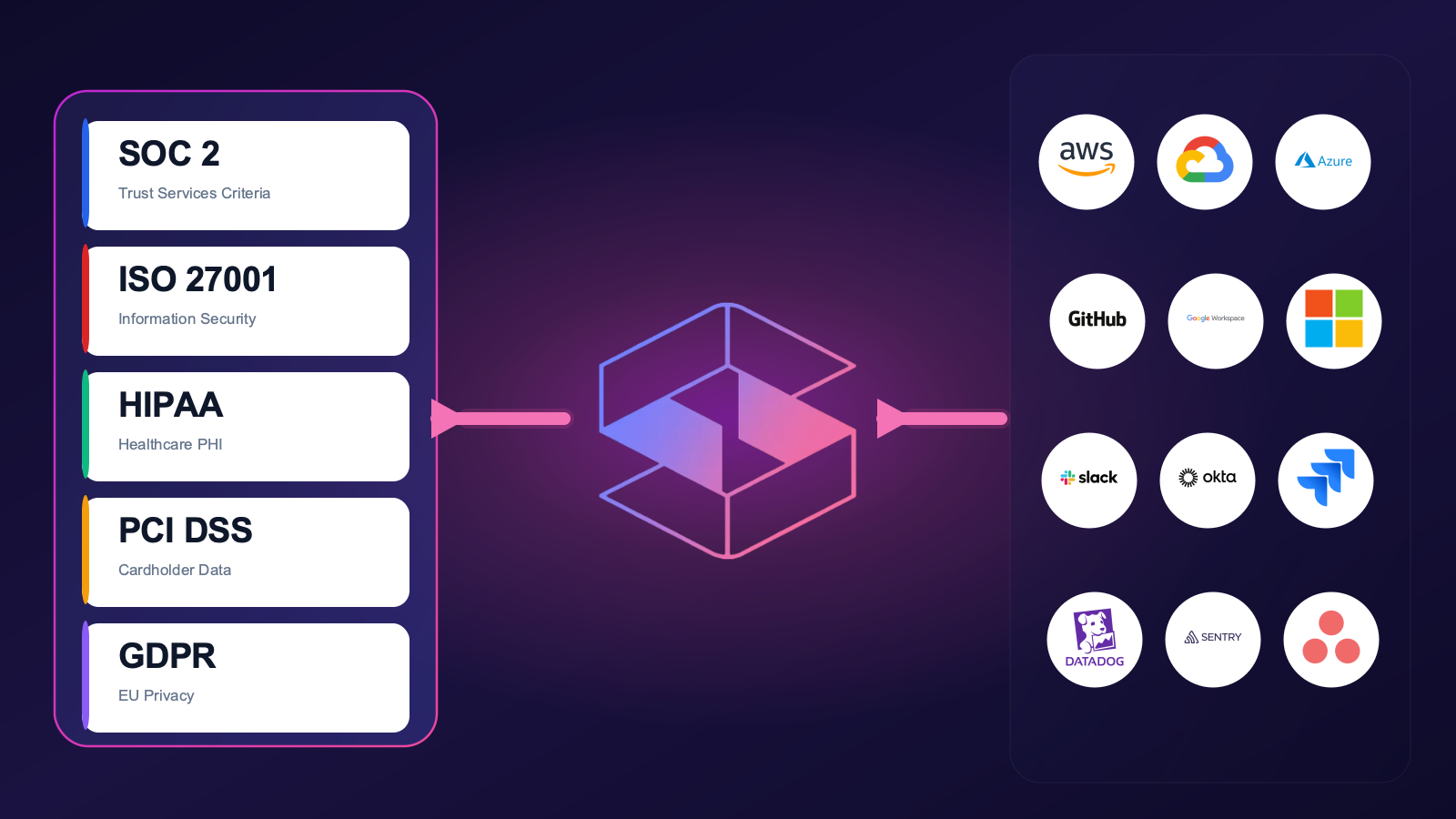
Strac Comply maps the same evidence to both SOC 2 and ISO 27001 simultaneously — plus HIPAA, PCI DSS, and GDPR in the same control plane
✨ How Strac Comply Handles Both
Strac Comply maps every piece of live evidence to both frameworks simultaneously. The architectural consequence: one continuous evidence stream feeds two audit cycles.
MCP tool-call audit logs → SOC 2 CC6.1 + CC7.2 + ISO 27001 A.8.15 + A.8.16 + EU AI Act Art. 12
ISO 27001-specific automation:
Statement of Applicability (SoA) auto-generated and version-controlled
Risk register with treatment-decision tracking
Internal audit program scheduling and evidence capture
Management review templates and minute-tracking
Continuous-improvement metric tracking
The unique angle: Strac Comply ships with Strac DLP and Strac DSPM as part of the same platform. For the data-protection controls that show up in both frameworks (SOC 2 CC6.6 / CC6.7 + ISO 27001 A.5.12 / A.5.13 / A.8.10-12), the evidence comes from the same product enforcing the control. No separate DLP integration. No two-vendor reconciliation.
SOC 2 + ISO 27001 with one platform and one evidence stream
Strac Comply maps every piece of live evidence to both frameworks simultaneously. The same DLP product securing your data generates the audit evidence. One platform, one bill, two clean reports.
ISO 27001 is structurally heavier because of the formal ISMS, internal audit, and management-review requirements. SOC 2 is more flexible — you design controls to meet criteria. ISO 27001 demands you operate a documented management system. For first-time programs, ISO 27001 typically takes 2-4 weeks longer.
Is ISO 27001 better than SOC 2?
Neither is "better." They serve different buyer profiles and geographies. ISO 27001 is more rigorous on system management; SOC 2 is more US-customary. Enterprise buyers in mixed geographies expect both above $5-10M ARR.
Can a single audit firm do both?
Yes, increasingly. Many auditors now offer SOC 2 + ISO 27001 combined engagements. The internal team submits one evidence package; the firm produces both reports. Strac Comply\'s evidence portal exports both formats from a single platform.
Should I do SOC 2 or ISO 27001 first?
Most US-headquartered SaaS companies do SOC 2 first because: (1) US enterprise procurement teams ask for it more often, (2) Type 2 reports issue in 4-6 weeks of fieldwork vs months for ISO 27001 first certification, (3) the audit process is more transactional and faster to learn. ISO 27001 comes next when international customer demand justifies it.
How does ISO 27001 handle data classification compared to SOC 2?
ISO 27001 A.5.12 (Classification of Information) and A.5.13 (Labelling of Information) are explicit control points. SOC 2 covers this implicitly under CC6.6 / CC6.7. The practical evidence is the same: a documented data classification scheme + labels applied to sensitive datasets + DLP enforcement of policies tied to labels. Strac DLP produces this evidence directly.
What is a Statement of Applicability?
The Statement of Applicability (SoA) is an ISO 27001-required document listing every Annex A control and either (a) why it applies to your ISMS, or (b) why it's excluded. SOC 2 has no equivalent. Strac Comply auto-generates the SoA from your scope and integration data.
Do I need an ISMS for SOC 2?
No. SOC 2 doesn't require a formal ISMS. You need policies, controls, and risk assessment, but not the structured management-system framework ISO 27001 mandates.
How does AI / MCP factor into both frameworks?
In SOC 2, AI-system controls map to CC6.1 (access by agents), CC6.6 (data classification at the tool-call boundary), CC7.2 (anomaly monitoring on agent behavior). In ISO 27001, the same controls map to A.8.2 / A.8.3 (access controls), A.5.12 / A.5.13 (classification), A.8.15 / A.8.16 (logging and monitoring). Plus the new ISO 42001 standard covers AI-specific operations. Strac Comply maps MCP DLP audit logs to all of these.
Can I get one platform to handle SOC 2 + ISO 27001 + HIPAA + PCI?
Yes. Strac Comply maps every evidence event across all four frameworks simultaneously. The same control evidence satisfies SOC 2 CC6.7 + HIPAA §164.312(a)(2)(iv) + ISO 27001 A.8.24 + PCI DSS Req. 3.4 from a single capture.
How does Strac Comply compare to Drata / Secureframe / Sprinto on the combined SOC 2 + ISO 27001 path?
The unique angle: Strac Comply ships with Strac DLP and Strac DSPM as part of the same platform. For controls under both frameworks that cover data protection (a substantial overlap), Strac produces evidence directly. Other platforms send you to integrate a separate DLP. The combined-platform architecture compresses audit cycles meaningfully.
What's the renewal cycle look like for each?
SOC 2 Type 2: rolling 12-month observation window + 4-6 weeks fieldwork per year. Continuous evidence collection across the window.
ISO 27001: 3-year certification cycle — initial certification audit, two annual surveillance audits, full recertification audit in year 3. Surveillance audits are lighter than the initial.
The Bottom Line
SOC 2 and ISO 27001 are the two dominant B2B security frameworks. They overlap ~80% on controls. SOC 2 for US-focused buyers, ISO 27001 for international, both for global enterprise SaaS. Strac Comply is the only compliance automation platform that maps every piece of evidence to both frameworks simultaneously — with the native DLP / DSPM / MCP DLP product the others don't ship.
ISO 27001 is structurally heavier because of the formal ISMS, internal audit, and management-review requirements. SOC 2 is more flexible — you design controls to meet criteria. ISO 27001 demands you operate a documented management system. For first-time programs, ISO 27001 typically takes 2-4 weeks longer.
Is ISO 27001 better than SOC 2?
Neither is "better." They serve different buyer profiles and geographies. ISO 27001 is more rigorous on system management; SOC 2 is more US-customary. Enterprise buyers in mixed geographies expect both above $5-10M ARR.
Can a single audit firm do both?
Yes, increasingly. Many auditors now offer SOC 2 + ISO 27001 combined engagements. The internal team submits one evidence package; the firm produces both reports. Strac Comply\'s evidence portal exports both formats from a single platform.
Should I do SOC 2 or ISO 27001 first?
Most US-headquartered SaaS companies do SOC 2 first because: (1) US enterprise procurement teams ask for it more often, (2) Type 2 reports issue in 4-6 weeks of fieldwork vs months for ISO 27001 first certification, (3) the audit process is more transactional and faster to learn. ISO 27001 comes next when international customer demand justifies it.
How does ISO 27001 handle data classification compared to SOC 2?
ISO 27001 A.5.12 (Classification of Information) and A.5.13 (Labelling of Information) are explicit control points. SOC 2 covers this implicitly under CC6.6 / CC6.7. The practical evidence is the same: a documented data classification scheme + labels applied to sensitive datasets + DLP enforcement of policies tied to labels. Strac DLP produces this evidence directly.
Discover & Protect Data on SaaS, AI, MCP, Endpoints & Cloud
Strac provides end-to-end data loss prevention for all SaaS and Cloud apps. Integrate in under 10 minutes and experience the benefits of live DLP scanning, live redaction, and a fortified SaaS environment.


.webp)




.avif)




.gif)
