Postgres MCP Server: Secure Setup for Claude & AI Agents (2026)
The Postgres MCP server lets Claude, Cursor, ChatGPT, and AI agents query your PostgreSQL database in plain English. Here's the setup, the real security risks of agent SQL access, and how to govern it with column-level redaction at the MCP layer.
The Postgres MCP server lets AI agents (Claude, Cursor, ChatGPT, Perplexity, custom agents) run SQL against your PostgreSQL database through the Model Context Protocol — listing schemas, inspecting tables, querying rows, and (on some servers) writing back.
The risk is structural: Postgres is the raw production database. Tables hold PII, credentials, and financial rows in plaintext, and a single agent SELECT can return whole columns straight into the model's context. Most MCP servers expose SQL with no row filtering and no redaction in the path.
Strac Postgres MCP DLP is the governance layer for AI-agent access to PostgreSQL. Strac sees every query, controls which tables and columns an agent can reach and whether it can write or bulk-export, protects sensitive columns with redaction, masking, tokenization, and vaulting, and proves every call as audit evidence — mapped to SOC 2 / HIPAA / PCI / GDPR. One control plane across every schema and table. Redaction is part of it, not the whole of it.
Setup is agentless and under 10 minutes. No application changes, no schema migration, no Postgres re-grant.
What Is the Postgres MCP Server?
The Postgres MCP server is a Model Context Protocol implementation that exposes a PostgreSQL database to AI agents as a set of standardized tools. Once connected, an agent like Claude can list schemas, describe tables, read column types, and execute SQL — turning your database into something an AI client can query in natural language.
There isn't one canonical server, and the difference matters. The community reference postgres server wraps queries in a read-only transaction and exposes table schemas as resources. AWS's official Aurora and RDS for PostgreSQL MCP server translates plain-English questions into Postgres SQL and supports read-only access or optional read/write, scoped by the database role you connect with. There are also several third-party servers with their own tool surfaces and their own defaults. Check the specific server's docs for its exact tool list and whether writes are enabled.
From the user's seat, the agent suddenly understands the database — it answers questions about live data without anyone exporting a CSV. From the security seat, the agent now holds query access to whatever the connected Postgres role can read, and possibly write.
That's the value. It's also exactly where a control layer belongs.
What AI Agents Can Actually Do With Postgres MCP
Point an agent at a Postgres MCP server and it works the real database directly, turning plain-English questions into SQL against the tables the connected role can touch. In practice it can:
Query tables in plain English — "How many accounts signed up last month and haven't activated?" becomes a live SQL query against real rows, not a stale dashboard.
Summarize a schema it's never seen — point the agent at an unfamiliar database and it lists tables, reads column types and foreign keys, and explains how the data model fits together.
Investigate a single row end to end — pull one customer record, join across orders, payments, and support tickets, and narrate the full history in one prompt.
Run analytics on demand — cohort counts, revenue rollups, funnel breakdowns, anomaly checks — computed against production data instead of waiting on an analyst.
Reason over your real data model — the agent works your actual tables and columns, the same ones your application reads, with all the messy production reality intact.
Every one of those runs through Postgres's own SQL engine and the privileges of the role you connected — which is what makes it genuinely useful, and exactly why the regulated data those queries return needs an inspection layer in the tool-call path.
The Real Security Risks of the Postgres MCP Server
The risks here are sharper than most SaaS MCP servers, because Postgres is the raw production database — not a curated app view of it. Five categories every healthcare, fintech, and enterprise security team should price in:
1. It's the production database, in the raw. A SaaS API hands back a shaped, permission-filtered object. Postgres hands back rows. The agent sees the users table the way your application's data layer sees it — every column, including the ones the UI never renders.
2. PII and secrets sit in plaintext columns. Email, SSN, date of birth, full card numbers, password reset tokens, API keys, and session secrets routinely live as plain text and varchar columns. A SELECT * returns them verbatim; the agent can't tell a regulated column from a benign one.
3. Read-write servers let agents mutate production. When the server is configured for read/write (AWS's supports it; others default to it), the agent isn't just reading — an UPDATE, DELETE, or INSERT generated from a misread prompt lands on live data. Read-only is a real configuration choice, and many deployments don't make it.
4. There is no row or column filter in the path. SQL has no WHERE not_regulated = true. Whatever the connected role can read, a single query returns — and a wide SELECT across a million-row table pulls regulated data in bulk straight into the model's context window.
5. Bulk SELECT is one prompt away. "Show me all customers and their payment details" is a valid query. Without a guardrail, the agent runs it, and thousands of regulated rows flow to the model in a single tool response — far more than any human would copy by hand.
The DLP a company already runs — network edge, file share, SaaS-native rule engine — does not sit in the SQL path between an agent and Postgres. The query result goes straight from the database into the AI agent's context window. That reach is precisely why each agent's access to Postgres must be governed: controlled (which tables and columns it can touch, and whether it can write or bulk-export), the sensitive data it returns protected, and every query audited. That is where Strac Postgres MCP DLP lives.
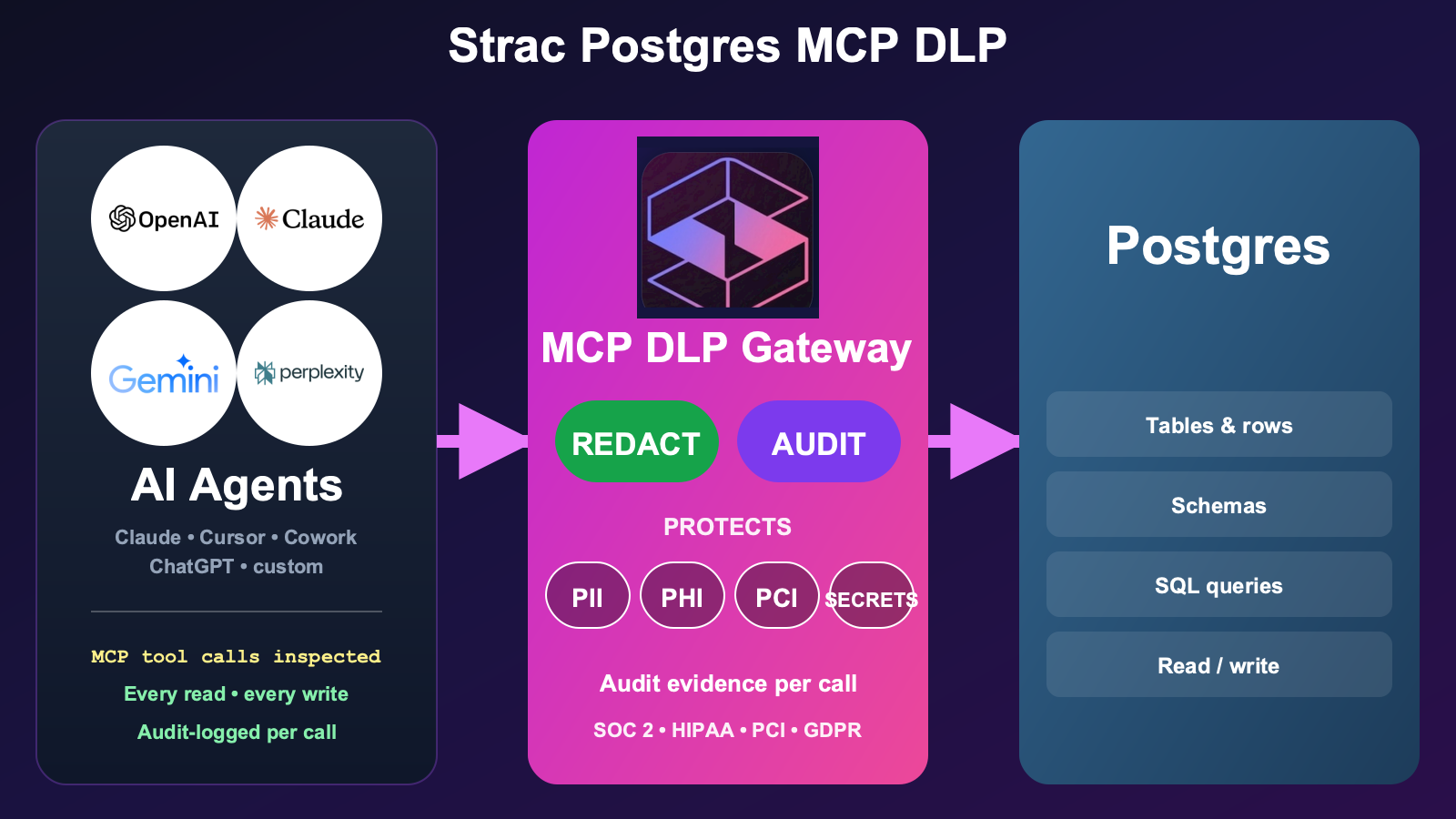
Strac's Postgres MCP DLP is the governance layer that sits between AI agents and the Postgres MCP server. Strac governs every query: it sees exactly what each agent runs, controls what it can reach and do, protects the sensitive columns it touches, and logs every call as audit evidence. In-policy, non-sensitive queries flow through untouched.
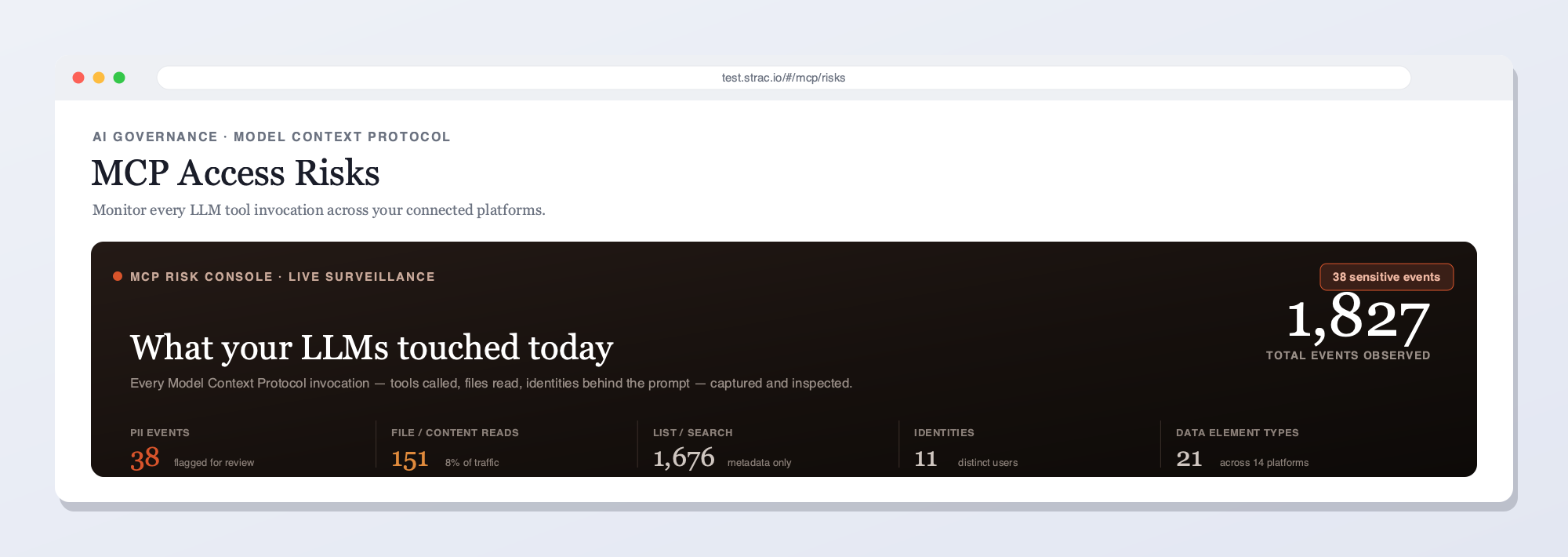
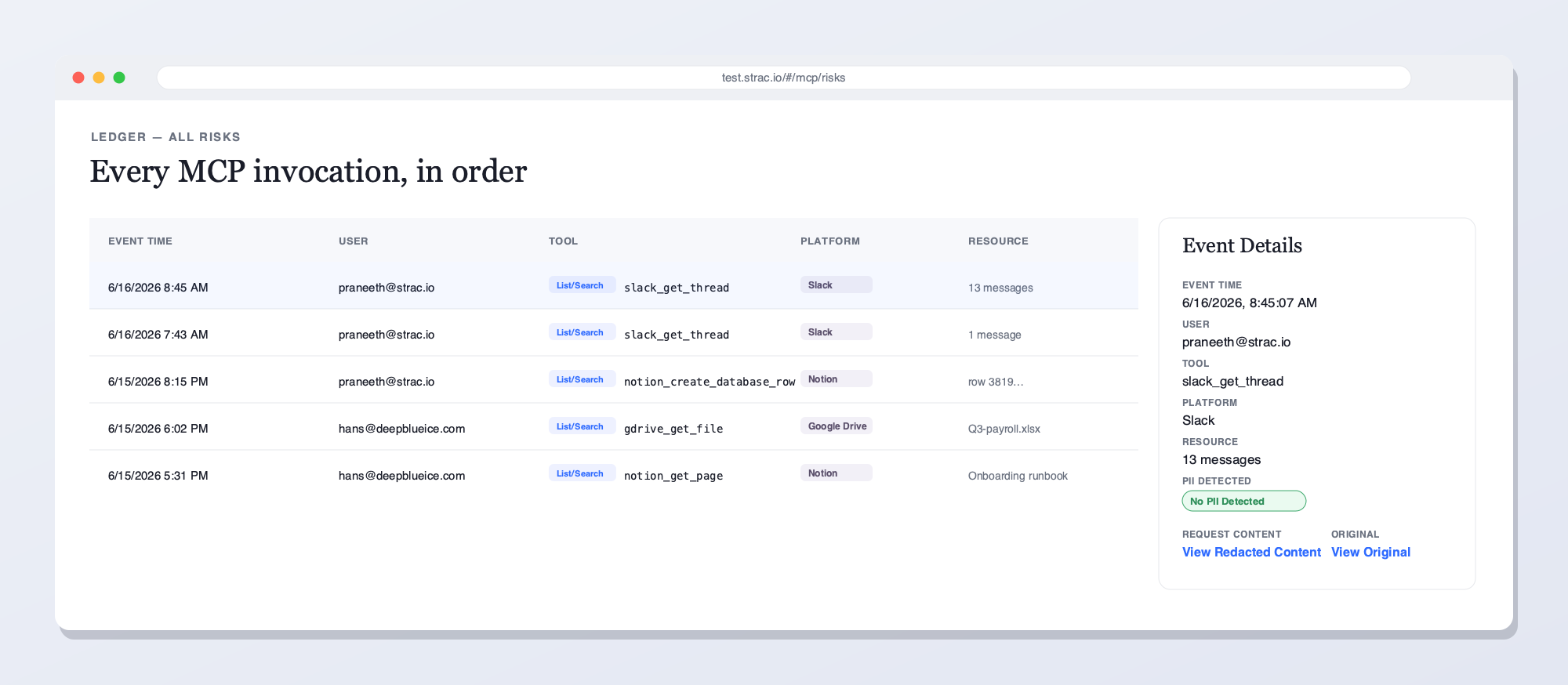
The Strac Postgres MCP DLP gateway sits between any AI agent (Claude, Cursor, ChatGPT, custom) and the Postgres MCP server. It scopes which tables and columns the agent can reach, blocks risky writes and bulk exports, and redacts regulated columns before any row reaches the model.Strac's live MCP Access console — every AI agent tool call touching Postgres and your other connected platforms, captured and inspected for sensitive data in real time. See what your LLMs reached for, who prompted, and what was flagged.Every MCP invocation in order — user, tool, platform, and the sensitive data found — with redacted vs. original content and a full audit trail. This is what Strac shows on Postgres that access-only gateways can't: the data in each call, not just the call.
Why not just an access gateway?
Access-only tools answer "who called what." They do not see the sensitive columns in a query result. Strac sits inline on every Postgres tool call: it detects and remediates the sensitive data inside — redact, mask, block, or revoke access — and approves or blocks risky actions per agent, and keeps the audit trail — the call and its contents.
What Strac does on every Postgres tool call
One inline pass over each MCP response — five actions, enforced by your policy:
Detect — finds sensitive columns in a result and any PII, PHI, PCI, secrets, or source code in the payload, including text inside images via OCR.
Redact or mask — replaces the sensitive elements inline, so the agent still gets its answer and the model never sees the raw data.
Block or require approval — stops a high-risk action like a write or bulk read, or routes it for sign-off before it runs.
Alert — notifies your team and streams the event to your SIEM (Microsoft Sentinel, Datadog, Splunk) in real time.
Audit — logs who, which agent, which tool, what data, and the action taken — evidence mapped to PCI DSS, SOC 2, HIPAA, and GDPR.
Beyond redacting or blocking, Strac can also pseudonymize or de-identify the data on a Postgres MCP tool call — swapping PII, PHI, and PCI for realistic, format-preserving fakes — so a team can keep using the data in an AI model, analytics, or a test environment while the real records never leave your control. See Data Pseudonymization.
What this looks like in practice, mapped to See / Control / Protect / Prove:
See — Strac surfaces every query an agent runs: which AI client, which user, which tables and columns it touched, how many rows came back, and which data classes were present. The opaque "the agent talked to the database" becomes a per-query record.
Control — Strac scopes access at the table and column level. You allow an agent to read orders and accounts but never payment_methods or auth_tokens. Writes (UPDATE / DELETE / INSERT) and bulk exports above a row threshold are blocked or routed for approval, so a misread prompt can't mutate production or vacuum a whole table.
Protect — Strac applies column-level redaction, masking, tokenization, and vaulting on the way back. An SSN column returns masked, a card_number tokenized, a secret vaulted behind a short-lived retrieval link — the agent still gets a usable result set, but the regulated values never enter the model context.
Prove — every query is logged with the data classes detected, the controls applied, and the disposition. The log is the SOC 2 / HIPAA / PCI / GDPR audit evidence for AI-agent database activity — produced automatically.
The teams asking for a scrubbing gateway are really asking two things. Will it protect the custom MCP tools we build on Postgres for our own people and our customers, not just the stock connector? And can we define the redaction ourselves — column-level masking, tokenization, or a custom regex for an internal identifier — without operating a Presidio or Bedrock pipeline? With Strac, the answer to both is yes, on one managed classifier.
The same Strac MCP DLP layer covers your other data warehouses and SaaS surfaces — Snowflake MCP, Databricks MCP, and BigQuery MCP — one control plane across every place AI agents query your regulated data. See the MCP DLP pillar for the full control model.
✨ Strac Native Postgres DLP — The Companion to MCP DLP
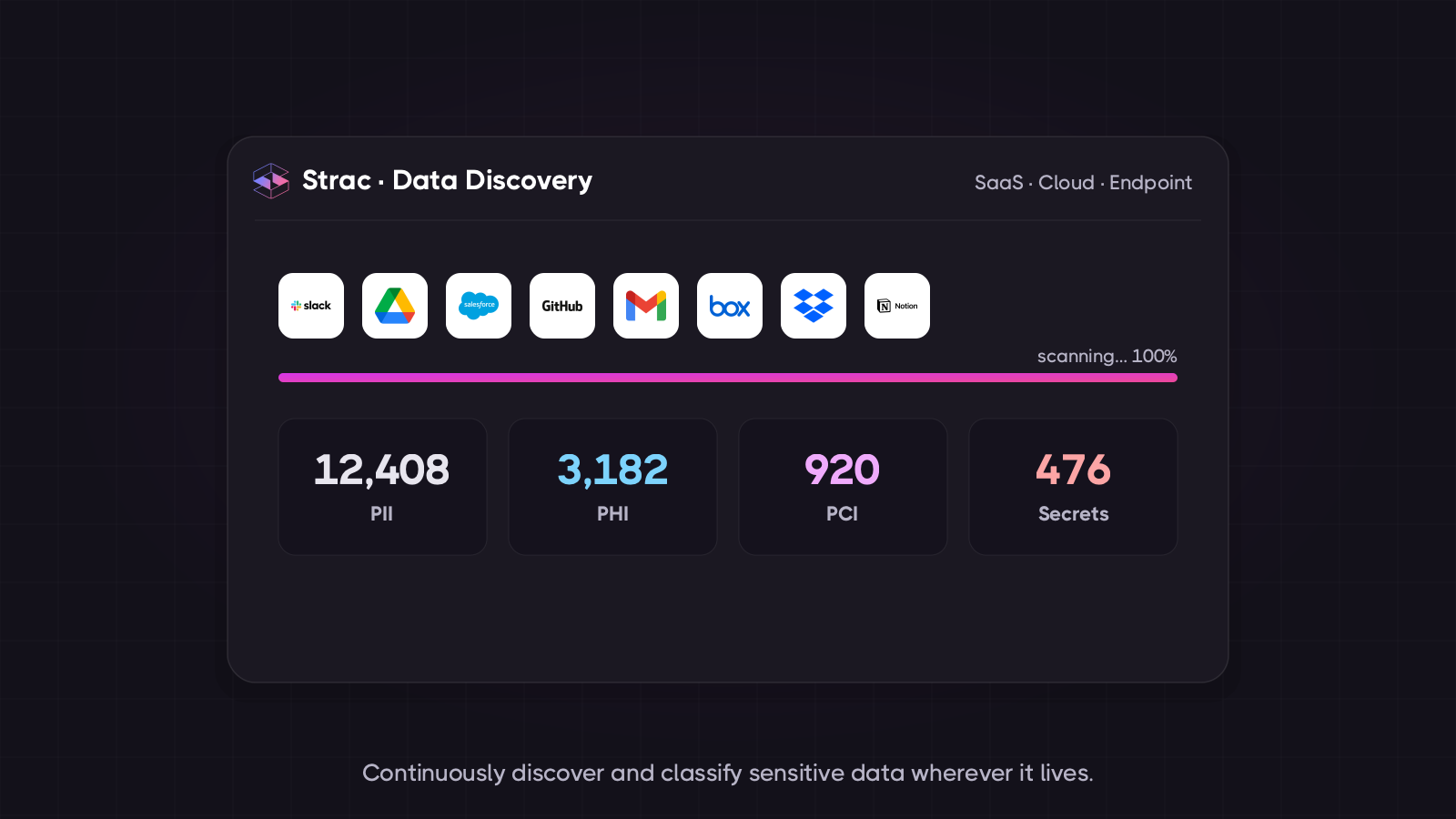
Strac natively discovers and classifies the regulated columns inside your Postgres database before any agent queries them — the companion to Postgres MCP DLP that maps where sensitive data lives.
MCP DLP governs the AI-agent query surface. Strac's native Postgres DLP governs the data at rest — the same database, but discovered and classified so you know where the regulated columns are before any agent ever queries them. This is DSPM for Postgres, and most teams run both: native discovery to map and label the sensitive data, MCP DLP to govern how agents reach it.
What Strac's native Postgres DLP includes:
Continuous discovery and classification of PII, PHI, PCI, and financial data across every schema, table, and column
Column-level labeling — Strac identifies which columns hold SSNs, card numbers, health data, credentials, and customer identifiers, so policy can target them precisely
Sampling at depth — Strac inspects column contents, not just names, so a notes field holding clinical data or a metadata blob hiding tokens is caught
A live data map of where regulated data sits, feeding directly into the MCP DLP column-level controls
Audit-ready findings mapped to SOC 2 CC6, HIPAA Security Rule, PCI Req. 3/7/10, and GDPR
For the broader practice this sits inside, see DSPM for AI. For every SaaS, cloud, database, and endpoint surface Strac covers, see strac.io/integrations.
✨ See Strac MCP DLP in Action
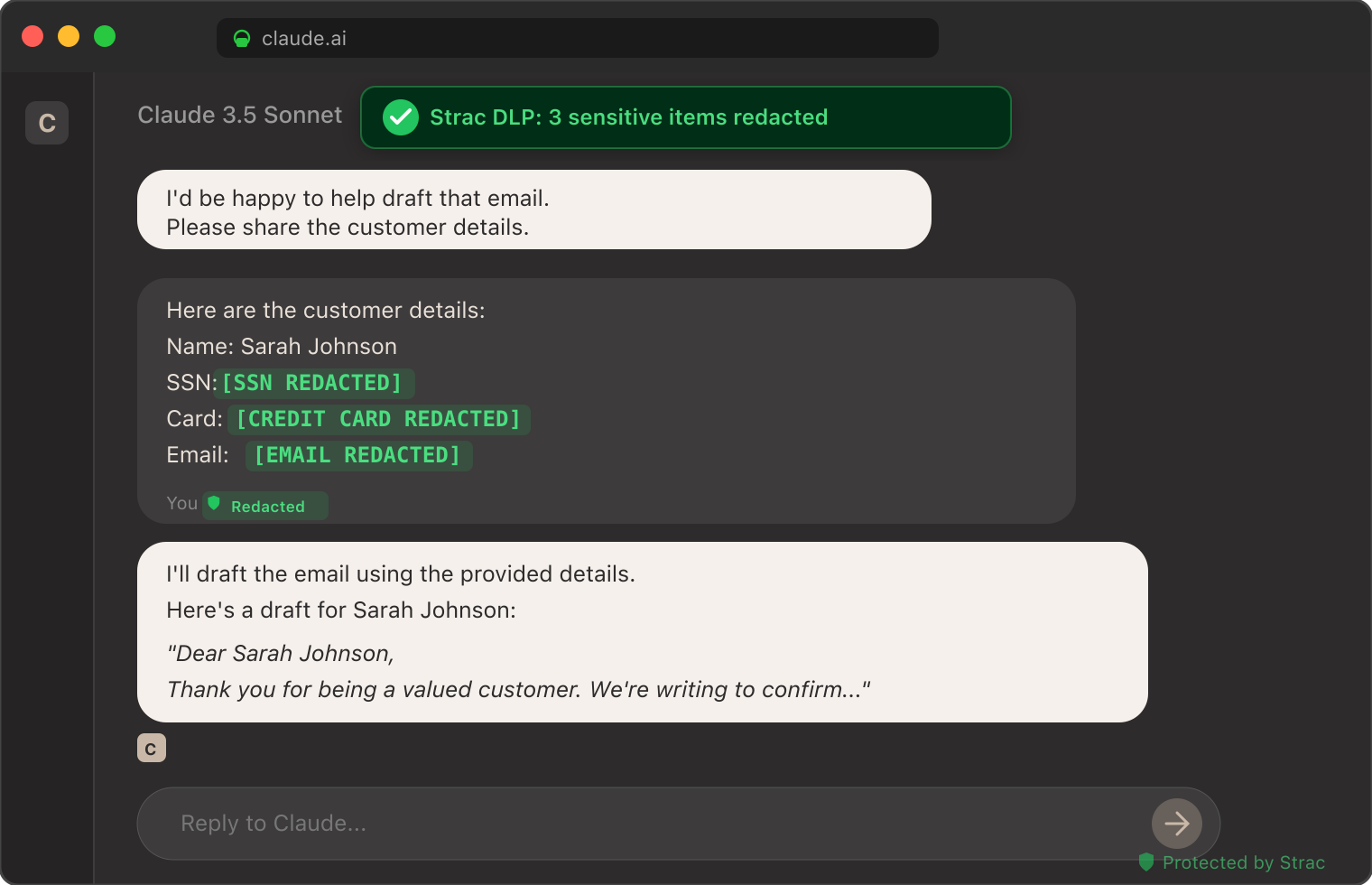
The screenshot below shows Strac's MCP DLP redacting sensitive data from a real Claude session — customer emails, identifiers, and credit card numbers tokenized inline before the model received them. The same inspection pattern runs on every Postgres MCP query routed through Strac, applied column-by-column to the returned rows.
Strac DLP at work inside a Claude conversation: sensitive elements tokenized inline before the model sees them. The same pattern runs at the MCP layer for every Postgres query result.
How to Set Up Strac Postgres MCP DLP
Setup is agentless and takes under 10 minutes.
Connect Strac to your PostgreSQL database. Strac uses a dedicated, least-privilege Postgres role — never the superuser or cluster master. It only ever sees what that role is granted, consistent with the AWS guidance to scope MCP database access to a narrow role.
Point your AI client at the Strac MCP endpoint. Strac issues an MCP server endpoint that drops into your AI client's configuration and proxies to the Postgres MCP server behind it. For Claude Desktop:
json
   "mcpServers": {
     "postgres": {
       "url": "https://mcp.strac.io/postgres",
       "auth": { "type": "bearer", "token": "<your-strac-token>" }
     }
   }
For Cursor, OpenAI Agents, and custom agents — same endpoint, same auth.
Pick your policy. Out-of-the-box templates for SOC 2, HIPAA, PCI, and GDPR. Custom policies — table-level allow/deny, column-level redaction, write-blocking, bulk-export thresholds — take minutes to configure.
Done. Every query between your agent and Postgres now flows through the Strac gateway. No application changes, no schema migration, no Postgres re-grant. The audit log starts populating immediately.
Compliance Coverage Out of the Box
The same Strac Postgres MCP DLP control produces evidence mapped to every major compliance framework.
Framework
What Strac Postgres MCP DLP Satisfies
SOC 2
CC6.1 (logical access to data), CC6.6 (unauthorized data exposure), CC6.7 (restricted transmission of data to external systems), CC7.2 (monitoring for anomalies including AI query activity)
Which Postgres MCP server should you use — and is it safe?
There are several, and the choice is a security decision, not just a tooling one. The community reference postgres server runs every query inside a read-only transaction — a sensible default that prevents the agent from mutating data. AWS's official Aurora/RDS PostgreSQL MCP server supports read-only and optional read/write, scoped by the role you connect with, and AWS explicitly recommends a dedicated least-privilege role rather than a superuser. Several third-party servers default to read/write. None of them — read-only or read-write — redact regulated columns from the rows they return; read-only still streams plaintext PII straight to the model. So the answer is: pick read-only unless you genuinely need writes, always connect a narrow role, and put a DLP layer like Strac in front so the rows themselves are inspected, not just the privileges.
Is the Postgres MCP connector the same as the Postgres MCP server?
Yes — the same thing. The MCP specification says server; Claude and Cursor surface it as the Postgres connector. Both let an agent query your tables and schemas in SQL, and Strac's Postgres MCP connector redacts regulated columns at the tool-call boundary regardless of the label.
What is the Postgres MCP server?
The Postgres MCP server is a Model Context Protocol implementation that lets AI agents (Claude, Cursor, ChatGPT, Perplexity, custom agents) query a PostgreSQL database through standardized tool calls — listing schemas, describing tables, running SQL, and on some servers writing back. It's how an AI assistant gets live, natural-language access to your production data.
Is the Postgres MCP server safe to use with sensitive data?
By itself, no — not without a governance layer. The server honors the connected role's privileges but returns whatever that role can read, including plaintext PII, credentials, and financial data, with no row or column filtering. For production use against regulated data you need an MCP-layer control like Strac Postgres MCP DLP that scopes table and column access, blocks risky writes and bulk exports, and redacts sensitive columns before any row reaches the model.
How is Strac Postgres MCP DLP different from Postgres's built-in security?
Postgres's built-in controls — role privileges, row-level security, column grants — gate what a role is allowed to read. They don't inspect the contents of the rows that come back. A role granted SELECT on users returns every SSN in that table in plaintext. Strac inspects the actual returned rows and redacts regulated columns inline, and it adds the controls Postgres lacks for agents: write-blocking, bulk-export thresholds, and a per-query audit log. It complements least-privilege roles; it doesn't replace them.
Does Strac Postgres MCP DLP work with Claude, Cursor, ChatGPT, and custom agents?
Yes. Strac exposes a standard MCP endpoint, so any MCP-aware AI client routes its queries through it with one configuration change. No SDK changes, no application code changes.
Can Strac stop an AI agent from writing to or deleting production data?
Yes. Strac inspects the SQL before it executes. Write statements (UPDATE, DELETE, INSERT, DDL) can be blocked outright, allowed only on specific tables, or routed for human approval — so even a read-write server can't let a misread prompt mutate production. Bulk reads above a row threshold are gated the same way.
What sensitive data types does Strac detect in Postgres query results?
PII (SSN, driver's license, passport, address, phone, email), PHI (clinical notes, MRN co-occurrence, ICD-10 codes adjacent to identifiers, lab values), PCI (full and partial card numbers via Luhn check), credentials (API keys, AWS / GCP / Azure access keys, OAuth tokens, JWTs, SSH keys, private keys — 48+ patterns), and custom detectors trained on your internal classifications. Detection runs column-by-column across the returned rows, including text inside JSON/jsonb columns.
Where does redacted data go — is it stored?
Redacted values are replaced inline in the result set. Optionally, a sensitive column value can be vaulted — swapped for a short-lived retrieval link only authorized users can resolve — so the original is recoverable for legitimate use without ever entering the AI context. Vaulted data is stored encrypted at rest in your Strac tenant; you control retention.
How long does Strac Postgres MCP DLP take to deploy?
Under 10 minutes for the first database. Connect Strac with a least-privilege Postgres role, paste the Strac MCP endpoint into your AI client's config, pick a policy template, done. No application changes, no schema migration, no Postgres re-grant.
When an AI agent reaches Postgres through Strac, it acts as the person who asked — Postgres's own role and row-level security decide what comes back, because Strac passes each user's identity through instead of a shared service account, not god-mode credentials. Strac protects the database rows and PII on the way through and proves per-user access in the audit log — identity to prevent retrieval, DLP to protect what's allowed.
The Bottom Line
The Postgres MCP server is fast becoming the way AI agents read — and sometimes write — your production database. That surface is the rawest, most regulated data your organization has: plaintext PII, credentials, and financial rows, one SELECT away from the model's context window. Running Postgres MCP in 2026 without an MCP-layer governance control isn't a question of if the first incident reaches your security team; it's when.
Strac Postgres MCP DLP gives you the control plane — see every query, scope every agent, protect every regulated column, prove every call — so your team can use PostgreSQL with Claude, Cursor, ChatGPT, and any future AI client without making each one a separate security exception.
If you are running — or about to run — Postgres MCP in production, book a 30-minute demo. We'll walk through the architecture, the read-only-vs-read-write decision, the policy templates, and a deployment plan for your specific database and AI clients.
Which Postgres MCP server should you use — and is it safe?
There are several, and the choice is a security decision, not just a tooling one. The community reference postgres server runs every query inside a read-only transaction — a sensible default that prevents the agent from mutating data. AWS's official Aurora/RDS PostgreSQL MCP server supports read-only and optional read/write, scoped by the role you connect with, and AWS explicitly recommends a dedicated least-privilege role rather than a superuser. Several third-party servers default to read/write. None of them — read-only or read-write — redact regulated columns from the rows they return; read-only still streams plaintext PII straight to the model. So the answer is: pick read-only unless you genuinely need writes, always connect a narrow role, and put a DLP layer like Strac in front so the rows themselves are inspected, not just the privileges.
Is the Postgres MCP connector the same as the Postgres MCP server?
Yes — the same thing. The MCP specification says server; Claude and Cursor surface it as the Postgres connector. Both let an agent query your tables and schemas in SQL, and Strac's Postgres MCP connector redacts regulated columns at the tool-call boundary regardless of the label.
What is the Postgres MCP server?
The Postgres MCP server is a Model Context Protocol implementation that lets AI agents (Claude, Cursor, ChatGPT, Perplexity, custom agents) query a PostgreSQL database through standardized tool calls — listing schemas, describing tables, running SQL, and on some servers writing back. It's how an AI assistant gets live, natural-language access to your production data.
Is the Postgres MCP server safe to use with sensitive data?
By itself, no — not without a governance layer. The server honors the connected role's privileges but returns whatever that role can read, including plaintext PII, credentials, and financial data, with no row or column filtering. For production use against regulated data you need an MCP-layer control like Strac Postgres MCP DLP that scopes table and column access, blocks risky writes and bulk exports, and redacts sensitive columns before any row reaches the model.
How is Strac Postgres MCP DLP different from Postgres's built-in security?
Postgres's built-in controls — role privileges, row-level security, column grants — gate what a role is allowed to read. They don't inspect the contents of the rows that come back. A role granted SELECT on users returns every SSN in that table in plaintext. Strac inspects the actual returned rows and redacts regulated columns inline, and it adds the controls Postgres lacks for agents: write-blocking, bulk-export thresholds, and a per-query audit log. It complements least-privilege roles; it doesn't replace them.
Discover & Protect Data on SaaS, AI, MCP, Endpoints & Cloud
Strac provides end-to-end data loss prevention for all SaaS and Cloud apps. Integrate in under 10 minutes and experience the benefits of live DLP scanning, live redaction, and a fortified SaaS environment.


.webp)




.avif)



.gif)
