MCP Data Security: Protect Sensitive Data in MCP (2026)
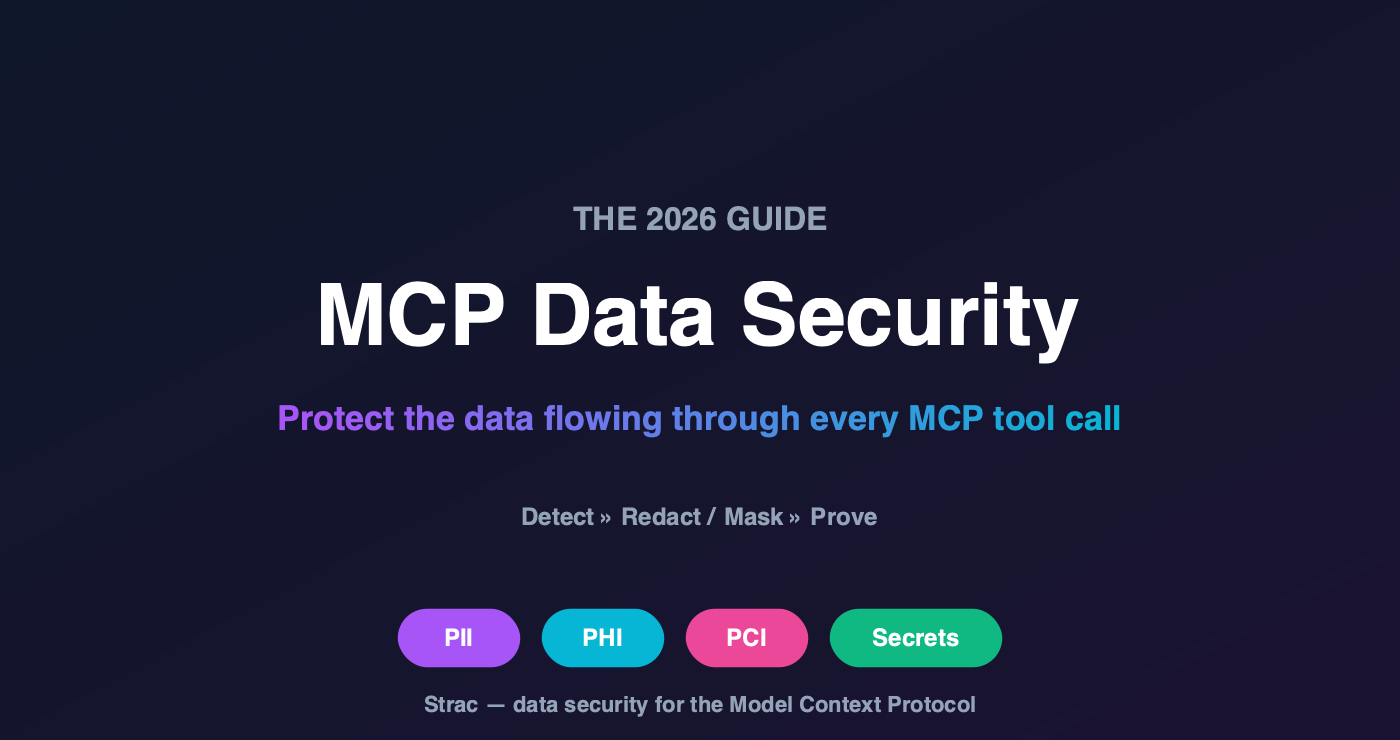
MCP data security is about protecting the PII, PHI, PCI, and secrets that AI agents pull in through MCP tool calls. Here's how MCP data leaks happen, and how to detect, redact, and mask sensitive data before it reaches a model.
MCP data security is the practice of protecting sensitive data — PII, PHI, PCI, secrets, source code — as AI agents read it and act on it through the Model Context Protocol. It is a distinct problem from model security or app security: the risk is the data moving through each tool call, not the model itself.
The defining shift is ingress. Classic DLP watched data leaving — uploads, email, copy-paste. MCP flips it: agents pull sensitive data in through connectors, into the model's context, where legacy DLP never looked.
MCP data leaks happen through over-permissioned connectors, unredacted tool results, logs and caches, and third-party MCP servers — usually with no malicious actor required, just an agent doing exactly what it was asked.
The fix is a data-layer control that detects, redacts, masks, or blocks sensitive data inside the tool-call payload — before it reaches a model — and logs every call as audit evidence.
Strac does this as a managed, contextual service across MCP connectors for Slack, GitHub, Google Workspace, Salesforce, Snowflake, and more — the MCP DLP and MCP gateway layer, with compliance evidence built in.
What Is MCP Data Security?
MCP data security is the discipline of protecting sensitive data that flows between AI agents and your systems over the Model Context Protocol. When an agent like Claude, Cursor, ChatGPT, or Copilot calls an MCP tool — slack_get_thread, gdrive_get_file, query_database — it pulls real data back into the model's context. MCP data security governs what that data is, who can reach it, and how it's protected before a model ever sees it.
It is worth separating from neighbors it gets confused with:
Not model security. Model security is about the model's weights, prompts, and outputs. MCP data security is about the business data the model ingests through tools.
Not just access control. Knowing which agent can call which server is necessary but not sufficient — an authorized agent can still pull a million records it shouldn't expose. Access control without data control still leaks.
A superset of MCP DLP. DLP (detect-and-redact) is the enforcement core, but MCP data security also covers discovery, classification, least-privilege, and audit evidence.
The one-line version: MCP data security makes sure that when an agent reaches into Slack, a data warehouse, or a healthcare record system, the PII, PHI, PCI, and secrets in the response are protected — not handed to a model in the clear.
✨ How MCP Data Leaks Happen
Most MCP data leakage isn't a hacker. It's an agent doing its job, pulling sensitive data into a context window that was never designed to hold it. The common leak vectors:
Over-permissioned connectors. An MCP server is wired with a broad service-account token, so an agent can read far more than the task needs — every channel, every file, every row.
Unredacted tool results (the ingress leak). The connector returns raw data — a payroll spreadsheet, a support ticket full of SSNs — straight into the model context. This is the ingress shift legacy DLP never watched.
Logs, traces, and caches. Tool-call payloads get logged for observability or cached for speed — quietly copying sensitive data into systems with weaker controls.
Third-party and community MCP servers. A connector you didn't build can forward data to an endpoint you don't control. Shadow MCP servers make this worse: you can't protect data flowing through a server you don't know exists.
Model and vendor exposure. Once sensitive data is in the context window, it may be processed, retained, or used by the AI provider — and a vendor BAA covers the provider's processing, not whether the data should have been sent at all (the Claude Cowork BAA gap is the sharpest example).
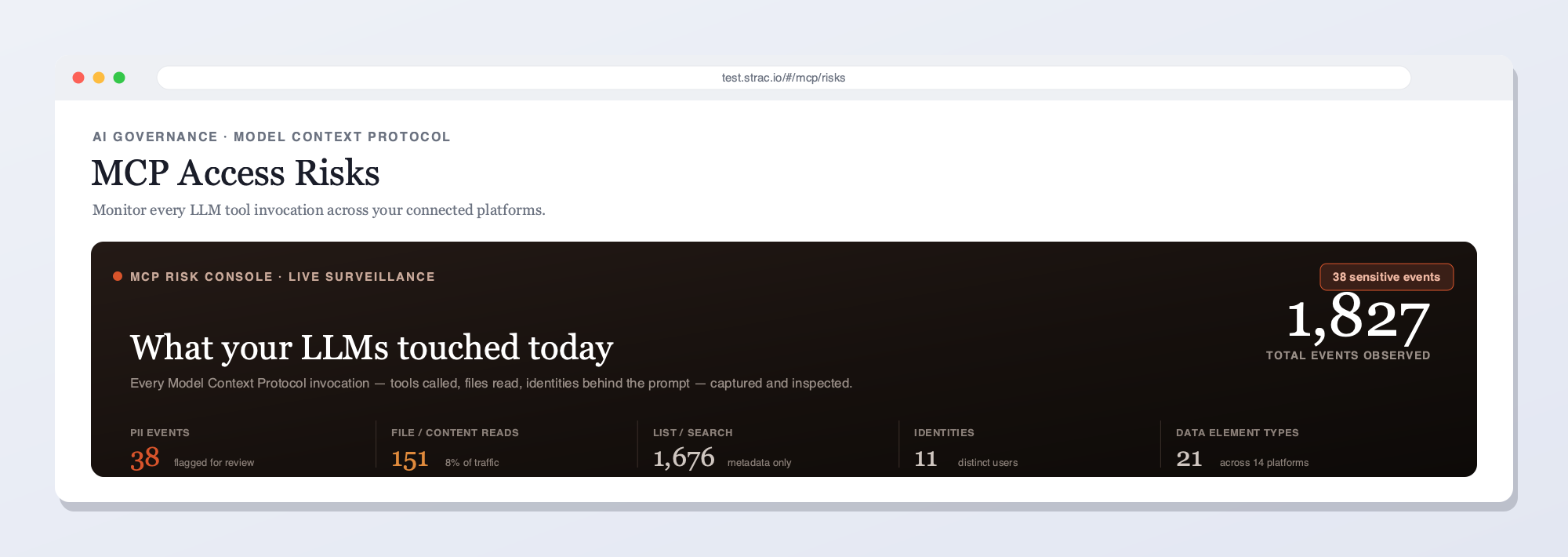
Before you can stop a leak, you have to see it. The console below surfaces exactly what every agent touched — and how many of those events were sensitive.
The Sensitive Data That Moves Through MCP
Not all MCP traffic is risky. The job of MCP data security is to find the slice that is. Ranked roughly by exposure:
Data class
Where it shows up in MCP
Risk if leaked
PHI (health records)
EHR, support, Drive/SharePoint docs
HIPAA violation; un-BAA'd model exposure
PCI (card data)
Billing tools, Stripe, spreadsheets, tickets
PCI DSS scope; fraud
PII (names, SSNs, emails)
Slack, CRM, databases, email connectors
GDPR/CCPA; identity theft
Secrets (keys, tokens)
Code repos, config files, logs
Lateral compromise
Source code / IP
GitHub, GitLab, internal wikis
Trade-secret loss
The practical takeaway: MCP sensitive data discovery has to be content-aware, not just connector-aware. Knowing an agent can reach Slack tells you nothing; knowing a specific thread contains card numbers is what lets you protect it. That requires inspecting the payload itself — the foundation of every layer that follows.
MCP Data Protection: The Four Layers
Durable MCP data protection is four layers working together, not a single toggle:
Discover — find every MCP server and connector in use, including shadow ones, and map what data each can reach.
Classify — inspect tool-call payloads to identify PII, PHI, PCI, secrets, and source code with context (a Luhn-valid card number, not just "16 digits").
Protect — apply the right remediation in real time: redact, mask, tokenize, or block the sensitive field, and let the clean call proceed.
Prove — log every call — agent, tool, data class, action — as audit-ready evidence mapped to SOC 2, HIPAA, PCI, and ISO 42001.
The center of gravity is layer 3, but it only works if layers 1–2 feed it accurate detection and layer 4 turns enforcement into compliance evidence. Notice that "block everything" isn't on the list — blocking the call breaks the agent workflow. The goal is protect-and-continue: remove the sensitive data, keep the agent working.
✨ MCP PII Redaction: How It Works
MCP PII redaction is the enforcement step most teams picture first, so it's worth being precise about the mechanism. It happens inside the tool call, in three moves:
Detect — as the connector returns data, a classifier scans the payload for PII (and PHI, PCI, secrets) using pattern + context, so 4242 4242 4242 4242 is caught as a card number and a 9-digit string in the right context is caught as an SSN.
Remediate — the sensitive value is replaced before the response continues: [SSN REDACTED], [CREDIT CARD REDACTED]. The rest of the response — the part the agent actually needs — flows through untouched.
Deliver clean — the model receives a response with zero raw sensitive data, so nothing sensitive ever enters the context window, the logs, or the provider's systems.
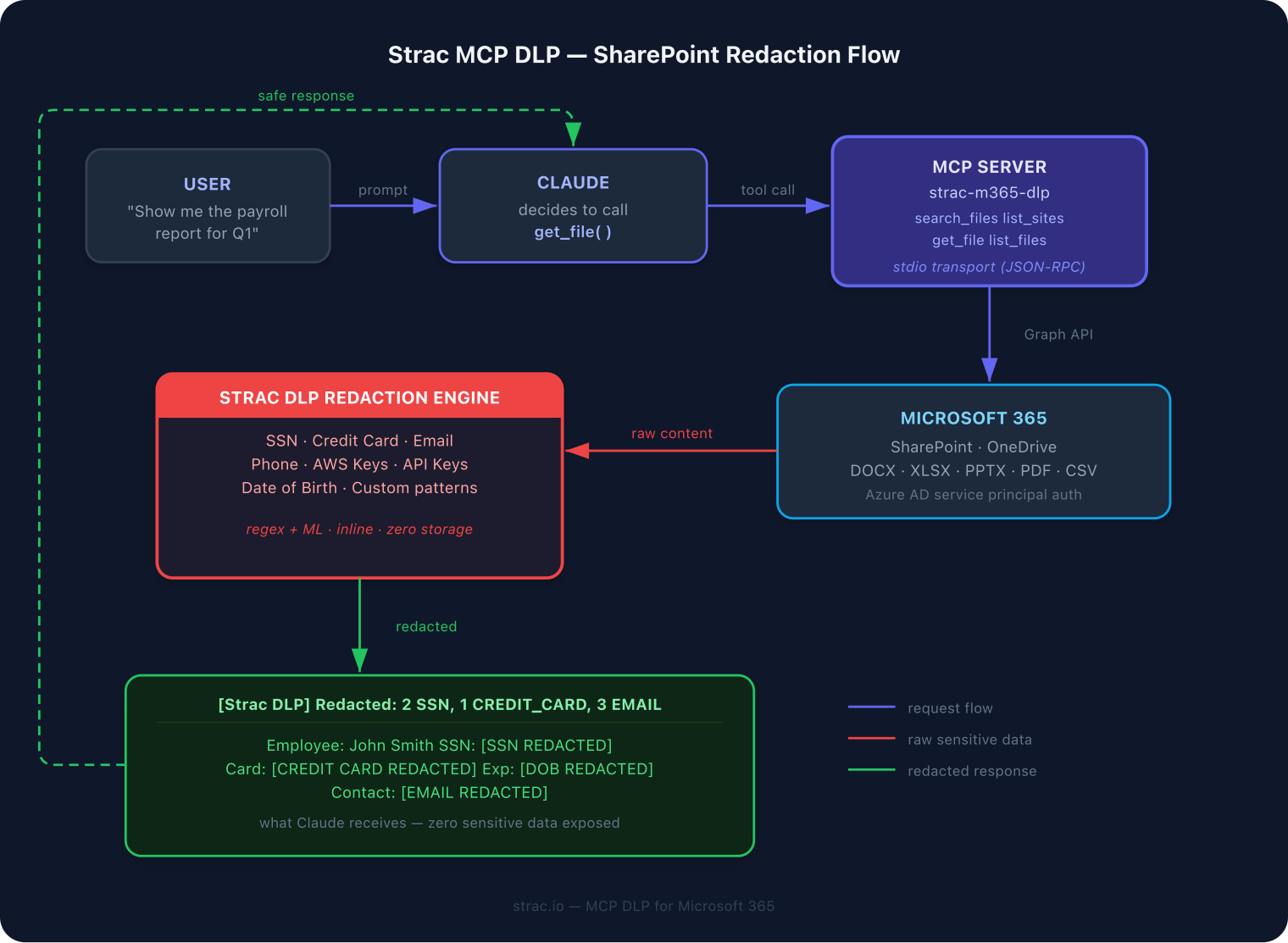
Crucially, redaction is one of several remediation actions, not the whole story — you might mask, tokenize (reversibly, via a vault), block, or require approval depending on the data and the action. Redaction is just the most visible. The diagram below shows the full flow: raw sensitive data comes back from the source, the redaction engine strips it, and the agent receives a clean, usable response.
Data Masking vs. Redaction vs. Tokenization in MCP
These terms get used loosely. For MCP data masking decisions, the differences matter:
Technique
What it does
Reversible?
Best for
Redaction
Removes the value entirely ([REDACTED])
No
Data the agent never needs to see
Masking
Shows a partial value (****-4242)
No
Cases where format/last-4 is useful
Tokenization
Swaps the value for a token, vaults the original
Yes (authorized retrieval)
Data a downstream step must rehydrate
Blocking
Stops the call entirely
n/a
Last resort — breaks the workflow
The right choice is per-field and per-action. A support agent summarizing tickets needs PII redacted; a billing workflow might need a card masked to its last four; a system that later charges the card needs tokenization so the value can be securely rehydrated. A mature MCP data security layer applies all of these from one policy — and the audit ledger records which action fired on which field, so the protection itself becomes evidence.
MCP Data Security Best Practices
A checklist you can act on this quarter:
Inventory your MCP servers first. You can't protect data flowing through a connector you don't know exists — start with discovery, including shadow MCP.
Inspect the payload, not just the connection. Classify the data inside each tool call; connection-level controls miss content-level risk.
Default to protect-and-continue. Redact/mask/tokenize the sensitive field and let the clean call proceed, instead of blocking and breaking the agent.
Apply least privilege per tool and action. Allow read, block write, require approval for exports — granular, not blanket.
Vault credentials; never pass tokens through. Token passthrough is forbidden by the MCP spec — broker per-upstream credentials.
Log every call as evidence. A per-call ledger (agent, tool, data class, action) that maps to SOC 2, HIPAA, PCI, and ISO 42001.
Cover the other surfaces too. Agents also reach data through the browser and endpoint — govern MCP and those with one policy via AI data governance.
For the deeper enforcement mechanics, see MCP DLP; for the control-plane that enforces all of this centrally, see the MCP gateway.
✨ How Strac Secures MCP Data
Strac is built for the data layer of MCP — not access and routing with security bolted on. It sits in front of your MCP servers and inspects every tool call, applying the See → Control → Protect → Prove model Strac uses across the browser, endpoint, and SaaS:
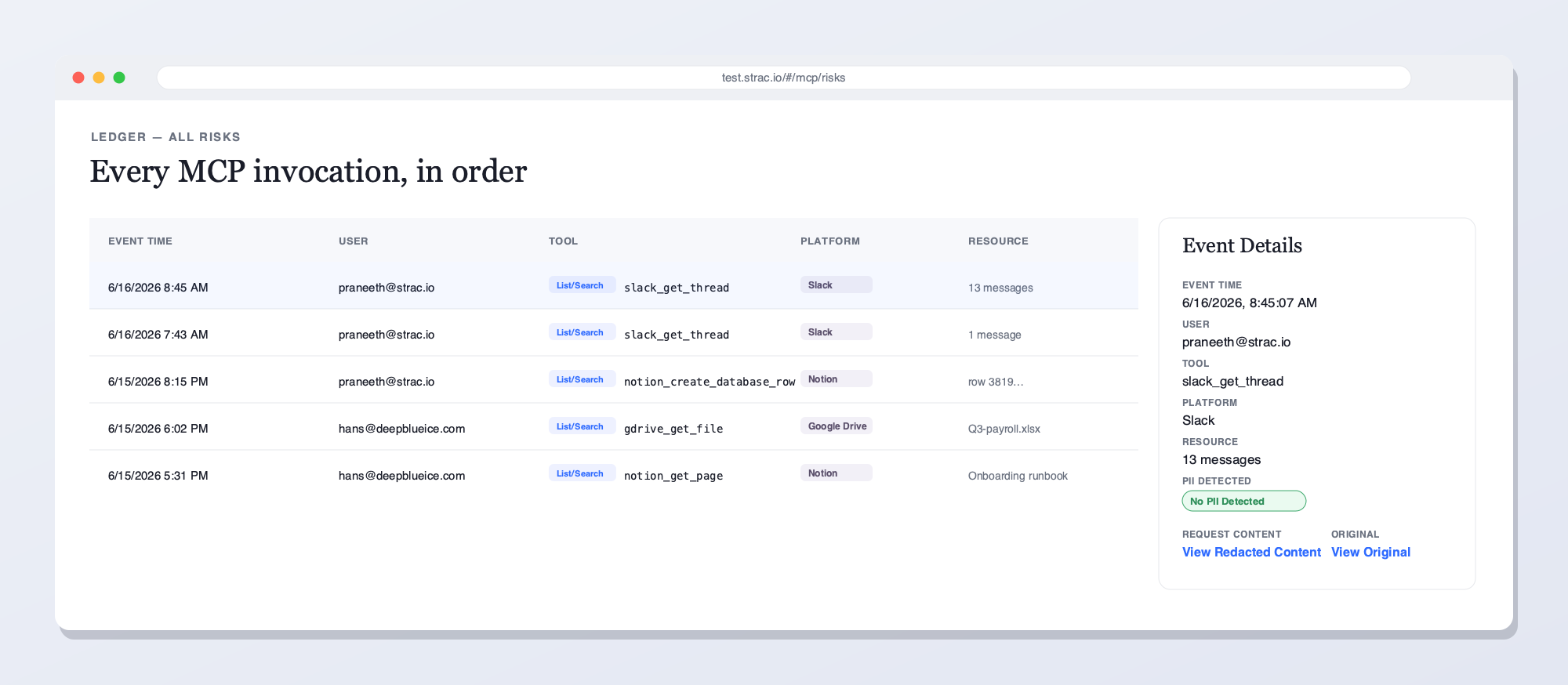
See — every tool call an agent makes, across all your MCP servers, with the PII in it and the identity behind the prompt.
Control — per-tool, per-action allow/block rules and approval gates, so an agent gets least privilege.
Protect — redact, mask, tokenize, or block PII, PHI, PCI, and secrets in the tool-call payload, in real time, before the data reaches a model.
Prove — a complete audit ledger that doubles as compliance evidence for SOC 2, HIPAA, PCI, and ISO 42001.
This applies to the MCP tools you author, not just the ones you consume: the same field-level enforcement — redact, mask, tokenize, or your own regex — runs on the custom MCP tools you expose to staff and customers. And because the classifier is managed, you skip the DIY Microsoft Presidio or AWS Bedrock tuning that bolt-on gateways leave on your plate.
Detection is a managed, contextual classifier — Luhn-checked cards, custom detectors, document and image parsing — not a self-managed open-source engine you have to tune. (Inline MCP redaction is something several vendors now offer; Strac's edge is the managed coverage plus the built-in compliance evidence, not a claim to be the only one.) It works across MCP connectors for Slack, GitHub, Google Workspace, Salesforce, Snowflake, and more — the same engine behind Strac's GenAI and AI DLP.
For the data-security model applied to a specific connector, the Slack MCP server and Google Workspace MCP server guides show redaction happening at the tool-call boundary in practice.
Connectors are one leg of a wider problem — see LLM security.
What is MCP data security?
MCP data security is the practice of protecting sensitive data — PII, PHI, PCI, secrets — as AI agents read and act on it through the Model Context Protocol. It covers discovering your MCP servers, classifying the data in each tool call, protecting it (redact, mask, tokenize, or block), and logging every call as audit evidence. It's distinct from model security: the risk is the business data the agent pulls in, not the model itself.
How do MCP data leaks happen?
Usually without an attacker. An agent with an over-permissioned connector pulls sensitive data into the model context, the raw tool result is never redacted, and copies land in logs and caches. Third-party or shadow MCP servers add servers you don't control. The fix is to inspect and protect the data inside each tool call, before it reaches the model.
What's the difference between MCP data masking and redaction?
Redaction removes the value entirely ([REDACTED]) — irreversible, for data the agent never needs. Masking shows a partial value (****-4242) when format or the last four digits is useful. Tokenization swaps the value for a token and vaults the original so an authorized step can rehydrate it. A good MCP data security layer applies all three per field, from one policy.
Does a vendor BAA make MCP HIPAA compliant?
No. A BAA covers the AI provider's processing of data it receives — it does not stop PHI from being sent to the model in the first place, and consumer tiers like Claude Cowork often have no BAA at all. MCP data security closes that gap by redacting PHI in the tool call before it ever reaches the model.
How is MCP data security different from DLP?
Traditional DLP watched data leaving — uploads, email, copy-paste. MCP data security watches data being pulled in through tool calls (the ingress shift) and protects it inside the model's context boundary. MCP DLP is the enforcement core; MCP data security is the full discipline around it — discover, classify, protect, prove.
Can I prevent MCP data leaks without breaking my agents?
Yes — that's the point of protect-and-continue. Instead of blocking the call (which breaks the workflow), the sensitive field is redacted, masked, or tokenized and the clean call proceeds. The agent keeps working; only the sensitive data is removed.
What is MCP data security?
MCP data security is the practice of protecting sensitive data — PII, PHI, PCI, secrets — as AI agents read and act on it through the Model Context Protocol. It covers discovering your MCP servers, classifying the data in each tool call, protecting it (redact, mask, tokenize, or block), and logging every call as audit evidence. It's distinct from model security: the risk is the business data the agent pulls in, not the model itself.
How do MCP data leaks happen?
Usually without an attacker. An agent with an over-permissioned connector pulls sensitive data into the model context, the raw tool result is never redacted, and copies land in logs and caches. Third-party or shadow MCP servers add servers you don't control. The fix is to inspect and protect the data inside each tool call, before it reaches the model.
What's the difference between MCP data masking and redaction?
Redaction removes the value entirely ([REDACTED]) — irreversible, for data the agent never needs. Masking shows a partial value (****-4242) when format or the last four digits is useful. Tokenization swaps the value for a token and vaults the original so an authorized step can rehydrate it. A good MCP data security layer applies all three per field, from one policy.
Does a vendor BAA make MCP HIPAA compliant?
No. A BAA covers the AI provider's processing of data it receives — it does not stop PHI from being sent to the model in the first place, and consumer tiers like Claude Cowork often have no BAA at all. MCP data security closes that gap by redacting PHI in the tool call before it ever reaches the model.
How is MCP data security different from DLP?
Traditional DLP watched data leaving — uploads, email, copy-paste. MCP data security watches data being pulled in through tool calls (the ingress shift) and protects it inside the model's context boundary. MCP DLP is the enforcement core; MCP data security is the full discipline around it — discover, classify, protect, prove.
Discover & Protect Data on SaaS, AI, MCP, Endpoints & Cloud
Strac provides end-to-end data loss prevention for all SaaS and Cloud apps. Integrate in under 10 minutes and experience the benefits of live DLP scanning, live redaction, and a fortified SaaS environment.


.webp)



.avif)



.gif)
