What Is AI Governance? The 2026 Guide for Enterprise Security and Compliance
AI governance is the set of policies, processes, and technical controls enterprises use to manage AI risk. Here's what it means in 2026, how it differs from AI compliance, and what modern platforms actually do.
AI governance is how organizations manage AI risk — via policies, processes, and technical controls — across the AI they build and the AI they use.
It splits into two subcategories in 2026: AI model governance (managing models your company builds) and AI usage governance (managing AI tools your employees use). Most enterprises need the latter.
AI governance is broader than AI compliance. Compliance is the subset that proves you meet specific regulatory requirements (NIST AI RMF, EU AI Act, ISO 42001, HIPAA). Governance includes policy, culture, and operational controls.
Modern AI governance platforms discover AI usage, inspect data flows, enforce policy, and generate audit evidence — all continuously, all at the speed of AI adoption.
Strac is the AI usage governance layer: real-time prompt DLP, shadow AI discovery, policy enforcement across ChatGPT, Copilot, Claude, and 50+ tools, aligned to every major framework.
What Is AI Governance? The 2026 Guide for Enterprise Security and Compliance
Modern AI governance covers usage, models, data flows, and audit evidence — continuously, not quarterly
🎥 AI Governance, Defined
AI governance is the set of policies, processes, and technical controls an organization uses to manage the risks and obligations that come with AI. It spans:
Policy — rules for who can use AI, for what purposes, with what data
Process — review, approval, incident response workflows
Technical controls — detection, enforcement, monitoring, and audit
Culture and training — making governance real to employees
Evidence — documentation, logs, and metrics that demonstrate compliance
The concept predates generative AI. Organizations have had "AI governance" programs since the early ML adoption era (2015+), focused on fairness, bias, model risk, and responsible AI development.
Generative AI changed the scope. When every employee can use ChatGPT, Copilot, or Claude from a browser tab, governance extends from "the models our data science team builds" to "all AI, everywhere, used by everyone."
Modern AI governance is operational and real-time, not GRC paperwork — browser-level inspection on every prompt
Why AI Governance Matters in 2026
Three forces make AI governance urgent now, not later:
1. Employees are using AI faster than governance can keep up. Enterprise AI adoption surveys consistently show 60–80% of employees use generative AI at work. The majority use personal accounts on corporate devices. Traditional controls — SSO, CASB, DLP — weren't built for prompt-level data inspection.
2. Regulators are writing AI rules in real time. The EU AI Act took effect in phases starting 2024. NIST AI RMF 1.0 published 2023. ISO 42001 published late 2023. State-level US laws (California, Colorado, Texas) are proliferating. Auditors are asking questions that didn't exist 18 months ago.
3. AI incidents get loud. Samsung's ChatGPT source-code leak (2023), Italy's ChatGPT ban (2023), OpenAI's Redis bug (2023), Copilot oversharing findings (ongoing), prompt injection attacks on ChatGPT memory (2024). Each one surfaces risks boards want reported on.
Without an AI governance program, the question "how are we managing AI risk?" doesn't have a defensible answer.
✨ The Two Kinds of AI Governance
The category split is now unavoidable. Understanding both subcategories is essential to picking the right program.
AI Model Governance
Manages risk in models your company builds and deploys.
What it addresses: algorithmic bias, model drift, training data provenance, model performance, responsible AI development
Core capabilities: model registry, AI bill of materials, bias/fairness evaluation, model cards, evaluation pipelines, lineage tracking
Who sells it: Credo AI, IBM watsonx.governance, Cranium, Monitaur, Fairly AI, Arize
Who needs it: organizations training their own ML/LLM systems — roughly 5% of enterprises
AI Usage Governance
Manages risk in how your employees use third-party AI tools.
What it addresses: data leakage to AI, shadow AI, prompt injection, oversharing amplification, regulatory exposure
Core capabilities: prompt inspection, shadow AI discovery, data redaction, policy enforcement, cross-SaaS controls, audit evidence
Who sells it: Strac, Microsoft Purview, Netskope AI, Zscaler AI
Who needs it: organizations with employees using ChatGPT, Copilot, Claude, Gemini, or similar — roughly 100% of enterprises
Most enterprises need usage governance urgently and model governance only if they build models. See AI usage governance vs model governance for the full decision framework.
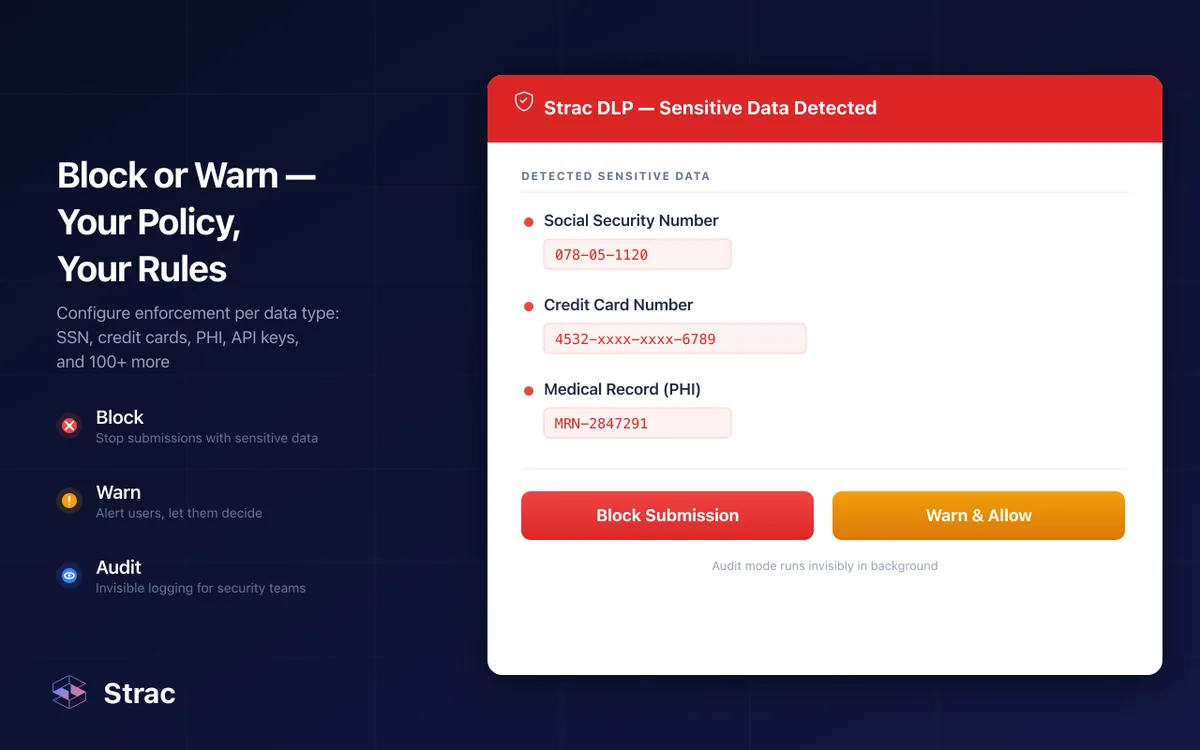
Three enforcement modes per policy — the real-time layer that separates modern AI governance from GRC documentation
AI Governance vs. AI Compliance vs. AI Security
These three terms get used interchangeably. They aren't the same.
AI Governance — the broad program. Policies, processes, controls, culture, evidence. Everything an organization does to manage AI risk.
AI Compliance — the subset that proves governance meets specific external requirements. Auditors check compliance. Examples: demonstrating alignment with NIST AI RMF, proving EU AI Act Article 26 deployer obligations, showing HIPAA safeguards around PHI in AI prompts.
AI Security — the subset that protects AI systems and AI-touched data from attack. Includes prompt injection defense, model extraction prevention, AI supply chain security, data loss prevention on AI usage, and infrastructure security.
All three overlap. Most enterprise AI governance platforms deliver capabilities across all three — the distinction matters for how you scope the program and how you talk to auditors versus operators versus executives.
The Core Activities of a Modern AI Governance Program
A mature program does these six things continuously:
1. Discover — inventory every AI model deployed, every AI tool used by employees, every data flow in and out of AI systems. Most enterprises discover 3× more tools in use than IT believed existed.
2. Classify — determine which AI systems are high-risk (grounded on regulated data, making consequential decisions, integrated with external APIs), medium-risk, or low-risk. Different controls for different tiers.
3. Enforce — apply policy at the moment data crosses the boundary. For usage governance, that means real-time prompt inspection. For model governance, that means evaluation gates in the deployment pipeline.
4. Monitor — detect policy violations, anomalous behavior, new AI tools entering the environment, regulatory-scope changes.
5. Audit — generate evidence continuously. Log every detection, every block, every override. Map logs to framework controls (NIST, EU AI Act, ISO 42001, HIPAA, PCI, SOC 2).
6. Improve — review incidents, update policies, retrain users, expand coverage. AI moves fast; governance has to move with it.
Frameworks That Shape AI Governance Today
Four frameworks matter most in 2026:
NIST AI Risk Management Framework (AI RMF) — US federal framework, widely adopted outside government. Four functions: Govern, Map, Measure, Manage. Voluntary but increasingly expected by enterprise buyers and auditors.
EU AI Act — EU regulation, phased enforcement through 2026+. Categorizes AI by risk (unacceptable / high / limited / minimal), imposes obligations by tier. Article 26 specifically covers deployer obligations (organizations using AI, not just building it) — the provision most relevant to usage governance.
ISO/IEC 42001 — international standard for AI management systems. Certifiable. Expected to become the AI equivalent of ISO 27001. Published late 2023, early adopter organizations certifying through 2025–2026.
Sector-specific frameworks — HIPAA (healthcare), PCI DSS (payments), GLBA/SOX (finance), FERPA (education). All predate generative AI but apply when AI touches regulated data.
A good AI governance program maps to all relevant frameworks simultaneously, producing evidence that satisfies multiple auditors from a single data source.
What Modern AI Governance Platforms Do
Platform capabilities that distinguish modern AI governance tools from first-generation GRC-style systems:
Real-time content inspection on prompts and responses across every major AI tool
Shadow AI discovery on the endpoint (not just network traffic analysis)
Cross-SaaS controls — because AI governance extends to the tools feeding AI connectors
Agent-aware DLP — inspection at Model Context Protocol and similar boundaries
Pre-built framework mapping — continuous evidence generation for NIST, EU AI Act, ISO 42001, HIPAA, PCI, SOC 2
Agentless deployment — no proxy, no TLS break, no network changes
Legacy GRC-style AI governance (model registries, questionnaires, attestation workflows) is still useful for documentation and audit prep — but it doesn't prevent incidents. Modern platforms combine real-time enforcement with evidence generation.
Who Owns AI Governance Inside the Enterprise?
The answer varies, but three patterns dominate in 2026:
CISO-led — AI governance reports into security. Usage governance fits naturally here (it's real-time data protection). Model governance may sit in data/ML if the org builds models.
Chief AI Officer-led — newer role, often spans governance, AI strategy, and AI procurement. Well-suited to organizations treating AI as a strategic function.
GRC / Compliance-led — traditional governance organization extends to AI. Works well for documentation, policy, and audit. Less well for real-time technical enforcement.
Most enterprises end up with shared ownership: CISO/security for technical controls, GRC for policy and evidence, a cross-functional AI council for strategic decisions. What matters is that technical enforcement actually happens — a policy without a detection engine is unenforceable.
✨ Getting Started: The 90-Day AI Governance Program
A practical path for organizations starting fresh:
Days 1–15: Discovery
Deploy an endpoint agent and browser extension. Baseline what AI your employees actually use. Publish the inventory to stakeholders; expect surprise.
Days 16–45: Policy
Write a pragmatic AI acceptable use policy based on actual usage data (not aspirational prohibitions). Run it through legal, HR, and security. Distribute and train.
Days 46–75: Enforcement
Move from audit mode to warn mode to block mode incrementally. Start with highest-risk data (PCI, PHI, secrets, source code). Expand to PII and custom patterns.
Days 76–90: Evidence
Wire up audit logs to your SIEM. Generate first monthly AI risk report for executives. Map controls to NIST / EU AI Act / ISO 42001. Hand off to GRC for quarterly compliance reporting.
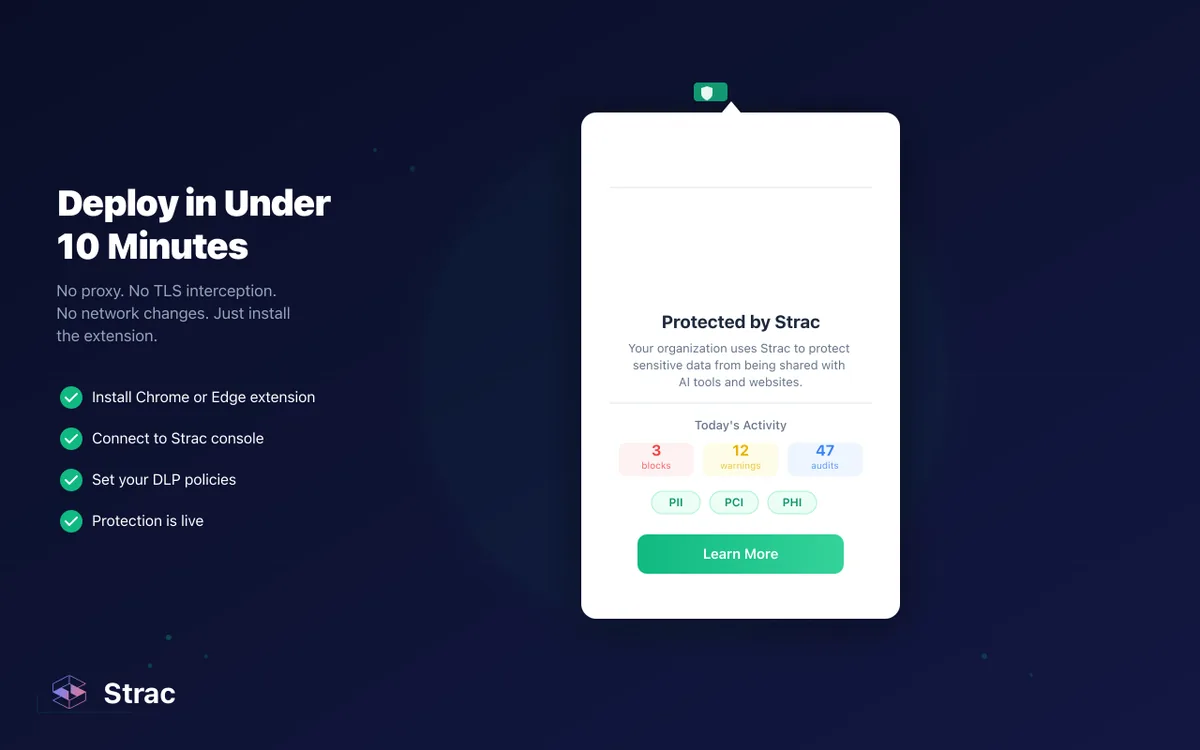
Platform deployment takes minutes — the 90 days are policy development, rollout sequencing, and evidence wiring
🎥 How Strac covers AI data security across every surface
In practice, AI governance plays out across five surfaces where data flows into and out of AI systems. Strac covers all five:
1. Browser DLP — every prompt to Claude, ChatGPT, Gemini, Copilot, Perplexity
Strac's browser extension intercepts every prompt before it reaches the LLM API and redacts PII, PHI, PCI (cardholder data), source code, and secrets inline. The model still works — it never sees the raw sensitive data. Coverage extends to claude.ai, ChatGPT, Gemini, Microsoft Copilot, Perplexity, Mistral, DeepSeek, plus Anthropic and OpenAI APIs. See Strac Generative AI DLP and Strac Claude DLP.
2. MCP DLP — for AI agents acting on enterprise data
When a Claude, Cursor, or ChatGPT agent calls a Slack, Gmail, Google Drive, GitHub, Notion, or any other MCP server, Strac sits inline and redacts sensitive data in every tool-call response. Strac is the first DLP with native Model Context Protocol policy enforcement — most enterprise DLP vendors still have no MCP support at all. Full background: MCP DLP guide.
3. SaaS DLP and Data Discovery — across 47+ integrations
The same redaction and labeling policies apply to every SaaS surface where data lives — Slack, Google Drive, Gmail, M365, OneDrive, SharePoint, Salesforce, Notion, Jira, Confluence, GitHub, Linear, HubSpot, Asana, Zendesk, Intercom, Box, ServiceNow, and 30+ more. Continuous data discovery and classification (DSPM) inventories every personal data type across your environment and automatically applies the right sensitivity label.
4. Cloud DSPM — AWS, Azure, GCP
Strac continuously scans AWS (S3, RDS, EBS, CloudWatch), Azure (Blob Storage, SQL), and GCP (Cloud Storage, BigQuery) for sensitive data at rest. Not point-in-time scans — continuous discovery with automatic classification. The output powers compliance evidence for GDPR, HIPAA, PCI DSS, SOC 2, and ISO 27001 audits.
5. Endpoint DLP — Mac, Windows, Linux
For data egress outside the SaaS perimeter — local file shares, USB drives, screenshots, terminal output, IDE clipboards. Strac's endpoint agent enforces the same policies as the SaaS, browser, and MCP layers, with full audit logs for any sensitive data movement.
AI governance is how an organization manages the risks that come with AI — through policies, processes, and technical controls. It covers both the AI systems the organization builds (model governance) and the AI tools employees use (usage governance). The goal is to prevent AI-related incidents, prove compliance to regulators, and enable AI adoption safely.
Is AI governance the same as AI compliance?
No. AI governance is the broader program — policies, processes, technical controls, culture, and evidence. AI compliance is the subset that proves governance meets specific regulatory or framework requirements (NIST AI RMF, EU AI Act, ISO 42001, HIPAA, PCI). Most compliance requires governance; not all governance is about compliance.
What are the main components of AI governance?
Six continuous activities: Discover (inventory AI systems and usage), Classify (risk-tier AI systems), Enforce (apply policy in real time), Monitor (detect violations and changes), Audit (generate evidence), and Improve (iterate on incidents and changes). A complete program covers all six with coordinated tooling and process.
Who is responsible for AI governance in a company?
It varies. In most 2026 enterprises, the CISO leads technical governance (enforcement, detection, response), GRC leads policy and evidence, and a cross-functional AI council makes strategic decisions. Newer companies often appoint a Chief AI Officer to span all three. The critical thing is that technical enforcement actually happens — a policy without a detection engine is unenforceable.
Which AI governance frameworks should my company follow?
Start with the ones your auditors and customers expect. In the US, NIST AI RMF is widely expected (voluntary but standard). In the EU, EU AI Act Article 26 (deployer obligations) applies to most organizations. ISO 42001 is the emerging international standard. Sector-specific frameworks (HIPAA, PCI, GLBA) apply when AI touches regulated data. A good AI governance platform maps to all relevant frameworks at once.
How much does AI governance cost?
Platform costs vary by vendor and scope. AI usage governance platforms (Strac and comparable vendors) typically price per-user per-year, ranging from $30–100 depending on modules and volume. AI model governance platforms (Credo AI, IBM watsonx.governance) typically start at enterprise-only pricing ($100+ per user or annual flat fees). Internal program costs (people, process, training) often exceed platform licensing.
The people, policies, and controls that make sure AI and AI agents are used safely, legally, and in line with your risk appetite — and that you can prove it.
How is AI governance different from AI security?
Security is the controls that stop attacks and misuse; governance is the wider program that sets the rules, assigns ownership, and proves the controls work. You need both.
Does AI governance apply to AI agents specifically?
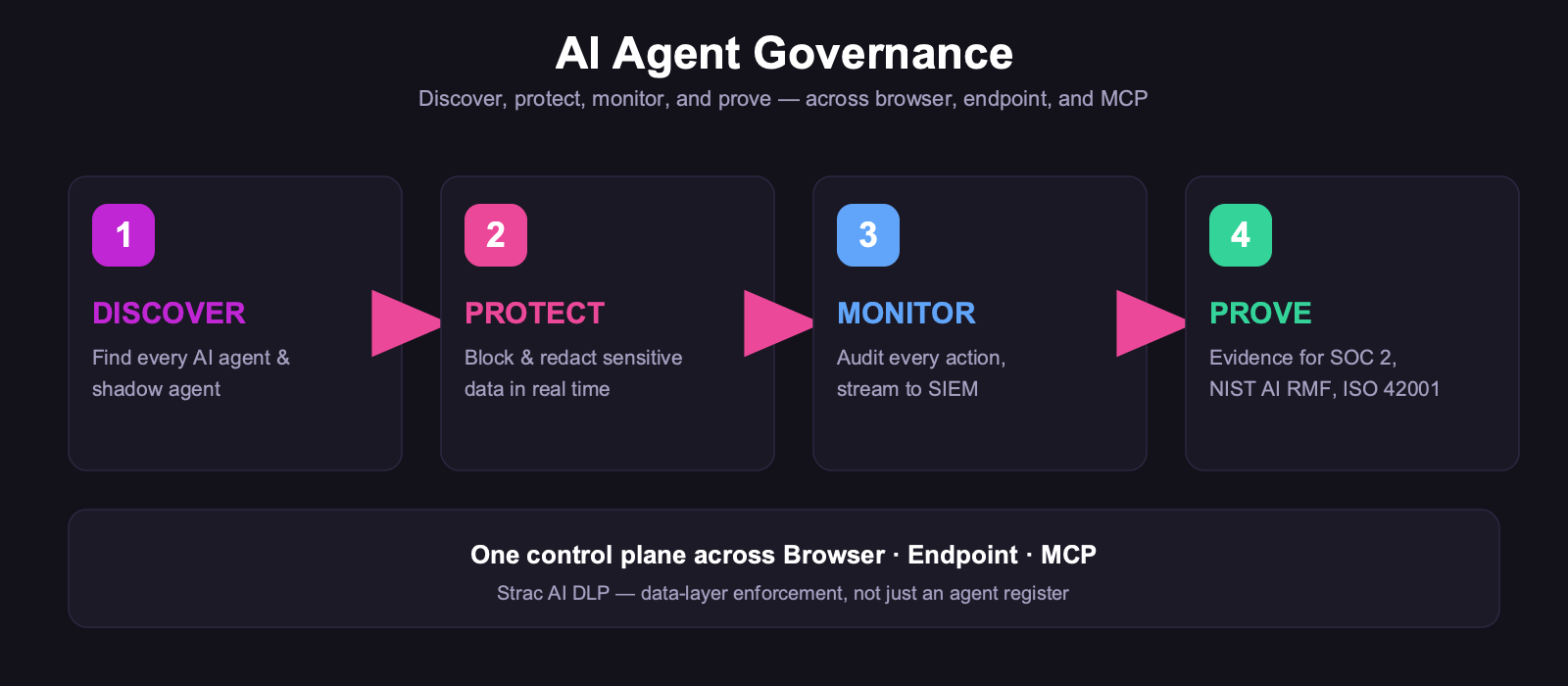
Yes — agents are the sharpest edge because they take actions. Agent governance (discover, protect, monitor, prove) is a core subset of AI governance.
What is the most overlooked part of AI governance?
The data layer. Most programs govern models and access but never inspect the data flowing through an authorized AI action — which is where PII, PHI, and secrets actually leak.
What is AI governance in simple terms?
AI governance is how an organization manages the risks that come with AI — through policies, processes, and technical controls. It covers both the AI systems the organization builds (model governance) and the AI tools employees use (usage governance). The goal is to prevent AI-related incidents, prove compliance to regulators, and enable AI adoption safely.
Is AI governance the same as AI compliance?
No. AI governance is the broader program — policies, processes, technical controls, culture, and evidence. AI compliance is the subset that proves governance meets specific regulatory or framework requirements (NIST AI RMF, EU AI Act, ISO 42001, HIPAA, PCI). Most compliance requires governance; not all governance is about compliance.
What are the main components of AI governance?
Six continuous activities: Discover (inventory AI systems and usage), Classify (risk-tier AI systems), Enforce (apply policy in real time), Monitor (detect violations and changes), Audit (generate evidence), and Improve (iterate on incidents and changes). A complete program covers all six with coordinated tooling and process.
Who is responsible for AI governance in a company?
It varies. In most 2026 enterprises, the CISO leads technical governance (enforcement, detection, response), GRC leads policy and evidence, and a cross-functional AI council makes strategic decisions. Newer companies often appoint a Chief AI Officer to span all three. The critical thing is that technical enforcement actually happens — a policy without a detection engine is unenforceable.
Which AI governance frameworks should my company follow?
Start with the ones your auditors and customers expect. In the US, NIST AI RMF is widely expected (voluntary but standard). In the EU, EU AI Act Article 26 (deployer obligations) applies to most organizations. ISO 42001 is the emerging international standard. Sector-specific frameworks (HIPAA, PCI, GLBA) apply when AI touches regulated data. A good AI governance platform maps to all relevant frameworks at once.
Discover & Protect Data on SaaS, AI, MCP, Endpoints & Cloud
Strac provides end-to-end data loss prevention for all SaaS and Cloud apps. Integrate in under 10 minutes and experience the benefits of live DLP scanning, live redaction, and a fortified SaaS environment.


.webp)







.avif)


.gif)
