ISO 42001 Certification: Process, Cost & Timeline (2026)
How to get ISO 42001 certified in 2026 — the full process from gap analysis to certification audit, realistic costs and timelines, the Annex A controls, and how AI-native compliance automation compresses the work.
ISO 42001 certification is the accredited, auditable proof that your organization runs a real AI Management System (AIMS) under ISO/IEC 42001:2023 — the first certifiable international standard for governing how AI is developed, deployed, and used.
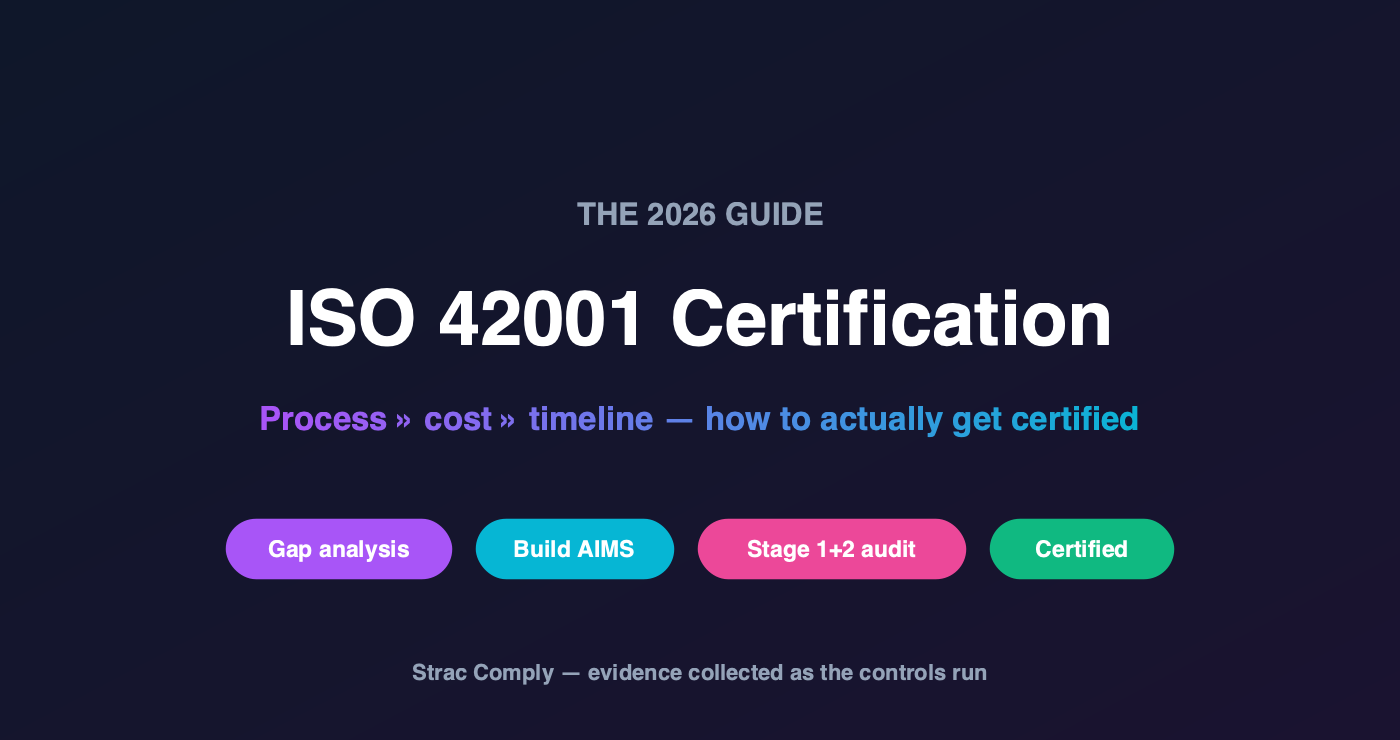
The path has five stages: gap analysis → AIMS implementation → internal audit and management review → Stage 1/Stage 2 certification audit → a 3-year cycle with annual surveillance audits.
Realistic budget: certification-body audit fees typically run $15K–$50K+ depending on organization size and scope, and preparation is usually the larger cost — most teams take 3–9 months from gap analysis to certificate.
The heaviest lifts are the AI system impact assessments, the Annex A control set (38 controls across AI policy, lifecycle, data governance, and third parties), and the ongoing evidence collection audits demand.
That evidence layer is where automation changes the math: Strac Comply maps AI data-protection controls to ISO 42001, collects evidence continuously, and — because Strac's data security platform actually enforces the controls (discovering and protecting sensitive data in AI systems) — the protection itself becomes the audit evidence.
What ISO 42001 Certification Actually Is
ISO/IEC 42001:2023 defines an AI Management System (AIMS) — the AI equivalent of what ISO 27001 is for information security. Certification means an accredited certification body has audited your AIMS and confirmed it meets the standard: you have an AI policy, defined roles, risk and impact assessments for your AI systems, lifecycle controls, and a working improvement loop.
Two clarifications buyers ask first:
Who can be certified? Any organization that develops, provides, or uses AI — you don't need to be an AI vendor. A company deploying Claude, ChatGPT, or AI agents on customer data is squarely in scope.
Who certifies? Accredited certification bodies (the same ecosystem that audits ISO 27001). A software platform, consultant, or "badge" is not a certificate — only a certification body's audit is.
Why it's surging in 2026: enterprise buyers have started asking for it in security reviews the way they ask for SOC 2, and it maps cleanly onto EU AI Act readiness. For what the standard contains clause-by-clause, see our ISO 42001 guide; this page is about getting certified.
The ISO 42001 Certification Process, Step by Step
Step 1 — Scope and gap analysis (2–4 weeks). Define which AI systems, teams, and sites the AIMS covers, then assess current state against the standard's clauses and Annex A. The output is your remediation backlog. Scoping decisions matter: too broad and the project balloons; too narrow and the certificate doesn't cover what customers ask about.
Step 2 — Build the AIMS (1–4 months). The core artifacts:
- AI policy and objectives approved by leadership, with defined roles and accountability
- AI risk assessment — the risks your AI systems create (see ISO 23894 for the companion risk-management methodology)
- AI system impact assessments — 42001's signature requirement: documented analysis of how each in-scope AI system affects individuals and society
- Annex A controls — the standard's 38 controls, covering the AI lifecycle, data quality and governance, transparency, human oversight, and third-party AI suppliers
- Data protection for AI in practice — knowing what sensitive data your AI systems touch and controlling it; this is where a data security layer for AI does the enforcing
Step 3 — Operate, internally audit, and review (1–2 months). Auditors need to see the system running: records, metrics, at least one internal audit, and a management review with findings and actions. Certification bodies routinely reject systems that were written the month before the audit.
Step 4 — Certification audit.Stage 1 reviews documentation and readiness; Stage 2 tests operation — sampling records, interviewing owners, tracing controls to evidence. Nonconformities get corrective-action plans; major ones delay the certificate.
Step 5 — Keep it (3-year cycle). Annual surveillance audits, then full recertification at year three. Evidence collection never stops — which is exactly why manual screenshot-driven programs decay.
What ISO 42001 Certification Costs
Cost bucket
Typical range
Notes
Certification body (Stage 1 + 2)
$15K–$50K+
Scales with headcount, sites, and AI scope
Surveillance audits (annual)
$5K–$15K/yr
Years 1 and 2 of the cycle
Preparation (internal time or consultants)
Highly variable — often the largest cost
Impact assessments and evidence are the time sinks
Tooling / compliance automation
Varies
Pays back in prep time and audit-day speed
Two honest cost notes: quotes vary widely between certification bodies, so get several; and if you already hold ISO 27001, integrated audits (27001 + 42001 together) meaningfully reduce both cost and audit fatigue — see ISO 27001 AI compliance for how the two standards divide the work.
✨ The Hard Parts (Where Programs Stall)
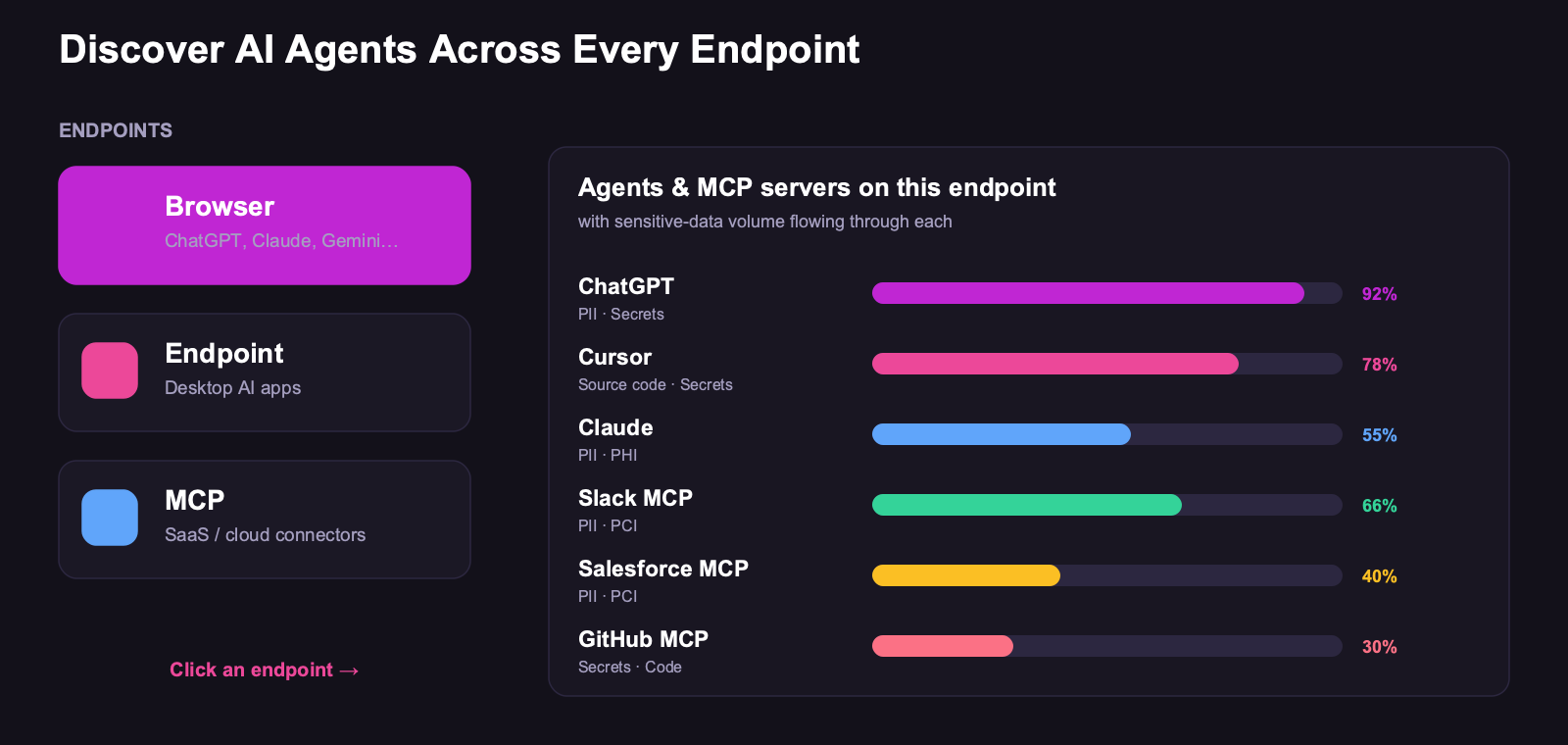
The inventory auditors ask for: every AI tool, agent, and MCP server in use — and the sensitive data flowing through each.
AI system inventory. You can't assess what you haven't found — and shadow AI (unapproved tools, agents wired to SaaS via connectors) is precisely what auditors now probe. Continuous AI discovery beats a one-time spreadsheet.
Impact assessments that mean something. Template answers get flagged; assessments must reflect each system's real data, users, and failure modes.
Evidence at audit depth. "We control sensitive data in AI" needs proof: which data, which policy fired, what was redacted or blocked, when, mapped to the control. This is where Strac Comply changes the effort curve — Strac's DLP and AI data-security controls generate that evidence continuously as they enforce, instead of someone screenshotting quarterly.
Third-party AI. Annex A reaches your AI suppliers — model providers, AI features inside SaaS — so vendor assessment and shadow-AI discovery land in scope.
✨ ISO 42001 Certification vs. the Adjacent Frameworks
One control set, every AI framework — how Strac Comply maps evidence across ISO 42001, NIST AI RMF, and the EU AI Act.
vs. ISO 27001 — 27001 governs information security; 42001 governs AI specifically (impact on people, lifecycle, transparency). Complementary, commonly integrated. Start with the overlap: data protection controls satisfy both.
vs. ISO 23894 — 23894 is guidance for AI risk management, not certifiable; it's the methodology your 42001 risk clauses can follow. Details: ISO 23894 explained.
vs. the EU AI Act — the Act is law, 42001 is a management standard; a certified AIMS is strong scaffolding for Act compliance but not a legal safe harbor.
vs. NIST AI RMF — voluntary framework vs. certifiable standard; many programs map both from one control set.
✨ How Strac Comply Compresses the Certification Timeline
Most of the 3–9 months goes to two things: building the AI inventory and impact-assessment inputs, and accumulating operating evidence deep enough for Stage 2 sampling. Strac attacks both directly, because the platform that enforces your AI data controls is the same one filling the binder:
Inventory on day one — Strac's discovery maps every AI tool, agent, and MCP server with its sensitive-data flows, giving you the asset base your scoping and impact assessments need without a months-long census.
Evidence that accrues while you operate — every redaction, block, and access decision lands in Strac Comply pre-mapped to 42001's clauses and Annex A, so by audit day the operating history Stage 2 demands already exists.
One control set, four frameworks — the same events evidence ISO 27001, SOC 2, and EU AI Act readiness, which is what makes the integrated-audit path cheap.
The residual manual layer — Strac's AI Evidence Agent captures what still needs a human, replacing the screenshot backlog that stalls most programs.
What Stage 2 actually samples: a per-action ledger that wrote itself while your controls ran.
Since most 42001 programs ride on an existing ISMS, the ISO 27001 compliance software comparison is the natural companion read.
🌶️ Spicy FAQs for ISO 42001 Certification
How long does ISO 42001 certification take?
Most organizations take 3–9 months from gap analysis to certificate: a few weeks of scoping, one to four months building and operating the AIMS, then the two-stage certification audit. The variables that stretch timelines are AI system count, the depth of impact assessments, and how much evidence collection is manual. Teams that automate evidence typically land at the short end.
How much does ISO 42001 certification cost?
Certification-body fees typically run $15K–$50K+ for the initial two-stage audit, plus $5K–$15K per year for surveillance audits, scaling with company size and AI scope. Preparation — impact assessments, control implementation, evidence — is usually the larger real cost. Integrated audits with an existing ISO 27001 program and compliance automation both pull the total down meaningfully.
Who needs ISO 42001 certification?
Any organization whose customers, regulators, or risk profile demand provable AI governance — AI product companies first, but increasingly any enterprise deploying AI on customer data. You don't have to build models: using AI tools and agents on regulated data is enough to be in scope, and enterprise security reviews have started asking for 42001 the way they ask for SOC 2.
Can you self-certify ISO 42001?
No. Only an accredited certification body can issue an ISO 42001 certificate, through a Stage 1 (documentation) and Stage 2 (operation) audit. You can self-assess against the standard as preparation — and should — but "aligned with ISO 42001" is not "certified."
Is ISO 42001 certification worth it if we already have SOC 2 and ISO 27001?
If AI is material to your product or operations, increasingly yes. SOC 2 and 27001 don't cover AI-specific obligations — impact assessments, AI lifecycle controls, transparency, human oversight — which is exactly what enterprise AI questionnaires now probe. The good news: your existing control set carries much of the weight, and the data-protection evidence you already produce can be mapped across all three frameworks at once.
What evidence do ISO 42001 auditors actually ask for?
The AI policy and risk/impact assessments, an AI system inventory (including third-party AI), records showing Annex A controls operating — data governance logs, access reviews, monitoring of AI data flows, incident records — plus internal audit and management review outputs. The recurring pain is proving data protection inside AI systems; controls that log their own enforcement, like Strac's redaction and policy events, turn that from a screenshot hunt into an export.
The Bottom Line
ISO 42001 certification is becoming the SOC 2 of AI: a buyer-driven, auditable proof that your AI is governed. The process is well-trodden — scope, build, operate, two-stage audit, surveillance — and the certificate goes to teams whose controls run continuously, not teams with the best-written policy binder. Automate the inventory, the data-protection enforcement, and the evidence, and certification becomes a project instead of a lifestyle.
Book a demo of Strac Comply to see ISO 42001 evidence collected continuously — with the AI data-security controls doing the proving.
Most organizations take 3–9 months from gap analysis to certificate: a few weeks of scoping, one to four months building and operating the AIMS, then the two-stage certification audit. The variables that stretch timelines are AI system count, the depth of impact assessments, and how much evidence collection is manual. Teams that automate evidence typically land at the short end.
How much does ISO 42001 certification cost?
Certification-body fees typically run $15K–$50K+ for the initial two-stage audit, plus $5K–$15K per year for surveillance audits, scaling with company size and AI scope. Preparation — impact assessments, control implementation, evidence — is usually the larger real cost. Integrated audits with an existing ISO 27001 program and compliance automation both pull the total down meaningfully.
Who needs ISO 42001 certification?
Any organization whose customers, regulators, or risk profile demand provable AI governance — AI product companies first, but increasingly any enterprise deploying AI on customer data. You don't have to build models: using AI tools and agents on regulated data is enough to be in scope, and enterprise security reviews have started asking for 42001 the way they ask for SOC 2.
Can you self-certify ISO 42001?
No. Only an accredited certification body can issue an ISO 42001 certificate, through a Stage 1 (documentation) and Stage 2 (operation) audit. You can self-assess against the standard as preparation — and should — but "aligned with ISO 42001" is not "certified."
Is ISO 42001 certification worth it if we already have SOC 2 and ISO 27001?
If AI is material to your product or operations, increasingly yes. SOC 2 and 27001 don't cover AI-specific obligations — impact assessments, AI lifecycle controls, transparency, human oversight — which is exactly what enterprise AI questionnaires now probe. The good news: your existing control set carries much of the weight, and the data-protection evidence you already produce can be mapped across all three frameworks at once.
Discover & Protect Data on SaaS, AI, MCP, Endpoints & Cloud
Strac provides end-to-end data loss prevention for all SaaS and Cloud apps. Integrate in under 10 minutes and experience the benefits of live DLP scanning, live redaction, and a fortified SaaS environment.


.webp)





.avif)



.gif)
